
The AI Bubble Test: Anthropic's IPO and the First Public Price for AI (2026)

Updated: 9 hours ago
In this Report


The AI Bubble Test: Anthropic's IPO and the First Public Price for AI (2026)
The Question: what happens when a private boom meets a public price
On Thursday 5 November 2026, two prices moved in opposite directions. In Washington, the midterm elections returned a Congress and a set of state governors who campaigned against the data centres that power artificial intelligence. In New York, the Nasdaq fell 5.52 per cent, its steepest one-day drop since April 2025, wiping roughly 2.5 trillion dollars from the value of American technology companies. The next morning, investors began to talk openly about marking down Anthropic, the company behind the Claude models, from the 1.5 trillion dollar valuation it had hoped to achieve in its initial public offering. One investor told CNBC that 1.5 trillion dollars was "a stretch" and that 1 trillion to 1.25 trillion was more likely. Another said the market "really needs this IPO to go well."
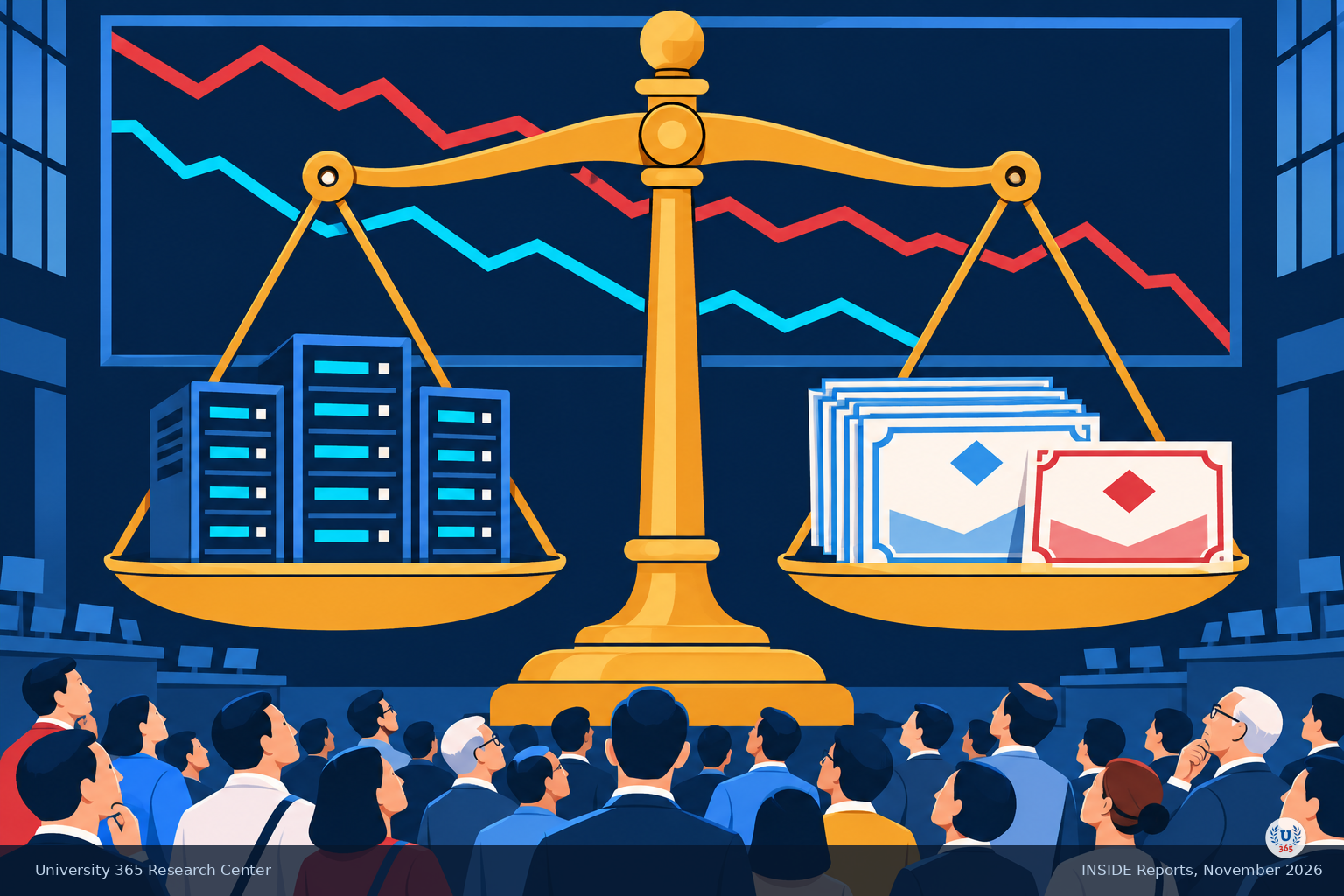
Illustration: a valuation weighed against a commitment. One pan holds the asset, the other the promise to pay for it.
Anthropic is expected to begin its roadshow in the week of 9 November and to price its shares within weeks. It will list on the Nasdaq under the ticker ANT. It will be the first pure-play artificial intelligence laboratory to be priced by public shareholders. That makes it the first real test of a question that has been argued in private since ChatGPT appeared: what is an AI company actually worth?
The question is not academic. OpenAI closed the first 11 billion dollars of a new round on 6 November at a valuation of 1.25 trillion dollars, after originally seeking 30 billion dollars or more at 1.4 trillion. Its annualized revenue is approaching 50 billion dollars, according to figures given to investors, about 20 billion below what earlier reports had suggested. Private capital is still clearing at record levels while public markets turn cautious. The gap between those two facts is the subject of this report.
So the question is simple and uncomfortable: is artificial intelligence a bubble that is about to burst, or a general-purpose technology being repriced on its way to becoming ordinary infrastructure? And if a bubble is bursting, why is the money still arriving?

The AI Bubble Test: Anthropic's IPO and the First Public Price for AI (2026)
The Context: how a private boom gets a public price
To follow the argument, a reader needs five pieces of vocabulary: how an initial public offering works, how a technology company is valued, how the AI buildout is financed, how depreciation turns spending into reported profit, and why an American governor matters to a data centre in Texas.
The initial public offering
An initial public offering (IPO) is the process by which a private company sells shares to the public for the first time. It begins with a registration statement filed with the Securities and Exchange Commission. In the United States, the main document is called an S-1. It contains the company's audited financial statements, its risk factors, its customers, its contracts, its competition and its legal exposure. A company may file confidentially at first, which lets it test investor appetite without publishing its numbers. When it files publicly, the numbers become available to everyone.
After the S-1 comes the roadshow: two weeks of meetings in which management presents the business to institutional investors. The underwriters, the banks running the deal, then collect indications of demand in a process called bookbuilding. On the night before listing, they set a price range and, finally, a single offer price. If demand is strong, the deal is oversubscribed and the shares often rise on the first day. If demand is weak, the deal can be priced below range, cut in size, or pulled. A pulled deal is rare and damaging: it tells the market that the company could not be sold at any acceptable price.
Anthropic's amended filing on 2 November left the price range and the number of shares blank. That is normal at that stage. It also means that everything said about a 1.5 trillion dollar valuation is an expectation, not a fact. The company had reportedly been seeking as much as 2 trillion dollars when it filed confidentially. As of May 2026, its last private valuation was 965 billion dollars. The public price will be set against those two numbers, and against the revenue and losses disclosed in the filing.
How a technology company is valued
A valuation is a price, not a measurement. For a public company it is the share price multiplied by the number of shares. For a private company it is the price of the last funding round, or an estimate made by investors. The two can diverge sharply, and an IPO is the moment when the private number has to meet the public one.
Investors compare valuations using multiples. The most common for a fast-growing company is the price-to-sales ratio: the valuation divided by annual revenue. If a company is valued at 100 billion dollars and has 10 billion dollars of annual revenue, it trades at ten times sales. A run rate, or annualized revenue, multiplies the most recent quarter by four. It is a projection, not a fact: it assumes the next three quarters look like the last one.
Anthropic reported 16.96 billion dollars of revenue in the third quarter of 2026. Annualized, that is about 67.8 billion dollars. At a 1.5 trillion dollar valuation, the company would trade at 22 times that annualized figure. At 1.25 trillion, 18 times. At 1 trillion, 15 times. Those multiples are not absurd for a software company growing at triple-digit rates. They are high for a company whose growth is decelerating, and they are very high for a company that buys computing power on multi-year contracts.
How the buildout is financed
A modern AI laboratory does not own most of the computers it uses. It rents them. The largest providers, Amazon Web Services, Microsoft Azure and Google Cloud, build data centres: warehouses full of servers, networking equipment, cooling systems and, increasingly, their own custom chips. A hyperscaler is a company that operates cloud infrastructure at that scale. In 2026 the four largest American hyperscalers, Amazon, Microsoft, Alphabet and Meta, plan capital expenditure of 720 to 745 billion dollars between them.
Below the hyperscalers sit the neoclouds: specialised companies such as CoreWeave that rent graphics processing units (GPUs) to AI labs. A GPU is the chip that trains and runs modern AI models. The most advanced come from Nvidia, with alternatives from AMD and from the hyperscalers themselves. A purchase commitment is a contract to buy a quantity of something over time, usually at a fixed or indexed price. It appears in the notes to a company's accounts, not on the income statement. It is a promise, and promises must be paid even if revenue disappoints.
The buildout is increasingly financed with debt. A company can issue bonds to public investors, borrow from banks, or raise private credit from funds that lend directly. It can also move assets off its own balance sheet into a special purpose vehicle (SPV), a separate legal entity that borrows against the project. The Bank for International Settlements reported that gross bond issuance by the five largest hyperscalers reached 222 billion dollars by September 2026. Off-balance-sheet structures add to that total without appearing as debt in the sponsor's accounts. This matters because a bubble financed by equity fails slowly; a bubble financed by debt fails when a lender stops rolling it over.
How depreciation turns spending into profit
When a company buys a server, it does not record the whole cost as an expense that year. It capitalises the purchase and spreads the cost over the asset's useful life, the period during which it expects the asset to earn revenue. The annual charge is depreciation. A GPU assumed to last six years costs one sixth of its purchase price per year. The same GPU assumed to last three years costs one third.
This is not a technicality. Depreciation is a real cost, and the choice of useful life changes reported profit. If the industry assumes six years and the economic life is three, profits are overstated and the assets are worth less than the balance sheet says. When an asset is written down because it is worth less than its book value, the charge is called an impairment. Gartner estimated in October 2026 that more than 3.5 trillion dollars of AI infrastructure spending could be exposed to impairment by 2030 if capital spending continues at its current pace. That is the accounting version of the bubble question.
Two more terms matter. Gross margin is revenue minus the direct cost of delivering the service, divided by revenue. For an AI lab, the direct cost is mostly computing power. Adjusted operating income is operating profit with certain non-cash or one-off items removed. Companies use adjusted figures because they believe the excluded items obscure the underlying business. Critics use them because they can make a loss look like a profit. Anthropic reported an adjusted operating income of 2.5 billion dollars in the third quarter, a 15 per cent margin, alongside a net loss of 23.3 billion dollars driven mostly by non-cash charges on convertible notes and related instruments.
Why a governor matters to a data centre
A data centre needs three permissions that are mostly local: land, power and political consent. A state governorship controls two of them indirectly. Governors appoint the utility commissioners who set electricity tariffs and approve grid connections. They influence the tax incentives that attract investment. They sign or veto state infrastructure policy. County and municipal boards retain planning authority, which is why 41 data centre measures appeared on local ballots in ten states in November 2026.
The federal government matters less than it appears. Presidents do not site data centres. Congress can hold hearings, attach conditions to federal procurement, and pass disclosure rules, but a determined state can slow a project for years through permitting and litigation. That is why the midterm result mattered to the market more than a federal AI bill would have. Democrats flipped the governorships of Texas, Georgia, Ohio, Iowa and Nevada, states that together hold 37 per cent of planned American data centre capacity, according to an analysis of Cleanview data published by The National. Texas alone accounts for 22.8 per cent of the planned national total.

The AI Bubble Test: Anthropic's IPO and the First Public Price for AI (2026)
The Contradiction: the best numbers in AI history, and the largest bill
Here is the contradiction at the centre of this report.
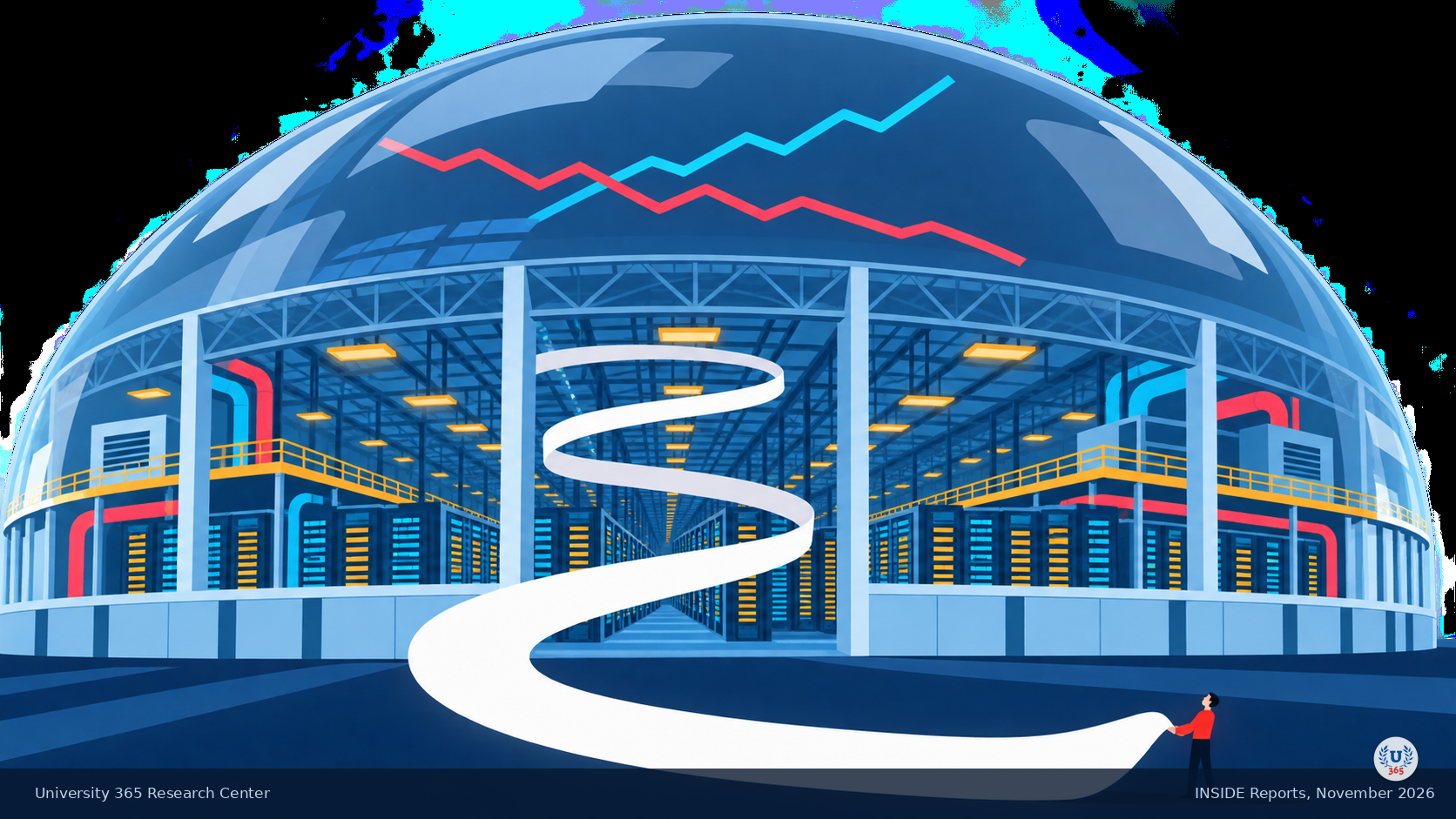
Illustration: the invoice arrives before the revenue does. The bubble holds the asset; the paper trail leads to the buyer.
Anthropic's third quarter was, by the standards of enterprise software, extraordinary. Revenue reached 16.96 billion dollars, up 1,127 per cent from the same quarter a year earlier. That is faster than almost any company of its size has ever grown. Compute and infrastructure costs rose 382 per cent, slower than revenue. Adjusted operating income reached 2.5 billion dollars. The company held 95.6 billion dollars of cash and another 36.3 billion in short-term investments. On any honest reading, this is not a failing business.
And yet the same filing discloses 895.4 billion dollars of purchase commitments, about 13 times annualized revenue. It reports an operating loss of 567 million dollars for the quarter, because 5 billion dollars of computing power had to be bought under short-term contracts that "currently cost significantly more" than its multi-year deals. It reports a net loss of 23.3 billion dollars. Revenue growth, while enormous, slowed sharply in the third quarter: from 144 per cent in the second quarter to 47 per cent, after 132 per cent in the first. A company cannot grow at 47 per cent per quarter forever, and the commitments assume that it grows for years.
The same pattern appears at OpenAI. It has reportedly committed about 1.4 trillion dollars to data centres and cloud services over eight years, including a 300 billion dollar Oracle contract. Its annualized revenue is approaching 50 billion dollars. That is a commitment equal to 28 times current annual revenue. The company raised 11 billion dollars on 6 November, less than half of what it first sought, at a valuation below its original target. Private capital is still available. It is no longer unconditional.
Now add the political fact. The largest building programme in the history of American industry just lost its most reliable political allies in the states where it is building. Texas, which holds nearly a quarter of the planned national capacity, elected a governor who promised a moratorium on data centre construction and greater community input. Georgia and Ohio elected governors who pledged pauses on large projects. Voters approved nearly every data centre moratorium on the ballot. The incoming Senate majority has called for a national moratorium, though it cannot pass one over a presidential veto.
So the contradiction is this: the better these companies perform, the more capital they must commit; the more they commit, the more the public price matters; and the public price is being set at the precise moment the political permission for the buildout has narrowed. The bubble thesis and the boom thesis are not competing descriptions of different facts. They are two readings of the same facts, and the IPO is the instrument that will decide which reading the market adopts.
There is a third possibility, and it is the one this report takes seriously: both readings can be true in different places. A technology can be genuinely transformative and still be overpriced at a given moment. Railways transformed the world and railway shares collapsed. The internet transformed the world and internet shares collapsed. The question is not whether AI matters. It is whether the companies now being priced can carry the commitments they have made through the period in which the revenue has not yet arrived.

The AI Bubble Test: Anthropic's IPO and the First Public Price for AI (2026)
The Current State: a market that lost two and a half trillion dollars in a day
Four events in five days
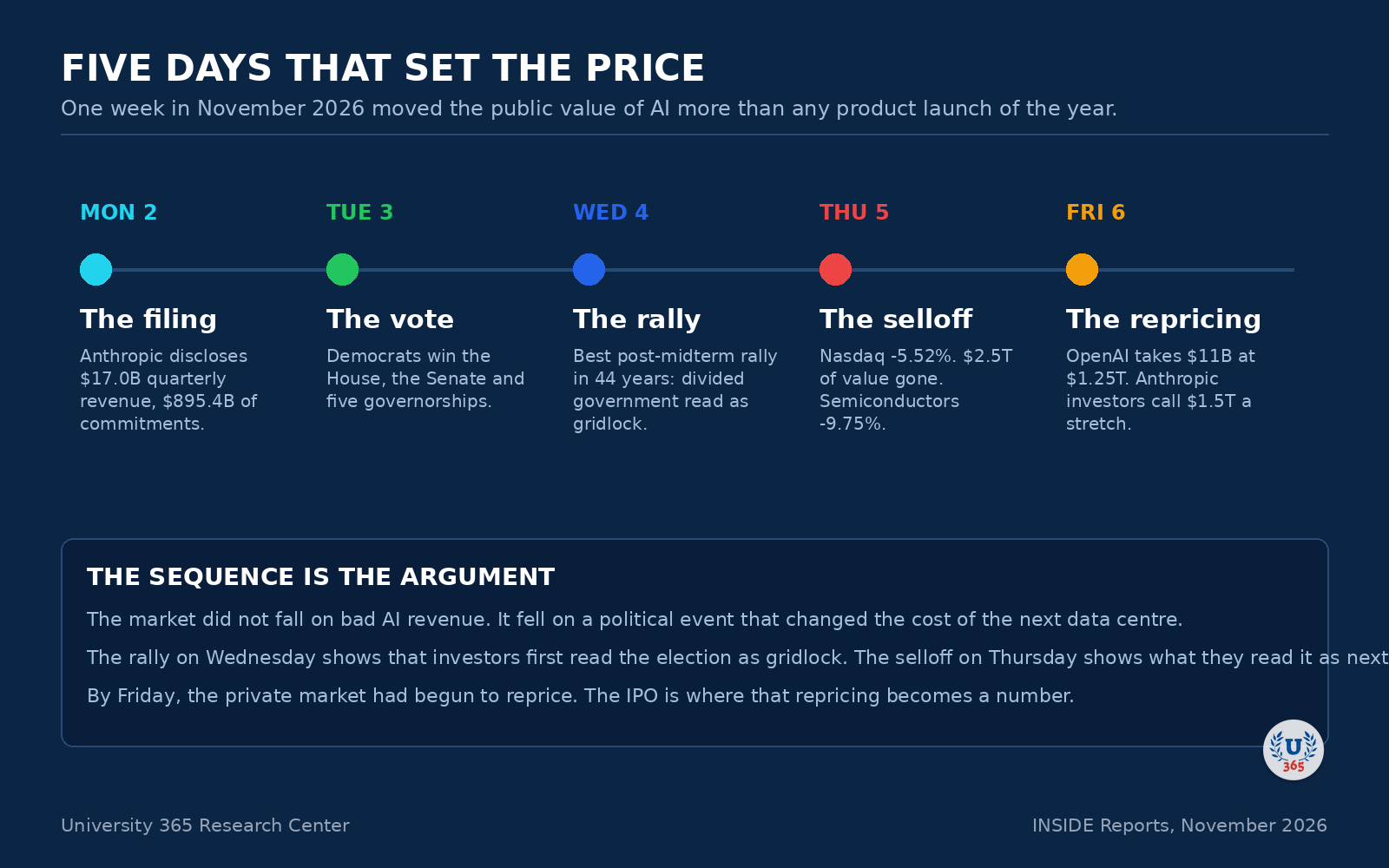
Five days in November 2026: the filing, the vote, the rally, the selloff, the repricing.
Sources: Anthropic S-1/A; Reuters; CNBC; Fortune; Bloomberg. See Table 1 for the filing figures.
The week of 2 November 2026 will be studied for as long as people study AI. It contained four events that normally arrive years apart.
On Monday 2 November, Anthropic filed an amendment to its S-1 disclosing third-quarter results: 17 billion dollars of revenue, an operating loss of 567 million dollars, 895.4 billion dollars of purchase commitments, and 131.9 billion dollars of cash and short-term investments. The numbers were, depending on which line the reader stopped at, either the strongest argument for AI ever published or the clearest warning.
On Tuesday 3 November, Americans voted. The result was a Democratic wave. As of 6 November, Reuters counted 250 Democratic seats in the House of Representatives against 157 Republican seats, a gain of 40, and 54 Democratic Senate seats against 44 Republican, a gain of 7. Democrats flipped governorships in Texas, Georgia, Ohio, Iowa and Nevada. Voters in 38 local jurisdictions across 10 states considered at least 41 data centre measures; they approved nearly every moratorium on the ballot. The Guardian called the election's three biggest losers Donald Trump, Elon Musk and data centres.
On Wednesday 4 November, the stock market rallied. It was the best post-midterm rally in 44 years, according to Fortune, because investors initially read divided government as a brake on regulation.
On Thursday 5 November, the market reversed. The Nasdaq fell 5.52 per cent into correction territory, the S&P 500 fell about 4.4 per cent, the Dow fell 1,833 points, and the Philadelphia Semiconductor Index fell as much as 11 per cent and was down about 9.75 per cent in intraday trading, its steepest daily loss since March 2020. Roughly 2.5 trillion dollars of market value disappeared. The Magnificent Seven, the largest technology companies in the index, lost about 1 trillion dollars between them. The trigger was not a profit warning. It was the realisation that the election had changed the cost and the permission of building data centres, and that the companies being priced had assumed neither would change.
By Friday 6 November, the repricing had reached private markets. OpenAI closed 11 billion dollars of a round at 1.25 trillion, down from a target of 30 billion at 1.4 trillion. Reports said its annualized revenue was approaching 50 billion dollars, about 20 billion below earlier estimates. Anthropic investors began to brief that 1.5 trillion was a stretch. The Nasdaq's October had already been its worst month since March 2025, led by chipmakers and neoclouds.
The public price of a private boom
The scale of the private AI economy is now comparable to a national economy. OpenAI at 1.25 trillion dollars and Anthropic at a hoped-for 1.5 trillion would be worth more than most listed companies in the world. Neither has ever reported an annual profit. Both have committed to spending that exceeds the annual defence budget of most countries.
The commitments are the part the public argument misses. Anthropic's 895.4 billion dollars of purchase commitments include 110 billion dollars for Amazon's Trainium chips through 2036, 114.5 billion for Google's tensor processing units, and more than 20 billion for AMD chips. OpenAI has committed about 1.4 trillion dollars to data centres and cloud services over eight years. Add the two companies' commitments and the total is about 2.3 trillion dollars, before the hyperscalers' own 720 to 745 billion dollars of 2026 capital expenditure.
These are not vague intentions. They are contracts with penalties, take-or-pay clauses and minimum volumes. A take-or-pay clause obliges the buyer to pay for a quantity whether or not it uses it. In a growing market, such clauses are a way to secure supply. In a slowing market, they are a fixed cost that cannot be cut. That is the mechanism by which a demand slowdown becomes a solvency problem.
The political repricing
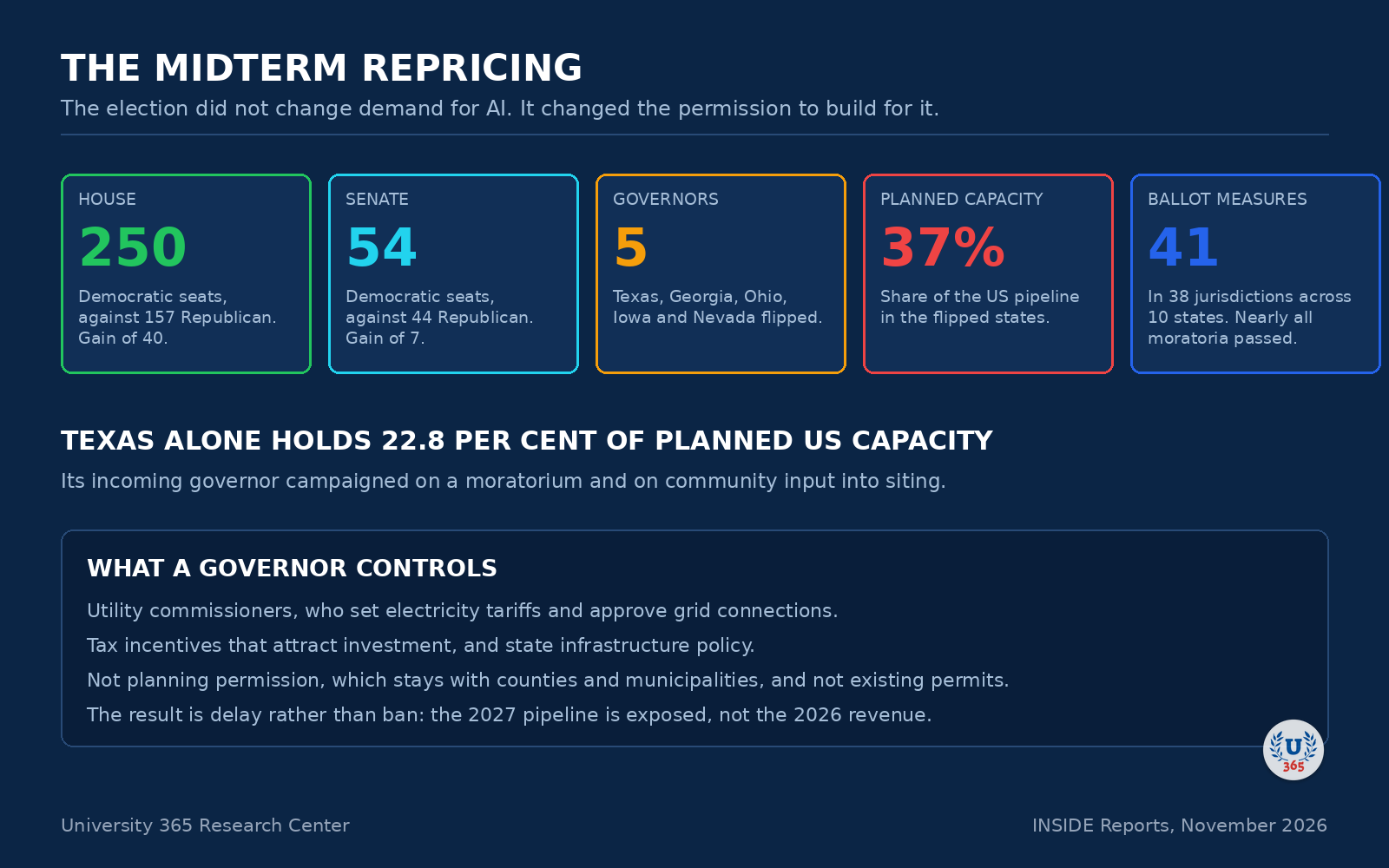
The midterm repricing: the House, the Senate, five governorships and 41 local measures.
Sources: Reuters; The National, citing Cleanview; CNBC, citing Ballotpedia.
The election did not create the data centre backlash. It ratified it. For two years, local opposition had been building in Virginia, Arizona, Georgia, Texas and Ohio over electricity bills, water use, noise and land. What changed in November is that the opposition acquired governors.
A governor's leverage is indirect but decisive. Utility commissioners, whom governors appoint, decide who pays for grid upgrades. In many states, data centres have been offered preferential tariffs or direct connections that shift part of the cost to other customers. That is now politically toxic. The incoming governor of Texas, Gina Hinojosa, campaigned on a moratorium and on community input into siting. The incoming governors of Georgia and Ohio, Keisha Lance Bottoms and Amy Acton, pledged pauses on large projects. None of them can stop a project that already has a permit. All of them can slow the next one, and the next one is what the 2027 revenue forecasts depend on.
The federal picture is more divided. Democrats gained control of Congress but not the presidency. They can hold hearings, request documents, attach conditions to federal procurement and pass disclosure requirements. They cannot enact a national moratorium over a presidential veto. The realistic federal outcome is not a ban but a set of conditions: disclosure of energy contracts, local benefit agreements, and procurement rules that favour vendors able to document their models. Those conditions raise the cost of building and the cost of selling, and they arrive when the industry is least able to absorb either.
The credit market
The buildout is no longer funded only by retained earnings and equity. The Bank for International Settlements reported that gross bond issuance by the five largest hyperscalers reached 222 billion dollars by September 2026. Private credit funds, insurers and infrastructure investors have lent against data centre projects, often through special purpose vehicles that sit outside the sponsor's balance sheet. The total stock of AI-related debt is difficult to measure precisely because a meaningful share is private.
Debt changes the physics of a bubble. An equity-funded boom can deflate gradually: share prices fall, hiring slows, projects are postponed. A debt-funded boom has thresholds. A lender marks down collateral, a rating agency changes an outlook, a refinancing fails, and a project that was viable at a four per cent interest rate is not viable at seven. The Bank for International Settlements warned in its September 2026 bulletin that the structures connecting AI capital, compute and credit had become complex enough to transmit shocks across markets that appear unrelated.
The first signs are already visible in the specialised layer. Crusoe sold its troubled Wyoming data centre campus to Google in early November, a transfer that showed how hard it is to build very large campuses on schedule and on budget. When a hyperscaler absorbs a stalled project, capacity concentrates further among the largest balance sheets. That is rational for Google. It is not reassuring for the smaller companies that planned to compete with it.
The Chinese price
The final piece of the current state is the one American investors discuss least. Chinese open-weight models have become a structural price ceiling on the model layer.
An open-weight model is a model whose parameters are published, so that anyone can download it, run it on their own hardware, modify it and deploy it without paying the original developer per token. DeepSeek, Alibaba's Qwen, Moonshot's Kimi and Zhipu's GLM have released models at or near the frontier of open capability. In July 2026, DeepSeek models handled 17.6 per cent of all tokens routed through OpenRouter, a public marketplace that measures which models developers actually call. In some weeks of 2026, Chinese open models accounted for more than 30 per cent of OpenRouter traffic. DeepSeek's V4-Pro was priced at 1.74 dollars per million input tokens and 3.48 dollars per million output tokens, a fraction of the closed-model price.
The Chinese advantage is not only price. It is industrial policy. A March 2026 report for the U.S.-China Economic and Security Review Commission described a "two loops" strategy: permissive licensing at home, aggressive pricing abroad, and an ecosystem that accelerates adoption and iteration. Chinese labs benefit from state-directed compute, local government procurement and a domestic market large enough to amortise training costs. The result is a steady downward pressure on the price of intelligence, which is good for users and difficult for any company whose valuation assumes stable margins.
For an American lab, the Chinese price sets a ceiling on what it can charge for a commodity model. The strategic response has been to move up the stack: agents, coding, enterprise workflows, specialised reasoning, and the compliance and reliability that large organisations pay for. That is a real business. It is also a narrower market than "all of computing", and it is the market that Anthropic's 1.5 trillion dollar valuation is implicitly claiming.
Where the queue stands
The listing itself is now a macroeconomic event. Anthropic's IPO will be the first time public shareholders set a price for a pure-play AI laboratory. Every private valuation in the sector, every employee stock option, every venture fund's marks, every university's procurement decision and every pension fund's exposure will be referenced to that price. If the deal clears at 1.25 trillion and trades up, it validates the private market. If it clears at 1 trillion and trades down, it re-prices the entire stack. If it is pulled, it removes the exit that the private market has been assuming.
That is why this report calls it the first public price, and why the answer to the bubble question will not come from an economist's model. It will come from a bookbuilding process that starts in the week of 9 November 2026.

The AI Bubble Test: Anthropic's IPO and the First Public Price for AI (2026)
Key Findings
1. The bubble question has moved from private marks to a single public price. Anthropic's IPO is the first mark-to-market event for the AI laboratory business model. Its outcome will set the reference price for every private AI company, not because Anthropic is typical, but because it is the first one that has to publish audited numbers and sell shares to strangers.
2. The valuation is high but not obviously irrational on revenue alone. At 1.5 trillion dollars, Anthropic trades at about 22 times annualized third-quarter revenue. At 1 trillion, about 15 times. Those multiples are within the range paid for exceptional software companies. They become irrational only when the commitments behind them are included.
3. The commitments are the real exposure. Anthropic has 895.4 billion dollars of purchase commitments, about 13 times annualized revenue. OpenAI has reported commitments of about 1.4 trillion dollars against annualized revenue approaching 50 billion. These are fixed obligations that assume years of uninterrupted growth. A slowdown does not merely reduce profit; it creates a bill that cannot be reduced.
4. The midterms changed the cost of building, not the demand for AI. The election did not reduce the use of AI. It raised the political price of the infrastructure that supplies it. Democrats flipped governorships in states holding 37 per cent of planned data centre capacity, and voters approved nearly every moratorium on the ballot. The effect will appear in 2027 project timelines, not in 2026 revenue.
5. The break, if it comes, will come through credit and depreciation before it comes through demand. The hyperscalers issued 222 billion dollars of bonds by September 2026, and a meaningful share of the buildout is financed off balance sheet. Depreciation schedules assume useful lives of five to six years for assets that may be economically obsolete in three. Impairment, not a sudden drop in usage, is the most likely trigger of a repricing.
6. China sets a price ceiling that makes the "explosion" case narrower than it looks. Open-weight models at a fraction of the closed-model price cap what any lab can charge for a commodity model. The Western labs can escape that ceiling only by selling agents, workflows and assurance. That is a large market, but it is not the whole economy, and the current valuations price the whole economy.
7. The most likely outcome is a repricing, not a collapse. A soft landing is possible if Anthropic prices at 1 to 1.25 trillion and 2027 revenue doubles. A rupture is possible if the deal is pulled and credit tightens. The central case is a 30 to 50 per cent markdown in private valuations over 2027, a slower buildout, consolidation among neoclouds, and a public market that continues to pay for AI but at a lower multiple. That is a bubble deflating, not a technology failing.

The AI Bubble Test: Anthropic's IPO and the First Public Price for AI (2026)
Deep Analysis: five tests of the first public price
The rest of this report applies five tests to the valuation: price discovery, revenue quality, capital intensity, political risk and the Chinese price ceiling. Each test can be passed or failed independently. The valuation survives only if the company passes most of them at once.
Test one: price discovery
The first test is arithmetic. Anthropic's revenue has grown from an implied 4.75 billion dollars in the first quarter of 2026, to 11.6 billion in the second, to 16.96 billion in the third. Annualized, that is 19 billion, 46 billion and 68 billion dollars in nine months. The growth is extraordinary and decelerating.
At a 1.5 trillion dollar valuation, the company would trade at 22 times the third-quarter annualized figure. At 1.25 trillion, 18 times. At 1 trillion, 15 times. For comparison, the S&P 500 traded at about 22 times forward earnings in late 2026, and the largest software companies have historically traded at 10 to 15 times sales when growing at 30 to 40 per cent. Anthropic is growing faster than that, which justifies a premium. The question is how much of the premium is already in the price.
The more revealing comparison is against the company's own trajectory. If revenue doubles in 2027, which is slower than its 2026 pace, the 2027 annualized figure would be about 136 billion dollars. At a 1.5 trillion dollar valuation, the multiple falls to 11 times. If revenue grows 50 per cent, it falls to 15 times. If revenue stalls at 68 billion, the multiple stays at 22 times and the company looks expensive. The valuation is therefore a bet on one year of growth, not on a decade. That is a narrower bet than the rhetoric suggests, and a more fragile one.
The public market will make that bet with a price range. The roadshow is where the range is tested. A deal priced at the low end of a reduced range is not a failure; it is price discovery working. A deal that is cut in size and still falls on the first day is a verdict.
Test two: revenue quality
The second test is the quality of the revenue, not its quantity.
The cost of delivering the revenue is the first thing to read. Compute and infrastructure costs were 9.86 billion dollars against 16.96 billion of revenue in the third quarter, or 58 per cent of revenue. The company does not present that line as its gross margin, and the two should not be confused. But the company disclosed that 5 billion dollars of that compute was bought under short-term contracts that cost "significantly more" than its multi-year deals. That is a warning about the cost of growth: when demand outruns contracted capacity, the marginal revenue is much less profitable than the average.
The customer base is also concentrated. The S-1 reportedly discloses a narrow set of large customers, which is typical of an enterprise model business and risky for a public company. A single customer renegotiating a contract can move a quarter. The adjusted operating margin fell from 19 per cent in the second quarter to 15 per cent in the third, even as revenue grew 47 per cent. That is what a company looks like when it is buying market share in a capacity-constrained market.
At the industry level, the demand signal is mixed. Ramp, a corporate spend management platform, reported in November that AI usage was still rising while enterprise AI spending had flattened, as price cuts and cost controls took hold among the largest buyers. That is consistent with cheaper tokens and more consumption, which is good for adoption and bad for revenue per user. The Census Bureau's Business Trends and Outlook Survey put AI use at 23.8 per cent of American firms in the autumn of 2026, with 37 per cent among firms with 250 or more employees. Adoption is real. Monetisation is thinner than the valuations assume.
Test three: capital intensity and depreciation
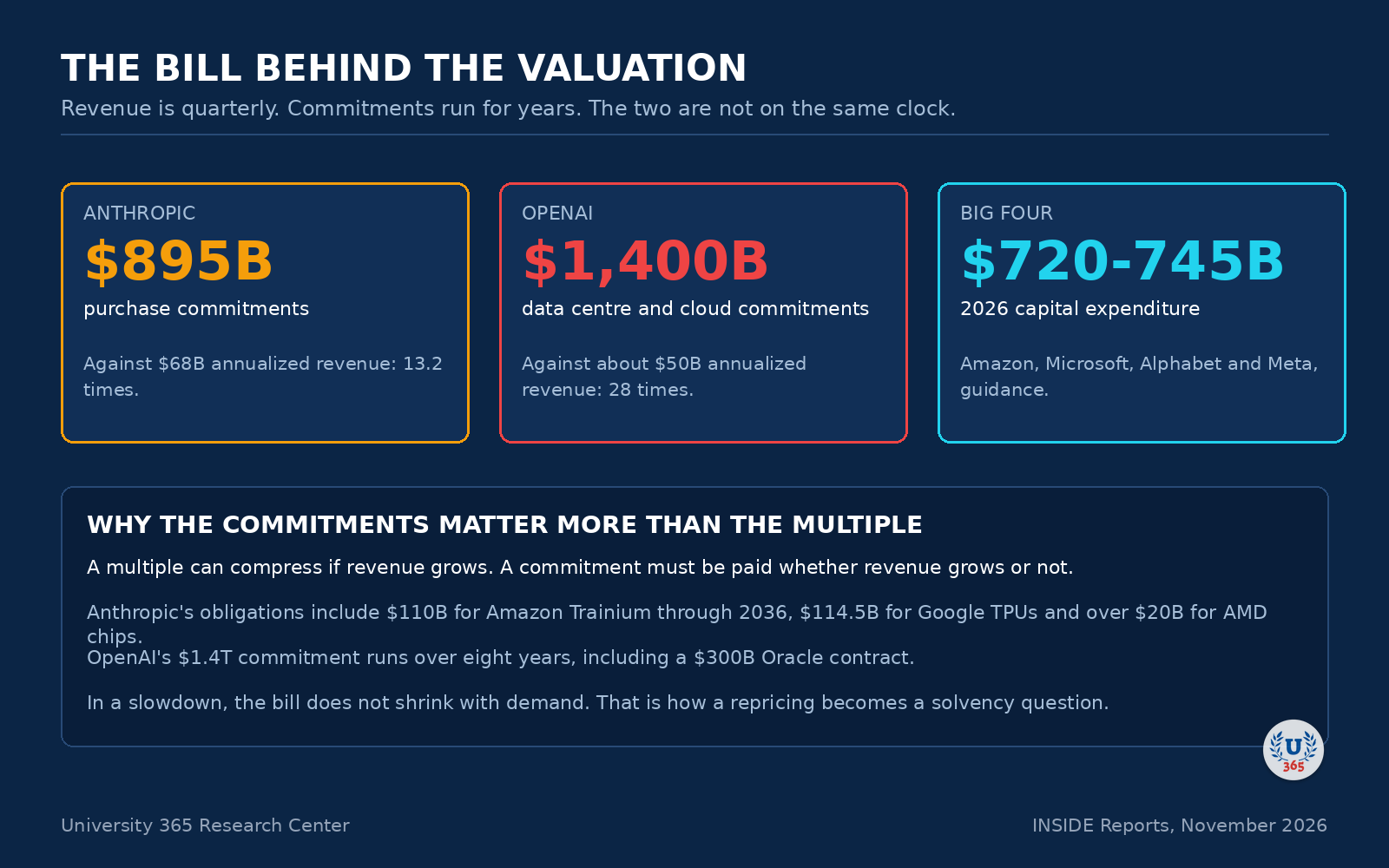
The bill behind the valuation: commitments measured against annualized revenue.
Sources: Anthropic S-1/A; Bloomberg and Reuters; company guidance; Gartner.
The third test is whether the capital being spent earns a return above its cost.
The four largest hyperscalers plan 720 to 745 billion dollars of capital expenditure in 2026. Gartner estimates that data centre owners will need 8.5 trillion dollars of cumulative revenue by 2030 to justify the investment, against a forecast of 3.6 trillion. The gap is 4.9 trillion dollars. Gartner also estimates that more than 3.5 trillion dollars of infrastructure spending could be exposed to impairment by 2030.
Those are large numbers, and they are forecasts. The more concrete problem is accounting. A GPU is capitalised and depreciated over an assumed useful life, typically five to six years. Its economic life is shorter. Nvidia releases a new architecture roughly every two years, and each generation makes the previous one less efficient per unit of work. If the true life is three years, the industry is understating depreciation by tens of billions of dollars a year. The investor Michael Burry argued publicly in November 2026 that extending useful life flatters earnings, a charge the industry rejects. The argument will be settled by disclosures in the 2026 annual reports, not by debate.
Depreciation matters because it is the mechanism that converts a capital boom into a profit problem. A company can report strong operating cash flow while its assets are consuming themselves. When the assets are eventually written down, the loss arrives all at once. That is what an impairment is, and it is why the credit market, not the product market, is the place to watch for the first crack.
Test four: political risk
The fourth test is whether the buildout can obtain permission at the speed the business model assumes.
The United States had 73.5 gigawatts of installed data centre capacity at the end of the third quarter of 2026, after adding 7.2 gigawatts in a single quarter, nearly the entire national capacity of 2019, according to Avison Young. Wood Mackenzie counted more than 430 gigawatts of disclosed pipeline, a number that includes projects announced but not financed, permitted or built. BloombergNEF expects 118 gigawatts of installed capacity by 2030, a forecast it revised upward by 52 per cent during 2026.
Those forecasts were made before the election. A pipeline of 430 gigawatts cannot be delivered if the states holding the largest share of it elect governors who promised pauses. Texas alone accounts for 22.8 per cent of planned capacity. The incoming governor has promised a moratorium and community input. Georgia and Ohio, two other flipped states, have governors who pledged pauses on large projects. Even if every promise is softened in office, the permitting process will slow, and the slowdown will fall on the projects scheduled for 2028 and beyond, which are the projects that justify today's valuations.
There is a counter-argument, and it deserves a hearing. A slower buildout may be good for the industry. The Business Insider headline on 5 November made exactly this point: the blue wave crushed the AI trade, but a slower buildout may be just what it needs. If fewer data centres are built, the ones that are built earn higher utilisation and better prices. The boom has been characterised by overordering, duplicate projects and speculative capacity. A political brake could force discipline, raise returns on the capacity that exists and extend the life of the current generation of chips. That is the soft-landing case, and it is more plausible than either the collapse or the explosion narrative.
Test five: the Chinese price ceiling
The fifth test is whether the model layer can sustain American prices against Chinese open weights.
The evidence says it cannot, at least not for commodity models. DeepSeek's models handled 17.6 per cent of OpenRouter tokens in July 2026. Chinese open models exceeded 30 per cent of the platform's traffic in some weeks. DeepSeek V4-Pro was priced at 1.74 dollars per million input tokens and 3.48 per million output, against closed-model prices several times higher. The quality gap has narrowed to the point where, for many tasks, the open model is good enough.
The strategic response is to sell what the open model cannot: assurance, compliance, integration, agentic workflows, and the reliability that a bank or a hospital needs. Anthropic's enterprise focus, its safety brand and its coding products are exactly that response. It is a coherent strategy. It also means the addressable market is the enterprise software market, not the entire economy. A 1.5 trillion dollar valuation implies the larger market.
The Chinese side is not a monolith. Its labs face export controls on the most advanced chips, rely on domestic alternatives that are less efficient, and are funded by a state that expects strategic returns. The U.S.-China Economic and Security Review Commission's "two loops" analysis describes a system that converts permissive licensing and aggressive pricing into global adoption, which in turn funds the next generation. That is a durable competitive advantage in the commodity layer. It is not a guarantee of frontier leadership. The American labs still lead on the most difficult tasks. The question is whether the most difficult tasks are where the money is.
The scenario matrix
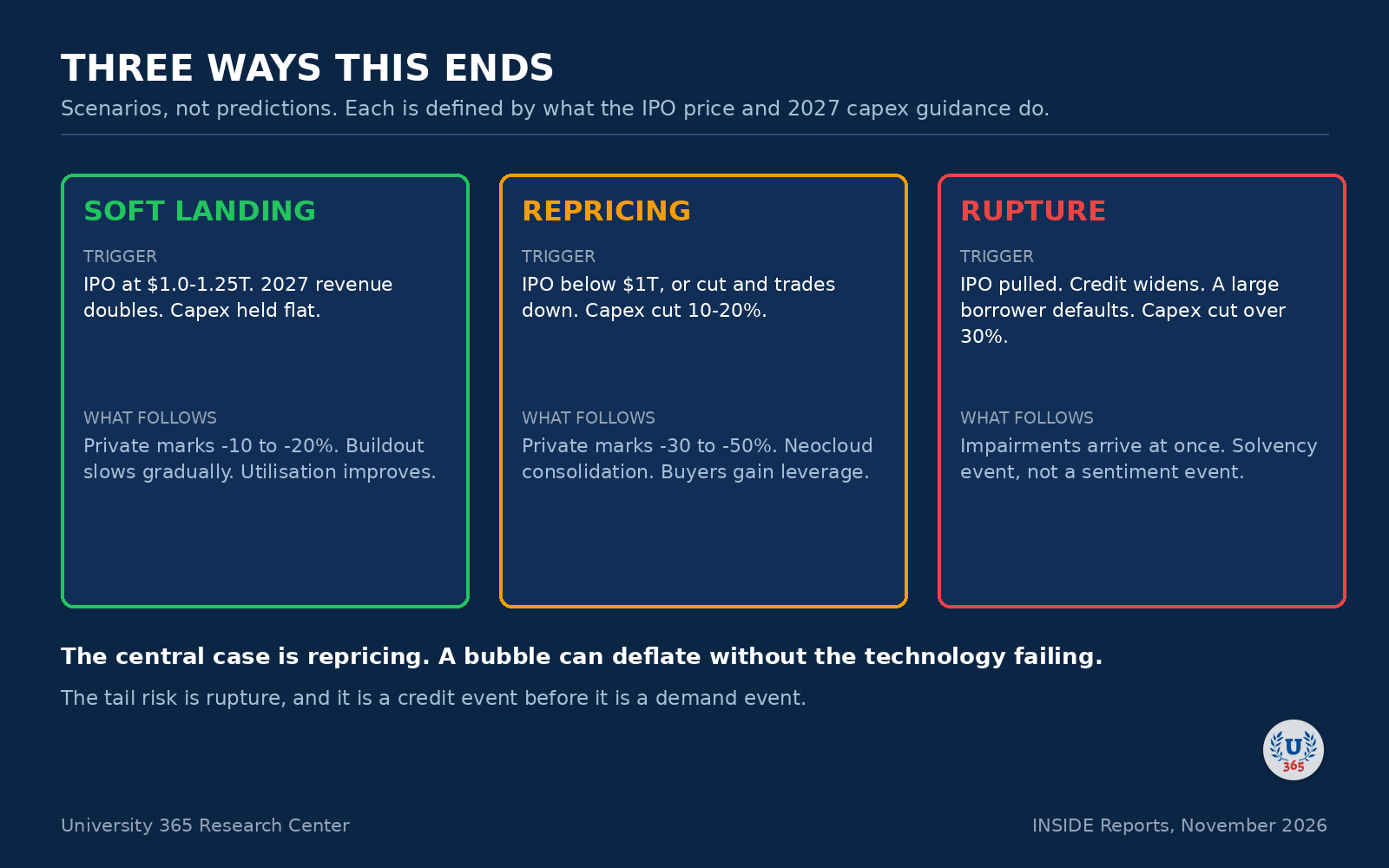
Three scenarios, defined by the IPO price and the 2027 capital expenditure guidance.
Illustrative scenarios, University 365 Research Center.
Combining the five tests produces three scenarios. They are not predictions. They are structured ways to watch the next twelve months.
Soft landing. Anthropic prices at 1 to 1.25 trillion dollars, trades modestly up, and 2027 revenue doubles. Hyperscalers hold capital expenditure flat in 2027 rather than cutting it. A slower buildout raises utilisation and prices for existing capacity. Private valuations mark down 10 to 20 per cent without a forced sale. AI adoption continues to spread through enterprises. This is the outcome the industry needs, and it requires the political slowdown to be gradual.
Repricing. Anthropic prices below 1 trillion or cuts the size of the deal, and the shares trade down. Private marks fall 30 to 50 per cent over 2027. Neoclouds consolidate; one or two fail or are absorbed. Hyperscalers cut 2027 capital expenditure by 10 to 20 per cent. Depreciation charges rise as useful lives are shortened. Enterprise buyers gain leverage and renegotiate contracts. The technology keeps spreading, but the financial returns are redistributed from investors to customers. This is the central case.
Rupture. The IPO is pulled or postponed. Credit spreads widen, a large data centre borrower defaults, and a hyperscaler announces a multi-billion-dollar impairment. Capital expenditure is cut by more than 30 per cent, and the companies that supply chips, power and construction feel it first. Usage keeps growing, but the companies that built for infinite growth cannot service their commitments. This is the tail risk, and the 895 billion dollar commitment is what makes it a solvency event rather than a sentiment event.
The trigger dates are knowable. The roadshow begins in the week of 9 November. Pricing is expected within weeks. The first public earnings report will come in the first quarter of 2027. The 2026 annual reports, which will disclose useful lives and impairment tests, arrive in February and March. The new governors take office in January, and their first budget and utility appointments will reveal how much of the campaign survives contact with office. Each of those dates is a chance for the market to revise its price.

The AI Bubble Test: Anthropic's IPO and the First Public Price for AI (2026)
Data and Evidence
The tables below consolidate the numbers used in this report. Each figure is dated and attributed. Where a figure is a projection, it is labelled as one.
Table 1. Anthropic's disclosed quarterly trajectory
Metric | Q3 2025 | Q2 2026 | Q3 2026 |
Revenue, billions of dollars | 1.38 | 11.60 | 16.96 |
Revenue growth, year on year | not applicable | not disclosed | 1,127 per cent |
Revenue growth, quarter on quarter | not applicable | 144 per cent | 47 per cent |
Compute and infrastructure cost, billions | 2.05 | not disclosed | 9.86 |
Operating income (loss), billions | (3.09) | 0.97 | (0.57) |
Adjusted operating income, billions | (1.30) | 2.20 | 2.50 |
Net loss, billions | (12.14) | (66.30) | (23.29) |
Source: Anthropic, PBC, Amendment No. 1 to Form S-1, filed with the Securities and Exchange Commission on 2 November 2026. Parentheses indicate a loss.
The third quarter is the most informative because it is the first in which the company disclosed the cost of buying computing power at short-term prices. The 5 billion dollars of short-term compute that "currently costs significantly more" than contracted capacity explains why an operating profit of 974 million dollars in the second quarter became a loss of 567 million in the third, even as revenue grew 47 per cent.
Table 2. What each valuation implies
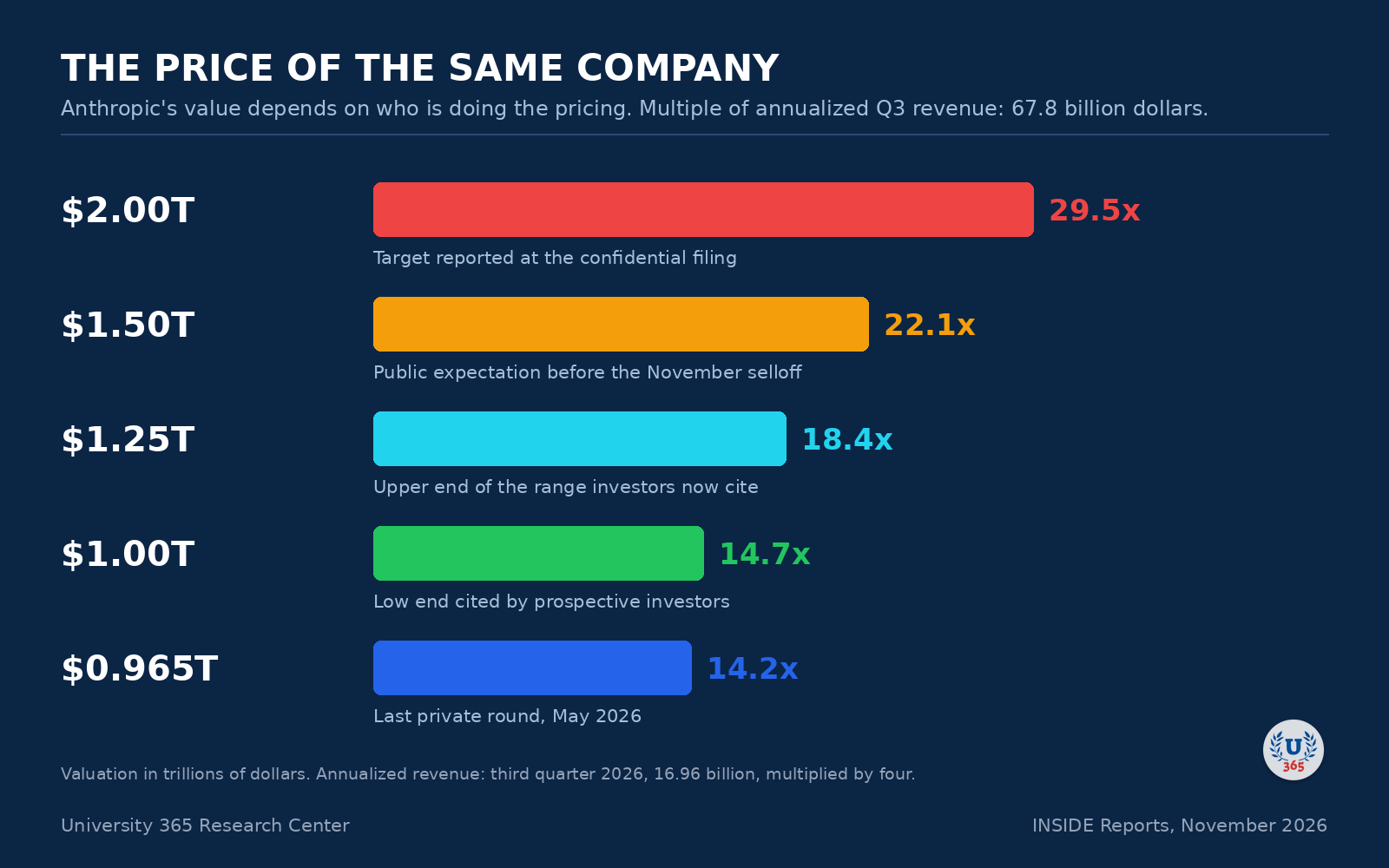
The same company at five prices, and the revenue multiple each one implies.
Sources: Anthropic S-1/A; CNBC, 6 November 2026; Bloomberg and Reuters, 6 November 2026.
Valuation, trillions of dollars | Multiple of annualized Q3 revenue | Context |
2.00 | 29.5 | Target reported at the confidential filing |
1.50 | 22.1 | Public expectation before the November selloff |
1.25 | 18.4 | Valuation of OpenAI's latest round, 6 November |
1.00 | 14.7 | Low end cited by prospective Anthropic investors |
0.965 | 14.2 | Anthropic's last private valuation, May 2026 |
Annualized revenue is the third-quarter figure of 16.96 billion dollars multiplied by four, or 67.84 billion. The multiple is the valuation divided by that figure. Sources: Anthropic S-1/A; CNBC, 6 November 2026; Bloomberg and Reuters, 6 November 2026.
The table makes the central point of the price discovery test. The distance between 2 trillion and 1 trillion is not a sentiment gap. It is the difference between 30 times revenue and 15 times revenue, and it is being decided by a bookbuilding process in which the buyers have just watched the Nasdaq fall 5.5 per cent in a day.
Table 3. The commitments behind the valuations
Commitment | Amount, billions of dollars | Source |
Anthropic purchase commitments | 895.4 | S-1/A, 2 November 2026 |
Anthropic, Amazon Trainium through 2036 | 110.0 | S-1, 26 October 2026 |
Anthropic, Google tensor processing units | 114.5 | S-1, 26 October 2026 |
Anthropic, AMD chips | more than 20.0 | S-1, 26 October 2026 |
OpenAI, data centre and cloud commitments over eight years | about 1,400 | Sam Altman, public remarks, 2026 |
Big four hyperscaler capital expenditure, 2026 | 720 to 745 | Company guidance, October 2026 |
Bond issuance by the five largest hyperscalers, to September 2026 | 222 | Bank for International Settlements, 2026 |
Revenue required by 2030 to justify the buildout | 8,500 | Gartner, 14 October 2026 |
Revenue forecast by 2030 | 3,600 | Gartner, 14 October 2026 |
The commitments in the first five rows are contractual or reported, not forecasts. The Gartner figures are projections and are labelled as such.
Table 4. What the midterms changed
Measure | Result | Source |
House of Representatives | 250 Democrats, 157 Republicans, Democratic gain of 40 | Reuters, 6 November 2026 |
Senate | 54 Democrats, 44 Republicans, Democratic gain of 7 | Reuters, 6 November 2026 |
Governorships flipped | Texas, Georgia, Ohio, Iowa, Nevada | The National, 5 November 2026 |
Planned data centre capacity in flipped states | 37 per cent of the United States total | Cleanview analysis via The National |
Texas share of planned capacity | 22.8 per cent | Cleanview analysis via The National |
Local data centre measures | 41 measures in 38 jurisdictions across 10 states | Reuters, citing Ballotpedia |
Moratorium outcomes | Approved in nearly every contest | CNBC and Reuters, 4 to 5 November 2026 |
The 37 per cent figure is an analysis of project data, not an official statistic. It measures planned capacity, including projects that may never be built. It is used here because it is the best available estimate of the exposure, and its direction is unambiguous.
What the data does not show
Three things are not in the data, and they matter.
First, no one knows the true useful life of a 2026 GPU. The companies assume five to six years. The economic evidence will arrive only when the first generation of large-scale AI infrastructure is retired and resold. Until then, depreciation is an assumption dressed as an accounting fact.
Second, no one knows how much AI demand is substitutive and how much is additive. A company that uses AI to replace ten analysts produces a cost saving that is easy to measure and a capability loss that is not. A company that uses AI to make ten analysts more effective produces a gain that is harder to measure and more durable. The aggregate revenue of the AI industry does not distinguish between the two.
Third, no one knows what the Chinese labs will charge next year. Open-weight prices have fallen faster than any forecast. A price war in the model layer would be good for users and devastating for any valuation that assumes stable margins. The current price of DeepSeek V4-Pro is a data point, not a floor.

The AI Bubble Test: Anthropic's IPO and the First Public Price for AI (2026)
Implications: what a public price changes
Four implications follow from the analysis, and they apply beyond the companies involved.
1. The price of intelligence will keep falling even if the valuations fall. The bubble question is often confused with the technology question. A collapse in AI share prices would not make models less useful. It would make them cheaper, because the same competition that produced open-weight models at 1.74 dollars per million tokens would intensify. Institutions that plan on the assumption of cheaper intelligence each year are planning correctly, whatever happens to Anthropic's share price.
2. Concentration is now the main financial risk. A small number of companies account for most of the market value, most of the capital expenditure and most of the debt issuance in the sector. When those companies are repriced, the effect reaches pension funds, insurers and index investors who never chose to take a position in AI. The Bank for International Settlements warned that the links between AI capital, compute and credit are now complex enough to transmit shocks. Diversification at the level of a portfolio does not protect an institution whose suppliers, partners and students are all exposed to the same handful of firms.
3. Political risk has become a cost of capital. For a decade, the technology industry treated regulation as a compliance cost to be managed after the fact. The 2026 midterms turned it into a variable that changes the value of a project before it is built. A data centre that cannot obtain a grid connection is not an asset. A model that cannot be sold to a public university without a disclosure agreement is a smaller market. Companies that price political risk into their plans will raise capital more cheaply than companies that do not.
4. The buyer gains leverage in a repricing, and should use it. If private valuations fall, enterprise customers will face vendors who need revenue more than they need margin. That is the moment to negotiate multi-year contracts with price ceilings, exit clauses, model portability and data portability. It is also the moment to avoid becoming dependent on a single vendor. The cheapest contract signed at the peak of a boom is often the most expensive one in the downturn, because it locks in peak prices for years.

The AI Bubble Test: Anthropic's IPO and the First Public Price for AI (2026)
Education and Skills Impact
A bubble is an educational event as much as a financial one, because it changes what students should learn and what institutions should teach.
The first lesson is that tool fluency is not AI literacy. A student who can prompt a chatbot has learned a interface, not a capability. The interface will change, the model will change and the price will change. What survives is the ability to judge whether an answer is true, to frame a problem precisely, to check a source and to recognise when a confident output is wrong. Those are the skills that make AI useful and that no model provides on its own.
The second lesson is that the economics of AI belongs in the curriculum. Students in every discipline will make decisions about AI procurement, vendor selection, data governance and automation. They need to understand a unit cost, a contract term, a depreciation schedule and a valuation multiple, at least well enough to ask the right question. The AI bubble is a case study in how a transformative technology can be overpriced without being unimportant. Teaching only the technology, and not the economics, leaves graduates unable to interpret the world in which they will use it.
The third lesson is that the skills which resist automation are the skills that verify, integrate and decide. The tasks most exposed to AI are those with a clear input, a clear output and a checkable answer. The tasks least exposed are those that require judgment under uncertainty, accountability for a decision, and the ability to work with people who disagree. A curriculum that trains students to produce text will produce graduates who compete with a model priced per token. A curriculum that trains them to evaluate text, design systems and take responsibility will produce graduates who direct the model.
The fourth lesson concerns institutional strategy. Universities are both buyers and producers of AI. As buyers, they face the procurement problem described above. As producers, they face a market in which the price of course content and tutoring may fall. The institutions that will do well are not those that adopt the most tools. They are those that use AI to increase the number of students they can teach well, without reducing the quality of the judgment they teach. That is a harder goal than buying a licence, and it is the one that survives a repricing.
For University 365, the practical consequence is a shift in emphasis. The methods that matter are the ones that keep the human in charge of the judgment: the CI-First approach, the verification habits it requires, and the economic literacy that lets a graduate read a contract or a balance sheet. Those are teachable, durable and independent of which model is leading the benchmark this month.

The AI Bubble Test: Anthropic's IPO and the First Public Price for AI (2026)
The CI-First Perspective
The Co-Intelligence-First (CI-First) approach is a genuine and unique University 365 concept: a proposal for imagining a better future where AI and Human Intelligence coexist productively, each amplifying the other rather than replacing it.
The financial argument in this report has a methodological twin. A bubble forms when capital is deployed faster than the judgment needed to deploy it. That is as true of a curriculum as it is of a data centre.

Illustration: the human directs the machine. The analyst holds the judgment; the assistants carry the material.
CI-First asks a question that the market does not: does this use of AI amplify the human being who uses it, or does it substitute for the human being who used to do the work? The distinction is not moral. It is economic. A substitutive deployment competes with an open-weight model on price, and the open-weight model will win. An ampliative deployment combines the model with context, accountability and judgment that the model does not have, and that combination can sustain a price.
The AI Imposture risk in this story is specific. It is the risk of mistaking usage for capability, a pilot for a production system, and revenue for profit. Anthropic's 17 billion dollar quarter is real revenue from real customers. The 23 billion dollar net loss is also real. A reader who sees only one of those numbers has been fooled, and the fooling is not done by the company. It is done by the desire to believe that a technology we can see working must be a business that works.
The CI-First test for an investor, an institution or a student is the same. Ask what the human is doing that the model cannot do. If the answer is nothing, the value will migrate to the cheapest model. If the answer is judgment, context, accountability or trust, the value can persist. The companies that survive the repricing will be those whose customers are doing something with AI that they could not do without it, and could not do with a cheaper substitute.
This is also why the educational mission matters to the financial question. A market full of substitutive deployments is a market that competes on price, and price competition in a commodity layer is a race to the bottom. A market full of ampliative deployments is a market that competes on outcomes, and outcomes can carry a margin. The difference is not produced by the model. It is produced by the people who use it, and by the institutions that taught them how.

The AI Bubble Test: Anthropic's IPO and the First Public Price for AI (2026)
What This Means for You and Us
For a reader who is not an investor, the practical question is what to do differently on Monday morning. Five actions follow from the evidence.
Do not lock in peak prices. If you are negotiating an AI contract in the next six months, assume that the price per token will fall and that the vendor's need for revenue will rise. Ask for a price ceiling rather than a discount, a right to renegotiate at defined intervals, and an exit clause with a defined data export. The vendor may refuse. The request itself tells you how confident the vendor is in its own pricing.
Keep the ability to switch models. The model layer is commoditising faster than the application layer. Build your systems so that the model is a replaceable component, not the foundation. That means owning your prompts, your evaluation sets, your data and your integration layer. It also means testing an open-weight alternative at least once a year, even if you do not deploy it.
Measure outcomes, not usage. A dashboard that reports seats, prompts or tokens measures activity. A dashboard that reports cycle time, error rates, cost per case and the quality of the decision measures value. The companies that will cut AI budgets in a repricing are the ones that could never show the second set of numbers.
Treat concentration as a risk in your own institution. If your learning platform, your student records, your research compute and your administrative workflows all depend on one vendor, you have a single point of failure that no contract can fully cover. A second supplier, an internal fallback and a documented exit plan are boring investments that become valuable in exactly the week you need them.
Teach the judgment, not the tool. For a university, this is the strategic conclusion. The tools will change. The ability to verify, to frame a problem, to read a contract and to take responsibility will not. An institution that teaches those things is positioned for any outcome of the bubble test. An institution that teaches only the current interface is positioned for one.
For University 365 specifically, the report argues for three commitments. First, keep procurement multi-vendor and contractually flexible, because the institution's budget should not be a bet on one lab's valuation. Second, put the economics of AI into the curriculum, because graduates will manage AI budgets whatever their discipline. Third, keep the CI-First method at the centre, because it is the one asset that appreciates when models become cheaper: the judgment of the person directing them.

The AI Bubble Test: Anthropic's IPO and the First Public Price for AI (2026)
The Road Ahead
The next twelve months contain a small number of dates that will settle the argument. They are worth diarising.
The roadshow, week of 9 November 2026. Anthropic meets institutional investors. The questions they ask, and the answers the company gives about purchase commitments and customer concentration, will shape the price range.
The pricing, expected within weeks. The offer price is the first public mark. A price at the top of a reduced range, with a modest first-day gain, is the soft-landing signal. A price below 1 trillion, or a cut in deal size, is the repricing signal. A pulled deal is the rupture signal.
The first public quarterly report, early 2027. A newly listed company reports on a calendar that its investors can inspect. The first report will show whether the growth rate held through the fourth quarter, and whether the cost of short-term compute fell as new capacity came online.
The 2026 annual reports, February and March 2027. This is where useful lives, impairment tests and purchase commitments are disclosed in detail. If hyperscalers shorten useful lives, the depreciation charge rises and reported profit falls. That is the accounting channel through which a bubble deflates.
The new governors take office, January 2027. Their first budgets and utility appointments will show how much of the campaign survives. A moratorium in Texas would be the single largest political shock to the buildout. A review that delays permits without banning them would be the more likely, and less disruptive, outcome.
The 2027 capital expenditure guidance, January and February 2027. The hyperscalers will tell the market whether they are holding, slowing or cutting. A hold is the soft landing. A cut of 10 to 20 per cent is the repricing. A cut above 30 per cent is the rupture.
Two indicators are worth watching above all others. The first is the spread between the private marks and the public price: if Anthropic lists at 1.25 trillion and the shares hold, the private market keeps its marks; if it lists at 1 trillion and falls, every private mark is suspect. The second is the credit spread on data centre debt: if the bonds of the largest borrowers widen while the equity market recovers, the problem is financing, not sentiment.
What would change this report's mind? A rapid fall in the cost of inference combined with a rapid rise in enterprise revenue would justify the buildout even at a high multiple. That is the explosion case, and it is not impossible. Anthropic's revenue grew 1,127 per cent in a year. If it grows another 100 per cent in 2027 and the industry's capital expenditure stays flat, the arithmetic improves dramatically. The report would then be wrong about the price and right about the risk, which is the most common way to be wrong about a bubble.

The AI Bubble Test: Anthropic's IPO and the First Public Price for AI (2026)
Sources and Methodology
Methodology
This report was researched between 6 and 8 November 2026 by the University 365 Research Center. It draws on primary documents wherever possible: the Anthropic registration statement and its amendment filed with the Securities and Exchange Commission, official election results reported by Reuters, central bank research, company guidance and market data. Where a primary document was not available, the report uses reporting from established outlets and labels the figure as reported. Where a figure is an estimate or a projection, it is labelled as such.
Three rules governed the use of numbers. First, every figure is dated and attributed to a specific period. Second, a valuation multiple is always stated with the revenue base used to calculate it. Third, where sources disagree, the report states the disagreement rather than averaging it. The most important disagreements are the size of Anthropic's addressable market, the useful life of current GPUs, and the share of AI demand that is substitutive rather than additive.
The report is an analysis of the public record as of 8 November 2026. The situation is moving quickly: the IPO may be priced, repriced or postponed within weeks of publication. Readers should check the current price and the current filings before relying on any number for a decision.
Sources
1. Anthropic, PBC, Form S-1, Securities and Exchange Commission, 26 October 2026. https://www.sec.gov/Archives/edgar/data/2130357/000162828026067168/anthropicpbc-sx1.htm
2. Anthropic, PBC, Amendment No. 1 to Form S-1, Securities and Exchange Commission, 2 November 2026. https://www.sec.gov/Archives/edgar/data/2130357/000162828026068676/anthropicpbc-sx1ax1.htm
3. CNBC, Anthropic reports $17 billion in Q3 revenue, purchase commitments of $895.4 billion in revised S-1, 2 November 2026. https://www.cnbc.com/2026/11/02/anthropic-ant-s-1-quarter-financials.html
4. StockAnalysis, Anthropic's amended IPO filing shows Q3 revenue of $17.0B, up 1,127%, and a swing to a $567M operating loss, 2 November 2026. https://stockanalysis.com/news/anthropic-third-quarter-revenue-17-billion-ipo-filing
5. CNBC, Investors brace for lower Anthropic valuation, calling $1.5 trillion a stretch, 6 November 2026. https://www.cnbc.com/2026/11/06/investors-brace-for-anthropic-valuation-1point5-trillion-a-stretch.html
6. Reuters, Exclusive: AI backlash could threaten Anthropic IPO timing, potential investors say, 5 November 2026. https://money.usnews.com/investing/news/articles/2026-11-05/exclusive-ai-backlash-could-threaten-anthropic-ipo-timing-potential-investors-say
7. CNBC, Anthropic IPO hits AI backlash after midterms show rebuke on data centers, 7 November 2026. https://www.cnbc.com/2026/11/07/anthropic-ipo-ai-data-center-backlash.html
8. The Telegraph, Anthropic IPO in turmoil as AI sell-off hammers valuation, 6 November 2026. https://www.telegraph.co.uk/business/2026/11/06/anthropic-ipo-in-turmoil-as-ai-sell-off-hammers-valuation/
9. Reuters, US midterm results in maps and charts, 5 and 6 November 2026. https://www.reuters.com/graphics/US-ELECTIONS/GRAPHICS-BLOG/akpelkldzvr/
10. The National, Democrats' midterm gains put US data centre boom under pressure, 5 November 2026. https://www.thenationalnews.com/news/2026/11/05/democrats-midterm-gains-put-us-data-centre-boom-under-pressure/
11. CNBC, Top Democrats call to rein in AI buildout after midterms sweep, 5 November 2026. https://www.cnbc.com/2026/11/05/democrats-data-center-restrictions-midterms.html
12. CNBC, Voters rebuff data centers in every ballot measure except one, 4 November 2026. https://www.cnbc.com/2026/11/04/data-center-ballot-measures-2026-midterm.html
13. The Guardian, Datacenters were on the ballot. US voters rejected them, 4 November 2026. https://www.theguardian.com/us-news/2026/nov/04/datacenters-midterm-elections
14. Fortune, Wall Street's best post-midterm rally in 44 years lasted just one day, 5 November 2026. https://fortune.com/2026/11/05/wall-street-drop-off-tech-ai-plunge-2-trillion
15. CNBC, Magnificent 7 loses $1 trillion: the most eye-popping stats from Thursday's tech stock plunge, 5 November 2026. https://www.cnbc.com/2026/11/05/stock-market-selloff-ai-fears.html
16. Reuters, Investors wipe $2.5 trillion off Nasdaq as blue tsunami prompts AI fears, 5 November 2026. https://live.euronext.com/en/financial-news/investors-wipe-25-trillion-nasdaq-blue-tsunami-prompts-ai-fears
17. Bloomberg, OpenAI completes $11 billion portion of funding at $1.25 trillion value, 6 November 2026. https://www.bloomberg.com/news/articles/2026-11-06/openai-completes-11-billion-portion-of-funding-at-1-25-trillion-value
18. TechCrunch, OpenAI reportedly raises an additional $11 billion at a $1.25 trillion valuation, 6 November 2026. https://techcrunch.com/2026/11/06/openai-reportedly-raises-an-additional-11-billion-at-a-1-25-trillion-valuation
19. Yahoo Finance, OpenAI just raised $11 billion at a $1.25 trillion valuation, below the $1.4 trillion it first sought, 6 November 2026. https://finance.yahoo.com/technology/ai/articles/openai-just-raised-11-billion-133842228.html
20. Yahoo Finance, OpenAI revenue $20 billion below previous reports, 2026. https://finance.yahoo.com/technology/ai/articles/openai-revenue-20b-below-previous-181839907.html
21. TechCrunch, Ramp data shows AI spending stalling just as Anthropic nears its IPO, 6 November 2026. https://techcrunch.com/2026/11/06/ramp-data-shows-ai-spending-stalling-just-as-anthropic-nears-its-ipo/
22. TechCrunch, Crusoe sells troubled Wyoming data center project to Google, 7 November 2026. https://techcrunch.com/2026/11/06/crusoe-sells-troubled-wyoming-data-center-project-to-google/
23. Gartner, Gartner says over $3.5 trillion of AI infrastructure spending could be exposed to impairment by the end of 2030, 14 October 2026. https://www.gartner.com/en/newsroom/press-releases/2026-10-14-gartner-says-over-us-dollars-three-and-a-half-trillion-of-artificial-intelligence-infrastructure-spending-could-be-exposed-to-impairment-by-the-end-of-2030
24. Fortune, The AI boom is nearly $5 trillion short of paying for itself, Gartner says, 21 October 2026. https://fortune.com/2026/10/21/ai-boom-5-trillion-paying-itself-data-centers
25. Bank for International Settlements, Building AI on credit: structures and spillovers, BIS Bulletin 140, September 2026. https://www.bis.org/publications/bulletin-140-building-ai-credit-structures-and-spillovers.pdf
26. UBS Asset Management, Webs of AI debt: unpicking capital, compute and credit, 29 September 2026. https://www.ubs.com/dk/en/assetmanagement/insights/investment-outlook/the-red-thread/trt-end-year-2026/articles/webs-of-ai-debt.html
27. Wood Mackenzie, US data centre additions return to growth in Q2 2026 as the pipeline continues to expand, 2026. https://woodmac.com/press-releases/us-data-centre-additions-return-to-growth-in-q2-2026-as-developers-push-construction-and-pipeline-continues-to-expand2
28. Avison Young, Q3 2026 US Data Center Report, 2026. https://avisonyoung.us/documents/d/us/q3-2026-us-data-center-report
29. BloombergNEF, Six things to know about BNEF's new US data center capacity outlook, 2026. https://about.bnef.com/insights/data-centers/six-things-to-know-about-bnefs-new-us-data-center-capacity-outlook/
30. Digital in Asia, DeepSeek: research strategy and the economics of China's open-weight AI, 2026. https://digitalinasia.com/deepseek/
31. The Straits Times, DeepSeek champions China's bid to flood the world with cheap AI, 2026. https://www.straitstimes.com/business/companies-markets/deepseek-champions-chinas-bid-to-flood-the-world-with-cheap-ai
32. U.S.-China Economic and Security Review Commission, Two Loops: How China's open AI strategy reinforces its industrial dominance, March 2026. https://www.uscc.gov/sites/default/files/2026-03/Two%5FLoops--How%5FChinas%5FOpen%5FAI%5FStrategy%5FReinforces%5FIts%5FIndustrial%5FDominance.pdf
33. DeepSeek, API pricing for V4-Flash and V4-Pro, 2026. https://deepseek.ai/pricing
34. Business Insider, The blue wave crushed the AI trade. But a slower buildout may be just what it needs, 5 November 2026. https://www.businessinsider.com/ai-stocks-selloff-election-data-center-buildout-bubble-debate-explained-2026-11
35. Fortune, Tech stocks are suffering their biggest selloff since Covid, 5 November 2026. https://fortune.com/2026/11/05/tech-stocks-are-suffering-the-biggest-selloff-since-covid-as-investors-see-premature-end-to-ai-datacenter-boom
36. U.S. Census Bureau, Business Trends and Outlook Survey, AI supplement, period ending 4 October 2026. https://www.census.gov/hfp/btos/data
37. CNBC, Anthropic says annualized revenue climbed to $65 billion in July, 17 August 2026. https://www.cnbc.com/2026/08/17/anthropic-says-annualized-revenue-climbed-to-65-billion-in-july.html
38. Data Center Dynamics, Sam Altman: OpenAI has $1.4 trillion in data center commitments, 2026. https://datacenterdynamics.com/en/news/sam-altman-openai-isnt-seeking-a-government-bailout-has-14tn-in-data-center-commitments-may-launch-an-ai-cloud-service
39. Data Center Dynamics, OpenAI signs $300bn cloud deal with Oracle, 2026. https://datacenterdynamics.com/en/news/openai-signs-300bn-cloud-deal-with-oracle-report
40. Michael Burry, post on GPU useful life and depreciation, X, November 2026. https://x.com/michaeljburry/status/1987918650104283372

The AI Bubble Test: Anthropic's IPO and the First Public Price for AI (2026)
About This Report
This report was produced by University 365 as part of the INSIDE Reports series.
Author: Hubert Graef, Dean of Research, University 365 Research Center
Date: 8 November 2026
Report type: Isolated report, with a scenario analysis
Scope: Global, with a United States emphasis where the primary documents and market data are concentrated
This report is part of University 365's INSIDE publication platform, providing applied AI research and analysis for individuals, companies, and institutions.
This report is published on University 365's INSIDE platform. Explore more publications at university-365.com/inside. Learn about University 365's programs at university-365.com.
Revision 4, 8 November 2026, 16:13 UTC. Published 8 November 2026.




Comments