
The Box That Rebuilt World Trade

In this Interest


The Box That Rebuilt World Trade
Snapshot
A shipping container is a steel box with a fixed outside size and a unique number. Because the outside is the same everywhere, a crane, a ship, a truck or a train can handle it without opening it.
The box is still the unit in which world trade is counted: ports handled 920 million twenty-foot equivalent units in 2024, 6.9 per cent more than in 2023 (UNCTADstat).
By the end you will be able to name the dimensions that won, say why the pioneers' boxes lost, and describe what the change did to dock work.
This brief runs about twelve minutes.

The Box That Rebuilt World Trade
Why Now
The dated hook is an anniversary and a standards review. On 26 April 1956 the converted tanker Ideal X left Newark with 58 containers and reached Houston five days later (Levinson). Seventy years on, UNCTADstat recorded 920 million TEU of container port throughput in 2024, growth of 6.9 per cent, after two years at 0.6 per cent. In the same period ISO 668, the standard that fixes the dimensions of a series 1 container, went through its five-year systematic review during 2025, and the 2020 edition remains current.
What did not change is the box. It is still 8 feet wide and 8 feet 6 inches high, and the working lengths are still 20 and 40 feet. What changed is everything around it: the average port call in 2023 lasted 40.5 hours, and container ships now spend about 15 to 20 per cent of their rotation time in port (Container Port Performance Index 2023). The fixed object let the moving parts be optimised.
The Box That Rebuilt World Trade
The Explainer
The Cost Was in the Handling
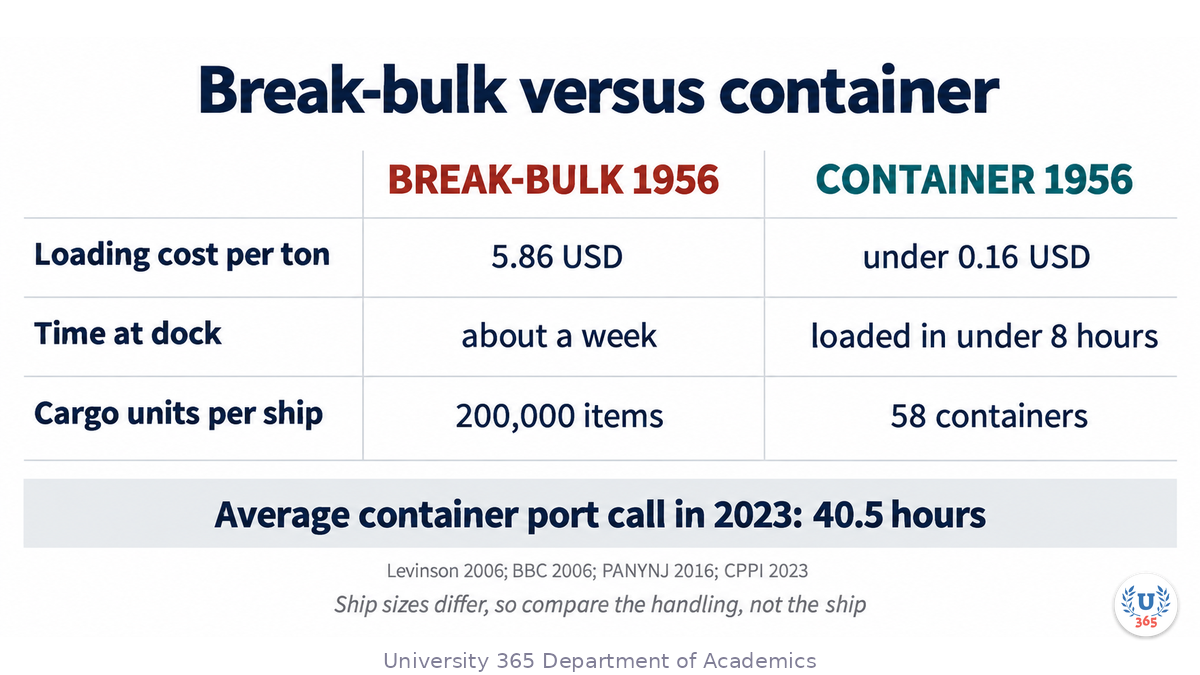
Before the box, most general cargo moved as break-bulk: cartons, bales, barrels and crates, each one handled on its own. A typical cargo ship in the 1950s might have 200,000 individual items to load, and a typical ship might spend a week tied up at dock (Levinson, BBC 2006). A ship earns money only when it is at sea, so the port was the expensive part of the journey.
The first voyage put a number on the difference. On 26 April 1956 the Ideal X, a converted T-2 tanker, left Port Newark with 58 containers. The crane placed one container on deck every seven minutes, and the ship was loaded in under eight hours (Port Authority of New York and New Jersey). Loading loose cargo onto an average ship cost about 5.86 US dollars a ton in 1956; loading a container ship cost just under 16 cents a ton (BBC 2006, reporting Levinson's figures). That is a fall of more than 97 per cent in the handling step.
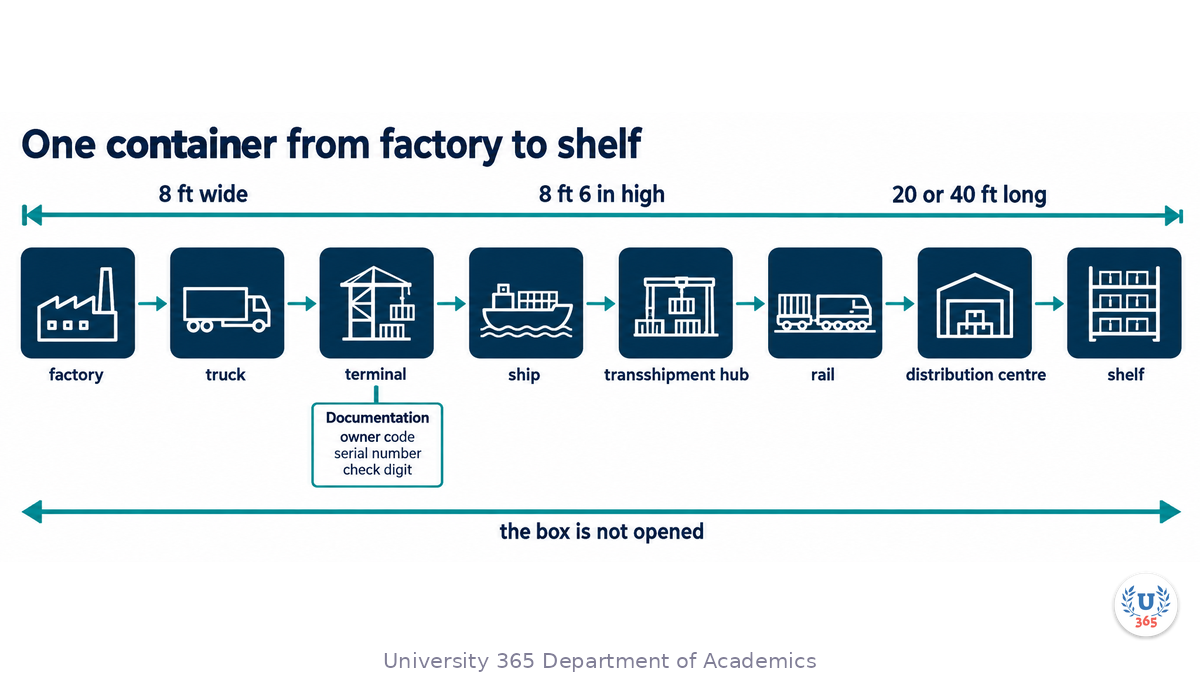
The unit of account follows the same decision. A twenty-foot equivalent unit, or TEU, is one 20 foot box; a forty-foot equivalent unit, or FEU, is twice the length. The standard 20 foot box measures 20 feet long (6.09 metres), 8 feet wide (2.4 metres) and 8 feet 6 inches high (2.6 metres), dimensions set by ISO (World Shipping Council). Port throughput and ship capacity are quoted in TEU, which is why a committee decision taken in the 1960s still sets the first number in every port statistics table.
The Fight Over Dimensions
The early boxes did not match. Sea-Land used 33 foot containers, then 35 foot, partly to fit the roads to its New Jersey base. Competitors in Latin America used 17 foot boxes for mountain roads. Matson, on the West Coast, used 24 foot boxes, partly because a larger box filled with canned Hawaiian pineapple would have been too heavy to lift (ISO, 2017, quoting Levinson).
Each size imposed its own handling equipment. A port or a shipping line had to commit to one maker's design, and the more designs there were, the less any of them saved. The problem was coordination, and coordination is what a standard supplies.
ISO technical committee 104, Freight containers, was created in 1961. The standard that came out of it, ISO 668, classifies series 1 containers by external dimensions and ratings, and covers minimum internal and door opening dimensions where they apply. It is now in its seventh edition, published in January 2020. Two lengths won in practice: ships generally carry a mix of 20 foot and 40 foot boxes, and most can also take 45 foot and 48 foot units on deck, with some able to carry 53 foot units (World Shipping Council). The standard 40 foot box is 12.192 metres long (ISO, 2017).
The pioneers did not win their own standard. McLean's patents were made available to ISO free of charge, which helped the standard spread (ISO, 2017). The commercial result is uncomfortable for the usual story: the box that rebuilt trade was not the best box, it was the box everyone could agree to handle.
Identity is the other half. Every container carries an identification number made of a three letter owner code, one category letter (U for a freight container), a six digit serial number and one check digit, marked in characters at least 100 millimetres high. Owner codes are registered by the Bureau International des Containers. The check digit is arithmetic rather than a database lookup, so any party can test whether the number it has been given is internally consistent (BIC).
What the Box Did to the Docks
The box removed labour from the most expensive point in the journey, and the union on the United States West Coast saw it coming. In 1960 the International Longshore and Warehouse Union signed the Mechanization and Modernization Agreement with the Pacific Maritime Association. Employers gained freedom to introduce labour-saving machinery and to remove restrictive work practices. The union gained no layoffs, a workforce that shrank from the top through voluntary early retirement, a share of the gains in wages and benefits, and an undertaking that machines would be used to lighten hard and hazardous work (ILWU).
The agreement held for a decade and then broke. In 1971 the membership voted 96.4 per cent for a strike, struck for 134 days, the longest coastwise longshore strike in United States history, and accepted the settlement by 71 per cent. The settlement included a Pay Guarantee Plan for registered longshoremen whose work had declined (ILWU). The dispute was about jurisdiction over the boxes and about whether the hiring hall would survive.
The job losses ran ahead of the bargain. Levinson records that Teddy Gleason, the New York dock union president, predicted containerisation would eliminate 30 per cent of his members' work; by 1976, 75 per cent had gone. The same shift moved the ports themselves. New York City spent well over a billion dollars in today's money between 1955 and 1966 rebuilding piers that were abandoned by 1970, and London dockers who boycotted containerships in 1968 found the ships calling at Felixstowe instead (Levinson).
The mechanism is not simply machines replacing people. Longshore bargaining power rested on the ship having to call at a particular port. A container ship could choose a site with road space, a crane and no restrictive work rules, so the port lost its negotiating position before it lost the work.
The ILWU bargain still mattered. It did not save the jobs, and its own members later judged it harshly, but it converted part of the saving into retirement, benefits and a pay guarantee that a purely defensive strategy would not have produced.
The Box That Rebuilt World Trade
The Feynman Summary
A container is a steel box that is the same size outside wherever it goes. Before 1956, general cargo went into a ship piece by piece: barrels, bales, cartons and crates, each one carried, stacked and counted by hand. A large ship might load 200,000 separate items, and it might sit at the dock for a week while the work went on.
The box changed the unit of work. A crane lifted one box instead of a hundred parcels, the ship loaded in hours, and the cargo travelled sealed, which reduced theft and damage as well as cost. The box only worked if every box was the same outside size, and in the beginning they were not. Sea-Land, Matson and their competitors each built a different length, and a port that invested in one could not handle another. A committee was created in 1961, standards were agreed, and the trade settled on 8 feet wide, 8 feet 6 inches high, and lengths of 20 and 40 feet.
The gain was real, and the cost fell on dock workers. The fight over who would handle the boxes lasted into the 1970s. The open question is not whether the box changed trade, but how much of the change belongs to the box and how much to the tariff cuts happening at the same time.
The Box That Rebuilt World Trade
The Evidence
The strongest quantitative evidence is the trade estimate. Bernhofen, El-Sahli and Kneller build a bilateral measure of container adoption from the year each country first handled containers at a port or on a railway, and apply it to product level trade flows for 1962 to 1990. In their benchmark specification for North-North trade, the concurrent effect is a 320 per cent increase in bilateral trade. The lagged effects add 232, 156 and 82 per cent over the next three five year periods, for a cumulative average treatment effect of 790 per cent over 20 years, which the authors report as larger than the effects they estimate for free trade agreements or GATT membership.
The cost evidence is weaker than its repetition suggests. The comparison of 5.86 dollars a ton against just under 16 cents is McLean's own calculation after the first voyage, as Levinson reports it. It measures the handling step on one route for one carrier, and it is not an audited price series across the industry.
The volume evidence is routine. UNCTADstat puts world container port throughput at 920 million TEU in 2024, growth of 6.9 per cent after two years at 0.6 per cent. The decade added 248 million TEU, or 37 per cent; ports in developing Asia handled 60 per cent of the total.
The time evidence comes from the World Bank and S and P Global Container Port Performance Index, which measures total container ship time in port. The average port call in 2023 lasted 40.5 hours, against 36.8 hours in 2022. Container ships spend about 15 to 20 per cent of their full rotation time in port, only 60 per cent of port time is cargo operations, and 3.71 hours per call was idle at the berth before and after cargo work.
What the evidence does not show is the world without the box. The trade estimate identifies an effect from adoption timing and assumes nothing else moved with it; the cost figure is one carrier's calculation; the port time figures compare ships of very different sizes. The direction is not in doubt. The size of the attribution is.
The Box That Rebuilt World Trade
The Counter-Case
The strongest competing reading is that the box arrived alongside changes it did not cause. Tariffs fell through the 1960s and 1970s under GATT, road and air freight became cheaper, and the countries that containerised first were often the countries liberalising first. Bernhofen and his colleagues include free trade agreement and GATT variables in their specification and still find larger effects for containerisation, but an estimate built on adoption dates cannot exclude the possibility that early adopters were already trading more.
The second objection is that the winning standard was the agreeable one rather than the best one. The 8 foot width follows the road network the box had to travel on, not an optimum for ships. The 40 foot length was not the length either pioneer used. A different committee, or different road rules, would have produced a different series 1 and a different cost curve.
What would settle the question is a long-run series of freight cost per ton that separates the handling step from the sea leg on several routes, together with a case where a port received containers years before its trading partners did. Neither is available in public form, so the direction is established and the magnitude is estimated.

The Box That Rebuilt World Trade
What It Means for You
Career and Finance is the domain this reaches. A standard is a price term. It decides which supplier can bid, which machine can be used and who carries the cost of a change. Once you see the container as a fixed outside dimension that a committee chose, you can ask the same question about the things you buy: what size is fixed, who fixed it, and what would have to change for a cheaper alternative to fit.
The labour lesson is the second. The box did not simply remove dock jobs. It moved the decision to a place where the union had less bargaining power, and the union that bargained early converted part of the saving into retirement, benefits and a pay guarantee. When a technology removes a handling step in your own work, the question to prepare for is not whether it will happen, but who captures the saving and on what timetable.
LIPS places this in the Interests pillar while it stays understanding. If you review your own suppliers or your industry's standards, it becomes a project with a date and an owner. This brief follows the pattern described in the Interests method page, which explains how a subject like this becomes a brief you can use.
Name one fixed size Pick a product you buy often and find the standard that fixes its size or format; the answer is usually a committee, not a law.
Ask what a saving removes When a supplier promises a lower cost, ask which handling step disappears and who is paid for it today.
Test before you type If you handle container numbers, check the check digit before the number reaches your system; it catches the common transcription error without a lookup.
The Applied AI Connection
The container number is the part of the standard that software can check. Every box carries an ISO 6346 code: a three letter owner code, a category letter, a six digit serial number and a check digit computed from the other characters. Reading that code at a terminal gate used to be a manual job that produced transcription errors. The current route is a camera plus a deep learning pipeline that locates the code on the container and reads the characters, and the check digit then tests the reading arithmetically. A 2025 scoping review catalogues 63 empirical studies of computer vision for container, semi-trailer and swap body identification between 1990 and 2025, and finds deep learning now dominant (arXiv 2509.17707).
The same review is the reason to ask for a number rather than a demonstration. Reported end to end accuracy ranges from 5 to 96 per cent, because the field has no public benchmarking datasets and every study tests on its own camera positions, lighting and weather. If you specify or audit a terminal, ask for the exact match rate on ISO codes measured at that gate, by day and by night, and for the fallback process when the check digit fails. That is the difference between a gate that reads boxes and a gate that reads most boxes.
The Box That Rebuilt World Trade
The Five-Minute Version
The object. A series 1 container is 8 feet wide and 8 feet 6 inches high, and the working lengths are 20 and 40 feet. A 20 foot box is one TEU and a 40 foot box is one FEU (ISO, 2017; World Shipping Council).
The saving. Loading loose cargo onto an average ship cost about 5.86 US dollars a ton in 1956; container loading cost just under 16 cents a ton. The box eliminated as many as twelve separate handlings (BBC 2006; Bernhofen et al., quoting Containerisation International 1970).
The first voyage. On 26 April 1956 the converted tanker Ideal X left Newark with 58 containers, one placed on deck every seven minutes, loaded in under eight hours and bound for Houston (PANYNJ).
The fight. Sea-Land used 33 and 35 foot boxes, Latin American operators 17 foot, Matson 24 foot. ISO technical committee 104 was created in 1961 and ISO 668 fixed the dimensions.
The labour. The ILWU signed the Mechanization and Modernization Agreement in 1960, struck for 134 days in 1971. 75 per cent of New York dock jobs had gone by 1976, against a predicted 30 per cent (ILWU; Levinson).
The measurement. Ports handled 920 million TEU in 2024. On North-North trade the concurrent effect is estimated at 320 per cent, and the cumulative effect over 20 years at 790 per cent (UNCTADstat; Bernhofen et al.).
If you remember one number, remember 16 cents a ton. If you remember one judgement, remember that the design that won was a compromise, and that the saving arrived anyway.

The Box That Rebuilt World Trade
Sources
Every source below was opened and read on 20 October 2026. Where a publisher blocks automated reading, the link goes to an archived copy.
Levinson, How a box transformed the world, Financial Times (24 April 2006). marclevinson.net
BBC News, Thinking inside the box (25 April 2006). news.bbc.co.uk
Port Authority of New York and New Jersey, Port Newark: How Malcom McLean Changed the World (27 April 2016). portfolio.panynj.gov
ISO, Boxing clever: how standardization built a global economy (11 September 2017), archived copy. web.archive.org
ISO 668:2020, Series 1 freight containers, ISO catalogue page, archived copy. web.archive.org
Bureau International des Containers, Container identification number. bic-code.org
UNCTADstat, Container port throughput, data updated 15 April 2026. unctadstat.unctad.org
Bernhofen, El-Sahli and Kneller, Estimating the effects of the container revolution on world trade, GEP Research Paper 2013/02. nottingham.ac.uk
World Bank and S and P Global, The Container Port Performance Index 2023. documents1.worldbank.org
World Shipping Council, Glossary of shipping terms, and Container and Roro ships. worldshipping.org glossary and container ships
International Longshore and Warehouse Union, The ILWU Story. ilwu.org
Automatic Intermodal Loading Unit Identification using Computer Vision: A Scoping Review, arXiv 2509.17707 (2025). arxiv.org




Comments