
TickClip: buyer-first product verdicts, and the vendor's own documents disagreeing about how they are paid for

Status: Active | Last tested: 2026-09-25 (TickClip against methodology version tickclip-verdict-v2 dated 2026-09-22, on a methodology page the vendor last reviewed 2026-09-10, with the terms of service and privacy policy dated 2026-06-20) | Re-check: trigger-based (max 6 months)
Active: the tool is current and recommended.
What Active means here. Active means current and recommended for the reader this review describes: a buyer checking a mid-range purchase against the product's own trading history before spending, who will read the confidence figure and re-run the verdict before acting. It does not mean the verdicts are measured. No accuracy figure for them exists on any vendor surface or any third-party surface, and the vendor's own methodology states that its confidence percentage measures coverage rather than the likelihood that a verdict is right. The product is also weeks old rather than years old, its coverage is one retailer, and the two documents governing its commercial relationship do not say the same thing. A reader who needs a measured reliability guarantee, a second retailer, or a decision they can stand behind in writing a month later should treat those as not currently available and act accordingly. Section 7c is where the commercial finding sits.
For detailed explanations of the CI-First evaluation terms used in this review, including the Humics Protection Badge and the AI Imposture Risk levels, see the Glossary at the end of this post.


In this Tool Review
Status and Re-check
Re-check triggers:
Publication of any figure for verdict accuracy. No accuracy figure for the verdicts exists at the time of writing, on any vendor surface or on any third party surface. The methodology page states plainly that its confidence percentage measures coverage and not the likelihood that a verdict is right. That absence is the reason the Quality sub-score is capped, and a first published accuracy figure, measured on a stated sample, would move it.
A change to the affiliate position on any surface. The vendor's marketing pages state in the present tense that TickClip earns no affiliate commission from retailer links. The terms of service reserve the right to earn one. If the marketing sentence changes, or if the terms clause is exercised, the independence finding in Section 7c needs to be re-read and the reader's calculus changes.
Restoration of the editorial independence policy. The vendor's structured data names an ethics policy address on every page, and the about page invites the reader to read an independence policy. Both addresses that carry that invitation currently resolve to the site's own not-found page. Publication of a live policy, or of a commercial-relationship statement that replaces it, is a re-check trigger.
Publication of a price, a paid tier, or any other stated revenue source. The product is free, no account is required, no rate card exists, and no revenue source is declared anywhere. What pays for the service is currently unstated, and a stated business model would resolve that.
A change to the data dependency or the coverage list. Price history and tracked lows come from a third party, and coverage is Amazon products identified by ASIN. If a second retailer is added, or if the third-party price source changes, the Price and Timing dimensions and the coverage claims should be re-scored.
A change to the review-integrity method. The vendor states it infers review integrity from aggregate rating and rating-count series and that it does not read individual review text and does not claim to detect fake reviews, while its marketing pages offer a review checker. If the method changes, or if the marketing wording is tightened to match the methodology, the Limits section changes.
A resolution to the two live defects reported publicly at launch. A public launch thread records a reported price display defect and a reported discrepancy between the no-affiliate claim and the links on a verdict page. The vendor acknowledged the defects and committed to fixing them without disputing the substance. If the verdict pages are re-checked and confirmed clean, this trigger closes.
A first independent evaluation of verdict quality. The only independent benchmark found measures the website's production readiness, not its decisions. One 2026 directory entry describes a launch without independent assessment. A first accuracy study, or a first substantial review corpus, belongs in the next re-check.
The TickClip scope, stated before the review begins
Two things about TickClip are easy to get wrong from the marketing pages alone, and both change what the tool can be used for.
First, the coverage is one retailer, and the verdict vocabulary is narrower than the slogan suggests. The methodology page states that coverage today is Amazon products identified by ASIN, that other retailers are not yet analysed, and that the site will say so rather than guess at a store it cannot check. On the day this review was written, the vendor's own sitemaps listed 1,010 verdict pages and 294 brand pages. Tick: buy now. Clip: wait, watch the price, or gather more evidence. Skip: the evidence indicates poor value or material risk. There is no fourth verdict for "this is a good product at a bad price from an unknown seller", and you should read the three words as answers to the question "should I buy this, now, on these terms" rather than as any judgement about the product itself.
Second, TickClip is not a review site and does not pretend to be one. Its own about page says so directly, and the site's structured data describes it as a buyer-first shopping decision service. What it does not do is read customer review text. The methodology states that review integrity is inferred from aggregate rating and rating-count series, that individual review text is not read or classified, and that it does not claim to detect fake reviews. The marketing pages offer a review checker that flags signals worth a closer look, and that is a narrower promise than the name suggests. Read the two together and the tool is a price-and-timing instrument with a review-signal warning light, not an authenticity service.
The naming trap. Searches for the product name meet a crowded field of unrelated software: Tick, TickTick, Tickkl, Tickkle, Tickr, Tick, Clip and Skip is also the name of the vendor's own verdict language rather than of a separate product, and a large volume of YouTube content carries the words "tick clip" for reasons that have nothing to do with shopping. The vendor's own brand surface is small: one website, one account on X, and no video channel. When you search for evidence about this product, search for the domain and for the founder's name rather than for the product name.
The honest summary of provenance. TickClip is a young product. Its published methodology was first dated 2026-08-13, its methodology page was last reviewed 2026-09-10, its current scoring version tickclip-verdict-v2 is dated 2026-09-22, and one directory records it as shipped 2026-08-23. A public launch thread on Hacker News was posted roughly forty five days before this review. That is a few weeks of operating history on a tool whose only output is a judgement, and it is the context for every score below.
Tool Snapshot
TickClip (tickclip.ai)
Tagline: "Buyer-First Product Decisions" and, on the application surface, "AI Product Verdict: Tick, Clip, or Skip?" (tickclip.ai, read 2026-09-25.)
Category: Decision-support tool with an agent surface. A cloud service that takes a product link, an ASIN, or a description of what you need, collects price history, marketplace rating signals and seller observations, scores four dimensions against published thresholds, applies four published override rules, and returns one verdict with a score and a confidence percentage. It also exposes public verdicts to AI clients through a read-only MCP surface. The vendor's own framing is a fiduciary decision layer for shopping.
Business model, as stated: Free, no account required. The vendor states on its homepage, its about page, in its FAQ and in its page footer that it currently earns no affiliate commission from retailer links and does not sell placement. The terms of service state that the vendor may use affiliate links and may earn a commission on purchases made through them. Both statements are live on the same site. See Section 7c.
Founder and provenance: Tarik Aarbaoui, who describes himself in the product's public launch thread as an affiliate and influencer marketing specialist of fourteen years, and who states that the conflict he observed in that work, that the people recommending products are usually only paid when a purchase happens, is what he built TickClip to remove. That origin story is the strongest single argument for the product's premise, and the founder's own professional history is also the reason the affiliate question in Section 7c deserves a section of its own.
Methodology version: tickclip-verdict-v2, dated 2026-09-22, stamped on every published verdict. The result ordering is versioned separately as tickclip-ranking-v1, dated 2026-09-11.
Platforms: Web application at tickclip.ai/app, plus a verdict site with 1,010 published verdict pages and 294 brand pages in the vendor's own sitemaps, a deals page, a guides library, an MCP surface for AI clients, and an API documentation page.
Pricing: Free. No rate card, no subscription page, and no paid tier is published. The pricing address resolves to the site's own not-found page, and no vendor document describes a charged product.
Primary use cases:
Checking whether an advertised Amazon discount is real against the product's own 90-day and 30-day price history.
Deciding whether to buy now or wait, when the answer depends on where today's price sits in the product's own range.
Screening a product whose review signal looks wrong: thin sample, sudden growth in review count, or a rating shift that does not match the history.
Sanity-checking a basket of pending purchases against a consistent standard rather than a feeling.
Teaching the underlying checks. The guides library covers fake discounts, price-history reading, review-velocity red flags, anchor pricing and cost per use.
Not built for: anything outside Amazon, anything requiring an assessment of whether the product itself is good, anything you need to stand behind later as a documented decision, and any workflow where a verdict is treated as durable. Every verdict carries an expiry, and the price signal behind it expires in three days.
Key limitation, in the vendor's own words: "Confidence is a statement about coverage, not about how likely the verdict is to be right." No accuracy figure for the verdicts is published.
At a Glance Dashboard
Field | Value |
Tool | TickClip |
Vendor | TickClip (tickclip.ai), founder Tarik Aarbaoui |
Category | Decision support and verdict agent for consumer purchases |
CI-First Profile | Primary: Analyst and Tester (level 4). Secondary: Co-Worker and Assistant (level 2) |
Collaboration Mode | Centaur |
CI-First Benefit Score | 5.3 / 10 (CI-First Positive) |
Humics Protection Badge | Humics-Neutral (-1 / +3) |
AI Imposture Risk | Medium overall (Skill Illusion High, Time Illusion Medium, Quantity Illusion Low) |
Status | Active |
Pricing | Free, no account. No rate card published |
Coverage | Amazon products identified by ASIN |
Price data source | Third-party marketplace price history, named on the methodology page |
Stated revenue source | None declared. Affiliate commission denied in the present tense and reserved in the terms |
Independent evaluation of verdict quality | None found |
Framework v1.2 clause outcomes | 5.2.3-a null (argued boundary), 4.2-a null, 7.5 null |
The Problem
You are about to spend money on an Amazon product, and every surface you can consult is optimised for a different question than the one you are asking.
The product page answers "what is this and what does it claim to do". The star rating answers "how did the last few thousand buyers feel". The struck-through price answers "what does the seller want me to compare this against". None of them answers the question you actually have, which is whether this purchase deserves your money today, on these terms, from this seller, and whether waiting would serve you better.
Four specific problems follow, and each of them is a known feature of the retail interface rather than a fringe complaint.
The discount is usually a claim, not a measurement. A struck-through list price, a percentage badge and a countdown timer are seller-side statements. A price raised in the weeks before a sale and discounted back to where it started produces a large percentage off and no saving at all. The information that would settle it, the product's own trading history, exists but is not on the page.
Review evidence is a number with no history. A 4.4 average from 87 ratings reads the same on the page as a 4.4 from 4,000, and a rating that climbed quickly in a short window reads the same as one that was earned over years. The signals that make a rating worth less than it appears are in the count and its movement, not in the average.
Seller and offer context sit outside the product. The same product can be sold by several sellers at different prices with different fulfilment routes and different return paths, and a listing that looks identical can be a materially different transaction depending on who is behind it.
The effort of checking is real, and it is why most people do not. Reading a price history chart, comparing two windows, and inspecting a review-count series takes time you will not spend on a twenty dollar item, which is exactly the purchase where the effort would matter most.
Tools exist for the price half of this. Price-history trackers show you the chart and leave the judgement to you. Nothing widely used offers a decision with its evidence attached and its uncertainty stated, which is the gap TickClip was built to fill.
The Outcome
TickClip turns the question into one of three answers, and it does so in a way that is unusually well documented for a product of this age.
What you get, concretely. You paste a product link, an ASIN, or a description, with no account. You get one verdict, Tick, Clip or Skip, a decision score from 0 to 100, a separate confidence percentage, the price facts behind the call (today's price against the 90-day average, and the distance to the tracked low), and, where the vendor holds one, a verified promo code. Every verdict carries the methodology version that produced it, the expiry it was given, and the reasons that shortened that expiry.
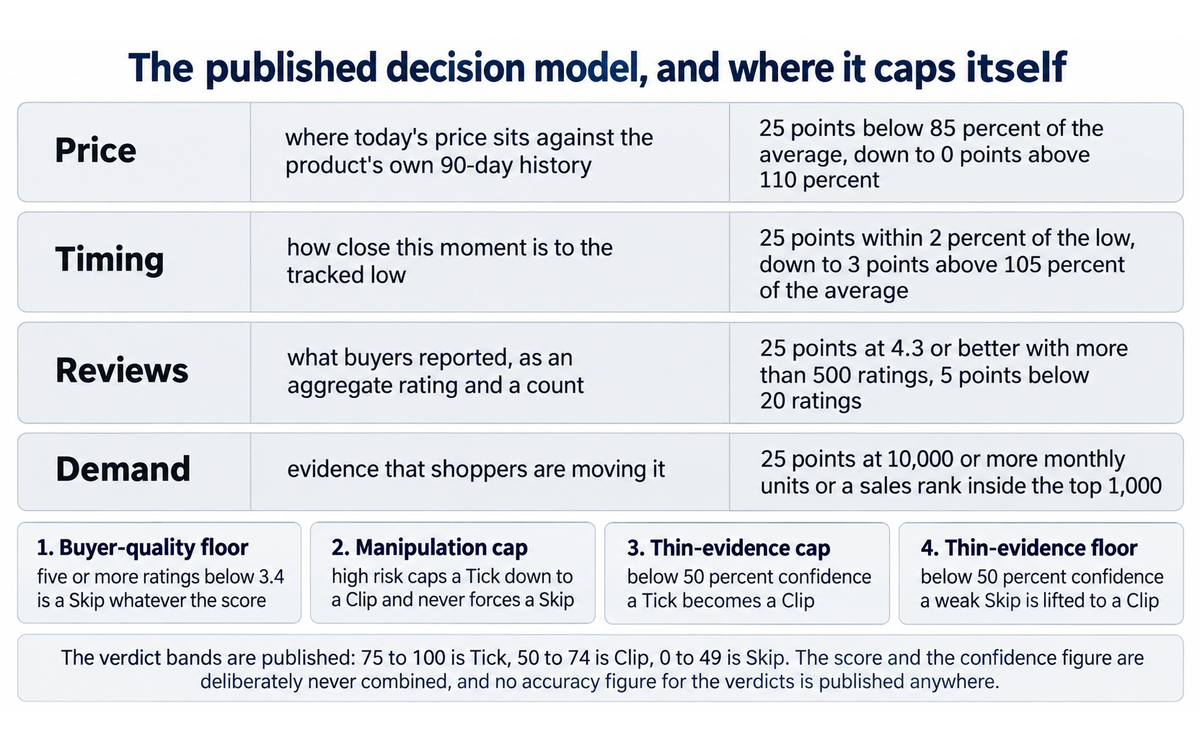
The decision quality is the point, and it is traceable in principle. The score is built from four dimensions scored 0 to 25 each: price position against the product's own history, timing against the tracked low, the rating and rating-count series, and demand evidence from monthly units or sales rank. The bands are fixed and published: 75 to 100 is Tick, 50 to 74 is Clip, 0 to 49 is Skip. Four override rules sit on top of the bands, and they are the most interesting part of the design because all four push toward the middle rather than the extremes. A product with five or more ratings averaging below 3.4 becomes a Skip regardless of score. High manipulation risk caps a Tick to a Clip and never forces a Skip, on the stated reasoning that a flag is suspicious activity rather than proof. A verdict below 50 percent confidence has a Tick capped to a Clip and a Skip earned purely by a low score lifted to a Clip. The fourth rule is stated as a principle: thin evidence moves a verdict toward the middle, never out of it.
Uncertainty is kept visible rather than averaged away. The score and the confidence are deliberately not combined. The methodology states that a 90 with 45 percent confidence and a 90 with 100 percent confidence are different situations, and that averaging them would hide the difference. Missing inputs cost confidence rather than score, and a dimension with no measurable evidence is given zero weight rather than a zero score, with its weight shared across the dimensions that were measured. Absence of evidence is treated as absence of evidence throughout: a product with no rating is excluded from a rating average rather than dragging it down, a malformed price is rejected, a discount is not calculated at all when the reference price is missing or below the current price, and a rate computed over too few records returns an insufficient-data statement rather than a number.
The published limitations are real and unusually candid. Price history depends on a third party. Review integrity is inferred and individual review text is not read. There is no access to returns, defect rates or warranty outcomes. Manipulation flags are signals rather than findings. Demand estimates are estimates. And a verdict is about a moment, which is why every one carries an expiry.
What it does not solve. It cannot tell you whether the product is any good. It cannot tell you whether a review is fake, only whether the rating series looks unusual. It cannot see a second retailer. It cannot give you a decision you can defend in writing a month later, because the verdict expires. And no independent measurement of whether its verdicts are right exists, so the traceability of the reasoning is not the same thing as evidence that the conclusion is sound. Holding those two apart is the work this review asks of you.
Who Should Use TickClip
Fellows and students buying kit on a budget. The common case is a purchase between thirty and three hundred euros where the difference between buying today and waiting three weeks is a real fraction of the price. TickClip answers that question in one paste, and the price facts it shows are the ones a careful buyer would otherwise have to assemble from a chart.
Researchers and staff building or checking a procurement judgement. Not for institutional purchasing, where you need a documented evaluation rather than a verdict, but for the pre-work: establishing quickly whether a quoted discount is real before a purchase request is written.
Anyone who teaches how offer framing works. The guides library is a usable teaching resource on fake discounts, anchor pricing, review velocity and cost per use. It is free, requires no account, and it explains mechanisms rather than results. For a U365 Fellow studying persuasion, retail design or consumer financial behaviour, this is the part of the product with the clearest educational value.
Institutions that need a documented decision. TickClip is the wrong layer on its own. Its verdicts are explicitly informational estimates generated from available data, its terms disclaim any guarantee of outcome, and every verdict expires. It is an input to a documented decision, not a substitute for one.
Anyone outside Amazon. The coverage statement is explicit, and the site says it will not guess at a store it cannot check. A reader buying from a European retailer, a manufacturer direct, or a marketplace outside Amazon gets nothing from this tool today.
Anyone who needs the answer to be durable. If the purchase decision will be revisited next month, the verdict will have expired and the price signal behind it certainly will have. Re-running it is the correct habit, and the vendor built the freshness system to force that habit rather than to hide it.
U365 Institutes Alignment
Institute | Rating | Why, stated as the competency that remains | The limit that holds the row |
UIT (Technology, AI, Data Science) | High (primary) | The competency is appraising a machine decision system against its own published specification. The Fellow has to read four weighted dimensions with named bands, four override rules with their stated reasoning, a confidence formula with named deductions, a source hierarchy with a trust order, a publication gate with two condition lists, per-signal freshness windows and a version identifier on every output, and then say what the model does and does not claim. The decisive competency is the separation of a coverage figure from a correctness figure: the vendor states that its confidence percentage measures how much evidence sat behind a verdict and not how likely the verdict is to be right, and a Fellow who can hold those two apart is doing evaluation work that transfers to every other system that returns a conclusion. The read-only MCP surface over a live verdict corpus is the second, smaller contact: a documented callable interface to published decisions. No published U365 programme assesses decision-model appraisal or confidence semantics, which the mapping table below records | The product is a read-only surface. There is no SDK, no model access, no configuration, no training path and no evaluation surface, and the review records no independent measurement of the verdicts from any source, so a technology cohort cannot build, instrument or measure anything on this product. The published model is the teaching artefact, not the engineering. The row stands at High rather than Medium because the published specification is more complete than any comparable consumer product in this series, which is a real reason to study it and not a reason to build on it |
UIB (Business Management, Entrepreneurship) | High | Three competencies, all of them costable or readable from a published record. The first is price and offer appraisal: reading a price position against the product's own trading history rather than against a seller's reference price, and refusing a struck-through number as a measurement. The second is cost per use against a stated threshold, which is the arithmetic the review's third workflow asks for. The third is reading an incentive structure: the vendor states on four surfaces that it earns no affiliate commission from retailer links while its terms reserve the right to, and the independence policy its own structured data points at resolves to a not-found page. Deciding what has to be answered in writing before advice on your money is trusted is a management decision, and the Fellow makes it by reading two published documents against each other. Every one of the three survives the removal of the tool, and this is the first review in the series where the business content is the product's subject matter rather than a by-product of it. That is why this row is High here while the UIB rows on the media and avatar reviews are Medium | The tool teaches no management, finance, entrepreneurship or leadership content of its own, and it produces nothing a business cohort could be assessed on. A verified term search over all 79 published programme descriptions returned zero matches for pricing, promotion, discount, offer construction, financial literacy, personal finance, budget, procurement, supplier, vendor and total cost of ownership. The nearest verified teaching is the marketing group, whose published modules cover market research and the customer decision journey, and neither is an assessment home for consumer price literacy. The row is High on subject-matter fit and on coursework, and no credential outcome stands behind it |
UIC (Digital Communication, Marketing) | Medium | The competency is judging a commercial claim against the contract that governs it, and stating what an audience is owed. The review's Section 7c puts four vendor surfaces that deny affiliate commission beside a contract clause that reserves the right to earn it, and the section states plainly that the two can both be live. A Fellow reading that is practising the disclosure judgement a communication professional makes: whether a recommendation may be paid for without saying so, and what a reader is owed when the answer is unclear. The vendor's own guides on discount framing and review velocity are usable mechanism material for the same session | The tool builds no brand voice, no audience analysis, no campaign craft and no editorial judgement, and the vendor's origin story is an account of the industry rather than a communication competency the Fellow gains. No published U365 programme assesses recommendation ethics or disclosure practice, and the catalogue term search returns zero matches for disclosure, conflict of interest and persuasion. No UIC credential chain is mapped on this tool, and the mapping table below states the verified reason. The rating is Medium rather than High because the competency is exercised by reading two documents rather than by producing a communication |
UID (Digital Design, UX/UI) | Low | A design-cohort reading, not a design competency. A Fellow can read the buyer-side persuasion devices the review names, which are a discount badge, a countdown, a struck-through price and a review counter, and can read the verdict page as an example of a recommendation presented with its uncertainty attached. Both are evaluation of an interface the Fellow did not make, and the second one is worth the reading because most systems present a conclusion without its confidence beside it. The competency that remains is interface criticism with a stated basis | Nothing in the UID competency set is exercised as a design act. The product evaluates no design against a brief, offers no design surface, no template control and no editable artefact, and returns a verdict rather than a designed object. The row is Low because a single reading contact, with no design decision and no artefact, is not enough to carry Medium, and because a rating that rests on the appeal of the subject rather than on the work the Fellow does would misstate what remains with them. No UID credential chain is mapped, and the row is published so the judgement is visible rather than left silent |
The sentence that holds across all four rows. No institute in the U365 system should adopt TickClip as a taught or institutional tool, and the reason is that its output is one word with an unmeasured core. The teaching value is in the reading: a decision model published end to end, a price claim tested against the product's own history, and two documents about the same commercial relationship that do not say the same thing. The primary institute is UIT, and it is primary because the published specification is the part of this product a Fellow can study line by line.
Tool to Skill to Credential
Tool skill | U365 competency | Credential (verified published programme) | Institute | Published next step |
Reading a price position against the product's own trading history, and refusing a seller's struck-through reference price as a measurement | Price and offer appraisal against a published record | Financial Analysis Specialist, 30 days, diploma, verified published 2026-09-25. Its published programme covers the dissection of financial statements, financial modeling, forecasting, economic statistics and analytical evaluation | UIB (Business Management, Entrepreneurship) | Associate of Business Administration (A.B.A.) 1/2 and 2/2, then Bachelor of Business Administration (B.B.A.), then Master of Business Administration (M.B.A.) 1/2 and 2/2 |
Reading a rating series by its count and its movement, and stating an inference as an inference rather than as a finding | Statistical reading of a data series, and evidence discipline | Data Analyst Expert, 84 days, diploma, verified published 2026-09-25. Its published programme covers statistics essentials, data analytics foundations, data fluency and critical thinking, and its public module list is the one U365 publishes for analytical work | UIT (Technology, AI, Data Science) | Associate of Science in IT (A.Sc.) 1/2 and 2/2, then Bachelor of Science in IT (B.Sc.), then Master of Science in IT (M.Sc.) 1/2 and 2/2 |
Telling a coverage figure from a correctness figure, and saying what a confidence number does not measure | Probability and measurement interpretation | Data Scientist, 60 days, diploma, verified published 2026-09-25. Its published programme covers statistics, probability, storytelling, data governance and data fluency, and probability is the published module closest to what a confidence percentage is not | UIT (Technology, AI, Data Science) | Associate of Science in IT (A.Sc.) 1/2 and 2/2, then Bachelor of Science in IT (B.Sc.), then Master of Science in IT (M.Sc.) 1/2 and 2/2 |
Writing a buying standard down as a threshold with stop conditions, and defending it as your own rule | Requirements precision and benefit specification | Business Analysis Professional, 60 days, diploma, verified published 2026-09-25. Its published programme covers business analysis foundations, agile requirements, business benefits realization and business process modeling | UIB (Business Management, Entrepreneurship) | Associate of Business Administration (A.B.A.) 1/2 and 2/2, then Bachelor of Business Administration (B.B.A.), then Master of Business Administration (M.B.A.) 1/2 and 2/2 |
Reading a purchase decision journey and how an offer is framed to be believed, including a discount claim that is not a measurement | Consumer decision journey and offer framing | Digital Marketing Assistant, 28 days, diploma, verified published 2026-09-25. Its published programme covers marketing foundations, SEO foundations, content marketing, social media marketing, analytics and ecommerce, and the customer decision journey. Customer Decision Journey and Analytics and Ecommerce are the two published modules that carry this competency | UIC (Digital Communication, Marketing) | Associate in Communication & Marketing (A.C.) 1/2 and 2/2, then Bachelor in Communication & Marketing (B.C.), then Master in Communication & Marketing (M.C.) 1/2 and 2/2 |
Judging a recommendation business by its published contract, and deciding what must be answered in writing before advice on your money is trusted | Vendor and counterparty appraisal, and conflict-of-interest reading | No U365 credential. No published programme assesses vendor appraisal in a recommendation business. Recorded here as a curriculum gap. The nearest verified material is the marketing group for the customer decision journey, and it publishes no counterparty outcome | None asserted, because no credential is attached |
The transferable discipline across the five chains is the one the review itself names at the end of Section 13: given any system that returns a conclusion, ask which inputs produced it, what the confidence figure actually measures, and what the system states it cannot see. That habit is what transfers, and it is assessment work rather than tool operation.
All five chains lead into a degree: two into the business ladder, two into the information technology ladder and one into the communication and marketing ladder. The degree outcome in all five of them is open to SUPERHUMAN Fellows only, so the degree pathway should not be read as available to every Fellow.
The sixth row carries no credential, because U365 publishes no programme that assesses vendor and counterparty appraisal in a recommendation business. Attaching a plausible programme name to that competence would inflate the academic claim and would mislead a Fellow about where the skill is assessed. The row publishes the gap rather than dropping it. Three gaps are recorded against this tool, each verified by term search rather than by reading titles: consumer price and offer literacy; decision-model appraisal and confidence semantics; and vendor and counterparty appraisal in a recommendation business. The nearest published teaching in each direction is the marketing group on the customer decision journey, Statistics Essentials in Data Analyst Expert and the probability module in Data Scientist, and Financial Analysis Specialist, and none of those is presented here as an assessment home for the competency the gap row names.
How TickClip Works
This section is the core of the review, because a tool whose entire output is a judgement lives or dies on whether that judgement can be traced. TickClip publishes more of that trace than almost any consumer product in its category. What follows is what the vendor states, on its own methodology page, that the software actually does.
The architecture, as published
One decision, two measurements. Every verdict carries a decision score from 0 to 100 and a separate confidence percentage. The score describes how good the evidence looks. The confidence describes how much evidence there was. The vendor states that the two are deliberately not combined, and the reasoning it gives is sound: an 85 at 40 percent confidence and an 85 at 100 percent confidence are different situations, and one number would hide that. Amazon's own customer rating is kept as a separate 1 to 5 marketplace value and is never presented as TickClip's score.
Four scored dimensions, each worth 0 to 25.
Dimension | What it reads | Best and worst bands as published |
Price | Where today's price sits against the product's own history | 25 points below 85 percent of the 90-day average; 15 points within plus or minus 5 percent of it; 5 points above 105 percent; 0 above 110 percent |
Timing | How close this moment is to the floor | 25 points within 2 percent of the tracked low; 20 within 10 percent; 10 by default; 3 points above 105 percent of the 90-day average |
Reviews | What buyers reported | 25 points for a rating of 4.3 or better with more than 500 ratings; 20 for 4.0 or better with more than 100; 15 for 3.8 or better with more than 50; 5 points when there are fewer than 20 ratings; 0 for a rating below 3.5 with more than 50 ratings |
Demand | Evidence that shoppers are moving it | 25 points for 10,000 or more monthly units, or 22 for a sales rank inside the top 1,000; falling to 5 points below 50 monthly units or below the top 50,000 |
Weighting is by evidence, not fixed. A dimension the software could not measure carries zero weight, and the weight it would have carried is shared evenly across the dimensions that were measured. The published score is therefore the share of what was measurable, which keeps two products comparable when one has four dimensions of evidence and another has two. The vendor states the reason for doing it this way: a dimension with no evidence should cost confidence, not score, because charging it to the score twice would punish a product for TickClip's own data gaps.
Every number is anchored to the product's own history rather than to the seller's claim. An advertised discount earns no points anywhere, and the methodology states the reason in one sentence: a struck-through list price is a claim by the seller, not a measurement. Where a 90-day average is unavailable, a listing with at least 30 distinct days of TickClip's own tracked prices inside the last 180 days is scored on the same bands using the median of that record, and the site labels it as what it is rather than calling it a 90-day average or an all-time low.
Four override rules sit above the bands.
Buyer-quality floor. Five or more ratings with an average below 3.4 is a Skip regardless of score, on the reasoning that a large discount on a product buyers dislike is still a bad purchase.
Manipulation cap. High manipulation risk caps a Tick to a Clip and never forces a Skip, because a flag is suspicious activity rather than proof.
Thin-evidence cap. Below 50 percent confidence, a Tick is capped to a Clip, on the reasoning that below that line at most one independent signal sits behind the score.
Thin-evidence floor. Below 50 percent confidence, a Skip earned only by a low score is lifted to a Clip, because a low score on thin evidence is not proof that the product is bad. The Skip stands when the buyer-quality floor applies or when high manipulation risk sits on top of the weak score.
The fourth rule is the one to notice. A tool designed to sell a verdict would not have a rule that makes a negative verdict harder to reach. This one does, and it states the reason.
Confidence is a coverage percentage with published deductions. It starts at 100 and is reduced for each missing input: 20 for no 90-day average, 15 for no 30-day average, 15 for no tracked all-time low, 10 for fewer than 20 ratings, 5 for no sales rank and no monthly-sales estimate. Where a listing is scored on TickClip's own tracked record, that record stands in for the 90-day average and the tracked low, so those deductions do not apply. The vendor states the limit of the measure directly: "Confidence is a statement about coverage, not about how likely the verdict is to be right." That sentence is the most honest line on the site and it is also the reason this review's Quality score is capped.
The data inputs and the order in which they are trusted
The methodology publishes a source hierarchy, and it is worth reproducing because it answers the question a reader will ask about where the numbers come from.
Marketplace price history from a third-party service, named by the vendor as the source of current price, the 30-day and 90-day averages, the tracked all-time low, list price, offer counts, Buy Box and seller observations, sales rank and monthly sales estimates. The vendor calls this measured history and the strongest evidence it holds.
Marketplace aggregate ratings. Described as third-party aggregate data rather than the vendor's own testing.
Retailer-published product data. Title, images, brand, category, availability.
TickClip's own derivations. The score, the price facts and the decision, computed from the above.
Community mentions, where shown. Labelled as third-party opinion, linked to the source, and never mixed into structured marketplace data.
The rule attached to the hierarchy is that a higher-numbered source never overrides a lower-numbered one, so a community post cannot move a price comparison.
What is done about data that is missing, duplicated or contradictory
Four published behaviours, and they are the part of the methodology a sceptical reader should read first, because each of them is a decision that could have gone the other way.
Missing values are excluded from every average rather than counted as zero.
A zero price, a negative price or a malformed price is rejected, so it cannot move an average or produce a discount.
A discount is not calculated at all when the reference price is missing, zero or below the current price, and a price rise is never shown as a negative saving.
A rate computed over too few records returns an insufficient-data statement rather than a number, on the stated reasoning that below the minimum sample there is no percentage to show and that zero percent would be a different claim entirely.
Duplicate handling is stated as an identity rule: a product is the unit and a listing is not, one product sold by five sellers is one product and five listings with the two counts labelled separately, and rows are de-duplicated on the ASIN, the internal product ID and the public verdict ID at once. Amazon variants resolve to the canonical parent so that colour and size variants do not each become a separate verdict.
Publication is gated. A verdict is computed for every product analysed and published only after passing a gate. Six conditions block publication outright: no usable price, no product title, unresolved product identity, no product image, an implausible discount where a struck-through price is more than 20 percent above what the product has actually been trading at, and an internal contradiction between the verdict and its own stated evidence. Six other conditions are recorded but do not block publication, and the vendor states the reasoning: a non-US currency or marketplace, a variant child, thin price history, a small review sample, low confidence, a thin analysis or stale evidence are quality signals worth improving, and withholding an accurate page over them costs more than it protects.
Freshness, expiry and what happens when a verdict goes stale
This is the mechanism that decides whether a verdict is usable at all, and TickClip publishes it in more detail than it needed to.
Different facts expire at different speeds, each with a base window: a promo code in one day, a deal in two, availability in two, price in three, verdict reasoning in fourteen, seller in fourteen, and product data in ninety. A verdict expires at its earliest signal expiry rather than its latest, on the stated reasoning that a verdict reasoned twelve days ago on a price last checked three weeks ago is out of date on the price and that taking the latest would hide exactly that. Windows are adjusted by category and demand, shortened to 0.6 times in volatile categories such as electronics, computers, phones, video games and cameras and extended to 1.5 times in stable ones such as books, kitchen and tools, with further shortening when the price is at a historic low, when a deal is attached, when the seller is unknown or higher risk, and when a product is selling in volume. Shortening is floored at 0.35 times so it cannot compound into an implausibly short window. Each verdict publishes the window it was given and the reasons that shortened it, which makes the expiry auditable rather than asserted.
At expiry the verdict, the score and the price recommendation are withdrawn from every surface, including the page, the title, the meta description, the social card and the structured data, and replaced with a needs-refresh state, the date the verdict was last true, and the re-check state. The page itself stays indexed. Staleness withdraws the answer and never removes the page, which is a deliberate choice about honesty over traffic. A daily sweep queues verdicts a full day before they expire and an hourly job processes the queue, a failed re-check is retried up to three times and then parked for a person, and a product whose price cannot be read is marked unverifiable, which withdraws its recommendation rather than leaving a stale one standing. Beyond the calendar, a verdict is invalidated early by a price move of 15 percent or more, a promo code expiring, a product going out of stock, a review count growing by 20 percent or more, or a sales rank moving by 50 percent or more. A price move of 5 percent or more marks it for a background re-check while it continues to be served.
Corrections, rollback and the version identity
Every published verdict is kept, and a publication is written once and never edited, so anything citing a verdict is promised that what sits behind the citation does not change. That makes a genuine correction possible: a previous version can be promoted back to live with a recorded reason, and a rollback is itself a publication that is refused if the restored version would not pass today's publication checks. Verdicts whose answer changed are kept permanently, because they are the record of what was said and when, while routine re-checks that changed nothing meaningful are pruned to the most recent few per product.
The version identity is the mechanism that makes a citation meaningful. The scoring methodology is versioned as tickclip-verdict-v2, dated 2026-09-22, and every published verdict carries the identifier so a verdict can be read against the rules that produced it. Result ordering is versioned separately as tickclip-ranking-v1, because it answers a different question. The v2 change added the thin-evidence cap and floor and scoring against TickClip's own tracked price record when no vendor average exists, and the vendor states that the thresholds and weights were unchanged so that older verdicts remain readable against v1. The version history table records changes to publication and freshness enforcement even when no score changed, which is the right test to apply.
The result ordering, published for the same reason the scoring is
When TickClip shows several results, the order is set by seven published inputs weighted to 100: the verdict at 40, confidence at 15, price position at 15, seller trust at 10, review integrity at 10, availability at 5 and requirement fit at 5. Three rules around it are worth naming. A Skip never outranks a Tick or a Clip, enforced separately rather than by weights, because "do not buy this" should order below "this is fine" whatever else is true. Missing inputs score at half rather than zero, on the reasoning that a product whose reviews have not been analysed is not a product with bad reviews. And insufficient evidence is excluded with a reason rather than ranked low, because position itself reads as a judgement. Discount size is not an input to the ranking at all, and the vendor's reason is exact: a large percentage off tells you what the seller wants you to compare against.
The ranking statement that matters most for Section 7c is this one: "The ordering is not for sale. There is no field in the ranking for sponsorship, seller submission, or any commercial relationship. Not a field that is ignored, but one that does not exist, so there is nothing a future change could start reading." The vendor states that this is enforced by a test rather than only by policy. A reader weighing the finding in Section 7c should hold that statement next to the terms clause, because the two are about different surfaces: the ranking has no commercial field, while the outbound retailer link is where the terms reserve a commission.
The agent surface
TickClip exposes its published verdicts to AI clients through an MCP surface documented on its own page, with four read tools: verdict retrieval by ID, slug or ASIN; a list of the newest public verdicts with an optional filter by action; a search over published verdicts by text and filters; and a search by need. All four are read-only. That makes the product an unusual combination: a consumer decision tool and a data source that another agent can call. For a U365 reader it is the cleanest small-scale example in this series of a product whose value is exposed as a callable decision rather than as a page.
What the verdict output claims to be, and what it does not
The terms of service answer this directly, and the answer should be quoted because it is the boundary of the whole product: "A verdict and its confidence score are informational estimates generated from available data, such as price history, review sentiment, and demand signals. They are not financial, investment, or professional advice, and they are not a guarantee of outcome." The same section states that confidence reflects data completeness rather than certainty that a purchase is right for you, and that you are responsible for your own purchase decisions.
Read beside the methodology, the output claims to be a traceable, time-stamped, version-stamped recommendation built from the product's own trading history and marketplace signals, with its coverage and its uncertainty stated and its expiry enforced. It does not claim to be accurate, right, or durable. That is a narrow claim, and it is consistently maintained. Where the marketing pages widen it, the widening is in the review-checking and discount-checking language, and it is treated in the Faculty Note.
Getting Started with TickClip
No account is required to start, and the first useful result takes about two minutes.
The 15-minute onboarding:
Open the application surface at https://tickclip.ai/app. No sign-up, no email, no card.
Pick a purchase you are genuinely undecided about, and one where the price is large enough that the answer matters to you. A test on a product you were going to buy anyway teaches you nothing about the tool.
Paste the Amazon product link, or the ASIN, or describe what you need in a sentence. For a first run the link is the cleaner test, because it isolates the evidence gathering from the intent parsing.
Read the four parts of the output, in this order: the verdict, the score, the confidence, and the price facts. If the confidence is below 50 percent, the verdict you are looking at has already been held toward the middle by a published rule, and you should read it as a prompt to gather evidence rather than as an answer.
Open the methodology page at https://tickclip.ai/methodology and find the two dimensions your product scored on. This is the step that converts the tool from an oracle into an instrument, and it takes four minutes.
Read the published limitations list on the same page, at the section headed Limitations. It is short, it is written in the vendor's own voice, and it names every gap this review relies on.
Re-run the same product a day later. The verdict may move. Watching it move, and reading the reason, is the fastest way to understand what the freshness system is actually protecting you from.
Claim a conversation only if you want history across devices. Signed-out use stores the conversation in your own browser and creates an ownerless thread with an identifier not tied to your real-world identity.
What to ignore at first. The deals page, the guides library and the verdict index are all larger surfaces than the application, and none of them is the product. Start with one product you care about.
What to do within the first week. Run the tool on three products you already own and know the price history of. This is the only cheap calibration available, because no published accuracy figure exists. If it reads a product you know well as a Tick at a price you know was high, that tells you more about the tool than any vendor page can.
First-week verification checklist
VERIFICATION CHECKLIST for first-week calibration:
[ ] Multi-Model Check: Run the same product through a price-history tracker you can read yourself, and compare the 90-day average and the tracked low with the figures TickClip reports. The numbers should agree.
[ ] External Source: Read the product's own Amazon price history chart before you accept the verdict's price position claim.
[ ] Human Review: You. The check is whether you can state, without the tool, why the verdict was Tick, Clip or Skip, and which of the four dimensions moved it.
[ ] CI-First Test: Can you explain and defend the verdict without TickClip open? [Y/N]
Real Workflows
Workflow 1: Test whether a discount is real before a sale purchase
The situation. A product you have been watching carries a percentage-off badge and a struck-through list price during a promotional period, and you cannot tell from the page whether the price is genuinely low.
Steps:
Paste the product link into TickClip and read the verdict, the score and the confidence together.
Read the price facts: today's price against the 90-day average, and where the current price sits relative to the tracked all-time low.
If the confidence is below 50 percent, treat the verdict as held toward the middle by rule and go to step 4 rather than accepting it.
Open the price-history chart from a tracker you can read yourself and check the same two figures against what TickClip reported.
If the badge discount is large and the price sits above the 90-day average, the discount is a claim rather than a measurement. Say so in your own words before you decide anything.
If the price sits within 2 percent of the tracked low, note the low and the date it occurred, because that is the number that makes the decision defensible to yourself later.
UP-Context prompt pack for this workflow:
Context: I am buying [product] and today's price is [X]. The listing shows a
  discount against a struck-through reference price.
Role: AI as Analyst and Tester (level 4), reporting evidence rather than a
  conclusion I must accept.
Task: Tell me whether today's price is genuinely low against this product's own
  trading history.
Constraints: Use the 90-day average and the tracked all-time low. State the
  confidence figure. Do not treat the struck-through reference price as a
  measurement. If the price history is unavailable, say that rather than
  substituting a weaker baseline.
Stops: Stop if the confidence is below 50 percent, and name the evidence that is
  missing before giving me any verdict.
Output format: The verdict, the score, the confidence, the two price facts, and
  the single reason that moved the verdict.
UP-Context verification: I restate the price position from a chart I opened
  myself, and if the two disagree I do not act until I can explain why.
Verification checklist:
VERIFICATION CHECKLIST for Workflow 1:
[ ] Multi-Model Check: Compare TickClip's price position against an independent price-history chart for the same ASIN.
[ ] External Source: The product's own Amazon price history, read directly.
[ ] Human Review: You confirm the discount claim is seller-stated rather than measured before acting on it.
[ ] CI-First Test: Can you explain why the price is or is not low without the tool? [Y/N]
Workflow 2: Screen a product whose review signal looks unusual
The situation. A product has a strong average rating, but the number of ratings grew quickly in a short period, or the count is small enough that the average means very little.
Steps:
Run the product through TickClip and read the Review dimension of the score against the bands on the methodology page.
Note the two thresholds that matter: 25 points requires a rating of 4.3 or better with more than 500 ratings, and 5 points applies when there are fewer than 20 ratings.
Read the product's rating-count movement yourself, and compare it with what the vendor says its review signal flags: thin samples, sudden growth in review count and rating shifts that do not match the history.
Hold the vendor's own limit in view, because it is the boundary of this workflow: TickClip reads aggregate rating and rating-count series, does not read individual review text, and does not claim to detect fake reviews. It tells you that a pattern deserves caution, not that a review is fake.
If the average is below 3.4 with five or more ratings, the buyer-quality floor makes the verdict a Skip regardless of how large the discount is. That rule is published and it is worth checking against the score, because it is the one case where a score and a verdict can diverge completely.
Write down what you actually know afterwards: the rating, the count, the direction of movement, and the fact that no tool has told you the reviews are genuine.
UP-Context prompt pack for this workflow:
Context: I am considering [product], rated [X] from [N] ratings, and the count
  moved quickly in the last [period].
Role: AI as Analyst and Tester (level 4), separating what was measured from what
  was inferred.
Task: Tell me whether the rating signal is strong enough to rely on.
Constraints: Use the aggregate rating and the rating-count series only. Do not
  claim to have read individual reviews. Do not call a pattern proof of
  manipulation. Say what the confidence figure measures here.
Stops: Stop and tell me if the sample is too thin for the rating to carry weight.
Output format: The verdict, the review dimension reading, what was measured, what
  was inferred, and what remains unknown.
UP-Context verification: I state the inference as an inference in my own words
  before I buy, and I keep the count and the direction of movement in my own
  record rather than in the tool.
Verification checklist:
VERIFICATION CHECKLIST for Workflow 2:
[ ] Multi-Model Check: Read the product's rating-count movement on a second surface and compare the direction.
[ ] External Source: The product's own rating history, read directly rather than through a summary.
[ ] Human Review: You decide whether the signal is strong enough, and you state the inference as an inference.
[ ] CI-First Test: Can you describe the review risk without the tool? [Y/N]
Workflow 3: Build a consistent buying standard for a category you buy repeatedly
The situation. You buy in one category often, for a household, a workshop or a course, and you want the same standard applied every time rather than a fresh judgement on each occasion.
Steps:
Run the tool across several products in the category and record each verdict with its score, confidence and date.
Read the freshness windows on the methodology page and note which signal expires fastest for the category you buy in. Volatile categories such as electronics and computers get shortened price windows.
Decide your own threshold in advance: for example, you buy when the verdict is a Tick, the confidence is above 50 percent and the price sits within 10 percent of the tracked low.
Use the guides library to write down the checks you will always run yourself: whether the seller is known, whether the return policy covers your use, and what the product has to do for you.
Re-run each verdict before acting on it, because the price signal expires in three days and the reasoning in fourteen. A verdict from two weeks ago is a record of a past moment rather than a current recommendation.
Keep the record somewhere you own, because the vendor's own record of what changed is retained and the record of your decision is not.
UP-Context prompt pack for this workflow:
Context: I buy in [category] regularly and I want one standard rather than a
  fresh judgement each time.
Role: AI as Analyst and Tester (level 4), holding a rule I wrote rather than
  proposing one.
Task: Apply my threshold to [N] products and tell me which clear it.
Constraints: Use the published bands, the confidence figure and the freshness
  state. Tell me when a verdict has expired rather than serving me a stale one.
  Do not build a durable conclusion out of a time-limited reading.
Stops: Stop when a product's price history is unavailable, and say so plainly.
Output format: A table of product, verdict, score, confidence, price position and
  freshness state, then the products that clear my threshold.
UP-Context verification: My threshold and its stop conditions live in my own
  knowledge system, with the date of each reading, because the verdict expires
  and my standard does not.
Verification checklist:
VERIFICATION CHECKLIST for Workflow 3:
[ ] Multi-Model Check: Apply your own written threshold to each product and compare with the tool's verdict.
[ ] External Source: The seller's own return and warranty terms, which TickClip states it has no access to.
[ ] Human Review: You own the standard. The tool does not know what the product has to do for you.
[ ] CI-First Test: Can you restate your buying rule and defend it as yours? [Y/N]
Strengths, Limits, and AI Imposture Risk
Strengths
The methodology is published to a level most consumer products never reach. Four dimensions with named bands and point values, four override rules with stated reasoning, a confidence formula with named deductions, a source hierarchy with a trust order, a publication gate with two lists of conditions, freshness windows per signal, a result-ordering model with seven weights, and a version identifier stamped on every output so any verdict can be traced to the rules that produced it. A reader who wants to audit a TickClip verdict can do it with one page open. This is the single strongest thing about the product and it is the reason the CI-First Profile is Analyst and Tester.
All four override rules push toward the middle rather than the extremes. The thin-evidence cap turns a Tick into a Clip, the thin-evidence floor lifts a weak Skip to a Clip, the manipulation cap refuses to force a Skip from a flag alone, and the design principle is stated as a sentence: thin evidence moves a verdict toward the middle, never out of it. A tool built to monetise verdicts would have rules that reward confidence. These rules do the opposite, and the vendor states why in each case.
The confidence measure is separated from the score and its limits are stated. The vendor writes that confidence is a statement about coverage, not about how likely the verdict is to be right. That sentence costs the vendor something to publish and it is the most important honest line on the site.
Missing data is handled in a way that does not punish the product. A dimension with no evidence carries zero weight rather than a zero score, missing values are excluded from averages rather than counted as zero, malformed prices are rejected, a discount is not calculated when the reference price is missing or below the current price, and a rate over too few records returns an insufficient-data statement rather than a number. Absence of evidence is treated as absence of evidence.
Staleness withdraws the answer and keeps the page. At expiry the recommendation is removed from every surface and replaced with a needs-refresh state, while the page stays indexed. The vendor chose honesty over traffic, and the freshness design has its own published floor so windows cannot compound into an implausibly short claim.
The limitations section is candid enough to be usable as the basis of a review. Price history depends on a third party. Review integrity is inferred, individual review text is not read, and fake-review detection is explicitly not claimed. Returns, defect rates and warranty outcomes are not accessible. Manipulation flags are signals rather than findings. Demand estimates are estimates. A verdict is about a moment. Every one of those statements is a place where a less careful vendor would have been vaguer.
The published price facts are facts about the product's own trading rather than a modelled opinion of what it ought to cost. The vendor states that it publishes no fair-value range on purpose, because a range implies a precision the data does not support, and that where no 90-day average exists the weaker baseline is labelled as what it is rather than presented as the same thing.
The free tier is genuinely free at the point of use. No account, no card, no rate card, and the tool's answer can be "do not buy this". The permission to say no is the product's own stated design point, and the verdict vocabulary supports it.
The MCP surface makes the verdicts callable by another agent. Four read-only tools over a live public verdict corpus. For a U365 reader this is the clearest small example in the series of a decision exposed as a callable service rather than as a page.
Limits
No accuracy figure for the verdicts exists anywhere. Not on the methodology page, not on the homepage, not in the version history, and not on any third-party surface found for this review. The methodology page states what confidence measures and explicitly disclaims that it measures correctness. A reader therefore cannot know from any published source whether a Tick is right two times in three or three times in four. That absence is the principal reason the Quality sub-score is capped, and it is an absence rather than a measured weakness.
The confidence figure is a coverage measure, and it can read high on evidence that does not matter. A verdict with a complete price record and a healthy rating series can reach full confidence while resting on nothing that speaks to product quality, because the tool has no access to returns, defect rates or warranty outcomes. The vendor states that gap itself. High confidence and a well-evidenced verdict are not the same statement, and the product's own wording says so.
Review integrity is inferred and the tool does not read reviews. The methodology is explicit that aggregate rating and rating-count series are read, individual review text is not read or classified, and fake-review detection is not claimed. The marketing pages offer a review checker, and the name of that surface is wider than the method behind it.
Coverage is one retailer. Amazon products identified by ASIN. The site states that other retailers are not yet analysed and that it will say so rather than guess at a store it cannot check, which is the right behaviour and still a hard boundary on the product's usefulness.
Price history is a third-party dependency. The vendor states that averages and tracked lows come from a named third-party price-history service, that where that service has no history TickClip has none either, and that the price dimension is then simply not measured. The quality of the most heavily weighted evidence in the product is therefore outside the vendor's control.
A verdict expires, and the fastest expiry is the price. Three days for price, two for availability and a deal, one for a promo code. A verdict is deliberately not durable, which is correct behaviour and means the tool cannot produce a decision you can rely on next month without re-running it.
Some inputs are declared but not yet supplied. The published ranking table weights seller trust at 10 and review integrity at 10 and then states that two of the weighted inputs are not yet supplied and are treated as unknown rather than assumed, scoring at half their weight. The vendor publishes this rather than hiding it, and it means two fifths of the ordering model is currently running on an explicit unknown.
The terms disclaim any guarantee of outcome and put the decision on you. Verdicts are informational estimates, confidence is not certainty that a purchase is right for you, and you are responsible for your own purchase decisions. That is a normal clause and it is also an accurate description of what the product can deliver.
The product is very young. First published methodology 2026-08-13, current scoring version 2026-09-22, one directory recording a ship date of 2026-08-23. Weeks, not years.
AI Imposture Risk
Trap | Rating | Evidence |
Time Illusion | Medium | The tool is genuinely fast: one paste with no account, and the price facts and verdict arrive in a single response. The savings are real because the alternative is assembling a price comparison and a review-history judgement by hand. The trap is in the reading rather than the running. A verdict is one word, and the work that makes it meaningful, checking the confidence figure, reading the price position against the history, and knowing which of the four dimensions moved it, is work the tool does not ask for. The published design pushes back on this: confidence sits beside every verdict, the four override rules announce themselves in the verdict's own text when they fire, and every verdict carries its expiry and the reasons that shortened it. Held at Medium rather than Low because the one-word output is the part people will act on, and the traceable reasoning is one page away rather than on screen |
Quantity Illusion | Low | The product returns one verdict rather than a volume of output, so the volume illusion has little to attach to. Where volume could appear, the vendor handles it deliberately: insufficient evidence is excluded with a reason rather than ranked low, missing inputs score at half rather than zero, and the two counts of products and listings are always labelled separately. The verdict index is large and it is not the product. Rated Low |
Skill Illusion | High | The framework's High threshold is the substitution case, and this product meets it. It replaces a judgement, which is the reasoning the framework's Knowledge and Skill dimension exists to protect. The specific mechanism is the separation of a score from a confidence figure and the separation of both from correctness: a reader can be shown a number that looks like a quality measure, a percentage that looks like a probability, and a verdict that reads as an answer, while the one sentence that reclassifies the percentage as a coverage measure sits on a different page. A tool whose entire output is a judgement will be trusted at whatever level it is presented at, and the marketing surfaces present a verdict while the methodology surface presents a model. The mitigations are real and they are the vendor's own: the coverage disclaimer, the four override rules, the published limitations, and the fact that the reasoning is auditable. They are mitigations rather than a fix, because the reader who most needs them is the reader least likely to open the methodology page. Rated High with the mitigations named |
Overall AI Imposture Risk: Medium. One trap is High with clear mitigations, which the framework places at Medium. The overall rating is not High because the vendor publishes the disclaimer, the override rules and the limitations list that dissolve the illusion, and because the tool refuses to force a negative verdict on thin evidence. It is not Low because a judgement presented as a single word will be consumed as an answer.
Framework v1.2 clause note
Clause 5.2.3-a, agent-authored procedural memory, returns a null, and the boundary needs drawing explicitly. The clause sets a Skill Illusion floor of no lower than Medium for a tool that writes procedural memory on the user's behalf. TickClip does write durable artefacts about the user's activity: conversation history, stored in the browser for signed-out users and on the profile for account holders, claimable when an anonymous user later signs up. That is memory, and it is agent-mediated. It is not procedural memory in the clause's sense. It records what you asked and what you were told rather than authoring a procedure, a skill or a reusable method that changes how the tool behaves on your behalf. The vendor documents no skill file, no learned procedure and no self-authored guidance as an output, and the scoring methodology is versioned centrally rather than adapted per user. The floor therefore does not trigger. The boundary is drawn here rather than left implicit because the durable store exists and a reader could reasonably assume the clause applies. Skill Illusion is rated High on the evidence set out above, which is above the clause's floor and therefore not a product of the clause.
Clause 4.2-a, agent-mediated conversation, returns a null. The clause applies when agent-authored text is presented as a person's own voice, or when agent interaction substitutes for human contact. Neither holds. TickClip's conversational surface is a disclosed business agent answering the user's own buying questions, attributed to TickClip and never presented as a person, and every verdict is labelled with the version of the methodology that produced it. The vendor's public launch thread has the founder answering in his own name, which is the opposite of the pattern the clause reaches. Nothing in the product drafts or sends a message in a user's name, and no part of it places an agent between two people. The clause returns a null rather than being omitted.
Clause 7.5, team-level rooms, returns a null. The clause applies to a shared channel where more than one agent acts, and requires Centaur mode. TickClip is a single-agent tool for one buyer. Its MCP surface is a read-only exposure of published verdicts rather than a shared room, and no configuration of the product puts two agents into one channel acting on a common task. This is a single-execution surface and the clause does not reach it.
Section 7c: The affiliate position and the missing independence policy, stated plainly
TickClip sells itself on independence. The homepage says "Nobody can pay for a Tick". The about page says sellers cannot buy placement, a score or a positive verdict. The methodology page states that TickClip takes no payment from any seller, retailer, brand or marketplace to produce, alter, rank or withhold a verdict, and that there is no affiliate revenue in the ranking, the score or the decision. The FAQ on the application surface states in the present tense that TickClip currently earns no affiliate commission when you continue to a retailer.
Read alone, that is a clean position. Read against the vendor's own terms of service, it is a narrower position than the marketing pages imply, and the two documents describe the same commercial relationship differently.
The terms clause, quoted verbatim. Section 5 of the terms of service, headed Amazon Links and Trademarks, contains this sentence:
"TickClip currently focuses on products listed on Amazon. We may use affiliate links, which means we can earn a commission when you buy through them, at no extra cost to you. Affiliate participation never influences a verdict."
The privacy policy states the same commercial arrangement from the data side, in its section on how information is shared:
"When you click an affiliate or product link, your visit is subject to that retailer's own privacy practices."
What the two sets of documents actually say. They are not in flat contradiction, and the distinction matters. The marketing pages describe a present fact: no affiliate commission is earned today. The terms describe a reserved right: the vendor may use affiliate links and may earn a commission through them, and has structured its contract on the assumption that it might. The methodology's independence statement is about the ranking, the score and the decision, and the ranking section is explicit that there is no commercial field at all in the ordering model. The affiliate question lives on a different surface: the outbound retailer link a reader clicks after reading a verdict.
The decision this puts in front of you is therefore precise rather than dramatic. A buyer's adviser that earns a commission when you buy through it has an interest in you buying through it, and the reader is entitled to know whether that interest exists today, has existed, or is planned. The vendor's own answers differ by document: the marketing surfaces say no, and the contract says possibly. Anyone advising an institution to adopt a recommendation tool should require the present-tense answer in writing before adoption, and should require it to be reconciled with the clause that reserves the right.
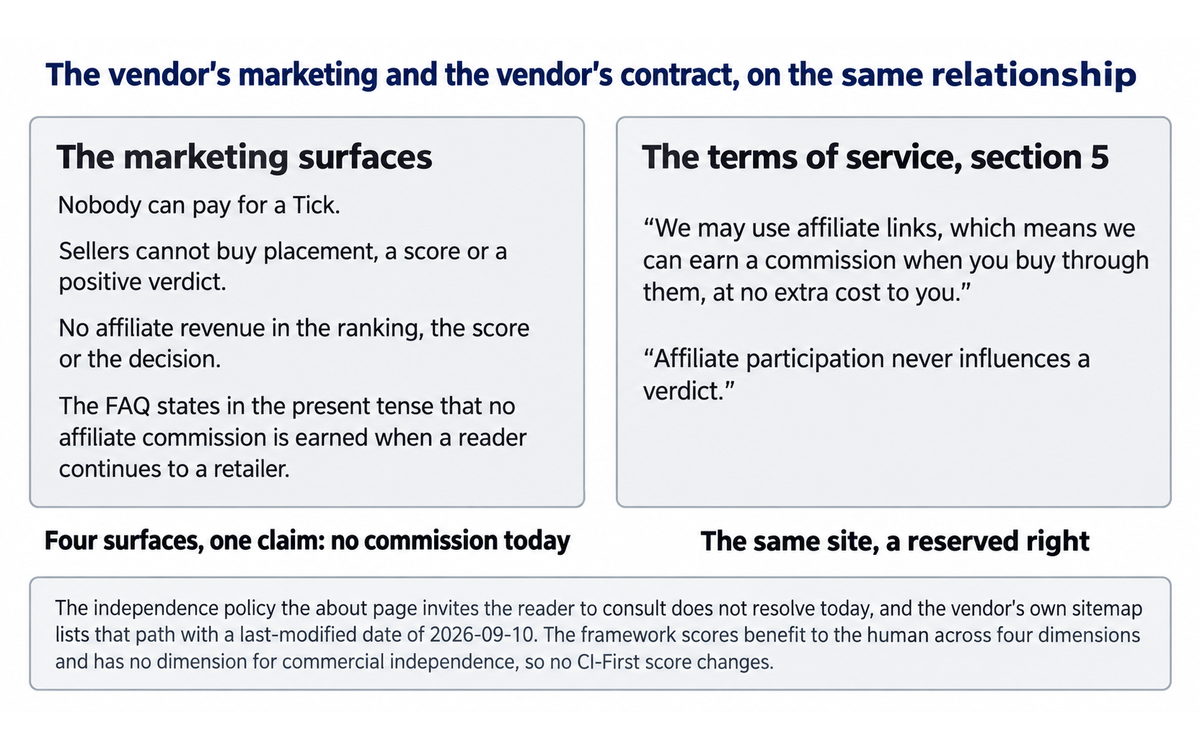
The independence policy itself is not reachable. The about page invites the reader to read an independence policy. The methodology page points to an editorial independence page for the full policy, including how the vendor handles commercial relationships with data providers. On every page of the site the structured data names an ethics policy address. All three point at the same path, and that path currently resolves to the site's own not-found page, which carries the message that the page has been moved, renamed, or never existed. The sitemap lists the path with a last-modified date of 2026-09-10, so it was published at some point. It does not resolve today. The vendor is therefore asking readers to trust a stated independence position while the document that would state its terms in full is unavailable, and while its contract reserves the revenue route its marketing denies.
One public report at launch, and the vendor's response. A public launch thread recorded during the product's first weeks makes two allegations against the surface. The first is that a verdict page carried affiliate parameters and that the FAQ's no-affiliate claim was therefore false. The second is that some prices rendered as zero, which the poster described as a bug. The vendor responded in the same thread, acknowledged the defects, said the model and concept are at launch stage and that these would be fixed, did not dispute either observation, and restated that the company is not taking commissions. This review records the allegation and the response as they are: an observation made by a third party and acknowledged by the vendor, not an adjudicated finding about the company's intentions, and not evidence of misconduct. The material point for a reader is that the question has been raised publicly once already and the two documents still differ.
One further detail, stated as fact rather than inference. The founder describes himself publicly as an affiliate and influencer marketing specialist of fourteen years, and states that the conflict he saw in that work, that the people making product recommendations are usually only compensated when a purchase happens, is the reason he built the product. That is an unusually direct account of the problem the tool claims to solve and it counts in the product's favour. It is also the reason the affiliate clause is worth reading rather than skimming: the person best placed to see the conflict is also best placed to structure around it, in either direction.
No score changed, and here is why. The CI-First framework measures benefit to the human across Time, Quantity, Quality and Knowledge and Skill, net of overhead, and rates three Humics dimensions. It has no dimension for commercial independence or supplier conduct. A reader who sees an unchanged score next to a governance finding will otherwise assume the finding was discounted. It was not discounted and it was not counted: the score would be the same whether the affiliate clause read as it does, read more restrictively, or were absent altogether, because the framework does not measure it. The finding is recorded here because a reader adopting a tool that advises them on money should know the shape of the commercial relationship behind the advice, and because the difference between the vendor's two documents is the kind of thing that is better found by a reviewer than by the reader after a purchase.
What this section does not do. It does not allege that the vendor earns affiliate commission today, because the vendor states it does not and the terms reserve rather than exercise. It does not allege that a verdict has been shaped by commercial interest, and no evidence of that was found. It does not treat the launch-thread report as a proven defect. It does not advise against using the tool, which would substitute a judgement for the reader's own. It states what the vendor's documents say, quotes the operative text, distinguishes the allegation from the finding, and names the decision the reader now has: whether to check the position in writing before relying on a verdict, and whether an adviser that may be paid on your purchase is one you want.
U365 Co-Intelligence Rating
CI-First Profile
Primary profile: Analyst and Tester (level 4).
Secondary profile: Co-Worker and Assistant (level 2).
Why level 4 as the primary. The framework's test for Analyst and Tester is that the tool's primary value is finding what the user missed, and TickClip meets that test on evidence rather than on presentation. It reads a price history the user will not read, computes 30-day and 90-day positions and the distance to a tracked low, detects a discount that is measured against a number the product never traded at, notices a review-count series that grew too fast, and reports an expiry state. Each of those is a finding the user does not have. The 45-degree case is that the verdict is the tool's own conclusion and the user must judge it, which is exactly what the framework's conservative Skill scoring is designed to catch.
Why level 2 rather than level 1. Level 1 requires the human and the tool to build on each other's thinking in an iterative loop. TickClip's design is the opposite: you ask, it answers, and you read. There is a conversational surface and it will take a follow-up, but the product is built around producing a single verdict rather than around a dialogue with a model, and the framework places delegation with review at level 2.
Why level 4 rather than a null. The framework's test is whether the tool's primary value is finding what the user missed. For TickClip that is the whole product rather than a feature of it. A null would mean the tool's value sits elsewhere, and it does not: the verdict is derived from evidence the user does not hold, and the evidence is the value.
What does not fit. Challenger and Devil's Advocate (level 5) does not apply. The product answers the user's buying question and does not argue against the user's assumptions or the brief they brought. Coach and Tutor (level 3) applies narrowly, in the guides library, which explains mechanisms such as anchor pricing and review velocity, and it is not the product's purpose.
Collaboration Mode
Recommended mode: Centaur.
Alternative mode: None recommended. Cyborg is not available here.
Mode rationale: Framework Section 7.2 assigns Centaur when the Imposture Risk is Medium or High, and the overall risk here is Medium, with Skill Illusion High. The tool-specific ground points the same way. Cyborg requires a stopping criterion the human applies inside a fast iteration loop, and TickClip has no loop to stop: you ask once, you get a verdict, and the work of checking it happens outside the tool. The controls that make the Centaur boundary real are therefore procedural rather than interactive. Read the confidence figure every time, and treat anything below 50 percent as a verdict that has already been held toward the middle by a published rule. Read the two price facts rather than the verdict word. Re-run before acting, because the price signal expires in three days. And keep your own written standard for what you will buy, because the tool is advising you and not deciding for you.
CI-First Benefit Score
Dimension | Score (0-10) | Rationale |
Time | 6 | Strong savings, and they are structural rather than claimed. Assembling a price position against a 30-day and a 90-day average, locating the tracked low, judging the rating series and weighing the three into one answer takes a careful buyer twenty minutes or more per product, and it does not happen at all for a twenty euro item. TickClip returns it in one paste with no account. Held below 7 because the net saving subtracts the work the tool does not remove: reading the confidence figure, checking the price facts against a chart you can read yourself, and re-running because the verdict expires. For a user who does not do those things, the tool is faster and the decision is not better |
Quantity | 6 | Moderate to strong increase, and this is the dimension where the tool's design deserves credit. The user can now apply a consistent standard across a whole basket of pending purchases instead of the two or three they would have examined by hand, and the deals page and verdict index extend the reach further. Held below 7 because quantity here means decisions that were actually checked, and the framework's Quantity Illusion warning applies at the margin: running the tool on thirty products and reading the words is volume without verification, and the tool makes that volume effortless. The vendor's own handling of the risk is unusually good, with insufficient evidence excluded and named rather than ranked low, which stops volume from becoming a false quality signal |
Quality | 5 | Moderate improvement, and it survives checking where the checking exists. The price position is a fact about the product's own trading history rather than a modelled opinion, the discount logic refuses to treat a seller's struck-through number as a measurement, the override rules push toward the middle on thin evidence, and the freshness system withdraws a stale answer rather than serving it. The judgement is genuinely better traced than anything comparable at this price, which is zero. Capped at 5 for one reason and it is the absence, not the contradiction: no accuracy or validation figure for the verdicts exists on any vendor surface or any third-party surface, and the vendor states that its confidence measure is coverage rather than correctness. On the framework's own rule, a quality claim without a measurement is not a quality benefit, and this review treats the absence of a claim as stronger evidence than a vendor-published figure would be. The traceability of the reasoning is not evidence that the conclusion is sound, and that distinction is the whole of this score |
Skill | 4 | Marginal to moderate benefit, scored conservatively as the framework directs. There is a real learning surface: the methodology page teaches price-position bands, review-signal thresholds, evidence weighting and the difference between coverage and correctness, and a reader who works at it comes away understanding how a discount is framed and how a rating series can mislead. The guides library extends that deliberately. Against it, the product's purpose is to replace the judgement rather than to build it, and the framework's most conservative dimension exists to catch exactly that. The specific erosion is the one named under Skill Illusion: a number that looks like a quality measure and a percentage that looks like a probability are presented together, and the sentence that reclassifies the percentage is on another page. A reader gains vocabulary and a set of thresholds and does not gain the capability the vocabulary describes. Clause 5.2.3-a returns a null, so the 4 is this review's own judgement rather than a floor |
CI-First Benefit Score: (6 + 6 + 5 + 4) / 4 = 5.3 / 10 (CI-First Positive)
Why this score is not higher, and why it is not lower
5.3 is CI-First Positive, and the band label matters. This is a recommendation for the situation it fits, which is a buyer checking a mid-range purchase on Amazon before spending, and it is a tool that costs nothing to try. It is not a criticism of the product and it is not a claim that TickClip is weak.
The score is not higher for one reason, and it repeats across three dimensions. No measurement of whether the verdicts are right exists. Not a vendor accuracy figure, not an independent study, not a substantial review corpus. The vendor states in its own methodology that confidence measures coverage rather than the likelihood that the verdict is right, which is an honest sentence that also removes the only number on the site that could have stood in for an accuracy measure. Quality is capped at 5 on that absence. Skill is held at 4 because the product substitutes for the judgement it does not build. And because the dimensions average, an unscored reliability question presses down a total that is otherwise carried by genuinely fast and genuinely well-designed evidence gathering. A score in the Strong band would be a claim about reliability that nothing supports, and it would sit inconsistently beside this series' treatment of other tools whose Quality was capped for exactly this reason.
The score is not lower because the fundamentals are real and unusually well documented, and three things in particular count in the product's favour. First, the methodology is published at a level that lets a reader audit a verdict, with named bands, published override rules, a confidence formula, a source hierarchy, a publication gate and a version identifier on every output. Second, all four override rules push toward the middle rather than the extremes, including a rule that makes a negative verdict harder to reach on thin evidence, which is the opposite of what a commercially optimised verdict engine would do. Third, the vendor publishes its own limitations in a form a reviewer can use: price history depends on a third party, reviews are not read, returns and defect rates are inaccessible, manipulation flags are signals rather than findings, and a verdict is about a moment. A tool that states those five things about itself is giving the reader the material to use it well, and Time 6 and Quantity 6 are earned scores that reflect that.
The two dimensions that cap the total are the two this review turns on. Quality is held at its 5 because a quality claim without a measurement is not a quality benefit, and because the one number the vendor could have offered as an accuracy proxy is explicitly reclassified as a coverage measure. Skill is held at 4 because the product replaces a judgement it does not build, which is the pattern the framework's most conservative dimension exists to catch.
Humics Protection Badge
Dimension | Rating | Rationale |
Creativity | Neutral (0) | The product answers a question you brought. It originates no direction, produces no material you would claim as your own, and its verdict language is deliberately narrow rather than generative. There is a substitution risk for a reader whose interest is in the reasoning rather than the answer, and it is named under Limits and Skill Illusion rather than here. The framework's question is whether the tool replaces the user's own ideation in the common case, and here the user still decides what to buy and what matters to them |
Critical Thinking | Erodes (-1) | Two mechanisms, both documented. First, a verdict is a conclusion reached for you, and the framework's own reasoning behind its most conservative dimension is that conclusions the user did not reach are the ones a user cannot evaluate. Second, the presentation separates three numbers that mean different things, a score that reads as a quality measure, a confidence percentage that reads as a probability, and a verdict that reads as an answer, while the sentence that separates them, that confidence is a statement about coverage and not about how likely the verdict is to be right, sits on the methodology page rather than beside the verdict. The erosion is held at -1 rather than a more severe reading because the mitigations are unusually strong and unusually available: the override rules announce themselves in the verdict's own text, every verdict carries its expiry, the limitations are published, and no accuracy claim is made anywhere that a reader could accept instead of checking. The product's most honest sentence is also its most useful one |
Social Authenticity | Neutral (0) | The product touches no human-facing communication, drafts nothing in a person's name, and places no agent between two people. Its conversational surface is a disclosed business agent answering the user's own buying question, attributed to the vendor and labelled with the methodology version behind each verdict. Framework clause 4.2-a is explicit that agent-mediated conversation is not erosion by itself, and the null under that clause is recorded in the clause note above. This neutral rating follows from that clause outcome rather than from a gap in the check |
Humics Protection Score: 0 + (-1) + 0 = -1 / +3 Badge: Humics-Neutral
This is the same badge as most of this series and it should be read with its reason attached rather than as a verdict on the product. The erosion is in one place: a conclusion arrives finished, and the numbers that accompany it are easy to read as stronger claims than they are. Every part of that has a control attached, the controls are the vendor's own, and they are one page away. Humics-Neutral describes a tool that neither strengthens nor weakens you on its own, and the whole point of the Co-Intelligence framework is that the reading habit decides which of the two it becomes.
Superhuman Usage Guidance
When to invite this tool:
A mid-range Amazon purchase where the difference between today and three weeks from now is a real fraction of the price, which is the case the product is built for.
Any purchase carrying a percentage-off badge during a promotional period, where the first question is whether the discount is measured or claimed.
A shortlist of pending purchases you want screened against one consistent standard rather than a feeling.
A product whose rating count moved quickly, where you want the signal flagged even though the tool will not tell you whether a review is genuine.
Teaching material on offer framing, price anchoring and review velocity, where the guides library is free, account-free and mechanism-focused.
A read-only feed of buyer-side verdicts into another agent or workflow through the MCP surface, provided you treat each verdict as time-stamped and expiring.
When to keep this tool out:
Anything outside Amazon. The coverage statement is explicit and the site says it will not guess at a store it cannot check.
Any purchase where you need to know whether the product is good. The tool scores the transaction, not the item, and it has no view on product quality beyond the rating series.
Any decision you must document for an institution. Verdicts expire, the fastest signal in three days, and the terms state that a verdict is an informational estimate rather than advice.
Any decision about authenticity or seller conduct that you intend to act on. Manipulation flags are signals rather than findings, and the tool does not read reviews.
Any purchase where you will not read the confidence figure. A verdict below 50 percent confidence has already been held toward the middle by a published rule, and a reader who ignores that is reading a different product than the one described on the methodology page.
Any use where an affiliate position would affect your judgement, until you have the present-tense answer in writing. See Section 7c.
Any case where you would accept the verdict instead of understanding it. The trace is available and the whole claim of the product is that the trace is checkable.
U365 method integration:
LIPS + CARE: the natural division is between Execute and Review. Let TickClip execute the evidence gathering and hold the price facts, and keep the Review phase as your own work, with the reason recorded in your Digital Second Brain rather than left in the tool. A verdict expires and your reason for buying does not.
ULM + EVA: relevant to Quality of Life, in the sense that money not spent on a bad moment is time and resource returned, and relevant to Character in one specific way: deciding not to buy, when everything around you is designed to close a sale, is a discipline and not a mood.
UP-Context: this tool needs the context and constraints lines more than most, because an under-specified request produces a verdict on the wrong product or the wrong question. State what you are buying, the price you see, what you actually need it for, and the stops, including that you want the confidence figure and the missing evidence named. The workflows in Section 6 use that order.
SL-OS: no direct fit. TickClip is a consumer surface rather than a workspace tool, it integrates with nothing, and no part of it belongs in a Microsoft-centred institutional stack. The one indirect use is research: the MCP surface gives a small read-only corpus of buyer-side verdicts that a U365 research workflow can query.
UNOP: an indirect fit and a useful one. The methodology page is a worked example of a decision model with published weights and thresholds, which is directly usable as study material for how a judgement can be made traceable. The transferable skill is the habit of asking which inputs produced a conclusion and what the answer's confidence actually measures, and that habit transfers to every other AI tool a Fellow will meet.
Over-delegation warning. Two failure modes, and the second is specific to this tool.
The general one is that the product's ease is the risk. Pasting a link costs nothing, no account is required, and the answer arrives as one word. The CI-First formula applies as it always does: if your Human Intelligence input falls while the Artificial Intelligence term rises, the product falls. Here the fall is a purchase you would not have made if you had asked what the confidence figure measured.
The specific one is the split between a verdict and its evidence, and it is the most consequential thing in this review. A verdict is designed to be read in one second and the evidence behind it is designed to be read on a separate page. Everything the vendor publishes about its own limits sits on the methodology page, and the reader who never opens it is reading a confident word rather than a coverage-measured estimate. The honest practice is short: read the confidence every time, read the two price facts rather than the verdict word, re-run before acting because the price signal expires in three days, and keep your own written standard for what you will buy. A reader who does those four things has a genuinely useful instrument. A reader who does none of them has outsourced a decision about their own money to a system that never claimed to know whether it was right.
What Users Say
TickClip is a young product with no review corpus. That is the finding, and the honest version of this section is a table that says so, alongside the small amount of attributable evidence that does exist.
Aggregate Rating Table
Platform | Rating | Number of reviews | Link |
G2 | No listing found | No reviews found on G2 | N/A |
Capterra | No listing found | No reviews found on Capterra | N/A |
GetApp | No listing found | No reviews found on GetApp | N/A |
Trustpilot | No listing found | No reviews found on Trustpilot | N/A |
Product Hunt | Listing exists | No review count found on Product Hunt | |
No thread found for the product | No reviews found on Reddit | N/A | |
Tekpon | No listing found | No reviews found on Tekpon | N/A |
Softonic | 5 / 5 shown on the listing page, with a count that does not render as text | Not determined | |
Legit.Show, an independent benchmark of the website rather than of the verdicts | 87 / 100 | Not a review count: a measured benchmark of the public surface |
Two rows need a note. The Softonic entry shows a five-out-of-five figure beside the product name on a directory page that carries no readable review text and no review count in the page source, so this review does not treat it as a rating a reader can rely on and it is recorded as undetermined rather than as a five. The Legit.Show score is the only independent measurement found anywhere for this product, and it is important to be precise about what it measures: the website's production readiness across seven frames, described as a public-surface assessment with no language model in the scoring path. It scored Privacy at 100, Reliability, Standards and Discoverability at 100, Accessibility at 96, Performance at 71 and Security at 45, placing the site in the top 21 percent of 13,729 measured products and fourth of 23 in its price-comparison category. That is a measurement of the site, not of the verdicts, and no part of this review's Quality score rests on it.
What Users Praise
There is no review corpus to draw praise from. What can be reported is the response in the product's own public launch thread, where the premise drew a specific compliment from a reader who said the decision model idea was decent and that they do the same checking themselves manually, along with a request for a browser extension so the check happens while browsing rather than by pasting a link. The vendor acknowledged the extension request and named it as a roadmap item. That is a single data point from a launch thread and it is reported as one.
What Users Complain About
There is no review corpus to draw complaints from, so this section reports what a critical reader said at launch rather than what users have concluded over time. The same thread contains the two observations treated in Section 7c: that a verdict page carried affiliate parameters while the FAQ said no affiliate commission was earned, and that some prices rendered as zero. A separate reader asked whether a version existed that could work across any site rather than Amazon alone. The vendor responded to all three points, acknowledged the defects, and did not dispute them. No complaints from sustained users exist, because there are no sustained users on record.
Sentiment Summary
Signal | Reading |
Independent review corpus | None found on any review platform |
Independent measurement | One benchmark, of the website rather than of the verdicts. No benchmark of verdict accuracy found |
Community discussion | One launch thread with four comments, and a founder account on Indie Hackers and Hacker News describing the build. No subreddit, no forum thread, no sustained discussion |
Substantial published analysis | One 2026 directory entry describing the product, and one launch-day analysis describing it as a tool that can recommend not buying. Neither assesses verdict accuracy |
Launch-stage defects | Two reported publicly in the launch thread and acknowledged by the vendor, both concerning the surface rather than the decision model |
Sustained users on record | None found |
U365 Editorial Note
A launch without independent assessment is itself a finding, and it belongs in this section rather than buried. TickClip shipped in August 2026, published its methodology on 2026-08-13, and by 2026-09-25 has a public methodology at version two, roughly a thousand published verdict pages in its own sitemap, a deals surface, a guides library and a documented MCP surface. What it does not have is a single independent assessment of whether its verdicts are right. The only independent measurement of anything about this product measures web performance, privacy and security headers, and it is careful to say so.
That is not a reason to avoid the tool and it is a reason to read it the way this review does. The evidence basis for a TickClip verdict is unusually visible, and the vendor's own honesty about what its confidence figure measures is more useful to a reader than an accuracy percentage would be if it were published without a stated sample. But the reader should hold two propositions apart: that the reasoning behind a verdict is traceable, and that the verdict is correct. The first is supported by the vendor's documentation. The second is unmeasured, and it will stay unmeasured until someone with no stake in the answer runs the check.
Comparison and Alternatives
TickClip competes less with other AI tools than with two categories of habit: the free price-history tracker, and doing nothing.
Tool | What it does | What it costs | Choose it when |
TickClip | Returns one buyer-side verdict on an Amazon product with price facts, a score, a confidence figure and an expiry, from published rules | Free, no account | You want an answer with its evidence and its uncertainty attached, and you will read the confidence figure |
A price-history tracker | Charts a product's price over time and lets you set an alert | Free tiers and paid tiers | You want to read the chart yourself and decide, and you are willing to spend the time. This is the honest alternative for a careful buyer, and the tool's own stated price source is one of these services |
A browser extension that overlays price history on the product page | Shows the history where you are already looking, with no separate site | Free | You want the check to happen while browsing rather than by pasting a link. The vendor has named this as a roadmap item for its own product rather than shipping it |
A coupon and deal aggregator | Collects promo codes and discounts | Free, usually commission-funded | You want code hunting rather than a judgement, and you should assume the aggregator earns on the purchase in a way TickClip's marketing states it currently does not |
Reading the reviews and the price yourself | Your own judgement on the page you are already on | Free, and the cost is time | The purchase is small enough that the answer does not matter, which is the correct choice more often than any tool's marketing admits |
A general-purpose assistant | Can compare prices, reason about value and apply your own criteria, using whatever sources it can reach | Free tiers and subscriptions | The question is not one product's pricing but a comparison across options, or you need the reasoning spelled out in prose rather than a verdict |
How TickClip differs, stated honestly. The differentiator is not the price data, which it buys from a third party that sells the same data elsewhere. The differentiator is the decision layer: published bands, published override rules that push toward the middle on thin evidence, a score and a confidence kept separate, and an enforced expiry. The price-history trackers are better than TickClip at what they do and are the right tool if you want the chart rather than the answer. General-purpose assistants can reason about value in ways TickClip cannot, because TickClip is deliberately confined to four measurable dimensions. And for a purchase where the answer genuinely does not matter, doing nothing is the best alternative on this list.
One honest comparison note. No vendor-published head-to-head figures for TickClip were found, and this review does not construct any. Where a comparison is implied by the product's own framing, such as the claim that the tool protects the decision rather than the transaction, that is a positioning statement rather than a measurement and it is treated as one.
Verdict and Next Steps
The verdict: TickClip is a genuinely useful instrument with an unmeasured core, and it is worth an afternoon of your time.
What earns the recommendation is unusual and should be said first. This is a free consumer tool, built by a small team, that publishes its scoring bands, its four override rules, its confidence formula, its source hierarchy, its publication gate, its freshness windows, its result-ordering weights, its version history and a candid list of its own limitations. All four of its override rules push verdicts toward the middle rather than the extremes, including one that makes a negative verdict harder to reach when the evidence is thin. Its structured data names an ethics policy and a publishing principles address on every page. It refuses to treat a seller's struck-through price as a measurement. And it states in its own words that its confidence percentage measures coverage rather than the likelihood that the verdict is right, which is the single most useful sentence it publishes and the one a reader should carry.
What holds the score at 5.3 is equally plain. No accuracy figure for the verdicts exists on any surface, the vendor's own confidence disclaimer removes the only number that could have substituted for one, and the product's whole output is a judgement. Traceable reasoning is not the same thing as a sound conclusion, and only one of those two is currently supported by evidence. Skill is held at 4 because the product replaces a judgement it does not build, and the presentation places a score, a percentage and a verdict together in a way that reads stronger than the method behind them.
What a reader must decide before relying on it is not a scoring question. The vendor states on four surfaces that it earns no affiliate commission from retailer links, and its terms of service state that it may use affiliate links and earn a commission through them. Both are live. The independence policy the site invites you to read does not currently resolve. Section 7c sets out the text. Whether an adviser that may be paid on your purchase is one you want is your decision, and it is a decision you can make precisely because the two documents are quoted in this review.
Next steps, in order:
Open the methodology page before the application. Read the four dimensions, the four override rules and the Limitations section. Ten minutes, and it changes what you see when the verdict arrives. https://tickclip.ai/methodology
Run it on three products you already know. This is the only cheap calibration available, because no published accuracy figure exists.
Read the confidence figure on every verdict, and treat anything below 50 percent as a verdict already held toward the middle by a published rule.
Read the two price facts rather than the verdict word. Today's price against the 90-day average, and the distance to the tracked low. Those are the numbers a decision can rest on.
Re-run before acting. The price signal expires in three days and the reasoning in fourteen. A verdict from last month is a record of a past moment.
Write your own buying rule down and keep it where you own it. The tool's verdict expires; your standard does not.
If you are considering this for an institution, ask two questions in writing: whether any affiliate commission is earned today, and where the independence policy is. Adoption should wait for the answers.
If you teach, use the guides library. It is free, needs no account, and explains mechanisms such as fake discounts, review velocity and anchor pricing rather than asserting conclusions. https://tickclip.ai/guides/how-fake-discounts-work
U365 Co-Intelligence Rating card
Dimension | Score | Reading |
Time | 6 | Strong savings on evidence gathering, net of the reading work the tool does not remove |
Quantity | 6 | Consistent standard across a whole basket, capped because unverified volume is not quantity benefit |
Quality | 5 | Well-traced reasoning, capped on the total absence of any accuracy measurement for the verdicts |
Skill | 4 | Real learning surface, held down because the product replaces the judgement it does not build |
CI-First Benefit Score | 5.3 / 10 | CI-First Positive |
Humics Protection | -1 / +3 | Humics-Neutral: creativity neutral, critical thinking erodes, social authenticity neutral |
AI Imposture Risk | Medium | Skill Illusion High, Time Illusion Medium, Quantity Illusion Low |
Collaboration Mode | Centaur | Derived from framework Section 7.2, since the overall risk is Medium |
CI-First Profile | Analyst and Tester (level 4) | Secondary: Co-Worker and Assistant (level 2) |
Integration notes for U365 readers
U.Copilot. TickClip is not an integration target. It has no account-level API for a workspace, its MCP surface is read-only over published verdicts, and it holds no institutional data. A U365 reader can use it as an individual buyer and can query its published verdicts from a research workflow, and it should not be wired into any U365 teaching or advising surface, because a verdict expires and an institutional answer must not.
SL-OS. No fit. TickClip is a consumer surface with no identity integration, no workspace data model and no Microsoft-stack touchpoint. Its only relevance to a U365 workspace is as an input to a buying decision made by a person, recorded by that person in their own knowledge system.
Migration Path
Not applicable. TickClip is an Active tool: it carries no announced retirement, no deprecation notice and no successor, and nothing in this review recommends migrating away from it. The heading is carried so the section inventory is complete, and the correct statement for an Active tool is that there is no migration plan to describe.
One adjacent fact belongs on the record rather than in a migration plan. The product's coverage is Amazon products identified by ASIN and it is stated as such on the methodology page, which says the site will not guess at a store it cannot check. A reader buying outside Amazon is not migrating away from TickClip, because TickClip does not analyse that purchase at all. The honest alternative for that reader is the comparison section's price-history tracker and their own judgement, which is also the honest alternative for a reader who does not want to read a confidence figure. The two re-check triggers that would turn this section into a real one are a vendor retirement announcement and a published successor.
U365's Recommendations to Learn More
The vendor's methodology page is the single most useful document on the site and the one this review is built on. Read it before the application, and read the video material below for the mechanism the product automates rather than for anything about the product itself.
Official learning resources
The methodology page, which states the two measurements, the four scored dimensions with their bands, the four override rules, the confidence formula and its deductions, the source hierarchy, the publication gate, the freshness windows and the version history. Read it first: https://tickclip.ai/methodology
The application surface, which needs no account and returns a verdict from a pasted link, an ASIN or a sentence: https://tickclip.ai/app
The about page, which states the three verdicts, the buyer-first position and the four limits the vendor attaches to its own claim: https://tickclip.ai/about
The terms of service, and specifically section 3 on verdicts being guidance rather than advice and section 5 on Amazon links and affiliate commission. Section 5 is the clause Section 7c quotes: https://www.tickclip.ai/terms
The privacy policy, read next to the terms because the two describe the affiliate arrangement and the data position from different sides: https://www.tickclip.ai/privacy
The MCP documentation, for the four read-only tools that expose published verdicts to an AI client, which is the most unusual surface the product has: https://tickclip.ai/mcp
The guides library, and specifically the entry on how fake discounts work, which explains anchor pricing and the raised-before-sale pattern in plain language: https://tickclip.ai/guides/how-fake-discounts-work
The verdict index, for the published verdict corpus and for seeing the vocabulary in use across many products: https://tickclip.ai/verdicts
The deals surface, where deals and promo codes are entered and reviewed by a person rather than scraped, each carrying a status and an expiry: https://tickclip.ai/deals
Video tutorials and channels
No video published by the vendor was found, and the vendor documents no video channel. The searches that surface video content for the product name return unrelated material, because the words carry a different meaning outside shopping. What follows is independently published material on the mechanism the product is built on, which is the price-history check. Neither identifier is TickClip, and no claim in this review rests on them.
Watch them for the mechanism, which is the same check TickClip automates, and not for anything about TickClip itself.
Written tutorials and deep-dive articles
The mechanism-based guides on discount framing, review velocity, anchor pricing, buying-remorse patterns and cost per use: https://tickclip.ai/guides
The founder's account of why he built the product, written from inside the affiliate and influencer marketing industry and describing the incentive conflict the tool exists to remove: https://www.indiehackers.com/post/i-built-tickclip-because-shopping-advice-is-optimized-for-clicks-not-buyers-hDfgbQHZ81YtD0VG5eqq
The same account in the founder's own words in a public launch thread, which is also where the two launch-stage defects treated in Section 7c were reported and acknowledged: https://news.ycombinator.com/item?id=49244355
An independent production-readiness benchmark of the website, scoring 87 out of 100 across seven frames measured from the public surface, and useful precisely because it measures the site rather than the verdicts: https://legit.show/s/tickclip-ai
A 2026 directory entry for the product, useful as an example of how a third-party directory describes it and what it does not assess: https://www.stork.ai/en/tickclip
Community and social
TickClip on X, the product account the vendor links from its own pages, which served an account-suspended page when it was checked on 2026-09-25. The account is listed here because it is the vendor's own channel and the state of it is worth knowing before you rely on it: https://x.com/tickclip
The launch discussion, for the initial community response and the vendor's replies: https://news.ycombinator.com/item?id=49244355
The Product Hunt listing, where the product is listed and where no review count appears in the page source: https://www.producthunt.com/products/tickclip
A product listing page that describes itself as a buyer-first AI shopping intelligence platform, which is one of the few third-party descriptions of the product: https://peerpush.com/p/tickclip-the-fiduciary-layer-of-e-comme
No community discussion of this product was found beyond the launch thread and the founder's own posts. No subreddit thread, no forum thread and no sustained review corpus exists, which is the same absence Section 9 reports and the reason the vendor's own methodology page is the most important document available on the product.
Resources on TickClip
The vendor's own surfaces are the ones to read first, because the methodology page is where every caveat in this review comes from and the application surface is the product.
Dedicated TickClip channels
The methodology page, the product's own specification and the document its verdicts are built from: https://tickclip.ai/methodology
The application surface, free and account-free: https://tickclip.ai/app
The guides library, its mechanism material on discount framing and review velocity: https://tickclip.ai/guides
Resources on X
Dedicated X channels
For this category the accounts worth following are the independent price-history services and the independent testing organisations, so that any claim in this review can be checked against a measurement rather than against a marketing page. The vendor's own social surface is recorded in Section 9, where its current state belongs.
Keepa on X, the price-history service TickClip's own methodology names as the source of its price averages and tracked lows: https://x.com/keepa
CamelCamelCamel on X, the best-known independent Amazon price tracker and the honest alternative to a verdict: https://x.com/camelcamelcamel
Legit.Show on X, the operator of the independent production-readiness benchmark cited in this review: https://x.com/Legit_Show
Consumer Reports on X, for independent product testing, which is the category TickClip explicitly does not occupy: https://x.com/consumerreports
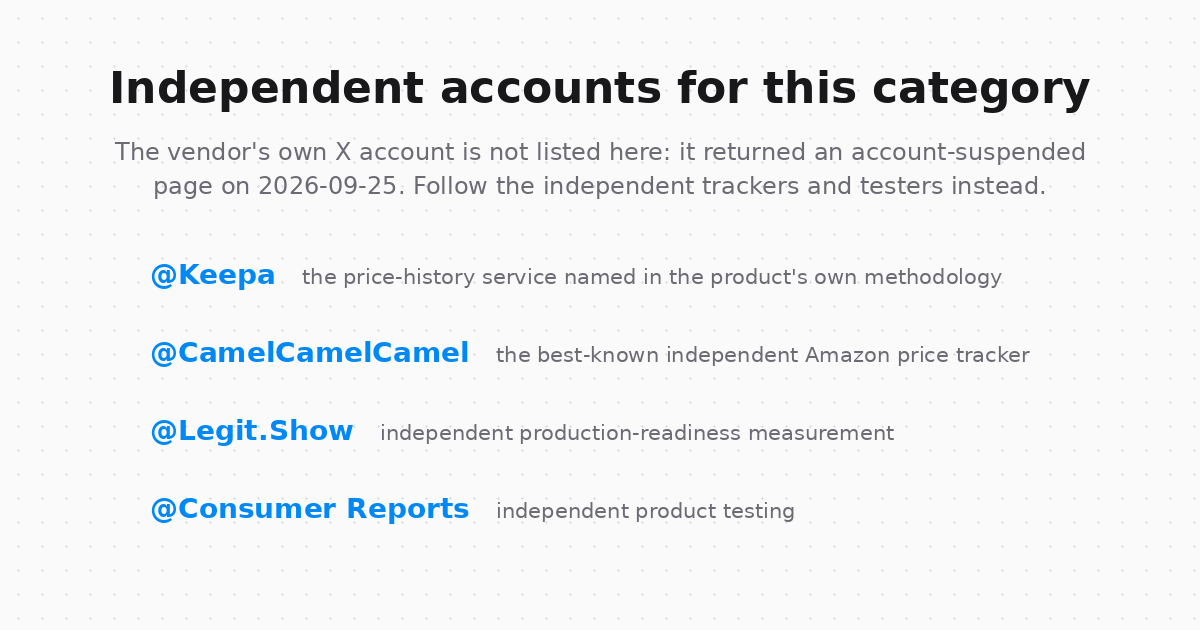
CI-First Evaluation Summary Card
Tool | TickClip |
Vendor | TickClip, tickclip.ai (founder Tarik Aarbaoui) |
Category | Decision support and verdict agent for consumer purchases |
CI-First Profile | Primary: Analyst and Tester (level 4). Secondary: Co-Worker and Assistant (level 2) |
Time | 6 / 10 |
Quantity | 6 / 10 |
Quality | 5 / 10 |
Skill | 4 / 10 |
CI-First Benefit Score | 5.3 / 10 |
Band | CI-First Positive |
Humics Protection | Creativity 0, Critical Thinking -1, Social Authenticity 0 |
Humics Badge | Humics-Neutral (-1 / +3) |
AI Imposture Risk | Medium (Skill Illusion High, Time Illusion Medium, Quantity Illusion Low) |
Collaboration Mode | Centaur |
Status | Active |
Last tested | 2026-09-25, methodology version tickclip-verdict-v2 (2026-09-22) |
Pricing | Free, no account required. No rate card published |
Coverage | Amazon products identified by ASIN. Other retailers not yet analysed |
Framework v1.2 clauses | 5.2.3-a null with an argued boundary; 4.2-a null; 7.5 null |
Key strength | A fully published decision model with named weights, published override rules that all push toward the middle on thin evidence, and a version identifier stamped on every verdict |
Key limit | No accuracy figure for the verdicts exists anywhere, and the vendor states that its confidence measure is coverage rather than correctness |
Decisive finding | The vendor states on four surfaces that it earns no affiliate commission from retailer links, while its terms of service state that it may use affiliate links and earn a commission through them, and the independence policy the site invites readers to consult does not currently resolve. See Section 7c |
Glossary
Each term below is defined as it is used in this review, not as the vendor uses it.
CI-First Benefit Score
The average of four dimensions, each scored 0 to 10: Time, Quantity, Quality, and Knowledge and Skill. It answers whether using the tool makes Co-Intelligence more profitable than Human Intelligence alone. Bands: 0 to 2.0 CI-First Negative, 2.1 to 4.0 CI-First Neutral, 4.1 to 6.0 CI-First Positive, 6.1 to 8.0 CI-First Strong, 8.1 to 10.0 CI-First Transformative. The score accounts for the overhead of prompting, supervising and verifying, not just the benefit the tool produces. TickClip scores 5.3.
CI-First Profile
The five levels of human and AI working relationship a tool supports. Level 1 Co-Creator, Level 2 Co-Worker and Assistant, Level 3 Coach and Tutor, Level 4 Analyst and Tester, Level 5 Challenger and Devil's Advocate. A tool can hold a primary and a secondary profile. TickClip is primary level 4 and secondary level 2.
Collaboration Mode
The framework's two modes for dividing work between a human and an AI. In Centaur mode the human sets the boundary and the AI works inside it, with the human judging the result. In Cyborg mode the human and the AI iterate rapidly in one loop with the human applying a stopping criterion inside it. Framework Section 7.2 assigns Centaur whenever the AI Imposture Risk is Medium or High, because Centaur mode is safer. TickClip is rated Medium overall, so it is a Centaur tool.
Humics Protection Badge
The sum of three ratings, each +1, 0 or -1: Creativity, Critical Thinking, and Social Authenticity. It answers whether the tool strengthens or weakens the human capacities that make Co-Intelligence worth having. +2 to +3 is Humics-Friendly, -1 to +1 is Humics-Neutral, -2 to -3 is Humics-Risky. TickClip scores -1, Humics-Neutral.
AI Imposture Risk
The likelihood that a tool traps the user in one of three usage illusions, each rated Low, Medium or High: the Time Illusion, where speed appears while net time savings are small; the Quantity Illusion, where volume looks good and does not hold up under inspection; and the Skill Illusion, where competence appears while the user is not developing the skill. Overall risk is Medium when one or two traps are Medium, or one is High with clear mitigations. TickClip is Medium overall, with Skill Illusion High.
Review Status
The badge attached to a review and the vocabulary that goes with it. Active means the tool is current and recommended. Risky means the tool has significant unresolved issues, or it has been clearly surpassed by newer alternatives, and should be used with caution after reading the Limits section. Retired and Deprecated mean the tool is no longer available or no longer supported, and a Migration Path is required. TickClip is Active.
Verdict vocabulary
Tick means the evidence supports buying now. Clip means wait, watch the price, or gather more evidence. Skip means the evidence indicates poor value or material risk. The bands are published: 75 to 100 for a Tick, 50 to 74 for a Clip, 0 to 49 for a Skip, with four published rules that can move a verdict toward the middle.
User Sentiment
What the public says about a product across review platforms, community forums and independent assessments, reported separately from the CI-First score because crowd sentiment can contradict a scored evaluation. Where the two agree the finding is stronger, and where they diverge the divergence is worth explaining. TickClip's is the least informative in this series so far: no review corpus exists on any platform, one launch thread carries four comments, and the only independent measurement found anywhere scores the website's production readiness rather than its verdicts.
Confidence percentage
A TickClip measure of how much evidence sat behind a verdict, not how likely the verdict is to be right. It starts at 100 and is reduced for each missing input. The vendor states the distinction itself, and it is the reason the Quality score in this review is capped.
Sources
Every link below was retrieved on 2026-09-25.
Vendor primary sources
TickClip, homepage, for the three verdicts, the buyer-first position, the four stated limits, the no-affiliate statement and the FAQ entries on fake discounts, review checks, coverage and affiliate commission: https://tickclip.ai
TickClip, application surface, for the verdict output, the free and no-account access, the stated checks on price history, marketplace rating signals and seller reputation, and the review-checker description: https://tickclip.ai/app
TickClip, methodology page, last reviewed by the vendor 2026-09-10, and the source for the entire Section 4: the two measurements, the four scored dimensions with bands and points, evidence-based weighting, the four override rules, the confidence formula with its deductions, the baseline comparison and the refusal to publish a fair-value range, the seven ranking weights and the statement that the ordering is not for sale, the source hierarchy, the missing-data rules, the duplicate rules, the publication gate with its blocking and non-blocking lists, the deal and promo-code rules, the freshness windows and the six freshness states, the re-check cycle and the early invalidation thresholds, correction and rollback, the independence statement, the Limitations list, and the version history for tickclip-verdict-v1, tickclip-verdict-v2 and tickclip-ranking-v1: https://tickclip.ai/methodology
TickClip, about page, for the separation of product quality from purchase quality, the three verdicts and their meanings, the four stated commitments including the no-affiliate position, and the invitation to read a methodology and an independence policy: https://tickclip.ai/about
TickClip, terms of service, last updated 2026-06-20, for the definition of the service, section 3 on verdicts being guidance rather than advice, section 4 on promo codes, section 5 on Amazon links and affiliate commission, section 6 on accounts and anonymous use, section 7 on acceptable use, section 8 on intellectual property, and section 9 on the disclaimers and limitation of liability: https://www.tickclip.ai/terms
TickClip, privacy policy, last updated 2026-06-20, for what is collected, anonymous use and local storage, the use of data including the statement that it is used to measure the accuracy of verdicts, the third-party AI and infrastructure providers, the statement that personal information is not sold and that retailer links are subject to the retailer's own practices, data retention and user rights: https://www.tickclip.ai/privacy
TickClip, MCP documentation page, for the four read-only tools verdict_get, verdicts_list, search_products and search_by_need: https://tickclip.ai/mcp
TickClip, deals page meta description, for the claim that deals are verified hourly: https://tickclip.ai/deals
TickClip, guides library, for the mechanism-based guides on fake discounts, price-history reading, review velocity, anchor pricing, seller risk, return policies and cost per use: https://tickclip.ai/guides and https://tickclip.ai/guides/how-fake-discounts-work
TickClip, verdict index and a sample verdict page, for the published verdict corpus and the verdict output in use: https://tickclip.ai/verdicts and https://www.tickclip.ai/verdict/p_q3g3zbwlf8kn-coca-cola-zero-sugar-soda-soft-drink
TickClip, sitemaps, for the coverage counts of 1,010 verdict pages and 294 brand pages, the static page inventory and the last-modified dates including the 2026-09-10 date on the editorial independence path: https://www.tickclip.ai/sitemap-verdicts.xml, https://www.tickclip.ai/sitemap-brands.xml and https://www.tickclip.ai/sitemap-static.xml
TickClip, editorial independence path as linked from the about page, the methodology page and the structured data on every page, which currently resolves to the site's own not-found page: https://tickclip.ai/editorial-independence
TickClip, structured data on every page, for the description of the service and for the ethics policy and publishing principles addresses: https://www.tickclip.ai/opengraph-image
TickClip, pricing path, which resolves to the site's own not-found page and carries no published price: https://www.tickclip.ai/pricing
Independent sources
Legit.Show, TickClip production-readiness benchmark, last updated and measured 2026-08-23, for the 87 out of 100 score across seven measured frames, the frame scores of Performance 71, Accessibility 96, Security 45, Privacy 100, Reliability 100, Standards 100 and Discoverability 100, the placement in the top 21 percent of 13,729 measured products and fourth of 23 in the price-comparison category, and the measured observations including the missing Content-Security-Policy header, cookies and scripts loading with no consent prompt, and the 161 millisecond time to first byte. This is a measurement of the website and not of the verdicts, and no score in this review rests on it: https://legit.show/s/tickclip-ai
Stork.AI, TickClip review entry, describing the product as a buyer-first decision layer for e-commerce and recording a ship date of 2026-08-23 with a directory-measured monthly visit count of one. The visit figure is a directory measurement and is reported as one rather than as traffic evidence from the vendor: https://www.stork.ai/en/tickclip
Softonic, TickClip listing, which shows a five-out-of-five figure beside the product name with no readable review text and no review count in the page source, and is therefore recorded in this review as undetermined rather than as a rating: https://tickclip.en.softonic.com/web-apps
INITE Atlas, TickClip entry, describing the product as analysing Amazon product prices, reviews and sellers to recommend whether to buy, wait or skip, and recording a Product Hunt launch: https://inite.ai/en/atlas/tickclip.ai
A third-party digest entry describing TickClip as an AI shopping tool that analyses Amazon product links to deliver one of three verdicts, with the Skip verdict described as manipulation detected. This is a third-party paraphrase and differs from the vendor's own definition of Skip, which is poor value or material risk, and the difference is worth noting: https://hellomarvisaitoday.com/articles/aab4a3a1-fd95-447a-acb5-8bcf18e16885
Community and community-reported evidence
Hacker News, "Show HN: TickClip, An AI shopping agent that can recommend not buying", the product's public launch thread, for the founder's statement of his fourteen years in affiliate and influencer marketing, his account of the incentive conflict that motivated the product, the third-party observations about affiliate parameters on a verdict page and prices rendering as zero, and the vendor's replies acknowledging the defects. Retrieved through the thread page, and the content is reported as allegation plus vendor response rather than as an adjudicated finding: https://news.ycombinator.com/item?id=49244355
Indie Hackers, the founder's build account, "I built TickClip because shopping advice is optimized for clicks, not buyers", for the product's stated purpose and the founder's description of the problem: https://www.indiehackers.com/post/i-built-tickclip-because-shopping-advice-is-optimized-for-clicks-not-buyers-hDfgbQHZ81YtD0VG5eqq
PeerPush, TickClip listing, for a third-party description of the product as a buyer-first AI shopping intelligence platform: https://peerpush.com/p/tickclip-the-fiduciary-layer-of-e-comme
Product Hunt, TickClip listing page, which exists and shows no review count in the page source: https://www.producthunt.com/products/tickclip
The TickClip account on X, the only social surface the vendor links from its own pages: https://x.com/tickclip
No community discussion was found beyond the launch thread and the founder's own posts. No subreddit thread, no forum thread and no sustained review corpus exists as of the date of this review, and that absence is reported as the finding rather than as a gap in the search: https://www.university-365.com/tools
Video identifiers verified for this review
Every YouTube identifier cited above was checked against the oEmbed endpoint on 2026-09-25, with a known-live identifier returning the same result and a known-dead identifier returning an error, so the check was working rather than passing by default:
Internal sources
CI-First Evaluation Framework v1.2, the scoring rubrics in Section 3, the Humics rating and clause 4.2-a in Section 4, the imposture risk assessment and clause 5.2.3-a in Section 5, the profiles in Section 6, the collaboration modes and clause 7.5 in Section 7, and the scoring procedure and principles in Section 9: https://www.university-365.com/tools
INSIDE Tools Post Template, including the Agent Platform variant, which applies here alongside the decision-support framing: https://www.university-365.com/tools
Published INSIDE Tools Reviews used as comparisons: Jev AI, the first decision-model review in this series and the closest structural precedent; Rabbit OS3, a Humics-Risky product without independent measurement; MiMo-V2.6-Flash, the precedent for scoring Quality down where a measurement is unverifiable; and Klarent, the contract-terms Section 7c precedent: https://www.university-365.com/tools
This is a new review rather than a refresh of an earlier one: https://www.university-365.com/tools
Faculty Note on Evidence Quality
Six things did not survive checking, and the pattern across them is worth stating before the list. This is a vendor whose methodology page is markedly more careful than its marketing pages, and whose legal pages are the most specific documents it publishes.
First, the accuracy question has no number anywhere, and the one number that could have stood in for one is reclassified by the vendor itself. No accuracy figure for the verdicts was found on any vendor surface or any third-party surface. The methodology page states that confidence is a statement about coverage, not about how likely the verdict is to be right. That sentence is to the vendor's credit and it is also the reason this review's Quality score is capped: the product asks to be trusted with a judgement and publishes no measurement of whether the judgement is sound. The claim to carry away is not that TickClip is inaccurate. It is that its accuracy is unmeasured, and that the vendor says so.
Second, the verdict vocabulary is defined differently in a third-party description. The vendor's own definition of Skip is that the evidence indicates poor value or material risk. A third-party digest describes the Skip verdict as manipulation detected. Those are different claims about what the tool concludes, and the vendor's own wording is the narrower and more defensible one. The paraphrase is reported because a reader will meet it in search results and should know which version is the product's.
Third, the review-checking surface promises more than the method delivers. The application surface offers a review checker, and the methodology states plainly that review integrity is inferred from aggregate rating and rating-count series, that individual customer review text is not read or semantically classified, and that the tool does not claim to detect fake reviews. The marketing name is wider than the method behind it. The vendor is honest in the methodology and looser in the marketing, and the methodology is the document to believe.
Fourth, the coverage claim and the coverage count sit at different scales. The site says coverage is Amazon first and properly, and more retailers are on the way. The vendor's own sitemaps list 1,010 verdict pages and 294 brand pages on 2026-09-25. A thousand published verdicts is a real corpus; it is also a very small fraction of Amazon, and a reader should not read the verdict index as a coverage guarantee for the product they are considering. If a product has no published verdict, the tool will analyse it on request, which is the correct behaviour and is not the same thing as coverage.
Fifth, the deals surface claims a frequency the vendor's own methodology does not describe. The deals page meta description states that deals are verified hourly. The methodology states that deals and promo codes are entered and reviewed by a person rather than scraped and published automatically, that each carries a status and an optional expiry date, and that a daily job expires any active deal whose expiry date has passed. Those two descriptions can coexist, since a person can review hourly and a daily job can sweep expiries, but the meta description states a cadence that no product document confirms, and a reader checking whether a deal is current should not rely on the word hourly.
Sixth, the two launch-stage defects reported publicly were acknowledged rather than disputed, and no fix was confirmed. The launch thread records a reported price display defect and a reported discrepancy between the no-affiliate statement and the links on a verdict page. The vendor acknowledged both, described the product as being at launch stage, and committed to fixing them. This review found no public confirmation that either is resolved, and the second one is the origin of the finding in Section 7c rather than a separate matter.
What the vendor got right, stated with the same emphasis, and it is a longer list than this section usually carries. The scoring model is published at a level that lets a reader audit any verdict: four dimensions with named bands and point values, a confidence formula with named deductions, four override rules with their reasoning stated, a source hierarchy with a trust order, a publication gate with blocking and non-blocking conditions listed separately, freshness windows per signal with a published floor, and a version identifier stamped on every output so a citation can always be read against the rules that produced it. All four override rules push toward the middle rather than the extremes, including a rule that makes a negative verdict harder to reach on thin evidence, which is the opposite of what a verdict engine built to monetise its conclusions would do. The limitations list is candid enough to be usable as the basis of a review, naming the third-party price dependency, the fact that individual reviews are not read, the absence of returns and defect-rate data, the fact that manipulation flags are signals rather than findings, and the fact that a verdict is about a moment rather than a property of the product. The vendor publishes the confidence disclaimer that costs it the most and gains it the most. Staleness withdraws the answer and keeps the page indexed. And the founder's account of why the product exists, written from fourteen years inside the affiliate and influencer industry, is a more concrete statement of the problem than most products in this category offer.
The pattern is consistent, and it is the reason this review recommends the tool while holding its Quality score down. Where this vendor describes a mechanism, it is precise and it is often arguing against itself. Where it describes a result, it publishes no measurement and says so. A reader of this review should treat the methodology page as the evidence and the marketing pages as positioning, and should treat the vendor's own statement about what its confidence figure measures as the most useful sentence in the release.
End of review.




Comments