
Undersea Cables: The Physical Internet

In this Interest


Undersea Cables: The Physical Internet
Snapshot
Almost all intercontinental data crosses the seabed. TeleGeography tracks more than 600 active and planned submarine cables and estimates over 1.5 million kilometres in service as of early 2026.
This brief explains how one cable is built, laid, powered and repaired, who owns the route, and why the map of those routes is read by governments as a strategic document.
By the end you will be able to name the layers of a cable, the spacing of its repeaters, the usual causes of a fault, and the questions to ask when a cut is reported.
This brief runs about eleven minutes.

Undersea Cables: The Physical Internet
Why Now
The dated hook is institutional. The International Telecommunication Union and the International Cable Protection Committee created the International Advisory Body on Submarine Cable Resilience in November 2024. Its working groups endorsed their recommendations on 2 February 2026, approved the explanatory reports on 10 July 2026, and published the collected report this year. The body met at summit level in Abuja in February 2025 and in Porto in February 2026, where more than 350 stakeholders from over 70 countries took part.
What the report adds is a measurement. Between 2012 and 2024 the average time to begin a repair more than doubled, from under 20 days to more than 50, according to the ICPC data it cites.
Two things did not change. The physics of a fibre under pressure is the same, and most faults remain accidental. What changed is that a repair now waits on permits, visas and spare vessels as much as on weather.
Undersea Cables: The Physical Internet
The Explainer
What Is Inside a Cable
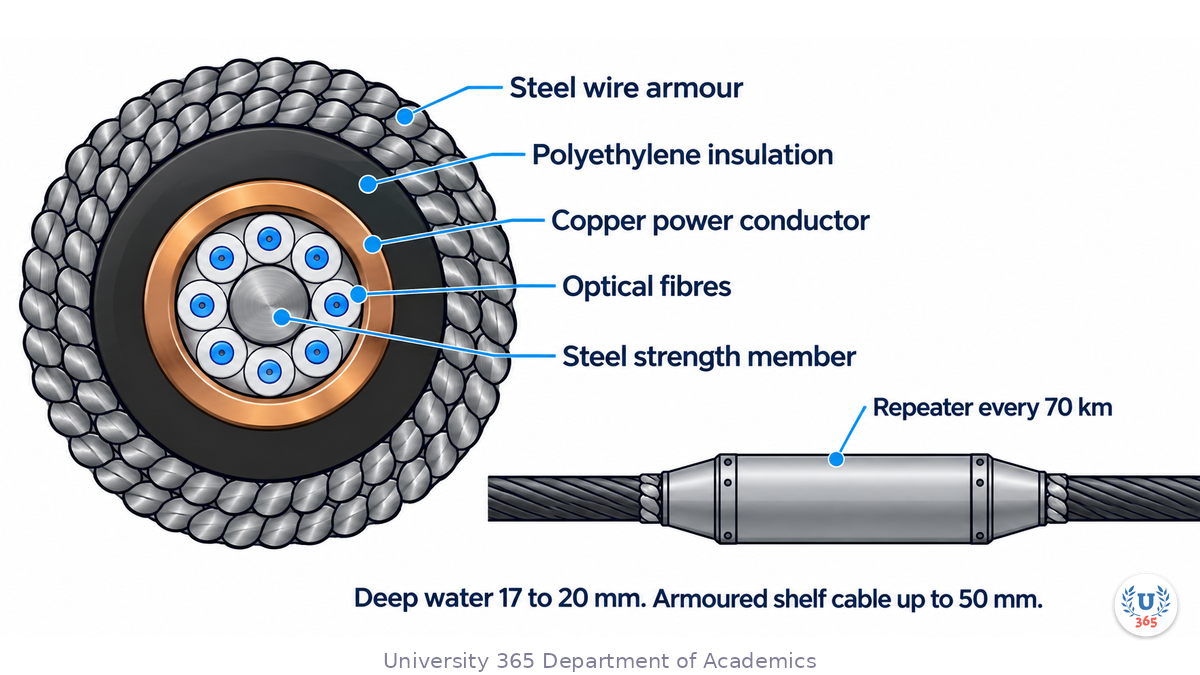
The cable is thinner than most people expect. In deep water it measures about 17 to 20 millimetres across. On the continental shelf, where anchors and trawls reach it, armour brings the diameter to between 28 and 50 millimetres, and a double-armoured cable can carry a breaking strength above 40 tonnes (UNEP-WCMC, Submarine Cables and the Oceans, 2009).
The layers have separate jobs. At the centre sit the optical fibres, each about the diameter of a human hair, which carry the light. Steel strength members take the tension of laying and recovery. A copper conductor carries the direct current that powers the repeaters. Polyethylene insulates the assembly, and steel wire armour protects it where the water is shallow enough for damage.
Repeaters are the part that makes distance possible. Light weakens as it travels through glass, so the signal is amplified about every 70 kilometres by an erbium-doped fibre amplifier inside a sealed cylinder (UNEP-WCMC 2009). Those cylinders need power, which is why a cable carries copper as well as glass. Capacity is set by the number of fibre pairs and the terminal equipment: TeleGeography gives the MAREA system a potential capacity of 224 terabits per second.
Damage has two shapes. If the copper is exposed, current leaks into the sea and the repeaters beyond the shunt lose power even though the fibres are intact. If the fibres are cut, the optical path is lost. Both trigger an alarm in the terminal station within seconds (UNEP-WCMC 2009).
How a Cable Reaches the Seabed
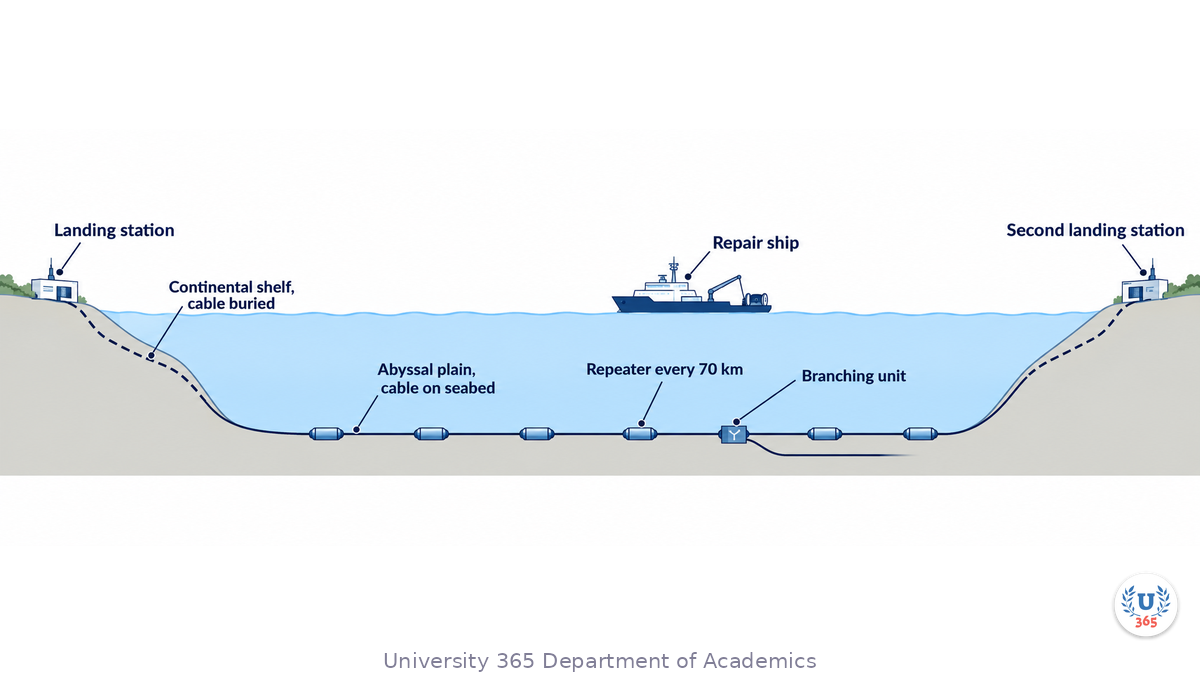
Every route starts with a marine survey. The survey maps the seabed, the fishing grounds, the anchorages and the unstable slopes, because a cable that never needs a repair ship is the cheapest to operate. The route on TeleGeography's map is stylised: the company says its lines do not show precise positions, only the landing points and the general path.
Laying is a controlled feed, not a drop. A cable ship moves at about 6 to 8 knots, slowing to pass each repeater through its machinery, and pays out cable with enough slack to follow the seabed profile without spanning a trench (UNEP-WCMC 2009). Near shore, where the risks are, the cable is buried below the seabed by a plough or a water jet. In the abyss it is laid directly on the floor, and TeleGeography confirms that is where it stays.
At each end the cable enters a landing station, which supplies power and joins the system to terrestrial fibre. A modern system is engineered for a design life of at least 25 years, though most are retired for economic reasons before they fail (TeleGeography).
Who Owns the Route
Ownership is mixed. Cables were traditionally built by a consortium of telecom carriers who shared the cost and the capacity. In the late 1990s private companies built cables and sold capacity on them. Both models survive, and the bigger change is who is buying: content providers including Google, Meta, Microsoft and Amazon are now major investors in new systems (TeleGeography).
Ownership rarely means exclusivity. A landing station may serve several systems, and many cables are held by a club whose members own fractions. Below the commercial layer sit the maintenance agreements: regional contracts that keep a repair vessel on standby for the cables in a zone, such as the Atlantic Cable Maintenance Agreement and the South East Asia and Indian Ocean Cable Maintenance Agreement (ITU IAB report, 2026).
That structure explains the map. A cable is a private asset with a public function, built through territorial waters and exclusive economic zones under the law of the sea. The route is a set of permits before it is a line on a chart.
How a Fault Is Found and Repaired
A fault begins as an alarm. The terminal station sees loss of signal or a change in the power feed, and a test set measures the distance to the break by timing reflections down the fibre, a method called optical time domain reflectometry. The result can locate the fault to within metres on a route thousands of kilometres long (Zhang et al., Processes, 2026).
Then the waiting starts. The ICPC's 2026 statistical analysis, covering more than 3,000 repair records across 18 years, puts the average at 22.5 days from fault to the ship sailing, plus 7.5 days of transit to the site. The longest delay in the record is 947 days. The ITU report gives a global median commencement time of 8.0 days and an average of 22.7, a gap that shows how far the outliers sit from the typical case.
The repair itself is slow and precise. The ship lowers a grapnel and hooks the cable, then raises one end to the surface. A joint takes 10 to 24 hours of work, and the ship must hold station for 24 hours or more, so the jointing phase usually runs one to three days (ITU 2026; UNEP-WCMC 2009). The repaired cable is then lowered back to the seabed.
Why the Map Is a Political Document
Concentration is the reason. The ITU report counts at least 17 cables through the Bab el-Mandeb strait, carrying an estimated 17 to 20 per cent of global internet traffic through water less than 14 miles wide. The Suez corridor carries an estimated 90 per cent of Europe to Asia communications through shallow water for more than 100 miles.
Concentration turns an accident into an event. On 24 February 2024 three systems in the Red Sea were cut: EIG, Seacom/TGN-EA and AAE-1 (Kentik). Approvals for one repair took up to eight weeks, and repairs were completed in July 2024 (ITU 2026). In November 2024 two cables in the Baltic were damaged; the ICPC reports that service continued and both were repaired within two weeks.
The map also misleads in the other direction. The Strait of Hormuz carries five active cable segments and less than 1 per cent of international bandwidth, according to TeleGeography analysis cited by the ICPC, so claims that it holds the world's internet together overstate a regional route.
What makes the document political is not the drawing. It is the legal geography underneath: which state grants the permit, which state controls the landing station, which navy escorts the repair ship. The ITU's recommendations now ask governments to streamline permits, chart cables at all depths and treat the network as critical infrastructure (ITU 2026).
Undersea Cables: The Physical Internet
The Feynman Summary
Here is the whole thing in plain language. A submarine cable is a bundle of glass threads inside a steel and plastic tube, with a copper wire running alongside. The glass carries light, which is the data. The copper carries electricity, which powers the amplifiers that keep the light strong enough to cross an ocean. The amplifiers sit about every 70 kilometres, in sealed cylinders, and they are the reason a cable is a powered system rather than a passive one.
A cable is laid by a ship that pays it out onto the seabed, burying it near the coast and leaving it on the floor in deep water. It comes ashore at a landing station, where it joins the land network and the power supply.
When it breaks, which happens 150 to 200 times a year around the world, a test tells the operator how far away the break is. A repair ship sails, hooks the cable, cuts out the bad section, joins a new piece and lowers it back. Most breaks are caused by fishing gear or anchors, not by sabotage. The repair takes weeks, and the delay is now mostly paperwork, not engineering.
Undersea Cables: The Physical Internet
The Evidence
The engineering facts are well documented and stable. The layer structure, the 17 to 20 millimetre deep-water diameter, the 70 kilometre repeater spacing and the 10 to 24 hour joint all come from the 2009 ICPC and UNEP-WCMC report, a consensus industry document rather than a single study. The 2026 review in Processes repeats the same architecture and adds the current repair workflow, including reflectometry for fault location and grapnel recovery.
The fault statistics are the strongest part of the record and the weakest part of the public picture. The ICPC holds more than 3,000 anonymised repair records across 18 years and 137 jurisdictions, which is the best dataset available. Its 2026 analysis gives the cause split: fishing about 28 per cent, anchoring about 14 per cent, a further 38 per cent where the two cannot be separated, geological events and abrasion about 17 per cent, and intrinsic equipment failure about 3 per cent. Fishing and anchoring together account for about 80 per cent.
What the record does not show is a complete census. Cable owners treat route and fault data as confidential, the ICPC does not investigate causes, and there is no central global register. TeleGeography counts roughly 200 faults a year; the 2026 review counts 259 publicly reported faults between 2015 and 2025, which is a different measure. Totals for cable length also differ by counting rule: 1.48 million kilometres in early 2025 in one review, over 1.5 million in TeleGeography's estimate for early 2026, and 1.7 million in a 2025 paper. Treat any single total as an estimate with a stated method.
One case shows why redundancy matters more than fault counts. The January 2022 Hunga Tonga eruption sent seafloor flows at up to 122 kilometres per hour across the only international cable, and Tonga was left in near-total digital isolation for 61 days, with losses estimated at USD 182 million, or 38.7 per cent of its 2021 GDP (ITU 2026; Clare et al. 2025).
Undersea Cables: The Physical Internet
The Counter-Case
The strongest competing reading is that the network is more resilient than the coverage suggests. Faults are routine: 150 to 200 a year, with about 80 per cent caused by fishing and anchors. Outages are rare because operators spread traffic across several cables, and a single cut is usually absorbed. The ICPC makes this point directly about the Baltic, where two damaged cables in November 2024 caused no interruption and were repaired within two weeks.
On that reading, the cable map is a risk register, not a vulnerability report. Concentration at a chokepoint matters only when a second path does not exist, and TeleGeography's own guidance is that a country needs more than one cable for reliable connectivity.
The observation that would settle it is a measured one. A sustained outage at a chokepoint with no alternate path, or a fall in repair commencement times after permitting reform, would show which reading holds. Until then, both are consistent with the same fault statistics.

Undersea Cables: The Physical Internet
What It Means for You
Quality of Life is the ULM domain this touches first, because the practical gain is judgement. A headline about a cut cable is now readable: you can ask which system, which corridor, and whether an alternate path exists. That replaces a vague sense of fragility with a specific question, and it stops the most common overreaction, which is to treat every cut as evidence that the internet is about to fail.
Career and Finance is the second domain. If your work depends on cloud services or international payments, route diversity is a supplier question you can put in writing: how many distinct landing stations serve the region, which corridors do they use, and what repair arrangement is contracted. The answers separate a resilience plan from a marketing claim.
LIPS places this in the Interests pillar while it stays understanding. If it becomes a review of your own suppliers, it is a project, with a date and an owner. This brief follows the pattern described in the Interests method page, which explains how a subject like this is turned into a brief you can use.
Ask which system When a cut is reported, name the cable and the corridor before accepting a claim about global impact.
Ask for route diversity Request the number of distinct landing stations and corridors behind any service you depend on.
Read the permit line If a repair is delayed, check whether the cause is weather, a vessel shortage or an approval, because only the third is a policy choice.
The Applied AI Connection
How much AI a cable actually uses is narrower than the announcements suggest, and the narrow part matters most. Finding a break is physics, not statistics. A coherent OTDR sends a pulse down the fibre and reads the light scattered back through the loop-back path in each repeater, which places a fault along hundreds of kilometres of cable to within metres. That measurement is deterministic and has been routine for years.
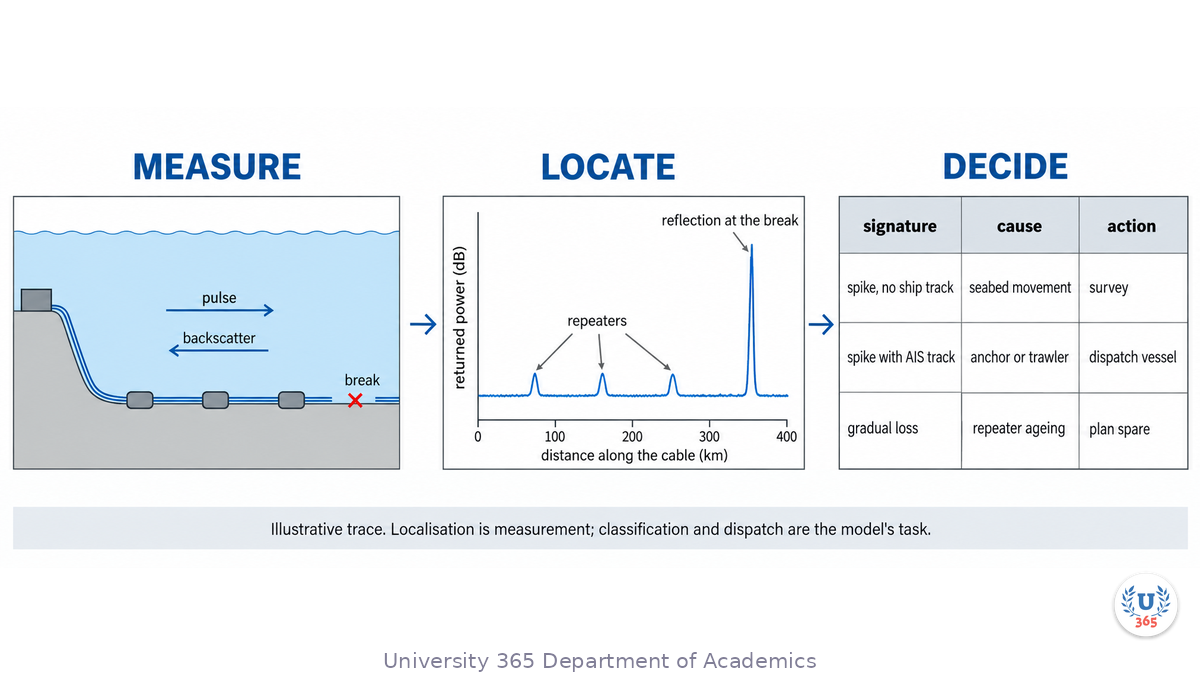
The statistical layer sits above it. Fault signatures differ by cause, an anchor drag, a trawler, a turbidity current, and sorting a signature from its trace, together with ship traffic recorded by AIS, is a pattern problem. So is repair planning: which vessel, which spare, which landing station, given weather and permits.
What changes for you: the model does not find the break. It shortens the argument about what caused it and which asset to move, and that argument decides how many weeks you wait for a route to come back.
Undersea Cables: The Physical Internet
The Five-Minute Version
The object. A cable is 17 to 20 millimetres across in deep water and up to 50 millimetres where it is armoured. Glass fibres carry light, steel takes the tension, copper powers the repeaters, and polyethylene and armour protect the assembly (UNEP-WCMC 2009).
The distance. Repeaters amplify the signal about every 70 kilometres, which is why a long cable is a powered system. MAREA has a potential capacity of 224 terabits per second (TeleGeography).
The route. A ship lays the cable at 6 to 8 knots, buries it near shore and leaves it on the seabed in deep water. It lands at a station that supplies power and joins the terrestrial network.
The ownership. Consortia, private operators and content providers own the systems. Regional maintenance agreements keep repair vessels on standby, and landing stations are often shared.
The fault. Fishing and anchors cause about 80 per cent of faults. A reflectometry test locates the break, a ship hooks the cable, and a joint takes 10 to 24 hours, with the ship holding station for a day or more.
The delay. The ICPC record averages 22.5 days from fault to sailing plus 7.5 days of transit, and average commencement time more than doubled between 2012 and 2024. Permits, visas and vessel scarcity drive the delay more than engineering does (ITU 2026).
If you remember one number, remember 70 kilometres, the repeater spacing that makes an ocean crossing possible. If you remember one judgement, remember that a cable cut is usually an accident, and that the interesting question is not whether the cable broke but how long the repair was allowed to take.

Undersea Cables: The Physical Internet
Sources
Every source below was opened and read on 20 October 2026. Where a publisher blocks automated reading, the link goes to an open bibliographic record for the same document.
TeleGeography, Submarine Cable Frequently Asked Questions (2026). telegeography.com
ICPC, Media Enquiries and Frequently Asked Questions (2026). iscpc.org
ICPC, Damage to Submarine Cables from Dragged Anchors (24 February 2025). iscpc.org
ITU and ICPC, International Advisory Body on Submarine Cable Resilience: Report of the Working Groups (2026). itu.int
ICPC and UNEP-WCMC, Submarine Cables and the Oceans: Connecting the World (2009). iscpc.org
Zhang et al., Processes 14(5), 821 (1 March 2026), open bibliographic record. openalex.org
Palmer-Felgate, Global Submarine Cable Faults and Repair Dynamics: A Statistical Analysis (2026), open bibliographic record. openalex.org
ICPC, Government Best Practices for Protecting and Promoting Resilience of Submarine Telecommunications Cables, version 1.2. iscpc.org
Clare et al., Volcanic eruptions and the global subsea telecommunications network, Bulletin of Volcanology 87, 51 (2025). link.springer.com
Kentik, What Caused the Red Sea Submarine Cable Cuts? (March 2024). kentik.com
Ciena, submarine network OTDR and C-OTDR measurements (21 October 2020). ciena.com




Comments