
Zapier: workflow automation and AI orchestration on three separate meters

Status: Active | Last tested: 2026-09-27 (Zapier, as its product, pricing and legal pages described it on that date) | Re-check: trigger-based (max 6 months)
Active: the tool is current and recommended.
Reviewed as documented at zapier.com in September 2026. Zapier sells one platform and two AI products that are metered three different ways, and it has spent 2026 moving them all onto the same task meter. A reader who compared prices last year will find a different bill today, and a reader who builds a workflow with AI steps and tool calls will find a different bill again. That billing structure is not a footnote to this review: it is the mechanism that decides whether the platform is worth its price for your work, and it is where most of the published confusion about this product lives.
Zapier scores 5.0 out of 10 on the U365 CI-First Review, which is CI-First Positive, with a Humics-Neutral protection badge at -1 / +3 and a Medium AI Imposture Risk carrying Skill Illusion High. The platform's connection layer is the widest in the category and its per-action meter is the most expensive, and the same billing structure produces both facts.
For detailed explanations of the CI-First evaluation terms used in this review, including the Humics Protection Badge and the AI Imposture Risk levels, see the Glossary at the end of this post.


In this Tool Review
Status and Re-check
Status: Active | Last tested: 2026-09-27 (Zapier, as its product, pricing and legal pages described it on that date) | Re-check: trigger-based (max 6 months)
Active: the tool is current and recommended.
For detailed explanations of the CI-First evaluation terms used in this review, including the Humics Protection Badge and the AI Imposture Risk levels, see the Glossary at the end of this post.
Re-check triggers:
A change to the task meter or to the published task rates. A task became "any successful action that runs in Zapier" during 2026, AI steps were priced by model tier at 1x, 3x and 5x, MCP tool calls were set at two tasks each, and pay-per-task overage became the default behaviour for accounts created after January 2024. Any further change to those rates, or to the cap at three times the plan limit, changes what this platform costs for the same work.
Publication of an independent measurement of AI-step or agentic reliability. No accuracy figure, eval or controlled test exists for the AI step, the tool-calling agent, or the MCP action layer. The Quality sub-score of 5 rests on that absence, and a published measurement with a stated method would require the score to be re-run rather than adjusted.
Completion of the Agents to AI by Zapier migration, and the arrival of knowledge sources in AI by Zapier. The standalone Agents product is being converted into the AI step, the vendor states that knowledge sources are coming in Q3 2026, and the Enterprise tier of the Agents add-on was still showing as coming soon on the public pricing surface. Any of those moving changes what this review is a review of.
A change to the Derived Data clause or to its opt-out path. The terms allow Zapier to derive de-identified data sets from your content and to use them including through model training, with an opt-out form and an automatic opt-out for Company and Enterprise plans. Any narrowing or widening of that clause is a re-check.
A change to the Sensitive Personal Data prohibition. The terms forbid uploading the categories they define as Sensitive Personal Data, which includes health information, financial account numbers, government identifiers and the GDPR special categories. A change in that list, or a compliance-oriented offering that changes the practical position, is a re-check.
A change to the default of per-tool approvals, or to the treatment of AI-composed messages. Tool actions run without pausing for confirmation by default, approval is opt-in per tool, and a single run that exceeds 75 tasks pauses itself. Those defaults decide the oversight position this review describes.
A pricing or availability change to the AI add-ons. The Agents add-on and the Chatbots add-on carry their own meters, with 400 free activities and 1,500 paid activities on Agents, and chatbot counts on Chatbots. Their retirement, repricing or folding into the platform meter is a re-check.
A published security incident, or a change to the certification position. The vendor publishes a trust centre and states SOC 2 Type II certification for the MCP surface. A material change to either belongs in this review's governance section.
One vendor, four products and three meters, stated before the review begins
Zapier is one of the products most often compared against the wrong version of itself. Blogs quote three different monthly prices for "Zapier Agents", guides written before June 2026 quote a task definition the vendor retired, and the product that was named Agents is currently being converted into a different product with a different meter. The distinctions below are the ones that decide a bill, so they belong at the top of the review.
Name | What it is | Relationship to this review |
zapier.com | The platform: Zap workflows, Tables, Forms, Canvas, Zapier MCP and the SDK, sold as one product and metered by tasks per month on a volume selector that runs from 100 to 2 million | The subject of this review. Every platform plan includes the full feature set; what differs between tiers is the task volume and the support level |
AI by Zapier | The AI step inside a Zap: a prompt, a model chosen from a tier list, and optionally tools (app actions and knowledge sources) that the step can call | The subject of this review. Metered from the same task pool, at a multiplier set by the model tier: Standard 1x with no tools, Advanced 3x, Premium 5x, or 1x with your own API key |
Zapier Agents | The standalone product at agents.zapier.com, metered by activities rather than tasks, and currently being migrated into AI by Zapier as a single AI step inside a Zap | In scope as the legacy surface. The vendor states that migration keeps the agent's prompt, tools and reasoning inside one AI step, and that agents which were not migrated before the trial windows expired convert to a free Agents account |
Zapier Chatbots | A separate product that answers customer questions, metered by the number of chatbots rather than by usage | In scope. It is the surface where a reader's customers meet a Zapier-built system directly, and it is priced on its own meter |
Zapier MCP | The action layer that lets an external AI client such as Claude, ChatGPT or Cursor run Zapier actions, at two tasks per successful tool call | In scope. It is also where the vendor's Skills surface lives, which is treated in the clause note and in Section 7c |
Zapier, Inc. | A Delaware corporation, with notice address in San Francisco and the contract governed by Delaware law | The contracting party. A reader comparing the site against a purchase order should use the entity in the terms |
Two consequences follow. First, the word "task" was redefined during 2026, so the same workflow can cost more tasks than it did before without any price changing: an AI step now consumes three or five tasks per run by default, a tool call inside it consumes the model rate again, and a Zapier MCP tool call consumes two. Second, a reader searching for the price of "Zapier Agents" will find figures from three different states of the world, and only one of them is current. This review uses the vendor's own pricing page, help centre and legal documents, read on 2026-09-27, and it names the meter behind every figure it quotes.
Tool Snapshot
Zapier
Provider: Zapier, Inc., a Delaware corporation and the contracting party named in the terms of service, with a notice address at 548 Market St. #62411, San Francisco, CA 94104-5401
Version tested: Zapier, as documented at zapier.com in September 2026
License: Proprietary, sold as a subscription, with AI steps drawn from the same task pool and the Agents and Chatbots add-ons metered on their own allowances
Platforms: Browser application at zapier.com, a Chrome extension for the agents surface, and an MCP server reachable from AI clients. No self-hosted deployment
Tagline: The agents page presents the product as "your new AI teammates" that "do work across 9,000+ apps - on command and while you sleep", against a trust line that reads "Zapier is trusted by 3.4 million companies". The same page carries a second trust line reading "Zapier is trusted by over 2.2 million". Both figures are discussed in the Faculty Note.
Category: Workflow automation and AI orchestration platform. A cloud service that connects applications through trigger-and-action workflows, adds AI steps and tool-calling agents inside those workflows, exposes the same action library to external AI clients through an MCP server, and adds data tables, forms and a diagramming surface around them.
Primary use cases:
Moving data between two applications on an event, which is the core use and the reason the product exists: a form submission becomes a CRM record, an invoice email becomes a row in a sheet, a support ticket becomes a Slack message.
Multi-step business processes with branching, error handling and human approval steps inside the workflow.
Adding AI work inside an automated process: classify, summarise, extract, draft or score, using a model tier chosen per step.
Running tool-calling agents that research, enrich and act across connected apps, either on a schedule, on a trigger, or from an AI client through the MCP server.
Customer-facing question answering through Chatbots.
Building the internal data layer around automations: Tables for storage, Forms for intake, Canvas for mapping the process.
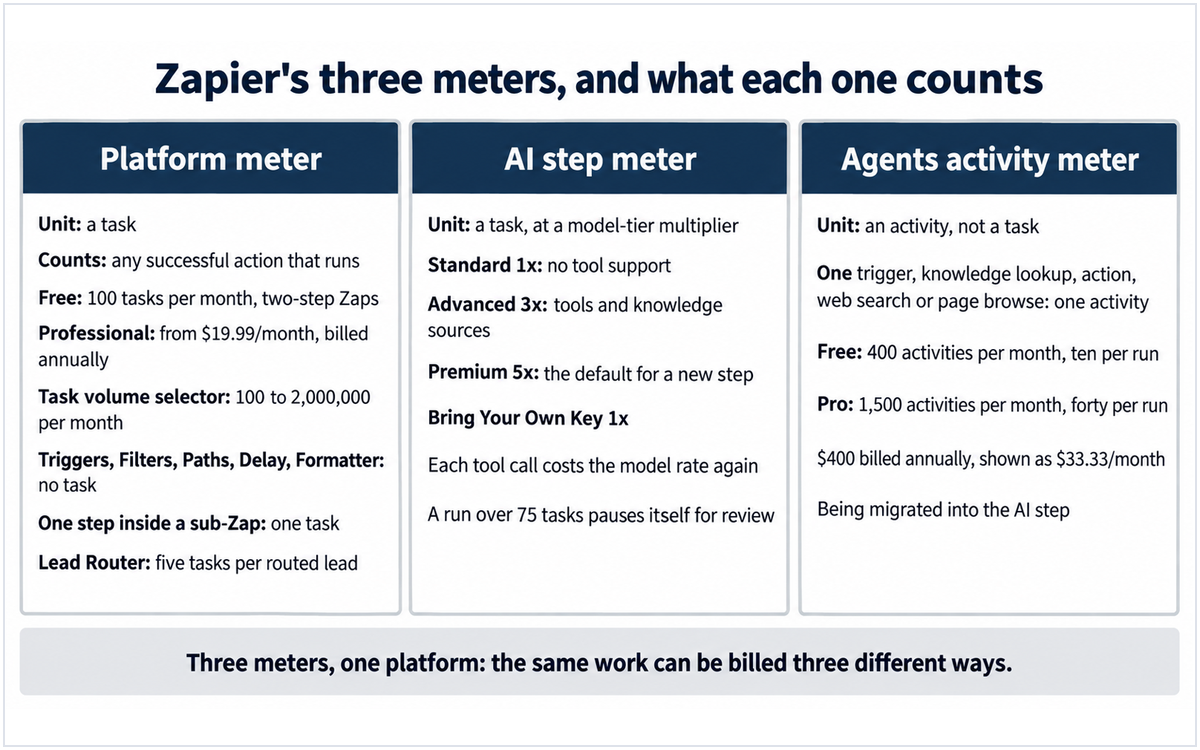
Pricing, as published on 2026-09-27. Three meters, and this is the part most comparison articles get wrong.
Meter | Free | Entry paid | What it counts |
Platform (Zap workflows, Tables, Forms, Canvas, MCP, SDK) | $0, 100 tasks per month, two-step Zaps | Professional, "starting from $19.99/month" billed annually, with the task volume chosen on a selector from 100 to 2 million tasks per month; Team "starting from $69/month" adds 25 users and shared administration | Tasks: any successful action that runs, at rates that vary by action type |
AI by Zapier (the AI step) | Included in the platform plans | No separate price: it draws on the task pool at the model-tier multiplier | Tasks, at 1x, 3x or 5x per model tier, plus the same multiplier again per tool call |
Zapier Agents (add-on, migrating) | $0, 400 activities per month | $400 billed annually, shown as $33.33 per month, for 1,500 activities per month | Activities: a trigger, a knowledge lookup, an action, a web search or a page browse each counts as one |
Zapier Chatbots (add-on) | $0, 2 chatbots | $160 billed annually, shown as $13.33 per month, for 5 chatbots; Advanced $800 billed annually, shown as $66.67 per month, for 20 chatbots | Chatbot count, not usage |
Published task rates, from the vendor's own help centre: one task per successful action step; one task per step inside an error handler when it runs; one task per step that reruns during a full Zap replay; one task for each step inside a sub-Zap; one task for a search action set to proceed if nothing is found, and no task when it is set not to proceed; five tasks per lead routed by Lead Router; two tasks per successful Zapier MCP tool call. Triggers never consume tasks, and neither do Filter, Paths, Delay, Looping, Digest, Storage, Tables or Forms steps. Failed and skipped steps consume nothing.
Platforms: A browser application at zapier.com, a Chrome extension for the agents surface, and an MCP server reachable from AI clients. There is no self-hosted deployment.
Integrations: The vendor states 9,000 or more apps across its product pages, and states 66,000 or more triggers and actions on the MCP page alongside a second figure of 30,000 or more actions in the same page's FAQ. Historical and third-party figures run lower, from 5,000 to 7,000 apps. The spread and what it means for planning are covered in the Faculty Note.
Security and compliance position, as published: A trust centre, SOC 2 Type II certification stated on the MCP page, SAML SSO on the Team plan and above, admin controls for app access, action restrictions and model blocking, and an approval flow that administrators can require before any Zap containing AI steps is published. The terms forbid High-Risk Activities and the upload of Sensitive Personal Data; Section 7c sets that position out.
Who it is for: Teams that need many applications connected without building the connections, and that are willing to pay a per-action rate for the convenience. The reader who gains most is the operations, marketing, sales or IT practitioner who currently moves data by hand between tools that do not talk to each other, and the reader who gains least is the engineering team whose volumes are high enough that the per-action rate dominates the bill.
What it is not: It is not a development platform and it does not try to be. There is no package manager, no version control on workflows, no local execution and no unit testing of a workflow in the ordinary software sense. Where a team needs those, the self-hosted alternatives in Comparison and Alternatives are the honest answer, and this review says so there.
The Problem
Automation is sold as a way to stop thinking about a process, and the thinking is the part that decides whether the process works.
The problem Zapier addresses is real and it is not a marketing problem. A modern small business runs on twenty or thirty applications that each hold a fragment of the same fact, and the fact has to move. A customer fills a form, and the same name and address has to appear in the CRM, the invoice system, the email tool and the support desk. Someone copies and pastes, or someone writes a script, or the business buys a product whose entire purpose is to move the data reliably. Zapier is that product, at the largest scale in the category, and it earned that position by being the easiest of the three options to start.
The first problem is cost, and Zapier's cost problem is structural rather than a matter of list price. The platform charges per action rather than per workflow run, which means the price of a process rises with its complexity: a five-step Zap that runs a thousand times costs five thousand tasks, and the same process on a platform that charges per run costs a thousand. Every published comparison in the category says the same thing in different words, and Zapier has answered it not by changing the meter but by redefining it, so that a task is now "any successful action that runs", AI steps cost three or five tasks each depending on the model, and a tool call inside an AI step costs the model rate again. The published starting price did not move while the unit of consumption broadened, and the consequence for a buyer is that the advertised entry figure describes the simplest possible month.
The second problem is the one this review weighs most heavily. When a process is automated, the process stops being visible. A Zap that stops working because an application changed its authentication, a step that silently receives an empty field, an AI step that returns a plausible classification that is wrong, and a filter that quietly excludes half the records all look identical from the outside: nothing appears to have happened, and that is exactly what a working automation looks like on a quiet day. The vendor's own help centre answers the question "why don't I get the same outcome from AI every time?" as one of its published FAQs, which is an honest thing to publish and also a statement that the AI surface is not deterministic. The user's exposure is that verifying an automation means reading its run history, and reading run history is the first habit that a tool sold as labour-saving discourages.
The third problem is the one every automation platform shares and Zapier's scale makes acute. When the connection layer becomes a single company, that company holds connections into mail, files, customer records and finance for millions of businesses, and it holds them with credentials it manages on the user's behalf. That concentration is the bargain: the platform exists precisely because connecting everything one-to-one is worse. What a buyer has to read, and what fewer buyers do read, is the contract that governs that position: how the content that passes through the platform may be used, what categories are forbidden to send through it at all, how the subscription renews, and what happens to the data when the account goes quiet. Section 7c reads those terms, because on this product they are not boilerplate: they contain a training clause with an opt-out, an outright prohibition on the categories most likely to appear in a CRM or a support inbox, and a cancellation mechanic that the platform's own customers complain about in public.
The fourth problem is specific to the moment this review is written. The product is mid-transformation: the standalone Agents product is being converted into a step inside Zaps, the pricing surface still sells an Agents plan whose Enterprise tier shows as coming soon, knowledge sources are announced for a quarter that has not finished, and whole categories of the product are labelled beta or early access. A buyer pricing this in September 2026 is pricing a moving target, and the honest advice is to price the workflow you have rather than the capability you were shown.
The Outcome
You get the widest connection layer in the category at the highest published per-action cost, and the platform's own defaults leave the oversight work with you.
If you adopt Zapier, this is what actually changes.
The connections stop being the bottleneck. Nine thousand applications, a template library, and an OAuth flow per app instead of a project per integration. A workflow that once needed a developer now needs an afternoon, and an operations person with no technical title can build something genuinely useful. That is the product's core benefit and it is not in dispute anywhere in the public record.
The bill becomes a function of your workflows' shape, and it is metered in a way that punishes complexity. You will find yourself counting steps before building, choosing between an AI step and three ordinary ones, and using filters earlier to keep the count down. That is not a defect of your budgeting; it is the intended discipline of a per-action meter, and the reviews in the public corpus confirm that experienced users make exactly those trade-offs. Budgeting for it deliberately is the difference between the platform costing what the pricing page suggests and costing a multiple of it.
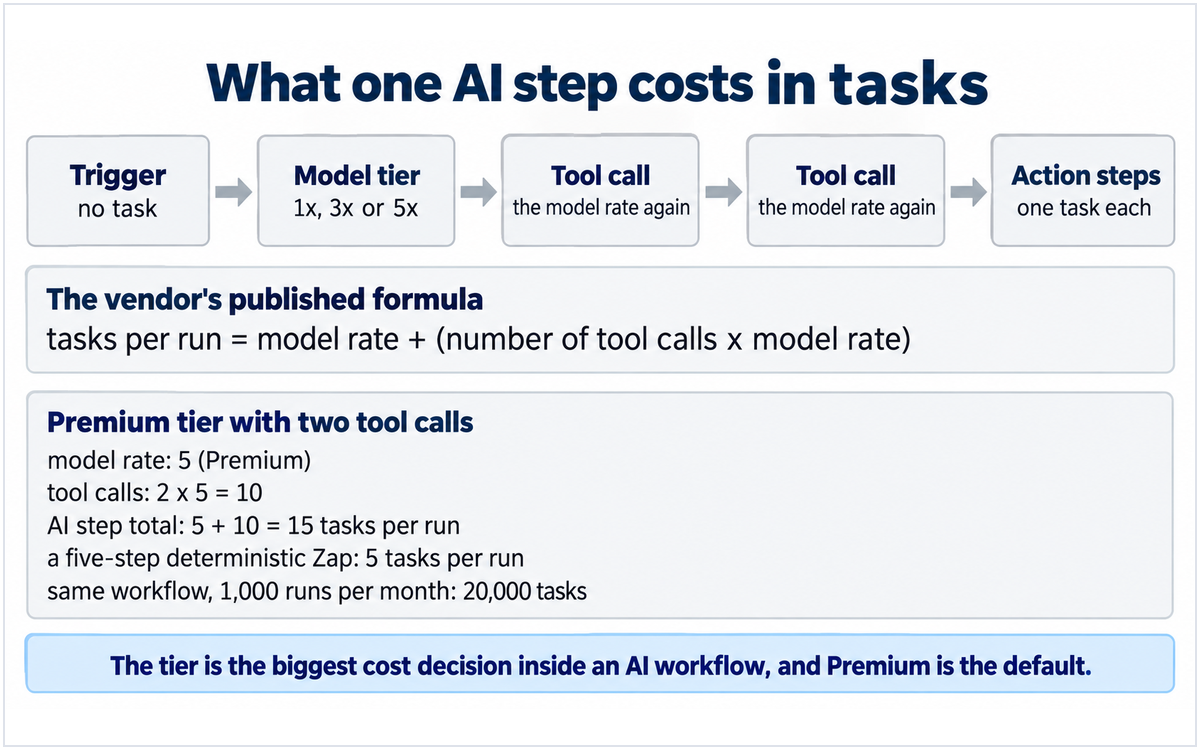
Your AI work will run inside the same process, at multipliers that need arithmetic. An AI step defaults to the Premium tier at five tasks per run, and a tool call inside that step costs the model rate again: a Premium step that calls two tools consumes fifteen tasks per run before any ordinary action runs. At the volumes where automation makes sense, that arithmetic is the cost model. The vendor publishes the formula and the model lists, which is the right thing to do, and the number it produces is still one most buyers will not have predicted.
Oversight becomes a configuration choice, and the default is off. Tool actions in an agentic step run without pausing for confirmation unless you turn on approval for that tool, and the vendor's own guidance is to leave approval off for reads and turn it on for writes. A single run that exceeds 75 tasks pauses itself, which is a real guardrail against runaway loops and not a substitute for a decision about what your agents may do unattended. If you write nothing down about which actions may run without you, the default you inherited is "all of them".
And the process will need an owner, permanently. The workflows that survive are the ones somebody reads. The platform gives you the tools to do that reading: a run history that shows which tools were called, which model tier ran and how many tasks the run consumed, error-handler paths, and admin publishing approvals for AI steps. None of those are on by default except the history, and a team that never opens it is running automations on trust.
Who Should Use Zapier
The short answer: the reader who needs many applications connected and can accept a per-action price, and the reader who will keep one person accountable for reading the run history.
Read this first if you are deciding. Zapier is not a tool you adopt for one workflow. It is a tool you adopt when the shape of your problem is "these twenty applications hold fragments of the same fact", and the value comes from the second, third and tenth workflow after the first one worked. A reader with one integration to build should use a script, a webhook or the applications' own built-in connectors, and this review says so in the Alternatives section rather than pretending otherwise.
The U365 Fellow who gains the most
An operations or marketing practitioner with no engineering title who currently moves data by hand. This is the reader the product was built for and the reader whose benefit is largest and most measurable. The published corpus says the same thing with volume behind it: the two pros named most often on the largest review platform are ease of use and integrations, and the recurring complaint is cost rather than capability. If your week contains an hour of copying names and addresses between tools, the platform pays for itself at the free tier before you spend anything.
A small team's generalist who has to answer a customer within a working day. Classify, route, draft against a knowledge base, escalate. The AI step and the Chatbots surface make a single person look like a small support desk, and the platform's own templates for exactly that job are published and free to copy. The caveat this review carries into that recommendation is the Skill Illusion rating: the platform makes the system look finished before you understand what it does when it is wrong.
A team that already pays for four tools whose only job is connecting two others. Consolidation is a real benefit. A reader running a form tool, an email tool and a spreadsheet connector can often replace all three with Forms, an AI step and Tables on one bill, and the administrative saving is as real as the licence saving.
A UIT or UIB cohort studying how business processes are actually connected. The platform is the reference implementation of the no-code automation category, its own help centre is well written, and the failure modes it demonstrates (silent step failures, polling delays, credential expiry, cost per action) are the failure modes of every process automation project a Fellow will meet later. The institute reading is in the U365 Institutes Alignment section and it is a strong one, with the limit stated there rather than here.
The U365 Fellow who should not adopt this
A technical team whose volumes are high. Above a certain volume, a per-action meter is the wrong meter, and the honest alternatives are in Comparison and Alternatives: n8n self-hosted, or Make at a lower per-unit rate, or writing the integration once. The threshold is not fixed and it is measurable on your own data, which is why the fifteen-minute checklist in Getting Started puts the arithmetic before the purchase.
Anyone whose data includes the categories the terms forbid. Health information, financial account numbers, government identifiers and the GDPR special categories are prohibited to upload, and a CRM or inbox wired into a workflow is exactly where those categories live. This is the first item in Section 7c and it is a disqualifier for some readers rather than a consideration.
A reader looking for an agent platform that owns a long-running task. The agents surface is being migrated into the AI step, knowledge sources are announced rather than present, and the autonomous, unattended, hours-long task belongs to other products in this series with their own reviews. Zapier's strength is many short, reliable, connected actions; a reader who needs a reasoning agent that works for an hour is buying the wrong shape of tool.
A reader who will not read the run history. Said plainly because it is the review's central practical claim: the platform's defaults are permissive, the failure mode is silence, and a team that treats a published workflow as finished is running on trust. If nobody will own that, the money is better spent elsewhere or on a person.
Institute alignment, in one paragraph
The primary home is clear and it is not the institute the category suggests. Automation is an engineering-adjacent skill, but what a U365 cohort can actually take from Zapier is a business and communication competence: which process is worth automating, where the approval boundary sits, what may leave an account without a person reading it, and how to cost a metered service against the work it replaces. The tool executes; the judgements are the institute content. The U365 Institutes Alignment section sets out the four institutes, each with the competency that remains and the limit that holds the row.
U365 Institutes Alignment
Zapier sits on the connective layer between applications, and the alignment below rates what a U365 institute could take from it as a working instrument and as an object of study. The primary home is UIB, because the decisions the platform forces are commercial before they are technical: which process, at what cost, with whose approval, and against which return. The other three readings are real and each is bounded.
Institute | Rating | Why | The limit that holds the row |
UIB (Business Management, Entrepreneurship) | High (primary) | Three competencies a practitioner supplies and each survives the removal of the tool. Process selection: deciding which process is worth automating from its volume, its error rate and what it costs to run. Approval-boundary design: stating which actions may run unattended and which must pause for a person, which the platform exposes as a per-tool switch and leaves off by default. And metered-service appraisal: converting a task allowance into a cost per completed process, allowing for the 3x and 5x model multipliers, the two-task MCP rate and the five-task Lead Router rate, then deciding the tier from a measured burn rather than from the advertised entry figure. Those are the questions of a business case, and this review's Getting Started checklist and Workflows put them in the reader's hands | The tool teaches no management content of its own and the appraisal is a costing exercise rather than a discipline. A word-start search over all 79 published programme descriptions in the Online Programs catalogue on 2026-09-27 returned zero matches for cost, pricing, price, metered, usage-based, unit economics, invoice, procurement and supplier, and zero for audit, compliance, retention, privacy, consent and disclosure. The single match for governance sits inside the Bachelor of Science in IT description as "Risk Management & Information Governance", which is organisational governance of data rather than the governance of an automated action, so it is recorded rather than counted. The nearest published anchor is Business Analysis Professional, which publishes Business Analysis Foundations, Agile Requirements, Business Bebefits Realization, Project Manager Collaboration, Business Process Modeling, Leadership Foundations and Communication skills, with the module spelling reproduced as the catalogue publishes it. That is process specification and benefits realisation, which is adjacent, and it does not publish procurement or total-cost appraisal. No credential is claimed here |
UIC (Digital Communication, Marketing) | Medium | One competency that matters and it is the one the platform makes invisible. The publication rule for an automated channel: what may leave an account without a person reading it, which voice it carries, and what the engagement numbers returned by the pipeline actually support. On this tool that rule is not theoretical. Chatbots answers customers on the reader's behalf, template agents draft sales email and support replies, and an AI step can write into a social or email surface. A communication cohort can also study the category's central case, which is the industrialisation of audience contact, and it can measure what an automated reply does to a relationship | The tool composes no communication craft. It teaches no register, no audience analysis and no standard for what a message should say, and its own published guidance points a user at templates rather than at writing. A word-start search over the same 79 published programme descriptions returned zero matches for consent, disclosure, impersonation and privacy. The nearest published anchors are Content Marketing Specialist and Digital Marketing Professional, which publish Content Marketing ROI, Content Stratégy, Producing and Promoting Live Video, SEO Content Writing and Link Building, and Social Media Marketing, Strategy and Optimization Marketing, TikTok and Instagram Reels, Marketing on Facebook, Marketing on LinkeIn, SEO: Keyword Strategy and SEO: Content Writing respectively, with the module spellings reproduced as published. Those are content planning and platform craft rather than a rule for an automated channel. Adjacent anchors, not assessment homes |
UIT (Technology, AI, Data Science) | Medium | Two real engineering readings. The integration reading: a workflow is a data contract between two systems, and building one forces a Fellow to decide what each step receives and emits, what happens when a field is empty, what a retry does to a record, and why a polling trigger behaves differently from a webhook. The platform exposes that reasoning through its run history, which shows the payload at every step, and it is the most transferable thing a technical Fellow can learn from a no-code tool. The second reading is the evaluation one this review performs: telling an automated process that is working from one that has silently stopped | Nothing here is assessable as engineering practice in the professional sense. There is no version control on workflows, no test suite, no local execution and no self-hosted option, so the deployment and observability disciplines a UIT cohort is meant to build are outside the product's scope. A term search of the same 79 published programme descriptions returned zero matches for error handling, monitoring, observability, logging, data flow, data transformation, pipeline and trigger. The nearest published anchors are Software Developer and Full-Stack Web Developer, whose published modules are Fundamentals, Databases, HTML CSS Javascript, Python Java C#, SQL Programming and Web Security, and HTML CSS Javascript, Git Essential, ECMAScript 6+, React.js, Node.js, SQL and No SQL, REST APIs and DevOps Foundations. Those publish application construction rather than the appraisal of a metered connective service. No credential is claimed |
UID (Digital Design, UX/UI) | Low | A reading contact rather than a design act. One genuine item: a designer can read how data moves through a system and what that system will and will not do before being asked to do it, which is a real prerequisite for designing any interface that depends on it. Canvas adds a second, thinner contact, because mapping a process visually is the kind of thinking a designer already does | The tool performs no design work and evaluates no design against a brief. It specifies no layout, interaction, prototyping or motion, and its own surfaces are built from templates rather than from a design system a Fellow could study. The row is rated as evaluation contact and it is stated that way rather than as a design claim. No credential is mapped |
U365 methods, not an institute (UNOP, ULM, LIPS, CARE and the UP-Context Method) | Applicable | The methods layer is relevant in one specific way and it is the operational one. An automation is a standing decision that keeps executing after the person who made it has stopped thinking about it, which is precisely the kind of decision LIPS and the UP-Context Method exist to record: the rule, the owner, the approval boundary and the review cadence. The platform holds the workflow; the method holds the reasoning | The platform keeps no record of why a workflow exists or who is accountable for it. It records what ran and when, not what was decided or on whose authority, so a team that does not keep the reasoning elsewhere has no record of it |
The sentence that holds across all four rows. No U365 institute should adopt Zapier as the instrument that decides what an organisation may automate and under what oversight, and the reason is the same in every row: the platform supplies a vast action layer and publishes its own defaults as configuration rather than as policy. The teaching value is in the judgements the tool makes unavoidable and makes no attempt to help with, which is why the primary institute is UIB rather than UIT despite the technical surface.
Relevance is not a credential, and the two diverge on this tool. A rating says a cohort has something to learn by reading or using the product. A credential says U365 assesses that competency and issues something for it. On this tool the first is true at all four institutes and the second is true at none, and the table below states the position row by row rather than leaving a reader to infer it.
Tool to Skill to Credential
No published U365 credential assesses any of the competencies this tool exercises. That is the finding and it is not a catalogue defect. It is a statement about what a connective platform does: it supplies capability that sits underneath a business process rather than teaching the process, and U365 credentials assess what a Fellow can do rather than what a service can do for them. The Skill sub-score of 3 records the same thing from the scoring side, and Skill Illusion High records it from the risk side.
Every row therefore does two things. It names the nearest published programme a Fellow could enrol in, and it states what that programme does not publish. An adjacent anchor is useful to a Fellow who wants the neighbouring skill. An adjacent anchor is not a credential claim, and none is presented as an assessment home for the competency in the row.
The programmes below were read from the published Online Programs catalogue on 2026-09-27, each as a published programme with its own description, duration and step count.
Tool skill | U365 competency | Credential | Institute |
Deciding which process is worth automating, from its volume, its error rate and its running cost, and stating the case before building anything | Process selection and business case construction | No published U365 programme assesses process selection for automation. The nearest published anchor is Business Analysis Professional (60 days, published), which publishes Business Analysis Foundations, Agile Requirements, Business Bebefits Realization, Project Manager Collaboration, Business Process Modeling, Leadership Foundations and Communication skills, with the module spellings reproduced as the catalogue publishes them. That is requirements and process modelling rather than the decision to automate a specific process, and it publishes no cost or return method for the decision. Business Analysis Professional also carries 252 steps. Adjacent anchor, not an assessment home | UIB (Business Management, Entrepreneurship), no credential mapped |
Converting a task allowance into a cost per completed process, allowing for 3x and 5x model multipliers, the two-task MCP rate and the five-task Lead Router rate, and choosing the tier from a measured burn | Metered-service cost appraisal | No published U365 programme assesses a usage-metered cost outcome. The term search over all 79 published programme descriptions returned zero matches for cost, pricing, price, metered, usage-based, unit economics, invoice, procurement, supplier and total cost. The nearest published anchor is Financial Analysis Specialist (30 days, published), which publishes Corporate Financial Statement, Financial Modeling, Forcasting Financial Statements, and Data, and Economic Modeling with Stata, with the module spellings reproduced as published. That is the analysis of a company's own statements rather than the appraisal of a supplier's rate card and consumption unit. Adjacent anchor, not an assessment home | UIB (Business Management, Entrepreneurship), no credential mapped |
Writing the approval boundary: which actions may run unattended, which must pause for a person, and what the pause should ask | Approval-gate design for automated systems | No published U365 programme assesses approval design or automated decision oversight. The term search returned zero matches for approval, human in the loop and human-in-the-loop, and zero for audit, compliance and retention; the single match for governance is the information-governance phrase inside the Bachelor of Science in IT description, recorded above. The nearest published anchor is Project Manager Mastery (25 days, published), which publishes Foundations, Ethics, Schedules, Budgets, Teams and Communication, and Project Management Basics appears inside Marketing Coordinator (30 days, published). Those publish project governance rather than the design of a control inside an automated process. Adjacent anchors, not assessment homes | UIB (Business Management, Entrepreneurship), no credential mapped |
Building a workflow as a data contract between two systems: what each step receives and emits, what an empty field does, what a retry does to a record, and how a polling trigger differs from a webhook | Integration design and execution inspection | No published U365 programme assesses no-code integration design. The nearest published anchor is the Automate your Work with n8n - Certificate (2 days, published), which teaches the same class of skill on a different platform and publishes a no-code automation workflow with escalations and webhook handling in its description. The competency is genuinely taught by a U365 programme there and it is taught on n8n, which this review's Comparison section names as the alternative, so the anchor is real and it is not an anchor for Zapier itself. Adjacent anchor on a competing platform, and it is named that way rather than as an assessment home for this tool | UIT (Technology, AI, Data Science), no credential mapped to this tool |
Writing the publication rule for an automated channel: what may leave an account without a person reading it, which voice it carries, and what the returned numbers support | Editorial control of an automated channel | No published U365 programme assesses the oversight of an automated communication channel. The term search returned zero matches for consent, disclosure, impersonation, privacy and retention. The nearest published anchors are Content Marketing Specialist (30 days, published), which publishes Content Marketing ROI, Content Stratégy, Producing and Promoting Live Video, SEO Content Writing and Link Building, and Digital Marketing Professional (30 days, published), which publishes Social Media Marketing, Strategy and Optimization Marketing, TikTok and Instagram Reels, Marketing on Facebook, Marketing on LinkeIn, SEO: Keyword Strategy and SEO: Content Writing, with the module spellings reproduced as the catalogue publishes them. Those are content planning and platform craft rather than a rule for what an automated channel may say unread. Adjacent anchors, not assessment homes | UIC (Digital Communication, Marketing), no credential mapped |
Reading a run history to tell a process that is working from one that has silently stopped, and fixing the failure without breaking the process | Operational verification of an automated process | No published U365 programme assesses operational verification of automation. The term search returned zero matches for error handling, monitoring, observability, logging, data flow, data transformation, pipeline and trigger. The nearest published anchor is IT Support Expert Diploma (40 days, published), which publishes PC Maintenance and Performance, Computer Components and Peripherals, Azure Active Directory, Windows 10: Administration, Security, Networking, Troubleshooting Common Issues, Windows 10 Troubleshooting and IT Support Careers. That is endpoint and directory troubleshooting rather than the review of an automated business process. Adjacent anchor, not an assessment home | UIT (Technology, AI, Data Science), no credential mapped |
Where relevance is present but uncredentialed, this review says so rather than leaving it silent. Six competencies are mapped above, every one names a verified published anchor and states what that anchor does not publish, and none is presented as an assessment home. The one place where a U365 programme genuinely teaches the competency in the row, the n8n automation certificate, is named as what it is: a programme on the competing platform this review recommends to technical readers, and therefore evidence that the competency is assessable rather than evidence that this tool is credentialed.
How Zapier Works
The product is one platform with four surfaces that share the same action library, and the way they fit together explains the pricing better than any plan table.
Step 1. Choose a trigger, or start from a template. A Zap begins with a trigger: a new row in a sheet, a form submission, an email arriving, a webhook being called, or a schedule. The vendor publishes several thousand templates that prefill common combinations, and Zapier Copilot can build a first draft from a plain-language description. Triggers never consume tasks, which is worth knowing because a busy trigger and a quiet one cost the same.
Step 2. Add actions, and each one costs. Every successful action step consumes one task. Filter, Paths, Formatter, Delay, Looping, Digest, Storage and the Zapier Tables and Forms steps do not, so the cheap move is always to filter earlier and to reshape data with Formatter rather than inside a paid step. Search actions cost one task if they are set to continue when nothing is found and nothing when they are set to stop. A step inside an error-handler path costs a task only when it runs, which is the correct design and the reason error handling is affordable.
Step 3. Branch, handle errors, and pause for a person. Paths split the workflow on conditions. Error handlers catch a failing step and run a recovery branch. Approval steps and the sub-Zap pattern let a process stop and wait, and a sub-Zap charges for each of its own action steps plus the call and return steps, which makes factoring a workflow a cost decision as well as a design one.
Step 4. Add AI where it belongs, and pay its multiplier. An AI by Zapier step takes a prompt, a model tier and optional tools. The tiers are Standard at 1x with no tool support, Advanced at 3x, Premium at 5x and the default for a new step, and Bring Your Own Key at 1x, where you pay your own model provider and get tool calls at the same rate. Tools are app actions and knowledge sources the step can call, and only Advanced and Premium support them. The vendor publishes the formula: tasks used per run equals one times the model rate, plus the number of tool calls times the model rate. A Premium step with two tool calls therefore consumes fifteen tasks per run. Two further facts matter operationally. A run that exceeds 75 tasks pauses itself for review, which the vendor states as a guardrail against runaway loops. And per-tool approval is off by default, with the vendor's own guidance being to leave reads unapproved and to require approval for writes.
Step 5. Reach the same actions from outside Zapier. Zapier MCP exposes the action library to an external AI client such as Claude, ChatGPT or Cursor, with credentials held in Zapier rather than passed into the model, per-app and per-action access controls, and a history of every action. A successful tool call consumes two tasks, and a failed one consumes none. The MCP page also carries the Skills surface, where a workflow that worked in a chat session can be saved as a reusable procedure and used across supported clients, and Code Actions, where the agent writes and runs code when no standard action fits.
Step 6. Agents, in their current form. The standalone Agents product ran at agents.zapier.com, metered separately by activities, where a trigger, a knowledge lookup, an action, a web search and a page browse each count as one. Zapier is converting it: a migrated agent becomes a Zap with a native trigger and a single AI step holding the original prompt, tools and reasoning, and the activity meter is retired in favour of the task meter. The migration documentation states the timeline, the fact that tests consume tasks the way production runs do, and the features not yet available in the new form, including knowledge sources, which are announced for a later quarter.
Step 7. Keep the data somewhere. Tables stores records that workflows read and write, and Tables steps do not consume tasks. Forms provides intake, and Canvas maps a process visually. For a small operation these three can replace a form tool, a spreadsheet connector and a diagramming subscription, which is where the consolidation argument in this review's Strengths section comes from.
Inputs: an event in a connected app, a schedule, a webhook, a form submission, a chat message to a chatbot, or a prompt from an external AI client through MCP. Outputs: changes in the connected apps, rows in Tables, notifications, generated and classified content returned to the workflow, published chatbot answers, and an action record in Zap history.
Technology, as the vendor publishes it. Zapier does not publish its own model architecture, and it does not try to: the AI step routes to third-party models by tier, and the vendor names them. The published Standard tier lists small OpenAI and Google models including GPT-4.1 nano, GPT-4.1 mini, GPT-4o Mini, GPT-5 nano, GPT-5 mini, GPT-5.4 Mini, GPT-5.4 Nano, Gemini 2.5 Flash and Gemini 2.5 Flash Lite. Advanced lists GPT-4.1, o3-mini, Claude 4.5 Haiku and Gemini 2.5 Pro, with Claude 4.5 Haiku as the default within the tier. Premium lists GPT-4o, GPT-5, GPT-5.2, GPT-5.4, Claude 4.5 Sonnet, Claude 4.6 Sonnet, and Claude 4.5, 4.6, 4.7 and 4.8 Opus, with Claude 4.6 Sonnet as the default. The model portfolio is therefore a routing layer over other vendors' models, and the tier a step uses is the single biggest cost decision inside an AI workflow.
Where the data goes, as the published documents describe it. The service operates from a cloud location in the United States, and the terms state that the service and the content may be accessed, mirrored or managed from various locations outside it. Zapier manages the application credentials so that they are not passed into a model, and the security measures are described in an annex to the data processing addendum rather than on the marketing pages. The privacy policy, the data processing addendum and the DORA addendum for EU financial entities are incorporated into the terms. Section 7c reads the clauses that decide what a buyer may send through the platform and what the vendor may do with it.
Getting Started with Zapier
The interface is easy and the setup is not, because the decisions that decide whether the bill and the oversight position are sane are made before the first Zap is published. This is the checklist that makes the difference.
A fifteen-minute checklist:
Run the arithmetic before you buy anything. Minutes 1 to 4. Take one process you intend to automate. Count its action steps, decide whether it needs an AI step and at which tier, count the tool calls that AI step will make, and multiply by how often the process runs. A Premium AI step with two tool calls is fifteen tasks per run before any ordinary action; a five-step Zap is five tasks per run. Add a month of your real volume and compare it to the task tiers. The published entry price describes a monthly volume, not a workflow.
Read the three legal documents. Minutes 4 to 8. The terms of service for the training clause, the opt-out path and the Sensitive Personal Data prohibition; the data processing addendum's annex for the security position; and the pricing page's own task-rate links for what counts. Section 7c sets out what each one says, and one of the three is a disqualifier for some readers.
Register and run the free tier on the realest process you have. Minutes 8 to 11. One hundred tasks is enough for a two-step Zap to run fifty times. Use a process whose failure you would notice and whose worst case is not a customer.
Build the workflow, then read its run history. Minutes 11 to 14. Open a run, look at what each step received and emitted, and confirm that the values you expected are the values that moved. This is the habit that decides whether the platform is a benefit or a liability, and it is the one the product's own framing discourages.
Decide the approval boundary and write it down. Minute 14. Which actions may run unattended and which must pause for a person. Tools run without confirmation by default and approval is opt-in per tool, so an unwritten boundary means no boundary. The vendor's own guidance is to leave reads unapproved and to require approval for writes; treat that as a starting point rather than as your policy.
Name the owner. Minute 15. One named person who reads the run history on a cadence and who has the authority to switch a workflow off. This is the single highest-value decision in the setup and the one the product's defaults omit.
What to do before you start, if you are doing this on behalf of an institution:
Confirm what may not be sent through the platform at all. The terms forbid Sensitive Personal Data and High-Risk Activities, and a CRM, a support inbox or a finance workflow is exactly where those categories appear. This is a data-mapping exercise, not a policy statement.
Confirm the opt-out position on Derived Data. The terms allow the vendor to derive de-identified data sets from your content and to use them, including through model training. Company and Enterprise subscribers are opted out automatically; everyone else opts out through a form, which is a link in the terms rather than a setting in the account.
Confirm who administers access. App connections, action restrictions and model blocking are administrative controls, and an approval flow can be required before any Zap containing AI steps is published. On a Team or Enterprise plan these are the controls that make the platform defensible inside an organisation, and on the lower tiers they are not available.
Decide where the reasoning lives. The platform keeps the workflow and the run history. It keeps no record of why the workflow exists, which approval boundary was chosen, or who signed it off. That record belongs in your own system, which for a U365 reader means LIPS rather than the platform.
Real Workflows
Three workflows, each with a time budget, a verification checklist and the point at which the honest user stops.
Workflow 1: The intake pipeline that replaces copy-and-paste
What it is. A form or an email becomes a record in the right system, with the duplicate check, the notification and the confirmation that a business actually needs.
Steps. Start from the form trigger. Add a Table step to check for an existing record, using a search action set to stop when a match is found, which costs nothing when it matches. Add a Paths step to route new and existing records. Reshape the fields with Formatter so that the CRM receives the format it expects. Write the CRM record. Send the acknowledgement. Add an error handler on the CRM step that writes the payload to a Table and notifies the owner, so a failed write becomes a record instead of a silence.
Time budget. Roughly forty minutes for the first version, and half of it is spent on the field mapping rather than on the workflow. Twenty of those minutes are the ones most people skip: checking what the CRM actually expects for a phone number, a date and a country.
The point at which the honest user stops. If you cannot say what the workflow should do when the same person submits twice, stop before publishing. The default behaviour is to create a second record, and the duplicate is discovered weeks later by a human who then has to trust the CRM less.
VERIFICATION CHECKLIST for Workflow 1:
☐ Multi-Model Check: describe the field mapping to a second person or to an AI assistant that has not seen the workflow, and have them restate what each field becomes. Mapping errors are visible in a restatement and invisible in a run history that shows values without labels.
☐ External Source: check every field name and format against the destination application's own documentation rather than against the template you copied. Where a platform template exists, read what it maps and confirm it is still correct, because templates age.
☐ Human Review: the person who will act on the CRM record reads three real records created by the workflow and confirms they are usable without correction.
☐ CI-First Test: can you explain, without opening Zapier, what happens between the form and the confirmation email? If not, the workflow is not yet yours.
Workflow 2: The AI step for classification and extraction
What it is. Free text arrives from a form, an email or a support inbox, and the workflow has to turn it into structured fields: a category, a priority, a request type, a sentiment, and the specific facts the next step needs.
Steps. Write the prompt as a specification rather than as a request, and define the output fields so the step returns typed values rather than a paragraph. Choose the tier deliberately: Standard at 1x has no tool support and is right for a plain classification; Advanced at 3x is the tool-capable middle; Premium at 5x is the default and should be a decision rather than an inheritance, because it multiplies the whole step by five. If a knowledge source or an app lookup is genuinely needed, add the tool and count its cost, remembering that each tool call costs the model rate again. Test on twenty real records rather than on two, and read what comes back for the awkward ones: the message with three requests in it, the one in another language, and the one that is empty.
Time budget. About an hour for a classification step that holds up, of which twenty minutes is the prompt and forty is reading real outputs. The second hour is the one that pays: a prompt tested on twenty records catches most of the failure population, and a prompt tested on two catches none of it.
The point at which the honest user stops. When the output fields keep disagreeing on the records that matter, the honest move is to stop adding AI and add a person: route the unclear cases to a human queue rather than raising the model tier. A higher tier buys better reasoning on ambiguous input; it does not buy a definition of what you wanted.
VERIFICATION CHECKLIST for Workflow 2:
☐ Multi-Model Check: run the same twenty records through a second model tier, or through the same prompt in an external assistant, and compare the classifications. Where the two disagree is where your definition is unclear, and those cases belong in the human queue rather than in either answer.
☐ External Source: for any extracted fact that will be acted on, such as an amount, an address or a policy category, check it against the source document rather than against the extracted value. Extraction errors are confident and specific.
☐ Human Review: the person who acts on the classified record reviews a sample weekly for the first month and tells you which categories are wrong. Classification quality drifts as the incoming text changes.
☐ CI-First Test: if the AI step were removed tomorrow, could you write the classification rule by hand for the cases you see most? If yes, the step is doing known work and you understand it. If no, you are trusting a judgement you have not made.
Workflow 3: The agentic step, where the oversight decision is made
What it is. A step that researches, enriches and acts across several apps with tools, which is the capability the platform is currently organised around and the one with the real risk profile.
Steps. State the task narrowly: one lead enriched from two named sources, one ticket routed with a summary, one meeting prepped from calendar and mail. Attach the fewest tools that can do the job, because every tool call costs tasks and every attached tool is an action the step may take. Turn on approval for any tool that writes, sends, deletes or touches money, and leave it off only for reads you have consciously decided are safe. Set the input fields and the output fields so results map into later steps rather than arriving as prose. Run it in a test Zap first and read the run history, which shows which tools were called, what data was passed, which tier ran and what the run consumed. Watch the 75-task pause: a run that crosses it stops for review, which is a guardrail and also a signal that the step is doing more than you thought.
Time budget. Ninety minutes for a first agentic step that is safe to publish, and most of it is the boundary work rather than the building: deciding the tools, deciding the approvals, and reading two runs.
The point at which the honest user stops. If you cannot state, in one sentence, what this step is allowed to do without you, do not publish it. The default is that tools run without pausing for confirmation, so a step with write access and no approval boundary is an unattended actor in your systems.
VERIFICATION CHECKLIST for Workflow 3:
☐ Multi-Model Check: for a consequential run, repeat it with a different tier or a second client and compare what each did. Divergence on the same task is information about how deterministic your process really is.
☐ External Source: verify every fact the step acted on against the system of record, not against the step's summary of it. An agent's account of what it did is a claim, not a record; the run history is the record.
☐ Human Review: the named owner reads the run history on a cadence and reviews any run that crossed the 75-task pause, any run that took a write action, and the first ten runs after any change to the tools.
☐ CI-First Test: could you defend the step's last significant action to the person it affected? If not, the approval boundary is wrong and the fix is in the configuration rather than in the prompt.
The verification rule that covers all three
The pattern is the same in each workflow and it is the whole of this review's practical advice. Count the tasks before you build, because on this platform the shape of a workflow is the shape of the bill. Filter early and reshape with the free tools, because the platform charges for work and gives away routing. And read the run history on a cadence, because the failure mode of automation is silence and the only instrument that breaks it is a person looking at what actually ran. None of the three is a feature. All three are the difference between an automation that carries a business and one that quietly stops carrying it.
Strengths, Limits, and AI Imposture Risk
Strengths
The connection layer is the widest in the category and the gap is measurable. Nine thousand or more apps against a few hundred to a few thousand on the alternatives, and the number matters in the way that counts: the awkward application your business depends on is more likely to be supported here than anywhere else. A reader choosing between platforms on the strength of one integration they need is usually choosing Zapier by default, and the reason is real rather than marketing.
The onboarding is genuinely the easiest of the three main platforms. Templates, Copilot, a linear builder and a help centre that answers the questions users ask. The published corpus agrees: the most frequent praise on the largest review platform is ease of use and integrations, with hundreds of reviews naming each. A reader with no technical background can produce something useful in an afternoon, and no other platform in this comparison can honestly claim that.
The migration to AI by Zapier is a real consolidation, not a rebrand. Agents lived outside the platform and could not use triggers, filters, branching or history. The new form puts the agent inside a Zap, which means an agentic step can sit next to deterministic steps in one workflow, every run is recorded in the same history, admin controls can require approval before a Zap with AI steps publishes, model access can be restricted by an administrator, and organizations that had Agents blocked get tool calling off by default. Those are the controls an institution needs and they are on the right side of the migration.
The pricing transparency is better than the category norm, and it was improved rather than reduced. The vendor publishes the task definition, the per-action rates, the model-tier multipliers, the formula for computing an AI step's consumption, the list of models in each tier, the pay-per-task mechanic and its three-times cap, and the fact that triggers and internal tools are free. A buyer can compute the bill from the vendor's own documentation, which is more than most metered services allow.
The free tier is a working trial rather than a demo. One hundred tasks per month, all the platform surfaces, and the full feature set on paid plans rather than a feature ladder. A reader can prove the value on the exact process they care about before paying anything, which is what the Getting Started checklist asks them to do.
Guardrails exist at the places where an automated system usually fails. Error-handler paths that cost a task only when they run. A 75-task per-run pause that stops a runaway loop. Per-tool approval that can be turned on for writes. Admin approval flows for AI-bearing Zaps. Task usage visible per run, broken down by tool call and model tier. A reviewer of automation platforms should note that these exist, because the failure modes they address are the ones real businesses hit.
Limits
The per-action meter is the wrong meter above modest volumes, and this is the finding that caps the Time score. A five-step process that runs a thousand times costs five thousand tasks here and one thousand executions on a per-run alternative. Every independent comparison in this category reaches the same conclusion with different arithmetic, and one tracker prices a 9,000-task month at roughly five to ten times what self-hosted or per-operation alternatives charge for equivalent output. The vendor's answer, pricing AI steps by model tier and MCP calls at two tasks, increases the rate at the high end. A platform can be both the easiest and the most expensive, and this one is.
The task definition was broadened without a price change, and buyers should read that as a rate increase. Before the current definition, a task was one successful external-app action. It is now any successful action that runs in Zapier, at weighted rates: AI steps by model tier, MCP tool calls at two tasks, Lead Router leads at five, Code steps at more tasks when the runtime is extended. The headline plan prices and allowances held steady. A buyer whose workflows grew AI steps during 2026 is paying more for the same allowance without a price list having changed, and that is the mechanism, not an accusation.
No independent measurement exists of AI-step, agentic or MCP reliability. No accuracy figure, no eval, no controlled test on any surface, from the vendor or from any third party. The vendor's own FAQ list includes "why don't I get the same outcome from AI every time?", which is an honest publication and also a statement that the AI surface is non-deterministic. The MCP page publishes adoption counts: 150,000 people running agent-led actions, 500,000 servers created, 25 million tool calls completed, 1.3 million apps connected. Those are scale figures, not quality measurements, and the review treats them as scale.
Complex workflows are hard to debug, and the corpus says so repeatedly. The complaints that recur across platforms are complexity, the learning curve and debugging. This is the direct consequence of the pricing model: because every action costs, the platform encourages terse workflows, and terse workflows with branches, filters and error paths are harder to inspect than the alternatives' visual canvases. A reader whose automations are genuinely complicated will feel this.
The published app and action counts disagree across the vendor's own surfaces and have drifted historically. Nine thousand or more apps on the product pages, and a second figure of 66,000 or more triggers and actions alongside a 30,000-or-more actions figure in the same MCP page's FAQ. Older and third-party pages cite 5,000 to 8,000 apps, and the Product Hunt listing still says 5,000. The count is not the buyer's problem in principle, because they will search for their own app, but it is a published-claim discipline that is worth naming.
The AI surface has a documented, published cost cliff per run, and most buyers will not have read it. The formula is published in the help centre and it is unforgiving: a Premium tier step with two tool calls consumes fifteen tasks per run, and two tool calls in a heavy workflow can consume far more depending on the loop. The 75-task pause exists precisely because runaway consumption is a real failure mode, and the fact that the guardrail is needed is the finding.
The product is mid-migration, and parts of it are announced rather than delivered. The Agents add-on's Enterprise tier showed as coming soon on the public pricing surface. Knowledge sources are stated for a later quarter in the migration document. MCP is described as early access for building Zaps from an AI client. A reader pricing a capability that was shown in a launch post should verify it exists in the account before building on it.
The legal position carries clauses a commercial reader should weigh, and one of them is disqualifying for some. The terms permit the derivation of de-identified data sets from customer content for use including model training, with an opt-out and an automatic opt-out on Company and Enterprise plans. They forbid uploading Sensitive Personal Data and High-Risk Activities outright, which puts a CRM or a support inbox in scope of a rule the buyer has to enforce. Fees are non-refundable, cancellation runs through account steps rather than through a support message, and the contract is governed by Delaware law with a jury-trial waiver and a class-action waiver. Section 7c sets these out.
Customers describe a commercial experience that diverges sharply from the product experience, and the divergence is large enough to record. Trustpilot carries a TrustScore of 1.3 from 321 reviews, with the complaints concentrated on refunds, cancellation, unexpected renewal charges and support. G2 carries 4.5 from 2,088 reviews, with the complaints concentrated on price. The same product, two cohorts, two questions. A buyer should read the first number as a statement about billing practice rather than about the software, and both are real.
AI Imposture Risk
Trap | Rating | Evidence |
Time Illusion | Medium | The mechanical saving is large and immediate: a workflow replaces a recurring manual task, a trigger replaces watching an inbox, and a template removes the blank-page cost of building the first version. The illusion is in three places. Setup and debugging are real work and the published corpus names the learning curve and debugging complexity among its recurring complaints. The meter makes the user hesitate before extending a workflow, which is a time cost the pricing page does not show. And polling triggers check at intervals rather than on the event, so a workflow that is meant to feel immediate can lag, which is a published limitation rather than a defect. The net saving is real at modest volume and it shrinks as the workflow grows |
Quantity Illusion | Medium | The platform's entire proposition is volume: thousands of runs, hundreds of records, many variants. The risk is that automation multiplies output without multiplying verification, and the specific mechanism is that a successful run looks identical to a correct run. A step that receives an empty field, a filter that excludes a record class, an AI step that classifies a message into the wrong category and a credential that quietly expired all produce the same outward signal as a working process: nothing. The vendor's own FAQ list concedes that AI outcomes vary. The volume is real and the quality of any individual unit is unmeasured |
Skill Illusion | High | Two mechanisms, both documented. First, the no-code premise: the vendor's framing is that anyone can build automation, templates and Copilot remove the need to understand the data model, and nothing in the product teaches what a workflow is. The consequence is a published workflow its builder cannot explain, and the published corpus records exactly this: the most frequent complaints are complexity, the learning curve and debugging, which are the vocabulary of people who built something they could not fully read. The n8n review in this series rated the same class of tool with the visual builder's over-delegation risk explicitly, and this platform is the no-code extreme of that family. Second, and more specific to this vendor: the new agentic surface writes durable procedure. Zapier MCP saves a workflow as a reusable Skill usable from Claude, ChatGPT or Cursor, and an AI step can call tools and write code. A saved Skill governs what happens in later sessions, and a reader who does not read what was saved holds a procedure they did not write. That mechanism is treated under clause 5.2.3-a below, and the rating is High on both grounds together |
Overall AI Imposture Risk: Medium, with Skill Illusion High. Two traps are Medium and one is High, which the framework places at Medium overall because the Time and Quantity traps carry mitigations the user controls, while the Skill trap is created by the product's design and is only partly resolved by it. The reason the overall level is not High is stated plainly, because a reader may expect it: the platform's deterministic surface is reliable and observable, the migrations are moving agentic behaviour under the run history and under administrative approval, and the mitigating controls exist and are documented. The reason it is not Low is equally plain: the AI surface is non-deterministic by the vendor's own admission, no independent measurement of it exists, and the default configuration runs tool actions without asking.
Framework v1.2 clause note
Three clauses of the CI-First framework, version 1.2, are checked against this tool. One applies. Each null is a finding rather than an omission.
Clause 5.2.3-a, agent-authored procedural memory, with a Skill Illusion floor of no lower than Medium: APPLIES, and the floor is satisfied at the High rating recorded above. The clause governs a tool where an agent creates or revises the user's skills, memory stores or standing instructions, and it sets Skill Illusion no lower than Medium even where a write-approval gate exists, and High where the agent can revise that memory during use without a per-write human decision or where the user has no routine practice of reading what was written. The mechanism here is the Skills surface on the MCP product: the vendor's own documentation states that a useful workflow can be saved as a reusable Skill, that Skills are reusable workflows created in chat, and that they can be saved, shared and used across supported AI clients, with the same page describing Code Actions where the agent writes and runs code to reach an internal API or reshape data. A Skill created in this way is a procedure the system follows in later sessions, authored by the agent on the user's instruction and stored outside the user's own files. The write is a human instruction, which is why the clause's Medium floor applies rather than its High condition, and the review rates Skill Illusion High on the separate and larger ground that the no-code surface already produces workflows their builders cannot explain. The floor and the rating agree, and the clause is the reason this review states the Skills mechanism explicitly rather than leaving it in the Strengths list.
Clause 4.2-a, agent-mediated conversation: null. The clause governs channel composition in agent-mediated human conversation and states that erosion requires either agent-authored text presented as the person's own voice in a human-facing channel, or the substitution of agent interaction for human contact. Zapier runs communication on the user's behalf: Chatbots answers customers, template agents draft support replies and sales email, and an AI step can write into a mail or social surface. The clause returns a null because the platform's own material frames the drafting surfaces as drafts and the Chatbots surface as a business deploying its own disclosed assistant to its own users, and because the agent-to-agent and agent-to-tool messages the platform routes are an oversight question that the clause assigns to Critical Thinking rather than to this dimension. The distinction matters for a reader: the Social Authenticity rating of 0 in this review does not rest on this clause, and it is 0 rather than negative because the common use of this platform is machine-to-machine data movement rather than persona substitution. A reader who deploys a Chatbot in an undisclosed way, or who lets an agent send sales email as themselves, creates the clause's first condition by configuration rather than by adopting the product, and Section 7c states the disclosure position the vendor publishes.
Clause 7.5, team-level rooms: null. The clause applies where several named agents share a channel with a human, requires a written task boundary per agent, and removes Cyborg as an option for such a room. Zapier's team features are people sharing an account, and an agentic step runs tools inside a single execution rather than several named agents conversing in one channel. The MCP surface connects the user's own AI client to Zapier's actions, which is one agent and one action layer rather than a room. No configuration observed in the vendor's documentation makes two Zapier agents converse with each other. Centaur is nevertheless the recommended Collaboration Mode in this review, and it is derived from the framework's own risk rule at Section 7.2 rather than from this clause.
Section 7c: The training clause, the forbidden data, and the cancellation mechanics, stated plainly
Three of the vendor's own documents decide whether a commercial deployment is safe here, and each one is quotable. This section quotes the operative text, keeps allegation and finding distinct, changes no score, and states what the section does not do.
The clause over your content, and the training permission inside it. The terms of service, posted 2026-04-08 and effective 2026-04-09, define Customer Content to include the inputs you submit and the outputs the service returns, and section 6(a) states that you retain ownership while granting a licence: "you hereby grant Zapier a worldwide, non-exclusive, and limited-term license to access, use, process, copy, store, distribute, perform, transmit, export, and display Customer Content and to access your Zapier Account, as reasonably necessary: (i) to provide, maintain, operate, improve, and update the Service; (ii) to prevent or address service, security, support, or technical issues; and (iii) as required by law."
Read alone, that is a service licence with a stated purpose and a limited term, and it is narrower than the permanent, unlimited licence other products in this series take over uploaded content. What follows in section 7(b) is the clause a buyer should read twice. It states that Zapier may collect, analyse and use Usage Information, and then: "Zapier may derive de-identified data sets from your Customer Content (Derived Data) and may use such Derived Data to operate, enhance, improve, and develop Zapier products or services, including through model training. You may opt out of providing Zapier with such permission for Derived Data by submitting this opt-out form; and (iii) if you are a subscriber to the Company Plan or the Enterprise Plan, your Zapier Account and all users on your Zapier Account are automatically opted out from Derived Data sets."
Three things follow and the review states all three. The permission exists, it is scoped to de-identified derived data, and it names model training explicitly rather than leaving it to inference. The opt-out is a linked form inside the terms rather than a setting in the account, which means the default is on and the reader has to act to change it. And the highest two plan tiers are opted out automatically, which is the reverse of the usual pattern where privacy protection comes with scale: on this product the automatic protection sits at the top of the price list, and a reader on Professional or Team who cares about it must submit the form. There is a second document in the same area, and it carries the sharper finding. The vendor publishes a reference copy of its AI Supplementary Terms version of 2023-05-12, headed with a notice that the document is outdated and was replaced by the current AI Supplemental Terms at a linked address. That older text states that Zapier may process AI Content "to further develop, enhance, and improve the Service and the AI Functions, and you expressly consent to Zapier's usage therefor", and adds the boundary that third-party subprocessors of the AI functions are not permitted to use user content to train their own models. It then carries a usage restriction that matters more to a reader than the training clause does: it forbids using the AI functions or their output "to mislead any person that Output from the Service was solely human-generated", and separately forbids "automated decisions that may have a detrimental impact on individual rights without appropriate human supervision". Those two rules are the closest thing this vendor publishes to a disclosure obligation and an oversight obligation, and they are worth quoting because they come from the vendor rather than from this review. The qualification is stated plainly rather than resolved: the replacement document that the reference copy names as current was not reachable at that address when this review was written on 2026-09-27, so the review records the 2023 text as the vendor's published wording and does not attribute those restrictions to the current terms. The 2026 terms of service are treated as governing on everything they address, which does not include model training outside the Derived Data clause or a disclosure rule for agent output.
The categories you are forbidden to send through the platform at all, and why this is the sharper of the two findings. Clause 4(c) of the terms states: "You may not access or use the Service for any High-Risk Activities or to upload or transmit any Sensitive Personal Data. We have no liability under these Terms for any High-Risk Activities or Sensitive Personal Data in violation of the foregoing." The definitions are specific. Sensitive Personal Data means "patient, medical, or other protected health information, including those regulated by the Health Insurance Portability and Accountability Act"; "credit, debit, bank account or other financial account numbers"; "social security numbers, driver's license numbers, or other government ID numbers"; and "special categories of personal data enumerated in the European Union General Data Protection Regulations". High-Risk Activities means "activities where use or failure of the Service could lead to death, personal injury, or environmental damage, including life support systems, emergency services, nuclear facilities, autonomous vehicles, air traffic control, or use cases prohibited under applicable law."
The finding is not that a vendor restricts what may be processed. It is that the restriction lands exactly where this product is most useful. A CRM wired to a mail tool is the platform's core use case, and a CRM holds customer identifiers; a support inbox is the second core use case, and it holds whatever a customer chose to write about their health, their account or their family. The rule places the compliance burden on the buyer to map their data before they automate, and it removes the vendor's liability for anything caught in the gap. A reader in a regulated sector should treat this as a scoping constraint on the whole platform rather than as a footnote, and the practical form of compliance is the data-mapping step in this review's Getting Started list rather than a configuration setting.
The cancellation and renewal mechanics, which is where the public complaints come from. Clause 3(a) of the terms states that "Fees paid are non-refundable, and payment obligations are non-cancelable" except as the terms expressly provide or as applicable law requires. Clause 3(e) of the terms provides for automatic renewal for a further term on the same plan unless the subscription is downgraded or cancelled before the renewal date. Clause 3(f) of the terms states the mechanics and excludes three methods explicitly: "the following do not constitute cancellation of a paid plan or termination of your Zapier Account: (i) an email, chat, or phone request to cancel your paid plan or close your Zapier Account; (ii) revoking or suspending any form of payment put on record with Zapier to pay your Zapier Account Fees; or (iii) any cancellation or termination confirmation from a party other than Zapier." Clause 3(h) of the terms adds that an account with no login and no active workflows for twenty-four months or more may be designated inactive and deleted, and that once an account is deleted neither it nor the content can be restored. Against that, section 3(g) is even-handed in one direction a reader should note: if Zapier terminates or suspends an account without cause it refunds a prorated portion of the monthly prepayment, and it states that it will not refund for cause.
This is a decision to make before purchase rather than a scandal, and the review states it that way. The practical position is that a subscription is a commitment for its billing period, that stopping the payment method does not stop the subscription, and that the account keeps running until someone cancels it through the account interface. A reader testing the platform on the free tier first and then starting on a monthly rather than an annual plan is choosing the terms the vendor's own documents reward, and that is the advice this section supports. What Users Say records that this mechanic, together with refunds, is the substance of the platform's low score on the review platform where paying customers write.
The security and compliance position, stated with the same evidence standard. The terms incorporate the privacy policy and the data processing addendum, and state that security measures are described in the DPA's annex. The service operates from a cloud location in the United States, and Clause 12(b) of the terms states that the service and customer content may be accessed, mirrored or managed from locations outside the United States. The MCP page states SOC 2 Type II certification and describes credentials as held in Zapier's managed connection layer rather than passed into the model, with app-level and action-level access control and a history for every action. There is a DORA addendum for EU-based customers that qualify as financial entities, which is a specific and unusual piece of documentation to publish and it is noted rather than interpreted. Clause 4(g) of the terms carries the DOJ bulk-sensitive-data rule, under which the customer confirms it is not a covered person and will not engage in covered data transactions. For a U365 reader the practical content is in the first item: the vendor publishes where the data is processed, and it is the United States with the possibility of access from elsewhere, which is a decision rather than a detail.
What this section does not do. It does not give legal advice, and it does not assert that any clause is unlawful, unfair or unenforceable. Terms of this shape are common in the category, and the review records them so a reader can weigh them. No score in this review changed because of anything in this section: the Quality sub-score is capped by the absence of independent measurement of the AI surface, not by the contract, and the Skill Illusion rating rests on the no-code mechanism and on the Skills surface rather than on the training clause. One asymmetry is recorded as a reader risk rather than as a defect, in the same form the previous review in this series used: the terms are unusually explicit about what the vendor may do and unusually explicit about what the customer may not send, and the burden of reading both is transferred to the buyer by a document that most buyers will not open.
U365 Co-Intelligence Rating
CI-First Profile
Primary profile: Co-Worker and Assistant (level 2). The platform executes work on the user's instruction and reports what it did: it moves data, transforms it, writes records, classifies and drafts, and holds the run history that lets a person check. Direction and judgement stay with the human. That is delegation with review, which the framework places at level 2.
Secondary profiles: Analyst and Tester (level 4), and this is not a courtesy rating on this tool. The run history is an inspection surface: it shows the payload at each step, which tools an agent called, which model tier ran and what the run consumed. A user who reads it is interrogating their own process and learning where it breaks, and the workflow templates plus Copilot make it cheap to build a variant and test it. Co-Creator and Thought Partner (level 1) applies narrowly on the surfaces that generate rather than move: an AI step that drafts or summarises, and Canvas, which is a mapping surface rather than a generation one. The level 1 entry is limited because the tool does not build on an idea with the user; it executes a described one.
What does not fit. Challenger and Devil's Advocate (level 5) does not apply. Nothing in the platform argues against the workflow you designed, the process you chose or the approval boundary you set. The nearest thing it does is fail visibly in a run history and pause a runaway run at 75 tasks, which are corrections of execution rather than challenges to a decision.
Collaboration Mode
Recommended mode: Centaur.
Mode rationale: The framework's own rule leads. Imposture Risk is Medium with Skill Illusion High, and Section 7.2 assigns Centaur when risk is Medium or High, because Centaur is safer. The independent ground is specific to this tool and it is a property of what it produces. A Cyborg loop requires the human and the AI to iterate on one piece of work in real time with a stopping criterion the human applies. Zapier's unit of work is a run, and a run is over before a person sees it: the workflow executes, the history records what happened, and the judgement a competent user makes is retrospective. Reading the history, deciding whether the output was right, correcting the mapping and re-running is a division of labour with a clear boundary. The boundary that makes Centaur real here is procedural rather than technical: keep one person accountable for reading the run history on a cadence, write down the approval boundary before an agentic step is published, count the tasks before you build, and treat the 75-task pause as a signal to investigate rather than as a guardrail to rely on. You own what the process is allowed to do and whether its output was right. The platform owns the execution.
CI-First Benefit Score
Dimension | Score (0-10) | Rationale |
Time | 6 | Moderate net savings, and they are real at the scale the platform is priced for. A recurring manual task disappears, a template removes the build cost, and the free routing tools mean the cheap steps are free. The score is 6 rather than higher because the overhead is documented and material: setup and debugging are work, the published corpus names complexity and the learning curve among its most frequent complaints, polling triggers check at intervals rather than on the event so a workflow that should feel immediate can lag, the run history has to be read or the automation is running on trust, and the per-action meter makes a user price a workflow in their head before extending it, which is a cost the pricing page does not show. At modest volume the net saving is large; at high volume the same meter becomes the dominant cost |
Quantity | 6 | A genuine step change in the volume of work one person can carry, and the multiplier is not marginal: thousands of runs, hundreds of records, several variants of a message, a support surface answering customers while nobody is at a desk. Held at 6 rather than higher because the framework scores verified usable quantity, and on this platform the marginal unit is metered: an AI step at 3x or 5x, a tool call at the model rate again, an MCP call at two tasks, a routed lead at five. Volume is also the mechanism of the Quantity Illusion here, because a successful run and a correct run are indistinguishable from outside, and no measurement exists of whether the AI-classified volume was right |
Quality | 5 | Moderate improvement, and it is scored from the shape of the evidence rather than from weakness. The deterministic surface is genuinely reliable and observable, and the run history is a better inspection instrument than most platforms supply. Against that: the vendor publishes no accuracy figure, eval or controlled test for the AI step, the agentic tool calls or the MCP layer; the vendor's own FAQ explains that AI outcomes vary; the published corpus reports bugs, instability and difficulty debugging complex workflows; and the strongest positive evidence is scale rather than accuracy, with 25 million MCP tool calls completed and 150,000 users counted, which measures adoption and not correctness. Quality is capped on the absence of measurement, in the same way and for the same reason the previous reviews in this series capped it |
Skill | 3 | Marginal, and scored conservatively because the framework directs it and because this tool makes the framework's Skill Illusion concrete. There is a real learning surface: building a workflow teaches what a data contract between two systems is, reading a run history teaches the discipline of operational verification, and the free Formatter and Paths steps teach data reshaping. The score is 3 because the product is sold on removing the requirement for exactly that understanding, it provides no critique and no standard against which a user's own workflow can be judged, and the surfaces that would teach the most, the failure modes, are hidden by default: a silently failed step looks like a quiet day. The published corpus states the outcome in its own vocabulary, with complexity, learning curve and debugging as recurring complaints, which is what a population of people who built something they cannot fully read sounds like. The Skills surface on MCP adds a second mechanism, treated under clause 5.2.3-a |
CI-First Benefit Score: (6 + 6 + 5 + 3) / 4 = 5.0 / 10 (CI-First Positive)
The arithmetic, stated so a reader can check it. The four dimension scores are Time 6, Quantity 6, Quality 5 and Skill 3, their sum is 20, and the mean is 5.0, which falls in the CI-First Positive band. Every figure elsewhere in this review and in the platform record carries the same values, and no band boundary is close.
Why this score is not higher, and why it is not lower
Why it is not higher. The step from Positive to Strong requires that the tool amplify the user across most of their work, and on this platform two things hold it below that line. The first is the meter: above modest volumes the per-action price is several times what equivalent automation costs elsewhere, and a tool that costs a multiple of its alternative is not amplifying the user's position, it is taxing it. The second is the oversight gap this review's entire practical section exists to address: no measurement of the AI surface's reliability is published, the defaults leave tool actions unapproved, the failure mode is silence, and the product's own framing discourages the reading that would catch it. A Strong rating would assert that the platform carries the process; this review says the platform carries the plumbing and the user still carries the process.
Why it is not lower. The capability is real and it is the widest in its category. Nine thousand or more applications, an onboarding that genuinely works for a non-technical reader, a free tier that proves the value before payment, an AI layer that is priced transparently enough to compute, and a migration that is moving agentic behaviour under history and administrative control rather than away from it. The platform also publishes the things that make it auditable: the task definition, the per-action rates, the model-tier formula, the model list, and the guardrails. That is more disclosure than its alternatives supply. A reader with a manual process, a modest volume and a named owner gains a lot, and that is what the CI-First Positive band means.
Humics Protection Badge
Dimension | Rating | Rationale |
Creativity | 0 | Neutral. The platform can protect a creative capability indirectly: removing a recurring clerical task returns time and attention to work that needs them, and building a workflow is itself a design exercise in decomposing a process. It can also do the opposite, because the template library and Copilot reduce process design to selecting a published pattern, and a user who never designs one stops reading processes as things with parts. The two effects balance, so the rating is neutral rather than protecting, and this is the dimension on which the platform is most nearly protective rather than most nearly erosive |
Critical Thinking | -1 | Erodes, and the mechanism is specific to automation. An automated process stops being visible at exactly the point where it stops being checked. A successful run and a correct run are indistinguishable from outside, a silently failed step looks like a quiet day, and the AI surface is non-deterministic by the vendor's own published admission. Against that, the platform supplies an inspection instrument that most of its category does not: a run history showing every step's payload, which tools ran, which tier ran and what each consumed. The rating is -1 rather than 0 because the instrument is opt-in and the product's framing works against using it, and because the vendor's own defaults run tool actions without pausing for confirmation, which trains a user to accept unattended action. The mitigation is real and it is stated in every workflow checklist in this review; the question is whether a reader will run it |
Social Authenticity | 0 | Neutral, and the reasoning is stated because a reader may expect a negative rating on a platform that can answer customers and draft sales email. The clause note above explains why. The platform's own material frames the drafting surfaces as drafts and its Chatbot surface as a business deploying its own disclosed assistant to its own users, and the agent-to-agent and agent-to-tool messages it routes are not presented as the person's own voice to another human. The dimension is not measured against the possibility that a user configures undisclosed automated outreach, which is a decision rather than a property of the tool. The rating would move to -1 for a reader whose actual configuration puts agent-authored text in front of their own customers under their own identity with no disclosure, and that is a configuration this review advises against in Verdict and Next Steps rather than a property of the product |
Humics Protection Badge: Humics-Neutral (-1 / +3)
Superhuman Usage Guidance
When to invite the tool:
A recurring process that currently costs a person time, has a nameable volume, and whose worst-case failure is a fixable record rather than a customer: intake, routing, notification, reporting, record synchronisation.
Any workflow where the value is the connection itself, because that is where this platform beats its alternatives and where the price is most clearly justified: the awkward application, the one-off integration, the tool nobody wrote an API client for.
AI work that is classification, extraction or summarisation against a defined output shape, tested on real records before publishing, and routed to a human queue when the model is uncertain.
Consolidation work: replacing a form tool, a spreadsheet connector and a document-template subscription with Forms, Tables and an AI step on one bill, which is a real saving for a small team.
Studying how business process automation actually behaves, for a cohort that will meet the same failure modes in every automation project afterwards.
When to keep the tool out:
Any process whose data includes the categories the terms forbid, until the data has been mapped and the position is documented. This is the first exclusion in the review because it is a legal position rather than a preference.
High volumes of simple work, and any workflow where the task count is dominated by repetition. The meter is the wrong one above a certain volume, and self-hosted or per-operation alternatives exist; a reader should compute the crossover on their own numbers rather than assume this platform is cheaper because it is easier.
Anything where the failure is quiet and the consequence is not: money movement, customer-facing entitlements, regulatory reporting, or any workflow where the presence of a record is itself the obligation. Those belong behind an approval step and a named reviewer, or outside the platform.
Autonomous agentic steps with write access that nobody reads. The default runs tools without confirmation, and a step with write access and no boundary is an unattended actor.
Regulated content categories, and any deployment where the United States processing location and possible access from other locations is a problem the buyer has not solved.
A reader who will not read the run history. Said plainly because it is this review's central claim: on an automation platform, an unread workflow is a trust decision.
U365 method integration:
LIPS and CARE: the decision record belongs in LIPS, not in the platform. Put the process rule, the approval boundary, the owner and the review cadence in your own system, because the platform keeps what ran rather than what was decided or by whose authority. In the CARE cycle this platform supports Collect and Execute strongly, and it must never be allowed to make the Review decision: the whole finding of this review is that an automation's Review step is a person reading a run history, and the defaults work against it.
UP-Context: the boundary this workflow needs is the one the default configuration omits. Write the automation rule before the first Zap: what may run unattended, what must pause, what the paused step asks, who reads the history, and how often. The prompt pack in Verdict and Next Steps turns that into a working brief.
ULM: primarily Career and Finance, and Quality of Life. The platform removes a recurring clerical burden, which is a Career and Finance question, and it returns time, which is a Quality of Life question. Character and Emotions is touched in one specific way: writing an approval boundary you did not have to write is a discipline of restraint rather than a feature, and it is the difference between automating a process and abandoning it. Weak fit for Body and Health, Spirit and Mind, and Social and Love Relationships.
My Successful Life: put the run-history review on the cadence the process already runs on, and treat any change to a connected application as a reason to re-read the workflow. The trigger to watch is an application's authentication change, because that is the most common cause of a silent stop and the one nothing in the platform will announce.
What Users Say
The platform is rated on several public surfaces, each read on 2026-09-27, and the divergence between the two with real volume is the finding of this section rather than noise in it. Averaging them would erase the reason they differ, so this review does not. The figures below are the listings' own published counts and scores on that date, and review counts on these platforms move daily.
Aggregate Rating Table
Platform | Rating | Volume | What the cohort is rating |
G2 | 4.5 out of 5 | 2,088 reviews | A technical and business cohort rating a working tool. The distribution is concentrated: 74 per cent five star, 20 per cent four star, 2 per cent three star, and 1 per cent one star. The named pros are ease of use, automation, integrations, easy integrations and time-saving; the named cons are expensive, complexity, pricing issues, learning curve and limited features |
Product Hunt | 4.7 out of 5 | 67 reviews, and the platform's Best Overall Award for AI Workflow Automation in Winter 2026 | Early adopters and makers. The platform's own summary records the trade-off precisely: easy to learn, reliable in the background, unusually strong at connecting a large range of apps, with costs that rise quickly with scale, restrictive paid tiers, and debugging that could be better. It adds one finding this review uses in its Skill reasoning: some users say the newer AI and advanced logic feel bolted on rather than built for deeper reasoning |
Capterra | 4.7 out of 5 | 3,051 reviews | A business software cohort, consistent with G2 and slightly higher, with sub-scores that place ease of use and value for money above features |
GetApp | 4.7 out of 5 | 3,052 reviews | The same corpus as Capterra under a different brand, which the review notes rather than counting as a second endorsement |
TrustRadius | 8.9 out of 10 | 887 reviews | A business cohort using a different scale, which converts to roughly the same position as G2 |
Trustpilot | 1.3 out of 5 | 321 reviews, of which 77 are in the last twelve months | A paying-customer cohort, and it is rating billing rather than the product: refunds, cancellation, unexpected renewal charges, strict no-refund policies and rigid email-only support. The profile's own summary states that the company has not invited reviews recently and that reviews may not be representative, and the complaints are concentrated in its top-mentioned themes: refund, cancellation, customer communications, subscription |
The spread is the finding. The same product holds 4.5 to 4.7 across the platforms where professionals rate a tool, and 1.3 on the platform where consumers rate a company. That divergence is not noise: it is one product with a widely used working core and a commercial layer that generates complaints, and both are real. A buyer should read the 4.5 as a statement about the software and the 1.3 as a statement about the billing relationship, which is exactly how the two corpora differ.
What Users Praise
Ease of use, named more often than anything else. Hundreds of reviews on the largest platform name it, and the pattern in the detailed reviews is specific: people describe building their first automation without technical help and staying because the interface remained comprehensible. One long-standing review records the combination that keeps users: the integrations make it possible to avoid building connections by hand, and the time saved is the reason to keep paying.
The breadth of the integrations, and specifically the awkward ones. The recurring positive case is not a mainstream connection but the one nobody else supports: a niche form tool, a small CRM, an internal service. One reviewer's summary describes choosing Zapier because the alternative was building the connector and maintaining it, and finding the reliability good enough to leave alone.
Reliability of the deterministic surface, described in years rather than features. Reviews that predate the AI layer describe workflows running for months without intervention, and that is consistent with the platform's design: triggers, transforms and writes are deterministic, the run history records what happened, and error handling is affordable. It is worth separating this from the AI surface, which the same platforms describe differently.
The newer data and interface surfaces, from people who use them. Tables and the MCP layer both appear in recent positive reviews, with reviewers describing the database and the ability to expose actions to an AI client as the reason they consolidated onto one platform. One recent review names the MCP surface as the change that made the platform worth revisiting.
Support, in the reviews where it was reached. Some positive reviews describe specific issues resolved, and the platform's own help centre is unusually good, with published definitions, formulas and rate tables. The negative cohort's complaint about support is about reachability rather than competence, which is a distinction worth keeping.
What Users Complain About
Cost, named more often than any other complaint. It appears on every platform and in every cohort: expensive, pricing issues, costs that rise quickly with scale, restrictive paid tiers, and the specific behaviour of counting every step. The most useful version of the complaint is the one that describes the consequence rather than the price: multiple reviewers say they hesitate before adding a step because they know it will count, which is a design tension rather than a billing error.
The billing and cancellation experience, concentrated on one platform and severe. Refunds refused, charges taken after a downgrade, subscriptions that continued after the user believed they had cancelled, and rigid email-only support. These reviews are consistent with the terms this review read in Section 7c: fees are non-refundable and non-cancelable, cancellation runs through account steps rather than through a support message, and stopping a payment method does not stop the subscription. The complaints and the contract describe the same system, and a reader should treat the first as evidence that the second is enforced.
Complexity and debugging, which is the pricing model showing up as an engineering problem. Reviews on every platform describe complex workflows as hard to build, harder to debug, and worse to inspect than the alternatives. The cause is structural: a per-action meter rewards terse workflows, and terse workflows with branches and error paths are harder to read than a visual canvas. This is the same finding the review's Skill reasoning uses, arriving from the user side.
The learning curve, from the cohort the product markets to. The gap between the marketing and the experience is the most informative complaint on the list: a product sold on requiring no technical skill has learning curve and complexity among its most-named cons. The resolution is not that the marketing is false but that it is partial: building the first automation is easy, and building the tenth, or fixing the fourth, is not.
The AI surface specifically. Some users say the newer AI and advanced logic feel bolted on and are not suited to deeper reasoning, which is consistent with this review's reading that the platform's strength is many short reliable connected actions rather than long-running reasoning. The vendor itself is consolidating the surface, which is an acknowledgement of the same point.
Unexpected charges and duplicate or runaway behaviour in a minority of reviews. A small number of the detailed complaints describe a workflow that ran more times than expected, or a charge that appeared without a clear cause. These are worth recording rather than dismissing, because the mechanisms exist in the product: a trigger that polls and retries, a replay that re-runs previously successful steps and charges for them, a loop that consumes tasks until the 75-task pause catches it. A reader should treat these as configuration hazards with published causes rather than as random failures.
Sentiment Summary
The pattern across all surfaces is consistent once the cohorts are separated. People who use the platform to connect applications that would otherwise not talk to each other are satisfied and rate it well, and their praise is about the two things the product is genuinely best at: breadth and ease of starting. People who meet the billing relationship, the cancellation mechanics or the cost at scale rate it poorly, and they rate the money rather than the software. Between those two, the strongest signal for a prospective buyer is that the complaint which appears in both cohorts is complexity, and it is the one that no price tier fixes. Nobody in the corpus praises the AI surface's reliability; the closest thing is praise of the MCP surface as a capability rather than as a measurement, and no independent measurement exists anywhere in the corpus because none exists at all.
U365 Editorial Note
This review is written for the reader who is deciding whether to put a business process on a metered platform, and the public record points at the decision rather than settling it. The praise and the complaints are not in conflict: they describe a product that does its job well at the scale it is priced for, with a commercial layer that costs more in practice than the entry figure suggests and that is enforced in the way its own terms describe. The practical consequence is that the honest cost of this platform is a cost per completed process rather than a cost per month, and a reader who computes that number on their own volume before choosing a tier will not be surprised by it later. Where sentiment and rigorous evaluation agree here, the finding is strong, and it is the same finding the whole review reaches from four directions: the tool does the plumbing competently and supplies no judgement about whether the process it is running is still right.
Comparison and Alternatives
Five alternatives, each with the case for choosing it over Zapier and the case against. Prices are the published entry points on annual billing as read during this review, and every one of them moves, so they are named as read rather than as current.
Tool | What it is | Choose it over Zapier if | Stay with Zapier if |
n8n | An open-source, source-available workflow automation platform, self-hostable for the cost of a server, with a cloud offering from around 20 euros per month for 2,500 executions and custom code in any node. Reviewed separately in this series at 6.5 | Your volumes are real, your workflows are complex, or your data must stay on your own infrastructure. One complete workflow run counts as one execution regardless of how many steps it contains, which means a five-step process that costs five tasks on Zapier costs one execution here, and the difference compounds with every step you add. The self-hosted Community Edition has no licence cost, so the price becomes a server rather than a meter. It is also the better platform for AI pipelines that need retrieval, loops and confidence routing, which the platform-native comparison articles place outside Zapier's native reach | You need the non-technical onboarding, the widest app catalogue, or managed infrastructure. n8n expects a technical owner, its integration count is an order of magnitude smaller, and self-hosting means owning uptime, upgrades and scaling rather than buying them |
Make | A visual automation platform with a canvas that shows the workflow's shape, per-operation pricing, and an entry point roughly half of Zapier's | The bill is the deciding factor and the workflows are visual. Its per-unit rate is materially lower, its canvas makes branching and error handling easier to read than a linear step list, and its built-in HTTP and JSON modules reach almost any API without a native connector. For a reader whose complaint about Zapier is value rather than capability, this is the direct answer | The workflow depends on an integration only Zapier supports, or the reader needs the simplest possible start. Make's canvas is more powerful and less immediate, its app count is smaller, and its learning curve is steeper for someone who has never built an automation |
Microsoft Power Automate | Automation built into the Microsoft 365 and Dynamics stack, licensed per user for cloud flows from around $15 per user per month, with desktop RPA on separate plans | The organisation already runs on Microsoft 365, SharePoint, Teams and Dataverse. Flows reach Office surfaces natively, premium connectors reach enterprise systems including SAP and Salesforce, and the whole estate is governed centrally through the Power Platform admin centre, which is a governance story this review cannot tell about Zapier's lower tiers. Desktop flows also cover applications with no API at all, which no cloud-only alternative does | The stack is not Microsoft-centric, or the licensing complexity is unwelcome. The per-user model scales with headcount rather than with usage, which is worse for a small team and better for a large one, and the premium connector costs add up quickly past basic Microsoft-to-Microsoft work |
Zapier's free tier, used as the destination rather than the trial | The same product at $0: 100 tasks per month, two-step Zaps, all the surfaces | The honest answer for a reader whose need is one or two simple automations. One hundred tasks covers two three-step workflows running daily, which is a complete solution for a solo operator, and paying for a platform at that volume is unnecessary | Workflows need multi-step logic, branching, webhooks or premium applications, which the free tier excludes by design, or the volume outgrows a hundred tasks and the next tier's annual commitment is a real decision |
A developer and a script | The conventional internal route: a small service that does the one job, with logs and a repository | The process is stable, the volume is high, or the logic is genuinely complex. A script has no per-action meter, no vendor to price, full observability and no contract terms to read, and a competent developer builds a well-scoped integration in the time the reader will otherwise spend learning a platform. This is the option this review's cost finding points at, and it remains the right answer above a certain volume | The connections are many and change often, nobody maintains the script, or the integrations need credential management the reader does not want to own. A team without a developer will maintain a Zapier account better than an undocumented script, and that is a real advantage |
What none of these alternatives changes. Every option in this comparison shares the same thing the reader has to supply: a definition of what the process is allowed to do, and a person who reads whether it did. Moving platform changes the price, the app catalogue and the deployment model, and it does not change the fact that an unread automation is running on trust. That is the finding this section inherits from the workflows and states here rather than leaving implied.
Verdict and Next Steps
Zapier is the category's reference platform and its most expensive meter, and the two facts are the same fact. You are paying for the connection layer and the ease of starting, and you are paying per action, which means the bill grows with the complexity of what you build rather than with the value it produces. Scored at 5.0 with a Humics-Neutral badge, Medium Imposture Risk and a High Skill Illusion rating, this is a CI-First Positive platform with a clear recommendation attached and a clear boundary drawn: adopt it for connected work at modest volume with a named owner, and do not adopt it for high-volume repetition, for data the terms forbid, or for unattended write access nobody reads.
Who should adopt. Operations, marketing, sales and support practitioners who currently move data by hand between applications and who can name the process they want automated. Small teams consolidating a form tool, a spreadsheet connector and a template subscription onto one platform. A UIT or UIB cohort using it as the working case for how business processes are connected and how they fail. A reader with one or two simple automations should stay on the free tier, which is a working solution at that scale rather than a trial.
Who should not. Technical teams at real volume, for whom a per-action meter is several times the cost of a per-run or self-hosted alternative. Anyone whose data includes the categories the terms forbid, until the data has been mapped and the position documented. Anyone who needs a long-running reasoning agent rather than many short connected actions. And anyone who will not assign a person to read the run history, because that is the one thing this review will not compromise on.
When. Now, with the arithmetic done first. The product is mature, the API surface is stable, and the platform is mid-migration in a way that makes building now a reasonable bet: agentic behaviour is moving under the run history and under administrative approval rather than away from them. The one thing to verify before building on a shown capability is that it exists in your account, because parts of the surface are announced rather than delivered.
For what. Intake and routing, record synchronisation, notifications, reporting, classification and extraction against a defined output shape, consolidation of several small tools onto one bill, and agentic steps with a narrow task and an approval boundary. Not for money movement, not for customer-facing entitlements, not for regulated content, and not for a process whose failure would be silent and expensive.
The five steps that make this platform work for you, in order:
Compute the cost per completed process on your own volume before buying, including the model tier and the tool calls an AI step will make.
Read the terms for the training clause, the opt-out path and the forbidden data categories, and map your data against the last of those before connecting anything.
Build the first workflow on the free tier, on a real process whose failure you would notice.
Read its run history, and keep reading it on a cadence you can actually hold.
Write the approval boundary and name its owner before publishing anything with write access.
U.Copilot Integration
Zapier's own Copilot is the feature most directly adjacent to U.Copilot, and the two are different instruments with a shared word. Zapier Copilot builds a first draft of a workflow from a plain-language description and answers questions about the platform; U.Copilot, in the U365 method, is the AI assistant a Fellow works with across their own context. On this platform the useful integration is one-directional and practical: the platform can be reached by an AI client through the MCP server, which means a U365 user's own assistant can trigger Zapier actions inside a governed action layer rather than the user opening Zapier. The caution belongs here rather than in the Strengths list. A workflow generated by a plain-language prompt is a workflow its author may not understand, which is the Skill Illusion mechanism this review rates High, and the same caution applies to a procedure saved as a Skill and reused later.
SL-OS Integration
Zapier sits beside the SL-OS stack rather than inside it, and it is most useful at the edges the stack does not reach. Microsoft 365, Outlook, To Do, OneNote, Teams, OneDrive and SharePoint are the working environment, and Power Automate is the native automation layer for them; a U365 user who needs to connect a third-party application to that environment is the reader Zapier serves, and a user whose automations are entirely inside Microsoft's estate should compare the two honestly before paying for both. The one place the platform adds something the native stack does not is the action layer for external AI clients, which lets an assistant reach nine thousand applications through a governed connection rather than through credentials handed to a model.
UP-Context prompt packs
Three prompts, written to be usable as they stand. Paste your own context into the brackets.
Prompt 1 (The automation brief, before anything is built). Context: I want to automate this process: [describe the process step by step, naming each application involved]. It runs about [volume] times per month. The steps that need a person are [list them]. The worst thing that could happen if this goes wrong is [describe the consequence]. Role: AI as an automation analyst building a case I will own. Profile: Act as a Co-Worker and Assistant. Task: ask me the questions I have not answered, then produce: (1) the workflow as a numbered list of steps with the application for each, (2) which steps I can do with routing and formatting tools that do not consume tasks, (3) which steps need an AI step and at which tier, (4) a task count per run for the happy path, and (5) the failure modes I have not thought about. Constraints: do not recommend a tier before the volume arithmetic exists; keep every number I gave you and say where you could not get an answer; never price a workflow you cannot count. Output format: the unanswered questions first, then the five numbered outputs. Memory: this platform keeps the run history, not the reasoning; the approved brief belongs in my own project record and in my LIPS record. UP-Context verification: I compute the task count myself and check it against the published rates before I build, I write down which process this is and why, and I settle every open question in writing rather than leaving it to the build. Data safety: this pack carries no personal data. I do not paste customer records, credentials or account numbers into it, and I map what the workflow will carry before anything is connected.
Prompt 2 (The approval boundary). Context: here is a workflow I have built: [paste the steps and the tools each one can use]. Role: AI as a control designer for an automated process. Profile: Act as an Analyst and Tester, applying my standard rather than inventing one. Task: for each tool, tell me whether it reads or writes, what the worst case is if it acts on the wrong record, and whether it should pause for approval. Then write the rule as a single paragraph I can put in my own notes, including who reviews the run history, how often, and what they look for. Constraints: do not tell me to enable everything or nothing; make a decision per tool and state the reason; never treat a read-only tool as harmless without saying what it reads. Output format: the per-tool decision table, then the single-paragraph rule. Memory: this platform keeps no record of the boundary you help me write; the rule belongs in my own notes and in my LIPS record. UP-Context verification: I decide the boundary myself rather than accepting your recommendation, I name who reads the run history and how often, and I treat the platform default of approval off as a decision I am making if I leave it. Data safety: this pack carries no personal data. I paste step names and tool names only, never the credentials or the records the tools touch.
Prompt 3 (The run-history review, as a recurring practice). Context: here is a run history from my workflow: [paste the step names, the values each step received and emitted, the tools called, the model tier, and the tasks consumed]. Role: AI as an operations reviewer testing my process against its own design. Profile: Act as an Analyst and Tester, applying my standard rather than inventing one. Task: tell me (1) which values look wrong or suspicious compared to what the process was supposed to do, (2) which steps succeeded but produced nothing useful, (3) whether the task consumption is consistent with the shape of the workflow or suggests a loop or a repeated run, and (4) the three things I should change. Constraints: assume the workflow is working as designed and that the problem is in what I designed; name what you could not tell from the record I pasted; do not reassure me about a run you cannot read. Output format: the four numbered answers, then the changes, each tied to the run it comes from. Memory: the review outcome belongs in my own record and in my LIPS record, because the platform will show the next run but not this conversation. UP-Context verification: I read the run myself before acting on your reading, I fix the process rather than the prompt where the design is wrong, and I keep the cadence I wrote down rather than reviewing once. Data safety: this pack carries no personal data. I paste step names and values only where the field is not personal, and I keep customer records out of the prompt.
Status and Last Tested
Status: Active | Last tested: 2026-09-27 (Zapier, as its product, pricing and legal pages described it on that date) | Re-check: trigger-based (max 6 months)
Active: the tool is current and recommended.
The re-check triggers listed at the top of this review are the conditions under which the assessment should be revisited. The most consequential of them is the first, because the platform's cost to a given team is a function of a meter the vendor redefined during 2026 and can redefine again: a task is now any successful action that runs, AI steps are priced by model tier at up to five tasks per run with tool calls charged again, and pay-per-task overage is the default behaviour for accounts created after January 2024. The second most consequential is the third, because the product is mid-migration: the standalone Agents surface is being converted into an AI step inside Zaps, knowledge sources are announced for a later quarter, and a review of this tool in six months may be a review of a differently shaped product.
Not applicable to this tool, stated rather than left silent. The clause note in Strengths, Limits, and AI Imposture Risk records what the framework's three v1.2 clauses return, and what each null means. Where a reader expected a clause to engage, the reasoning is given rather than the outcome alone.
Migration Path
Not applicable. Zapier is Active. No Migration Path section is required for an Active tool, and none is included. One migration is worth noting in this section rather than leaving it in the body, and it belongs to the vendor rather than the reader: Zapier is converting its own standalone Agents product into an AI step inside Zaps, with a published timeline and a documented set of features not yet available in the new form. A reader holding an Agents account should read that migration document directly, because the activity meter and the task meter are different instruments and the conversion changes how the same work is billed.
U365's Recommendations to Learn More
Official learning resources
The pricing page, which is the single most important page for a buyer, and which carries the task-volume selector, the three plan structures and the links to the rates that decide the bill: https://zapier.com/pricing
The help centre's article on how task usage is measured, which is the authoritative statement of what counts: one task per successful action step, five per routed lead, two per MCP tool call, nothing for triggers or for Filter, Paths, Delay, Formatter or Tables steps: https://help.zapier.com/hc/en-us/articles/8496196837261-How-is-task-usage-measured-in-Zapier
The AI by Zapier model tier pricing article, which publishes the 1x, 3x and 5x multipliers, the model list per tier, the task calculation formula and the fact that Premium is the default for a new step: https://help.zapier.com/hc/en-us/articles/46425475442829-AI-by-Zapier-model-tier-pricing
The article on adding tools to an AI by Zapier step, which explains per-tool approvals, the 75-task pause and where the model tier is chosen: https://help.zapier.com/hc/en-us/articles/45863491098893-Add-tools-to-your-AI-by-Zapier-step
The migration guide from Agents to AI by Zapier, which is the document that explains what the platform is becoming and what is not yet available: https://help.zapier.com/hc/en-us/articles/47402591569805-Migrating-from-Agents-to-AI-by-Zapier
The help centre's article on pay-per-task billing, which states the three-times cap and how to turn the behaviour off: https://help.zapier.com/hc/en-us/articles/15279018245901-Metered-tasks-in-Zapier
The Zapier MCP page, for the action layer, the Skills surface, the Code Actions and the enterprise controls: https://zapier.com/mcp
The MCP technical documentation, for the developer path: https://docs.zapier.com/mcp/home
The terms of service, and specifically sections 3, 4(c), 6(a) and 7(b), which Section 7c quotes: https://zapier.com/legal/terms-of-service
The data processing addendum, whose annex carries the security description the terms refer to: https://zapier.com/legal/data-processing-addendum
The trust centre, for the compliance and certification position: https://trust.zapier.com/
Video tutorials and channels
Three videos are listed below and two of them are the vendor's own, which is stated because a reader should know whose account of the product they are watching.
The vendor's own product demo for the agents surface, which is the clearest short statement of what the platform is now selling: https://www.youtube.com/watch?v=Mn5aYHq21Kw
The vendor's recorded webinar on building sales outreach agents, which is useful for watching how a real agent is scoped and what its tools are: https://www.youtube.com/watch?v=KUUCcd7_0S0
A beginner walkthrough of the platform from a third-party channel, which is more representative of how a new user actually meets the interface than the vendor's own material: https://www.youtube.com/watch?v=sGNTaF6lWwk
Watch the first two for how the platform's own team describes the agent surface and the third for the mechanics of a first workflow. None of the three substitutes for building one on the free tier against your own process, which is what the Getting Started checklist asks for.
Written tutorials and deep-dive articles
An independent guide to the Agents pricing model, which separates the activity meter from the task meter and states the published allowances and per-run caps in one place: https://5minsystems.com/guides/5minsystems-zapier-agents-pricing-for-small-business-2026
An independent pricing analysis that documents the 2026 meter unification and the per-action weighting in the detail this review relies on, including the shared task pool, the MCP two-task rate and the Lead Router five-task rate: https://usagepricing.com/blueprint/zapier
An independent review that states the model-tier multipliers and the June 2026 AI pricing change plainly, which is the fastest way to see what the change means for a specific workflow: https://saas.com.ai/tool/zapier
An independent comparison that explains why the word "agent" currently covers two differently billed products, which is the distinction this review opens with: https://www.usecarly.com/blog/zapier-agents-alternatives/
An independent tracker that records the pricing changes of 2026 alongside the plan structures, useful for dating any figure a reader finds elsewhere: https://modsignal.io/vendors/zapier
An independent review that records the pricing changes of June and July 2026 and the three material changes inside two months, which is the timeline this review's re-check triggers refer to: https://justprompt.io/review/zapier-review
A vendor-side comparison that is useful precisely because it is the vendor's own case for the AI orchestration framing, including the governance argument: https://zapier.com/blog/ai-agents-for-business
Community and social
Dedicated Zapier channels
The vendor's community forum, which is the most active place where users and Zapier staff answer real workflow questions: https://community.zapier.com/
The vendor's own help centre, which is unusually good and is where the definitions and rate tables in this review come from: https://help.zapier.com/
Zapier Learn, the vendor's course library, which teaches the platform rather than automation generally: https://learn.zapier.com/
The vendor's YouTube channel, which carries the product demos and the webinar recordings: https://www.youtube.com/@zapier
The G2 product page, where the 2,088-review corpus that carries the 4.5 rating lives, and which is the cohort rating the software: https://www.g2.com/products/zapier/reviews
The Trustpilot profile, where the billing complaints are concentrated, and whose own page states that reviews may not be representative: https://www.trustpilot.com/review/zapier.com
Resources on Zapier
Resources on X
The vendor's own account is the first channel to add, because a change to the task meter, the model tiers or the terms would appear there before it reached a documentation page. Verified 2026-09-27: the account is @zapier, linked from the vendor's own homepage footer, described as "Get your software working together, automatically." and verified as an organisation. For this category the accounts worth following alongside it are the practitioner and analyst accounts that publish comparative work on automation pricing, and the competitor accounts named in the comparison section above, so that any cost or capability claim in this review can be checked against a measurement rather than against a marketing page.
Dedicated X channels

CI-First Evaluation Summary Card
Field | Value |
Tool | Zapier (Zapier, Inc.) |
Category | Workflow automation and AI orchestration platform |
Version reviewed | Zapier, as documented at zapier.com in September 2026 |
Status | Active |
Last tested | 2026-09-27 |
CI-First Profile | Primary: Co-Worker and Assistant (level 2). Secondary: Analyst and Tester (level 4) on the run history and workflow testing surfaces, and Co-Creator and Thought Partner (level 1) narrowly on AI steps that draft or summarise and on Canvas |
Collaboration Mode | Centaur (Imposture Risk Medium with Skill Illusion High; a run is over before a person sees it, so the judgement is retrospective and there is no loop for a Cyborg stopping criterion to end) |
CI-First Benefit Score | 5.0 / 10 (CI-First Positive) |
Time | 6, moderate net savings at the volumes the platform is priced for, reduced by setup and debugging work, the learning curve the public corpus names repeatedly, polling delays, the read-the-history step the defaults discourage, and the meter anxiety that makes a user price a workflow before extending it |
Quantity | 6, a real step change in the volume one person can carry, held down because the marginal unit is metered at 3x to 5x for AI steps and again per tool call, and because no measurement exists of whether the automated volume was right |
Quality | 5, the deterministic surface is reliable and observable and the run history is a genuine inspection instrument, capped by the absence of any vendor or independent measurement of the AI step, the agentic tool calls or the MCP layer, by the vendor's own published admission that AI outcomes vary, and by recurring public reports of complexity and debugging difficulty |
Skill | 3, a real learning surface in data contracts and operational verification, scored low because the product removes the requirement rather than teaching it, supplies no critique or standard, hides its own failure modes by default, and because the public corpus's most frequent complaints are the vocabulary of people who built something they cannot fully read |
Humics Protection Badge | Humics-Neutral (-1 / +3) |
Creativity | 0 Neutral: removing clerical work returns attention to creative work, while templates and Copilot reduce process design to selecting a published pattern, and the two balance |
Critical Thinking | -1 Erodes: a successful run and a correct run look identical from outside, a silently failed step looks like a quiet day, and the AI surface is non-deterministic by the vendor's own published admission, while the run history that would break the pattern is opt-in and the defaults run tool actions without pausing |
Social Authenticity | 0 Neutral: the platform's drafting surfaces are framed as drafts and its chatbot surface as a disclosed assistant, and the messages it routes between systems are not presented as the person's own voice; the rating would move to -1 for a configuration that puts undisclosed agent-authored text in front of a reader's own customers |
AI Imposture Risk | Medium overall |
Time Illusion | Medium: fast first builds and a genuine recurring saving, against setup and debugging work, polling delays, meter anxiety and a run history someone has to read |
Quantity Illusion | Medium: automation multiplies output without multiplying verification, and the specific mechanism is that success and correctness look identical from outside |
Skill Illusion | High: the no-code premise removes the need to understand the data model, no critique or standard is supplied, the failure modes are hidden by default, and the public corpus records complexity, learning curve and debugging as its most frequent complaints; the MCP Skills surface adds a second mechanism, a saved procedure that governs later sessions |
Clause 5.2.3-a | APPLIES, and the floor is satisfied at the High rating recorded. The MCP Skills surface saves a workflow as a reusable Skill usable across AI clients, authored by the agent on the user's instruction and stored outside the user's own files; the write is a human instruction, which is why the Medium floor applies rather than the clause's High condition, and Skill Illusion is High on the larger no-code ground |
Clause 4.2-a | Null. The drafting surfaces are framed as drafts and the Chatbots surface as a business deploying its own disclosed assistant to its own users; the Social Authenticity rating of 0 does not rest on this clause, and an undisclosed deployment configures the clause's first condition rather than triggering it by default |
Clause 7.5 | Null. Team features are people sharing an account, and an agentic step runs tools inside one execution rather than several named agents sharing a channel. Centaur is derived from framework 7.2 rather than from this clause |
Section 7c finding | The terms permit Zapier to derive de-identified data sets from customer content and to use them including through model training, with an opt-out form and an automatic opt-out only on the Company and Enterprise tiers. They forbid uploading Sensitive Personal Data and High-Risk Activities outright, which places a CRM or a support inbox in scope of a rule the buyer must enforce. Fees are non-refundable and non-cancelable, an email or chat request does not cancel a subscription, and the contract is governed by Delaware law with jury-trial and class-action waivers. The vendor's own AI Supplementary Terms reference copy forbids output presented as solely human-generated and unsupervised automated decisions with a detrimental impact on individual rights, and the document that reference copy names as its replacement was not reachable when this review was written. No score changed |
Superhuman usage | Invite for a recurring process with a nameable volume whose worst-case failure is a fixable record; for the awkward integration nobody supports; for classification, extraction and summarisation against a defined output shape; for consolidation onto one bill; and for studying how business processes are connected. Keep out for data the terms forbid, for high-volume repetition where a per-run meter is cheaper, for money movement and customer-facing entitlements, for unattended write access nobody reads, and for any reader who will not open the run history |
Over-delegation warning | The failure mode is an organisation whose processes all run and none of them are read. The plumbing works, the records appear, and nobody can say what the automation is allowed to do, when it last succeeded, or what it does when an application changes. If you cannot name the person who last opened a run history, the platform is running your business on trust, and the platform will not tell you |
Verification checklists | Per workflow, in Real Workflows: multi-model check, external source, human review, CI-First test |
U365 methods | LIPS holds the process rule, the approval boundary, the owner and the review cadence, because the platform keeps what ran rather than what was decided. ULM: primarily Career and Finance, and Quality of Life, with Character and Emotions touched through the discipline of writing a boundary you did not have to write. UP-Context writes the automation rule and the review step. SL-OS: the platform sits beside the Microsoft stack rather than inside it, and its distinct contribution is the governed action layer for external AI clients. UNOP: weak, because the platform automates a process rather than teaching it |
Re-check triggers | A change to the task meter or the published task rates; publication of an independent measurement of AI-step or agentic reliability; completion of the Agents to AI by Zapier migration and the arrival of knowledge sources; a change to the Derived Data clause or its opt-out path; a change to the Sensitive Personal Data prohibition; a change to the tool-approval defaults; a pricing or availability change to the AI add-ons; a published security incident or a change to the certification position |
Glossary
CI-First
Co-Intelligence First: the U365 principle that the human is the ruler and the orchestrator and AI is the amplifier. The question this review answers with a score is whether the tool makes co-intelligence more profitable than human intelligence alone. Zapier is a CI-First Positive platform: a clear net benefit for connected work at modest volume with disciplined oversight, and more expensive than its alternatives as volume rises.
CI-First Benefit Score
The arithmetic mean of the four benefit dimensions, each scored 0 to 10, rounded to one decimal place. 0 to 2.0 is CI-First Negative, 2.1 to 4.0 is CI-First Neutral, 4.1 to 6.0 is CI-First Positive, 6.1 to 8.0 is CI-First Strong, and 8.1 to 10 is CI-First Transformative. Zapier scores 5.0, which is Positive.
Time Benefit
Whether the tool returns more time than it costs, after the overhead of using it is subtracted. Zapier is 6: a recurring manual task genuinely disappears and the templates remove the build cost, while setup and debugging, the learning curve, polling delays, the need to read a run history and the meter anxiety of a per-action price all subtract from the saving.
Quantity Benefit
Whether the tool raises the volume of usable work a person can produce, scored on verified usable output rather than on gross output. Zapier is 6: one person can carry work that previously needed several, and the marginal unit is metered at 3x to 5x for AI steps and again per tool call, with no measurement of whether the automated volume was right.
Quality Benefit
Whether the output is better than you would produce alone, verified and durable. Zapier is 5: the deterministic surface is reliable and the run history is a genuine inspection instrument, and the AI-step, agentic and MCP surfaces carry no accuracy measurement from the vendor or from any third party, with the vendor publishing that AI outcomes vary.
Knowledge and Skill Benefit
Whether the tool builds lasting capability in you, or substitutes for it. Zapier is 3: building a workflow teaches what a data contract between two systems is and reading a run history teaches operational verification, and the product is sold on removing the requirement for exactly that understanding while hiding its own failure modes by default.
CI-First Profile
The role the AI plays in your working relationship. (level 1) Co-Creator and Thought Partner, (level 2) Co-Worker and Assistant, (level 3) Coach and Tutor, (level 4) Analyst and Tester, (level 5) Challenger and Devil's Advocate. Assigning a profile before giving the AI a task is a core CI-First discipline. Zapier is primarily a Co-Worker and Assistant (level 2), with Analyst and Tester (level 4) on its run history and testing surfaces and Co-Creator and Thought Partner (level 1) narrowly on the AI steps that draft or summarise.
Collaboration Mode
How the work is divided between you and the AI. Centaur is a clear division of labour: you hold the judgement and the AI holds the execution, and you review before anything is relied on. Cyborg is continuous rapid iteration inside one piece of work, with no clear boundary about who did what, and it requires a stopping criterion you apply yourself. Zapier is Centaur, because the Imposture Risk is Medium with Skill Illusion High and because a run is over before a person sees it, which makes the judgement retrospective rather than iterative.
Humics
The three human capabilities Pascal Bornet's Humics framework identifies as the ones AI can either strengthen or erode: Creativity, Critical Thinking, and Social Authenticity. The question this review applies is whether sustained use makes you stronger or contributes to AI Obesity.
Humics Protection Badge
A rating of whether a tool protects, leaves neutral, or erodes those three capabilities. Each is scored +1, 0, or -1, and the sum gives the badge. +2 to +3 is Humics-Friendly, -1 to +1 is Humics-Neutral, -2 to -3 is Humics-Risky. Zapier is Humics-Neutral at -1 / +3: Creativity neutral, Critical Thinking eroded, Social Authenticity neutral.
AI Imposture Risk
The likelihood that a tool traps you in one of three illusions. The Time Illusion is the appearance of saving time when net time is lost. The Quantity Illusion is high volume that looks good but does not survive inspection. The Skill Illusion is the appearance of competence in you while the underlying skill is absent or eroding. Each trap is rated Low, Medium, or High with cited evidence, and the overall level is Low when all three are Low, High when two or more are High. Zapier is Medium overall, with Skill Illusion High, Time Illusion Medium and Quantity Illusion Medium.
Centaur
The collaboration mode in which you and the AI hold clearly separated roles: you set the task, define the boundary and review the output, and the AI performs the execution. Zapier's Centaur boundary is procedural rather than technical: compute the cost before you build, keep one person accountable for reading the run history, write the approval boundary before publishing a step with write access, and treat the platform's 75-task pause as a signal to investigate rather than as a guardrail to rely on.
Task and activity
Two meters that are not interchangeable, and the distinction that makes most published pricing comparisons on this platform wrong. A task is any successful action that runs in Zapier, counted at weighted rates: one per ordinary action step, three to five per AI step depending on the model tier, two per Zapier MCP tool call, five per lead routed by Lead Router, and nothing for triggers or for Filter, Paths, Delay, Formatter, Looping, Digest, Storage, Tables or Forms steps. An activity is the unit of the Agents add-on, where a trigger, a knowledge lookup, an action, a web search and a page browse each count as one, and it has its own allowance: 400 per month on the free tier with a ten-per-run cap, 1,500 on Pro with a forty-per-run cap. Zapier is migrating Agents into the AI step, which retires the activity meter in favour of the task meter.
Model tier
The setting that decides what an AI step costs. On AI by Zapier the published tiers are Standard at one task per run with no tool support, Advanced at three, Premium at five, and Bring Your Own Key at one, where you pay your own model provider. Only Advanced and Premium can call tools and knowledge sources. Premium is the default for a new step. The published formula is tasks per run equal to the model rate plus the number of tool calls multiplied by the model rate, so a Premium step with two tool calls consumes fifteen tasks in one run.
Derived Data
The category created by the terms of service: de-identified data sets derived from your Customer Content, which Zapier may use to operate, enhance, improve and develop its products, including through model training. The opt-out is a form linked inside the terms rather than a setting in the account, and subscribers to the Company and Enterprise tiers are opted out automatically. Section 7c quotes the clause.
User Sentiment
The aggregated public opinion from review platforms, community forums and directories. It is reported separately from the CI-First score because crowd sentiment can contradict a rigorous evaluation. Where the two agree, the finding is stronger. Where they diverge, the divergence is worth explaining. For Zapier the divergence is the finding: 4.5 to 4.7 across the platforms where professionals rate a tool, against 1.3 on the platform where paying customers rate the company, with the complaints concentrated on billing and cancellation. Averaging them would erase the reason they differ, so this review does not.
Review Status
Review Status records the current standing of the tool at the time of the last test. Active: the tool is current and recommended. Active (updated): recently re-checked and the content was refreshed. Changed: a re-check trigger fired and an update is pending, so read the review with that in mind. Risky: the tool has significant unresolved issues, or it has been clearly surpassed by newer alternatives. Use it with caution and read the Limits section. Stale: this review has not been re-checked in over 6 months, so treat details such as pricing and features as unverified. Retired: the tool still works but is no longer recommended. Deprecated: the tool has been shut down or fundamentally changed. Retired and Deprecated posts include a Migration Path section. Zapier is Active.
Last tested and Re-check
Last tested is the date on which the vendor's own published surfaces were read for this review, and it is the anchor for everything that follows: the plan structures, the task rates, the model tiers, the migration state and the contractual terms were read on 2026-09-27. Re-check triggers are the specific events that would require the assessment to be revisited before the six-month limit, and they are listed at the top of this review. The most consequential is a change to the task meter or the published task rates, because the cost of this platform to a given team is a function of a meter the vendor redefined during 2026.
Sources
Vendor primary sources
The product homepage, for the product framing and the platform surfaces: https://zapier.com/
The pricing page, for the three plan structures, the task-volume selector from 100 to 2 million tasks, the Agents and Chatbots add-on tiers and the published starting prices, read 2026-09-27: https://zapier.com/pricing
The AI landing page, for the orchestration framing and the governance argument: https://zapier.com/ai
The agents product page, for the templates, the customer testimonials and the trust figures: https://zapier.com/agents
The MCP product page, for the action layer, the Skills surface, the Code Actions, the adoption figures and the enterprise controls: https://zapier.com/mcp
The MCP technical documentation, for the developer path: https://docs.zapier.com/mcp/home
The terms of service, posted 2026-04-08 and effective 2026-04-09, section 3 for fees, renewal and cancellation, section 4 for prohibited use and the Sensitive Personal Data and High-Risk Activities rules, section 6 for the data licence, section 7(b) for Derived Data and model training, section 12 for the service location, and section 15 for the jury-trial and class-action waivers, quoted in Section 7c: https://zapier.com/legal/terms-of-service
The AI Supplementary Terms reference copy, version of 2023-05-12, published by the vendor with a notice that it is outdated, for the improvement clause, the subprocessor restriction and the usage restrictions on undisclosed AI output and unsupervised automated decisions, quoted in Section 7c: https://res.cloudinary.com/zapier-media/image/upload/v1695929631/Legal/Zapier_AI_Supplementary_Terms_2023-05-12_rey7hr.pdf
The data processing addendum, whose annex carries the security description the terms refer to: https://zapier.com/legal/data-processing-addendum
The DORA addendum, for EU-based financial entities: https://zapier.com/legal/dora-addendum
The trust centre, for the compliance and certification position: https://trust.zapier.com/
The help centre's article on how task usage is measured, which is the authoritative statement of what counts and what does not, updated 2026-08-21: https://help.zapier.com/hc/en-us/articles/8496196837261-How-is-task-usage-measured-in-Zapier
The help centre's article on pay-per-task billing, which states the three-times cap and the toggle, updated 2026-08-15: https://help.zapier.com/hc/en-us/articles/15279018245901-Metered-tasks-in-Zapier
The help centre's AI by Zapier model tier pricing article, for the multipliers, the model lists, the formula and the Premium default, updated 2026-08-20: https://help.zapier.com/hc/en-us/articles/46425475442829-AI-by-Zapier-model-tier-pricing
The help centre's article on adding tools to an AI by Zapier step, for the per-tool approval setting and the 75-task pause, updated 2026-08-12: https://help.zapier.com/hc/en-us/articles/45863491098893-Add-tools-to-your-AI-by-Zapier-step
The help centre's article on using AI by Zapier, for the tier descriptions and the provider list, updated 2026-08-12: https://help.zapier.com/hc/en-us/articles/8496342944013-Use-AI-by-Zapier-to-analyze-and-return-data
The help centre's migration guide from Agents to AI by Zapier, for the timeline, the migration mechanics and the features not yet available, updated 2026-09-07: https://help.zapier.com/hc/en-us/articles/47402591569805-Migrating-from-Agents-to-AI-by-Zapier
The help centre's key concepts article, for the definitions of a task, a premium app and the platform assets, updated 2026-08-13: https://help.zapier.com/hc/en-us/articles/8496181725453
The vendor's blog post on AI agents for business, for the vendor's own account of what agents are for: https://zapier.com/blog/ai-agents-for-business
The vendor's agent guide, for the templates and the trigger-and-instruction pattern: https://zapier.com/blog/zapier-agents-guide
Independent sources
Independent pricing guide for the Agents add-on, which separates the activity meter from the task meter and states the published allowances and per-run caps: https://5minsystems.com/guides/5minsystems-zapier-agents-pricing-for-small-business-2026
Independent pricing analysis documenting the 2026 meter unification, the shared task pool and the per-action weighting, which is the source of several cost findings in this review: https://usagepricing.com/blueprint/zapier
Independent review that states the model-tier multipliers and the June 2026 AI pricing change plainly, and records the per-model task arithmetic: https://saas.com.ai/tool/zapier
Independent comparison explaining that the word "agent" currently covers two differently billed products, which is the distinction this review opens with: https://www.usecarly.com/blog/zapier-agents-alternatives/
Independent tracker recording the 2026 pricing changes alongside the plan structures, useful for dating any figure: https://modsignal.io/vendors/zapier
Independent review recording the three material pricing changes of June and July 2026, which is the timeline this review's re-check triggers refer to: https://justprompt.io/review/zapier-review
Independent comparison of the four main platforms, which is the source of the per-platform entry prices quoted in Comparison and Alternatives: https://thebitechdigital.com/n8n-vs-make-vs-zapier-ai-automation
Independent aggregate of review-platform ratings, which records the per-platform counts cited in What Users Say: https://toolradar.com/tools/zapier
Independent comparison that prices the platform against its alternatives and records the per-task rate and the volume at which it becomes the most expensive option: https://automationatlas.io/guides/automation-tool-comparison-2026
Review platform sources
G2 product page, which carries the 2,088-review corpus, the 4.5 rating and the star distribution quoted in What Users Say, and which is where the cost complaints are concentrated: https://www.g2.com/products/zapier/reviews
Trustpilot profile, which carries the 321-review corpus, the 1.3 TrustScore, and the statement that the company has not invited reviews recently so they may not be representative, and which is where the billing and cancellation complaints are concentrated: https://www.trustpilot.com/review/zapier.com
Product Hunt page and its review summary, which carry the 67-review corpus, the 4.7 rating, the Winter 2026 award and the platform's own record of the cost-and-debugging trade-off: https://www.producthunt.com/products/zapier/reviews
Capterra listing, which carries the 3,051-review corpus at 4.7 referenced in the aggregate table: https://www.capterra.ca/software/130182/zapier
TrustRadius listing, which carries the 887-review corpus at 8.9 out of 10 referenced in the aggregate table: https://www.trustradius.com/products/zapier
Community and community-reported evidence
The vendor's community forum, which is where users and staff answer real workflow questions: https://community.zapier.com/
The vendor's help centre, which publishes the definitions and rate tables used throughout this review: https://help.zapier.com/
Zapier Learn, the vendor's course library: https://learn.zapier.com/
The vendor's YouTube channel: https://www.youtube.com/@zapier
Vendor product demo for the agents surface: https://www.youtube.com/watch?v=Mn5aYHq21Kw
Vendor recorded webinar on building sales outreach agents: https://www.youtube.com/watch?v=KUUCcd7_0S0
Third-party beginner walkthrough of the platform: https://www.youtube.com/watch?v=sGNTaF6lWwk
Framework and method
The U365 CI-First Evaluation Framework, version 1.2, which is the scoring method used here. It sets the benefit dimensions, the Humics protection rating, the AI Imposture risk assessment and the collaboration modes applied in this review: https://www.university-365.com/ci-first
The U365 INSIDE Tools review template, which sets the structure of this post: https://www.university-365.com/tools
Published U365 INSIDE Tools reviews, read as comparisons and linked where they are named in this post, including the n8n review cited in the comparison section: https://www.university-365.com/tools
Faculty Note on Evidence Quality
Four things should be said plainly about the evidence behind this review, because they change how much weight a reader should put on each part of it.
First, the vendor's own surfaces disagree about the size of its own product, and the disagreement is large enough to matter for planning. The product pages state 9,000 or more apps. The MCP page states that figure and then, in its own FAQ, states "30,000+ actions across 9,000+ apps" while the headline of the same section says 66,000 or more triggers and actions. Older and third-party pages cite 5,000 to 8,000 apps, and the Product Hunt listing still says 5,000. A second figure disagrees in kind: the agents page carries two trust lines, one reading "trusted by 3.4 million companies" and another reading "trusted by over 2.2 million", on the same page. None of these figures is the buyer's actual question, which is whether the specific application they need is supported, and that question is answered by searching the directory rather than by trusting a total. The review states the spread rather than picking a winner, and it treats the directory as the authority on coverage.
Second, the AI surface has no independent measurement at all, and that is a statement about the whole category rather than about this vendor. No accuracy figure, evaluation or controlled test exists for the AI step, for the tool-calling agent or for the MCP action layer, from Zapier or from any third party. What exists instead is scale: 150,000 people running agent-led actions, 500,000 MCP servers created, 25 million tool calls completed, 1.3 million apps connected, and customer stories that report leads scored and hours saved. Those are adoption and self-reported outcome figures, not measurements of correctness, and the review treats them as what they are. The vendor's own FAQ list, which asks and answers "why don't I get the same outcome from AI every time?", is the most honest document in the set and it is also the clearest statement that the surface is non-deterministic. That absence is why the Quality sub-score is 5 rather than higher, and it is the second re-check trigger at the top of this document.
Third, the two review cohorts answer different questions, and averaging them would hide the finding. G2's 2,088 reviews come from professionals rating a working tool and return 4.5, with 94 per cent of the distribution at four stars or above. Trustpilot's 321 reviews come from paying customers and return 1.3, with the complaints concentrated on refunds, cancellation, unexpected renewal charges and support reachability. Neither cohort is wrong and neither is paid: the one place they meet is the cost of the product, which the first cohort rates as its principal drawback and the second rates as its principal grievance. The review's own reading is that the 1.3 is a statement about the billing relationship and the 4.5 is a statement about the software, and Section 7c quotes the contract terms that make the first cohort's complaints consistent with the documents rather than with a misunderstanding.
Fourth, the platform is genuinely mid-transformation, and a reader pricing it should know which parts are delivered and which are announced. The standalone Agents product is being converted into a step inside Zaps, with a published migration window for trials that has already closed. Knowledge sources in AI by Zapier are stated as coming in a later quarter, and the vendor names the four sources that are not yet supported. The Enterprise tier of the Agents add-on has shown as coming soon on the public pricing surface while the product pages describe it. Building Zaps from an AI client is described as early access. None of this is unusual for a product moving this fast and one of the reasons this platform is worth reviewing is that it publishes its own roadmap; the practical consequence is that a reader who saw a capability in a launch post should confirm it exists in their own account before building a process on it, and the review's re-check triggers include the completion of that migration for exactly this reason.
One asymmetry, stated as a reader risk rather than as a defect. The vendor documents its meters with unusual care: the task definition, the per-action rates, the model tiers, the formula, the guardrail at 75 tasks and the pay-per-task cap are all published and all computable. The same documents transfer the reading burden to the buyer in a way the platform's marketing never mentions at the point of purchase. A reader who builds a workflow with a Premium AI step and two tool calls, then multiplies by volume, will find the number before the invoice does, and the vendor publishes everything needed to do it. That is a fair arrangement and it is not a friendly one, and this review's Getting Started checklist exists to put the arithmetic first.




Comments