
Command A+: Cohere's 218B Apache 2.0 enterprise MoE, two H100s, 48 languages, and a launch claim the current index does not carry


Status: Active | Last tested: 2026-11-19 (Command A+, command-a-plus-05-2026, CohereLabs/command-a-plus-05-2026-bf16, released 2026-05-20) | Re-check: trigger-based (max 6 months)
Active: the tool is current and recommended.
For detailed explanations of the CI-First evaluation terms used in this review, including the Humics Protection Badge and the AI Imposture Risk levels, see the Glossary at the end of this post.


In this Tool Review

Command A+
Command A+, command-a-plus-05-2026, and the four models it is not
One name covers one offer, and the family around it is easy to confuse because four earlier models carry similar names.
command-a-plus-05-2026 is the model id and the weights. It is Cohere's first mixture-of-experts model, 218B total parameters with 25B active, text and image input, a 128,000-token input window and 64,000 tokens of maximum generation. It is sold on the first-party API, on Model Vault, on Microsoft Foundry and on OpenRouter, and the weights are published under Apache 2.0 on Hugging Face in BF16, FP8 and W4A4.
Identifier | What it addresses | Where it is published |
command-a-plus-05-2026 | The hosted model and the model id | Cohere API, Model Vault, Microsoft Foundry, OpenRouter |
CohereLabs/command-a-plus-05-2026-bf16 | The BF16 master checkpoint, 218.75B parameters | Hugging Face |
CohereLabs/command-a-plus-05-2026-fp8 | The FP8 quantisation | Hugging Face |
CohereLabs/command-a-plus-05-2026-w4a4 | The 4-bit NVFP4 quantisation the vendor recommends | Hugging Face |
This is not Command A. Command A is the earlier model at command-a-03-2025, 111B parameters, text only, a 256,000-token context and 8,000 tokens of maximum output, published under CC BY-NC 4.0. U365's published review scores Command A at 5.3 / 10, CI-First Positive, with Time 6 / Quantity 6 / Quality 5 / Skill 4. It is a different model with a different licence, a different context window and a different evaluation, and no figure in this review is carried from that record. The prefix match on "command-a" is a naming artefact, not a duplicate.
This is not Command A Reasoning. command-a-reasoning-08-2025 is the earlier reasoning model at 111B, dense, 23 languages. The vendor's comparison tables use it as the baseline for the agentic and efficiency claims, and this review names it wherever that comparison is made.
This is not Command A Vision. command-a-vision-07-2025 is the earlier image-input model at 112B, six languages, and it is the baseline for the multimodal rows.
This is not Command A Translate. command-a-translate-08-2025 is a dedicated translation model at 111B, 23 languages. Command A+ absorbs translation into a general model, and the vendor presents that absorption as the reason the family ends here.
The price does not travel with the name. The rate card on the Command A+ card of the vendor's pricing page prints $2.50 per million input tokens and $10.00 per million output tokens, which is the same rate U365 recorded for Command A in August 2026. The Command A+ documentation on the same day states that the model is free on both trial and production keys until rate limits are reached, and that production runs through Model Vault. This review therefore treats the production rate as not published and records the surfaces it could verify, rather than presenting the earlier model's card as this model's price.

Command A+
Tool Snapshot
Command A+, Cohere's 218B open-weight sparse mixture-of-experts model: 25B active parameters, text and image input, a 128,000-token window with 64,000 tokens of output, 48 languages, Apache 2.0 weights, a free first-party API tier until rate limits, and an independent reading that places it at the bottom of its class on the current index.
Category: Applied AI / Open-weight multimodal sparse mixture-of-experts model. A decoder-only transformer with 128 experts, 8 active per token and one shared expert, interleaved sliding-window and global attention, a vision encoder, thinking on by default with a token budget, and native tool use with citations.
Primary use cases:
Grounded enterprise retrieval with citations. The model is trained for tool use and returns grounding spans inside <co> tags that name the tool result supporting each part of the answer. For a bank, a ministry or a regulated operator that must show the source of a sentence, that is the feature to evaluate first.
Multilingual document and image intake. 48 languages, including all official European Union languages, with image input for charts, tables, forms and scanned pages. The vendor's multilingual claim is a coverage claim, and coverage is the part that is easy to verify.
Agentic workflows on owned hardware. A 218B model at 25B active parameters, served at W4A4 on 1 x B200 or 2 x H100, with vLLM and Transformers recipes published. For an organisation that cannot send data to a frontier API, the hardware floor is the buying decision.
Sovereign and air-gapped deployment. Apache 2.0 weights, no per-token licence, and a vendor whose launch material is aimed at governments and regulated industries. The licence removes the negotiation that Command A's CC BY-NC 4.0 required for commercial use.
A teaching object for sparse mixture-of-experts design. 128 experts with a normalized sigmoid router, dropless training, additive-bias load balancing, a 3:1 sliding-window to global attention ratio, and three published quantisations with different hardware floors. A team can read the design and reproduce the serving.
What it is not. It is not a frontier reasoner: the current independent composite places it last in its class, and the vendor's own launch figure of 37 belongs to a superseded index version. It is not a 192K-context model: the vendor publishes 128,000 tokens of input and 64,000 of output, and the 192,000 figure appears only on third-party catalogues. It is not free at production volume: the first-party API is free until rate limits, and production runs through Model Vault under contract. It is not a vision generator: it reads images and produces text. It is not a model with a published safety evaluation. And it is not the same product as Command A, whatever the shared prefix suggests.
Pricing, as published on 2026-11-19:
Route | Input per 1M | Output per 1M | Notes |
Cohere API, trial and production keys | Free until rate limits | Free until rate limits | The documentation states this for both key types; rate limits are published per model and key type |
Cohere Model Vault | Not published | Not published | Dedicated inference under commercial agreement |
OpenRouter | $0.30 | $1.50 | Third-party reseller; cache reads at $0.15 per 1M |
Microsoft Foundry | Not published on the page read | Not published on the page read | Serverless availability announced 2026-06-24 |
Self-hosted weights | No vendor rate | No vendor rate | Apache 2.0; W4A4 on 1 x B200 or 2 x H100; BF16 on 4 x B200 or 8 x H100 |
The vendor's pricing-page card | $2.50 | $10.00 | The same figures U365 recorded for Command A; not reconciled with the documentation |
The cost basis has to be stated, because the rows are not equivalent. The first-party row is a free tier with a quota, not a price. The OpenRouter row is a reseller's per-token rate. The Model Vault and Foundry rows are commercial agreements whose rates are not published. The self-hosted row is a capital and operations cost: 218.75B parameters in BF16 is roughly 437 GB of weights before quantisation, and the W4A4 build the vendor recommends is the one that fits a single B200. A reader comparing a GPU purchase with $0.30 per million input tokens is comparing two different things.
Official links:
Cohere documentation, model page: https://docs.cohere.com/docs/command-a-plus
Cohere documentation, model catalogue: https://docs.cohere.com/docs/models
Cohere documentation, release notes: https://docs.cohere.com/changelog/command-a-plus-05-2026
Cohere documentation, reasoning guide: https://docs.cohere.com/docs/reasoning
Cohere rate card: https://cohere.com/pricing
Cohere launch post: https://cohere.com/blog/command-a-plus
Cohere enterprise launch post: https://cohere.com/blog/cohere-releases-command-a-plus
Hugging Face, BF16 checkpoint: https://huggingface.co/CohereLabs/command-a-plus-05-2026-bf16
Hugging Face, W4A4 checkpoint: https://huggingface.co/CohereLabs/command-a-plus-05-2026-w4a4
Hugging Face, FP8 checkpoint: https://huggingface.co/CohereLabs/command-a-plus-05-2026-fp8
Hugging Face Space: https://huggingface.co/spaces/CohereLabs/command-a-plus-05-2026
Artificial Analysis model page: https://artificialanalysis.ai/models/command-a-plus
Model-specific fields:
Vendor identifiers: command-a-plus-05-2026 on the Cohere API, Model Vault, Microsoft Foundry and OpenRouter; CohereLabs/command-a-plus-05-2026-bf16, -fp8 and -w4a4 on Hugging Face.
Release date: 2026-05-20, the date on the documentation model page and the publication date of the launch post.
Parameters and architecture: 218B total and 25B active, 128 experts with 8 active per token and one shared expert, a decoder-only sparse mixture-of-experts transformer, a token-choice router with a normalized sigmoid over the top-k logits, additive-bias load balancing, fully dropless training, and attention layers that interleave sliding-window attention with rotary position embeddings against global attention without positional embeddings in a 3:1 ratio.
Layer and cache geometry, from community conversions rather than the vendor card: 32 layers, 8 key-value heads, sliding-window attention on 24 of the 32 layers. The vendor card does not publish a layer count, and the community conversions agree on 32.
Quantisations and hardware floors, as the vendor publishes them: BF16 on 4 x B200 or 8 x H100; FP8 on 2 x B200 or 4 x H100; W4A4 on 1 x B200 or 2 x H100. The vendor recommends W4A4 for most uses.
Checkpoint size: Hugging Face records the BF16 repository at 218,750,277,872 parameters. A BF16 download is roughly 437 GB before quantisation; a community Q4_K_M conversion is about 135 GB, and the W4A4 build is about 132 GB.
Context window: 128,000 tokens of input. Third-party catalogues list 192,000, which the vendor does not publish; see the Section 7c finding.
Maximum output: 64,000 tokens.
Reasoning control: thinking is enabled by default on reasoning models; thinking set to disabled turns it off, and token_budget caps the thinking tokens. The vendor recommends unlimited thinking, or a 31,000-token budget for a maximum-length run, and asks callers to leave at least 1,000 tokens for the response. There are no named effort levels.
Modalities: text and image input; text output, with reasoning blocks and tool calls.
Knowledge cutoff: 2025-04-01, published on the documentation model page.
Licence: Apache 2.0 for the weights. The first-party service carries Cohere's usage policy and commercial terms.
Availability: Cohere API and Model Vault; Microsoft Foundry, announced 2026-06-24; OpenRouter; Hugging Face weights in three quantisations; Transformers and vLLM as the supported frameworks, with community GGUF, MLX and Ollama paths.
Repository signals on 2026-11-19: BF16 repository 148 likes and 14,310 downloads in the last month, created 2026-05-11, last modified 2026-06-15; W4A4 repository 249 likes and 9,014 downloads, created 2026-05-18, last modified 2026-08-17; FP8 repository 39 likes and 678 downloads; Hugging Face Space 43 likes.
At a Glance Dashboard
Field | Value |
Category | Applied AI / Open-weight multimodal sparse mixture-of-experts model (218B total, 25B active, text and image input) |
CI-First Benefit Score | 5.3 / 10 (CI-First Positive) |
Sub-scores | Time 6 / Quantity 6 / Quality 4 / Skill 5 |
Primary AI Profile | Co-Worker and Assistant (level 2) |
Humics Badge | Humics-Neutral (-1 / +3) |
AI Imposture Risk | Medium overall (Time Medium, Quantity Medium, Skill High) |
Cost of entry | Free first-party API until rate limits; $0.30 input and $1.50 output per 1M on OpenRouter; self-hosted W4A4 on 1 x B200 or 2 x H100 |
Independent index | 6, Artificial Analysis Intelligence Index v5.0.1, 32nd of 32 models in its class on 2026-11-19; 37 at launch in May 2026 on the then-current version |
Context window | 128,000 tokens of input, 64,000 tokens of output |
Status | Active |
Primary institute | UIT (Technology, AI, Data Science) |

Command A+
The Problem
In May 2026 Cohere released a model that answers three pressures at once. Enterprises wanted frontier-adjacent capability without sending data to a hosted API. Buyers wanted a licence that allowed a commercial product without a negotiation. Operators wanted a large model that did not need a cluster. Command A+ is the vendor's answer to all three, and the answer is an architecture decision: a 218B mixture of experts that activates 25B parameters per token, so the memory bill follows 218B while the compute bill follows 25B.
The problem it solves is deployment, not benchmark position. A team that cannot use a hosted frontier model has a short list of open-weight options at this size, and most of them require more hardware, a more restrictive licence, or both. Command A+ fits the recommended 4-bit quantisation on a single B200 or two H100s, ships under Apache 2.0, reads images, covers 48 languages and returns citations for tool results. For a ministry, a bank or a hospital group with a fixed hardware budget and a data-residency rule, that combination is the product.
The problem it creates is a set of claims that need separating before anyone commits a quarter to it.
The first is the benchmark claim. The launch post states a score of 37 on the Artificial Analysis Intelligence Index and places the model in line with Claude 4.5 Haiku. That was the reading in May 2026, on the index version current then. On 2026-11-19 the same evaluator's model page carries 6 on Intelligence Index v5.0.1, ranked 32nd of 32 in its class, with a class median of 23. Both numbers are the evaluator's. They are not comparable, and the vendor's launch material has not been updated to say so. A buyer who reads only the launch post is buying a model that no longer measures where the post says it measures.
The second is the price claim. The documentation states that the model is free on both trial and production keys until rate limits are reached, and that production runs through Model Vault. That is a generous position and it is not a rate card. The pricing page's Command A+ card prints $2.50 input and $10.00 output per million tokens, which is the rate U365 recorded for Command A, and OpenRouter lists $0.30 and $1.50. Three surfaces, three answers, and a budget built on any one of them is a budget built on an assumption.
The third is the context claim. The vendor publishes 128,000 tokens of input and 64,000 of output. Artificial Analysis and OpenRouter both list 192,000. The vendor is the authority on its own model, and the 192,000 figure is either a different configuration or an error, but the reader will meet it and should know which source said what.
The fourth is the quality claim, and it is the one that decides the review. The vendor's own table is respectable where the model was trained: 85 percent on tau-squared-Bench Telecom against 37 percent for Command A Reasoning, 25 percent on Terminal-Bench Hard against 3 percent, 63 percent on MMMU-Pro. Independent measurement is harsher and more recent: 6 on the current composite, last of 32 in class; 18 of 43 questions on a data-analysis examination, last of 35 models tested; 78th of 87 on a writing benchmark. Those are not the same instrument as a vendor table, and they are the instruments a buyer can check.
The fifth is the licence, and here the news is good. Command A shipped under CC BY-NC 4.0, which excludes commercial use without a separate arrangement. Command A+ ships under Apache 2.0. For a team that wants to build a product on the weights, that change removes the single largest legal obstacle in the previous generation, and it deserves to be stated as plainly as the benchmark gap.

Command A+
The Outcome
Command A+ gives an organisation a genuinely deployable open-weight enterprise model: 218B parameters at 25B active, a 128K input window, image input, 48 languages, Apache 2.0 weights, native citations, and a hardware floor of one B200 at the recommended quantisation. It does not give that organisation a frontier reasoner, and the current independent record says so in three separate instruments.
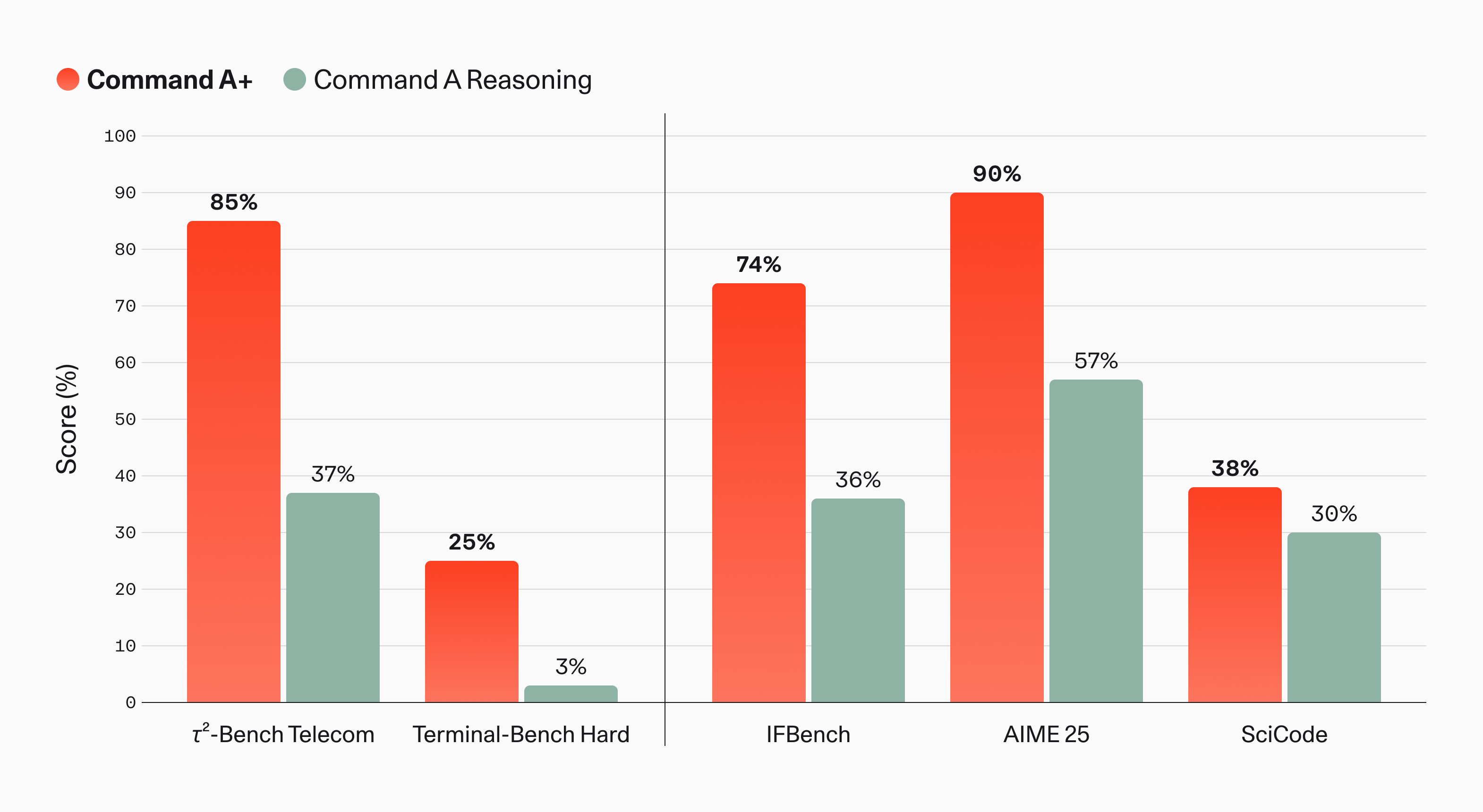
The capability position is specific and uneven. On the vendor's table the model reports 85 percent on tau-squared-Bench Telecom, 25 percent on Terminal-Bench Hard, 63 percent on MMMU-Pro, 75.1 percent on MMMU, 80.6 percent on MathVista and 52.7 on CharXiv reasoning. Artificial Analysis at launch measured HLE at about 11 percent, GPQA Diamond at about 76 percent, SciCode at about 38 percent, MMMU-Pro at 63 percent, and placed the model first on its Omniscience Non-Hallucination measure at 86 percent, with an accuracy of 9 percent and a headline Omniscience score of -4. That last result is the most interesting number in the file: the model declines to answer rather than inventing, more consistently than any model on that board at the time.
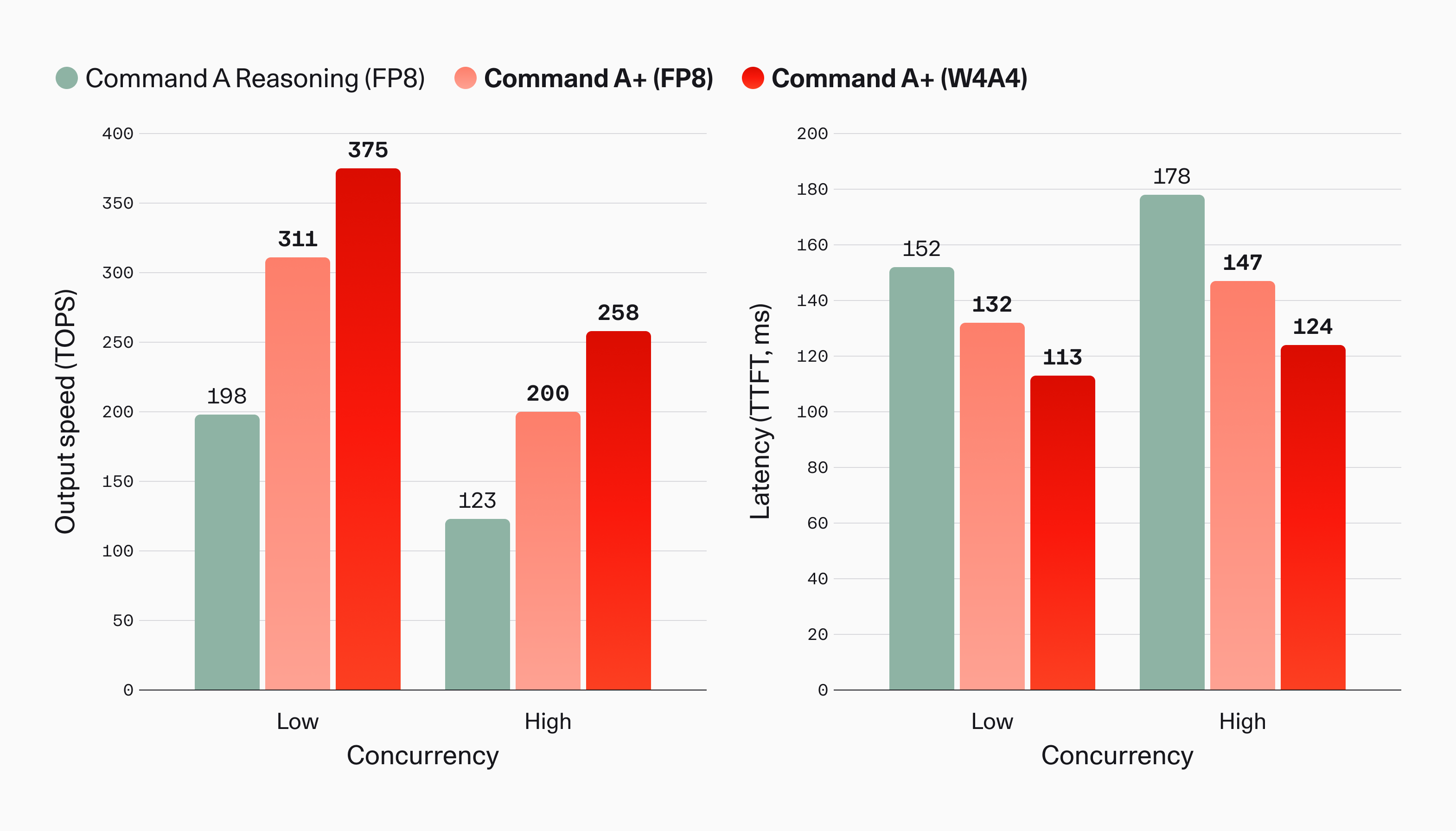
The efficiency position is the vendor's strongest engineering claim and it is measurable in hardware, not in benchmarks. The W4A4 quantisation applies NVFP4 to the mixture-of-experts layers with quantization-aware distillation, and the vendor recommends it for most uses. At that quantisation the model runs on one B200 or two H100s. The launch post claims up to 63 percent higher output tokens per second and up to 17 percent lower time to first token against Command A Reasoning, and the release notes claim up to 110 percent throughput and 30 percent lower latency against the same baseline. The two vendor pages disagree; the hardware floor does not.
The licence position is unambiguous, which is rare in this segment. Apache 2.0 permits commercial use, modification and redistribution with no field-of-use restriction, no user threshold and no separate model-as-a-service licence. A team can build a product on these weights and ship it. The first-party service is a different contract, and the weights do not carry it.
The distribution position is broader than the launch suggests. First-party API and Model Vault; Microsoft Foundry from 2026-06-24; OpenRouter at $0.30 and $1.50 per million tokens; Hugging Face in BF16, FP8 and W4A4; vLLM and Transformers as supported frameworks; community GGUF conversions for llama.cpp, Ollama and LM Studio, text only; and an MLX port in review. A team can start on a free API tier and end on its own hardware without changing the model.
Where the outcome is smaller than the release suggests. The current independent composite is 6, last in class. The data-analysis examination is 18 of 43, last of 35, with 24 percent of tool calls failing and about 28 model calls per question. The writing benchmark places it 78th of 87, in the bottom tenth. The context is 128K, not the 192K that two catalogues print. The production rate is not published. The model card carries no safety evaluation, so a regulated buyer has capability evidence and no refusal evidence. And the tool-calling path in llama.cpp needs a community patch because the runtime has no Cohere2 parser, which means the self-hosted route is not uniform across runtimes.
For U365 Fellows, the outcome is a model that teaches deployment economics. A learner can read a sparse mixture-of-experts design, compare three quantisations with three hardware floors, watch a tokenizer change the cost of Arabic, Korean and Japanese by 20, 16 and 18 percent, and see the difference between a vendor benchmark table and an independent composite that re-ran the same model six months later. That is a better object of study than a chat window, and it is why the Skill sub-score is not lower.
What the release does not change. It does not make the model a frontier reasoner, it does not publish a safety evaluation, it does not make the production price public, it does not make 192K the context, and it does not make the first-party free tier a production contract. It also does not make Command A's record apply: different licence, different context, different measurement.

Command A+
Who Should Use Command A+
Learner type | Difficulty | Typical ROI | Career path |
Students (Bachelor, Master) | Intermediate | Good as a first look at a sparse mixture-of-experts model that a university lab can actually serve. The free API tier removes the hardware question for coursework, and the three published quantisations make a concrete exercise in the trade between memory, speed and quality. The learning value is in the deployment arithmetic and in reading two independent benchmarks against a vendor table. The limits: a 218B checkpoint is not a laptop download, community GGUF builds are text only, and the licence reading is short enough that there is no excuse for skipping it. | UIT (Technology, AI, Data Science) for inference, quantisation and evaluation. UID (Digital Design, UX/UI) only as a document and interface reader, because the model takes image input and produces no image. No published U365 credential assesses open-weight serving or benchmark reading as a named component, and none is asserted. |
Professionals (career upskilling) | Intermediate | The strongest case: a platform or infrastructure engineer who has to put a capable model inside a regulated perimeter. One B200 at W4A4, Apache 2.0, a vLLM recipe, 48 languages and image input is a complete brief. The weaker case is any team that needs frontier reasoning or high-reliability data analysis, where the independent record is poor and the review says so. | |
Everyone (lifelong learners) | Intermediate | Moderate. There is a free playground and a Hugging Face Space, so a reader can try the model without an account commitment, but there is no consumer chat product built around this checkpoint. The useful learning is conceptual: what a mixture of experts is, why 25B active is cheaper than 218B dense, and why a citation is not a guarantee of accuracy. | LIPS Collect and Review phases for the model card, the licence and the benchmark record, and the UP-Context-Engineering Method order for prompting. No assessment home is asserted. |
For teams and organisations. A team deciding on Command A+ starts with four questions.
Team deployment. Two routes. First-party: call command-a-plus-05-2026 on the Cohere API, free until rate limits, or buy dedicated capacity in Model Vault. Self-hosted: download the BF16, FP8 or W4A4 checkpoint, serve it with vLLM 0.21.0 or later, and carry the Cohere tool-call and reasoning parsers. A third route exists through OpenRouter, Microsoft Foundry and other resellers, at their rates and under their terms.
Cost at team scale. The first-party tier is a quota, not a budget line. The published per-token rate on OpenRouter is $0.30 input and $1.50 output per million, with cache reads at $0.15. Self-hosted cost is the GPU or GPUs, the power, the rack space and the engineering time, with no licence fee. At 218.75B parameters in BF16 the download is roughly 437 GB, and the W4A4 build is the one that fits a single B200.
Data and compliance. The weights are Apache 2.0, and a self-hosted deployment keeps every token inside the perimeter. The first-party service carries Cohere's usage policy and commercial terms, and the vendor states that in most cases customers run Cohere models in their own environments and that Cohere does not use customer inputs for training. A team that needs a contractual data position should read the service terms rather than the model licence, and a team that self-hosts owns the position entirely.
U365 for companies. Professional learners reach University 365's academic services individually or through their organisation, and the company route runs through a customized training agreement for employee groups. Corporate education programmes are built on demand, and their tuition follows content and duration.
Skill level required: Intermediate. The hosted route needs an API key, a client that speaks the Cohere chat API and one decision about thinking. The self-hosted route needs Linux, GPU capacity, a quantisation choice, a serving stack, the correct parsers and a way to check the output.
Prerequisites. For the hosted route: a Cohere account, a key, and an understanding of the rate limit that applies to the key type. For self-hosting: storage for a 437 GB BF16 download or a smaller quantised build, a B200 or two H100s at W4A4, vLLM 0.21.0 or later with the melody library, and an evaluation set. The last item is the practical prerequisite.
Typical time to first result: Under fifteen minutes on the hosted route, including account setup and one request with an image. Four to eight hours self-hosted, dominated by the download, the quantisation choice, the parser configuration and the first tool call.
Typical time to competence: Twenty to thirty hours of active work for an engineer new to sparse mixture-of-experts serving. The material that carries the value is the model card's architecture section, the quantisation table and the vLLM flags.
Who should wait. Anyone who needs frontier reasoning or hard science results, where the current composite and HLE both read low. Anyone whose workload is data analysis, where the independent examination places the model last of 35 and records a 24 percent tool-call failure rate. Anyone who needs a published safety evaluation before deployment. Anyone who needs more than 128K of input context. Anyone whose volume is low enough that a reseller's per-token rate is cheaper than a GPU. And anyone who wants a vision path in llama.cpp, because the community GGUF builds are text only.

Command A+
U365 Institutes Alignment
The alignment below rates what a U365 institute could take from this model as a working instrument and as an object of study. The primary home is UIT (Technology, AI, Data Science), because the release is a serving and architecture object before it is a chat model.
UIT (Technology, AI, Data Science)
Rating. High (primary)
Why. Five engineering competencies, each of which survives the removal of the tool. Sparse mixture-of-experts design: 128 experts with 8 active per token and one shared expert, a token-choice router with a normalized sigmoid over the top-k logits, additive-bias load balancing and dropless training, all published in the model card and worth reading against the code. Quantisation engineering: three published checkpoints with three hardware floors, NVFP4 applied to the expert layers with quantization-aware distillation, and a documented recommendation to use the 4-bit build for most work. Serving: vLLM 0.21.0 or later with cohere_command4 as both the tool-call parser and the reasoning parser, the --enable-auto-tool-choice flag, and tensor parallelism of four on a B200 for the BF16 build. Evaluation reading: the same evaluator reports 37 in May and 6 in November, and telling an index version from a model regression is the skill. Grounded tool use: native citations inside <co> tags that name the tool result behind a span, which is a concrete exercise in provenance.
The limit that holds the row. The model supplies no method and no teaching surface of its own. The competencies come from the deployment work and from the vendor's documentation, and no published programme assesses open-weight serving, quantisation or benchmark reading as a named component. Adjacent anchors, not assessment homes.
UIB (Business Management, Entrepreneurship)
Rating. Medium
Why. Three commercial decisions the release forces. Licence as a product enabler: Apache 2.0 removes the field-of-use restriction and the model-as-a-service negotiation that Command A's CC BY-NC 4.0 required, which changes what a small team may legally ship. Build against buy: one B200 at W4A4 against a free quota and a reseller rate of $0.30 and $1.50 per million tokens, a comparison that closes only with the buyer's own utilisation. And benchmark due diligence: a launch claim of 37 against a current reading of 6 is a worked example of why a business case should carry the instrument and the date next to every number.
The limit that holds the row. The model supplies no management method and measures no return. It publishes no completion rate for a business workflow and no cost per finished task, and the vendor's internal North evaluations, a 20 percent gain in agentic question answering and a 32 percent gain in spreadsheet analysis, are vendor-run and not reproducible from outside. No published programme assesses AI infrastructure economics as a named component. Adjacent anchors, not assessment homes.
UIC (Digital Communication, Marketing)
Rating. Medium
Why. Two competencies with a real surface. Multilingual production: 48 languages including all official European Union languages, with the vendor reporting tokenizer efficiency gains of 20 percent for Arabic, 16 percent for Korean and 18 percent for Japanese, so a communication team working across those markets can hold one model rather than three. Grounded claim checking: the citation tags let a practitioner see which tool result supports a sentence, which is the mechanism a fact-check depends on. The writing surface is the weakest part: an independent writing benchmark places the model 78th of 87, with its lowest metric on continuity and emotion, so it is a translation and extraction instrument rather than a drafting one.
The limit that holds the row. The model teaches no register, no audience analysis and no publication standard, and it does not verify a source it has not been given. Rated as multilingual and evidentiary contact. No credential is mapped.
UID (Digital Design, UX/UI)
Rating. Low
Why. The contact is analysis rather than production. A designer can give the model a screenshot, a rendered layout or a scanned form and ask for a structured critique, a component inventory or a specification, and the 128K window holds a design-system document. The vendor's MMMU and CharXiv rows describe document and chart reasoning, not design judgement.
The limit that holds the row. The model produces no image, no layout and no motion artefact, so it cannot generate a design, and it cannot judge a composition against a visual standard it has not been given. No layout, interaction or motion competency is assessed. This is a screenshot and document reader that a designer may use, not a design instrument.
U365 methods, not an institute (UNOP, ULM, LIPS, CARE and the UP-Context-Engineering Method)
Rating. Applicable
Why. The methods layer matters in the way an infrastructure tool always does: the model holds no record, so the team has to. LIPS and CARE describe the discipline directly, because the model chosen, the quantisation, the thinking budget, the tool list, the licence reading and the cost per task belong in the team's own system rather than in a chat history. The UP-Context-Engineering Method's eight layers are what keep a tool-using agent inside a bounded job, and the constraint layer is where the context budget, the call cap, the thinking budget and the data limits belong. ULM is relevant to the purchase rather than to the run: a GPU or a per-token bill is a recurring cost in the Finance domain. UNOP has no direct fit: the model is not built to teach, and its gains come from execution rather than from any pedagogical mechanism.
The limit that holds the row. The model carries no method of its own, no coaching surface and no memory of the organisation's rules. A team that does not keep the evaluation set, the serving configuration and the licence decision in its own system has no account of its deployment.

Command A+
How Command A+ Works
A decoder-only sparse mixture-of-experts transformer with 218B total parameters and 25B active per token, 128 experts with 8 routed and one shared, attention that alternates three sliding-window layers with one global layer, a vision encoder for image input, thinking on by default with a token budget, and native tool use with grounding citations.
Inputs: Text and images. On the hosted API a request is a message list with an optional thinking object and an optional tool list; on the weights it is the Command A+ chat template. Images are encoded by the vision tower and interleaved with text tokens. Tool results are returned to the model as a tool role, and the model can attach a source index to a span.
Outputs: Text, with a reasoning block when thinking is enabled and structured tool calls when tools are supplied. Maximum generation is 64,000 tokens, of which the thinking budget consumes a share.
Underlying technology, as the vendor publishes it:
Architecture: a decoder-only sparse mixture-of-experts transformer. 128 experts, 8 active per token, and one shared expert applied to all tokens. A token-choice router with the softmax replaced by a normalized sigmoid over the top-k expert logits, additive-bias-based load balancing, and training that is fully dropless.
Attention: sliding-window attention layers with rotary position embeddings interleaved with global attention layers without positional embeddings, in a 3:1 ratio, as first introduced in Command A.
Vision: an image encoder feeding the same decoder, which is what makes the model Cohere2VisionForConditionalGeneration in the Transformers configuration and cohere2_vision in the model type field.
Quantisation: BF16, FP8 and W4A4 checkpoints. The W4A4 build applies NVFP4 to the mixture-of-experts layers with quantization-aware distillation, and the vendor recommends it for most uses because the quality difference is described as negligible while the hardware floor drops to one B200 or two H100s.
Reasoning: thinking is enabled by default. thinking set to {"type": "disabled"} turns it off, and thinking set to {"token_budget": n} caps the thinking tokens. The vendor recommends unlimited thinking, or 31,000 tokens for a maximum-length run, and asks callers to leave at least 1,000 tokens for the response.
Tool use: conversational function calling through the chat template, with tool descriptions supplied as JSON schema. In vLLM the model needs --tool-call-parser cohere_command4, --reasoning-parser cohere_command4 and --enable-auto-tool-choice.
Citations: with citations enabled, the model returns grounding spans inside <co> and </co> tags, and the closing tag lists the tool call and result indices that support the span. Sources from the same tool call are grouped, so a reader can trace a sentence to a specific tool result.
Languages: 48, including all official European Union languages. The vendor reports tokenizer efficiency gains of 20 percent for Arabic, 16 percent for Korean and 18 percent for Japanese against its previous tokenizer.
Context: 128,000 tokens of input and 64,000 tokens of output.
Knowledge cutoff: 2025-04-01, published on the documentation model page.
Licence: Apache 2.0 for the weights.
Runtimes: Transformers from source or a recent release, vLLM 0.21.0 or later with cohere_melody 0.9.0 or later for response parsing, and community GGUF builds for llama.cpp, Ollama and LM Studio. The community GGUF path is text only, because the converter routes the language backbone and drops the vision tower.
Distribution: Cohere API, Model Vault, Microsoft Foundry from 2026-06-24, OpenRouter, and Hugging Face weights in three quantisations.
What is not disclosed. A safety evaluation: the model card publishes capability results and no refusal, jailbreak or instruction-hierarchy results. A training-data description beyond the statement that the model is pre-trained on unlabelled data and post-trained with supervised fine-tuning and reinforcement learning, using public and proprietary data, human annotation, synthetic data and third-party datasets. A production rate for Model Vault or Microsoft Foundry. A layer count: the vendor card does not publish one, and the community conversions agree on 32 layers, which this review records as a community figure rather than a vendor one. And a statement on how the hosted service's data handling differs from the self-hosted position, beyond the vendor's general statement that customers usually run Cohere models in their own environments.
How the economics actually work. There are three markets for one artefact. The first-party market is a quota: free until rate limits on both trial and production keys, with dedicated capacity sold through Model Vault under contract. The reseller market prices tokens: $0.30 input and $1.50 output per million on OpenRouter, with cache reads at $0.15. The self-hosted market prices hardware and engineering: 218.75B parameters in BF16 is roughly 437 GB before quantisation, the W4A4 build is about 132 GB, and the recommended hardware is one B200 or two H100s. Three consequences follow. First, the free tier is the cheapest way to evaluate the model and the worst way to plan production, because a quota is not a contract. Second, the reseller rate and the hardware cost close only against the buyer's utilisation. Third, the Apache 2.0 licence removes the licence fee entirely, so the self-hosted case is a compute case and nothing else.
What it is bad at natively. Hard science and frontier reasoning, where HLE is about 11 percent and the current composite is last in class. Data analysis, where an independent examination records 18 of 43 and a 24 percent tool-call failure rate. Fluent long-form writing, where an independent benchmark places it in the bottom tenth. Work that needs more than 128K of input. Work that needs an image output, because it produces text only. Anything that requires a published safety evaluation before approval. And vision on a llama.cpp deployment, because the community GGUF builds are text only.

Command A+
Getting Started with Command A+
Required accounts: A Cohere account and API key for the hosted route, and a Hugging Face account for the weights. The weights are public and Apache 2.0, and the first-party service carries its own terms.
Hosted setup, in the order the vendor publishes it:
Create the account and the key. The model id is command-a-plus-05-2026. Trial and production keys are both free until their rate limits are reached, and the limits differ by key type, so read the rate-limit table before sizing a workload.
Send one text request with thinking on and one with it off. Thinking is enabled by default. Compare latency and answer quality on your own task before you choose a default for the application.
Send one request with an image. A text path can look healthy while the vision path is misconfigured.
Send one request with a tool schema and one tool result. Confirm that the call arrives as a structured tool call rather than as prose, and that the result is accepted in the tool role.
Turn citations on and read the tags. A citation that names a tool result is a claim you can check. Confirm that the span and the source index agree.
Set a thinking budget or accept unlimited thinking. The vendor recommends unlimited, or 31,000 tokens for a maximum-length run, with at least 1,000 tokens left for the response.
Record the rate limit and the service terms before sending anything confidential. The free tier is a quota, and the production route is Model Vault.
Self-hosted installation, in the order the vendor publishes it:
Size the machine before the download. BF16 needs 4 x B200 or 8 x H100, FP8 needs 2 x B200 or 4 x H100, and W4A4 needs 1 x B200 or 2 x H100. The BF16 download is roughly 437 GB.
Download the checkpoint you will actually serve. hf download CohereLabs/command-a-plus-05-2026-w4a4 --local-dir ./command-a-plus-w4a4 for the recommended build, or the -bf16 or -fp8 repository for the others.
Install a runtime that carries the model. vLLM 0.21.0 or later, plus cohere_melody 0.9.0 or later for accurate response parsing, or Transformers from the source repository that includes the architecture.
Serve with the Cohere parsers. The vendor's example is vllm serve CohereLabs/command-a-plus-05-2026-bf16 -tp 4 --tool-call-parser cohere_command4 --reasoning-parser cohere_command4 --enable-auto-tool-choice, with tensor parallelism adjusted to the hardware.
Test text, vision and tools separately. The three paths fail in different ways, and a passing text request says nothing about the other two.
Decide the thinking policy in the server or the client. A default of thinking on will spend tokens on every request, including the ones that do not need reasoning.
If you need llama.cpp, take a community conversion and read its limits. The GGUF builds are text only, the tokenizer needs a recent Transformers at conversion time, and tool calls need a chat-handler patch because the runtime has no Cohere2 parser.
First 15 minutes checklist, hosted route:
Create an account, confirm the model id command-a-plus-05-2026 and store the key.
Send one text request with thinking on and one with it off, and compare the latency.
Send one request with an image and confirm the answer uses the image.
Send one request with a function schema and confirm that the call arrives as a tool call.
Turn citations on and trace one span to its tool result.
Record the rate limit that applies to the key type before sending anything confidential.
Result: One working route, a thinking policy you chose rather than inherited, a tool call you have seen arrive, a citation you have traced, an image the model actually read, and a quota you can defend. That is a working setup rather than an impression.

Command A+
Real Workflows
Three workflows, each chosen because a measured strength and a check the reader already owns sit in the same place. Each sample prompt uses the UP-Context-Engineering Method's eight layers in method order, with the constraints and the data limits inside EXPECTED-FORMAT-AND-CONSTRAINTS.
Workflow 1: Answer an enterprise question from a document set, with a citation per sentence
When to use it: the answer must be traceable, the source set is internal, and a wrong sentence carries a cost. This is where the model's design is strongest: native citations that name the tool result behind a span, and an independent non-hallucination measure of 86 percent, the best on that board at launch.
This sample prompt uses the UP-Context-Engineering Method and the CI-First doctrine. Read the method at https://www.university-365.com/post/the-up-method-university-365-prompting-the-new-gold-standard-for-prompt-engineering, the doctrine at https://www.university-365.com/post/discover-the-ci-first-approach, learn both in a U365 online program at https://www.university-365.com/programs, and request a U.Coach for orientation at https://www.university-365.com/ucoach.
USER-PERSONA: My UP-Context-Engineering USER-PERSONA file is the file for this layer, attached. It is my psychographic file concatenated with the six ULM life-domain files. The parts that matter here: I sign the answer and I will not sign a sentence I have not traced. If the file is not attached, ask for it before you start.
FULL-CONTEXT: The FULL-CONTEXT set for this task, added and not merged: the document set as tool-accessible files [paths], the question [verbatim], the access rules that decide which files may be read [policy document], the citation format [example], and the documents that are out of scope [list]. The document set and the question are the only authorities. If a file is unreadable or the question is outside the set, say so and stop.
AI-PROFILE-ROLE-EXPERTISE: Act as a Co-Researcher, Analyst and Tester, in the role of an information analyst, with expertise in reading primary documents, separating a quotation from an inference, and citing the passage that supports a claim.
USER-FINAL-GOAL: Every sentence that carries a finding is supported by a cited passage, every gap is named, and I can defend the answer without the transcript.
AI-EXACT-TASK: Read the relevant files, answer the question, attach a source to every finding, and list what the set does not answer.
AUDIENCE: Me, the analyst who signs the answer, and a reader who will open two citations at random. The reader accepts the passage, not the summary.
EXPECTED-FORMAT-AND-CONSTRAINTS: Format: (1) the answer in no more than 400 words, (2) a source line per finding with the file and the passage, (3) the gaps, (4) what you did not read. Constraints: cite a passage, never a document alone; quote before you paraphrase; do not answer from memory; do not use a file outside the access list; stop and name the gap rather than inferring a number that is not printed; thinking on with a 12,000-token budget. Data limits: the set is cleared for this service under the trial quota; no personal record, credential or client name enters the prompt, and the citation log stays in the team's own system.
EXAMPLES: One signed answer from last quarter is the format example, attached, and its citation table is the quoting example.
Before you use the output, run the check yourself: open two cited passages at random and compare the sentence to the source. The decision is yours, per CI-First.
What the model does well here: the citation mechanism is native rather than bolted on, and the independent non-hallucination result is the strongest single number in the model's file. The model is also concise: Artificial Analysis records 53.9 million output tokens across its index run against a median of 101 million, which is a real cost advantage for a retrieval workload.
What to watch: a citation proves that a tool result was associated with a span, not that the span is correct. The model can cite a real passage that does not support the sentence. The quoted-passage column is the check, and it only works if you read it.
VERIFICATION CHECKLIST for Answer an enterprise question from a document set, with a citation per sentence:
Multi-Model Check: run the same question through a second model with the same documents and compare which passages each one cites.
External Source: open two cited passages and compare the quotation with the source text.
Human Review: read the gaps list and confirm that the set is genuinely silent where the model says it is.
CI-First Test: can you defend every finding from passages you have opened? If not, the answer is not ready.
Workflow 2: Read a multilingual document set into a structured record
When to use it: the documents arrive in several languages, some of them as scans or charts, and the output has to be one structured record rather than a narrative. This is where 48 languages and image input meet: a French invoice, a German table and a Polish form can enter the same call.
This sample prompt uses the UP-Context-Engineering Method and the CI-First doctrine. Read the method at https://www.university-365.com/post/the-up-method-university-365-prompting-the-new-gold-standard-for-prompt-engineering, the doctrine at https://www.university-365.com/post/discover-the-ci-first-approach, learn both in a U365 online program at https://www.university-365.com/programs, and request a U.Coach for orientation at https://www.university-365.com/ucoach.
USER-PERSONA: My UP-Context-Engineering USER-PERSONA file is the file for this layer, attached. It is my psychographic file concatenated with the six ULM life-domain files. The parts that matter here: I reconcile the record against the source documents, and a field I cannot check is a field I do not enter. If the file is not attached, ask for it before you start.
FULL-CONTEXT: The FULL-CONTEXT set for this task, added and not merged: the documents [paths and languages], the target schema [field list with types], the controlled vocabularies [list], the two fields that decide acceptance [names], and the documents that are out of scope [list]. The documents and the schema are the only authorities. If a page is illegible or a field is absent from every document, write null and name it.
AI-PROFILE-ROLE-EXPERTISE: Act as a Co-Worker and Assistant, in the role of a document analyst working in six languages, with expertise in reading forms, tables and chart labels, and in distinguishing a value that is printed from a value that is inferred.
USER-FINAL-GOAL: One structured record per document, every field traceable to a page and a region, every null explained, and no invented value.
AI-EXACT-TASK: Read each document, extract the fields into the schema, record the page and region for each value, and report the fields that are absent or ambiguous.
AUDIENCE: Me, the analyst who reconciles the record, and an auditor who will reopen one document and check one field. The auditor accepts the page reference.
EXPECTED-FORMAT-AND-CONSTRAINTS: Format: (1) one record per document in the schema, (2) a source line per field with page and region, (3) the nulls and the reason, (4) the ambiguous readings. Constraints: never translate a value into a different unit; keep the original script beside the normalized value; do not infer a value from a neighbouring field; mark a figure that is illegible rather than guessing it; thinking on with a 16,000-token budget. Data limits: the documents are cleared for this service under the trial quota; no personal identifier is copied into the team's own system beyond the schema field, and the source images stay in the team's repository.
EXAMPLES: One reconciled record from a three-language batch is the format example, attached, and its page references are the citation example.
Before you use the output, run the check yourself: reopen one document, find the cited region and read the value. The decision is yours, per CI-First.
What the model does well here: 48 languages in one model, image input for forms and charts, a 128K window that holds a batch, and a documented tokenizer gain for Arabic, Korean and Japanese that lowers the cost of non-European documents. The vendor reports 63 percent on MMMU-Pro and 52.7 on CharXiv reasoning, and those are the relevant rows for this work.
What to watch: a vision reading is only as good as the scan and the region. The model can read a value from the wrong column and be confident about it. It can also normalize a currency or a unit that it should have left in the original. The region citation and the original-script column are the checks.
VERIFICATION CHECKLIST for Read a multilingual document set into a structured record:
Multi-Model Check: run two documents through a second multimodal model and compare the extracted fields.
External Source: reopen one document at the cited region and read the value and the unit yourself.
Human Review: ask a speaker of the document's language to confirm one extracted value and its script.
CI-First Test: can you reconcile the record to the document without the model's explanation? If not, the record is not yours yet.
Workflow 3: Run a bounded agentic tool loop with a call budget
When to use it: the task has a clear success condition, the tools are known, and the run can be capped. The vendor's headline agentic result is 85 percent on tau-squared-Bench Telecom against 37 percent for Command A Reasoning, and the same model made about 28 model calls per question in an independent data-analysis examination, with 24 percent of its tool calls failing. Both facts belong in the design.
This sample prompt uses the UP-Context-Engineering Method and the CI-First doctrine. Read the method at https://www.university-365.com/post/the-up-method-university-365-prompting-the-new-gold-standard-for-prompt-engineering, the doctrine at https://www.university-365.com/post/discover-the-ci-first-approach, learn both in a U365 online program at https://www.university-365.com/programs, and request a U.Coach for orientation at https://www.university-365.com/ucoach.
USER-PERSONA: My UP-Context-Engineering USER-PERSONA file is the file for this layer, attached. It is my psychographic file concatenated with the six ULM life-domain files. The parts that matter here: I own the tool permissions and I stop a run that exceeds its budget. If the file is not attached, ask for it before you start.
FULL-CONTEXT: The FULL-CONTEXT set for this task, added and not merged: the tool catalogue with schemas [file], the success condition [one sentence], the database dialect and version [string], the call cap [number], the wall-clock cap [number], and the actions that are forbidden [list]. The tool schemas and the success condition are the only authorities. If a tool is missing or a schema does not validate, stop and name it.
AI-PROFILE-ROLE-EXPERTISE: Act as a Co-Worker and Assistant, in the role of an agent operator, with expertise in tool selection, query construction for a named dialect, and knowing when a run should stop rather than retry.
USER-FINAL-GOAL: The success condition met within the call cap, every tool call logged with its result, and a plain statement of what failed and why.
AI-EXACT-TASK: Plan the steps, call the tools, validate each result against the schema, and stop at the cap or at the first unrecoverable error.
AUDIENCE: Me, the operator who reads the log, and a reviewer who will re-run one step. The reviewer accepts the log, not the narrative.
EXPECTED-FORMAT-AND-CONSTRAINTS: Format: (1) the plan, (2) one line per tool call with the arguments and the result status, (3) the final answer, (4) the failures and the retries, (5) whether the cap was reached. Constraints: no more than the stated call cap; no destructive statement; no query written for a different dialect; do not retry the same failing call more than twice; stop and report rather than widening the task; thinking on with a 10,000-token budget. Data limits: the run touches a staging database only; no production credential enters the prompt, and the call log stays in the team's own system.
EXAMPLES: One capped run from last month is the format example, attached, and its failure lines are the stopping example.
Before you use the output, run the check yourself: read the call log, confirm the cap, and re-run one step by hand. The decision is yours, per CI-First.
What the model does well here: it is trained for conversational tool use, it emits structured calls with a documented parser in vLLM, and its tau-squared-Bench Telecom result is a large jump over its predecessor. At 25B active parameters the per-call cost is low, which makes a bounded loop affordable.
What to watch: a call cap is the control this model needs. The independent examination records 1,195 model calls across 43 questions, 28 per question, with 24 percent of calls failing, mostly on SQL written for another database. A run without a cap spends the budget on retries that repeat the same mistake.
VERIFICATION CHECKLIST for Run a bounded agentic tool loop with a call budget:
Multi-Model Check: run the same plan through a second tool-capable model and compare the calls it chooses.
External Source: re-run one step by hand against the same database and compare the result.
Human Review: read the failure lines and confirm that each retry changed the query rather than repeating it.
CI-First Test: can you explain why the run stopped, from the log alone? If not, the cap did its job but the design did not.

Command A+
Strengths, Limits, and AI Imposture Risk
Strengths
Time
Strength. Cheap to start, no hardware to stand up, and fast token generation.
Evidence. The first-party API is free on trial and production keys until rate limits; Artificial Analysis records 182 output tokens per second, 22.03 seconds to the first answer token and 3.3 minutes per index task on 2026-11-19; the vendor measured about 281 output tokens per second at launch. Held at 6 because thinking is on by default, the first answer token takes about 22 seconds, and the finished task still needs review.
Quantity
Strength. A long output window, 48 languages and image input in one model.
Evidence. 64,000 tokens of maximum generation and 128,000 of input; 48 languages including all official European Union languages; image input for charts, forms and scans; a free quota that costs nothing to fill. Held at 6 because 128K is mid-range in 2026, the model is concise by design, and the thinking budget consumes part of the output.
Quality
Strength. Strong on the vendor's agentic table and the best measured non-hallucination result on the board at launch.
Evidence. Vendor: 85 percent on tau-squared-Bench Telecom, 25 percent on Terminal-Bench Hard, 63 percent on MMMU-Pro, 80.6 on MathVista. Independent at launch: 86 percent on AA-Omniscience Non-Hallucination, first of the models measured, with HLE about 11 percent and GPQA Diamond about 76 percent. Held at 4 by the current composite of 6 at 32nd of 32, by 18 of 43 on a data-analysis examination, and by 78th of 87 on a writing benchmark.
Skill
Strength. Apache 2.0 weights, a documented sparse architecture and three quantisations with three hardware floors.
Evidence. 218.75B parameters published in BF16, FP8 and W4A4; a model card that explains the router, the load balancing and the attention ratio; vLLM and Transformers recipes with named parsers; community GGUF and MLX paths. Held at 5 because the model teaches nothing by itself, no technical report is linked from the model card or the launch material, and the common reader reaches it through an API.
Limits
The current independent composite is last in class. 6 on Artificial Analysis Intelligence Index v5.0.1, 32nd of 32, against a class median of 23.
The launch claim is stale. The model scored 37 on the index in May 2026 on the version current then, and the vendor's launch post still carries that figure without the version or the date.
Data analysis is the weakest measured task. 18 of 43 questions on an independent examination, last of 35 models, with 24 percent of tool calls failing and about 28 model calls per question.
Writing quality is in the bottom tenth. 78th of 87 models on a writing benchmark, with the lowest metric on continuity and emotion and a 5.5-point swing between drafts of the same script.
The context is 128K, not 192K. Two catalogues print 192,000; the vendor publishes 128,000 input and 64,000 output.
The production price is not published. The first-party tier is free until rate limits, Model Vault and Foundry are contractual, and the pricing-page card prints the predecessor's $2.50 and $10.00.
No safety evaluation is published. Capability results are in the model card; refusal, jailbreak and instruction-hierarchy results are not.
The tool-call path is not uniform across runtimes. vLLM carries the Cohere parsers; llama.cpp needs a community chat-handler patch, and without it an OpenAI-style tool request fails.
The vision path is lost in GGUF. Community conversions route the language backbone and drop the image encoder, so a llama.cpp deployment is text only.
The vendor's own efficiency claims disagree. The launch post says up to 63 percent higher throughput and 17 percent lower time to first token; the release notes say up to 110 percent and 30 percent, against the same baseline.
Thinking is on by default. A short chat or a classification task pays for a reasoning trace unless the caller turns it off.
AI Imposture Risk
Time Illusion
Rating. Medium
Evidence. The token rate reads as speed: 182 to 281 output tokens per second. The interval a reader experiences is different: 22.03 seconds to the first answer token, 3.3 minutes per index task, and an agent loop that made about 28 model calls per question in an independent examination. Thinking is on by default, so a short request can spend its time in a reasoning block. The counterweight is the free tier: a slow run costs nothing, so the lost time is cheaper here than on a metered frontier model. Medium.
Quantity Illusion
Rating. Medium
Evidence. The model is built to emit: a reasoning block, a structured tool call and a final answer, with 64,000 tokens of maximum generation and 48 languages of coverage. Volume reads as thoroughness. The counterweight is measured concision: 53.9 million output tokens across the independent index against a median of 101 million, so the model is not verbose by default, and a citation can be traced to a tool result. Medium.
Skill Illusion
Rating. High
Evidence. The presentation is a frontier-adjacent enterprise model: a launch claim of 37 on the index, 85 percent on an agentic benchmark, 48 languages, vision, citations and sovereign deployment. The current independent record is 6, last of 32, last of 35 on data analysis and 78th of 87 on writing. A reader who lacks the skill to evaluate the output has no way to tell a correct extraction from a confident unit error, and the citation tags make the answer look more verified than it is. That gap is the definition of the trap, and it is High. Mitigations are stated: a held-out evaluation set, a call cap, a citation check and a second model.
Overall Imposture Risk: Medium. Two traps are Medium and one is High. Under the framework's arithmetic, one High trap with clear mitigations stated gives Medium, and the band-precedence sentence does not change the outcome because the trap set is not two Highs. The rating would move to High if a deployment presented the model's output as the reader's own work without review, or if a second trap moved to High, for example a shipped memory that revised the user's procedures. The mitigations named in the row are the condition of the Medium reading.
Framework v1.2 clause note
Clause 5.2.3-a, agent-authored procedural memory, with a Skill Illusion floor of no lower than Medium, returns a null for the model, recorded with its boundary. The model has no memory store and writes nothing to the user's environment. It reads a chat template that carries the system instruction, the tool list, the thinking setting and the conversation; fine-tuning is authored by the team that runs it, with its own dataset and its own evaluation, which is the opposite of an agent writing the user's procedures during use. The live condition is specific: an agent built on this checkpoint that writes or revises the user's skills, rules or standing instructions by default, or that can revise them during a run without a per-write human decision, re-opens the clause at no lower than Medium, and at High where the user has no routine practice of reading what was written. A platform that wraps the model, such as one with a skills library or a memory system, carries that condition itself.
Clause 4.2-a, agent-mediated conversation, returns a null for the model and for the surfaces the vendor publishes. Neither erosion condition is met. The model generates text inside a session for the person who started it, and nothing in the release presents agent-authored text as a person's own voice in a human-facing channel or substitutes agent interaction for human contact. The live condition to watch on any deployment: an agent built on this checkpoint that sends, commits or publishes under a person's identity without that person reading the result first meets condition (a), and the team that builds it owns that condition rather than Cohere.
Clause 7.5 is not assessed. It was removed from the framework in v1.4, and this review derives no mode, writes no mode line and records no mode value. The two clauses above are the only pedagogical clauses that apply under v1.4.1.

Command A+
Section 7c: A launch claim of 37 against a current reading of 6, a rate card that prints the predecessor's price, and a context figure the vendor does not claim
A Section 7c finding is recorded where a supplier's governance, safety record or commercial terms have a real result for the reader. The items below were checked against primary sources on 2026-11-19, and they produce findings a buyer should carry. All findings are stated as facts of record, and the difference between a vendor statement, a published evaluation and a reseller listing is kept intact.
The launch benchmark and the current benchmark are the same evaluator, six months apart, and they do not agree. The Cohere launch post of 2026-05-20 states that Command A+ achieved a score of 37 on the Artificial Analysis Intelligence Index and places it in line with Claude 4.5 Haiku. Artificial Analysis published the same figure on the same day in its own launch article. On 2026-11-19 the Artificial Analysis model page reports 6 on Intelligence Index v5.0.1, ranked 32nd of 32 in its class, with a class median of 23 and a description that reads "among the least intelligent models". Intelligence Index v5.0.1 incorporates nine evaluations: AA-Briefcase v1.1, AutomationBench-AA, Terminal-Bench 4.0, FrontierCode-AA 2.0, AA-Omniscience v1.1, GDP.pdf, HLE-Diamond, CritPt v2 and Terminal-Bench-Science 0.1. The two numbers are not a regression in the weights, because the weights have not changed: they are two instruments, and the vendor's published claim has not been re-versioned. A reader comparing the launch post with the current model page will conclude either that the model collapsed or that one of the pages is wrong. Both readings are avoidable by carrying the version and the date, which this review does.
The pricing surfaces give three answers and one of them belongs to a different model. The Command A+ documentation states that the model is free on both trial and production keys until rate limits are reached, and that production runs through Model Vault. The pricing page's Command A+ card carries a price block of $2.50 per million input tokens and $10.00 per million output tokens. Those are exactly the figures U365 recorded for Command A in August 2026, on the same page's predecessor card, under a different licence. OpenRouter lists $0.30 input and $1.50 output per million, with cache reads at $0.15. The buyer's rule is to treat the first-party tier as a quota, the reseller rate as a market rate, and the pricing-page block as unverified for this model until Cohere publishes a production rate that reconciles with the documentation.
The context figure on two catalogues is 192K, and the vendor says 128K. The documentation model page, the release notes, the model card and the launch post all publish 128,000 tokens of input and 64,000 of output. Artificial Analysis lists 192,000, and OpenRouter lists 192,000 with 64,000 maximum completion. The vendor is the authority on its own checkpoint. The 192,000 figure is either a configuration the vendor does not document or an error in the catalogues, and a team that sizes a workload from it will overrun the window. The rule is to read the vendor's number and to test the limit on the route actually used.
The vendor's own pages disagree on the efficiency claim and on the active parameter count. The launch post states that Command A+ delivers up to 63 percent higher output tokens per second and reduces time to first token by up to 17 percent against Command A Reasoning at the same quantisation and concurrency. The release notes state up to 110 percent throughput increase and 30 percent decrease in latency against the same baseline. Separately, the enterprise launch post describes the model as activating "only 24 billion parameters per prompt", while the model card, the documentation and every other vendor page state 25B active. The 24B line is a rounding or a typo, and it does not change the architecture, but the two efficiency claims cannot both describe one measurement. A buyer should treat the hardware floor, which is published consistently, as the reliable part of the efficiency case and the percentage claims as vendor-run and setting-dependent.
The licence is the clearest improvement over the predecessor. Command A shipped under CC BY-NC 4.0, which excludes commercial use without a separate arrangement; U365's review of that model records the restriction. Command A+ ships under Apache 2.0, with no field-of-use restriction, no user threshold and no separate model-as-a-service licence. For a team that wants to build a product on the weights, that is a larger change than any benchmark movement in this review, and it is the reason the Skill sub-score is one point above Command A's.
What the difference means for a buyer. The model is a deployment instrument with a real licence and a real hardware story, and its measured capability is well below its launch framing. A team that needs a capable model inside its own perimeter, in 48 languages, with image input and citations, has a genuine option at one B200. A team that needs frontier reasoning, reliable data analysis or fluent long-form writing should read the comparison table instead. A team that budgets from the launch benchmark will overpay in expectation, and a team that budgets from the pricing-page card will overpay in fact.
One sub-score carries these findings and the rest do not move. The Quality sub-score is 4, and it already carries the current composite, the data-analysis result and the writing benchmark. The Time sub-score already carries 22.03 seconds to the first answer token and 3.3 minutes per index task. The Skill sub-score already carries Apache 2.0 and the published architecture. The price, context and vendor-disagreement findings are commercial and documentary facts rather than benefit dimensions, and Section 7c records them without moving a score. It does not allege that Cohere misstated a benchmark, because the launch figure was correct on the instrument of the day; it does not treat a superseded index version as a product defect; and it does not convert a stale card price into a finding against the vendor's pricing.

Command A+
U365 Co-Intelligence Rating
CI-First Profile
Primary profile: Co-Worker and Assistant (level 2). Secondary profile: Co-Researcher, Analyst and Tester (level 4).
Why this profile and not Co-Creator. The release positions the model for enterprise agents, retrieval, multilingual document work and tool use, and the measured strength is execution inside a bounded job: state the outcome, define the tools, hand over the run, check the result. That is a delegation framing, and Co-Worker and Assistant is the role the model actually plays. Analyst and Tester is recorded as secondary because the model reads an artefact, calls a tool and reports a result, and because its best work is verifiable against a passage, a page or a schema. Professor, Coach and Tutor is not claimed: the model explains a step on request and its thinking block is useful for study, but nothing in the release is built to move a capability from the model to the person.
CI-First Benefit Score
Time
Score (0-10). 6
Rationale. Cheap to start and fast in tokens: a free first-party tier until rate limits, 182 output tokens per second and 22.03 seconds to the first answer token on the independent page, and about 281 tokens per second in the vendor's launch measurement. Held at 6 by the first-answer latency, thinking on by default and 3.3 minutes per index task.
Quantity
Score (0-10). 6
Rationale. A large output budget and wide coverage: 64,000 tokens of maximum generation, 128,000 of input, 48 languages, image input and a free quota. Held at 6 because 128K is mid-range in 2026, the model is deliberately concise and the thinking budget consumes part of the output.
Quality
Score (0-10). 4
Rationale. Strong on the vendor's agentic table (85 percent on tau-squared-Bench Telecom, 25 percent on Terminal-Bench Hard) and first on AA-Omniscience Non-Hallucination at 86 percent. Held at 4 by the current composite of 6 at 32nd of 32, by 18 of 43 on an independent data-analysis examination and by 78th of 87 on a writing benchmark.
Skill
Score (0-10). 5
Rationale. A real learning and building surface: Apache 2.0 weights, 218.75B parameters published in three quantisations, a documented sparse architecture and vLLM and Transformers recipes with named parsers. Held at 5 because the model teaches nothing by itself and no technical report is linked from the model card or the launch material.
CI-First Benefit Score: 5.3 / 10 (CI-First Positive)
Why the score sits where it sits
5.3 with sub-scores 6 / 6 / 4 / 5 is a moderate position built from two different directions: a strong deployment story and a weak capability reading.
Why not higher. Three reasons, each measured. The current independent composite is 6 on version 5.0.1, last of 32 in class, which is the single largest drag on Quality. The independent data-analysis examination places the model last of 35, with 24 percent of tool calls failing, which is the task many enterprise buyers have in mind when they hear "agentic". And the writing benchmark places it in the bottom tenth, so the model is not a general production instrument for prose. A higher score would require a better current measurement, not a better licence.
Why not lower. The offering is genuinely strong where it is strong. Apache 2.0 removes the commercial restriction that limited Command A, the hardware floor at W4A4 is one B200, the model reads images and covers 48 languages, and the citation mechanism is native. The non-hallucination result is the best measured on that board at launch, and for a regulated buyer a model that declines rather than invents is worth more than a model that wins a mathematics contest. The free tier also means the evaluation cost is close to zero.
Why 5.3 and not a higher band, stated as arithmetic. Time 6, Quantity 6, Quality 4 and Skill 5 average to 5.25, which rounds to 5.3. That is CI-First Positive, the 4.1 to 6.0 band. It sits level with Command A at 5.3, Phi-4 at 5.3 and Muse Spark Open at 5.3, above Mistral Small 4 at 5.0, and below Llama 4 Scout at 5.5, GLM-5.3 and Nemotron 3 Ultra at 5.8, Qwen3.8 27B and Mistral Large 4 at 6.0, DeepSeek V4 Flash at 6.3 and Gemma 4 at 7.0. The level position with Command A is not a claim that the two models are equivalent: Command A scores 5 on Quality and 4 on Skill, while Command A+ scores 4 on Quality and 5 on Skill. The framework lands them at the same number from opposite directions, and the comparison section says why.
What the score does not carry. The four dimensions measure what the reader's work gains. They do not carry the licence terms, the free-tier policy, the unpublished production rate, the context disagreement, the vendor's conflicting efficiency claims or the absence of a safety evaluation. Those sit in Section 7c with an explicit statement that no sub-score changed. They do not carry the clause questions either, which return nulls with boundaries.
Humics Protection Badge
Creativity
Rating. Neutral (0)
Rationale. The model builds what it is asked to build: answers, extractions, tool calls and translations. It produces variants on request and originates no direction, and nothing in the release trains or replaces the reader's ideation. Image input can prompt an idea by showing what is in a document, which is a prompt rather than a capability.
Critical Thinking
Rating. Erodes (-1)
Rationale. The model reasons at length and shows a thinking block that reads as method, and its answer is expensive to check when the task is not computational. The failure modes are specific: a unit converted by a factor of a thousand, a query written for another database, a citation attached to a passage that does not support the sentence. The counterweight is real and measured: 86 percent on non-hallucination means the model often declines rather than inventing, which is the mechanism by which a model either erodes or protects this dimension. That counterweight holds the rating at -1 rather than lower, and it does not reverse the direction, because a confident wrong extraction is still the common failure.
Social Authenticity
Rating. Neutral (0)
Rationale. The model produces text inside a session for the person who started it, and clause 4.2-a returns a null for it as a generator. The live condition stays in the record: an agent built on this checkpoint that sends or publishes under a person's identity without that person reading the result first moves this dimension, and the enterprise framing makes such an agent a deliberate build rather than an accident.
Humics Protection Score: -1 / +3 Badge: Humics-Neutral
Superhuman Usage Guidance
When to invite this tool:
Self-hosted or sovereign deployment where the data cannot leave the perimeter and one B200 or two H100s is the hardware budget.
Grounded retrieval where every finding must carry a passage and a reader will open two of them.
Multilingual document intake across European languages, with image input for forms, tables and scans.
A product built on open weights, where Apache 2.0 removes the negotiation that the predecessor required.
Teaching a team how sparse mixture-of-experts serving, quantisation and index versions actually work.
A free evaluation tier for a proof of concept that would otherwise need a hosted budget.
When to keep this tool out:
Frontier reasoning, hard science and research questions, where HLE is about 11 percent and the current composite is last in class.
Data analysis and SQL generation without a call cap and a dialect check, where the independent record is the weakest in this review.
Long-form writing, copy and editorial work, where an independent benchmark places it in the bottom tenth.
Any workload that needs more than 128,000 tokens of input.
Any deployment that requires a published safety evaluation before approval.
A llama.cpp deployment that needs image input, because the community GGUF builds are text only.
A budget built on the pricing-page card, which prints the predecessor's rate.
U365 method integration:
LIPS + CARE: keep the evaluation set, the quantisation served, the thinking budget, the tool list, the licence reading and the cost per task in the Collect phase, and the deployment decision in the Action Plan and Review phases. The model can produce the trace; it cannot own the judgement about whether a deployment is licensed or whether its output is good enough to ship.
ULM + EVA: a GPU or a per-token bill is a recurring cost in the Finance domain, and the build-versus-buy decision belongs in the six-domain plan rather than in an infrastructure ticket. The Career domain holds the decision about which work is worth delegating to an agent at all.
UP-Context-Engineering: the eight layers are the control surface this model needs, because a stated AI-EXACT-TASK, a bounded FULL-CONTEXT and an EXPECTED-FORMAT-AND-CONSTRAINTS carrying the context budget, the tool list, the call cap, the thinking budget and the data limits are what keep a tool-using run inside the job it was given. The three workflow samples above use the eight layers.
UNOP: no direct fit. The model is not built to teach, and its gains come from execution and from the engineering work around it rather than from any pedagogical mechanism.
Over-delegation warning: the failure mode with this model is that a free tier and a good licence feel like permission to skip the evaluation. A team that pays nothing per token can conclude that another run costs nothing, when the cost has moved into review time and into the risk of a confident extraction, a unit error or a query that never ran. The second failure follows from the first: a thinking block that reads like a derivation is accepted as one, and the step where the assumption was chosen goes unread. The framework's arithmetic is the point: if your Human Intelligence input drops while the Artificial Intelligence term rises, the product falls. A team that moves analysis onto this model and does not add a held-out set, a call cap and a citation check has taken the release's worst offer.

Command A+
What Users Say
Aggregate Rating Table
Platform | Rating | Number of reviews | Link |
Artificial Analysis, model page | 6 on Intelligence Index v5.0.1, 32nd of 32 in class against a median of 23; 182 output tokens per second, 22.03 seconds to the first answer token, 3.3 minutes per index task, 53.9M output tokens | Independent benchmark, not a user rating | |
Artificial Analysis, launch article | 37 on the index at launch on 2026-05-20; first on AA-Omniscience Non-Hallucination at 86 percent, with 9 percent accuracy and a headline score of -4; HLE about 11 percent, GPQA Diamond about 76 percent, Terminal-Bench Hard about 25 percent, SciCode about 38 percent, MMMU-Pro 63 percent | Independent benchmark, not a user rating | |
ToneBench writing benchmark | 78th of 87 models, Writing Score 56.7 of 100, Writing Elo 363 with a 95 percent range of 303 to 428, 142nd of 151 configurations, last updated 2026-11-10 | Independent benchmark, not a user rating | |
Plotly data-analytics benchmark | 18 of 43 questions passed, last of 35 models; 1,195 model calls, about 28 per question; 24 percent of tool calls failed; $19.47 for one run at OpenRouter prices | Independent benchmark, not a user rating | |
Hugging Face, BF16 checkpoint | 148 likes and 14,310 downloads in the last month, created 2026-05-11, last modified 2026-06-15 | Repository signals, not a rating | |
Hugging Face, W4A4 checkpoint | 249 likes and 9,014 downloads in the last month, created 2026-05-18, last modified 2026-08-17 | Repository signals, not a rating | |
Hugging Face, FP8 checkpoint | 39 likes and 678 downloads in the last month | Repository signals, not a rating | |
Hugging Face Space | 43 likes on the public playground, created 2026-05-11 | Repository signals, not a rating | |
OpenRouter | $0.30 input and $1.50 output per 1M tokens, cache reads $0.15, 192K listed context, 64K maximum completion | Hosted catalogue, not a rating | |
Microsoft Foundry | Serverless availability announced 2026-06-24; rate not published on the page read | Hosted catalogue, not a rating | |
Hacker News, launch submission | 5 points and 3 comments on 2026-05-20; four further submissions of the same launch post drew 2 to 4 points and 0 to 2 comments each | Not a rating platform | |
Reddit, r/LocalLLaMA | A community MLX port with architecture notes, an open pull request against mlx-lm, and a measured run at 22.9 output tokens per second and 241GB peak memory on a large Apple Silicon machine | Not a rating platform | |
Reddit, r/SillyTavernAI | A launch thread with a cautious reception; commenters note the absence of a GGUF at release and praise reasoning plus vision support | Not a rating platform | |
llama.cpp issue tracker | Feature request for Cohere2MoeForCausalLM support, with community GGUF conversions linked in the thread from 2026-05-27 and text-only support added later | Not a rating platform | |
mlx-lm pull request | A community cohere2_moe implementation for Apple Silicon, in review | Not a rating platform |
Note on method, stated plainly because it affects how much this section is worth. No review platform rates an individual open-weight checkpoint, so this section does not pretend that a G2 or Capterra score exists. The meaningful signals are three independent evaluators that publish their method, the repository and distribution counts, the hosted catalogues, and the practitioner threads where people run the model on their own hardware. The independent evaluators disagree with each other in direction, and that disagreement is the finding rather than a defect in the section: a composite that includes hard science and agentic coding places the model last, a knowledge and hallucination measure places it first on non-hallucination, and a writing benchmark places it in the bottom tenth.
What Users Praise
The licence is the first theme in the coverage, and it is the one that changes a product decision. Every launch write-up this review read leads with Apache 2.0, and the contrast with Command A's non-commercial licence is the reason. A commenter in the r/LocalLLaMA thread summarised the architecture in public, which is what an open licence makes possible: 218B total, 25B active, 128 experts with top-8 routing, sigmoid routing, a 3:1 sliding-window ratio and parallel attention and MLP blocks.
Efficiency on modest hardware is the second theme. The model runs at the recommended W4A4 quantisation on one B200 or two H100s, and community conversions pushed it further: a measured 29 to 33 output tokens per second on eight AMD MI100 cards, 22.9 tokens per second on a large Apple Silicon machine, and text-only GGUF builds that fit a 128GB workstation at Q3. For an enterprise buyer with fixed hardware, that is the story.
The non-hallucination result is the third theme and the strongest single number in the file. Artificial Analysis measured 86 percent on its Omniscience Non-Hallucination task, about three points ahead of the next-best model, with an accuracy of 9 percent. One independent commentary framed the trade directly: for a bank or a government ministry, a model that makes things up less often matters more than a high score on a mathematics contest.
Multimodal and multilingual coverage is the fourth theme. 48 languages including all official European Union languages, image input for charts and documents, and tokenizer gains of 20 percent for Arabic, 16 percent for Korean and 18 percent for Japanese. A team that was running three models for three markets can run one.
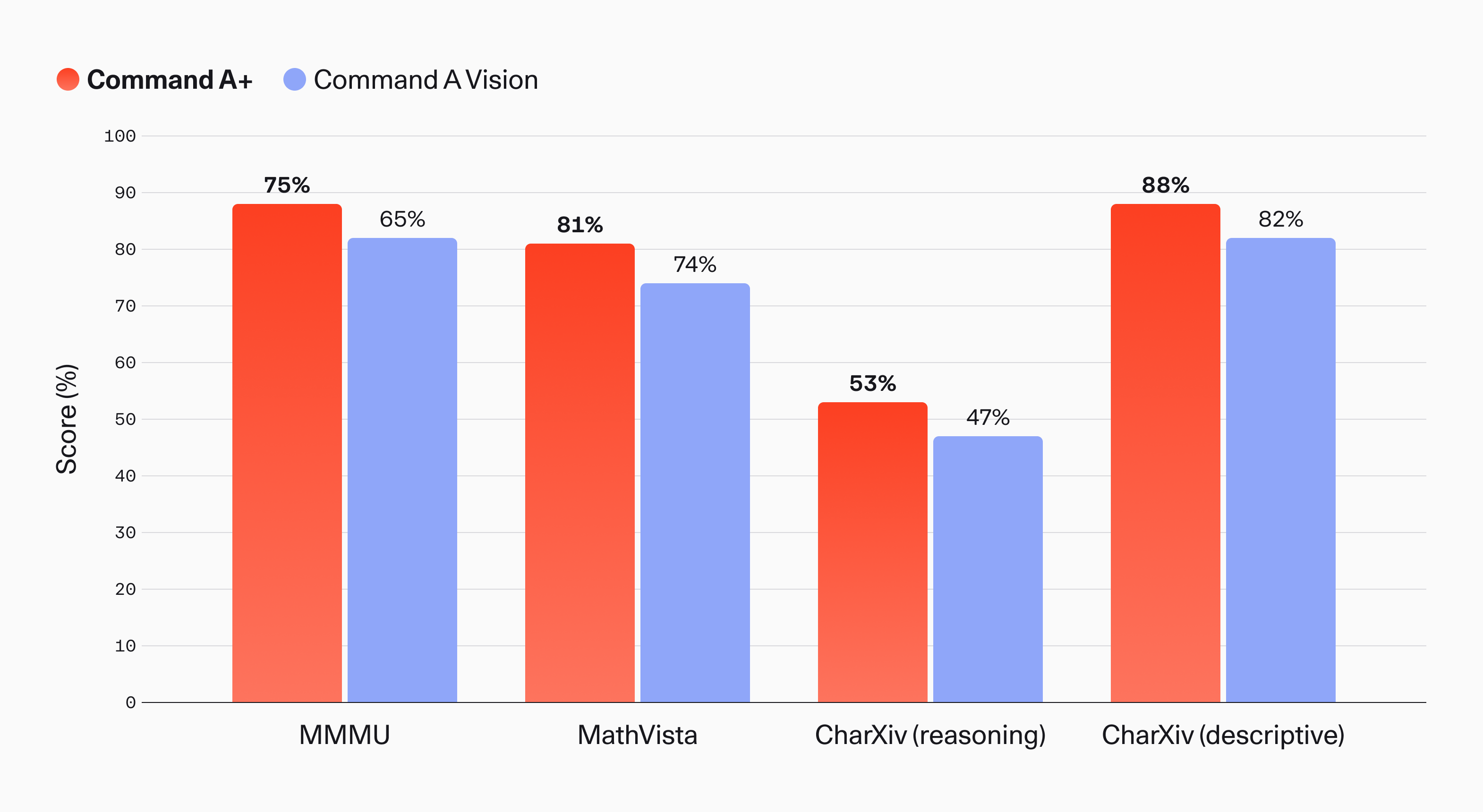
Community serving arrived quickly for a new architecture. Text-only llama.cpp support was added within weeks, GGUF builds from three publishers appeared with a range of quantisations, an MLX implementation is in review, and Ollama and LM Studio can run the GGUF path. That is a working set of runtimes rather than a weights drop.
What Users Complain About
The benchmark position is the loudest complaint. Independent commentary titles include "Cohere's Best Model Ever Is Kind of Disappointing", "Mid-Tier Copilot Or Hype" and "Why The Worst Ranking AI Model Is Worth $35B". The last one connects the bottom-of-leaderboard position to the vendor's funding round, which is a financial argument rather than a product one, but all three describe the same gap between the launch framing and the current measurement.
Data analysis is where practitioners report concrete failures. The independent examination records 18 of 43, with unit errors of a factor of a thousand, a count of turbines with a work order rather than work orders, and 24 percent of tool calls failing, mostly on SQL written for another database. Those are not abstract benchmark losses: they are the errors a reviewer catches only by redoing the calculation.
Writing quality is a secondary complaint and it is consistent across sources. The writing benchmark places the model in the bottom tenth, with its weakest metric on continuity and emotion and a 5.5-point swing between drafts of the same script. A team that wants a drafting model should look elsewhere.
The self-hosted path has friction that the launch material does not mention. At release there was no GGUF and no llama.cpp support; the conversions that followed are text only, so a team that needs image input cannot use them. Tool calls in llama.cpp need a chat-handler patch, because the runtime has no Cohere2 parser, and without it an OpenAI-style tool request fails with a parse error. vLLM carries the parsers and is the supported route.
Community attention is thin. The launch post drew 5 points and 3 comments on Hacker News, and four further submissions of the same post drew 2 to 4 points each. The Reddit threads are substantive but few. For a model with this licence and this hardware story, the practitioner conversation is smaller than the vendor's enterprise positioning would suggest, and a reader should weigh that when judging runtime support.
The vendor's own pages disagree, and readers noticed. The launch post's 37 and the current model page's 6 are the same evaluator, and the release notes and the launch post state different efficiency gains. A reader who compares two Cohere pages can come away with two different models.
Sentiment Summary
Overall sentiment: Positive on the licence, on the hardware floor, on non-hallucination and on multilingual and multimodal coverage; negative on the current benchmark position, on data-analysis reliability, on writing quality, on the friction in the self-hosted path, and on the gap between the launch claim and the current measurement.
Key themes: an Apache 2.0 model that fits one B200; a sparse architecture that is genuinely readable; a model that declines rather than invents; a bottom-of-class composite on the current index; a data-analysis workload that fails at the tool-call layer; and a vendor whose own pages carry two different benchmark stories.
U365 Editorial Note
The release argues in two directions and a reader should hold both. On the positive side, Apache 2.0 weights at 218B and 25B active, one B200 or two H100s at the recommended quantisation, 128K input with 64K output, image input, 48 languages, native citations, the best measured non-hallucination result on the board at launch, and a free first-party tier for evaluation. On the negative side, 6 on the current composite at 32nd of 32, 18 of 43 on an independent data-analysis examination with a 24 percent tool-call failure rate, 78th of 87 on a writing benchmark, a 192K context that the vendor does not publish, a production rate that is not published, an efficiency claim that two vendor pages state differently, and no safety evaluation. The Framework rates AI Imposture Risk Medium overall with Skill Illusion High, and that rating is the editorial position: Command A+ is a model to deploy inside a perimeter, for retrieval, extraction and multilingual document work, provided the team owns the evaluation set, the call cap, the citation check and the benchmark reading that the vendor cannot do for it. A reader who wants a frontier reasoner should read the comparison table instead.

Command A+
Comparison and Alternatives
Model or product | Position | Independent evidence | Commercial shape | Choose it if |
Command A+ | Cohere's open-weight sparse MoE, 218B total and 25B active, multimodal, 48 languages | 6 on Intelligence Index v5.0.1, 32nd of 32; first on AA-Omniscience Non-Hallucination at 86 percent; 18 of 43 on an independent data-analysis examination; 78th of 87 on a writing benchmark | Apache 2.0 weights; free first-party API until rate limits; $0.30 and $1.50 per 1M on OpenRouter; W4A4 on 1 x B200 or 2 x H100 | You need a capable Apache 2.0 model inside your own perimeter, with vision and 48 languages, and one B200 is the hardware budget |
Command A | Cohere's previous flagship, 111B dense, text only | U365's published score is 5.3, CI-First Positive, with Time 6 / Quantity 6 / Quality 5 / Skill 4 | CC BY-NC 4.0 weights, which excludes commercial use without a separate arrangement; $2.50 and $10.00 per 1M on the API | You already run Command A and the non-commercial licence fits, and you do not need vision or a permissive licence |
Mistral Small 4 | Mistral's small open-weight workhorse | U365's published score is 5.0, CI-First Positive, with Time 7 / Quantity 6 / Quality 4 / Skill 3 | Open weights, self-hostable; $0.15 input and $0.60 output per 1M with a 90 percent cache discount | You want the lowest per-token rate and a smaller footprint, and you accept a lower Skill reading |
Phi-4 | Microsoft's small MIT-licensed model | U365's published score is 5.3, CI-First Positive, with Time 6 / Quantity 6 / Quality 5 / Skill 4 | MIT weights, free to self-host; API around $0.125 and $0.50 per 1M | You need an MIT licence and a small model, and you do not need 218B of capacity or vision |
Llama 4 Scout | Meta's open-weight model | U365's published score is 5.5, CI-First Positive, with Time 6 / Quantity 7 / Quality 5 / Skill 4 | Llama 4 Community Licence, self-host or hosted | You want a higher Quantity reading and the Llama tooling, and the community licence fits |
Qwen3.8 27B | Alibaba's open-weight mid-size model | U365's published score is 6.0, CI-First Positive, with Time 7 / Quantity 6 / Quality 6 / Skill 5 | Apache 2.0 weights; cloud API around $0.50 and $1.50 per 1M | You want a higher score, a permissive licence and a far smaller model, and you do not need 48 languages or a 218B MoE |
Mistral Large 4 | Mistral's trillion-parameter open-weight flagship | U365's published score is 6.0, CI-First Positive, with Time 6 / Quantity 7 / Quality 7 / Skill 4 | $0.70 input and $0.07 cached input and $2.10 output per 1M; batch at half price | You want a higher Quality reading and can pay the rate or carry the hardware |
DeepSeek V4 Flash | DeepSeek's low-cost open-weight model | U365's published score is 6.3, CI-First Strong, with Time 8 / Quantity 7 / Quality 6 / Skill 4 | Open weights; API from $0.014 to $1.32 per 1M depending on peak and off-peak | You want the higher score and a faster per-task profile, and its licence fits |
Gemma 4 | Google's open-weight model | U365's published score is 7.0, CI-First Strong, with Time 7 / Quantity 8 / Quality 7 / Skill 6 | Free open weights, self-hosted | You want the highest U365 score among open-weight options and can serve a smaller model |
A hosted frontier route | Any current hosted model at the top of the index | Depends on the model | Per token, no weights | You need the strongest reasoning and have no constraint that requires self-hosting |
The comparison that matters most is not in the table. Command A+ and Command A sit at the same score, 5.3, and the difference is the shape of the trade. Command A scores 5 on Quality and 4 on Skill under a non-commercial licence; Command A+ scores 4 on Quality and 5 on Skill under Apache 2.0, with vision and 48 languages, and a hardware floor that is lower in practice because of the 4-bit quantisation. A buyer choosing between them is choosing which constraint binds: a better current measurement on the older model, or a permissive licence and a wider modality set on the newer one.
On U365's own published readings, this table spans 5.0 to 7.0. Mistral Small 4 is 5.0, Command A, Command A+ and Phi-4 are 5.3, Llama 4 Scout is 5.5, Qwen3.8 27B and Mistral Large 4 are 6.0, DeepSeek V4 Flash is 6.3 and Gemma 4 is 7.0. The spread is wide at the top and narrow in the middle, and the framework charges each product for its overhead: a hosted model buys convenience with a token bill, and an open model buys control with hardware and engineering. The score differences around 5.3 are not large enough for the framework to treat as decisive, which is why the "choose it if" column carries the decision.
Choose Command A+ if you need an Apache 2.0 model inside your own perimeter, with vision, 48 languages and a one-B200 floor, and you will run a held-out evaluation set and a call cap. Choose Command A if you already run it and the non-commercial licence fits. Choose Qwen3.8 27B or Gemma 4 if you want a higher U365 score and can serve a smaller model. Choose Mistral Large 4 if Quality matters more than the licence. Choose DeepSeek V4 Flash if you want the higher score and a faster per-task profile. Stay hosted if your volume is low enough that engineering time exceeds the token bill, because the self-hosted case closes only at utilisation you can measure.

Command A+
Verdict and Next Steps
Verdict: Command A+ is a genuinely deployable Apache 2.0 enterprise model with a one-B200 hardware floor, vision, 48 languages, native citations and the best measured non-hallucination result on its board at launch, and it is not the frontier reasoner its launch material implied.
At 5.3 / 10, CI-First Positive, with sub-scores 6 / 6 / 4 / 5, it is moderate on Time, Quantity and Skill and weak on Quality. A team that needs a capable model inside a regulated perimeter gets a real instrument at a real hardware floor. A team that needs frontier reasoning, reliable data analysis or fluent long-form writing should look at the comparison table instead, and the review says so in the same paragraph.
Adopt it if you need a permissive licence and self-hosted deployment, the workload is retrieval, extraction, translation or document intake, you can serve one B200 or two H100s at W4A4, and you will run a held-out evaluation set, a call cap and a citation check yourself. Do not adopt it as a frontier reasoner, a data-analysis engine without a dialect check, a writing model, a 192K-context model, a production service with a published rate, a deployment with a safety evaluation, or a way to skip evaluation because the licence is easy.
The four things to do in the first month:
Build a held-out set before you build anything else. Take fifty real tasks from the work you intend to delegate, run them on the free tier, and record correctness, tool-call failures and time per task. That record is the only basis for a build-versus-rent decision, and it is the control the current benchmark record says you need.
Cap the agent loop and check the dialect. The independent data-analysis examination records 28 model calls per question and a 24 percent tool-call failure rate, most of it on SQL written for the wrong database. A call cap and a dialect line in the prompt are the two cheapest fixes.
Test the three paths separately on the route you will use. Text, image and tools fail in different ways. On vLLM, confirm the cohere_command4 parsers and auto tool choice. On llama.cpp, accept that the GGUF path is text only and that tool calls need a patch.
Name the evaluation owner and the licence reader before the first production run. No safety evaluation is published and the production rate is not published. A retrieval step, a regression set and a signed licence reading are the three controls the vendor does not supply.
UP-Context prompt packs: the three samples are in Real Workflows, one per workflow, each in the UP-Context-Engineering Method's eight layers and each followed by the check the reader runs before using the output.
What would change this verdict. A new checkpoint or a repository revision, a published production rate or a change to the free-tier policy, a new index version, a Command A+ Reasoning release or a new family, a first-party safety evaluation, a change to the Apache 2.0 position or the service terms, a material change in the independent record, or a change in the deployment floor. The re-check triggers at the top of this review name each one.

Command A+
Status and Last Tested
Status: Active | Last tested: 2026-11-19 | Version tested: Command A+ (command-a-plus-05-2026, CohereLabs/command-a-plus-05-2026-bf16, released 2026-05-20)
Active: the tool is current and recommended.
The model was released on 2026-05-20 and this review was written against the Cohere documentation model page and release notes, the reasoning guide, the rate card and its embedded model cards, the two launch posts, the Hugging Face model card and repository metadata for the BF16, FP8 and W4A4 checkpoints, the Hugging Face Space, the Artificial Analysis model page and launch article, the OpenRouter model listing, the ToneBench writing benchmark, the Plotly data-analytics benchmark, the llama.cpp issue tracker, the mlx-lm pull request, the practitioner threads on Reddit and Hacker News, and Microsoft's Foundry announcement. The scores are set on that evidence and on the framework's application rules. The re-check is trigger-based with a six-month outer limit, and the first trigger is a new checkpoint or a repository revision, because the weights and the index are moving at different speeds.

Command A+
Migration Path
Not applicable. Command A+ is Active, not Retired, Deprecated or Risky, so this review carries no migration plan away from a tool.
If you are moving a workload onto it, the practical changes are these. From Command A: the licence changes from CC BY-NC 4.0 to Apache 2.0, the context falls from 256K to 128K, the maximum output rises from 8K to 64K, the model gains image input and 48 languages, and the hardware floor falls to one B200 at W4A4. The prompts should be re-evaluated rather than copied, because the model is a different architecture and the tokenizer is new. From Command A Reasoning: the reasoning control is a thinking toggle and a token budget rather than a fixed reasoning mode, and the agentic table moves from 37 to 85 percent on tau-squared-Bench Telecom in the vendor's comparison. From Command A Vision: the image path is preserved and the model adds text reasoning and tool use. From a hosted frontier model: the prompts move to the Cohere chat API, the thinking budget becomes explicit, and the context budget falls to 128K. From hosted to self-hosted: the quota becomes a GPU and a serving stack, and the W4A4 quantisation is the configuration to validate first, because it is the one the vendor recommends and the one that fits a single B200.

Command A+
U365's Recommendations to Learn More
Start with the model card, then the release notes
The model card is the document of record for the deployment facts: the parameter counts, the 128 experts with 8 active and one shared, the router and load-balancing design, the attention ratio, the three quantisations and their hardware floors, and the usage examples for Transformers and vLLM. The release notes add the vendor's efficiency claim, and reading the two together is the fastest way to see that the claim is stated differently on two Cohere pages. A reader who starts with the launch post meets the 37 before the current 6.
Then read the licence, because it is the reason to consider this model
Apache 2.0 is short and it decides more than any benchmark does. It permits commercial use, modification and redistribution with no field-of-use restriction, no user threshold and no separate model-as-a-service agreement. Read it beside the Command A licence, which is CC BY-NC 4.0, and the generational change is obvious. Then read the first-party service terms separately, because the weights and the service are two different contracts.
Then read the three quantisation rows together
BF16 on 4 x B200 or 8 x H100, FP8 on 2 x B200 or 4 x H100, W4A4 on 1 x B200 or 2 x H100. The vendor recommends W4A4 and states that the quality difference is negligible. A buyer should test that claim on their own task, because it is the claim that turns a cluster into a single GPU, and because the community conversions show that the vision path and the text path do not always travel together.
Then read the serving recipe for the runtime you will use
vLLM 0.21.0 or later with cohere_melody 0.9.0 or later, --tool-call-parser cohere_command4, --reasoning-parser cohere_command4 and --enable-auto-tool-choice are the flags that make tool use work. The llama.cpp path is a community conversion, text only, with a chat-handler patch for tool calls. A reader who skips the parsers gets a server that answers text and fails on tools.
Resources on X
Dedicated X channels: Cohere (@cohere) is the first-party account for model launches, and its launch thread for Command A+ carries the architecture summary and the weights link. The practitioner threads around the release are where the serving notes appear first, because the vendor publishes the model card and the community publishes what ran.

Cohere (@cohere): the first-party account for model launches, and the place the Command A+ launch thread carries the architecture summary. https://x.com/cohere
Watch two independent reviews before you deploy
A same-day review that tests the model against the vendor's claims, and a market view that reads the bottom-of-leaderboard position against the funding round while recording the non-hallucination result as the counterweight.
U365 courses and programmes that build the surrounding skill
UIT (Technology, AI, Data Science): the engineering track where inference, quantisation, evaluation and agent supervision belong.
UIB (Business Management, Entrepreneurship): the commercial track where a build-versus-buy decision and a licence reading are analysed as terms rather than as settings.
UIC (Digital Communication, Marketing): the track where multilingual production and claim checking belong.
The one habit to carry
Keep the evaluation set you own, and run it before you trust a checkpoint. A held-out set of your own tasks, a call cap, a citation check and a dialect check are the four controls that survive a runtime change, a quantisation change and a licence review. Command A+ is free enough to evaluate that the checks will feel unnecessary, and capable enough on retrieval that the team owns the consequences when they are skipped. Those are the Time, Quantity and Skill illusions arriving together, and the evaluation set is the answer to all three.

Command A+
CI-First Evaluation Summary Card
Field | Value |
Tool | Command A+ (command-a-plus-05-2026), weights CohereLabs/command-a-plus-05-2026-bf16, Cohere |
Category | Applied AI / Open-weight multimodal sparse mixture-of-experts model, 218B total and 25B active, text and image input, 48 languages |
CI-First Benefit Score | 5.3 / 10, CI-First Positive |
Sub-scores | Time 6 / Quantity 6 / Quality 4 / Skill 5 |
CI-First Profile | Primary: Co-Worker and Assistant (level 2). Secondary: Co-Researcher, Analyst and Tester (level 4) |
Humics Protection | Humics-Neutral (-1 / +3). Creativity 0, Critical Thinking -1, Social Authenticity 0 |
AI Imposture Risk | Medium overall. Time Medium, Quantity Medium, Skill High |
Framework v1.2 clauses | 5.2.3-a null with boundary, 4.2-a null with live condition |
Status | Active |
Last tested | 2026-11-19 |
Version tested | Command A+, command-a-plus-05-2026, CohereLabs/command-a-plus-05-2026-bf16, released 2026-05-20 |
Licence | Apache 2.0 for the weights; the first-party service carries Cohere's usage policy and commercial terms |
Deployment floor | W4A4 on 1 x B200 or 2 x H100; FP8 on 2 x B200 or 4 x H100; BF16 on 4 x B200 or 8 x H100; 218.75B parameters in BF16, roughly 437 GB before quantisation |
Price | Free on the first-party API until rate limits; $0.30 input and $1.50 output per 1M on OpenRouter; production through Model Vault at an unpublished rate |
Independent position | 6, Artificial Analysis Intelligence Index v5.0.1, 32nd of 32 in class on 2026-11-19; 37 at launch on 2026-05-20 on the version current then |
Primary institute | UIT (Technology, AI, Data Science) |
Review status | Active: the tool is current and recommended |

Command A+
Glossary
CI-First Benefit Score
The arithmetic mean of the four benefit dimensions, each scored 0 to 10, rounded to one decimal place. 0 to 2.0 is CI-First Negative, 2.1 to 4.0 is CI-First Neutral, 4.1 to 6.0 is CI-First Positive, 6.1 to 8.0 is CI-First Strong, and 8.1 to 10 is CI-First Transformative. Command A+ scores 5.3, which is Positive.
Time Benefit
Whether the tool returns more time than it costs, after the overhead of using it is subtracted. Command A+ is 6: the first-party API is free until rate limits and reaches the first answer token in about 22 seconds, against 182 output tokens per second, 3.3 minutes per index task and a thinking block that is on by default.
Quantity Benefit
Whether the tool increases the volume of usable work a person can produce in a given time. Command A+ is 6: 64,000 tokens of maximum generation, a 128,000-token input window, 48 languages, image input and a free quota make a large volume affordable, while the 128K window is mid-range and the model is deliberately concise.
Quality Benefit
Whether the tool helps the user produce better work than they could alone, judged after verification rather than on surface polish. Command A+ is 4: 85 percent on tau-squared-Bench Telecom, 25 percent on Terminal-Bench Hard and first place on AA-Omniscience Non-Hallucination at 86 percent, against 6 on the current composite at 32nd of 32, 18 of 43 on an independent data-analysis examination and 78th of 87 on a writing benchmark.
Knowledge and Skill Benefit
Whether the tool helps the user learn what they did not know and do what they did not know how to do. Command A+ is 5, scored conservatively: Apache 2.0 weights, 218.75B parameters in three quantisations, a documented sparse architecture and vLLM and Transformers recipes give a genuine building and learning surface, while the model itself teaches nothing and no technical report is linked from the model card or the launch material.
Humics Protection Badge
The sum of three ratings, each +1, 0 or -1, across Creativity, Critical Thinking and Social Authenticity. +2 to +3 is Humics-Friendly, -1 to +1 is Humics-Neutral and -2 to -3 is Humics-Risky. Command A+ scores -1, which is Humics-Neutral: it neither strengthens nor systematically destroys the three capabilities, and its measured non-hallucination result is a real counterweight to the erosion of critical thinking that a fluent reasoning trace normally causes.
AI Imposture Risk
The likelihood that the tool traps its user in one of three illusions: the Time Illusion, where the overhead exceeds the saving; the Quantity Illusion, where volume passes for quality; and the Skill Illusion, where the user believes they can do what the tool did. Each trap is rated Low, Medium or High. Command A+ is Medium overall, with Time Medium, Quantity Medium and Skill High, and the High rating rests on the gap between a launch claim of 37 on the index and a current reading of 6.
CI-First Profile
The role the AI plays in the working relationship: Co-Creator and Thought Partner (1), Co-Worker and Assistant (2), Professor, Coach and Tutor (3), Co-Researcher, Analyst and Tester (4), or Challenger, Critic and Devil's Advocate (5). Command A+ is primarily Co-Worker and Assistant, with Analyst and Tester as the secondary role.
Review Status
The badge on this review states how much confidence to place in it. The vocabulary: Active means the tool is current and recommended. Active (updated) means it is current and recommended and was recently re-checked and refreshed. Changed means a re-check trigger fired and an update is pending, so read it with that in mind. Risky means the tool has significant unresolved issues or has been clearly surpassed by newer alternatives, so use it with caution and read the Limits section. Stale means the review has not been re-checked in over six months, so treat pricing and features as unverified. Retired means the tool still works but is no longer recommended, and Deprecated means it has been shut down or fundamentally changed. This review is Active.
Last tested and Re-check
The date on which the review's evidence was last checked against the vendor's own surfaces, and the condition under which it will be checked again. This review was last tested on 2026-11-19 and is re-checked on a trigger list with a six-month outer limit, because a checkpoint, a rate card and an index version move at different speeds.
User Sentiment
The aggregate of what users report about a tool, read from the platforms that carry it and kept in separate cohorts: independent evaluators, repository adoption, hosted catalogues and practitioner threads are reported side by side and never averaged into one figure. Command A+ reads positive on its licence, its hardware floor and its non-hallucination result, and negative on its current benchmark position, its data-analysis reliability and its writing quality.

Command A+
Sources
Vendor primary sources:
Cohere, Command A+ model page with release date, context, knowledge cutoff and capabilities: https://docs.cohere.com/docs/command-a-plus
Cohere, model catalogue with the Command family table: https://docs.cohere.com/docs/models
Cohere, release notes for command-a-plus-05-2026: https://docs.cohere.com/changelog/command-a-plus-05-2026
Cohere, reasoning guide with the thinking toggle and token budget: https://docs.cohere.com/docs/reasoning
Cohere, launch post with the benchmark comparison and the 37 index claim: https://cohere.com/blog/command-a-plus
Cohere, enterprise launch post with the sovereign deployment framing: https://cohere.com/blog/cohere-releases-command-a-plus
Cohere, rate card and the embedded model card for Command A+: https://cohere.com/pricing
Cohere, Hugging Face model card and architecture details: https://huggingface.co/CohereLabs/command-a-plus-05-2026-bf16
Cohere, W4A4 quantisation the vendor recommends: https://huggingface.co/CohereLabs/command-a-plus-05-2026-w4a4
Cohere, FP8 quantisation: https://huggingface.co/CohereLabs/command-a-plus-05-2026-fp8
Cohere, public Hugging Face Space: https://huggingface.co/spaces/CohereLabs/command-a-plus-05-2026
Apache Software Foundation, Apache License 2.0: https://www.apache.org/licenses/LICENSE-2.0
Independent measurement and hosted catalogue:
Artificial Analysis, Command A+ model page with intelligence, price, speed and context: https://artificialanalysis.ai/models/command-a-plus
Artificial Analysis, launch article with the 37 index result and the Omniscience breakdown: https://artificialanalysis.ai/articles/cohere-launches-open-weights-model-command-a-more-than-a-year-since-the-command-a-release
Towards AI, ToneBench writing scorecard for Command A+ with thinking on: https://benchmark.towardsai.com/models/command-a-plus.html
Plotly, data-analytics benchmark for Command A+ with tool-call counts and failures: https://plotly.com/blog/cohere-command-a-plus-plotly-data-analytics-bench
OpenRouter, model listing with the per-token rate and the listed context: https://openrouter.ai/cohere/command-a-plus
Microsoft, Foundry availability announcement, 2026-06-24: https://techcommunity.microsoft.com/blog/azure-ai-foundry-blog/introducing-cohere-command-a-in-foundry/4530376
Hugging Face model API, repository signals for the three checkpoints: https://huggingface.co/api/models/CohereLabs/command-a-plus-05-2026-bf16
Secondary reporting and community:
Hacker News, Command A+ launch submission, 2026-05-20: https://news.ycombinator.com/item?id=48210308
Reddit r/LocalLLaMA, Command A+ on Apple Silicon with the MLX port: https://www.reddit.com/r/LocalLLaMA/comments/1tlqxeh/command_a_218b_moe_running_on_apple_silicon_mlx
Reddit r/SillyTavernAI, launch thread and first reactions: https://www.reddit.com/r/SillyTavernAI/comments/1tkbd0o/someone_test_new_cohere_model_commandaplus
GitHub, llama.cpp feature request for the Cohere2 MoE architecture: https://github.com/ggml-org/llama.cpp/issues/23452
GitHub, mlx-lm pull request for the cohere2_moe implementation: https://github.com/ml-explore/mlx-lm/pull/1294
Hugging Face, community GGUF conversion with quantisation sizes and llama.cpp notes: https://huggingface.co/SixVolts/command-a-plus-05-2026-GGUF
MarkTechPost, launch coverage with the quantisation detail: https://www.marktechpost.com/2026/05/21/cohere-releases-command-a-a-218b-sparse-moe-model-for-agentic-workflows-that-runs-on-as-few-as-two-h100-gpus
U365 internal reference:
U365 CI-First Evaluation Framework v1.4.1 (University 365 research methodology), explained for readers at https://www.university-365.com/post/discover-the-ci-first-approach

Command A+
Faculty Note on Evidence Quality
What this review rests on, in order of weight. First, the vendor's own primary documents: the documentation model page with the release date, the context and the knowledge cutoff, the release notes, the reasoning guide, the two launch posts, the rate card with its embedded model card, and the Hugging Face model card with the architecture, the quantisation table and the serving examples. Second, three independent evaluators that publish their method and their version: Artificial Analysis, which supplies the intelligence reading with its index version and the Omniscience breakdown; Towards AI's ToneBench, which supplies the writing scorecard with its configuration and its date; and Plotly's data-analytics benchmark, which supplies the question-level results and the tool-call counts. Third, the hosted catalogues that record price and context: OpenRouter and Microsoft Foundry. Fourth, practitioner material, used for sentiment and for specific reports about serving, quantisation and memory, never for a capability claim. No number in this review is attributed to a page whose content could not be checked.
Where the vendor's numbers and the independent numbers meet, and where they part. They meet on the shape of the model: a sparse mixture of experts at 218B and 25B active, a one-B200 floor at W4A4, image input, 48 languages and native tool use with citations. They part on the headline. The vendor's launch post says 37 on the Artificial Analysis Intelligence Index, and that was true in May 2026 on the version current then. The same evaluator's page on 2026-11-19 says 6 on version 5.0.1, last of 32 in class, on an index that now incorporates nine evaluations including Terminal-Bench 4.0, FrontierCode-AA 2.0, HLE-Diamond and CritPt v2. The model's weights have not changed, so the 6 is not a regression in the model. It is a harder instrument that weighs the tasks this model is weakest at, and the honest statement carries both numbers with their versions.
The measurement gap that matters most is the context figure. The vendor publishes 128,000 tokens of input and 64,000 of output on the model page, in the release notes, in the model card and in the launch post. Artificial Analysis and OpenRouter both list 192,000. A team that sizes a retrieval pipeline from the catalogue figure will overrun the vendor's window, and the review carries the vendor's number as the authority while naming the disagreement.
A second gap is price, and it is larger than a rounding. The documentation states that the model is free on trial and production keys until rate limits, and that production runs through Model Vault. OpenRouter lists $0.30 input and $1.50 output per million. The pricing page's Command A+ card prints $2.50 and $10.00, which are the figures U365 recorded for Command A under a different licence. Three surfaces, three commercial shapes, and no published production rate. The review records each surface with its owner rather than picking the most convenient one.
What is measured and what is inferred. The architecture, the parameter counts, the context figures, the licence terms, the hardware floors, the benchmark rows, the repository counts and the hosted limits are published by named parties and reported with their settings. The claim that this model is the right choice for an organisation that must keep data inside its perimeter is an interpretation of those facts against the work the model is sold for, and it is the interpretation this review defends. The claim that a free tier raises the risk of skipped evaluation is an inference from the framework's model of human behaviour, supported by the cost structure and by the fluency of the thinking block, and it is labelled as an inference where it appears.
Three findings cut in the vendor's favour and should be said as plainly as the rest. Cohere shipped Apache 2.0, which removes the commercial restriction that limited Command A and is the single largest improvement in the generation. It published three quantisations with three hardware floors and recommended the 4-bit build, which is a genuine efficiency result rather than a marketing claim, and it published the knowledge cutoff, which several vendors in this segment do not. And its non-hallucination result, 86 percent on the independent measure, is the best on that board at launch, which for a bank, a ministry or a hospital is a more useful property than a higher score on a mathematics contest. A supplier that opens its licence, publishes its quantisation table and scores first on declining to answer has done the reader a service, and this review records it.
What this review does not do. It does not score Command A, Command A Reasoning, Command A Vision or Command A Translate, which are separate models with separate records. It does not treat a community GGUF conversion or an MLX pull request as a vendor artefact. It does not treat a superseded index version as a product defect, a licence condition as a finding against the vendor, or a bottom-of-class position as a reason to ignore the deployment case. And it does not convert a benchmark row into a promise: a model that scores 85 percent on an agentic benchmark will still write a query for the wrong database, and the team that runs the log is the team the framework is written for.
Reviewed by Hubert Graef, Dean of Research, University 365 Research Center, on 2026-11-19, against the sources listed above as published up to that date.

Command A+
Status and Re-check
Status: Active | Last tested: 2026-11-19 (Command A+, command-a-plus-05-2026, weights CohereLabs/command-a-plus-05-2026-bf16, released 2026-05-20) | Re-check: trigger-based (max 6 months)
Active: the tool is current and recommended.
For detailed explanations of the CI-First evaluation terms used in this review, including the Humics Protection Badge and the AI Imposture Risk levels, see the Glossary at the end of this post.
Re-check triggers:
A new checkpoint or a repository revision. The BF16 repository was last modified on 2026-06-15 and the W4A4 repository on 2026-08-17. New weights, a new tokenizer or a changed chat template change the model a reader deploys.
A change to the vendor's published rate card or to the free-tier policy. The documentation states that Command A+ is free on both trial and production keys until rate limits are reached, and that production runs through Model Vault. A rate, a quota or a commercial term is a purchase-decision change.
A new Artificial Analysis Intelligence Index version. The launch claim was 37 on the index in May 2026, and the model page carries 6 on version 5.0.1 on 2026-11-19. The two figures are not comparable, and a further version change would move the reading again.
A successor in the Command line, or a Command A+ Reasoning release. The vendor describes Command A+ as the last model in the Command A family, which sets an expectation of a new family rather than another point release.
A published safety evaluation. The model card publishes capability results and no refusal, jailbreak or instruction-hierarchy results. A first-party safety report would change the deployment case.
A change to the Apache 2.0 licence position, or to the acceptable-use terms that travel with the first-party service. The weights are Apache 2.0; the hosted service carries its own terms and a usage policy.
A material change in the independent record. A new data-analysis or writing benchmark result, or a published tool-call reliability study, would move the Quality reading this review sets at 4.
A change in the deployment floor. The vendor publishes W4A4 on 1 x B200 or 2 x H100, and community conversions fit on different hardware. A change to the quantisation set or to the minimum hardware changes the cost case.




Comments