
ERNIE 5.1: Baidu's Chinese-first text model at a published yuan rate, with no independent measurement

Status: Active | Last tested: 2026-11-19 (ERNIE 5.1, ernie-5.1, released 2026-05-09) | Re-check: trigger-based (max 6 months)
Active: the tool is current and recommended.
For detailed explanations of the CI-First evaluation terms used in this review, including the Humics Protection Badge and the AI Imposture Risk levels, see the Glossary at the end of this post.


In this Tool Review

ERNIE 5.1
The six ERNIE names, and the one that is the API id
Baidu sells several models whose names begin with ERNIE, and the name a reader meets first is not the model id.
Name | What it is | Where it appears |
ERNIE 5.1 | The model this review scores. Released 2026-05-09, selected with the model id ernie-5.1 | The official release post, the Qianfan model list and the Qianfan billing table |
ERNIE-5.1 | The same model under its billing version name. No separate endpoint | The billing table's version column |
ERNIE 5.1 Preview | The earlier build that topped the LMArena text leaderboard among Chinese models on 2026-04-30. Superseded by the release | The preview announcement on the ERNIE site |
ERNIE 5.0 | The multimodal foundation model that 5.1 was distilled from. A different endpoint, listed separately, with its own price band and image, audio and video input | The Qianfan product page and billing table |
ERNIE 5.5 Flash Preview | The newer family member, released 2026-11-11, with a 1,000,000-token context and a promotional rate below 5.1's. Not the model this review scores | The ERNIE site's homepage banner on 2026-11-19 and the billing table |
ERNIE-Light-DT-1.0 | A separate long-context model with a switchable thinking mode and its own rate. A separate Atlas row and a separate review target | The Qianfan billing table and model list |
ERNIE X1.1 | The reasoning line that 5.1 replaced on Qianfan. A different model family, still listed as X1.1 Preview | The Qianfan product page |
This is a new review, not a re-score of a sibling. No ERNIE model has a U365 record: no ERNIE post is published in this series and no ERNIE record exists in the Tools catalogue, both checked on 2026-11-19. ERNIE-Light-DT-1.0 and ERNIE 5.5 Flash are different models with their own commissions, and neither inherits or lends a score here. No sibling record is touched.
What this review is not. It is not a review of the ERNIE chat assistant, of Baidu AI Studio, of the Qianfan Agent builder or of the ERNIE 4.5 open-weight family, which is Apache 2.0 licensed and is a different product line. It is not a review of ERNIE 5.0's multimodal surfaces, which 5.1 does not carry. It is not a comparison of Chinese models against each other on a benchmark that nobody published.
The release date is stated in two places and they disagree by one day. The release post is dated May 9, 2026 and the URL slug carries 0508. This review states 2026-05-09, the date printed on the post.

ERNIE 5.1
Tool Snapshot
ERNIE 5.1, Baidu's distilled flagship text model: a 128,000-token Chinese-first writer and answerer sold in yuan at a rate below its own predecessor, with no independent measurement of any kind.
Category: Applied AI / Large Language Model, built for Chinese-language professional writing, knowledge and search-style answering, and text work where the bill is measured in yuan. It is not the multimodal foundation model of the family and it is not the newest member of it.
Primary use cases:
Chinese-language professional writing. The vendor's release positions 5.1 on creative and professional writing, with internal evaluations it says approach Gemini 3.1 Pro, and it names creative production platforms among the launch partners. For a reader who writes Chinese for a living, that is the core use.
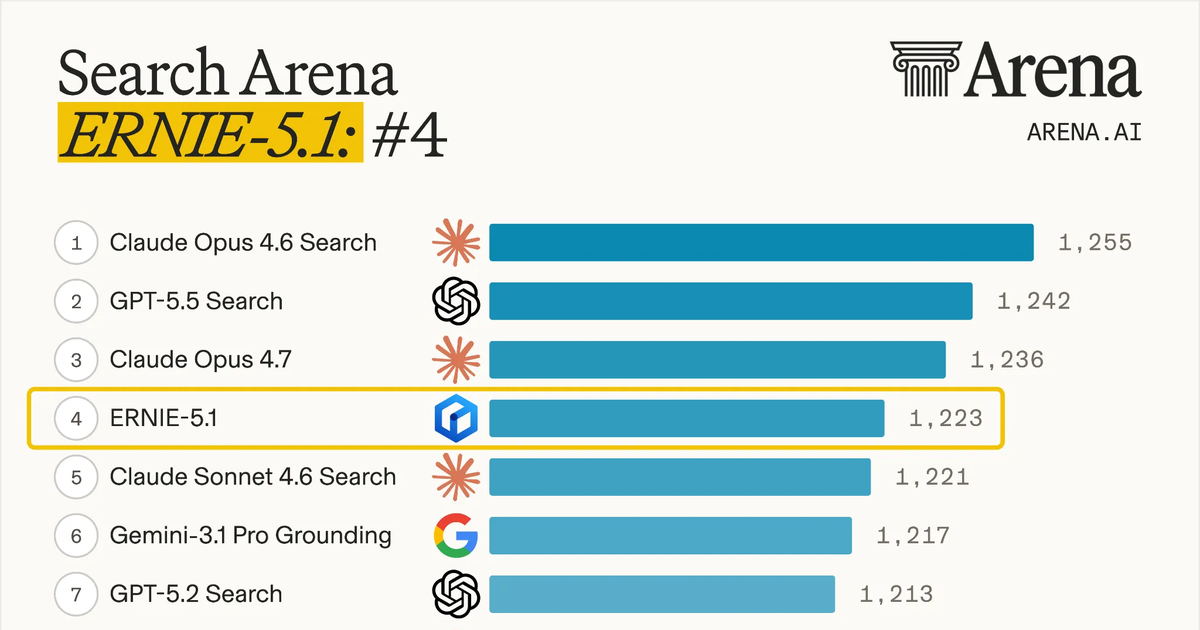
Search-style and knowledge answering. The vendor reports 1,223 points on the LMArena Search leaderboard on 2026-05-09, fourth globally and first among Chinese models. A search-shaped answer with a Chinese-language knowledge base behind it is the second use.
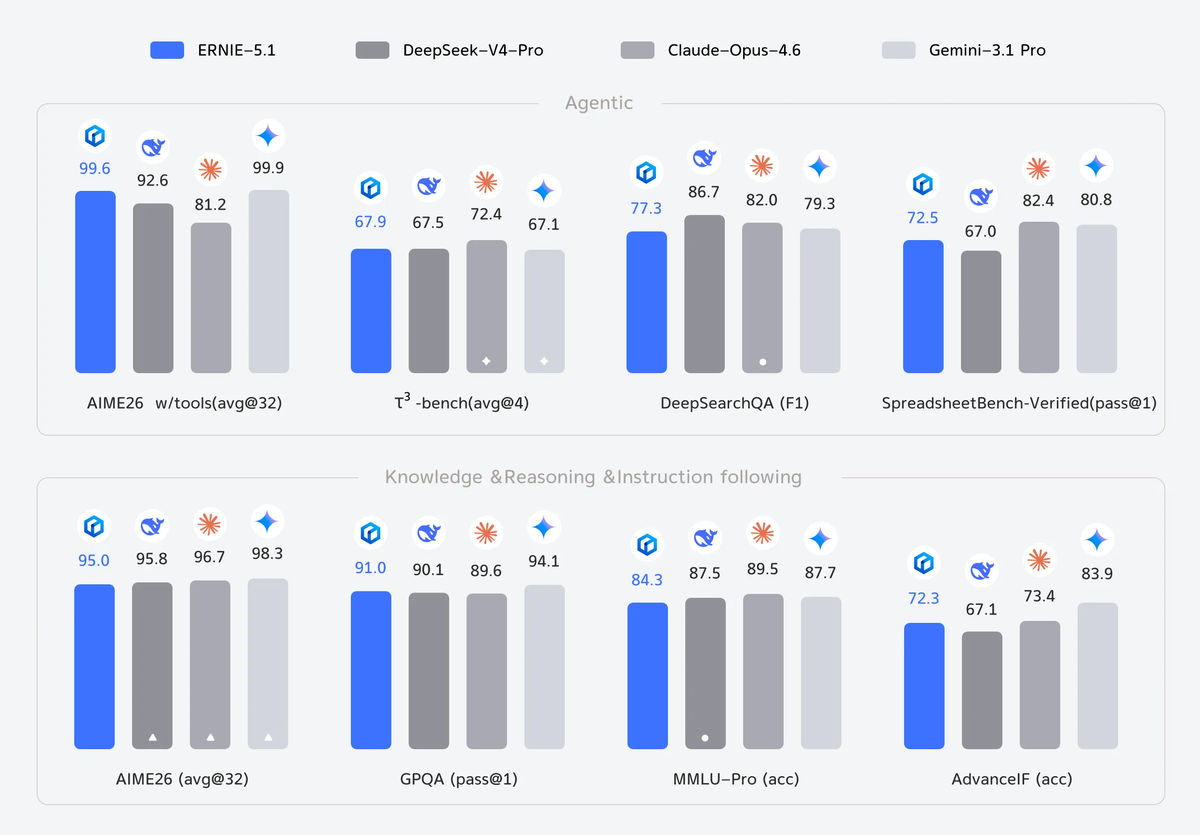
Agent and tool work on Chinese data. The vendor reports results above DeepSeek-V4-Pro on the τ³-bench and SpreadsheetBench-Verified agent evaluations, and a tool-assisted AIME26 score of 99.6.
Cost-sensitive volume text. At CNY 0.004 per thousand input tokens and CNY 0.018 per thousand output tokens below 32,000 input tokens, it is the cheapest ERNIE flagship on the Qianfan rate card that is not on a promotional price.
Long text inside a 119,000-token input budget. Contracts, filings and manuscript sets fit, with 65,536 tokens of output available for the answer.
What it is not. It is not a multimodal model: 5.1 takes text and returns text, and image, audio and video input belong to ERNIE 5.0. It is not the value pick in its own family any more: ERNIE 5.5 Flash Preview offers a 1,000,000-token context at a promotional CNY 0.001 and CNY 0.004 per thousand tokens. It is not open weights, it is not self-hostable, and no parameter count is published. It is not measured by any independent evaluator this review could find. And it is not a teaching product: nothing in it is built to move a capability from the model to the person.
Pricing, as published on 2026-11-19. Qianfan bills per thousand tokens, in yuan, pay as you go. The rate steps up once the prompt passes 32,000 input tokens.
Line | ERNIE 5.1 | ERNIE 5.0 | ERNIE 5.5 Flash Preview | ERNIE-Light-DT-1.0 |
Input, prompt up to 32k tokens | CNY 0.004 per 1k (CNY 4 per million) | CNY 0.006 to 0.01 per 1k | CNY 0.001 promotional, CNY 0.002 list, per 1k (peak) | CNY 0.008 per 1k |
Output, prompt up to 32k tokens | CNY 0.018 per 1k (CNY 18 per million) | CNY 0.024 to 0.04 per 1k | CNY 0.004 promotional, CNY 0.008 list, per 1k (peak) | CNY 0.028 per 1k |
Input, prompt 32k to 128k tokens | CNY 0.006 per 1k (CNY 6 per million) | Not published as a separate tier | Same as the base line | Same as the base line |
Output, prompt 32k to 128k tokens | CNY 0.022 per 1k (CNY 22 per million) | Not published as a separate tier | Same as the base line | Same as the base line |
Cached input | No cached-input line is published | No cached-input line is published | Yes, at one tenth of the input rate | Yes, at one tenth of the input rate |
Batch inference | Not offered | Not offered | Not offered | Not offered |
Dollar price | Not published | Not published | Not published | Not published |
Three arithmetic facts a buyer should carry. First, the step from 32,000 to 128,000 input tokens raises both lines by 50 percent and 22 percent respectively, so the long-context tier is a real pricing boundary rather than a rounding. Second, ERNIE 5.1 is cheaper than ERNIE 5.0 on both lines: its CNY 18 output rate sits 25 to 55 percent below 5.0's published CNY 24 to 40 band. Third, it is the expensive member of the current family: ERNIE 5.5 Flash Preview, released six months later, is priced at a quarter of 5.1's output rate under its promotional price and a half under its list price, with eight times the context. A reader choosing inside the family is choosing between a cheaper older model and a newer one that is cheaper still.
Official links:
Qianfan product page: https://cloud.baidu.com/product/wenxinworkshop
Qianfan model service billing, the rate card: https://cloud.baidu.com/doc/qianfan/s/wmh4sv6ya
Qianfan model list, with context and output limits: https://cloud.baidu.com/doc/qianfan/s/rmh4stp0j
Deep-thinking parameters, including the chain-length parameter: https://cloud.baidu.com/doc/qianfan-docs/s/Wm95lyynv
Text generation API reference: https://cloud.baidu.com/doc/qianfan-api/s/3m7of64lb
Qianfan platform user agreement: https://cloud.baidu.com/doc/qianfan/s/Cmh4stmpy
ERNIE 5.1 release post, 2026-05-09: https://ernie.baidu.com/research/posts/ernie-5.1-0508-release
ERNIE 5.1 Preview leaderboard announcement, 2026-04-30: https://ernie.baidu.com/research/posts/ernie-5.1-preview-0430-release-on-lmarena/
ERNIE site: https://ernie.baidu.com/
LLM-specific fields:
API model identifier: ernie-5.1, served on the OpenAI-compatible v2 chat-completions endpoint at https://qianfan.baidubce.com/v2. The billing table carries the version name ERNIE-5.1; there is no separate dated snapshot id.
Context window: 128,000 tokens, of which 119,000 are usable as input. Maximum output is 65,536 tokens.
Modalities: text input, text output. No image, audio or video input on this endpoint.
Reasoning control: the chain-length parameter is documented for ernie-5.1, and no on or off thinking parameter is documented for it. The vendor's deep-thinking model list does not include it either. Section 7c states the contradiction in full.
Tools and function calling: the endpoint accepts a tools array, and the vendor's agentic benchmark claims for this model are tool-use claims.
Structured output: JSON mode is available on the Qianfan v2 endpoint. No per-model support table for ernie-5.1 is published on the model-list page.
Rate limits, default: 60 requests per minute and 150,000 tokens per minute.
Parameters and architecture: not disclosed in absolute terms. The vendor states that total parameters are about one third and active parameters about one half of ERNIE 5.0's, and publishes no counts.
Knowledge cutoff: not published anywhere in the vendor's model documentation.
Licence: proprietary hosted service under the Qianfan platform terms. No weights are published for ERNIE 5.1, and the Apache 2.0 licence of the ERNIE 4.5 open-weight repository does not apply to it.
Availability: Baidu Qianfan, with billing in yuan. Baidu publishes no international catalogue entry and no dollar price for ernie-5.1.
At a Glance Dashboard
Field | Value |
Category | Applied AI / Large Language Model (Chinese-language professional writing, search-grounded answers and cost-sensitive text work) |
CI-First Benefit Score | 4.5 / 10 (CI-First Positive) |
Sub-scores | Time 5 / Quantity 5 / Quality 5 / Skill 3 |
CI-First Profile | Primary: Co-Worker and Assistant (level 2). Secondary: Co-Researcher, Analyst and Tester (level 4) |
Humics Protection | Humics-Neutral (-1 / +3) |
AI Imposture Risk | Medium overall, with Skill Illusion High |
Status | Active |
Last tested | 2026-11-19 |
Pricing | CNY 0.004 per 1k input and CNY 0.018 per 1k output up to 32k input tokens; CNY 0.006 and CNY 0.022 above; no cached-input rate, no batch tier, no dollar price |
Platforms | Baidu Qianfan API, Baidu AI Studio playground, the ERNIE assistant |
User sentiment | Thin: two launch-day Hacker News posts with no discussion, and no review-platform listing for the model |

ERNIE 5.1
The Problem
The work a Chinese-speaking professional brings to a model is not the work a frontier benchmark measures. It is a contract drafted in an official register, a policy note that has to sound like the ministry rather than like a chatbot, a set of filings reduced to four paragraphs, a customer reply that has to be firm without being rude. The evaluation that matters is whether the Chinese reads as though a competent native speaker wrote it. Almost no public benchmark scores that, and the ones that do score retrieval and search quality instead.
Behind that sits a cost problem with a currency attached. A reader in the Gulf, in Europe or in Africa who wants a Chinese-capable model is comparing a dollar-priced frontier model against a yuan-priced one, and the two rate cards are not published on a common basis. The frontier model is expensive per token and good at English; the Chinese model is cheap per token and its documentation is largely in Chinese, which is a barrier before the first call and a bigger one at the point of verification.
Baidu answers both halves with a distilled flagship. ERNIE 5.1 inherits ERNIE 5.0's pre-training and keeps, by the vendor's account, about a third of its total parameters and half of its active ones, at six percent of the pre-training compute of comparable models. The price sits below 5.0 on both lines. The model is text only, which is a saving rather than a limit for the work described above: a writing and reading model that does not carry image and audio machinery is a model whose bill is spent on tokens the reader wanted.
There is a third problem, and it is the one U365 cares about most. The evidence for the model's quality is almost entirely the vendor's own. The release post reports leaderboard positions and benchmark results, and no independent evaluator carries the model: Artificial Analysis has no ERNIE 5.1 page, and the LMArena position is the vendor's own report rather than an independent reading. A reader who cannot check a Chinese answer and cannot find an outside measurement is being asked to take a supplier's word for the one thing that decides whether the tool is worth using. That is the gap this review has to price honestly rather than fill.

ERNIE 5.1
The Outcome
ERNIE 5.1 gives a Chinese-language reader a competent, cheap and fast-moving text model with a documented rate card and a favourable data term, and it gives nobody an independent way to check how good it is.
The cost outcome is the strongest part of the release and it is fully documented. The Qianfan billing page publishes four rates for ernie-5.1, in yuan, per thousand tokens, with the tier boundary at 32,000 input tokens. The model list publishes the context at 128,000 tokens, the input ceiling at 119,000 and the output range at 1 to 65,536. The rate limits are published as 60 requests and 150,000 tokens per minute. Those are the numbers a buyer needs before the first call, and unlike most of this review they are verifiable on a vendor page without an account.
The performance outcome is a set of vendor claims. On 2026-05-09 Baidu reported 1,223 points on the LMArena Search leaderboard, fourth globally and first among Chinese models, results above DeepSeek-V4-Pro on τ³-bench and SpreadsheetBench-Verified, GPQA and MMLU-Pro results it describes as approaching leading closed-source models, 99.6 on AIME26 with tool use, and internal evaluations in which its creative writing approaches Gemini 3.1 Pro. Every one of those sentences is Baidu's, and the review records them as Baidu's.
Where the outcome is smaller than the launch. No independent index carries the model six months after release, which is the single most important fact in this review. The model is text only while its own predecessor is multimodal. Its 128,000-token context is an eighth of its newer sibling's. Its output rate is four times the promotional rate of that sibling. The thinking control is documented inconsistently. And the public conversation around the launch was close to silent: two Hacker News submissions, three points and two points, no comments, which is not evidence of a bad model but is evidence that no practitioner community formed around it in English.
For U365 Fellows, the outcome is a language instrument rather than a general one. A Fellow who works in Chinese, or who works with Chinese partners and documents, gets a model whose register is native, whose price is payable without a purchase order, and whose answers still have to be checked by someone who reads Chinese. A Fellow who does not work in Chinese gets very little: the writing strength is in a language they do not read, the search strength is in a knowledge base they cannot audit, and the documentation that would let them judge the model is mostly in the same language.
What the release does not change. It does not produce an independent measurement, it does not make the model multimodal, it does not remove the 60-request ceiling that keeps it out of high-volume pipelines, it does not add batch inference or a cached-input discount, and it does not give the model an English-first documentation set. Those facts sit in the limits, in the imposture table and in Section 7c, and no price cut moves them.

ERNIE 5.1
Who Should Use ERNIE 5.1
Learner type | Difficulty | Typical ROI | Career path |
Students (Bachelor, Master) | Intermediate | A cheap way to work on Chinese-language assignments, summaries and translations, provided the student reads Chinese well enough to correct the register. The gains are in the first pass over a dense Chinese text and in drafting that has to sound professional. The risk is the obvious one: a fluent Chinese answer that a learner cannot evaluate is a wrong answer that looks right. | |
Professionals (career upskilling) | Intermediate | The strongest case in the release for anyone whose working language includes Chinese: contract and filing reading inside a 119,000-token input budget, professional drafting, and search-shaped answers over Chinese sources, at a rate that makes repetition affordable. The limits are the rate ceiling and the absence of an outside measurement, which matters when the output goes to a client. | |
Everyone (lifelong learners) | Beginner to Intermediate | A capable Chinese-language assistant for reading and drafting, reachable through the ERNIE assistant without an API account. The gain is in the quality of a first pass over material that would otherwise go unread, and the cost is the verification habit. It is the wrong tool for English-only work and the wrong tool for images and audio. | LIPS Collect and Review phases for the reading work, and the UP-Context-Engineering Method order for prompting. No assessment home is asserted. |
For teams and organisations. The model is sold to companies through Qianfan, and a team deciding on it starts with four questions.
Team deployment. Reachable through the Qianfan API on an OpenAI-compatible endpoint, with a key per workspace and default limits of 60 requests and 150,000 tokens per minute. A team that runs volume work will be asking Baidu for a quota increase before it runs anything large, and a team that needs batch processing will not find a batch tier on this model's rate card.
Cost at team scale. Two lines move: the rate and the tier. The rate is flat within a tier and steps up by 50 percent on input and 22 percent on output once the prompt passes 32,000 input tokens, so a team that pastes whole document sets into every call pays the long-context rate on every call. There is no cached-input discount and no off-peak rate, which are the two levers a high-volume team would normally pull.
Data and compliance. The Qianfan user agreement states that input and output data belong to the customer, are used only inside the customer's account, are not used to train the vendor's models and are not shared with third parties. That is a stronger term than most Western consumer tiers carry. It does not remove the ordinary obligations: the same agreement disclaims the accuracy of output and places every judgement made on it with the customer, and Chinese content rules apply to what the service will and will not produce.
U365 for companies. Professional learners reach University 365's academic services individually or through their organisation, and the company route runs through a customized training agreement for employee groups. Corporate education programmes are built on demand, and their tuition follows content and duration.
Skill level required: Intermediate. The API is easy to call and the hard part is judgement: reading Chinese well enough to correct the register, knowing which claims in an answer are the model's and which are the sources', and keeping a prompt inside the cheap tier when the document set allows it.
Prerequisites. A Baidu Intelligent Cloud account with real-name verification, because Qianfan bills in yuan and payment is a verified-account function. An API key of the current form. A reading knowledge of Chinese for anything that will be published or sent, since the documentation and the strongest outputs are both in that language. A decision about how much of a document set goes into a single call, because that decision sets the rate tier.
Typical time to first result: Under five minutes in the ERNIE assistant. Under thirty minutes through the API for a first call, most of it spent on account verification rather than on code.
Typical time to competence: Ten to twenty hours of active use. Two habits carry most of the value: keeping prompts under the 32,000-token boundary unless the task needs more, and pairing every Chinese output with a reader who can judge it.
Who should wait. Anyone whose work is in English, because the model's measured strengths and its documentation are Chinese-first. Anyone who needs image, audio or video input. Anyone whose documents exceed 119,000 input tokens, because the newer sibling in the same family carries eight times that budget at a lower rate. Anyone who needs batch processing, a cached-input discount or a high request rate without a quota negotiation. And anyone who needs an outside measurement before adopting, because there is none.

ERNIE 5.1
U365 Institutes Alignment
The alignment below rates what a U365 institute could take from this model as a working instrument and as an object of study. The primary home is UIT (Technology, AI, Data Science), because the model's practical value for a U365 audience is API integration, cost engineering on a tiered yuan rate card, and the discipline of evaluating a model that nobody independent has measured. The other three readings are real and each is bounded.
UIT (Technology, AI, Data Science)
Rating. High (primary)
Why. Three engineering competencies, each of which survives the removal of the tool. API integration on an OpenAI-compatible endpoint: a base URL change, a model id, a bearer key and a token budget, which is the shape most production integrations now take. Cost engineering on a tiered rate card: computing cost per finished task from a rate, a 32,000-token boundary and a measured token count is arithmetic a cohort can practise on live numbers, and the comparison with ERNIE 5.5 Flash teaches the difference between a list rate and a promotional one. Evaluation design under absent measurement: the model has vendor benchmarks and no independent row, which makes it a worked example of how to read a supplier's claims, what a leaderboard position does and does not certify, and why a 404 on an independent evaluator's site is itself a finding. The published programme set already teaches Python, software development and cloud computing; this model is a working object on which those skills are exercised.
The limit that holds the row. The model is a hosted service with no weights, no parameter counts and no architecture description beyond its relationship to ERNIE 5.0, so the competencies are engineering-with rather than engineering-of. The catalogue's AI-agent instruction is concentrated in the n8n certificate series and the Superhuman certifications rather than spread across the degree paths, and no published programme assesses cost-per-finished-task or model evaluation as a named component. Adjacent anchors, not assessment homes.
UIB (Business Management, Entrepreneurship)
Rating. Medium
Why. Two decisions the release forces that are commercial before they are technical. Market entry into Chinese-speaking markets: a model whose register is native and whose price is in the local currency is part of the operating cost of a China-facing venture, and reading its rate card correctly is a finance skill. And the comparison inside a single vendor's catalogue: ERNIE 5.1 is cheaper than ERNIE 5.0 and dearer than ERNIE 5.5 Flash, which is a case in which the newest model is also the cheapest and the middle of the range is the worst value, a shape a business student should be able to recognise from any product line.
The limit that holds the row. The model supplies no management method and does not measure its own return. It publishes no completion rate and no time-per-task figure, and the vendor publishes no cost-per-task study, so a business case has to be built by the unit. The catalogue's business programmes publish process modeling and financial analysis, and no published programme assesses the economics of a model portfolio as a named component. Adjacent anchors, not assessment homes.
UIC (Digital Communication, Marketing)
Rating. Low to Medium
Why. The contact is real, and it is the writing surface itself: the vendor sells this model on writing, on register and on creative production, and it names creative platforms among its launch partners. A communication practitioner working in Chinese can use it for first drafts, tone variants and summarisation, and can study its failures as a lesson in what a language model does not know about audience: it produces a register on request, and it does not know which register a given publication, ministry or client expects. Reading a launch claim against the document that supports it is the second competency here, and this release is a worked example, because a leaderboard position reported by the vendor is not the same object as a leaderboard a reader can open.
The limit that holds the row. The model teaches no audience analysis, no publication standard and no editorial judgement, and it returns no sourced evidence by default. Rated as a writing surface with an evaluation lesson attached. No credential is mapped.
UID (Digital Design, UX/UI)
Rating. Low
Why. The contact is indirect and worth recording rather than inflating. The model reads and writes text, so a designer can use it for interface copy, for a content model, and for the language half of a design brief, and the discipline of writing a state, an error message and a confirmation in a consistent register is real work. Nothing in the release touches visual output.
The limit that holds the row. The model generates no images and reads none, so the design surface is copy and specification rather than visual authorship. No layout, interaction or motion competency is assessed by it. No credential is mapped.
U365 methods, not an institute (UNOP, ULM, LIPS, CARE and the UP-Context-Engineering Method)
Rating. Applicable
Why. The methods layer is relevant in the way any careful text model is: the UP-Context-Engineering Method's eight layers, from USER-PERSONA and FULL-CONTEXT through AI-EXACT-TASK to EXPECTED-FORMAT-AND-CONSTRAINTS, are exactly what a language-sensitive run needs, because the register instruction belongs in EXPECTED-FORMAT-AND-CONSTRAINTS and the audience belongs in AUDIENCE, and a model that writes fluent Chinese without either will write the wrong fluent Chinese. LIPS and CARE describe where the record goes: what a run was asked for, in which language, at which tier, and what came back, belongs in the Fellow's own system, because the model holds no state between calls. UNOP has no direct fit: the model is not built to teach, and its gains come from price and language rather than from any pedagogical mechanism.
The limit that holds the row. The model carries no method of its own and no coaching surface. A Fellow who does not keep the register decision and the verification record in their own system has no account of either.

ERNIE 5.1
How ERNIE 5.1 Works
A text-only model distilled from ERNIE 5.0's elastic sub-model matrix, sold on Qianfan at a yuan rate that steps at 32,000 input tokens, with a 128,000-token context, a 65,536-token output ceiling and a documented chain-length parameter but no documented switch for thinking.
Inputs: Text prompts, system instructions, conversation history, tool definitions and, where used, a supplied document set. The input ceiling is 119,000 tokens. The endpoint is the v2 chat-completions API, OpenAI compatible, authenticated with a bearer key.
Outputs: Text, including structured text and tool calls, up to 65,536 tokens. Where the chain-length parameter applies, the chain is part of the output budget, not separate from it, which is the same arithmetic Qianfan applies to its deep-thinking models.
Underlying technology, as the vendor publishes it:
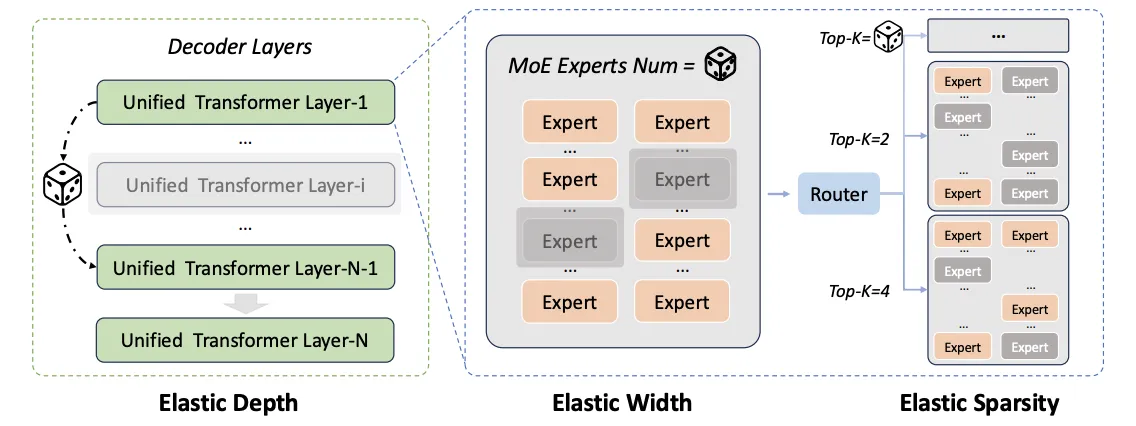
Model: ERNIE 5.1, model id ernie-5.1. Derived from ERNIE 5.0 by extracting a sub-network from a multi-dimensional elastic sub-model matrix, a training method the vendor calls Once-For-All: depth, expert capacity and routing sparsity were varied during ERNIE 5.0's single pre-training run so that smaller sub-models share the larger model's weights.
Size, in relative terms: total parameters about one third and active parameters about one half of ERNIE 5.0, with pre-training compute at about six percent of comparable models at the same scale. No absolute count is published.
Post-training: a four-stage pipeline the vendor describes as unified supervised fine-tuning, parallel domain-expert training, on-policy distillation from those experts into a single student, and a general online reinforcement-learning stage. The reinforcement-learning infrastructure is described as disaggregated and fully asynchronous on PaddlePaddle.
Context and output: 128,000 tokens of context, 119,000 usable as input, and 1 to 65,536 tokens of output, per the model list updated 2026-11-11.
Reasoning: the chain-length parameter thinking_budget is listed for ernie-5.1 in the vendor's deep-thinking documentation. The same documentation's model list for deep thinking does not include ERNIE 5.1, and neither on-or-off parameter list (thinking, enable_thinking) includes it. The practical reading is that a chain can be capped and cannot be switched, and the documentation does not say so in one place.
Tools: the endpoint accepts a tools array and a tool choice, and the vendor's agentic results for this model are tool-use results.
Rate limits: 60 requests per minute and 150,000 tokens per minute by default, published per model on the model list.
Billing tiers: CNY 0.004 and CNY 0.018 per thousand tokens while the prompt stays at or below 32,000 input tokens, and CNY 0.006 and CNY 0.022 above that, with no cached-input line and no batch column for this model.
Surfaces: the Qianfan API, the Baidu AI Studio playground, and the ERNIE assistant for readers who never touch an API.
What is not disclosed. No parameter count. No weights. No architecture description beyond the elastic sub-model method and the relationship to ERNIE 5.0. No knowledge cutoff on any page read. No cost-per-task study. No latency figures. No safety or evaluation report of the kind a Western lab publishes with a flagship, and no independent evaluation of any kind.
How the economics actually work. The bill is two rates and one boundary. Below 32,000 input tokens the model is the cheapest ERNIE flagship on a list rate; above it, both lines step up, and a long document set pays the higher rate on the whole call rather than on the excess. Output is the larger line by a factor of 4.5, so a run that thinks at length or answers at length is an output-cost run. There is no cache to soften a repeated long prompt and no batch tier to soften a volume job, which means the two techniques a team would normally use to cut a bill are both unavailable on this model.
What it is bad at natively. Anything visual, because it reads no images. Anything longer than 119,000 input tokens, which is a small budget by 2026 standards. High-request-rate work, because 60 requests per minute is a pipeline constraint rather than a preference. Volume work that would benefit from batch pricing, because there is no batch tier. Judging its own register, because a model that writes fluent Chinese does not know which fluent Chinese your reader expects. And any claim about its own quality, because the only measurements are its maker's.

ERNIE 5.1
Getting Started with ERNIE 5.1
Required accounts: A Baidu Intelligent Cloud account with real-name verification. Qianfan bills in yuan against that account, and verification is a precondition for payment rather than an optional step.
Installation: Nothing to install. The endpoint is HTTP and OpenAI compatible, so an existing client works with a base URL of https://qianfan.baidubce.com/v2 and a model id of ernie-5.1.
First-time configuration:
Create the key in the Qianfan console and store it outside your code. The current key form is a bearer token; the older OAuth access-token flow is being retired and new work should not use it.
Decide the tier before you decide the prompt. Below 32,000 input tokens you pay CNY 0.004 and CNY 0.018 per thousand; above it you pay CNY 0.006 and CNY 0.022 on the whole call. A document set that fits in two calls at the cheap tier is cheaper than one call at the long tier.
Set the output ceiling deliberately. The maximum is 65,536 tokens, and the chain of thought counts against it, so a low ceiling truncates the answer after the chain has already spent the budget.
Write the register instruction into the prompt, not into your hopes. Language, register, audience and the publication or counterparty belong in EXPECTED-FORMAT-AND-CONSTRAINTS and AUDIENCE, because the model will otherwise produce a fluent Chinese that is fluent in the wrong voice.
Check the rate limit against your job. 60 requests and 150,000 tokens per minute is enough for interactive work and short for a pipeline. Ask for a quota increase before a batch job, not during it.
Assume no cache and no batch. Neither is available on this model, so a repeated long prompt is paid in full every time. Keep the reusable part short or restructure the job.
Make the first task one that ends in a check you already own. A translation you can compare with a human translation, a summary of a document you have read, a table extracted from a filing whose numbers you know. The model's weaknesses are register and unverifiable confidence, and a first task should sit where neither can hide.
First 15 minutes checklist:
☐ Run one real Chinese-language task from your own work in a single message, with the audience and the register stated.
☐ Confirm the input token count and which billing tier the call used.
☐ Take one factual claim from the answer and check it against the supplied document or a source outside the conversation.
☐ Have a native reader judge one paragraph for register, not for facts.
☐ Write down the tokens used and compute the cost of the finished task in yuan.
Result: One real task completed end to end, a stated register, one verified claim, one judged paragraph and a known cost per finished task. That is a working setup rather than an impression.

ERNIE 5.1
Real Workflows
Three workflows, each chosen because the model's documented strength and a check the reader already owns sit in the same place. Each sample prompt uses the UP-Context-Engineering Method's eight layers in method order, with the register and the data limits inside EXPECTED-FORMAT-AND-CONSTRAINTS.
Workflow 1: Draft a Chinese-language document in a register you specify
When to use it: a report, a policy note, a formal letter or a partner communication has to be written in Chinese, and you can have a native reader judge the result. This is the workflow the vendor sells the model for, and the one where its price makes a second and third draft affordable.
This sample prompt uses the UP-Context-Engineering Method and the CI-First doctrine. Read the method at https://www.university-365.com/post/the-up-method-university-365-prompting-the-new-gold-standard-for-prompt-engineering, the doctrine at https://www.university-365.com/post/discover-the-ci-first-approach, learn both in a U365 online program at https://www.university-365.com/programs, and request a U.Coach for orientation at https://www.university-365.com/ucoach.
USER-PERSONA: My UP-Context-Engineering USER-PERSONA file is the file for this layer, attached. It is my psychographic file concatenated with the six ULM life-domain files. The parts that matter here: I write for a Chinese-speaking counterparty, I sign what I send, and I do not send Chinese I cannot defend line by line. If the file is not attached, ask for it before you start.
FULL-CONTEXT: The FULL-CONTEXT set for this task, added and not merged: BUSINESS-PERSONA for [the organisation], PROJECT-DESCRIPTION for [the document], the facts and figures at [paths], the two reference documents whose register I want matched, the glossary of house terms at [path], and the counterparty [role and relationship]. The supplied documents are the only factual authority. If the glossary or the reference documents are missing, name it and stop.
AI-PROFILE-ROLE-EXPERTISE: Act as a Co-Worker & Assistant, in the role of a Chinese-language professional writer working to a house register, with expertise in formal written Chinese, terminology consistency and the difference between a public notice and an internal note.
USER-FINAL-GOAL: A Chinese draft my native reviewer can correct in one pass rather than rewrite, with every number traceable to a supplied document and every house term matching the glossary.
AI-EXACT-TASK: Draft the document in Chinese, then list in English the three sentences you were least sure about and why.
AUDIENCE: [the counterparty], who reads formal written Chinese and will judge the register before the content, and my native reviewer, who will check terminology against the glossary.
EXPECTED-FORMAT-AND-CONSTRAINTS: Format: (1) the Chinese document, (2) a short English note listing the uncertain sentences and the register choices you made, (3) a term table showing each house term and the form you used. Constraints: use simplified Chinese unless I say otherwise; match the register of the supplied reference documents, not a generic formal tone; every figure must come from the supplied documents and carry its source in the note; write "not stated" rather than inferring a figure; do not translate a house term differently from the glossary; keep the prompt inside the cheap billing tier by drafting section by section if the set is large; if a required fact is missing, stop and name it. Data limits: the counterparts' documents are cleared at the level I state in FULL-CONTEXT; no unpublished term, personal data or privileged material leaves my control.
EXAMPLES: The two reference documents are the register examples, and one paragraph I wrote myself and had corrected is the standard the draft should meet.
Before you use the output, run the check yourself: have a native reader mark the register and the terminology, open the source for every figure, and read the English note before you read the Chinese draft, because the note is where the model admits what it guessed.
What the model does well here: formal written Chinese and terminology consistency are the strengths the vendor claims and the ones its launch partners are built on. The price is the second half of the argument: at CNY 0.018 per thousand output tokens, three drafts cost less than one draft on a dollar-priced frontier model, which changes how many attempts a careful writer makes.
VERIFICATION CHECKLIST for Draft in a specified register:
☐ Multi-Model Check: run the same prompt through a second Chinese-capable model and compare the register notes, not the drafts.
☐ External Source: open the supplied document for every figure in the draft and confirm it is there.
☐ Human Review: a native reader marks register and terminology before anyone reads for content.
☐ CI-First Test: can you explain each register choice without reopening the session? If not, the draft is not yours yet.
Workflow 2: Reduce a Chinese document set to a cited brief
When to use it: several Chinese documents have to become one short brief, and every claim in it will be challenged. The 119,000-token input budget is the constraint that decides how many documents fit.
This sample prompt uses the UP-Context-Engineering Method and the CI-First doctrine. Read the method at https://www.university-365.com/post/the-up-method-university-365-prompting-the-new-gold-standard-for-prompt-engineering, the doctrine at https://www.university-365.com/post/discover-the-ci-first-approach, learn both in a U365 online program at https://www.university-365.com/programs, and request a U.Coach for orientation at https://www.university-365.com/ucoach.
USER-PERSONA: My UP-Context-Engineering USER-PERSONA file is the file for this layer, attached. It is my psychographic file concatenated with the six ULM life-domain files. The parts that matter here: I am the analyst who signs the brief, and a reader who knows the file will check every sentence against it. If the file is not attached, ask for it before you start.
FULL-CONTEXT: The FULL-CONTEXT set for this task, added and not merged: BUSINESS-PERSONA for [the organisation], PROJECT-DESCRIPTION for [the decision], the documents at [paths] as the only sources allowed, the question the brief answers, the fields [fields], and the number of documents [n]. If a document or a field is missing, name it and stop.
AI-PROFILE-ROLE-EXPERTISE: Act as a Co-Researcher, Analyst & Tester, in the role of an analyst building a cited brief from Chinese primary documents, with expertise in clause-level extraction, uncertainty reporting and the difference between what a document says and what a summary says it says.
USER-FINAL-GOAL: A brief of no more than one page in which every sentence carries a document and a section, and every gap is visible rather than filled.
AI-EXACT-TASK: Extract the fields for each document, then write the brief and a list of the claims you are least confident about.
AUDIENCE: [role], who will open the cited section of every sentence, and the decision-maker who reads only the brief and the uncertainty list.
EXPECTED-FORMAT-AND-CONSTRAINTS: Format: a table of document, field and quoted text with a section reference, then the brief, then the uncertainty list. Constraints: one row per document; every cell carries a section reference in the same cell; if a field is absent, write "not stated" rather than inferring it; do not merge two documents into one row; quote the Chinese and give the English rendering beside it; a citation that resolves to the wrong section is worse than no citation; tell me before you start if the set exceeds the input budget, and say which documents you would drop; keep the whole set inside one billing tier if it fits. Data limits: the documents are cleared at the level I state; no client document, unpublished term or personal data leaves my control, and where the engagement forbids third-party processing I paste the material to no surface.
EXAMPLES: One row I built by hand from the same set is the format example, and the first page of each document is the quotation-style example.
Before you use the output, run the check yourself: open the cited section for every sentence you will act on, check the uncertainty list first, and re-extract two rows with a second model.
What the model does well here: the input budget is large enough for a real document set, the vendor's search and knowledge claims bear on this kind of reading, and the Chinese quotation is native rather than translated. The caveat is the one that runs through this review: the extraction is only as good as a check nobody independent has measured, so the citation is the check.
VERIFICATION CHECKLIST for Reduce a document set to a cited brief:
☐ Multi-Model Check: re-extract two rows with a second model and compare. A disagreement is a row to read by hand.
☐ External Source: open the cited section for every sentence you will act on.
☐ Human Review: a Chinese reader confirms that each quotation says what the English rendering says it says.
☐ CI-First Test: can you defend each sentence without reopening the session? If not, it is not evidence yet.
Workflow 3: Keep a volume job inside the cheap billing tier
When to use it: a repeated job has a predictable shape and the bill matters more than the convenience of one large call. This is cost engineering rather than prompting, and it is the workflow where the model's rate card is the product.
This sample prompt uses the UP-Context-Engineering Method and the CI-First doctrine. Read the method at https://www.university-365.com/post/the-up-method-university-365-prompting-the-new-gold-standard-for-prompt-engineering, the doctrine at https://www.university-365.com/post/discover-the-ci-first-approach, learn both in a U365 online program at https://www.university-365.com/programs, and request a U.Coach for orientation at https://www.university-365.com/ucoach.
USER-PERSONA: My UP-Context-Engineering USER-PERSONA file is the file for this layer, attached. It is my psychographic file concatenated with the six ULM life-domain files. The parts that matter here: I pay the bill, I answer for the unit cost, and I would rather run three cheap calls than one expensive one. If the file is not attached, ask for it before you start.
FULL-CONTEXT: The FULL-CONTEXT set for this task, added and not merged: BUSINESS-PERSONA for [the organisation], PROJECT-DESCRIPTION for [the job], the item list at [path] with [n] items, the per-item token estimate, the output fields [fields], and the rate card I am working to [rate and tier]. If the item list or the rate card is missing, name it and stop.
AI-PROFILE-ROLE-EXPERTISE: Act as a Co-Worker & Assistant, in the role of a production engineer planning a text job against a tiered rate card, with expertise in prompt budgeting, per-item token accounting and the arithmetic of a 32,000-token boundary.
USER-FINAL-GOAL: A job plan in which every call stays inside the cheap tier, the unit cost is known before the run, and no item is silently dropped.
AI-EXACT-TASK: Split the item list into calls that each stay under the tier boundary, state the token budget for each call, and give the per-item cost.
AUDIENCE: Me, as the person who approves the spend, and the operator who will run the calls.
EXPECTED-FORMAT-AND-CONSTRAINTS: Format: a table of call number, items, estimated input tokens, estimated output tokens and cost in yuan, then the total, then the items you would process differently and why. Constraints: no call may exceed the tier boundary unless you say so explicitly and give the cost difference; state every estimate as an estimate; do not assume a cache or a batch discount, because neither exists on this model; respect the 60-request-per-minute ceiling in the schedule; if the item list is longer than the call plan covers, say how many items remain rather than truncating silently. Data limits: the items are cleared at the level I state; no customer record or unpublished material leaves my control.
EXAMPLES: The last job plan that came in under budget is the form example, attached.
Before you use the output, run the check yourself: recount the items against the plan, run one call and compare its actual token count with the estimate, and recompute the per-item cost from the invoice rather than from the plan.
What the model does well here: the rate card is simple enough to plan against, the model's own output ceiling is published, and the boundary is a single number. The work is arithmetic, and the arithmetic is checkable.
VERIFICATION CHECKLIST for Keep a job inside the cheap tier:
☐ Multi-Model Check: have a second model or a spreadsheet recompute the plan's arithmetic.
☐ External Source: compare one call's actual usage with its estimate, from the API response rather than the plan.
☐ Human Review: the operator confirms the item count and the request rate before the run.
☐ CI-First Test: can you state the unit cost and defend it from the invoice? If not, the plan is a guess.

ERNIE 5.1
Strengths, Limits, and AI Imposture Risk
Strengths
Time
Strength. A real saving on Chinese-language reading and drafting, at a price that makes a second draft normal.
Evidence. Native-register Chinese writing and a 119,000-token input budget mean a document set goes in whole and a first pass comes back in one call. Held at 5 rather than higher by the absent latency measurement, the 60-request ceiling, an account that requires real-name verification and documentation that is mostly in Chinese.
Quantity
Strength. More usable Chinese text per unit of spend than the dollar-priced alternative, with a published output ceiling.
Evidence. CNY 0.018 per thousand output tokens below 32,000 input tokens, a 65,536-token output ceiling, and three published agent and knowledge benchmark claims. Held at 5 because no cache, no batch tier and a 150,000-token-per-minute ceiling cap the volume a team can actually run.
Quality
Strength. A competent Chinese writer with a leaderboard position the vendor reports and no independent measurement behind it.
Evidence. Vendor-reported: 1,223 on the LMArena Search leaderboard, fourth globally and first among Chinese models on 2026-05-09; above DeepSeek-V4-Pro on τ³-bench and SpreadsheetBench-Verified; 99.6 on AIME26 with tools. No independent index row exists. Held at 5 by that absence, which is the review's central limit.
Skill
Strength. Marginal, and honestly marginal.
Evidence. No teaching mode, no open weights, no published reasoning trace contract beyond a chain-length cap, and a language barrier in the documentation for the readers most likely to need instruction. Scored conservatively.
Limits
No independent measurement exists. Artificial Analysis carries no ERNIE 5.1 page, the LMArena position is the vendor's own report rather than an independent reading, and no review platform rates the model. Every performance sentence in this review is the vendor's.
It is text only. No image, audio or video input, while ERNIE 5.0 carries all three. A reader who needs multimodal work is looking at a different model.
The context is small for 2026. 128,000 tokens total and 119,000 usable as input, against 1,000,000 on ERNIE 5.5 Flash and ERNIE-Light-DT-1.0 in the same catalogue.
The rate ceiling is a pipeline constraint. 60 requests and 150,000 tokens per minute, with no batch tier and no cached-input rate, which is the wrong shape for volume work.
The rate steps at 32,000 input tokens, and it steps on the whole call. Output rises 22 percent and input 50 percent once the prompt passes the boundary.
The reasoning documentation contradicts itself. ERNIE 5.1 is absent from the deep-thinking model list and from both on-and-off parameter lists, and present in the chain-length parameter list. Section 7c states it in full.
It is the worst value in its own family. ERNIE 5.5 Flash Preview, six months newer, offers eight times the context at a quarter of the output rate under its promotional price.
The English record is thin. Two Hacker News submissions at three and two points, no comments, and no English-language practitioner discussion of consequence.
No weights, no parameter counts and no self-hosting. Nothing about this model can be inspected from outside the vendor's service.
No safety or evaluation report of the kind a flagship usually carries. No published knowledge cutoff either.
AI Imposture Risk
Time Illusion
Rating. Medium
Evidence. The saving is real on Chinese reading and drafting, and a 119,000-token input budget removes the chunking work that eats a day. The overhead is real as well: real-name account verification before the first call, documentation in Chinese, a register instruction that has to be written and then judged by a native reader, a tier decision before every large prompt, and no cache, so a repeated long prompt is paid again. No latency measurement exists, so the saving is asserted rather than timed.
Quantity Illusion
Rating. Medium
Evidence. The price invites volume: CNY 0.018 per thousand output tokens makes ten drafts cheaper than one frontier-model draft, and a 65,536-token ceiling makes long output normal. The failure mode is that fluent Chinese at volume reads as finished work. Nothing in the product flags an uncertain sentence, and the vendor's own agreement disclaims the accuracy of output in terms.
Skill Illusion
Rating. High
Evidence. A model that writes formal Chinese for readers who cannot judge formal Chinese, at a price that makes volume rational and with no independent measurement of its quality. The reader sees a document that looks like the work of a competent native writer and has no way to tell whether it is. The vendor's benchmark claims make the effect stronger rather than weaker, because a leaderboard position reads as a guarantee and the leaderboard cannot be opened. Mitigations exist and are in this review: the native-reader check, the cited-document workflow, and the cost arithmetic that forces a plan. They lower the frequency of failure and do not move the capability to the reader.
Overall Imposture Risk: Medium. One trap is High with identifiable mitigations, and two are Medium. Under the framework's arithmetic, one High with clear mitigations stated is Medium rather than High. The band-precedence sentence does not change that outcome, because the Medium band names this exact trap set and no second rating competes with it. The rating holds at Medium for a specific reason: the model's weaknesses are in verification and register, where a reader can build a check, rather than in a capability claim that no check can reach.
Framework v1.2 clause note
Clause 5.2.3-a, agent-authored procedural memory: NULL, recorded with its boundary. The model holds no state between API calls, writes nothing by itself and ships no memory or skill store. Qianfan's agent builder can hold a knowledge base and a conversation memory around a model, and those are user-authored or user-configured objects rather than a mechanism by which this model writes the user's procedural memory. No documented mechanism ships by default by which ERNIE 5.1 writes skills, memory stores or standing instructions on the user's behalf, so the clause returns a null rather than applying. The live condition is specific: any change that lets the model revise a stored instruction without a per-write decision re-opens this clause, which is why the re-check list keeps the model surface in view.
Clause 4.2-a, agent-mediated conversation: NULL for the model as a generator. Neither erosion condition is met. No agent-authored text is presented as the person's own voice in a human-facing channel by default, and nothing substitutes agent interaction for human contact. The live condition to watch on any deployment: an agent that sends Chinese text in the person's own name to a counterparty without the person reading it first would meet condition (a), and a writing model that produces correspondence makes that deployment easy to build. That is a property of the deployment rather than of the model.
Recorded together: the clause questions above return nulls with boundaries and live conditions rather than mechanisms, and the boundary is the part that matters. The reason Skill Illusion still rates High is not a clause mechanism; it is the plain fact that the model produces finished-looking formal Chinese for readers who often cannot judge it, with no independent measurement to set the expectation.

ERNIE 5.1
Section 7c: A yuan-only price, a reasoning control the documentation cannot settle, and a data term in the buyer's favour
A Section 7c finding is recorded where a supplier's governance, safety record or commercial terms have a real result for the reader. The items below were checked against primary sources on 2026-11-19, and they produce findings a buyer should carry. All findings are stated as facts of record, and the difference between a company statement, a published rate and a policy term is kept intact.
The price is published, and it is published only in yuan. The Qianfan billing page carries four rates for ernie-5.1, in yuan, per thousand tokens, under pay-as-you-go online inference: CNY 0.004 input and CNY 0.018 output while the prompt is at or below 32,000 input tokens, and CNY 0.006 and CNY 0.022 above that. The product page a reader meets first lists ERNIE 5.0, X1.1 Preview and the 4.5 line without 5.1's rate, which is how a reader concludes that no price is published. It is published, one document deeper, and Baidu publishes no dollar price and no international catalogue entry for this model. Every dollar figure in circulation is a third-party conversion with no stated exchange basis, and this review publishes none of them.
The reasoning control is documented inconsistently, and the contradiction is not cosmetic. The vendor's deep-thinking documentation has three support lists: one for the on-or-off parameter thinking, one for enable_thinking, and one for the chain-length parameter thinking_budget. ERNIE 5.1 appears in the chain-length list and in neither of the on-or-off lists, and the deep-thinking model list does not include it. A buyer therefore cannot tell from the documentation whether the model always emits a chain of thought, whether the chain-length parameter applies to it, or whether a call that sets the parameter is quietly ignored. Every one of those readings has a different bill attached, because the chain counts against the 65,536-token output ceiling.
The data term runs in the buyer's favour and is quotable. The Qianfan platform agreement, updated 2026-11-07 and effective 2026-01-09, states in section 5.1(6) that input and output data and any uploaded knowledge documents and datasets are the customer's user data, are used only inside the customer's account, are not put to any unauthorised use or disclosure, are not used to train the vendor's models, and are not shared with any third party. A hosted model whose contract says that plainly is a materially better instrument for client work than one whose terms leave the question open, and this review records it as a finding in the supplier's favour.
The efficiency claim is a training-cost claim, and it is being read as a price claim. Baidu states that ERNIE 5.1 keeps about a third of ERNIE 5.0's total parameters and about half of its active parameters, and that its pre-training cost about six percent of comparable models at the same scale. Those are statements about how the model was built. What a buyer pays is the rate card, and the rate card says ERNIE 5.1 costs more per token than ERNIE-Light-DT-1.0 on input and less on output, more than ERNIE 5.5 Flash on both lines under the promotional price, and less than ERNIE 5.0 on both lines. Efficiency in training and efficiency in inference are different quantities, and a launch that reports the first is not reporting the second.
No sub-score changed for these findings, and the reason is explicit. The Time and Quantity scores already carry the tier boundary, the absent cache and batch, and the 60-request ceiling. The Quality score already carries the absence of any independent measurement. The Imposture assessment already carries the fluency risk that a capable Chinese writer hands to a reader who cannot judge the register. The items above are a price published in one currency, a documentation contradiction, a favourable data term and a claim whose subject is training rather than inference. None of them is a resolved failure and none is a defect in the artefact a buyer receives. Section 7c closes with what it does not do: it does not allege misconduct, it does not treat a yuan-only price or a contradictory support list as a scandal, and it does not convert a company's own published caveats into findings against it.

ERNIE 5.1
U365 Co-Intelligence Rating
CI-First Profile
Primary profile: Co-Worker and Assistant (level 2). Secondary profile: Co-Researcher, Analyst and Tester (level 4).
Why this profile and not Co-Creator. Baidu's positioning does the reasoning. The release sells the model for writing, knowledge and agentic task execution, and its own division of labour casts it as the instrument a person directs and then reviews. That is a delegation framing: state the document, state the register, hand over the draft, read what returns. Co-Worker and Assistant is the role the model actually plays. Analyst and Tester is recorded as secondary because the document-set and extraction workflows are where a reader interprets rather than authors. Professor, Coach and Tutor is not recorded: the model has no teaching mode, its rationale is not exposed as instruction, and a learner reading its Chinese output learns the model's register rather than the language.
CI-First Benefit Score
Time
Score (0-10). 5
Rationale. Native-register Chinese writing and a 119,000-token input budget produce a real net saving on reading and drafting: a document set goes in whole and a usable draft comes back in one call, at a price that makes a second draft normal. Held at 5 rather than higher by the absent latency measurement, the real-name account step, documentation in Chinese, a tier decision before every large prompt, and no cache, so a repeated long prompt is paid again.
Quantity
Score (0-10). 5
Rationale. More usable Chinese output per unit of spend than a dollar-priced alternative: CNY 0.018 per thousand output tokens below the boundary, a 65,536-token output ceiling, and three published benchmark claims that bear on volume work. Held at 5 because there is no batch tier, no cached-input rate and a 150,000-token-per-minute ceiling, which cap what a team can actually run.
Quality
Score (0-10). 5
Rationale. A competent Chinese writer with vendor-reported strength: 1,223 on the LMArena Search leaderboard, fourth globally and first among Chinese models on 2026-05-09, above DeepSeek-V4-Pro on τ³-bench and SpreadsheetBench-Verified, 99.6 on AIME26 with tools. Held at 5, not higher, because no independent evaluator carries the model: the quality claim is unmeasured from outside, and the framework does not price a supplier's own benchmark as a verified benefit.
Skill
Score (0-10). 3
Rationale. Delegation rather than learning in the common case, with no teaching mode, no open weights, no published reasoning contract beyond a chain-length cap, and a documentation language barrier for the readers most in need of instruction. Scored conservatively per the framework's guidance.
CI-First Benefit Score: 4.5 / 10 (CI-First Positive)
Why the score sits where it sits
4.5 with sub-scores 5 / 5 / 5 / 3 is a moderate position on every benefit dimension and a marginal position on skill, and both halves of that sentence are deliberate.
Why not higher. Three reasons, each measured. There is no independent measurement of the model at all, which caps Quality at the middle of the scale however good the vendor's numbers look. The model is the worst value in its own family: ERNIE 5.5 Flash Preview is six months newer, carries eight times the context and costs a quarter of the output rate under its promotional price. And the operating constraints are real: text only, 119,000 input tokens, 60 requests per minute, no batch and no cache, with a rate that steps up on the whole call once the prompt passes 32,000 input tokens.
Why not lower. The price is genuinely low and it is published. The data term is unusually favourable and quotable. The Chinese writing is the work the vendor built the model for and the work its partners ship. The 119,000-token input budget is enough for a real contract set. And the model is available today, on an OpenAI-compatible endpoint, without a procurement cycle. A reader with Chinese-language work and a native reviewer gets a real instrument for a small bill, which is exactly what the Positive band describes.
Why 4.5 and not a higher band, stated as arithmetic. Time 5, Quantity 5, Quality 5 and Skill 3 average to 4.5. Under the v1.4.1 thresholds, 4.1 to 6.0 is CI-First Positive and 6.1 to 8.0 is CI-First Strong, so 4.5 is Positive. The band is a function of the score and is not set by hand.
What the score does not carry. The four dimensions measure what the reader's work gains. They do not carry the yuan-only price, the documentation contradiction on reasoning, the favourable data term or the training-cost claim, which is why those sit in Section 7c with an explicit statement that no sub-score changed. They do not carry the clause questions either, which return nulls with boundaries. A reader who wants the score to encode governance would need a different instrument, and the framework's instrument is the clause note and the 7c finding.
Humics Protection Badge
Creativity
Rating. Neutral (0)
Rationale. It writes creative and professional Chinese on request and the vendor markets it on creative writing, with creative production platforms among its launch partners. It does not originate the direction and it neither trains nor replaces the user's ideation: a model that produces ten Chinese variants leaves the judgement about which one is right with the reader.
Critical Thinking
Rating. Erodes (-1)
Rationale. Fluent formal Chinese whose register is expensive to check and whose factual claims rest on documents the reader may not open, produced at a price that invites volume and with no independent measurement to calibrate trust. The failure mode is not an obvious error; it is a document that reads as though a competent native speaker wrote it. The mitigations in this review lower the frequency and do not reverse the direction.
Social Authenticity
Rating. Neutral (0)
Rationale. The model produces text rather than speaking in a person's name, and clause 4.2-a returns a null for it as a generator. The live condition stays in the record: a deployment that sends Chinese correspondence under a person's identity without the person reading it first moves this dimension, and a writing model makes that arrangement easy to build.
Humics Protection Score: -1 / +3 Badge: Humics-Neutral
Superhuman Usage Guidance
When to invite this tool:
Chinese-language drafting where a native reader will mark the register before anything ships.
Reading a Chinese document set that fits in 119,000 input tokens and has to become a cited brief.
Cost-sensitive repetition: second and third drafts, tone variants, summaries of the same material at a price that makes them affordable.
Agent and tool work on Chinese data where the vendor's agentic claims bear and the tool calls are checkable.
A first pass over material larger than you would read, with a citation required in every cell and a spot-check afterwards.
When to keep this tool out:
Any output that will be sent to a Chinese counterparty without a native reader seeing it. The stronger the register, the more convincing the error.
English-only work, where the documentation and the measured strengths are both against you.
Image, audio or video input, which this endpoint does not take.
Document sets beyond 119,000 input tokens, where the newer sibling in the same family is cheaper and larger.
High-request-rate pipelines, batch jobs and repeated long prompts, because the ceiling, the missing batch tier and the missing cache all bite there.
Any decision that requires an outside measurement of the model before adoption, because there is none to have.
U365 method integration:
LIPS + CARE: route the model's reading and drafting output into the Collect phase, and keep the Action Plan and Review phases as your own work. The model can produce the collection and the draft; it cannot own the decision about what the draft should say to that counterparty.
ULM + EVA: the decision about which Chinese-language work is worth automating belongs in the Career and Quality of Life domains, and ULM is the six-domain frame that holds it. Cost per finished task is CI-First cost engineering rather than a ULM method, and the tier decision is a planning habit that sits with the Fellow. Weak fit elsewhere.
UP-Context-Engineering: the method's eight layers are the control surface this model needs, because AUDIENCE and EXPECTED-FORMAT-AND-CONSTRAINTS are where a register is specified, and a model that writes fluent Chinese without them writes the wrong fluent Chinese. The three workflow samples above use the eight layers, and the Verdict block points to them rather than repeating them.
UNOP: no direct fit. The model is not built to teach, and its gains come from price and language rather than from any pedagogical mechanism.
Over-delegation warning: the failure mode with this model is that its fluency justifies more delegation than the reader can verify. A document that reads as though a competent native speaker wrote it invites a reader to stop reading it as a draft, and a reader who does not speak Chinese has no signal at all. The framework's arithmetic is the point: if your Human Intelligence input drops while the Artificial Intelligence term rises, the product falls. A reader who moves Chinese correspondence to this model because it is cheap, and changes nothing about who reads the output before it is sent, has taken the release's worst offer.

ERNIE 5.1
What Users Say
Aggregate Rating Table
Platform | Rating | Number of reviews | Link |
LMArena, Search leaderboard | 1,223 points, reported by the vendor as fourth globally and first among Chinese models on 2026-05-09 | Leaderboard position, not a user rating | |
Artificial Analysis | No model page for ERNIE 5.1 | Not applicable | Not applicable |
Hacker News | Two launch-day submissions, three points and two points, no comments | Not a rating platform | |
G2 | No listing for the model | Not applicable | Not applicable |
Capterra | No listing for the model | Not applicable | Not applicable |
Trustpilot | No listing for the model | Not applicable | Not applicable |
The Decoder | Independent reporting that repeats the vendor's pre-training cost claim and its Arena Search position | Reporting, not a rating |
Note on method, stated plainly because it affects how much this section is worth. No review platform rates an individual language model, and this model has no review-platform listing of any kind. The independent benchmark house that would normally carry it does not, and the leaderboard position is the vendor's own report of it. What remains is the vendor's own report, one independent news account that repeats it, two Hacker News submissions with no discussion, and a set of third-party model catalogues that restate the vendor's specifications and publish their own dollar conversions. That is a thin record, and this section says so rather than padding it.
What Users Praise
There is no substantial body of user commentary to draw on, and the honest version of this section is short.
The price and the Chinese writing are what the vendor and its partners say. The release names creative production platforms among its launch partners, including roleplay, creative-canvas and short-drama products, which is a statement about where the model is being deployed rather than about what users said. No named practitioner review of the model was found in English.
The launch registered with almost nobody in the English-speaking developer community. Two submissions to Hacker News on the release, three points and two points, zero comments. A model can be excellent and quiet, and a model can be quiet because nobody could try it. This review cannot tell which, and it does not guess.
What Users Complain About
The documented complaints are about access and language, not about quality. The vendor's own documentation is Chinese-first, the account requires real-name verification, and billing is in yuan. Third-party guides aimed at international developers spend their first section on account creation and key management rather than on the model, which is a signal about where the friction sits.
The context and the family position are the two criticisms a reader can verify without using the model. A 128,000-token context is small next to the 1,000,000-token models in the same catalogue, and the newer sibling is cheaper. Those are facts about the rate card and the model list rather than complaints from users, and they are stated here as facts.
Sentiment Summary
Overall sentiment: Unmeasured. The vendor reports strong results, the launch drew almost no English-language discussion, and no review platform or independent evaluator carries the model.
Key themes: a cheap, Chinese-first text model with a published rate card and a favourable data term; a small context and a low request ceiling for its price class; a newer and cheaper sibling in the same catalogue; and an evidence base that is entirely the supplier's.
U365 Editorial Note
The model's record argues in two directions at once, and a reader should hold both. In its favour, the price is published and low, the data term says plainly that input and output are not used for training, the Chinese writing is the work the model was built for, and 119,000 input tokens is enough for a real document set. Against it, no independent evaluator carries the model six months after release, the context is an eighth of its newer sibling's, the request ceiling keeps it out of pipelines, and the reasoning documentation contradicts itself. The Framework rates AI Imposture Risk Medium overall with Skill Illusion High, and that rating is the editorial position: ERNIE 5.1 is a tool to write and read Chinese with, provided a native reader stands between the output and the counterparty. A reader who wants a higher score is asking for an independent measurement that does not exist, and this review will not invent one.

ERNIE 5.1
Comparison and Alternatives
Model | Position | Published evidence | Price, per million tokens | Choose it if |
ERNIE 5.1 | The distilled Chinese-first text flagship, priced below its predecessor | Vendor-reported only: 1,223 on LMArena Search (fourth globally, first among Chinese models, 2026-05-09), above DeepSeek-V4-Pro on τ³-bench and SpreadsheetBench-Verified, 99.6 on AIME26 with tools. No independent row | CNY 4 input and CNY 18 output up to 32k input tokens; CNY 6 and CNY 22 above | Your work is Chinese-language, a native reader reviews the output, and you need a published rate card in yuan |
ERNIE 5.5 Flash Preview | The newer family member and the value pick inside the catalogue | Vendor-reported agentic and coding claims; not scored by this review | CNY 1 input and CNY 4 output promotional, CNY 2 and CNY 8 list, per million, at peak; off-peak lower; cached input at one tenth | You need a 1,000,000-token context or the lowest output rate in the family, and you accept a preview model |
ERNIE-Light-DT-1.0 | The long-context model with a switchable thinking mode | Not scored by this review | CNY 8 input and CNY 28 output per million, cached input at one tenth | You need a long context and the ability to turn thinking off for routine work |
ERNIE 5.0 | The multimodal foundation model, and 5.1's parent | Vendor-reported | CNY 6 to 10 input and CNY 24 to 40 output per million | You need image, audio or video input and will pay more for it |
DeepSeek-V4.1-Flash | The other Chinese text model on the same rate card | Published on the same billing page, with peak and off-peak rates | CNY 2 input and CNY 8 output at peak, CNY 1 and CNY 4 off-peak, cached input at one fiftieth | You want a lower rate with a cache and an off-peak discount, and you will benchmark it yourself |
A dollar-priced frontier model | The comparison a Western reader will actually make | Independent benchmarks exist for these models, which is the point | Dollar rates, published in dollars | You need independent measurement, English-first documentation and multimodal input more than you need a low yuan rate |
The comparison that matters most is not in the table. ERNIE 5.1 is not competing with a frontier model for a U365 reader's general work; it is competing with the other models on the same Qianfan rate card for Chinese-language work. On that comparison the numbers are unambiguous: ERNIE 5.5 Flash carries eight times the context at a quarter of the output rate under its promotional price, ERNIE-Light-DT-1.0 carries eight times the context at a higher rate with a switchable thinking mode, and DeepSeek-V4.1-Flash carries a cache and an off-peak discount at a lower peak rate. A buyer choosing inside the catalogue on price and context alone would not choose 5.1. A buyer choosing on the specific thing 5.1 was built for, which is Chinese professional writing at a low list rate with a stable model id, has a reason the rate card does not show.
On U365's own published readings, there is nothing to compare yet. This is the first ERNIE model in the Tools Reviews corpus, so it has no sibling score. Its 4.5 sits in the Positive band with a composition of 5 / 5 / 5 / 3, which is the shape of a moderately useful, moderately verifiable tool rather than a flagship. The nearest published scores in the corpus are models with independent measurement behind them, and a reader should not read across from those to this one.
Choose ERNIE 5.1 if your work is Chinese-language professional writing and reading, you have a native reviewer, and you want a published yuan rate card and a stable model id. Choose ERNIE 5.5 Flash Preview if you want the value pick in the family, a 1,000,000-token context and the lowest output rate, and you accept preview status. Choose ERNIE-Light-DT-1.0 if you need long context with thinking you can switch off. Choose ERNIE 5.0 if you need multimodal input. Choose DeepSeek-V4.1-Flash if you want a cache and an off-peak rate on the same platform. Choose a dollar-priced frontier model if independent measurement is a precondition, which for most regulated work it is.

ERNIE 5.1
Verdict and Next Steps
Verdict: ERNIE 5.1 is the Chinese-language text model U365 would put in front of a Chinese document set, at a published yuan rate, provided a native reader stands between the output and the counterparty, and with the plain warning that nobody outside Baidu has measured it.
At 4.5 / 10, CI-First Positive, with sub-scores 5 / 5 / 5 / 3, it is a moderate instrument on every benefit dimension and a marginal one on skill. The price is low and published, the data term is in the buyer's favour, and the Chinese writing is the work the model was built for. The limits are equally concrete: no independent measurement, text only, 119,000 input tokens, 60 requests per minute, no batch, no cache, and a newer sibling that is cheaper and larger.
Adopt it if your work is Chinese-language, your documents fit in 119,000 input tokens, your volume is interactive rather than pipelined, and a native reader reviews everything that leaves the building. Do not adopt it as a general-purpose model for English work, as a multimodal model, as a high-volume pipeline engine, as the value pick in its own family, or as a model whose quality you can state without a caveat.
The three things to do in the first week:
Run one real Chinese document through it and have a native reader mark the register. Use your own document, your own register and your own reviewer, because the model's quality claim is unmeasured and your reviewer is the only instrument available. Write down the corrections; that count is your baseline.
Compute the cost per finished task at both tiers. Take the token counts from the API response, apply CNY 0.004 and CNY 0.018 below 32,000 input tokens and CNY 0.006 and CNY 0.022 above, and compare the result with the model you would otherwise use. Remember that the boundary applies to the whole call.
Decide the family question before you commit. Compare ERNIE 5.1 against ERNIE 5.5 Flash Preview on your own task: eight times the context at a quarter of the output rate is a strong argument unless the stable model id or the non-preview status is what you need.
UP-Context prompt packs: the three samples are in Real Workflows, one per workflow, each in the UP-Context-Engineering Method's eight layers and each followed by the check the reader runs before using the output.
What would change this verdict. The first independent benchmark row, in either direction. A published dollar price and an international catalogue entry. A resolved thinking-parameter documentation. A successor that retires 5.1, which the 5.5 Flash line has already begun to signal. Or a change to the data-use terms, which are the strongest thing the product has. The re-check triggers at the end of this review name each one.

ERNIE 5.1
Status and Last Tested
Status: Active | Last tested: 2026-11-19 | Version tested: ERNIE 5.1 (`ernie-5.1`, released 2026-05-09)
Active: the tool is current and recommended.
ERNIE 5.1 was released on 2026-05-09 and this review was written on 2026-11-19, against the vendor's release post, the Qianfan model list, the Qianfan billing page, the deep-thinking parameter documentation, the text generation API reference, the platform user agreement, the ERNIE site and the independent coverage that exists. The scores are set on that evidence and on the framework's application rules. The re-check is trigger-based with a six-month outer limit, and the first trigger is the rate card, because the cost argument in this review turns on a 32,000-token boundary.

ERNIE 5.1
Migration Path
Not applicable. ERNIE 5.1 is Active, not Retired, Deprecated or Risky, so this review carries no migration plan.
If you are moving a workload from ERNIE 5.0 or from ERNIE X1.1 Preview to 5.1, the practical changes are documented in Getting Started: the model id becomes ernie-5.1, the modality narrows to text, the context becomes 128,000 tokens with 119,000 usable as input, the rate changes to CNY 0.004 and CNY 0.018 below 32,000 input tokens, and the thinking parameters that X1.1 users relied on are not documented for this model in the same way. That is a configuration change rather than a migration away from a tool, and this review does not treat it as one.

ERNIE 5.1
U365's Recommendations to Learn More
Start with the primary document
Read the release post before any coverage of it. It states the distillation method, the relative parameter counts, the pre-training cost claim and the leaderboard position in one place, and its own framing is the most useful available: a cost-performance model that inherits ERNIE 5.0's knowledge at a fraction of the training cost. A reader who starts with a secondary summary will meet the six percent claim without the sentence that says it is a pre-training figure.
Then read the two pages that decide the bill
The billing page and the model list are where the real specification lives: four rates, a tier boundary at 32,000 input tokens, no cached-input line, no batch column, a 128,000-token context, a 119,000-token input ceiling, a 65,536-token output range and a 60-request default. A reader who reads only the release post knows what the model is for and not what it costs.
Then read the reasoning documentation, and notice what it does not say
The deep-thinking page carries three support lists. ERNIE 5.1 appears in one of them. Reading that page beside the model list is the clearest available lesson in how a vendor's documentation can be internally inconsistent, and why a buyer should test a parameter rather than assume it.
Two videos worth the time
Julian Goldie SEO, "Chinas New FREE AI Baidu Ernie 5.1 is WILD!": a walkthrough of the release with chapters on what the model is, the benchmark claims and a comparison against Claude, Gemini, ChatGPT and DeepSeek. https://www.youtube.com/watch?v=ZRPXqr5C2xo
Bijan Bowen, "Ernie 5.1 First Look & Test": a first-look test with chapters on the technical detail and a set of creative and browser tasks, which is the closest thing to a hands-off walkthrough of the model's behaviour. https://www.youtube.com/watch?v=Sdwrtqj1oWI
Resources on X
Dedicated X channels: the vendor's own pages list no ERNIE channel on X. The ERNIE research blog is the publication channel, and the release card below is the artwork published with the launch.

U365 courses and programmes that build the surrounding skill
UIT (Technology, AI, Data Science): the engineering track where API integration, cost-per-finished-task arithmetic and evaluation design belong.
UIB (Business Management, Entrepreneurship): the commercial track where a yuan rate card, a promotional window and a build-versus-buy decision are analysed.
UIC (Digital Communication, Marketing): the communication track where register is judged against an audience rather than against a grammar check.
The one habit to carry
Put a native reader between the model and the counterparty, and name that reader before you name the task. ERNIE 5.1 is fluent enough that the check will feel unnecessary. That feeling is the Skill Illusion, and the reader is the answer to it.

ERNIE 5.1
CI-First Evaluation Summary Card
Field | Value |
Tool | ERNIE 5.1 (ernie-5.1), Baidu |
Category | Applied AI / Large Language Model (Chinese-language professional writing, search-grounded answers and cost-sensitive text work) |
CI-First Benefit Score | 4.5 / 10, CI-First Positive |
Sub-scores | Time 5 / Quantity 5 / Quality 5 / Skill 3 |
CI-First Profile | Primary: Co-Worker and Assistant (level 2). Secondary: Co-Researcher, Analyst and Tester (level 4) |
Humics Protection | Humics-Neutral (-1 / +3). Creativity 0, Critical Thinking -1, Social Authenticity 0 |
AI Imposture Risk | Medium overall. Time Medium, Quantity Medium, Skill Illusion High |
Framework v1.2 clauses | 5.2.3-a null with boundary, 4.2-a null with live condition |
Status | Active |
Last tested | 2026-11-19 |
Version tested | ERNIE 5.1, released 2026-05-09 |
Pricing | CNY 0.004 per 1k input and CNY 0.018 per 1k output up to 32k input tokens; CNY 0.006 and CNY 0.022 above; no cached input, no batch tier, no dollar price |
Primary institute | UIT (Technology, AI, Data Science) |
Review status | Active: the tool is current and recommended |

ERNIE 5.1
Glossary
CI-First Benefit Score
The arithmetic mean of the four benefit dimensions, each scored 0 to 10, rounded to one decimal place. 0 to 2.0 is CI-First Negative, 2.1 to 4.0 is CI-First Neutral, 4.1 to 6.0 is CI-First Positive, 6.1 to 8.0 is CI-First Strong, and 8.1 to 10 is CI-First Transformative. ERNIE 5.1 scores 4.5, which is Positive.
Time Benefit
Whether the tool returns more time than it costs, after the overhead of using it is subtracted. ERNIE 5.1 is 5: native-register Chinese writing and a 119,000-token input budget produce a real saving on reading and drafting, against a real-name account step, Chinese-language documentation, a tier decision before every large prompt and no cache.
Quantity Benefit
Whether the tool increases the volume of usable work a person can produce in a given time. ERNIE 5.1 is 5: a low published output rate and a 65,536-token output ceiling raise the volume a reader can attempt, against a 150,000-token-per-minute ceiling, no batch tier and no cached-input rate.
Quality Benefit
Whether the tool helps the user produce better work than they could alone, judged after verification rather than on surface polish. ERNIE 5.1 is 5: a competent Chinese writer with vendor-reported leaderboard and benchmark results and no independent measurement behind any of them, which caps the score at the middle of the scale.
Knowledge and Skill Benefit
Whether the tool helps the user learn what they did not know and do what they did not know how to do. ERNIE 5.1 is 3, scored conservatively: it writes and reads rather than teaches, it has no teaching mode, there are no open weights, and the documentation that would let a reader learn the model is mostly in the language they came to learn.
Humics Protection Badge
The sum of three ratings, each +1, 0 or -1, across Creativity, Critical Thinking and Social Authenticity. +2 to +3 is Humics-Friendly, -1 to +1 is Humics-Neutral and -2 to -3 is Humics-Risky. ERNIE 5.1 scores -1, which is Humics-Neutral: it neither strengthens nor systematically destroys the three capabilities, and it requires the reader to keep the critical habit that fluent writing discourages.
AI Imposture Risk
The likelihood that the tool traps its user in one of three illusions: the Time Illusion, where the overhead exceeds the saving; the Quantity Illusion, where volume passes for quality; and the Skill Illusion, where the user believes they can do what the tool did. Each trap is rated Low, Medium or High. ERNIE 5.1 is Medium overall, with Skill Illusion High and the other two Medium.
User Sentiment
The direction of independent and practitioner reaction to the tool, read from what testers and users actually reported rather than from a rating average, because no review platform rates an individual language model. ERNIE 5.1 has no review-platform listing, no independent benchmark row and almost no English-language discussion: the launch drew two Hacker News submissions with three points and two points and no comments, and one independent news account repeated the vendor's claims. Sentiment is therefore unmeasured, and the vendor's own benchmark claims are the only performance material in circulation.
CI-First Profile
The role the AI plays in the working relationship: Co-Creator and Thought Partner (1), Co-Worker and Assistant (2), Professor, Coach and Tutor (3), Co-Researcher, Analyst and Tester (4), or Challenger, Critic and Devil's Advocate (5). ERNIE 5.1 is primarily Co-Worker and Assistant, with Analyst and Tester as the secondary role.
Review Status
The badge on this review states how much confidence to place in it. The vocabulary: Active means the tool is current and recommended. Active (updated) means it is current and recommended and was recently re-checked and refreshed. Changed means a re-check trigger fired and an update is pending, so read it with that in mind. Risky means the tool has significant unresolved issues or has been clearly surpassed by newer alternatives, so use it with caution and read the Limits section. Stale means the review has not been re-checked in over six months, so treat pricing and features as unverified. Retired means the tool still works but is no longer recommended, and Deprecated means it has been shut down or fundamentally changed. This review is Active.
Last tested and Re-check
The date on which the review's evidence was last read against the vendor's own surfaces, and the condition under which it will be read again. This review was last tested on 2026-11-19 and is re-checked on a trigger list with a six-month outer limit, because a model's price, context and documentation move faster than a calendar interval can track.

ERNIE 5.1
Sources
Vendor primary sources:
Baidu, "ERNIE 5.1 Officially Released! Topping Multiple Leaderboards", 2026-05-09: https://ernie.baidu.com/research/posts/ernie-5.1-0508-release
Baidu, ERNIE 5.1 Preview on the LMArena text leaderboard, 2026-04-30: https://ernie.baidu.com/research/posts/ernie-5.1-preview-0430-release-on-lmarena/
Baidu Qianfan, model service billing and rate card, updated 2026-11-11: https://cloud.baidu.com/doc/qianfan/s/wmh4sv6ya
Baidu Qianfan, model list with context, input, output and rate limits, updated 2026-11-11: https://cloud.baidu.com/doc/qianfan/s/rmh4stp0j
Baidu Qianfan, deep-thinking parameters and support lists, updated 2026-11-11: https://cloud.baidu.com/doc/qianfan-docs/s/Wm95lyynv
Baidu Qianfan, text generation API reference: https://cloud.baidu.com/doc/qianfan-api/s/3m7of64lb
Baidu Qianfan, platform user agreement, updated 2026-11-07: https://cloud.baidu.com/doc/qianfan/s/Cmh4stmpy
Baidu Qianfan, product page: https://cloud.baidu.com/product/wenxinworkshop
Baidu, ERNIE site: https://ernie.baidu.com/
Independent reporting and measurement:
The Decoder, "Baidu's Ernie 5.1 cuts 94 percent of pre-training costs while competing with top models": https://the-decoder.com/baidus-ernie-5-1-cuts-94-percent-of-pre-training-costs-while-competing-with-top-models
Artificial Analysis, model index, read on 2026-11-19: no ERNIE 5.1 page exists
LMArena, Search leaderboard: https://lmarena.ai/leaderboard/search (the position is reported as the vendor states it, and is not independently verified here)
Community:
Hacker News, launch-day submissions: https://news.ycombinator.com/item?id=48091012 and https://news.ycombinator.com/item?id=47957671
Baidu ERNIE AI Studio playground: https://aistudio.baidu.com/playground
U365 internal reference:
U365 CI-First Evaluation Framework v1.4.1 (URC methodology)

ERNIE 5.1
Faculty Note on Evidence Quality
What this review rests on, in order of weight. First, the vendor's own primary documents: the release post, the Qianfan model list, the Qianfan billing page, the deep-thinking parameter page, the text generation API reference and the platform user agreement. Those six documents carry every specification, every rate and every term in this review, and each was read on 2026-11-19. Second, one independent news account, which repeats the vendor's claims rather than testing them. Third, two Hacker News submissions, which are evidence of attention rather than of quality. There is no independent benchmark, no review platform and no practitioner record to weigh. No number in this review is attributed to a page whose content could not be read.
The central finding is an absence, and it is measured rather than assumed. Artificial Analysis, the index that most of this series uses as its independent reading, carries no ERNIE 5.1 page, and no model page answers for it under either name. The LMArena position is the vendor's report of a leaderboard, and the review records it as the vendor's. So the quality claim rests entirely on the supplier, and the framework does not price a supplier's own benchmark as a verified benefit. That is why Quality is 5 and not 7: the vendor's numbers would support 7 if they were independently confirmed, and none of them is.
Where the vendor's numbers and the review's reading meet. They meet on the specifications, which are published and unambiguous: 128,000 tokens of context, 119,000 usable as input, 65,536 of output, four rates with a boundary at 32,000 input tokens, a 60-request and 150,000-token default. They part on the quality claim, where the review records the vendor's sentence and adds nothing to it, and on the reasoning control, where the vendor's own pages disagree with each other.
The most arguable score is Quality. A reader who trusts the vendor's leaderboard report would put it at 7 and the total at 5.0; a reader who treats an unmeasured model as unmeasured would put it at 4 and the total at 4.3. This review chooses 5 because the model has a plausible, specific claim in a language where its maker has a long record, and because no contrary measurement exists. The band does not change across that range: every option from 4.3 to 5.0 is CI-First Positive. A reader who needs the difference to matter should get an independent measurement before adopting, not a different review.
One adverse finding stated as plainly as the favourable ones. ERNIE 5.1 is the worst value in its own catalogue: a model released in May 2026, priced above the November model that carries eight times its context, on a rate card with no cache and no batch tier. The favourable finding is equally plain: the Qianfan agreement states that input and output are the customer's data, are not used for training and are not shared with third parties, which is a stronger term than most consumer tiers carry. Both are facts of record, and neither moves a sub-score.
What is measured and what is inferred. The rates, the context, the limits, the absence of an independent index page, the absence of a review-platform listing and the contents of the data-use clause are measured and cited. The claim that this model suits Chinese-language professional work is an interpretation of the vendor's positioning and of the language of its documentation, and it is the interpretation this review defends. The claim that a reader will over-delegate is an inference from the framework's model of human behaviour, supported by the fluency of the product rather than by a controlled study, and it is labelled as an inference wherever it appears.
What this review does not do. It does not score ERNIE 5.5 Flash Preview or ERNIE-Light-DT-1.0, which are separate commissions with their own Atlas rows. It does not treat the vendor's leaderboard position as an independent measurement, and it does not treat the absence of one as evidence of weakness. It does not convert a yuan rate into dollars, because the vendor publishes no exchange basis and a conversion would be this review's number rather than the vendor's. And it does not convert a benchmark claim into a promise: a model that reports a first place among Chinese models on a search leaderboard will still produce a Chinese paragraph that a native reader has to correct, and the reader who plans for that is the reader the framework is written for.

ERNIE 5.1
Status and Re-check
Re-check triggers:
Any change to the yuan rate card, or to the 32,000-token boundary where the rate steps up. The whole cost argument in this review rests on CNY 0.004 and CNY 0.018 per thousand tokens below 32,000 input tokens, and on CNY 0.006 and CNY 0.022 above it.
A published dollar price, or an international catalogue entry. The vendor publishes the rate in yuan only, and every dollar figure in circulation on 2026-11-19 is a third-party conversion.
Any change to the 128,000-token context, the 65,536-token output ceiling, or the 60 RPM and 150,000 TPM defaults. Time and Quantity rest on those numbers.
The first independent benchmark row. No independent index carries ERNIE 5.1 today, and the Quality score is capped by that absence.
The thinking-parameter documentation being made consistent. ERNIE 5.1 is absent from the deep-thinking model list and from both on and off thinking parameter lists, and present in the chain-length parameter list, which is a contradiction a buyer cannot resolve from the documentation.
ERNIE 5.5 Flash Preview, or a successor, retiring ERNIE 5.1. The newer sibling already carries eight times the context at a quarter of the output rate under its promotional price.
Any change to the Qianfan data-use terms. The current agreement states that input and output are the customer's data and are not used for training, and that sentence is the strongest term in the product's favour.




Comments