
ERNIE-Light-DT-1.0: A Million-Token Window, a Light-Model Label and No Published Measurement

Status: Active | Last tested: 2026-11-19 (ERNIE-Light-DT-1.0, ernie-light-dt-1.0, released 2026-11-12) | Re-check: trigger-based (max 6 months)
Active: the tool is current and recommended.
For detailed explanations of the CI-First evaluation terms used in this review, including the Humics Protection Badge and the AI Imposture Risk levels, see the Glossary at the end of this post.


In this Tool Review

ERNIE-Light-DT-1.0
The light label, the GLM base and a rate that is not low
Four facts settle before any score, because each one changes what a number on the vendor's page means.
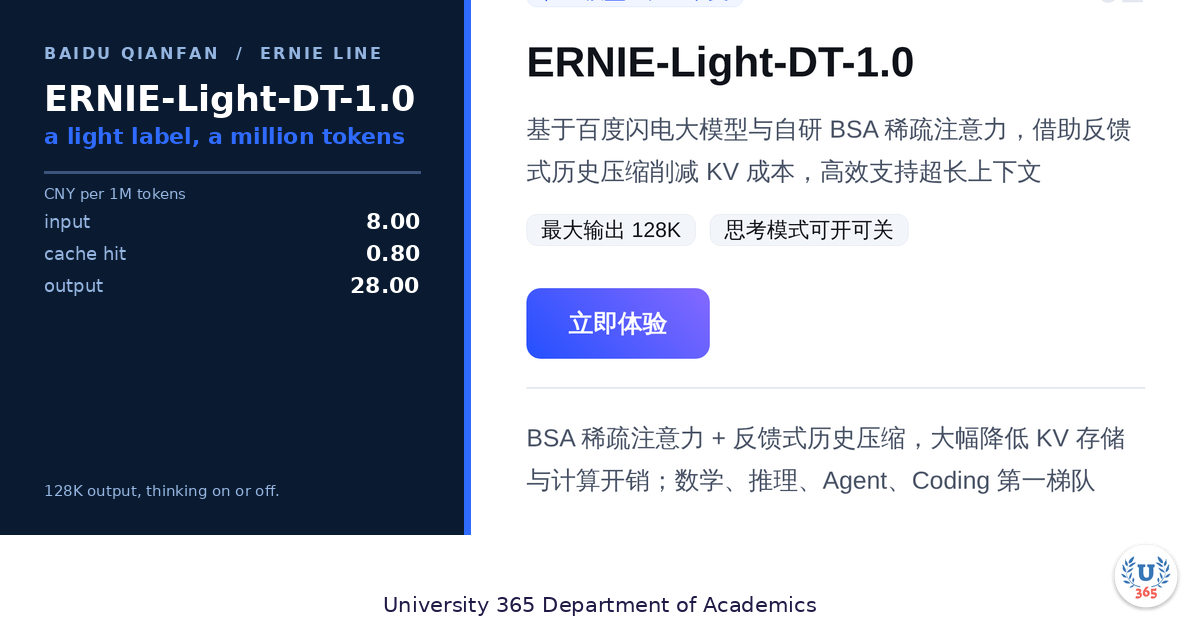
"Light" is a tier label, not a size. Baidu publishes no parameter count for this model. What it publishes is a 1,000,000-token context, a 1,000,000-token maximum input and a 128,000-token maximum output, on a page whose headline calls it a light model with a long context. The context is eight times the 128,000 tokens published for ERNIE 5.1 on the same model list, so the light label describes the price tier and the compute profile Baidu chose, not the reach of the model. A reader who reads "light" as "small window" has it backwards.
The model is described as a GLM derivative in the listing Baidu supplies to the international route, and the Chinese product page does not say so. The description on OpenRouter, under Baidu's name, states that "ERNIE-Light-DT-1.0 is based on open-source GLM models and includes research findings from Baidu Search's Lightning large model", and then describes Baidu Sparse Attention and feedback-driven history compression. The Chinese product page presents the same mechanisms as ERNIE technology and makes no mention of GLM. Both statements can be true at once, because a post-trained and inference-optimized derivative is still an ERNIE product, and the provenance matters for two practical reasons: it explains how a model reaches a one-million-token window at this price, and it invites the comparison with the GLM-5.3 endpoint that sits on the same platform at exactly the same rate.
The "low cost" headline does not survive the rate card, once the comparison stays inside the catalogue. Baidu's announcement calls this a low-cost long-context model. The published rate is CNY 8 per million input tokens and CNY 28 per million output tokens, with cached input at one tenth. On the same billing page, ERNIE-5.5-Flash Preview is priced at a promotional CNY 1 and CNY 4, DeepSeek-V4.1-Flash at CNY 2 and CNY 8 at peak, Qwen3.5-397B-A17B at CNY 1.2 and CNY 7.2, GLM-5.3 at CNY 8 and CNY 28, and GLM-5.2 at CNY 8 and CNY 28. ERNIE-Light-DT-1.0 therefore shares the highest rate among the one-million-token models on its own platform with two GLM endpoints, is seven times the promotional output rate of the Flash model, and is priced identically to the GLM model it is reported to derive from. Low cost is a defensible claim against dollar-priced frontier models. It is not a claim that survives a comparison with the vendor's own neighbours.
Nothing independent measures the model, and the absence is measured on three surfaces. Artificial Analysis lists two Baidu models, ERNIE 5.0 Thinking Preview and ERNIE 4.5 300B A47B, and its page for this model does not exist. The benchmark tracker that watches new releases records no result from Artificial Analysis, LMArena, Epoch AI, Vals AI, LiveBench, ARC Prize, Scale AI or SWE-bench, nine days after the model was first listed. Baidu's own claim is that the model sits in the first tier on public evaluation sets in mathematics, reasoning, agent work and coding, and the product page prints no score for any of them. A first-tier claim with no number attached is a claim a reader cannot check, and this review treats it as one.
What follows from the four facts. The window is real and unusually large for the price class. The price is mid-market in dollars and top of its own catalogue in yuan. The architecture is a derivative with an undisclosed base contribution. And the quality is unmeasured by anyone except the party selling it. Those four statements set the Time and Quantity scores at moderate, hold Quality at marginal, and make the Skill Illusion the highest trap in the assessment.

ERNIE-Light-DT-1.0
Tool Snapshot
A hosted Chinese-language long-context model with a 1,000,000-token window, 128,000 tokens of output, a switchable thinking mode with two effort levels, tool calling and structured output, sold per token in yuan at a rate identical to the GLM endpoint on the same platform, on a catalogue that also sells cheaper models with the same window, and with no independent measurement of its quality anywhere.
Category: Applied AI / Hosted long-context language model for document analysis, agent work on Chinese data, batch extraction and cost-sensitive high-frequency calls. It is a text model on Baidu's Qianfan platform, and it is the long-context member of the current ERNIE line rather than its flagship.
Primary use cases:
Long-document question answering and summarization. The model takes a 1,000,000-token prompt, so a 600-page filing, a full contract set or a year of reports fits in one call. Baidu names long-document question answering and summarization first in its own use-case list, and the window is the reason the model exists.
Multi-turn work over a large history. The feedback-driven history compression is a mechanism for keeping a long conversation's stored history cheap to index, which is the multi-turn case Baidu names second.
Agent and tool-calling work on Chinese data. The endpoint accepts a tools array and JSON Schema structured output, and Baidu's launch material lists agent tool calling among the intended uses and claims first-tier agent results without publishing a number.
Batch text processing where the alternative is a pipeline. Classification, extraction, translation review and summarization over a document set fit the window, and the cached-input rate at one tenth makes a repeated long prefix cheaper than a chunked pipeline that re-reads it.
Cost-sensitive high-frequency calls with thinking switched off. The thinking mode can be turned off, the endpoint accepts an effort setting when it is on, and a routine classification call does not need a chain of thought. That is the shape Baidu names last, and it is the one that makes the rate card work.
What it is not. It is not the ERNIE flagship: ERNIE 5.1 is a different model with a 128,000-token context and a lower input rate, and the two carry separate commissions and separate reviews. It is not a multimodal model: text goes in and text comes out, and image, audio and video belong to other endpoints on the same platform. It is not open weights: no repository exists for it, no configuration files are published, and no licence permits self-hosting. It is not a reasoning-only model: thinking is a switch, not the product. It is not the cheapest long-context model on its own platform, whatever the announcement headline says. And it is not measured: no independent evaluator carries a result for it.
Pricing, as published on 2026-11-19. Qianfan bills per thousand tokens, in yuan, pay as you go, online inference only. The published rate has no peak and off-peak split for this model, and no batch inference price.
Route | Price | Notes |
ERNIE-Light-DT-1.0, input | CNY 8.00 per million tokens | CNY 0.008 per thousand. Uniform across the day, with no peak or off-peak step |
ERNIE-Light-DT-1.0, cached input | CNY 0.80 per million tokens | CNY 0.0008 per thousand, one tenth of the input rate. The billing page is the authority; the product card prints the same cell a factor of one thousand lower, and Section 7c records the contradiction |
ERNIE-Light-DT-1.0, output | CNY 28.00 per million tokens | CNY 0.028 per thousand, uniform across the day |
ERNIE-Light-DT-1.0, batch inference | Not offered | The batch column is empty for this model on the billing page |
International route, OpenRouter | $1.13 per million input, $3.94 per million output | Cached input at $0.113 per million. Served as baidu/ernie-light-dt-1.0-intl on Baidu Qianfan as the only provider |
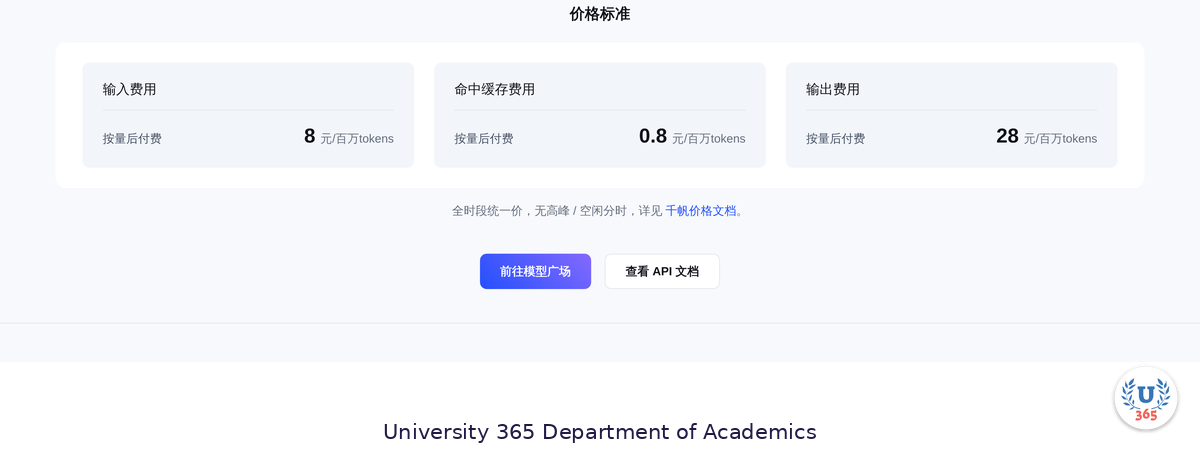
The price needs one paragraph of arithmetic, and the arithmetic is the finding. At a three-to-one input-to-output ratio the yuan list price blends to CNY 13.00 per million tokens and the dollar route blends to $1.83, which places the model above most of the catalogue it sits in. The same window is sold on the same page at a promotional CNY 1 and CNY 4 by ERNIE-5.5-Flash Preview, whose limit is 300 requests and 3,000,000 tokens per minute against this model's 60 and 1,000,000. The cached-input line is the one genuine cost lever: a 500,000-token document read once and asked five questions costs CNY 4.00 for the first read and CNY 0.40 for each of the five cached reads, CNY 6.00 in total, against CNY 24.00 for six full reads at the input rate. That arithmetic is why the model is usable for document sets and why a reader who ignores the cache will overpay by most of the bill.
Official links:
Qianfan product page: https://cloud.baidu.com/product/wenxinworkshop
Launch announcement for the three models, published 2026-11-12: https://cloud.baidu.com/product/qianfan_home/model_3.html
Qianfan product page with the model cards and prices: https://cloud.baidu.com/product/qianfan.html
Qianfan model service billing, the rate card, updated 2026-11-11: https://cloud.baidu.com/doc/qianfan/s/wmh4sv6ya
Qianfan model list, with context, input, output and default flow control: https://cloud.baidu.com/doc/qianfan/s/rmh4stp0j
Text generation API reference, the v2 chat completions schema: https://cloud.baidu.com/doc/qianfan-api/s/3m7of64lb
Deep-thinking parameters: https://cloud.baidu.com/doc/qianfan-docs/s/Wm95lyynv
Qianfan platform user agreement, updated 2026-11-07, effective 2026-01-09: https://cloud.baidu.com/doc/qianfan/s/Cmh4stmpy
International listing with the model description and the dollar rate: https://openrouter.ai/baidu/ernie-light-dt-1.0-intl
Artificial Analysis, Baidu model index, two models and not this one: https://artificialanalysis.ai/models/creators/baidu
Benchmark tracker page for this model: https://benchleader.com/models/ernie-light-dt-1-0-intl
LLM-specific fields:
API model identifier: ernie-light-dt-1.0, served on the Qianfan v2 chat completions endpoint. The billing table carries ERNIE-Light-DT-1.0 as the version name. The international route uses baidu/ernie-light-dt-1.0-intl.
Context window: 1,000,000 tokens, with a 1,000,000-token maximum input, stated in the Qianfan model list. The international listing states the same 1,024,000 figure and adds 131,072 completion tokens.
Maximum output: 128,000 tokens, stated in the Qianfan model list and on the product page. The maximum includes the thinking content when thinking is enabled.
Modalities: text input, text output. No image, audio or video input on this endpoint.
Reasoning control: a thinking switch with enabled and disabled values, documented with a default of disabled at API level, and an effort parameter with high as the documented default and max for complex agent requests. The documentation states that low and medium map to high, and that xhigh maps to max. The product page states that the thinking mode can be turned on or off.
Tools and function calling: the endpoint accepts a tools array, a tool choice setting and parallel tool calls, and the international listing advertises tool calling and JSON Schema structured outputs.
Structured output: JSON object and JSON Schema response formats are documented on the v2 endpoint.
Rate limits, default: 60 requests per minute and 1,000,000 tokens per minute, stated per model in the model list. ERNIE-5.5-Flash Preview carries 300 requests and 3,000,000 tokens per minute on the same table.
Parameters: not disclosed. No parameter count, no architecture document and no technical report for the BSA mechanism or the feedback-driven history compression are published.
Provenance: the description Baidu supplies to the international route states that the model is based on open-source GLM models with research from Baidu Search's Lightning model, and that it adds Baidu Sparse Attention with feedback-driven history compression. The Chinese product page describes the same mechanisms without naming GLM.
Licence: proprietary hosted service under the Qianfan platform agreement. No weights are published, and the Hugging Face model search returns no repository for this model.
Availability: Baidu Qianfan, billed in yuan, with an international route through OpenRouter at a dollar rate. No EU in-region routing on the international route.
Data term: the Qianfan agreement states that input and output data and uploaded knowledge documents and datasets are the customer's user data, used only inside the customer's account, not used to train the vendor's models, and not shared with any third party.
Knowledge cutoff: not published.
At a Glance Dashboard
Field | Value |
Category | Applied AI / Hosted long-context language model, 1,000,000-token context |
CI-First Benefit Score | 4.8 / 10 (CI-First Positive) |
Sub-scores | Time 6 / Quantity 6 / Quality 4 / Skill 3 |
CI-First Profile | Primary: Co-Worker and Assistant (level 2). Secondary: Co-Researcher, Analyst and Tester (level 4) |
Humics Protection | Humics-Neutral (-1 / +3) |
AI Imposture Risk | Medium overall, with Skill Illusion High |
Status | Active |
Last tested | 2026-11-19 |
Pricing | CNY 8 per million input, CNY 0.8 cached input, CNY 28 output; no batch tier; $1.13 and $3.94 on the international route |
Platforms | Baidu Qianfan API (v2 chat completions), OpenRouter for the international route |
User sentiment | Unmeasured: no review-platform listing, no repository, and no practitioner report found on 2026-11-19 |

ERNIE-Light-DT-1.0
The Problem
A person with a large document set in 2026 has three routes and each one fails in a different place. A retrieval pipeline splits the corpus into chunks, embeds them, and retrieves the few passages that score well against a question. It is cheap and it scales, and it fails on the questions that need the whole document: a cross-reference between clause 4.2 and an annex, a contradiction between two filings, a summary that must account for what the set does not say. A frontier model with a 200,000-token window takes more of the document and still needs a map-reduce pass, and its per-token price makes a full-corpus read a budget decision. A human analyst reads the set and is the quality reference, and cannot be duplicated for the ten sets that arrive in the same week.
The gap is not a better answer to a short question. It is a model that can hold the set, answer across it, and be paid for by the token rather than by the seat. That is the gap a one-million-token window at a mid-market rate addresses, and it is why Baidu built this model rather than a larger flagship.
The Chinese-language dimension is the second half of the problem. A team working with Chinese contracts, filings, policy documents or research reports has fewer hosted options than a team working in English, and the options that exist are priced in dollars. A Qianfan endpoint priced in yuan, with a data term that says input and output are not used for training, is the procurement answer for that team, provided the account, the billing currency and the real-name requirement attached to payment are acceptable.
The third half is the one the vendor does not name. A one-million-token window makes a new failure mode cheap: a reader can put a corpus in, receive a fluent summary, and have no way to check it against the source without reading the corpus, which was the work the model was supposed to save. That is the imposture question this review returns to, and it is the reason the Skill Illusion carries the highest rating in Strengths, Limits, and AI Imposture Risk.

ERNIE-Light-DT-1.0
The Outcome
ERNIE-Light-DT-1.0 gives a team a hosted one-million-token window with 128,000 tokens of output, a thinking mode it can switch off, tool calling, structured output and a cached-input rate at one tenth, sold in yuan with a data term that keeps the input out of training, at a price that matches the GLM endpoint beside it and is undercut by three cheaper models on the same page, and with no independent measurement of its quality.
The capacity position is real and unusual. A 1,000,000-token input budget holds a 600-page document set, a year of board papers or a full contract pack in one call, and the 128,000-token output budget is enough for a long brief that cites what it used. The cached-input line at CNY 0.8 per million tokens is the mechanism that makes a multi-question session over one long document affordable, because the second question costs a tenth of the first. On the international route the same window is published at $1.13 and $3.94 per million tokens, which is where the dollar comparison belongs.
The control position is better than a chat endpoint's. Thinking is a switch with a documented default of off, and when it is on the effort parameter has a documented default of high with max available for agent work, plus documented mappings so that a call written for another provider does not fail. Tool calling, parallel tool calls, JSON object mode and JSON Schema mode are all documented on the same endpoint. A team that needs a cheap extraction pass and an expensive reasoning pass can run both against one model id.
The price position is the part that is smaller than the announcement. Baidu's launch material calls this a low-cost long-context model, and the rate card makes it share the highest one-million-token rate in the catalogue: CNY 28 per million output tokens, the same as GLM-5.3 and GLM-5.2, against CNY 8 for DeepSeek-V4.1-Flash at peak and CNY 4 for ERNIE-5.5-Flash Preview under its promotional rate. The model is cheap against a dollar-priced frontier model and expensive against its own platform. Both statements are true, and the second one is the one a buyer inside Qianfan needs.
The evidence position is the weakest part and it is not a defect of the model. Nothing published measures this endpoint. The vendor claims first-tier results in mathematics, reasoning, agent work and coding on public evaluation sets, and prints no score. The independent index that would normally carry a hosted Chinese model carries two other Baidu models and not this one. A buyer therefore has a specification, a rate card and a marketing sentence, and no measurement, which is exactly the position the Quality score reflects.
Where the outcome is smaller than the announcement, stated plainly. The first-tier claim has no table behind it. The low-cost claim does not survive the rate card. The GLM provenance is stated on the international listing and absent from the Chinese page. There is no batch inference price, so a hundred-thousand-document job pays the online rate. The default flow control of 60 requests and 1,000,000 tokens per minute means a one-million-token prompt can be sent once per minute, which is a real ceiling. And the 128,000-token output ceiling includes the thinking trace when thinking is on, so a reasoning call has less room for the answer than the number suggests.
What the release does not change. It does not make the model self-hostable, it does not publish a parameter count, it does not publish the numbers behind the first-tier claim, it does not add a batch tier, it does not remove the 60-request ceiling, and it does not make a one-million-token summary checkable by a reader who has not read the source. Those facts sit in the limits, in Section 7c, in the imposture table and in the clause note, and no price cut moves them.

ERNIE-Light-DT-1.0
Who Should Use ERNIE-Light-DT-1.0
Learner type | Difficulty | Typical ROI | Career path |
Students (Bachelor, Master) | Intermediate | A real but bounded case. A student working on Chinese-language documents can put a reading pack into one call, ask for a cited summary, and then check the citations against the source, which is a better exercise in verification than a chat window allows. The return collapses where the student cannot read Chinese: a fluent summary of a Chinese corpus that the student cannot check is a confidence exercise, not a research method. The published rate is high enough that a class project needs a budget line, and the free tiers on other models are the honest recommendation for a first taste. | |
Professionals (career upskilling) | Advanced | A narrow, real case: an analyst, paralegal or compliance officer who works with Chinese document sets and needs a cited first pass before reading. The cached-input rate makes a five-question session over one filing affordable, and the tools and JSON Schema support make the output usable in a workflow rather than in a chat. It is not the tool for a professional who needs a consumer interface: there is no app, the console is Chinese-first, and the account requires real-name verification for payment. | |
Everyone (lifelong learners) | Not recommended | There is no consumer product and no onboarding, the console and the documentation are Chinese-first, and the price per million output tokens is high for personal use. A learner who wants help with a long document is better served by a general assistant with a document-upload surface and a subscription. | None asserted. |
Researchers and lab engineers | Intermediate | A useful object of study with one gap. A lab can measure a one-million-token window on its own needle-in-a-haystack and cross-reference tasks, which is exactly the measurement the vendor has not published, and can compare the endpoint with GLM-5.3 on the same platform at the same price. The gap is that there is no paper, no parameter count and no weights, so the model can be measured but not studied. | UIT for the evaluation design and the reproducibility record. No credential is claimed for research supervision. |
For teams and organisations. A team deciding on this model starts with four questions, and the first one is the bill.
Team deployment. One route: a Baidu Cloud account with real-name verification, a Qianfan API key, and calls to the v2 chat completions endpoint with the model id ernie-light-dt-1.0. There is no self-hosted route and no weight licence. A second route exists for teams outside China, which is OpenRouter under baidu/ernie-light-dt-1.0-intl at a dollar rate with Baidu Qianfan as the only provider.
Cost at team scale. The rate is CNY 8 per million input and CNY 28 per million output, with cached input at CNY 0.8. A team reading twenty 200,000-token filings a month in full and asking three questions of each pays CNY 1.60 for the first read of each filing and CNY 0.16 for each cached follow-up, which is about CNY 42 a month at list price before output. A team that sends the same corpus to ERNIE-5.5-Flash Preview pays a fraction of that and accepts a preview model, and a team that needs a batch tier has none here.
Data and compliance. The Qianfan agreement states in section 5.1(6) that input and output data and uploaded knowledge documents and datasets are the customer's user data, used only within the customer's account, not used to train the vendor's models, and not shared with any third party. Payment requires real-name verification, which collects personal information including sensitive personal information. A European team also needs to read the international route's terms, because the EU in-region routing option is not available for this model.
U365 for companies. Professional learners reach University 365's academic services individually or through their organisation, and the company route runs through a customized training agreement for employee groups. Corporate education programmes are built on demand, and their tuition follows content and duration.
Skill level required: Intermediate. The API call is a few lines. Deciding what belongs inside a one-million-token prompt, designing a citation contract, and running the cache so that follow-up questions cost a tenth are the engineering work, and the third one is where most of the saving sits.
Prerequisites. A Baidu Cloud account with real-name verification for billing, a Qianfan API key, and a document set that is cleared for the endpoint. For Chinese-language work, a native reader who will check the output. For a European deployment, a reading of the international route's terms and a decision about where the data may go.
Typical time to first result: Thirty minutes, most of it account setup and payment verification. The call itself is one request.
Typical time to competence: Twenty to forty hours, most of it on prompt design for long context and on building the citation check. Three habits carry the value: put the question at the end of the prompt rather than the start, keep the long prefix byte-stable so the cache hits, and require the model to name the passage each claim came from before you accept the brief.
Who should wait. Anyone who needs independent measurement before adoption, because none exists. Anyone who needs a batch tier, because the model has none. Anyone who needs self-hosting or a weight licence, because no weights are published. Anyone who needs image or audio input. Anyone whose volume needs more than 60 requests a minute or 1,000,000 tokens a minute on a sustained basis. And anyone who cannot staff a reader of the source language, because a fluent summary is not a check.

ERNIE-Light-DT-1.0
U365 Institutes Alignment
The alignment below rates what a U365 institute could take from this model as a working instrument and as an object of study. The primary home is UIT (Technology, AI, Data Science), because the release's most useful property for a cohort is that a one-million-token window, a documented reasoning control, a cached-input rate and an unmeasured quality claim can all be examined on one endpoint with a published rate card.
Institute | Scope | Rating | Why | Limit |
UIT (Technology, AI, Data Science) | Context engineering, evaluation design, cost arithmetic, API integration | High (primary) | Four engineering competencies survive the removal of the model. Context engineering: a 1,000,000-token budget with a 128,000-token output forces the student to decide what belongs in the prompt, where the question sits and how a citation contract is written, and the difference between a good and a bad long-context prompt is measurable on the same document set. Evaluation design: a vendor that claims first tier without a number, and an independent index that carries two other models from the same vendor, is the best available case for teaching what a benchmark row is worth. Cost arithmetic: an input rate, an output rate and a cached-input rate at one tenth produce a real break-even between reading a document once and reading it five times, and the arithmetic is checkable against the billing page. API integration: tool calling, JSON Schema output, an effort parameter and a documented rate ceiling are a working syllabus in production integration. | The limit that holds the row: no independent measurement exists and the architecture is unpublished, so a cohort can design an evaluation of this endpoint but cannot cite a benchmark result for it, and the BSA mechanism cannot be studied beyond one published sentence. |
UIB (Business Management, Entrepreneurship) | Procurement, pricing, build versus buy | Medium | A direct contact, with a condition. The procurement question is concrete: four one-million-token models sit on one rate card at CNY 8, CNY 2, CNY 1.2 and CNY 1 per million input tokens, and a cohort can model the monthly bill for a document-heavy team on published numbers. The condition is that the cheapest of the four carries a preview label and the most expensive carries the longest output ceiling, so the exercise is a trade-off rather than a price list. The scope is narrow because the model has no product surface and no distribution of its own. | The limit that holds the row: the cheaper rows on the same rate card are a preview model and two endpoints this review did not score, so a procurement exercise rests on published rates that can move and on a comparison the cohort cannot verify by measurement. |
UIC (Digital Communication, Marketing) | Chinese-language content operations, editorial review | Medium | A narrow contact. The model summarizes and drafts over long Chinese source material, which is useful for a communication team that works from reports, transcripts or policy documents, and the 128,000-token output can carry a structured brief. The condition is editorial and it is the same one the framework keeps returning to: register, terminology and brand voice are instructions the team writes and a native reader checks, and a fluent summary in a language the team does not read is not evidence that the brief is right. | The limit that holds the row: the console and the documentation are Chinese-first and the review records no practitioner reporting, so a communication team needs a native reader before a brief can be judged rather than merely read. |
UID (Digital Design, UX/UI) | Interface copy, structured content, documentation | Low | A very narrow contact. The model produces structured JSON and can hold a long specification, so a design team could use it to turn a requirements document into interface strings or content inventory. Nothing in the release touches visual work, layout, asset generation or design research, and a designer who needs those is looking at a different product. | The limit that holds the row: nothing in the release touches visual work, and the product card prices the cache three orders of magnitude below the billing page, so a cost model built from the card is wrong before the design work starts. |
U365 methods, not an institute (UNOP, ULM, LIPS, CARE and the UP-Context-Engineering Method) | Method layer: task definition, context, review and record | Applicable | The methods layer fits the way a long-context run has to be controlled. The UP-Context-Engineering Method's eight layers make the run repeatable: AI-EXACT-TASK fixes the question and the citation contract, EXPECTED-FORMAT-AND-CONSTRAINTS fixes the output shape and the length ceiling, and FULL-CONTEXT carries the document set and the glossary that must stay byte-stable for the cache to hit. CARE applies to the review of every brief, because the check belongs to a reader of the source rather than to the model. LIPS applies to the record, because a brief that does not name the model id, the date and the prompt cannot be compared with the next one. UNOP has no direct fit: the model summarizes and answers, and its gains come from context capacity rather than from any pedagogical mechanism. | Not an institute row: the methods layer carries no institute rating, and the run control it describes is the subject of this section rather than a claim about the model. |

ERNIE-Light-DT-1.0
How ERNIE-Light-DT-1.0 Works
A hosted text model with a one-million-token window, built on a reported GLM base with Baidu's own sparse attention and history compression added, controlled by a thinking switch and a two-level effort setting, sold per token with a cached-input discount, and documented at the API level without a parameter count or an architecture paper.
The attention mechanism. Baidu names Baidu Sparse Attention as the mechanism that makes the window affordable, and describes it as reducing the KV cache storage and the index computation over a long history. The product page adds a second mechanism, feedback-driven history compression, which it says optimizes how historical information is stored and indexed. Both descriptions are one sentence long, and neither is accompanied by a paper, a diagram or a number. A reader can accept that the mechanisms exist and cannot check how they work, and this review states the claim at that level and no higher.
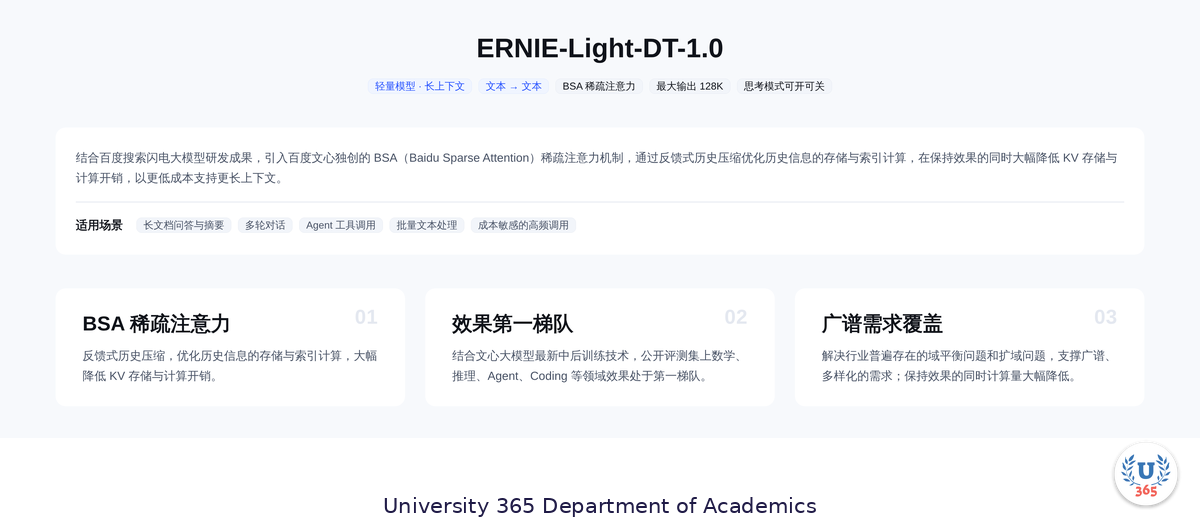
The base. The description Baidu supplies to the international listing states that the model is based on open-source GLM models and includes research findings from Baidu Search's Lightning large model, with the BSA mechanism added on top. The Chinese product page presents the same result as a combination of Baidu Search's Lightning work and ERNIE's own attention mechanism. The two statements describe one product from two angles, and the practical consequence is that the model is a derivative rather than a new base, which is consistent with a 1,000,000-token window arriving at a mid-market rate nine days after a platform launch.
The window and the output budget. The Qianfan model list gives a 1,000,000-token context, a 1,000,000-token maximum input and a 128,000-token maximum output. The international listing gives the same figures as 1,024,000 and 131,072, which are the same limits counted in units of 1,024 tokens. The output ceiling includes the thinking content when thinking is enabled, so a reasoning call that spends 40,000 tokens thinking has 88,000 for the answer.
The reasoning control. Thinking is a switch. The API schema documents a thinking object with enabled and disabled values and a default of disabled, and a separate effort parameter with high as the documented default and max for complex agent requests. The same schema documents that low and medium map to high, and that xhigh maps to max, so a call written for another provider's effort levels does not fail. The product page states that the thinking mode can be turned on or off, and the model list gives 128,000 tokens of maximum output that must cover both the trace and the answer.
The cache. Cached input is billed at one tenth of the input rate, CNY 0.8 against CNY 8 per million tokens. The cache is what makes a multi-question session over one long document affordable, and it depends on a byte-stable prefix: the same document, in the same position, with the question after it. A prompt that rewrites the document or moves it will miss the cache and pay the full rate, which is the most common way a long-context bill runs away.
The endpoint and the integration. The model is served on the Qianfan v2 chat completions endpoint, which is OpenAI-compatible, with a tools array, a tool choice setting, parallel tool calls, JSON object and JSON Schema response formats, a seed, stop sequences and the usual sampling parameters. The international route exposes the same capabilities through OpenRouter, with tool calling and structured outputs advertised on the listing.
The rate ceiling. The default flow control is 60 requests per minute and 1,000,000 tokens per minute, published per model. At a full one-million-token prompt the second figure allows one request per minute, and at a 20,000-token prompt the first figure is the binding one. A team planning a batch job has to design around both.
What the model does not do. It does not publish a parameter count, an architecture document or a technical report. It does not accept images, audio or video. It does not offer batch inference or a batch price. It does not offer self-hosting or weights. It does not report its own confidence, and it does not mark which passage of a one-million-token prompt a sentence came from unless the prompt requires it. And it does not come with an independent measurement: the only quality statement in the release is the vendor's own first-tier claim.

ERNIE-Light-DT-1.0
Getting Started with ERNIE-Light-DT-1.0
The fastest path is the Qianfan API, and the thirty-minute checklist below is enough to see whether the model belongs in your workflow. The account and the payment verification are the slow part, not the call.
Route 1, the Qianfan API, in about thirty minutes:
Create a Baidu Cloud account and complete the real-name verification that payment requires. Billing is in yuan.
Create a Qianfan API key and confirm that ernie-light-dt-1.0 appears in the model list for your account.
Send one document you or a colleague can read in the source language, with the question placed after the document and a citation requirement in the instruction. Do not start with a document nobody on the team can check.
Ask for a short answer with the passage each claim came from, and compare three claims against the source. Count errors rather than judging fluency.
Send a second question against the same document and check the bill: if the cached-input line moved, the prefix is stable and the cache is working.
Record the model id, the date, the prompt and the settings with the sample, because a later version will not reproduce it.
The endpoint is OpenAI-compatible, so the call is one request:
import os
from openai import OpenAI

client = OpenAI(
    api_key=os.environ["QIANFAN_API_KEY"],
    base_url="https://qianfan.baidubce.com/v2",
)
response = client.chat.completions.create(
    model="ernie-light-dt-1.0",
    messages=[
        {"role": "system", "content": "Answer only from the document. Cite the clause or page for every claim."},
        {"role": "user", "content": document_text + "\n\nQuestion: " + question},
    ],
    max_completion_tokens=4000,
    extra_body={"thinking": {"type": "disabled"}},
)
print(response.choices[0].message.content)
Route 2, the international listing, in about ten minutes: use baidu/ernie-light-dt-1.0-intl through OpenRouter at $1.13 and $3.94 per million tokens, with the cached-input rate at $0.113. The listing advertises tool calling and JSON Schema structured outputs, and Baidu Qianfan is the only provider behind it. EU in-region routing is not available for this model, which is the fact a European procurement reviewer needs before a pilot.
What it costs to try. One 100,000-token document read once and asked three questions costs about CNY 0.80 for the first read at the input rate, CNY 0.08 for each of the two cached follow-ups, and whatever the answers cost at CNY 28 per million output tokens. A 2,000-token answer is CNY 0.056. The trial therefore costs a few yuan, and the arithmetic that matters is the monthly one in Who Should Use ERNIE-Light-DT-1.0.
The first decision is not the model, it is who reads the source. A one-million-token window without a reader of the source language is a summary machine with a citation habit that nobody checks. The model's output is fluent enough that an unreviewed brief will usually pass, and that is exactly what makes the unreviewed workflow dangerous: it works until the one document where it does not.

ERNIE-Light-DT-1.0
Real Workflows
Workflow 1: Reduce a 600-page document set to a cited brief inside one window
The job. A team has a document set that no one has time to read: a tender pack, a filing bundle, a year of board papers. The output is a ten-page brief where every claim names the document and the page or clause it came from, and a list of the questions the set does not answer.
The shape of the run. Put the whole set in one prompt, place the question after the documents, and require a citation for every claim. Run the first pass with thinking enabled and effort at max, because cross-document synthesis is the task the effort setting exists for. Then run the follow-up questions against the same byte-stable prefix so the cached-input rate applies, and check the bill to confirm the cache hit.
The prompt.
USER-PERSONA: My UP-Context-Engineering USER-PERSONA file is attached: the psychographic file concatenated with the six ULM life-domain files. The parts that matter here: I commission this brief, I sign what leaves the team, and I will not forward a claim I cannot trace to a page.
FULL-CONTEXT: The FULL-CONTEXT set for this task, added and not merged: BUSINESS-PERSONA for [the organisation], PROJECT-DESCRIPTION for [the decision the brief informs], the document set at [path] converted to text in this order, the document index that maps each file to its page or clause numbering, and the list of questions the brief must answer. The document set and the index must stay byte-identical across questions, because the cache depends on it.
AI-PROFILE-ROLE-EXPERTISE: Act as a Co-Researcher, Analyst and Tester, in the role of an analyst preparing a decision brief over a closed document set, with expertise in cross-referencing, contradiction detection and citation discipline.
USER-FINAL-GOAL: A ten-page brief in which every claim carries a document and page citation, every contradiction between documents is named, and the questions the set does not answer are listed as gaps rather than filled from general knowledge.
AI-EXACT-TASK: Produce (1) the answer to each question with a citation per claim, (2) a contradiction table with the two passages and their citations, (3) a gap list of questions the set does not answer, and (4) a one-page executive summary that cites nothing it has not already cited above. Then state the three claims in your summary that a reader should check first, and why.
AUDIENCE: The decision meeting, where a reader will pick one citation at random and open the page.
EXPECTED-FORMAT-AND-CONSTRAINTS: Format: markdown with four sections matching the task, a citation in the form [document, page or clause] on every claim, and no sentence that a reader cannot trace. Constraints: no claim from outside the document set; no citation to a page that does not exist in the index; if a passage is ambiguous, quote it and mark the reading as contested; the executive summary adds no new claim. Data limits: the set is cleared for this endpoint at the level I state in the FULL-CONTEXT set; no personal data enters the brief beyond what the decision requires.
EXAMPLES: The previous quarter's brief is attached as the format example, including its gap list.
Verification checklist.
Trace check. Pick five citations at random and open each page. A citation that does not support the sentence is a failed run, not a formatting issue.
Gap check. Compare the gap list against the questions in the FULL-CONTEXT set. A question that the set does not answer and that the brief answers anyway is a fabricated answer.
Contradiction check. Read the contradiction table against both passages. A contradiction the model invented is the failure mode that matters, because it reads as insight.
Length and cache check. Confirm the output is inside the length constraint and that the follow-up questions billed at the cached-input rate. A cache miss doubles the cost of the session and usually means the prefix moved.
Workflow 2: Keep a volume extraction job inside the rate ceiling
The job. Two thousand short Chinese-language documents have to be classified into twelve categories with three extracted fields each. Quality matters less than consistency, the schema must be exact, and the bill must be predictable.
The shape of the run. Thinking off, JSON Schema output, one document per call, and a batch size computed from the published ceiling of 60 requests and 1,000,000 tokens per minute. At an average of 800 tokens per document the token ceiling is not binding and the request ceiling is: 60 requests a minute is 3,600 an hour, so 2,000 documents take about 35 minutes of wall time with no retries.
The prompt.
USER-PERSONA: My UP-Context-Engineering USER-PERSONA file is attached. The parts that matter here: I own this extraction job, the schema is consumed by a downstream system I also own, and a wrong field is worse than an empty field.
FULL-CONTEXT: The FULL-CONTEXT set for this task, added and not merged: BUSINESS-PERSONA for [the organisation], PROJECT-DESCRIPTION for [the extraction job], the category list with a one-line definition for each of the twelve categories, the three field definitions with their allowed values, and the JSON Schema that the downstream system enforces.
AI-PROFILE-ROLE-EXPERTISE: Act as a Co-Worker and Assistant, in the role of an extraction operator, with expertise in schema discipline, ambiguity handling and Chinese document structure.
USER-FINAL-GOAL: A dataset where every document carries one category from the list, three fields that validate against the schema, and an explicit uncertainty marker instead of a guess.
AI-EXACT-TASK: Return one JSON object per document with the category, the three fields and an uncertainty list. If a field cannot be determined from the document, return null for that field and name the reason in the uncertainty list. Do not infer a category from a document's filename or from the sender.
AUDIENCE: The downstream validation job, which rejects any object that fails the schema and any category outside the list.
EXPECTED-FORMAT-AND-CONSTRAINTS: Format: JSON only, matching the attached schema exactly, one object per call, no prose outside the object. Constraints: exactly one category; null rather than a guess; the uncertainty list is mandatory and may be empty; no field carries a value that is not in the allowed set. Data limits: the documents are cleared for this endpoint; personal identifiers are masked before the call, and the model must not reconstruct them.
EXAMPLES: Three labelled documents with their expected objects are attached as the format example, one of them with a null field and its uncertainty entry.
Verification checklist.
Schema check. Run every object through the schema validator. A model that respects JSON mode still returns values outside an allowed set, and the validator is the only check that catches it.
Sample check. Hand-label fifty documents and compare. Report the per-category agreement, not the overall rate, because a model that gets the common category right and the rare one wrong looks good on an average.
Null check. Count the null fields and read the uncertainty reasons. A null rate of zero on ambiguous documents is a sign of guessing, not of confidence.
Throughput check. Confirm the job stayed inside 60 requests and 1,000,000 tokens per minute, and record the retry rate. A job that needed retries is a job whose wall time was under-estimated.
Workflow 3: Measure the model against your incumbent on material you can check
The job. A team is considering this endpoint against a model it already uses. The question is not which model is better in general. It is which model produces a better result on this team's documents, at what cost, with what review burden.
The shape of the run. Fifty items drawn from real work, with a known answer or a human reference for each. Three task types, because a one-million-token window and a JSON schema are different capabilities: a cross-document synthesis, an extraction, and a needle test where one sentence in a long document contradicts the rest. Run both models on the same items with the same prompt and compare.
The prompt.
USER-PERSONA: My UP-Context-Engineering USER-PERSONA file is attached. The parts that matter here: I run the evaluation, I report to the person who signs the invoice, and I would rather report a tie than a number I cannot defend.
FULL-CONTEXT: The FULL-CONTEXT set for this task, added and not merged: BUSINESS-PERSONA for [the organisation], PROJECT-DESCRIPTION for [the decision the evaluation informs], the fifty evaluation items with their reference answers or human references, the task definition for each of the three task types, the incumbent model and its settings, and the budget ceiling for the evaluation.
AI-PROFILE-ROLE-EXPERTISE: Act as a Co-Researcher, Analyst and Tester, in the role of an evaluation lead, with expertise in task design, error counting and cost per completed task.
USER-FINAL-GOAL: A decision on which model to use for each task type, resting on counted errors, measured cost and a stated review burden, with the losing result reported as plainly as the winning one.
AI-EXACT-TASK: Design the fifty-item evaluation, define the pass criterion for each task type before any output is generated, then produce the comparison table with accuracy by task type, cost per completed task at the published rates, and the review minutes per accepted output. State which result would change the decision, and which of the three task types the one-million-token window actually helps.
AUDIENCE: The person who approves the invoice, who will ask what the evaluation does not cover.
EXPECTED-FORMAT-AND-CONSTRAINTS: Format: (1) the pass criteria, written before the results, (2) the comparison table by task type, (3) the cost arithmetic with the cache assumption stated, (4) the review burden, (5) what the evaluation does not cover. Constraints: no overall score without the per-task breakdown; report a tie as a tie; no vendor claim is used as a result; the needle test is reported separately from the synthesis task because it measures a different thing. Data limits: the items are cleared for both endpoints; the references are not sent to either model.
EXAMPLES: The last procurement evaluation is attached as the format example, including its "what this does not cover" section.
Verification checklist.
Pre-registration check. Confirm the pass criteria were written before the outputs were generated. A criterion written after the results is a rationalisation.
Error count check. Count errors against the reference, per task type. Do not score fluency, and do not let the model grade itself.
Cost check. Recompute the bill from the token counts at the published rates, including the cached-input line when the prompt was stable. A cost comparison that assumes no cache overstates this model's bill by most of it.
Needle check. Confirm the contradicting sentence was found and named. If both models miss it, the test measured the prompt rather than the model, and the prompt needs the question moved after the document.

ERNIE-Light-DT-1.0
Strengths, Limits, and AI Imposture Risk
Strengths
CI-First Benefit | Strength | Evidence |
Time | A real saving on long-document work, in the upper half of the moderate band. | A 1,000,000-token input budget holds a 600-page set in one call, so the chunking, embedding and multi-pass map-reduce steps disappear, and the 128,000-token output carries a long cited brief in the same call. The thinking switch keeps routine calls short. Held at 6 rather than 7 because the reader still checks the citations, the default ceiling of 60 requests and 1,000,000 tokens a minute caps a batch job, and a 128,000-token answer at the measured throughput takes about half an hour to generate. |
Quantity | A real multiplier for per-call capacity, bounded by the rate ceiling and the price. | One call carries a corpus instead of a chunk, the cached-input rate at one tenth makes repeated questions over the same prefix cheap, and JSON Schema output lets the result feed a system without rework. Held at 6 because usable volume is capped by 60 requests and 1,000,000 tokens per minute, there is no batch tier, and the output rate at CNY 28 per million tokens makes volume a budget decision. |
Quality | Marginal and unverifiable: the specification is real and no measurement backs the claim. | The model states a 1,000,000-token window, 128,000 tokens of output, tool calling, structured output and an effort control, and those are checkable. The quality statement is a first-tier claim with no published number, and no independent evaluator carries the model nine days after listing. Held at 4 because the framework scores verified improvement, and this release publishes nothing a reader can verify. |
Skill | Marginal: the reader learns long-context and cost control, not a method. | The API teaches a real discipline: what belongs inside a one-million-token prompt, where the question goes, why a byte-stable prefix turns five reads into one full read and five cached ones, and how an effort setting trades latency for reasoning. Held at 3 because there is no paper, no parameter count and no architecture document, the BSA mechanism is described in one sentence, and the model teaches nothing about how it reached its answers. |
Limits
No independent measurement exists. Artificial Analysis carries two Baidu models and not this one, and the benchmark tracker records no result from eight publishers. The only quality statement is the vendor's first-tier claim, which prints no score.
The first-tier claim is unquantified. Baidu states first-tier results in mathematics, reasoning, agent work and coding on public evaluation sets and publishes no table, no sample and no protocol.
The low-cost claim does not survive the rate card. CNY 28 per million output tokens equals GLM-5.3 and GLM-5.2 on the same platform, and it is seven times the promotional output rate of ERNIE-5.5-Flash Preview.
There is no batch tier. Every job pays the online rate, and the batch column is empty for this model on the billing page.
The rate ceiling is low for a long-context model. Sixty requests and 1,000,000 tokens a minute means a full-window prompt can be sent once a minute.
The output ceiling includes the thinking trace. A reasoning call has less room for its answer than 128,000 tokens suggests.
The parameter count and the architecture are undisclosed. No model card, no paper, no configuration files, and a mechanism described in one sentence.
The provenance is stated in only one place. The GLM base is named in the description Baidu supplies to the international listing and not on the Chinese product page, so a reader's answer to "what is this built on" depends on which page they read.
The product card's cached-input cell is wrong by a factor of one thousand. The card prints CNY 0.0008 per million tokens for cache hits, where the billing page prints CNY 0.8 per million, and the billing page is the tariff of record.
The data terms are Chinese-law terms. The Qianfan agreement is governed by the law of the People's Republic of China and provides for disputes in a Beijing court, which is a procurement fact for a European buyer.
The international route has no EU in-region option. OpenRouter states that baidu/ernie-light-dt-1.0-intl is not available through EU in-region routing.
Billing requires real-name verification. The agreement states that payment requires real-name authentication, which collects personal information that includes sensitive personal information.
AI Imposture Risk
Trap | Rating | Evidence |
Time Illusion | Medium | The saving is real: one call over a whole set replaces a chunking pipeline, and the cache makes a follow-up question cheap. The illusion sits in the review. A cited brief over 600 pages takes minutes to produce and hours to check, because checking it means opening the pages, and the check is the part the tool does not do. A team that measures time to output rather than time to approved output will overstate the saving by most of the workflow. |
Quantity Illusion | Medium | A one-million-token window makes a whole archive look processable, and the cached rate makes repeated questions look free. A team can produce a brief for every document set it owns and forward them without a reader. Held at Medium rather than High because the 60-request and 1,000,000-token ceiling, the absent batch tier and the output rate at CNY 28 per million tokens each put a real brake on volume, and a citation requirement is a design a team can enforce before the first run. |
Skill Illusion | High | The vendor claims first-tier results in mathematics, reasoning, agent work and coding, prints no score, and sells the model as a light long-context instrument. A reader who puts a corpus in and receives a fluent cited brief will believe they have understood the corpus, and the model will not tell them which of its citations is wrong. The gap between "I read the set" and "I can judge the set" is the illusion, and it is widest exactly where the window is most useful. The mitigation is concrete: require a citation per claim, open five at random, and keep a reader of the source in the loop. |
Overall Imposture Risk: Medium. One trap is High and two are Medium. Under the framework's arithmetic, one High with clear mitigations stated is Medium rather than High, and the band-precedence sentence does not change the outcome because no second High competes with it. The Skill Illusion mitigation is specific: a citation contract in the prompt, a random sample opened against the source, and a named reader of the source language before a brief leaves the team.
Framework v1.2 clause note
Clause 5.2.3-a, agent-authored procedural memory: NULL, recorded with its boundary. The endpoint holds no state between calls and writes nothing by itself. A tool-calling loop can write a result into a store the caller owns, and the caller decides whether that store becomes an instruction, which is user-authored memory in the plain sense. No documented mechanism ships by default by which this model writes skills, memory files or standing instructions on the user's behalf, so the clause returns a null rather than applying. The live condition is specific: an agent built on this endpoint that writes its own routing rules, prompts or corrections into a store without a per-write human decision re-opens the clause, and a long-context model makes that arrangement attractive because it can read the whole store before writing to it. The clause's no-lower-than-Medium floor for Skill Illusion changes nothing here, because Skill Illusion is already rated High on the evidence above.
Clause 4.2-a, agent-mediated conversation: NULL for the model as an API. Neither erosion condition is met by the default use. The person writes the question and receives an answer that is addressed to them, and the model does not speak in a persona or hold a conversation on the user's behalf. The live condition to watch on any deployment: an agent that answers customers, colleagues or counterparties in the organisation's name, over a long context it has assembled without a per-message check, meets condition (a) in substance. A long-context model makes that deployment easier to build, because the agent can hold the whole history, which is why the condition is recorded rather than dismissed.
Recorded together: both clause questions return nulls with boundaries and live conditions rather than mechanisms, and the boundary is the part that matters. The reason Skill Illusion rates High is not a clause mechanism. It is the plain fact that the only quality statement in the release is the vendor's own first-tier claim, that no independent evaluator carries the model, and that the reader most exposed is the one who commissioned a brief over a corpus they have not read.

ERNIE-Light-DT-1.0
Section 7c: A low-cost label the rate card contradicts, a GLM base named on one page and not the other, and a cached-input cell that is wrong by a thousand
A Section 7c finding is recorded where a supplier's governance, safety record, documentation or commercial terms have a real result for the reader. The items below were checked against primary sources on 2026-11-19, and they produce findings a buyer should carry. All findings are stated as facts of record, and the difference between a company statement, a published rate and a documentation defect is kept intact.
The announcement calls this a low-cost model, and the rate card places it at the top of its own long-context group. The launch page headlines the model as a low-cost long-context model and prints its input and output prices as CNY 8 and CNY 28 per million tokens; the cached-input cell on that card is treated separately in the next finding but one. On the billing page, ERNIE-5.5-Flash Preview is listed at a promotional CNY 1 and CNY 4 with a 1,000,000-token window and a 300-request, 3,000,000-token ceiling, DeepSeek-V4.1-Flash at CNY 2 and CNY 8 at peak with a 1,000,000-token window, Qwen3.5-397B-A17B at CNY 1.2 and CNY 7.2 with a 256,000-token window, and GLM-5.3 and GLM-5.2 at the same CNY 8 and CNY 28 as this model with the same 1,000,000-token window and the same 60-request ceiling. The finding is a positioning problem rather than a pricing error: the model is cheap against a dollar-priced frontier model and expensive against its own neighbours, and a buyer who reads only the announcement will expect the opposite.
The GLM base is named in the description Baidu supplies to the international route and not on the Chinese product page. The OpenRouter listing, under Baidu's name, states that "ERNIE-Light-DT-1.0 is based on open-source GLM models and includes research findings from Baidu Search's Lightning large model", and then describes Baidu Sparse Attention and feedback-driven history compression as the additions. The Chinese product page describes the same mechanisms as Baidu's own work and makes no mention of GLM. Both statements can be true, and the difference matters for three reasons a buyer carries: it explains how a one-million-token endpoint reached the market nine days before this review, it makes the identical price with GLM-5.3 on the same platform a comparison rather than a coincidence, and it means the model's intellectual-property position rests on a base whose licence Baidu has not described. This review records the provenance as Baidu states it on the international listing and does not resolve the licence question in either direction.
The product card's cached-input cell is wrong by a factor of one thousand. The Qianfan product page prints the cached-input price for this model as CNY 0.0008 per million tokens, beside an input price of CNY 8 per million and an output price of CNY 28 per million. The billing document prints CNY 0.0008 per thousand tokens, which is CNY 0.8 per million, and the international listing prices the cache at $0.113 per million against an input price of $1.13, exactly one tenth. Two independent surfaces therefore agree on one tenth and the product card's unit is wrong by three orders of magnitude. A buyer who plans a multi-question session from the card will budget the cache at almost nothing, and a buyer who plans it from the billing page will budget it at a tenth of the input line. The billing page is the tariff of record.
No parameter count, no model card and no paper are published for the mechanisms the model is sold on. The release names Baidu Sparse Attention and feedback-driven history compression as its two contributions, describes each in one sentence, and publishes neither a diagram, a measurement, a parameter count nor a technical report. The Hugging Face model search returns no repository for the model, so no configuration file, tokenizer or generation configuration is available either. A reader can accept that the mechanisms exist and cannot check what they do.
The first-tier claim is a claim without a number. The product page states that, with ERNIE's latest mid-training and post-training techniques, the model sits in the first tier on public evaluation sets in mathematics, reasoning, agent work and coding. No score, no benchmark name and no protocol are printed on the page. The benchmark tracker records that no independent publisher has posted a result for this model nine days after listing, and Artificial Analysis carries two other Baidu models. The finding is a measurement gap rather than a contradiction: the vendor may well be first tier, and a buyer cannot tell from anything published.
The release date is stated by three surfaces and no two agree exactly. Baidu Cloud's announcement page carries a publication date of 2026-11-12, the rate card it appears in was updated on 2026-11-11, the benchmark tracker records a first listing on 2026-11-11, and the international route's model slug carries a 2026-11-10 stamp. This review states 2026-11-12, the date printed on the announcement, and records that the other three are listing and update dates rather than release statements.
The data term runs in the buyer's favour and is quotable. The Qianfan platform agreement, updated 2026-11-07 and effective 2026-01-09, states in section 5.1(6) that input and output data and any uploaded knowledge documents and datasets are the customer's user data, are used only inside the customer's account, are not put to any unauthorised use or disclosure, are not used to train the vendor's models, and are not shared with any third party. A hosted long-context model whose contract says that plainly is a materially better instrument for client document work than one whose terms leave the question open, and this review records it as a finding in the supplier's favour.
No score changed for any finding in this section, and here is why. The framework scores benefit to the reader and the three Humics. A positioning label, a provenance disclosure, a unit error in a price cell, an unpublished architecture and an unquantified quality claim are facts a buyer should carry, and none of them changes what the model does on a document task. The findings that do touch a score are already inside it: the rate card and the request ceiling hold Quantity at 6, the absent measurement holds Quality at 4, and the absent architecture documentation holds Skill at 3. What this section does not do is treat a documentation defect as a capability finding, or a marketing label as a measured price.

ERNIE-Light-DT-1.0
U365 Co-Intelligence Rating
CI-First Profile
Primary profile: Co-Worker and Assistant (level 2). Secondary profile: Co-Researcher, Analyst and Tester (level 4).
Why this profile and not Co-Creator. The model takes a document set and a question and returns a brief, an extraction or an answer. That is a delegation framing: the job is defined, the output is checked against a source, and the person owns the decision that follows. Co-Worker and Assistant is the role it actually plays. Analyst and Tester is recorded as secondary because a one-million-token window over a closed corpus is the analytical case the model was built for, and a team that runs it against a reference set is using it as an object of measurement. Professor, Coach and Tutor is not recorded: the model returns an answer, not a correction, and nothing in the release is built to move a capability to the reader. Challenger, Critic and Devil's Advocate is not recorded either: the model does not argue against the user, and the contradiction table it produces is a finding about the documents rather than a challenge to the user's position.
CI-First Benefit Score
Dimension | Score (0-10) | Rationale |
Time | 6 | A real saving on long-document work, at the upper half of the moderate band. One 1,000,000-token call replaces a chunking and map-reduce pipeline, 128,000 tokens of output carries a long cited brief, and thinking can be switched off for routine calls. Held at 6 because the citations still have to be checked, the 60-request and 1,000,000-token ceiling caps batch work, and a full-length answer at the measured throughput takes about half an hour. |
Quantity | 6 | A real multiplier for per-call capacity, bounded by the ceiling and the price. A corpus fits in one call, cached input at one tenth makes repeated questions cheap, and JSON Schema output feeds a downstream system without rework. Held at 6 because 60 requests and 1,000,000 tokens a minute cap the volume, there is no batch tier, and CNY 28 per million output tokens makes volume a budget decision. |
Quality | 4 | Marginal and unverifiable. The specification is checkable: a 1,000,000-token window, 128,000 tokens of output, tool calling, structured output and a documented effort control. The quality claim is the vendor's first-tier statement with no published number, and no independent evaluator carries the model nine days after listing. Scored on measured absence rather than on measured weakness. |
Skill | 3 | Marginal. The API teaches a real discipline in context engineering and cost control: what to put inside a one-million-token prompt, why a byte-stable prefix halves the bill, and how effort trades latency for reasoning. No paper, no parameter count, no architecture document and no weights mean the model can be used and cannot be studied, and the common user meets a summarization box rather than a method. |
CI-First Benefit Score: 4.8 / 10 (CI-First Positive)
Why the score sits where it sits
4.8 with sub-scores 6 / 6 / 4 / 3 is a long-context instrument that saves real time and multiplies per-call capacity, with an unverified quality position and almost no transferable method.
Why not higher. The two dimensions that would raise the score are the two the release cannot support. Quality cannot rise above marginal while the only quality statement is the vendor's own claim with no number attached and no independent evaluator carries the model. Skill cannot rise above marginal while the architecture is described in one sentence and no paper, parameter count or weight file exists.
Why not lower. The capacity and control positions are real and documented: a 1,000,000-token window with a 1,000,000-token input budget, 128,000 tokens of output, a thinking switch with two documented effort levels and documented mappings, tool calling, JSON Schema output, a cached-input rate at one tenth, and a data term that keeps the input out of training. A Neutral band would misdescribe an endpoint that removes an entire pipeline from a document workflow.
Why 4.8 and not a higher band, stated as arithmetic. Time 6, Quantity 6, Quality 4 and Skill 3 average to 19 divided by 4, which is 4.75, rounded to 4.8, and 4.8 sits in the CI-First Positive band, which runs from 4.1 to 6.0. The composition is the finding: the two dimensions that describe capacity carry the score, and the two that describe verifiable quality and transferable method hold it at the bottom half of Positive rather than into Strong.
What the score does not carry. The four dimensions measure what the reader's work gains. They do not carry the positioning problem, the provenance disclosure, the unit error in the cached-input cell or the rate ceiling, which is why those sit in Section 7c and in the limits with an explicit statement that no sub-score moved for them. They do not carry the clause questions either, which return nulls with boundaries. A reader who wants the score to encode legal or procurement risk would need a different instrument, and the framework's instrument is the 7c finding.
Humics Protection Badge
Dimension | Rating | Rationale |
Creativity | Neutral (0) | The model reads a corpus and returns a brief, an extraction or an answer. It can restructure material and propose framings inside the prompt, and it does not originate the question, the argument or the decision, and a reader who receives a fluent brief still decides what the organisation does with it. The craft changes: less reading of everything, more judgment about which claims to check. That is a shift in the work, not an erosion of the capability. |
Critical Thinking | Erodes (-1) | A one-million-token window produces a cited brief over material the reader has not read, at a price that makes the run routine, under a first-tier claim that no independent evaluation repeats. The failure mode is not an obvious error: it is a plausible claim with a citation that points to a page which says something slightly different, in a corpus the reader commissioned the model to read precisely because nobody had time. The mitigations lower the frequency and do not reverse the direction: a citation contract, a random sample opened against the source, and a named reader of the source language are checks the reader has to design. |
Social Authenticity | Neutral (0) | The model answers the user's own question over the user's own documents, and clause 4.2-a returns a null for it as an API. The live condition stays in the record: an agent that answers counterparties in the organisation's name over a long assembled context, without a per-message check, moves this dimension. A one-million-token window makes that deployment easier to build, which is why the condition is recorded. |
Humics Protection Score: -1 / +3 Badge: Humics-Neutral
Superhuman Usage Guidance
When to invite this tool:
Reading a closed document set you own, where a reader of the source can check a sample of the citations before the brief is used.
Cross-document synthesis where the alternative is a retrieval pipeline and the questions need the whole set: contradictions, cross-references and gaps.
Extraction and classification at moderate volume with thinking off, a JSON Schema contract and a per-category accuracy check.
Repeated questions over one long document, where the cached-input rate at one tenth makes the session affordable.
Chinese-language document work, where the endpoint's language coverage and its yuan rate card are the practical advantages.
Teaching context engineering and evaluation design, because the window, the ceiling, the cache and the absent measurement are all visible on one endpoint.
When to keep this tool out:
Any decision that needs an independent capability measurement, because none exists.
Any corpus nobody on the team can read, because a fluent cited brief is not a check.
Any volume job that needs a batch tier or more than 60 requests a minute on a sustained basis.
Any workflow that needs image, audio or video input.
Any deployment that requires self-hosting, a weight licence or EU in-region processing.
Any assumption that the announcement's low-cost label describes this model's position inside its own catalogue.
U365 method integration:
LIPS + CARE: route the document set into the Collect phase and keep the Action Plan, Review and Execute phases as your own work. The model can produce the brief; it cannot own the decision the brief informs. CARE is the review that opens the citations.
ULM + EVA: the decision about which document work to delegate belongs in the Professional and Quality of Life domains, and the EVA cycle is where a team explores whether the added coverage changes the work or only the volume.
UP-Context-Engineering: the method's eight layers are the control surface this model needs, because AI-EXACT-TASK fixes the question and the citation contract, EXPECTED-FORMAT-AND-CONSTRAINTS fixes the output shape and the length ceiling, and FULL-CONTEXT carries the document set and the index that must stay byte-stable for the cache to hit. The three workflow samples above use the eight layers.
UNOP: no direct fit. The model reads and answers, and its gains come from context capacity and price rather than from any pedagogical mechanism.
Over-delegation warning: the failure mode with this model is that a whole archive looks like one decision. A team feeds every document set it owns through one endpoint, receives a cited brief for each, and forwards them because each one carries page references. The citations make the output look checked, and the check is exactly what nobody performed. The framework's arithmetic is the point: if your Human Intelligence input drops while the Artificial Intelligence term rises, the product falls. Keep a reader of the source for every corpus, open a sample of citations on every brief, and treat an unreviewed brief as a draft rather than a finding.

ERNIE-Light-DT-1.0
What Users Say
Aggregate Rating Table
Platform | Rating | Number of reviews | Link |
G2 | No listing | 0 | No product page exists for a hosted model endpoint |
Capterra | No listing | 0 | No product page exists |
Trustpilot | No listing | 0 | No product page exists |
Gartner peer reviews | No listing | 0 | No product page exists |
Hugging Face | No repository for this model | 0 | The model search returns no result |
LMArena | No entry for this model | Not applicable | No public result was found on 2026-11-19 |
Artificial Analysis | No model page | Not applicable | The Baidu index lists two other models |
OpenRouter | No user rating, one provider | Not a rating platform |
Note on method, stated plainly because it affects how much this section is worth. No review platform rates a hosted language model, and this model has no listing of any kind. It has no repository, so the download and discussion surface that an open-weight model accumulates does not exist. The independent catalogue that tracks new releases records no result from eight benchmark publishers, and the only third-party numbers in circulation are price and speed measurements taken from the international route's traffic. That is an empty record, and this section says so rather than padding it.
What practitioners report
There is no body of practitioner reporting to draw on, and the honest version of this section is short. The model was listed on the international route on 2026-11-10 per its slug and announced in China on 2026-11-12, so nine days of public life had produced no user report, no comparison post and no repository thread at the time of this review. The one measurement a reader can use is traffic-derived: the benchmark tracker reports a seven-day median of 79 output tokens per second and a 1.54 second first token on the international route, with the Qianfan provider row at 84 tokens per second and 1.08 seconds. That is a throughput reading from live traffic, not a quality report, and it is the only independent number attached to the model.
What users complain about
The documented friction is access, not quality. Billing runs through a Baidu Cloud account with real-name verification, the console and the documentation are Chinese-first, and the price is in yuan. A team outside China reads the international listing for the dollar rate, and that listing states that EU in-region routing is not available for this model. None of that is a complaint from a user, because there are no users on the record; it is the friction a reader will meet, taken from the vendor's own pages.
The two criticisms a reader can verify without using the model are the price and the ceiling. On the same rate card, three models with the same or a comparable window are cheaper, and one of them is cheaper by a factor of seven on output at its promotional rate. The default ceiling of 60 requests and 1,000,000 tokens a minute is the lowest among the one-million-token group except the two models that share it. Those are facts about the rate card and the model list rather than user complaints, and they are stated here as facts.
Sentiment Summary
Overall sentiment: Unmeasured. The vendor claims first-tier results, no English-language discussion of the model was published in the nine days after the announcement, and no review platform or independent evaluator carries the model.
Key themes: a one-million-token window with a 128,000-token output budget and a switchable thinking mode; a rate at the top of its own long-context group; a cached-input discount that makes repeated questions affordable; an undocumented architecture on a reported GLM base; and an evidence base that is entirely the supplier's.
U365 Editorial Note
The record argues in two directions at once, and a reader should hold both. In its favour, a one-million-token window at a published yuan rate with a cached-input line at one tenth is a genuinely useful instrument for document work, the reasoning control is documented with defaults and mappings rather than left to guesswork, tool calling and JSON Schema output make the result usable in a workflow, and the platform agreement says plainly that input and output are not used for training. Against it, no independent evaluator carries the model, the vendor's first-tier claim prints no number, the low-cost label is contradicted by the rate card beside it, the provenance is disclosed on one page and not the other, and the cached-input cell on the product card is wrong by a factor of a thousand. The Framework rates AI Imposture Risk Medium overall with Skill Illusion High, and that rating is the editorial position: ERNIE-Light-DT-1.0 is a document instrument to use with a citation contract and a reader of the source, not a substitute for reading. A reader who wants a higher score is asking for an independent measurement that does not exist, and this review will not invent one.

ERNIE-Light-DT-1.0
Comparison and Alternatives
Model | Window and output | Position | Published evidence | Price, per million tokens | Choose it if |
ERNIE-Light-DT-1.0 | 1,000,000-token context, 1,000,000 input, 128,000 output | The long-context model in the ERNIE line, on a reported GLM base | Vendor first-tier claim with no published number; no independent result | CNY 8 input, CNY 0.8 cached input, CNY 28 output; no batch tier | You need a one-million-token window, a switchable thinking mode and a documented effort control, and you will check the citations |
ERNIE-5.5-Flash Preview | 1,000,000-token context, 1,000,000 output | The value pick in the same catalogue | Vendor claims only; preview status | CNY 1 input and CNY 4 output promotional, CNY 2 and CNY 8 list, at peak; off-peak lower; 300 requests and 3,000,000 tokens a minute | You want the same window at a quarter of the output rate and its eight times higher request ceiling, and you accept a preview model |
GLM-5.3 | 1,000,000-token context, 131,072 output | The GLM endpoint the model is reported to derive from, on the same platform | Not scored by this review | CNY 8 input, CNY 2 cached input, CNY 28 output; 60 requests and 1,000,000 tokens a minute | You want the upstream model at the same output rate with a larger cached-input discount |
DeepSeek-V4.1-Flash | 1,000,000-token context, 393,216 output | The cheaper long-context workhorse on the same rate card | Not scored by this review | CNY 2 input and CNY 8 output at peak, CNY 1 and CNY 4 off-peak, cached input at one fiftieth | You want a long window at a quarter of the peak input rate with an off-peak discount |
ERNIE 5.1 | 128,000-token context, 119,000 input, 65,536 output | The ERNIE flagship for Chinese professional writing | Reviewed separately in this corpus at 4.5 and banded Positive | CNY 4 input and CNY 18 output up to 32k input tokens; CNY 6 and CNY 22 above | Your work is Chinese writing rather than long-document analysis, and a 128,000-token window is enough |
A dollar-priced frontier model | 200,000 tokens typical, larger on some routes | The comparison a Western reader will actually make | Independent benchmarks exist for these models, which is the point | Dollar rates, published in dollars | You need independent measurement, English-first documentation and multimodal input more than a low yuan rate |
The comparison that matters most is not in the table. This model is not competing with a frontier model for a U365 reader's general work; it is competing with the other one-million-token endpoints on the same Qianfan rate card. On that comparison the numbers are unambiguous: ERNIE-5.5-Flash Preview carries the same window, eight times the output budget and a five times higher request ceiling at a quarter of the output rate under its promotional price, DeepSeek-V4.1-Flash carries the same window at a quarter of the peak input rate with an off-peak discount and a 393,216-token output budget, and GLM-5.3 carries the same output rate with the same window and a larger cached-input discount. A buyer choosing inside the catalogue on price and ceiling alone would not choose Light-DT. A buyer choosing on the specific thing it was built for, which is an effort-controlled thinking model with a one-million-token window and a documented data term, has a reason the rate card does not show.
On U365's own published readings, the nearest comparison is a different model. ERNIE 5.1 was scored in this corpus at 4.5 on a composition of 5 / 5 / 5 / 3, the shape of a moderately useful and thin-evidence tool with a smaller window. Light-DT reaches 4.8 on a different composition, 6 / 6 / 4 / 3, which is more capacity and less verifiable quality. A reader should not read across from one to the other: the models do different work, and neither score borrows from the other.
Choose ERNIE-Light-DT-1.0 if you need a one-million-token window with a switchable thinking mode, you work with Chinese-language document sets, and you will run a citation contract and a reader of the source. Choose ERNIE-5.5-Flash Preview if you want the same window at a quarter of the output rate with a higher ceiling and you accept preview status. Choose GLM-5.3 if you want the upstream model at the same output rate with a larger cache discount. Choose DeepSeek-V4.1-Flash if you want the lowest peak input rate with an off-peak discount and a long output budget. Choose ERNIE 5.1 if your work is Chinese writing rather than long-document analysis. Choose a dollar-priced frontier model if independent measurement is a precondition, which for most regulated work it is.

ERNIE-Light-DT-1.0
Verdict and Next Steps
ERNIE-Light-DT-1.0 is a 4.8 / 10 CI-First Positive instrument for one job: holding a large document set in a single call, with a switchable thinking mode, tool calling, structured output and a cached-input discount, on a platform whose agreement keeps the input out of training. It is not the cheap long-context model the announcement describes, and it is not measured by anyone except its vendor.
The verdict in one paragraph. The release is strong in the parts that are hard to build and thin in the parts that are easy to check. A one-million-token window with a 128,000-token output budget, a documented thinking switch with two effort levels and documented mappings, tool calling, JSON Schema output and a cache at one tenth of the input rate are a serious instrument for document work on Chinese-language material. Against that, the rate is the joint highest among the one-million-token models on its own platform, there is no batch tier, the request ceiling is 60 a minute, the architecture is described in one sentence, the provenance is disclosed on one page and not the other, and no independent evaluator carries a result. A team that adopts it should adopt the citation discipline with it.
What to do in the first week:
Run one 100,000-token document through the endpoint with a citation requirement, open five citations against the source, and count the errors rather than judging the fluency.
Send a second question against the same document and confirm the cached-input line moved. If it did not, the prefix is not stable and the bill will be several times the plan.
Price the same workload on ERNIE-5.5-Flash Preview and DeepSeek-V4.1-Flash before committing, because both carry a one-million-token window at a lower rate.
Read the Qianfan agreement's data term and the international listing's terms if any data leaves China, and decide where the documents may go.
Name the reader of the source language for every corpus, and block any brief that has no named reader before the first run rather than after the first error.
UP-Context prompt pack for the first session:
USER-PERSONA: My UP-Context-Engineering USER-PERSONA file is the file for this layer, attached. It is my psychographic file concatenated with the six ULM life-domain files. The parts that matter here: I own the document set, I sign the brief that leaves the team, and I will not forward a claim I cannot trace to a page.
FULL-CONTEXT: The FULL-CONTEXT set for this task, added and not merged: BUSINESS-PERSONA for [the organisation], PROJECT-DESCRIPTION for [the decision the brief informs], the document set at [path], the index that maps files to page or clause numbering, the question list, the data classification of the set, and the deployment route (Qianfan in China or the international listing).
AI-PROFILE-ROLE-EXPERTISE: Act as a Co-Worker and Assistant, in the role of a document analyst preparing a cited brief over a closed set, with expertise in cross-referencing, contradiction detection, long-context prompt design and cost control.
USER-FINAL-GOAL: A brief where every claim carries a citation, every contradiction is named, every gap is listed, and the cost of the session is known before the run rather than after the invoice.
AI-EXACT-TASK: Produce (1) the citation contract for this run, (2) the brief with a citation per claim, (3) the contradiction table, (4) the gap list, (5) the cost estimate at the published rates with the cache assumption stated. Then state the three ways this run could produce a confident wrong brief and the check that would catch each one.
AUDIENCE: My review meeting, which will pick one citation at random and open the page.
EXPECTED-FORMAT-AND-CONSTRAINTS: Format: (1) the citation contract, (2) the brief, (3) the contradiction table, (4) the gap list, (5) the cost estimate, (6) the three failure modes with a check each. Constraints: no claim from outside the set; no citation to a page that does not exist; a contested passage is quoted and marked; the cost estimate names the input, cached-input and output lines separately. Data limits: the set is cleared for this endpoint at the level I state in the FULL-CONTEXT set; no personal data enters the brief beyond what the decision requires, and I paste no credential into a surface I have not cleared.
EXAMPLES: The previous quarter's brief and its citation contract are attached as the format example.
Related U365 content:
The CI-First doctrine, for the scoring logic behind this review: https://www.university-365.com/post/discover-the-ci-first-approach
The UP-Context-Engineering Method, for the eight layers in the prompt pack: https://www.university-365.com/post/the-up-method-university-365-prompting-the-new-gold-standard-for-prompt-engineering
The U365 programmes that build the surrounding skill: https://www.university-365.com/programs
Orientation with a U.Coach: https://www.university-365.com/ucoach

ERNIE-Light-DT-1.0
Status and Last Tested
Status: Active | Last tested: 2026-11-19 | Version tested: ERNIE-Light-DT-1.0 (ernie-light-dt-1.0, released 2026-11-12)
Active: the tool is current and recommended.
The model was announced on 2026-11-12 at Baidu World, it appears in a rate card updated on 2026-11-11, and the international route's model slug carries a 2026-11-10 listing stamp. This review was written on 2026-11-19, against the launch announcement, the product page, the model cards, the billing page, the model list, the API reference, the deep-thinking documentation, the platform agreement, the international listing, the Artificial Analysis Baidu index and the benchmark tracker's page for this model. The scores are set on that evidence and on the framework's application rules. The re-check is trigger-based with a six-month outer limit, and the first trigger is an independent evaluation, because nothing independent scores the endpoint today.
A reader who arrives more than six months after this date should treat the rate card, the request ceiling, the window, the provenance and the data terms as unverified until they are re-checked against Baidu's pages.

ERNIE-Light-DT-1.0
Migration Path
ERNIE-Light-DT-1.0 is Active, so this review carries no migration away from it. It carries the migration into it, because a reader arriving here is more likely to be moving from a retrieval pipeline, from a smaller-window model, or from a dollar-priced endpoint than starting from nothing.
The vendor publishes no retirement notice for anything this review replaces, so this section describes the move rather than an obligation. Five things change:
Change the pipeline into a prompt. A retrieval pipeline has an index, a chunk size and a top-k setting. A one-million-token window has a document order, a question position and a citation contract instead. The work does not disappear; it moves from infrastructure into prompt design, and the prompt is the thing to version.
Change the cost model. A pipeline bills for embeddings and a handful of completions; this endpoint bills for every input token in the window and every output token in the answer, with the cache as the only discount. The move is cheaper or more expensive depending on how many questions one document set receives, and the cache is what decides it.
Change the review. A retrieval pipeline returns passages a reader can see. A long-context answer returns claims a reader has to trace. The citation contract and the random sample are the review, and they are work the team now owns.
Change the ceiling assumptions. Sixty requests and 1,000,000 tokens a minute, no batch tier, and a 128,000-token output budget that includes the thinking trace. A pipeline scaled on concurrency has to be re-planned around the request ceiling.
Change the data path. A hosted Chinese endpoint with a data term that keeps the input out of training, a real-name requirement for payment and Chinese law governing the agreement is a different procurement position from a Western API. The international route is the alternative, and it has no EU in-region option.
The vendor publishes no migration guide for this move. The model list, the billing page, the API reference and the platform agreement are the documents that carry it.

ERNIE-Light-DT-1.0
U365's Recommendations to Learn More
Start with the rate card, not the announcement
The announcement calls this a low-cost long-context model. The billing page shows the same window on the same platform at a quarter of the output rate, a fifth of the input rate and an eighth of the input rate in three other models. Read the billing page with the model list open, because the window, the output ceiling and the request limit sit on one and the price sits on the other, and the comparison only works when both are in front of you.
Then read the API reference for the reasoning controls
The thinking object, the effort parameter and the documented mappings are the difference between a bill you planned and a bill you did not. The schema states that thinking defaults to disabled, that effort defaults to high, that low and medium map to high and that xhigh maps to max. A team that writes those settings down once has a repeatable run; a team that leaves them to a default has a different run every time.
Then read the model list for the ceiling
Sixty requests and 1,000,000 tokens a minute is the constraint that decides whether this endpoint is a workflow or a demonstration. Read the row for this model beside the row for ERNIE-5.5-Flash Preview, which carries 300 requests and 3,000,000 tokens a minute, and decide which ceiling your job actually needs before you design around the model.
Then read the platform agreement's data term
Section 5.1(6) is the paragraph a client asks about: input and output are the customer's user data, used only inside the account, not used for training, not shared with third parties. Read it beside the real-name requirement and the governing-law clause, because the three together are the procurement position rather than any one of them.
Watch a working run before you deploy
Two third-party videos discuss this model directly: a price comparison that sets it against Baidu's own cheaper endpoint, and a short report of blank answers from a paid test. Both are independent of Baidu, and neither is a benchmark.
Resources on X
Dedicated X channels: @Baidu_ERNIE is the account for the ERNIE foundation-model line and @Baidu_Inc is the corporate account. Both publish release notes and model cards for the ERNIE line, and a reader watching for a published measurement of this model has those two feeds, the Qianfan launch page and the OpenRouter listing.

U365 courses and programmes that build the surrounding skill
UIT (Technology, AI, Data Science): the engineering track where context engineering, evaluation design, cost arithmetic and API integration belong.
UIB (Business Management, Entrepreneurship): the commercial track where four one-million-token rates on one page become a procurement decision.
UIC (Digital Communication, Marketing): the track where a Chinese-language brief is judged against a native reader rather than against a fluency impression.
The one habit to carry
Require a citation before you accept a summary, and open a sample of them. This model's evidence problem is not that its numbers are false; it is that the only quality statement is the vendor's own, the window makes a whole corpus feel read, and the reader most exposed is the one who commissioned the brief because nobody had time to read. The citation contract and the random sample are the only defence, and that habit transfers to every long-context model that follows this one.

ERNIE-Light-DT-1.0
CI-First Evaluation Summary Card
Field | Value |
Tool | ERNIE-Light-DT-1.0 (ernie-light-dt-1.0), Baidu |
Category | Applied AI / Hosted long-context language model, 1,000,000-token context, text only |
Primary use case | Holding a large document set in one call for cited briefs, extraction and agent work on Chinese-language material |
CI-First Benefit Score | 4.8 / 10, CI-First Positive |
Sub-scores | Time 6: a real saving on long-document work, held by citation review, the 60-request ceiling and a half-hour full-length answer. Quantity 6: a corpus per call, cached input at one tenth, held by the ceiling, the absent batch tier and CNY 28 per million output tokens. Quality 4: a checkable specification and an unverifiable first-tier claim, with no independent evaluator. Skill 3: a real discipline in context and cost control, held by the absent paper, parameter count and weights. |
CI-First Profile | Primary: Co-Worker and Assistant (level 2). Secondary: Co-Researcher, Analyst and Tester (level 4) |
Humics Protection | Humics-Neutral (-1 / +3). Creativity 0, Critical Thinking -1, Social Authenticity 0 |
AI Imposture Risk | Medium overall. Time Medium, Quantity Medium, Skill Illusion High |
Framework v1.2 clauses | 5.2.3-a null with boundary, 4.2-a null with live condition |
Invite conditions | Cited briefs over a closed document set, cross-document synthesis, extraction with a schema, repeated questions over one long document, Chinese-language document work, context-engineering teaching |
Keep-out conditions | Decisions that need an independent measurement, any corpus nobody on the team can read, volume that needs a batch tier, image or audio input, self-hosting or EU in-region processing, and any assumption that the low-cost label describes the catalogue |
U365 methods | LIPS + CARE on the review of a brief, ULM + EVA on the decision to delegate document reading, the UP-Context-Engineering Method on the run, UNOP no direct fit |
Over-delegation warning | A whole archive looks like one decision. The citations make a brief look checked. Keep a reader of the source and open a sample of citations on every brief. |
Verification checklist | One 100,000-token document with a citation contract, five citations opened against the source, one cache-hit confirmation, one per-category accuracy check, one price comparison against two cheaper long-context models |
Status | Active |
Last tested | 2026-11-19 |
Version tested | ERNIE-Light-DT-1.0, released 2026-11-12 |
Framework version | CI-First Evaluation Framework v1.4.1 |
Review status | Active: the tool is current and recommended |

ERNIE-Light-DT-1.0
Glossary
CI-First Benefit Score
The arithmetic mean of the four benefit dimensions, each scored 0 to 10, rounded to one decimal place. 0 to 2.0 is CI-First Negative, 2.1 to 4.0 is CI-First Neutral, 4.1 to 6.0 is CI-First Positive, 6.1 to 8.0 is CI-First Strong, and 8.1 to 10 is CI-First Transformative. ERNIE-Light-DT-1.0 scores 4.8, which is Positive.
Time Benefit
Whether the tool returns more time than it costs, after the overhead of using it is subtracted. ERNIE-Light-DT-1.0 is 6: a 1,000,000-token call replaces a chunking and map-reduce pipeline, 128,000 tokens of output carries a long brief, and thinking can be switched off for routine calls. It is held at 6 because the citations still have to be checked, the request ceiling caps batch work, and a full-length answer at the measured throughput takes about half an hour.
Quantity Benefit
Whether the tool increases the volume of usable work a person can produce in a given time. ERNIE-Light-DT-1.0 is 6: a corpus fits in one call, cached input at one tenth makes repeated questions cheap, and JSON Schema output feeds a downstream system without rework. It is held at 6 because 60 requests and 1,000,000 tokens a minute cap the volume, there is no batch tier, and the output rate makes volume a budget decision.
Quality Benefit
Whether the tool helps the user produce better work than they could alone, judged after verification rather than on surface polish. ERNIE-Light-DT-1.0 is 4: the specification is checkable, with a one-million-token window, 128,000 tokens of output, tool calling and structured output, and the quality claim is the vendor's first-tier statement with no published number and no independent evaluator carrying the model. The score reflects measured absence rather than measured weakness.
Knowledge and Skill Benefit
Whether the tool helps the user learn what they did not know and do what they did not know how to do. ERNIE-Light-DT-1.0 is 3: the API teaches a real discipline in context engineering and cost control, because the window, the question position, the byte-stable prefix and the effort setting are all decisions the user makes and can learn from. It is held at 3 because there is no paper, no parameter count and no architecture document, so the model can be used and cannot be studied.
Humics Protection Badge
The sum of three ratings, each +1, 0 or -1, across Creativity, Critical Thinking and Social Authenticity. +2 to +3 is Humics-Friendly, -1 to +1 is Humics-Neutral and -2 to -3 is Humics-Risky. ERNIE-Light-DT-1.0 scores -1, which is Humics-Neutral: it erodes critical thinking by producing a cited brief over material the reader has not read, and it neither strengthens nor destroys creativity or social authenticity by default.
AI Imposture Risk
The likelihood that the tool traps its user in one of three illusions: the Time Illusion, where the overhead exceeds the saving; the Quantity Illusion, where volume passes for quality; and the Skill Illusion, where the user believes they can do what the tool did. Each trap is rated Low, Medium or High. ERNIE-Light-DT-1.0 is Medium overall, with Skill Illusion High and the other two Medium.
CI-First Profile
The role the AI plays in the working relationship: Co-Creator and Thought Partner (1), Co-Worker and Assistant (2), Professor, Coach and Tutor (3), Co-Researcher, Analyst and Tester (4), or Challenger, Critic and Devil's Advocate (5). ERNIE-Light-DT-1.0 is primarily Co-Worker and Assistant, with Analyst and Tester as a secondary role.
User Sentiment
The direction of independent and practitioner reaction to the tool. For ERNIE-Light-DT-1.0 the record is empty rather than mixed: no review platform lists it, no repository exists, and no practitioner report was published in the nine days after the announcement. The only independent number attached to the model is a traffic-derived throughput reading of 79 output tokens per second on the international route, which measures speed rather than quality. Sentiment is therefore recorded as Unmeasured, and the absence is the finding this review carries into the Quality score.
Review Status
The badge on this review states how much confidence to place in it. The vocabulary: Active means the tool is current and recommended. Active (updated) means it is current and recommended and was recently re-checked and refreshed. Changed means a re-check trigger fired and an update is pending, so read it with that in mind. Risky means the tool has significant unresolved issues or has been clearly surpassed by newer alternatives, so use it with caution and read the Limits section. Stale means the review has not been re-checked in over six months, so treat pricing and features as unverified. Retired means the tool still works but is no longer recommended, and Deprecated means it has been shut down or fundamentally changed. This review is Active.
Last tested and Re-check
The date on which the review's evidence was last read against the vendor's own surfaces, and the condition under which it will be read again. This review was last tested on 2026-11-19 and is re-checked on a trigger list with a six-month outer limit, because a brand-new endpoint's rate card, request ceiling and measurement coverage move faster than a calendar interval can track.

ERNIE-Light-DT-1.0
Sources
Vendor primary sources:
Baidu Cloud, launch announcement for ERNIE-5.5-Flash Preview, ERNIE-Light-DT-1.0 and ERNIE-Wizshot-ME, published 2026-11-12, read 2026-11-19: https://cloud.baidu.com/product/qianfan_home/model_3.html
Baidu Cloud, Qianfan product page with the model cards, read 2026-11-19: https://cloud.baidu.com/product/qianfan.html
Baidu Cloud, Qianfan product page for the Wenxin workshop: https://cloud.baidu.com/product/wenxinworkshop
Baidu Cloud, model service billing, updated 2026-11-11, read 2026-11-19: https://cloud.baidu.com/doc/qianfan/s/wmh4sv6ya
Baidu Cloud, model list for text generation, with context, input, output and default flow control, read 2026-11-19: https://cloud.baidu.com/doc/qianfan/s/rmh4stp0j
Baidu Cloud, text generation API reference, v2 chat completions schema, read 2026-11-19: https://cloud.baidu.com/doc/qianfan-api/s/3m7of64lb
Baidu Cloud, deep-thinking parameters: https://cloud.baidu.com/doc/qianfan-docs/s/Wm95lyynv
Baidu Cloud, Qianfan platform user agreement, updated 2026-11-07, effective 2026-01-09, read 2026-11-19: https://cloud.baidu.com/doc/qianfan/s/Cmh4stmpy
OpenRouter, Baidu ERNIE-Light-DT-1.0 listing and model description, read 2026-11-19: https://openrouter.ai/baidu/ernie-light-dt-1.0-intl
OpenRouter, public model catalogue entry for baidu/ernie-light-dt-1.0-intl, read 2026-11-19: https://openrouter.ai/api/v1/models
Independent measurement and reporting:
Artificial Analysis, Baidu model index, two models and neither is this one, read 2026-11-19: https://artificialanalysis.ai/models/creators/baidu
Artificial Analysis, model page for this model, which does not exist, checked 2026-11-19: https://artificialanalysis.ai/models/ernie-light-dt-1-0
BenchLeader, ERNIE-Light-DT-1.0 launch tracker, unranked and unmeasured by eight publishers, read 2026-11-19: https://benchleader.com/models/ernie-light-dt-1-0-intl
U365 internal reference:
U365 CI-First Evaluation Framework v1.4.1 (University 365 research methodology), read alongside the published doctrine at https://www.university-365.com/post/discover-the-ci-first-approach

ERNIE-Light-DT-1.0
Faculty Note on Evidence Quality
What this review rests on, in order of weight. First, the publisher's own primary documents: the launch announcement, the product page, the two model cards, the billing page, the model list, the API reference, the deep-thinking documentation and the platform agreement, all read on 2026-11-19. Second, the international listing that carries Baidu's own model description and the dollar rate. Third, two independent catalogues: the model index that records which Baidu models have been benchmarked, and the launch tracker that records which publishers have posted a result. Fourth, the arithmetic in this review, which is computed from the published rates and can be checked line by line.
Where the vendor's numbers and the independent numbers meet, and where they part. They meet on the specification: the model list and the international listing agree on a one-million-token window, and the model list and the product page agree on a 128,000-token output and a switchable thinking mode. They part on quality, because there is no independent quality number to compare with. The vendor states a first-tier position in four domains and prints no score, and the independent catalogues record no result from any of nine publishers. This is the framework's unverifiable case in its purest form: not a contradiction between two measurements, but one party's claim with no measurement at all.
The conflict inside the publisher's own materials is a positioning conflict rather than a contradiction. The announcement calls the model low cost, and the rate card places it at the top of its own long-context group. The international listing says the model is based on open-source GLM models, and the Chinese product page does not. The product card prints a cached-input price a thousand times lower than the billing page. Each of the three is a statement about presentation rather than about capability, and the review resolves each in favour of the document of record: the billing page for the price, the international listing for the provenance, and the billing page again for the cache.
What is measured and what is inferred. The window, the input and output limits, the rate card, the cached-input rate, the request and token ceilings, the parameter names and the data term are measured by named parties and reported with their settings. The throughput figures on the international route are traffic measurements over a seven-day window and are reported as such. The judgement that this model is the right instrument for a cited brief over a Chinese-language document set is an interpretation of those facts against the work the model is sold for, and it is the interpretation this review defends. The claim that a reader will forward an unreviewed brief is an inference from the framework's model of human behaviour, supported by the zero marginal cost of a follow-up question and the citation-shaped output, and it is labelled as an inference wherever it appears.
The most arguable score dimension, stated plainly. Quantity is the dimension a reasonable reviewer could move. A reader who counts a one-million-token window and a cache at one tenth as near-unlimited capacity would score it 7, and a reader who notes the 60-request ceiling, the absent batch tier and the output rate would score it 5. This review holds 6 because the per-call capacity genuinely multiplies what one person can read, while accepting that the ceiling and the price set the usable volume and that a batch tier would settle the question.
One adverse finding stated as prominently as the favourable ones. The low-cost label is contradicted by the rate card beside it, and the first-tier claim has no number behind it. A reader who adopts this model on the strength of either sentence has adopted a positioning statement rather than a measurement. The favourable finding is equally plain: a one-million-token window with 128,000 tokens of output, a documented reasoning control, tool calling, JSON Schema output and a cached-input discount at one tenth, on a platform whose agreement keeps the input out of training, is a real instrument for document work, and it arrived nine days before this review.
One finding cuts in the publisher's favour and should be said as plainly as the rest. The data term is better than most hosted offerings: section 5.1(6) of the platform agreement states that input and output are the customer's user data, used only inside the account, not used training the vendor's models and not shared with third parties. A long-context endpoint is the case where that clause matters most, because the material inside the window is the client's whole document set, and a vendor that says so in the contract has removed the question a procurement reviewer would otherwise have to negotiate.
What this review does not do. It does not score ERNIE 5.1, ERNIE-5.5-Flash Preview, GLM-5.3, DeepSeek-V4.1-Flash or the Qianfan platform, which are different models and different surfaces with their own reviews or their own commissions. It does not treat the international route's throughput as a quality measurement, and it does not convert the vendor's first-tier claim into a score. A reader who needs a quality number has to run the comparison in Workflow 3, because no one else has published one.
Review by Hubert Graef, Dean of Research, University 365 Research Center. Scored on 2026-11-19 under the CI-First Evaluation Framework v1.4.1.

ERNIE-Light-DT-1.0
Status and Re-check
Status: Active | Last tested: 2026-11-19 (ERNIE-Light-DT-1.0, ernie-light-dt-1.0, released 2026-11-12) | Re-check: trigger-based (max 6 months)
Active: the tool is current and recommended.
For detailed explanations of the CI-First evaluation terms used in this review, including the Humics Protection Badge and the AI Imposture Risk levels, see the Glossary at the end of this post.
Re-check triggers:
A published independent evaluation of this endpoint. No independent evaluator carries the model today: Artificial Analysis lists two Baidu models and not this one, and the index that tracks new releases records eight publishers with no result for it. One reproducible third-party row would replace the vendor's first-tier claim as the quality evidence.
A published parameter count, model card or technical report. Baidu discloses neither the parameter count nor a paper for the BSA attention mechanism or the feedback-driven history compression. Either document would change what a reader can verify about the architecture and could move the Skill score.
A change to the rate card. The current rate is CNY 8 per million input tokens, CNY 0.8 per million cached-input tokens and CNY 28 per million output tokens, online inference only. A batch tier, a cached-input correction or a price step would change the Quantity score and the cost arithmetic in the Tool Snapshot.
A change to the default flow control. The published default is 60 requests per minute and 1,000,000 tokens per minute. A higher ceiling would change the Quantity score, because the current ceiling is what keeps a one-million-token window out of sustained batch work.
A successor or a change to the limits. A version 1.1, a different window, a smaller maximum output or a new reasoning control is a different product with different numbers.
A change to the Qianfan platform agreement. The data term that keeps input and output out of training, and the real-name requirement attached to payment, are the two clauses a business reader depends on.
A change to the international route. The model is served outside China under baidu/ernie-light-dt-1.0-intl with a dollar rate and a published context length. A price change, a second provider or an EU in-region route changes the procurement answer for a European reader.
Baidu publishing the numbers behind the first-tier claim. The product page states first-tier results in mathematics, reasoning, agent work and coding on public evaluation sets and prints no score. A published table would be the single most useful addition to the record.




Comments