
Granite 4.2 3B: IBM's small reasoning model that skips the family's agentic training

Status: Active | Last tested: 2026-11-19 (Granite 4.2 3B, granite-4.2-3b, released 2026-08-25) | Re-check: trigger-based (max 6 months)
Active: the tool is current and recommended.
For detailed explanations of the CI-First evaluation terms used in this review, including the Humics Protection Badge and the AI Imposture Risk levels, see the Glossary at the end of this post.


In this Tool Review

Granite 4.2 3B
Three sizes, one name, and a 3B that stops before the agentic stage
IBM released Granite 4.2 on 25 August 2026 as its first family of dense reasoning language models, in three sizes under Apache 2.0. The model this review scores is the smallest of the three, granite-4.2-3b, and the single fact that decides most of the reading is that the 3B does not receive the agentic reinforcement learning that the 8B and the 30B receive. IBM states it in the technical blog, states it again in the release note, and its own benchmark table marks all four agentic coding rows as NA for the 3B. Everything else in this review follows from that.
The name is the first trap, because three products share the family name and only one is scored here.
Name | What it is | Measured size | Independent index | Where it appears |
Granite 4.2 3B | The model this review scores, granite-4.2-3b. A dense decoder, 40 layers, 2,560 hidden, 8 key-value heads, a 131,072 position ceiling, text in and text out, three thinking modes. Released 2026-08-25 | 3,659,737,600 parameters in bf16, 7.32 GB of weights | Artificial Analysis Intelligence Index 4.72 on a 0 to 100 scale, displayed as 5, above the tiny class median of 4 | The model card, the GGUF and quantized repositories, the Ollama library, the technical blog |
Granite 4.2 8B | The balanced size. Same architecture family, 40 layers, 4,096 hidden, and it takes the full agentic reinforcement-learning block | 8,791,592,960 parameters, 5.3 GB on Ollama | Intelligence Index 5.10, displayed as 5, at the lower end of a class median of 10 | Its own repository, the OpenRouter listing at $0.06 input and $0.15 output per million tokens, and a separate commission in the same campaign |
Granite 4.2 30B | The flagship. 64 layers, 4,096 hidden, the full agentic block, and the only size IBM scopes the 512K long-context extension to | 29,276,770,304 parameters, 18 GB on Ollama | Intelligence Index 5.54, displayed as 6, below a class median of 10 | Its own repository, the IBM Research charts, and a separate commission in the same campaign |
Granite 4.2 3B is not the 8B, and the difference is the agentic training rather than the parameter count. The three sizes are 3.66 billion, 8.79 billion and 29.28 billion parameters measured, and the independent index spread across that tenfold range is 4.72 to 5.54, less than one point on a 0 to 100 scale. What separates them is the stage list. IBM's own table gives the 3B a code skill booster and no software-engineering, terminal or search stage, and the 8B and 30B the full ladder. A reader who buys the 3B because the family page says the models are purpose-built for agentic work has bought a model that was deliberately held out of the agentic training.
Granite 4.2 3B is not Granite 4.1 3B either. The 4.2 model is post-trained from ibm-granite/granite-4.1-3b-base, which is a base checkpoint of 3,402,836,480 parameters released on 2026-04-06 with no reasoning mode and no chat training. The independent evaluator marks Granite 4.1 3B as deprecated, released 2026-04-29. The two share a lineage and not a capability, and no figure in this review applies to the 4.1 release.
The licence is the opposite of a restriction, and it is the family's strongest asset. All three sizes are Apache 2.0. IBM states that the family ships with cryptographic signatures, ISO certification and full transparency disclosures, and the repository carries a model.sig file. There is no commercial-use clause to read, no acceptable-use addendum attached to the weights, and no request route to open. For a university that wants to run a model on its own hardware and build teaching material on top of it, that is a different starting position from a non-commercial release.
This is a new review, and there is no baseline to inherit. U365's Tools CMS carries 137 records and the published Tools category carries 138 posts, both read on 2026-11-19 by offset paging. Neither surface carries a record or a post for Granite 4.2 in any size, and no IBM Granite record exists at all. The two IBM-named posts on the site are general articles from 2025 that carry no Tools category.
The release needs two dates. The public release date is 2026-08-25, the date on the model card, on the technical blog and in the independent evaluator's record. The Hugging Face repository was created on 2026-08-07, eighteen days earlier, and last modified on 2026-10-20. The repository date is a staging fact and not a release, and this review uses 2026-08-25 everywhere a reader would date the model.
The size in the name is rounded, and the real figure is larger. The published safetensors index reports 3,659,737,600 parameters, which is 3.66 billion, and the bf16 checkpoint is 7.32 GB. The same rounding runs through the family: the 8B measures 8.79 billion and the 30B measures 29.28 billion. A reader sizing hardware from the name will under-provision by about a fifth at this size, which on a laptop is the difference between comfortable and tight.
The context headline needs three sentences, because three vendor surfaces say three different things. The 3B model card reads "Natively Supports 128K (Long-context extension to 512K)". IBM's documentation page reads "All models natively support a 128K context window (with long-context extension to 512K on the 30B model)". An IBM engineer answering a repository question on 2026-09-11 wrote that all 4.2 models were trained to support 512K, that a platform flag raises the ceiling with no RoPE scaling, and that all 4.2 models were benchmarked and evaluated at 128K, which is "the maximum verified length". The checkpoint config carries 131,072 positions and the vendor's own serving commands pass 131,072. This review treats 128K as the operative and verified ceiling, records 512K as an untested extension that IBM's own documentation scopes to the 30B, and does not credit the 3B with a 512K context.

Granite 4.2 3B
Tool Snapshot
Granite 4.2 3B, IBM's 3.66 billion parameter dense reasoning model: a readable thinking mode, three thinking settings, native tool calling in the OpenAI format, a verified 128K context, Apache 2.0 weights that run from a 2.24 GB file, and no agentic reinforcement learning behind any of it.
Category: Applied AI / open-weight small reasoning language model. It is built for local and edge deployment: drafting, summarising, code generation, single-step tool calls, multilingual text work, and a study object for post-training method.
Primary use cases:
A private text model on hardware you already own. The Q4_K_M file is 2.24 GB, the FP8 build is 4.18 GB and the bf16 checkpoint is 7.32 GB. A reader can serve it through Ollama, vLLM, SGLang or Transformers and keep every prompt inside the estate. That is the use the licence and the size make easy.
Reasoning on a budget, with a switch. The model thinks by default and produces a thinking block before the answer. Two further settings turn the thinking off entirely or ask for a short version, so the same checkpoint covers a fast classification call and a slower multi-step question.
Single-step tool calling in the OpenAI format. Tools are declared with the OpenAI function schema, the model emits <tool_call> blocks with named parameters, and vLLM and SGLang both have parsers for it. What the 3B was trained on is single-step function calling inside its verifiable-reward stage, not multi-step agent loops.
Multilingual text work in twelve tested languages. English, German, Spanish, French, Japanese, Portuguese, Arabic, Czech, Italian, Korean, Dutch and Chinese are the tested set. The vendor's own multilingual knowledge row is the weakest number in its table, so the language list describes coverage rather than equal quality.
A study object for how a small reasoning model is built. The technical blog publishes the data mixture by category and percentage, the reinforcement-learning stage table, the group-relative policy optimisation settings, the quantization schemes and the hardware. For a reader who wants to see a post-training pipeline described at that level of detail under a permissive licence, the documentation is the product.
What it is not. It is not the 8B or the 30B, and it did not receive the software-engineering, terminal or search training those sizes received. It is not a 512K context model in any verified sense: the checkpoint ceiling is 131,072 tokens, and IBM's own documentation scopes the 512K extension to the 30B. It is not multimodal: input and output are text only. It is not a hosted product: there is no first-party per-token rate and no OpenRouter listing for this size. It is not a frontier model on any measure, and its independent composite is 4.72 on a 0 to 100 scale, which is a small-model number and not a frontier one. And it is not a reasoning model that can be trusted to narrate its own actions: the practitioner test recorded in the What Users Say section shows it reporting a file save that never happened.
Pricing and deployment, as published on 2026-11-19:
Deployment shape | Weights and memory | What it costs | Commercial use |
Self-host, bf16, vLLM or SGLang | 7.32 GB of weights, plus about 80 KiB of key-value cache per token, which is about 10 GiB at the full 128K | The hardware, its power and the person who serves it. No per-token fee | Permitted by Apache 2.0 |
Self-host, Q4_K_M GGUF | 2.24 GB, and 1.46 GB at Q2_K | A laptop or a small GPU. No per-token fee | Same |
Self-host, FP8, NVFP4 or MXFP4 | 4.18 GB for FP8, 2.80 GB for NVFP4, 2.70 GB for MXFP4 | The GPU, which must support the format | Same |
Ollama, library tag granite4.2:3b | 2.2 GB | Free | Same |
watsonx.ai deploy on demand | Not applicable | Hourly GPU rates: L40S $4.43, A100 $5.80, H100 $14.50, H200 $16.00 for one card of each type | No Granite 4.2 row on the price table on 2026-11-19 |
Third-party per-token API | Not applicable | No listing for the 3B on OpenRouter on 2026-11-19. The 8B is listed at $0.06 input and $0.15 output per million tokens | The 8B route, not this model |
There is no metered price for this model, and that is a finding rather than a gap in the review. IBM's watsonx.ai price table on 2026-11-19 lists Granite 4.1 3B, 8B and 30B with "Not available" in the per-token column, carries no Granite 4.2 row in any size, and prices deploy-on-demand hosting by the GPU hour. OpenRouter lists ibm-granite/granite-4.2-8b at $0.06 input and $0.15 output per million tokens with a 131,072 context, created 2026-08-31, and carries no 3B entry. A reader who wants a per-token Granite 4.2 route is buying the 8B, and a reader who wants the 3B is buying hardware time.
Official links:
Model card: https://huggingface.co/ibm-granite/granite-4.2-3b
GGUF repository: https://huggingface.co/ibm-granite/granite-4.2-3b-GGUF
FP8 repository: https://huggingface.co/ibm-granite/granite-4.2-3b-fp8
Technical blog, "Granite 4.2 LLMs: How They're Built": https://huggingface.co/blog/ibm-granite/granite-4-2
IBM Research release note: https://research.ibm.com/blog/introducing-granite-4-2
IBM Granite documentation, Granite 4.2: https://www.ibm.com/granite/docs/models/granite4-2
GitHub, granite-4.2-language-models: https://github.com/ibm-granite/granite-4.2-language-models
Hugging Face collection: https://huggingface.co/collections/ibm-granite/granite-42-language-models
SGLang cookbook for Granite 4.2: https://docs.sglang.io/cookbook/autoregressive/IBM/Granite-4.2
Ollama library: https://ollama.com/library/granite4.2
watsonx.ai pricing: https://www.ibm.com/products/watsonx-ai/pricing
Apache License 2.0: https://www.apache.org/licenses/LICENSE-2.0
Artificial Analysis model page: https://artificialanalysis.ai/models/granite-4-2-3b
Model-specific fields:
Vendor identifier: ibm-granite/granite-4.2-3b on Hugging Face, and granite-4.2-3b as the served model name in the vendor's own vLLM and SGLang commands. There is no first-party API model id, because there is no first-party hosted endpoint for this size.
Release date: 2026-08-25. The repository was created 2026-08-07T16:26:43Z and last modified 2026-10-20T20:44:28Z.
Licence: Apache 2.0. No commercial-use restriction, no acceptable-use addendum attached to the weights, and a model.sig signature file in the repository.
Parameters: 3,659,737,600 in bf16, which is 3.66 billion. The name rounds to 3B.
Architecture: GraniteForCausalLM, a dense decoder with 40 layers, a 2,560 hidden dimension, 40 attention heads, 8 key-value heads, a 64-dimension head, an 8,192 feed-forward dimension, SwiGLU, RMSNorm with epsilon 1e-5, RoPE with theta 10,000,000, a 100,352-token vocabulary, untied input and output embeddings, and bf16 throughout.
Context window: 131,072 positions in the published config, which is 128K. The model card describes a long-context extension to 512K, IBM's documentation scopes that extension to the 30B, and an IBM engineer states that 128K is the maximum verified length. This review uses 128K.
Maximum output: no separate figure is published. Input and output share the 128K window. The card recommends 8,192 new tokens in thinking mode and 2,048 in non-thinking mode.
Modalities: text input, text output. No image, audio or video input, and no generation of any of the three.
Reasoning: a thinking block before the answer, with three settings. Thinking is the default and is enabled by enable_thinking=True; non-thinking sets enable_thinking=False and closes the block immediately; low-effort sets enable_thinking=True with low_effort=True, which appends {reasoning effort: low} to the user message. There is no numeric effort ladder beyond those three.
Tool calling: the OpenAI function definition schema, with the model emitting <tool_call><function=name><parameter=key>value</parameter></function></tool_call>. vLLM needs the granite_thinking_parser plugin from the repository at v0.20 or later, or the built-in nemotron_v3 parser, with the qwen3_coder tool-call parser. SGLang needs v0.5.18 or later with --reasoning-parser auto and --tool-call-parser auto.
Serving: vLLM, SGLang and Transformers 4.57.1 recipes on the card, official GGUF, FP8, NVFP4 and MXFP4 builds, an Ollama library tag, and LM Studio and AnythingLLM listings. The card also carries configuration recipes for OpenCode, Pi and OpenHands.
Recommended sampling: temperature 1.0 and top_p 0.95 across all tasks and all backends, which the card states as a requirement rather than a suggestion.
History handling: truncate_history_thinking=True by default, which strips the thinking content of earlier assistant turns to save context. A caller who wants the full reasoning history sets it to false.
Knowledge cutoff: not stated on the card, in the config or in the blog, and not inferred here.
Languages: twelve tested languages, named in the snapshot above. The card states that other languages may work but have not been fully tested.
Region: the licence carries no geographic field. The repository is hosted in the US region.
At a Glance Dashboard
Field | Value |
Category | Applied AI / open-weight small reasoning language model |
CI-First Benefit Score | 5.3 / 10 (CI-First Positive) |
Sub-scores | Time 6 / Quantity 6 / Quality 4 / Skill 5 |
Primary AI Profile | Co-Worker and Assistant (level 2) |
Humics Badge | Humics-Neutral (-1 / +3) |
AI Imposture Risk | Medium overall (Time Medium, Quantity Medium, Skill Illusion High) |
Price | No per-token rate. Self-host from a 2.24 GB Q4_K_M file or a 7.32 GB bf16 checkpoint. watsonx.ai deploy on demand from $4.43 per GPU hour |
Independent index | 4.72 on Artificial Analysis Intelligence Index v5.0.1, displayed as 5, above the tiny class median of 4, with no speed and no cost measurement because there is no hosted endpoint |
Independent knowledge measure | AA-Omniscience -18.33, accuracy 9.2 percent, hallucination rate 30.3 percent |
Context window | 128K verified, 131,072 positions in the config. A 512K extension is claimed on the card, scoped to the 30B by IBM's documentation, and unverified for this size |
Status | Active |
Primary institute | UIT (Technology, AI, Data Science) |

Granite 4.2 3B
The Problem
A team that wants a reasoning model on its own hardware has three requirements that usually conflict. It needs the model to think before it answers, because the work it cares about is multi-step. It needs the whole thing to fit on hardware it already owns, because the data cannot leave. And it needs a licence that lets the output be used commercially without a conversation. Most releases satisfy two of the three.
Granite 4.2 3B answers all three on paper. It is Apache 2.0 with no strings, it reasons before it answers, and it runs from a 2.24 GB file on a laptop. That combination is unusual at this size and it is the reason the model is worth a review. The problem is deciding what to do with it, because the three requirements a reader brings to a 3B are usually agentic, and this is the one size in the family that was held out of the agentic training.
The second problem is the family framing. IBM's release note is written around agentic workflows, and the sentence a reader remembers is that the models are purpose-built for them. The qualification sits in the training table: the 3B gets foundational reinforcement learning and a code skill booster, and the 8B and 30B get software engineering, terminal and search stages on top. The benchmark table then marks the 3B's software-engineering rows as NA. A reader who takes the headline and buys the smallest size has taken the marketing and left the qualification.
The third problem is the context claim, which arrives in three versions. The model card describes a 512K extension without saying which size gets it. IBM's documentation attaches the extension to the 30B. An IBM engineer states that the family was trained for 512K and that 128K is the maximum verified length. The checkpoint carries 131,072 positions. Each of those statements is defensible on its own, and together they leave a reader unable to answer a simple procurement question: how much text can this model take, and what happens when I pass it more.
The fourth problem is verification, and it is milder here than on most small releases. An independent evaluator has measured the model and publishes its method and its index version, and on the measures that overlap the vendor's table the two agree closely: GPQA at 55.86 percent against the vendor's 54.80, SciCode at 25.35 against 24.11. What the independent record does not carry is a speed figure, a price, or any of the reasoning benchmarks the vendor leads with, because there is no hosted endpoint to measure and the evaluator does not run AIME or LiveCodeBench on this model. The reader therefore has a measured composite, a partly overlapping benchmark set, and a knowledge measure that is unflattering: a 30.3 percent hallucination rate on the evaluator's own knowledge test.
The fifth problem is the one that decides the deployment, and it is memory rather than parameters. A 3.66 billion parameter model at bf16 is 7.32 GB of weights. The key-value cache is about 80 KiB per token at this configuration, which is about 10 GiB at the full 128K context. The laptop that runs the Q4 file comfortably at 8K tokens is not the machine that runs 128K, and the difference between those two sentences is the whole serving plan.

Granite 4.2 3B
The Outcome
Granite 4.2 3B gives a reader a genuinely local reasoning model under a permissive licence: 3.66 billion parameters, three thinking settings, native tool calling, a verified 128K context, and an independent intelligence reading of 4.72 on a 0 to 100 scale, in the one size of its family that did not receive agentic training.
The licence outcome is unqualified and it is the reason this review is positive rather than neutral. Apache 2.0 means the weights can be used commercially, modified, redistributed and served without a request. IBM states that the release carries cryptographic signatures, ISO certification and full transparency disclosures, and the repository carries a signature file beside the weights. For a university building teaching material, or for a team that wants to fine-tune on internal data and keep the result, that is the most permissive position in the current field and it costs nothing to verify.
The capability outcome is measurable and modest. On the vendor's own table the 3B reaches 78.33 on AIME25, 69.71 on LiveCodeBench v6, 54.80 on GPQA, 67.84 on MMLU-Pro and 74.33 on IFBench. Those are strong numbers for 3.66 billion parameters and they are all self-run. The independent evaluator's composite is 4.72 on a scale where the current frontier sits above 60, which places this model where a tiny open model belongs: above the median of its own class, and nowhere near a general-purpose assistant. The independent measures that overlap the vendor's table confirm the vendor rather than contradict it, which is worth stating, because on most small releases this review cannot say that.
The knowledge outcome is the caution. Artificial Analysis measures the model at -18.33 on AA-Omniscience, with 9.2 percent accuracy and a 30.3 percent hallucination rate. A negative score on that index means the model is wrong more often than it is right when it answers from memory. The consequence for a reader is specific: this model is a reasoning and drafting tool, not a knowledge base, and any workflow that asks it to recall facts without a retrieved source will produce confident errors at a rate near one in three.
The agentic outcome is a null, and it is stated by the vendor rather than inferred here. The training table gives the 3B no software-engineering, terminal or search stage, and the benchmark table marks all four agentic coding rows NA. The independent evaluator still measured Terminal-Bench 2.1 at 13.86 percent for this model, which is the number a reader should carry: it can produce a tool call, it can sometimes complete a bounded terminal task, and it is not a coding agent. A practitioner test recorded in the What Users Say section shows the failure mode plainly, with the model reporting a file save that never happened.
The cost outcome depends on hardware the reader already has. The Q4_K_M quantized file is 2.24 GB and the FP8 build is 4.18 GB, so the model itself is not the constraint. The constraint is the cache: about 80 KiB per token at bf16, about 10 GiB at 128K, and about 40 GiB if a reader tries to raise the ceiling to 512K through an override. There is no metered route for this size to compare against, and the nearest metered sibling is the 8B at $0.06 input and $0.15 output per million tokens.
For U365 Fellows, the outcome is a teaching asset with a clear boundary. A Fellow can download 2.24 GB, run a real reasoning model on a laptop, read its thinking trace, and compare the three thinking settings on the same prompt. That is a better lesson in how reasoning models behave than any demonstration on a hosted endpoint, and it costs nothing per token. What the same Fellow cannot do is use it as a coding agent, or trust its recall without a source, and the review keeps those two sentences apart.

Granite 4.2 3B
Who Should Use Granite 4.2 3B
Learner type | Difficulty | Typical ROI | Career path |
Students (Bachelor, Master) | Beginner | A strong return for the cost, which is zero. The Q4_K_M file is 2.24 GB, Ollama serves it with one command, and the thinking trace is readable, so a student can run a reasoning model on a laptop and study how the three thinking settings change an answer. The case against is scope: the agentic coding rows are NA, the hallucination rate is 30.3 percent, and a student who uses it as a coding assistant will spend more time correcting than writing. | UIT (Technology, AI, Data Science) tracks through local inference, quantization and evaluation. UIB (Business Management, Entrepreneurship) for the build-versus-buy comparison at this size. No published U365 credential assesses local model serving or evaluation as a named component, and none is asserted. |
Professionals (career upskilling) | Intermediate | A real case for an engineer who needs a private model for drafting, summarising, classification or code explanation, and who already owns a GPU. The measured case is a 128K verified context, a thinking switch, native tool calling and Apache 2.0 terms. The case is weak for anyone whose work is multi-step agentic coding, where the 8B is the entry point in the same family and the vendor's own table says so. | |
Everyone (lifelong learners) | Beginner | A good fit as a first local model, and a poor fit as a general assistant. It runs offline, keeps prompts on the machine, and answers in the reader's language in twelve tested languages. It has no knowledge base behind it and hallucinates on recall tasks, so a reader who wants an assistant for facts should use a hosted product with retrieval, and a reader who wants to understand what a reasoning model does will learn more here. | LIPS Collect and Review phases for the record a local model needs, and the UP-Context-Engineering Method order for the prompt that bounds it. No assessment home is asserted. |
For teams and organisations. The model is free, small and permissively licensed, and a team deciding on it starts with four questions.
Team deployment. The unit of deployment is a GPU or a laptop, not a key. Ollama serves the 2.2 GB tag with one command; vLLM and SGLang serve the bf16 or FP8 build behind an OpenAI-compatible endpoint with the reasoning and tool parsers enabled. The operational work is the serving stack, the parser plugin and the context ceiling, and the team owns all three. There is no vendor endpoint to fall back on for this size.
Cost at team scale. The line that moves is hardware and electricity, not tokens. The 3B fits a small GPU and the 8B needs a materially larger card at long context, so the sizing question is answered by the context a team actually uses rather than by the parameter count. A metered comparison exists only one size up, at $0.06 input and $0.15 output per million tokens for the 8B, which is cheap enough that a team without spare GPUs should price it before buying a card.
Data and compliance. Self-hosting keeps prompts, documents and outputs inside the estate, which is the privacy argument and the reason a university reaches for a local model at all. Apache 2.0 removes the licence question that would otherwise sit beside it. The remaining questions are internal: who operates the serving stack, how the model is versioned, and what a reader is allowed to do with an output that was never reviewed.
U365 for companies. Professional learners reach University 365's academic services individually or through their organisation, and the company route runs through a customized training agreement for employee groups. Corporate education programmes are built on demand, and their tuition follows content and duration.
Skill level required: Beginner to serve, Intermediate to serve well. ollama run granite4.2:3b is one command. Serving the bf16 checkpoint behind vLLM with the reasoning parser plugin, sizing the key-value cache for the context the work needs, and reading a benchmark table that marks four rows NA is a different level of work.
Prerequisites. A machine with 8 GB of free memory for the Q4 file, or a GPU with enough memory for the bf16 or FP8 build plus the cache the intended context requires. A runtime from the documented list: Ollama for the simplest path, vLLM 0.20 or later or SGLang 0.5.18 or later for a served endpoint with parsers, Transformers 4.57.1 for a single-process run. The chat template applied through the tokenizer, because the thinking mode and the tool catalogue are rendered by the template. For tool use, a schema and a confirmation rule, because this model reports success it did not achieve.

Granite 4.2 3B
U365 Institutes Alignment
The alignment below rates what a U365 institute could take from this model as a working instrument and as an object of study. The primary home is UIT (Technology, AI, Data Science), because a permissively licensed reasoning checkpoint that runs on a laptop is a teaching object before it is a chat model.
UIT (Technology, AI, Data Science)
Rating. High (primary)
Why. Four competencies that survive the removal of the tool. Local inference: one checkpoint, four quantization families, four runtimes and a memory arithmetic a student has to do before the first request, which turns context length and precision into measured decisions rather than settings. Post-training: the technical blog publishes the data mixture by category and percentage, the reinforcement-learning stage table, the group-relative policy optimisation settings and the split between foundational and agentic training, so a learner can see what was left out of the smallest size and why. Evaluation: an independent composite exists at this size, with published benchmark rows that can be compared with the vendor's own table, which is a rarer teaching asset than another leaderboard screenshot. Licence and redistribution: Apache 2.0 with a signature file makes the legal question trivial and leaves the engineering question in view.
The limit that holds the row. The model supplies no method and no teaching surface of its own, and the training data and the synthetic environments are closed, so the recipe can be read but not reproduced. A learner without a GPU can study everything except the serving behaviour. No published programme assesses local model serving or post-training as a named component. Adjacent anchors, not assessment homes.
UIB (Business Management, Entrepreneurship)
Rating. Medium
Why. The release forces a real commercial comparison at a small scale: a 2.24 GB file on hardware you already own against a metered API, where the nearest metered sibling in the same family is $0.06 input and $0.15 output per million tokens. That is a total-cost exercise a business cohort can complete with a spreadsheet and a stopwatch, and the Apache 2.0 terms make the vendor-concentration question concrete rather than theoretical. The absence of a per-token rate for this size is itself the lesson: not every open model has a market price.
The limit that holds the row. The model measures no return, publishes no cost per finished deliverable and carries no management method. Any business case has to be assembled from the buyer's own records. No published programme assesses AI infrastructure economics as a named component. Adjacent anchors, not assessment homes.
UIC (Digital Communication, Marketing)
Rating. Low
Why. The practical contact is high-volume text work: classification, summarising, translation drafts across twelve tested languages, and first-pass copy where the cost per item is near zero. A content operation can run every item through the model rather than a sample, and keep the material inside its own estate while doing it.
The limit that holds the row. There is no image, audio or video input and no media output, so it cannot review a campaign asset or produce one. The vendor's own multilingual knowledge row is 27.78, which is the weakest number in its table, so translation drafts need a second reader. Register is plain rather than distinctive, and no row measures brand voice. Rated as a text utility, not as a creative instrument, and no credential is mapped.
UID (Digital Design, UX/UI)
Rating. Low
Why. A design team can use the model for the text around the work: turning a usability note into a ticket, writing a component description, generating alt text at volume, or drafting the copy inside a wireframe. Tool calling and structured output make those tasks automatable on a local endpoint.
The limit that holds the row. There is no image input, so it cannot look at a screenshot, a layout or a design system, and no vision benchmark applies because the modality is absent. Design judgement is not measured. The honest rating is Low, and a design learner should use a multimodal model for visual critique and this one for the text around it.
U365 methods, not an institute (UNOP, ULM, LIPS, CARE and the UP-Context-Engineering Method)
Rating. Applicable
Why. The methods layer matters in the way an open model always does, and here it matters more because the reader also owns the weights. LIPS and CARE describe the discipline directly: the checkpoint version, the quantization, the context length, the runtime, the sampling parameters and the evaluation set belong in the team's own record rather than in a chat history, because no vendor holds them for you. The UP-Context-Engineering Method's eight layers are the control surface, and the thinking switch gives the method a lever it rarely has: a bounded FULL-CONTEXT, an explicit AI-EXACT-TASK and EXPECTED-FORMAT-AND-CONSTRAINTS carrying the schema and the output ceiling, plus a stated decision about whether this call needs reasoning at all. ULM is relevant to the purchase rather than to the run, because a GPU or a laptop is a recurring cost in the Finance domain. UNOP has no direct fit: the model is not built to teach, and its gains come from execution rather than from a pedagogical mechanism.
The limit that holds the row. The model carries no method of its own and no coaching surface, and an open licence means nobody else maintains the deployment, the parser plugin or the evaluation set. A team without that discipline has an asset it cannot account for.

Granite 4.2 3B
How Granite 4.2 3B Works
A dense decoder-only transformer with 40 layers, grouped-query attention over 8 key-value heads, a 100,352-token vocabulary and a single thinking switch that decides whether the model deliberates or answers, trained in three stages of which the last is a set of reinforcement-learning runs the 3B does not all receive.
The architecture is deliberately plain, and that is the first thing to understand about the cost. Each layer is full attention with 40 query heads and 8 key-value heads, followed by a SwiGLU feed-forward block of 8,192 dimensions, with RMSNorm and rotary position embeddings at theta 10,000,000. There is no mixture of experts and no state-space layer. IBM's previous generation used a hybrid design that compressed the key-value cache by a large factor; this generation returns to attention in every block, which simplifies the kernel support and the quantization work and raises the memory cost of a long context. The cache arithmetic is therefore the reader's problem: 40 layers, 8 key-value heads, a 64-dimension head, two tensors and two bytes per value gives about 80 KiB per token, which is about 10 GiB at the full 128K.
The thinking switch has three settings, and they are rendered by the chat template rather than by a server flag. With thinking enabled, the generation prompt ends inside an open thinking marker and the model reasons until it closes the block. With thinking disabled, the prompt ends with the block already closed and the model answers directly. Low-effort keeps thinking on and appends {reasoning effort: low} to the user message, which shortens the trace without removing it. The same checkpoint serves all three, so a team can route easy items to non-thinking and hard items to thinking without deploying two models.
The tool format is the OpenAI schema, and the parsers are named rather than default. A caller declares functions in the standard JSON schema, and the model returns a <tool_call> block containing the function name and its parameters. vLLM needs the granite_thinking_parser plugin shipped in the repository, at version 0.20 or later, or its built-in nemotron_v3 parser, together with the qwen3_coder tool-call parser. SGLang 0.5.18 or later resolves both automatically. A reader who skips the plugin gets the raw markers in the content field and concludes the model cannot call tools.
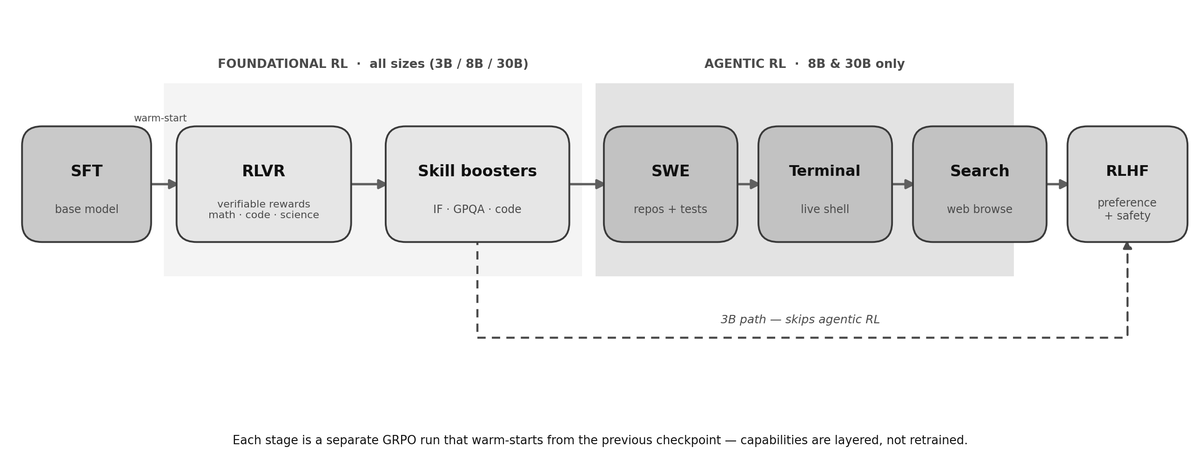
Training runs in three stages, and the third stage is where the sizes diverge. Supervised fine-tuning uses about 7.2 million samples, roughly 100 billion tokens of which about 65 billion are trainable, split into an agentic corpus of 31.6 percent and a non-agentic corpus of 68.4 percent. The foundational reinforcement-learning stage then runs group-relative policy optimisation across verifiable-reward environments: mathematics with boxed-answer checking and Lean proving, competitive coding against hidden tests, graduate-level science questions, instruction following, single-step tool use, reasoning puzzles and abstention. Two rounds of that stage run on the 3B, with a code skill booster. The agentic block, which covers software engineering, terminal use and web search inside live environments, runs on the 8B and the 30B only. A final preference and safety stage closes the pipeline for all three.
Quantization is a first-class part of the release rather than an afterthought. IBM publishes FP8 with dynamic per-channel weights and per-token activations and no calibration, NVFP4 and MXFP4 builds calibrated with GPTQ on 2,000 samples, and a GGUF repository with files from Q2_K to Q8_0 plus bf16 and the thinking parser beside them. The GGUF repository has more downloads than the base checkpoint, which is the clearest signal in the release about how people actually use this model.
What the model does not do is as defined as what it does. It holds no memory between requests: every call is independent unless the caller resends context, and the template strips earlier thinking from the history by default. It has no retrieval path, no tool registry and no permission model, so confirmation rules and schema validation belong to the caller. It does not verify its own actions: the trace is a description of an intent, not a record of what happened, and the practitioner test in this review is the proof.

Granite 4.2 3B
Getting Started with Granite 4.2 3B
Five steps: choose the build, serve it, set the context to what the cache can hold, enable the parsers, and check the model against three prompts before any work depends on it.
Step 1. Choose the build from the memory you have, not from the parameter count.
Build | File size | Runtime | What it is for |
granite-4.2-3b bf16 | 7.32 GB, two safetensors shards | vLLM, SGLang, Transformers | A GPU with headroom for the cache |
granite-4.2-3b-fp8 | 4.18 GB | vLLM or SGLang on FP8-capable hardware | Serving throughput without a bf16 memory bill |
granite-4.2-3b-nvfp4 | 2.80 GB | Blackwell-generation GPUs | The smallest GPU build |
granite-4.2-3b-GGUF Q4_K_M | 2.24 GB | llama.cpp, Ollama, LM Studio | A laptop or a small GPU |
granite-4.2-3b-GGUF Q2_K | 1.46 GB | llama.cpp, Ollama | The floor, with a quality cost nobody measured here |
Ollama granite4.2:3b | 2.2 GB | Ollama | The fastest path to a first answer |
Step 2. Serve it. The vendor's vLLM recipe is the reference, and the parser plugin is part of it.
huggingface-cli download ibm-granite/granite-4.2-3b granite_thinking_parser.py --local-dir .
vllm serve ibm-granite/granite-4.2-3b \
    --served-model-name granite-4.2-3b \
    --dtype bfloat16 \
    --max-model-len 131072 \
    --reasoning-parser granite_thinking_parser \
    --reasoning-parser-plugin ./granite_thinking_parser.py \
    --tool-call-parser qwen3_coder \
    --enable-auto-tool-choice
The SGLang recipe is shorter because the parsers resolve by name at version 0.5.18 or later:
python3 -m sglang.launch_server \
    --model-path ibm-granite/granite-4.2-3b \
    --dtype bfloat16 \
    --context-length 131072 \
    --reasoning-parser auto \
    --tool-call-parser auto
Ollama is one command, and it is the right first step for a reader who has not served a model before:
ollama run granite4.2:3bStep 3. Set the context to what the cache can hold. The weights are fixed and the cache is not. At bf16 the cache costs about 80 KiB per token, so the ceiling is decided by the card:
Context you set | Key-value cache | Plus bf16 weights | Practical hardware |
8,192 tokens | about 640 MiB | 7.32 GB | One 12 GB card |
32,768 tokens | about 2.5 GiB | 7.32 GB | One 16 GB card, tight |
131,072 tokens | about 10 GiB | 7.32 GB | One 24 GB card, or an FP8 build on 16 GB |
524,288 tokens | about 40 GiB | 7.32 GB | Not a laptop, and not a verified setting |
The last row is arithmetic and not a recommendation. Raising the ceiling means overriding max_position_embeddings, which IBM describes as supported by training and not evaluated, and which the vendor's own serving commands do not do.
Step 4. Enable the parsers, and keep the sampling parameters the card requires. Temperature 1.0 and top_p 0.95 are stated as a requirement for all tasks and all backends, and a caller who brings the usual 0.2 fails in a way that looks like a model defect. In thinking mode the card recommends 8,192 new tokens; in non-thinking mode, 2,048. A vLLM server refuses a maximum length above the config value, so an override is the only route to 512K and it is untested.
Step 5. Check the model before any work depends on it. Three prompts, ten minutes. Ask it a fact you can verify without a source, and watch whether it answers or confabulates, because the independent knowledge measure says it will confabulate about one time in three. Ask it to call one tool with one argument and confirm the argument from the tool's own record, not from the model's summary. And ask the same multi-step question with thinking on and with thinking off, because the difference tells you what the trace is worth in your own domain.

Granite 4.2 3B
Real Workflows
Three workflows, each chosen because the model's measured strength and a check the reader already owns sit in the same place. Each sample prompt uses the UP-Context-Engineering Method's eight layers in method order, with the schema, the reasoning switch and the data limits inside EXPECTED-FORMAT-AND-CONSTRAINTS.
Workflow 1: A private document reasoning pass on a laptop
When to use it: a long document that cannot leave the estate, a question that needs more than extraction, and a reader who will check the answer against the page. This is the use the licence and the size make easy.
This sample prompt uses the UP-Context-Engineering Method and the CI-First doctrine. Read the method at https://www.university-365.com/post/the-up-method-university-365-prompting-the-new-gold-standard-for-prompt-engineering, the doctrine at https://www.university-365.com/post/discover-the-ci-first-approach, learn both in a U365 online program at https://www.university-365.com/programs, and request a U.Coach for orientation at https://www.university-365.com/ucoach.
USER-PERSONA: My UP-Context-Engineering USER-PERSONA file is the file for this layer, attached. It is my psychographic file concatenated with the six ULM life-domain files. The parts that matter here: I sign the answer, I answer to the document's owner, and I will not forward a claim I have not seen on a page. If the file is not attached, ask for it before you start.
FULL-CONTEXT: The FULL-CONTEXT set for this task, added and not merged: the document [path, page count], the question set [file], the glossary the document uses [file], and the rule for what counts as unanswered [document]. The document is the only authority on a fact. If the document is not supplied, name it and stop.
AI-PROFILE-ROLE-EXPERTISE: Act as a Co-Worker and Assistant, in the role of a research assistant reading one long document, with expertise in clause reading, citation and structured extraction.
USER-FINAL-GOAL: One answer per question, every answer traceable to a page and a quotation, a separate list of questions the document does not answer, and a note on where the reasoning was doing work rather than recall.
AI-EXACT-TASK: Read the document, answer each question from it only, quote the sentence that supports each answer with its page, mark any question the document does not answer, and return the table plus the unanswered list.
AUDIENCE: Me, the owner of the document, and a colleague who will open two answers at random. The colleague accepts the quotation, not the summary.
EXPECTED-FORMAT-AND-CONSTRAINTS: Format: (1) the answer table with question, answer, page, quotation and confidence, (2) the unanswered list with the reason, (3) the passages that were ambiguous, (4) what you did not verify. Constraints: cite a page for every answer; never answer from general knowledge, and say so when you would have to; keep thinking on for questions that require joining two passages and off for single-passage extraction; the thinking trace stays out of the deliverable. Data limits: the document is confidential and stays on this machine; the model runs locally; no excerpt leaves the estate.
EXAMPLES: The glossary is the terminology example, and two answered questions from the file are the format example.
Before you use the output, open one cited page and read the quotation in place. The answer is yours, per CI-First.
What the model does well here: it reasons inside a bounded document, it quotes when the prompt demands a quotation, and it runs entirely on local hardware, which is the only reason the document can be used at all. A 128K window holds a long report with room for the questions.
What to watch: the independent knowledge measure is -18.33 with a 30.3 percent hallucination rate, so an answer given from memory rather than from the page is likely to be wrong and will read as confident. The RULER rows also fall with length, from 67.52 at 64K to 55.30 at 128K, so a full-window request is where accuracy is weakest.
VERIFICATION CHECKLIST for A private document reasoning pass on a laptop:
Multi-Model Check: run the same questions through a second model with the same prompt and compare the quotations, not the prose.
External Source: open two cited pages and read the quotation in place.
Human Review: read the unanswered list first. A model that answers everything on a document with gaps has filled the gaps.
CI-First Test: can you defend one answer from the page without the trace? If not, the page is not yours yet.
Workflow 2: A single-step tool-calling endpoint for a small internal application
When to use it: one function, one argument schema, a bounded vocabulary and a rule that nothing irreversible happens without a confirmation. This is the shape the 3B was trained for, which is single-step function calling inside its verifiable-reward stage.
This sample prompt uses the UP-Context-Engineering Method and the CI-First doctrine. Read the method at https://www.university-365.com/post/the-up-method-university-365-prompting-the-new-gold-standard-for-prompt-engineering, the doctrine at https://www.university-365.com/post/discover-the-ci-first-approach, learn both in a U365 online program at https://www.university-365.com/programs, and request a U.Coach for orientation at https://www.university-365.com/ucoach.
USER-PERSONA: My UP-Context-Engineering USER-PERSONA file is the file for this layer, attached. It is my psychographic file concatenated with the six ULM life-domain files. The parts that matter here: I operate the endpoint and I answer for every call it makes. If the file is not attached, ask for it before you start.
FULL-CONTEXT: The FULL-CONTEXT set for this task, added and not merged: the tool definitions in JSON [path], the argument rules [file], the twenty resolved examples [file], and the list of actions that require a human confirmation [document]. The definitions and the argument rules are the only authority on a call. If either is missing, name it and stop.
AI-PROFILE-ROLE-EXPERTISE: Act as a Co-Worker and Assistant, in the role of a service-desk router, with expertise in argument construction, schema validation and evidence citation.
USER-FINAL-GOAL: One tool call per request, or an explicit refusal, with the argument values traceable to the request and every ambiguous request routed to a person.
AI-EXACT-TASK: Read the request, choose one function from the defined set, construct the arguments from the request only, stop before any write and return the call plus the evidence field for each argument.
AUDIENCE: Me, the operator, and the service-desk lead who will replay three calls. The lead accepts the argument evidence, not the intent.
EXPECTED-FORMAT-AND-CONSTRAINTS: Format: (1) the call with function name and arguments, (2) the evidence for each argument, (3) the refusal list with the reason, (4) what you did not verify. Constraints: one function per request; never invent an argument value; never call a write function without the confirmation flag; keep thinking off for a single-field extraction and on when the request joins two conditions; the thinking trace stays out of the response. Data limits: the request text is internal; the endpoint is local; no request leaves the estate.
EXAMPLES: The twenty resolved examples are the format and decision examples.
Before you wire the endpoint into anything, replay one call by hand and check the argument against the source record. The call is yours, per CI-First.
What the model does well here: the OpenAI tool format is native, the parsers exist in two runtimes, and the vendor's own tool row is 52.41 on BFCL v4, which is close to the 8B at 52.39. Single-step function calling with a closed vocabulary is the narrow shape this checkpoint handles.
What to watch: the practitioner test recorded in this review shows the 3B narrating a successful tool call that never happened, and the independent Terminal-Bench row is 13.86 percent. Treat every model-side claim of success as unverified, log the call at the tool, and never let the model's summary stand as the record of an action.
VERIFICATION CHECKLIST for A single-step tool-calling endpoint for a small internal application:
Multi-Model Check: run the same twenty requests through a second model with the same schema and compare the arguments.
External Source: read the tool's own log, not the model's summary, for every call in the first week.
Human Review: read the argument values, not the function names. A valid call with a wrong argument passes the schema and fails the task.
CI-First Test: can you explain one call without the trace? If not, the endpoint is not yours yet.
Workflow 3: A study bench that compares the three thinking settings
When to use it: a course, a lab or a research group that wants to show what a reasoning trace costs and what it buys, on one checkpoint and one prompt set. This is the use that no hosted endpoint makes possible at zero cost.
This sample prompt uses the UP-Context-Engineering Method and the CI-First doctrine. Read the method at https://www.university-365.com/post/the-up-method-university-365-prompting-the-new-gold-standard-for-prompt-engineering, the doctrine at https://www.university-365.com/post/discover-the-ci-first-approach, learn both in a U365 online program at https://www.university-365.com/programs, and request a U.Coach for orientation at https://www.university-365.com/ucoach.
USER-PERSONA: My UP-Context-Engineering USER-PERSONA file is the file for this layer, attached. It is my psychographic file concatenated with the six ULM life-domain files. The parts that matter here: I teach the session, I publish the comparison, and I will not report a difference I did not measure. If the file is not attached, ask for it before you start.
FULL-CONTEXT: The FULL-CONTEXT set for this task, added and not merged: the prompt set [file, count], the scoring rubric [document], the fixed sampling parameters [file], and the record sheet [path]. The rubric is the only authority on a correct answer. If it is missing, name it and stop.
AI-PROFILE-ROLE-EXPERTISE: Act as a Co-Researcher, Analyst and Tester, in the role of a teaching assistant running a controlled comparison, with expertise in experimental design, token accounting and error classification.
USER-FINAL-GOAL: One table that shows, for the same prompts, what thinking, low-effort and non-thinking each cost in tokens and latency and what each returned in correctness under the rubric, with the failures classified.
AI-EXACT-TASK: Run the prompt set three times with the three settings and the fixed parameters, record tokens and elapsed time per item, score each answer against the rubric, classify each failure, and return the table with the per-item record.
AUDIENCE: Me, the class, and a colleague who will rerun two prompts on the same hardware. The colleague accepts the per-item record, not the average.
EXPECTED-FORMAT-AND-CONSTRAINTS: Format: (1) the settings table, (2) the per-item record with setting, tokens, latency, score and error class, (3) the failure taxonomy with counts, (4) what you did not measure. Constraints: identical sampling parameters across settings; no cherry-picked prompts; report the median and the spread, not the best row; separate a reasoning error from a knowledge error and from a tool error. Data limits: prompts are course material; the model runs locally; no student data enters the set.
EXAMPLES: One scored item from each setting is the format example.
Before you teach from the table, rerun one prompt yourself and confirm the token count. The comparison is yours, per CI-First.
What the model does well here: the three settings are template parameters rather than separate models, so the comparison is clean, and the independent verbosity figure gives the class a reference point: 34,286 output tokens per task on the evaluator's own index, split into 19,221 reasoning tokens and 15,064 answer tokens.
What to watch: that verbosity figure is measured on a much harder benchmark than a course exercise, so a student who generalises it will overstate the cost. Measure your own prompts, and expect the 3B to spend a large share of its output on the trace when thinking is on.
VERIFICATION CHECKLIST for A study bench that compares the three thinking settings:
Multi-Model Check: run one prompt through a second runtime, such as Ollama against vLLM, and confirm the answer does not depend on the serving stack.
External Source: check one scored answer against the rubric line by line rather than by impression.
Human Review: read the failure taxonomy. A bench where thinking always wins is a bench that scored style rather than correctness.
CI-First Test: can you explain one difference from the per-item record without rerunning the model? If not, the result is the bench's, not yours.

Granite 4.2 3B
Strengths, Limits, and AI Imposture Risk
Strengths
Time
Strength. A reasoning model that starts in one command and costs nothing per token, with a switch that lets a caller skip the trace on easy work.
Evidence. A 2.24 GB Q4_K_M file, a 2.2 GB Ollama tag, and three thinking settings on one checkpoint. Held at 6 by the cache cost at long context, by the parser plugin a served endpoint needs, and by an output profile the evaluator records at 34,286 tokens per task.
Quantity
Strength. A verified 128K context and twelve tested languages in a 3.66 billion parameter package.
Evidence. 131,072 positions in the config, about 10 GiB of cache at that ceiling, and a tested language set of twelve. Held at 6 because the vendor's own multilingual knowledge row is 27.78, and because the useful volume is bounded by how much output a person will check.
Quality
Strength. Vendor benchmark rows that are strong for the size, and an independent composite that confirms the two rows it shares with the vendor.
Evidence. AIME25 78.33, LiveCodeBench v6 69.71, GPQA 54.80, MMLU-Pro 67.84, IFBench 74.33, all vendor-run. Artificial Analysis measures GPQA at 55.86 against the vendor's 54.80 and SciCode at 25.35 against 24.11, and places the composite at 4.72 on a 0 to 100 scale. Held at 4 by that absolute level, by a 30.3 percent hallucination rate, and by a weak multilingual row.
Skill
Strength. An unusually readable post-training record under a permissive licence.
Evidence. The data mixture by category and percentage, the reinforcement-learning stage table, the group-relative policy optimisation settings, four quantization schemes, a thinking parser in the repository and a config a reader can compute a cache from. Held at 5 because the training data and the synthetic environments are closed, and because the 3B's own stage list is the short one.
Limits
The 3B did not receive the agentic training its family is sold on. The vendor's stage table gives it foundational reinforcement learning and a code skill booster only, and its benchmark table marks all four agentic coding rows NA. Independent Terminal-Bench 2.1 is 13.86 percent.
There is no verified 512K context. The checkpoint ceiling is 131,072 tokens, IBM's documentation scopes the 512K extension to the 30B, and an IBM engineer states that 128K is the maximum verified length. The extension requires an override the vendor does not document as a setting.
The knowledge measure is negative. Artificial Analysis records AA-Omniscience at -18.33 with 9.2 percent accuracy and a 30.3 percent hallucination rate, which makes this a reasoning tool and not a knowledge base.
The cache is the real deployment cost. Full attention in every block with 8 key-value heads costs about 80 KiB per token, about 10 GiB at 128K and about 40 GiB at an override to 512K. The weights are 7.32 GB and the cache is larger than they are at the full window.
The name rounds the size down by about a fifth. The checkpoint measures 3,659,737,600 parameters and the bf16 file is 7.32 GB, against the 3B a reader plans from the name.
There is no first-party and no third-party per-token price for this size. The watsonx.ai price table carries no Granite 4.2 row, and OpenRouter lists the 8B and not the 3B. A team that wants metered billing is buying a different model.
The vendor documentation site is frozen. IBM's Granite documentation page carries a banner stating that the site is no longer being updated and pointing readers to Hugging Face and GitHub, so the model card is the living surface and the docs page is a snapshot.
The multilingual knowledge row is weak. MMLU-ProX lite at 27.78 against 61.06 for the 8B is not a translation quality problem alone; it says the small model holds much less world knowledge outside English.
Text only. No image, audio or video input, and no generation of any of the three.
The model ships no verifier, no permission system and no sandbox. Tool confirmation, schema validation, logging and the record of what actually happened are the caller's work, and the practitioner test shows why that matters.
AI Imposture Risk
Time Illusion
Rating. Medium
Evidence. The saving is real on a machine the reader already owns: one command to serve a 2.2 GB build, no queue, no per-token bill, and a switch that skips the trace on easy work. The overhead is real as well: the plugin and parser set-up for a served endpoint, the cache arithmetic before a long request, and an output profile the evaluator records at 34,286 tokens per task, of which 19,221 are reasoning tokens. A reader who equates a small file with a fast answer has counted the download and not the trace.
Quantity Illusion
Rating. Medium
Evidence. A 128K window invites a reader to pass a whole report, and the volume of fluent, structured, twelve-language output reads as more work than it is. The measured counterweights are specific: RULER falls from 67.52 at 64K to 55.30 at 128K, MMLU-ProX lite is 27.78, and the hallucination rate is 30.3 percent. The trap is Medium rather than High because the length is verified, the cache cost is arithmetic a reader can do, and a second reader catches the volume quickly.
Skill Illusion
Rating. High
Evidence. The family is marketed as purpose-built for agentic work, the card lists agentic workflows among its best uses, and the 3B ships tool calling and a reasoning trace that reads like a plan. What the vendor's own training table says is that this size skips the software-engineering, terminal and search stages, and a practitioner test records the model reporting a file save that never happened. A reader can easily conclude that a model which narrates an action has taken it. Mitigations exist and are published (the stage table, the NA rows, an independent Terminal-Bench row at 13.86 percent, and the practitioner account), and they lower the frequency without moving the capability to the reader, so the trap stays High.
Overall Imposture Risk: Medium. One trap is High (Skill Illusion) with clear mitigations stated above, and the framework's Section 5.3 arithmetic places one High trap with clear mitigations in the Medium band. Two traps are Medium and none is Low. The v1.3 band-precedence sentence does not change the outcome, because only one rating applies to this trap set. The rating would move to High if a second trap became High, for example a deployment in which the model's tool calls were executed without a confirmation step, or a workflow in which a 128K window was filled on every request and the answers were accepted without opening a page.
Framework v1.2 clause note
Clause 5.2.3-a, agent-authored procedural memory: NULL, recorded with its boundary. A clause note in this review names the version that introduced the two clauses, v1.2, and the framework of record is the CI-First Evaluation Framework v1.4.1, which retains both; the version in the heading is the clause's origin, not a stale framework. The model holds no memory store and writes nothing by itself: every request is independent unless the caller resends context, the chat template strips earlier thinking from the history by default, and the checkpoint carries no file, database or configuration write path. No documented mechanism ships by default by which ibm-granite/granite-4.2-3b writes skills, memory stores or standing instructions on the user's behalf, so the clause returns a null rather than applying. The live condition is specific: a scaffold that lets the model write or revise the workspace's skills, rules or procedural memory by default, or a deployment in which the model's own tool narration becomes the standing instruction without a per-write human decision, re-opens this clause at no lower than Medium, and at High where the user has no routine practice of reading what was written. That condition is the eighth re-check trigger.
Clause 4.2-a, agent-mediated conversation: NULL for the model and for its shipped surface. Neither erosion condition is met. The model returns text to the caller, no agent-authored text is presented as a person's own voice in a human-facing channel by default, and nothing in the product substitutes agent interaction for human contact. The live condition to watch on any deployment: a scaffold that lets the model draft replies, send messages or publish under a person's identity without that person reading the result first meets condition (a), and a workflow in which a person deals with the agent instead of with colleagues meets condition (b). Both are properties of a deployment built around this model rather than properties of the model.
Clause 7.5 is not assessed. It was removed from the framework in v1.4, and this review derives no mode, writes no mode line and records no mode value. The two clauses above are the only pedagogical clauses that apply under v1.4.1.

Granite 4.2 3B
Section 7c: The 512K claim, the agentic block the 3B skips, the rounded size, and the price no table carries
A Section 7c finding is recorded where a supplier's governance, safety record or commercial terms have a real result for the reader. The items below were checked against primary sources, and they produce findings a buyer should carry. All findings are stated as facts of record, and the difference between a company statement, a published measurement and a licence term is kept intact.
The 512K context claim exists in three versions, and the checkpoint is the tiebreaker. The 3B model card's summary table reads "Natively Supports 128K (Long-context extension to 512K)" and its capability list says "512K Context Window". IBM's documentation page reads "All models natively support a 128K context window (with long-context extension to 512K on the 30B model)". An IBM engineer, answering a repository question on 2026-09-11, wrote that all 4.2 models were trained to support 512K, that a platform flag raises the ceiling with no RoPE scaling, and that all 4.2 models were benchmarked and evaluated at 128K, "the maximum verified length". The published config carries max_position_embeddings at 131,072, and the vendor's own vLLM and SGLang commands both pass 131,072. The finding is not that IBM contradicts itself in bad faith: a training capability and a verified serving limit are different things, and the engineer says so. The finding is that a reader taking the card's capability bullet at face value plans a 512K request that the checkpoint does not carry by default, needs an override to attempt, and IBM's documentation attributes to another size. Raising the ceiling through a config override is the route a practitioner guide describes, and it labels the path untested. Treat 512K as an experiment with no published evaluation, and plan on 128K.
The cache arithmetic makes the 512K question concrete rather than academic. Full attention in every block costs about 80 KiB per token at this configuration, so 128K needs about 10 GiB of cache on top of 7.32 GB of weights, and 512K would need about 40 GiB. A reader who is tempted by the larger number should compute that first, because the number that decides the machine is the cache and not the parameter count. This generation dropped the hybrid design of Granite 4.0, which had compressed the cache by a large factor, and a reader migrating from 4.0 should not carry the old memory plan across.
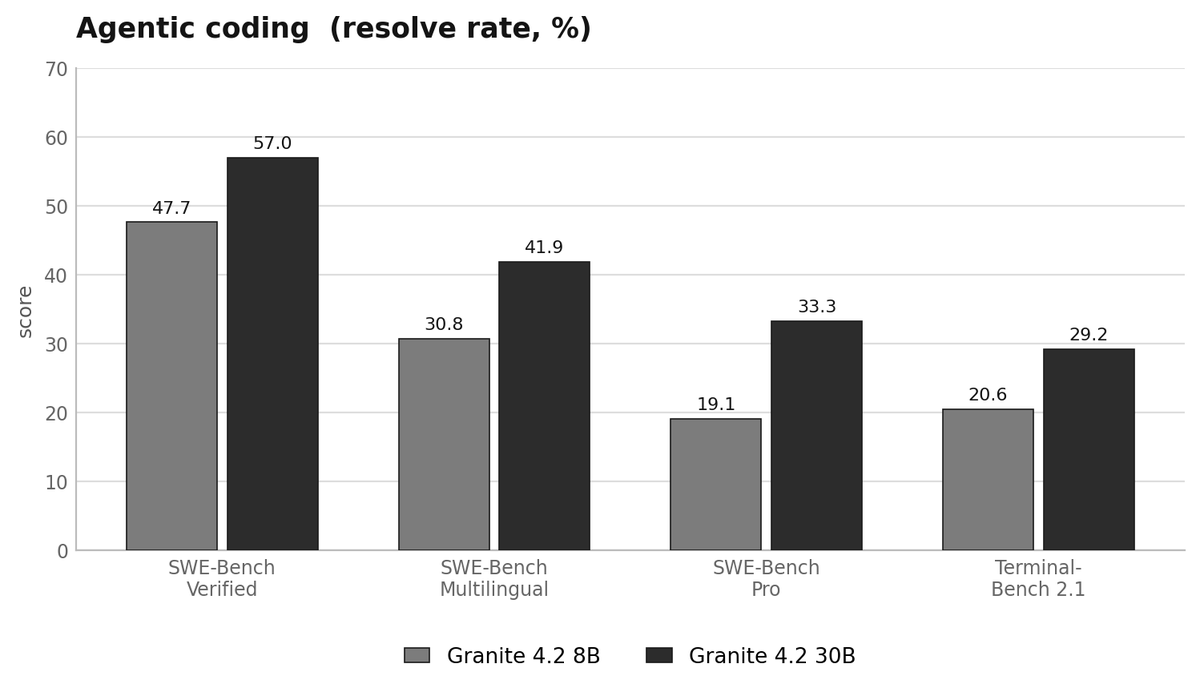
The 3B is the one size the family's agentic training skips, and the vendor's own table says so three ways. The technical blog's stage table gives the 3B a code skill booster and dashes against the software-engineering, terminal and search stages, and the sentence beside it reads that the 8B and 30B add the agentic block on top. The IBM Research release note repeats the split for the larger two sizes. The benchmark table then marks SWE-Bench Multilingual, SWE-Bench Pro, SWE-Bench Verified and Terminal-Bench 2.1 all NA for the 3B, which is a vendor declining to publish a number rather than a number that failed. The independent evaluator published one anyway: Terminal-Bench 2.1 at 13.86 percent, against 20.56 for the 8B and 29.24 for the 30B on the vendor's own table. A reader who needs agentic coding at this price point is looking at the wrong size, and IBM's documentation says so before any reviewer has to.
The model is named 3B and measures 3.66 billion parameters. The published safetensors index reports 3,659,737,600 parameters and the bf16 checkpoint uses 7.32 GB of storage across two shards. The rounding is consistent across the family, at 8.79 billion for the 8B and 29.28 billion for the 30B, so it is a naming convention rather than a defect of this size. It still matters operationally: a reader who sizes a card from the name and a rule of thumb of two bytes per parameter plans about 6 GB and meets a 7.32 GB checkpoint plus a cache.
No price table sells this model by the token, and the nearest one sells its sibling. The watsonx.ai price table read on 2026-11-19 lists Granite 4.1 3B, 8B and 30B with "Not available" in the per-token column, carries no Granite 4.2 row in any size, and prices deploy-on-demand hosting by the GPU hour, from $4.43 for one L40S to $16.00 for one H200. OpenRouter lists ibm-granite/granite-4.2-8b at $0.06 input and $0.15 output per million tokens with a 131,072 context, created 2026-08-31, and carries no 3B entry. The finding is a planning one: this model has no market price, so a team comparing it with a hosted API is comparing hardware and a person against a meter, and the meter it can actually compare with is the 8B's.
The vendor's documentation page is frozen, and the model card is the living surface. The IBM Granite documentation page carries a banner at the top reading "This documentation site is no longer being updated. For the latest Granite documentation and models, see Hugging Face and GitHub." A reader who lands on the documentation page from a search result is reading a snapshot, and the card, the config and the technical blog are where the current facts sit. The consequence for this review is procedural: every figure here was read on the card, the config, the repository metadata, the blog or the independent evaluator, and the docs page is cited only for the sentences it uniquely carries, which are the 512K scoping and the certification statement.
No sub-score changed for these findings, and the reason is explicit. The Time sub-score already carries the local serving path and the trace overhead. The Quantity sub-score already carries the verified 128K ceiling and the cache cost. The Quality sub-score already carries the independent composite, the overlapping rows and the hallucination rate. The Skill sub-score already carries the open weights and the readable post-training record. The Imposture assessment already carries the agentic framing and the practitioner failure. The items above are a context scoping, a stage-list reading, a naming correction, a price absence and a documentation status. None of them is a defect in the artefact a buyer receives, and none is a resolved failure that the four dimensions do not already price. Section 7c closes with what it does not do: it does not allege misconduct, it does not treat a marketing sentence as a false claim, and it does not convert a company's own published caveat into a finding against it.

Granite 4.2 3B
U365 Co-Intelligence Rating
CI-First Profile
Primary profile: Co-Worker and Assistant (level 2). Secondary profiles: Professor, Coach and Tutor (level 3).
Why this profile and not Co-Creator. The model is positioned as a small reasoning worker: read the input, think, answer, and call a function when one is defined. That is a delegation of a task rather than a share in a decision, and the role it plays is the one the caller gives it. Co-Worker and Assistant is that role. Professor, Coach and Tutor is recorded as secondary on two concrete grounds: a readable thinking trace makes the model a worked example that a teacher can show, and a 2.24 GB file that runs offline lets a Fellow run it on their own material without sending anything anywhere, which is a teaching arrangement a hosted endpoint cannot offer. Co-Researcher, Analyst and Tester is not recorded, because the model designs no experiment and audits no method; it executes one when it is given a rubric. Challenger, Critic and Devil's Advocate is not recorded either: nothing in the release is built to disagree, and the model's failure mode under pressure is agreement rather than challenge.
CI-First Benefit Score
Time
Score (0-10). 6
Rationale. Moderate net saving. A 2.2 GB Ollama tag or a 2.24 GB Q4_K_M file starts in minutes, there is no queue and no per-token bill, and the three thinking settings let a caller skip the trace on easy work. Held at 6 by the cache cost at long context, by the parser plugin and sampling parameters a served endpoint needs, and by an output profile the evaluator records at 34,286 tokens per task.
Quantity
Score (0-10). 6
Rationale. A verified 128K context and twelve tested languages in a 3.66 billion parameter package: 131,072 positions in the config, about 10 GiB of cache at that ceiling, and a tested language set of twelve. Held at 6 because the vendor's own multilingual knowledge row is 27.78, and because the useful volume is bounded by how much output a person will check.
Quality
Score (0-10). 4
Rationale. Strong vendor rows for the size and an independent composite that confirms the two rows it shares. AIME25 78.33, LiveCodeBench v6 69.71, GPQA 54.80, MMLU-Pro 67.84 and IFBench 74.33, all vendor-run, against an independent GPQA of 55.86 and SciCode of 25.35. Held at 4 by an independent composite of 4.72 on a 0 to 100 scale, a 30.3 percent hallucination rate, a multilingual knowledge row of 27.78, and no independent run of the reasoning benchmarks the vendor leads with.
Skill
Score (0-10). 5
Rationale. An unusually readable post-training record under a permissive licence: the data mixture by category and percentage, the reinforcement-learning stage table, the group-relative policy optimisation settings, four quantization schemes and a thinking parser in the repository. Held at 5 because the training data and the synthetic environments are closed, the recipe can be read but not reproduced, and the 3B's own stage list is the short one.
CI-First Benefit Score: 5.3 / 10 (CI-First Positive)
Why the score sits where it sits
5.3 with sub-scores 6 / 6 / 4 / 5 is a small local model position: a good time and volume position because the thing runs anywhere, a modest quality position because the measurements are modest, and a middle skill position because the documentation is better than the model.
Why not higher. Three reasons, each measured. The independent composite is 4.72 on a 0 to 100 scale, which places this model in the tiny class and nowhere else, and the class position it does hold, above a median of 4, is a statement about small models rather than about this one. The knowledge measure is negative, with a 30.3 percent hallucination rate, so any workflow that relies on recall needs a retrieved source before the model is useful. And the agentic rows are absent by design: a reader who wants the capability the family advertises has to buy the 8B or the 30B, which is a different purchase at a different price.
Why not lower. The release does something most small models do not. It puts a real thinking mode, three settings, native tool calling in the OpenAI format, a verified 128K context and twelve tested languages into a 2.24 GB file under Apache 2.0 with a signature, and it publishes a post-training recipe detailed enough to teach from. The independent evaluator confirms the two vendor rows it shares rather than contradicting them, which is rare in this size class, and the GPQA agreement within one point is a genuine signal about the vendor's table. A model that a university can run offline, study and build on without a licence conversation is a positive tool in the framework's terms, even when its benchmark level is modest.
Why 5.3 and not a higher band, stated as arithmetic. Time 6, Quantity 6, Quality 4 and Skill 5 average to 21 divided by 4, which is 5.25, rounded to 5.3. That is CI-First Positive, the 4.1 to 6.0 band. It sits below the reviews of Nemotron 3.5 Lightning at 6.0 and GLM-5.3 Flash at 6.0, and above MiniMax M2.7 at 4.5, which is the order the instrument should produce: a small local model with a clean licence and a modest measured level transfers less benefit than a stronger model with the same access, and more than a larger model under a licence that forbids the work.
What the score does not carry. The four dimensions measure what the reader's work gains. They do not carry the 512K scoping, the stage table, the rounded parameter count, the missing price rows or the frozen documentation site. Those sit in Section 7c with an explicit statement that no sub-score changed. They do not carry the clause questions either, which return nulls with boundaries. A reader who wants the score to encode the licence would need a different instrument, and the framework's instrument for that is the 7c finding and the clause note.
Humics Protection Badge
Creativity
Rating. Neutral (0)
Rationale. The model executes what it is given: read the document, answer the question, draft the text, construct the call. It originates no direction, and the person holds the design. A thinking trace can look like ideation, and it is the model working through the caller's brief rather than proposing one.
Critical Thinking
Rating. Erodes (-1)
Rationale. The product is built to answer fluently after a trace that reads like reasoning, and the measured knowledge behaviour is a 30.3 percent hallucination rate on the evaluator's own test. A reader who accepts a confident paragraph because the trace looked careful exercises less judgement per claim than before. Mitigations exist (read the unanswered list, cite a page, run the three-prompt check, compare thinking against non-thinking) and they lower the frequency without reversing the direction.
Social Authenticity
Rating. Neutral (0)
Rationale. The model returns text to a caller and produces no human-facing voice by default, and clause 4.2-a returns a null for it as a generator. The live condition stays in the record: a scaffold that lets the model draft or send messages under a person's identity without that person reading the result first moves this dimension.
Humics Protection Score: -1 / +3 Badge: Humics-Neutral
Superhuman Usage Guidance
When to invite this tool:
A private drafting, summarising or classification pass on hardware you already own, where no prompt may leave the estate.
A bounded document question-and-answer task with a page citation requirement, on a document short enough to hold in the window you can afford.
A single-step tool-calling endpoint with one closed schema, a confirmation rule and a log at the tool.
A teaching bench that shows what a reasoning trace costs and what it buys, using the three thinking settings on one checkpoint.
Multilingual drafting in the twelve tested languages, with a second reader wherever the output will be published.
A first local model for a learner, because 2.24 GB and one command is a low-risk way to see how a reasoning model behaves.
When to keep this tool out:
Any multi-step agentic coding workflow, where the vendor's own table points to the 8B or the 30B and this size has no agentic training.
Any factual question-and-answer without a retrieved source, because the independent knowledge measure is negative.
Any plan that depends on a 512K context, which is an override with no published evaluation and is scoped to another size by IBM's documentation.
Any workload that needs image, audio or video input, or any generation of the three.
Any deployment that needs a metered per-token price for this exact size, because no vendor publishes one.
Any scaffold that lets the model's tool narration stand as the record of an action, which is the clause boundary as much as an operational rule.
Any team that cannot maintain a serving stack, a parser plugin and an evaluation set, because an open licence transfers that work rather than removing it.
U365 method integration:
LIPS + CARE: keep the checkpoint version, the quantization, the context length, the runtime, the sampling parameters and the score on your own prompt set in the Collect phase, and put the acceptance decision in the Action Plan and Review phases. The model can draft; it cannot own the judgement about whether the draft is right.
ULM + EVA: a GPU or a laptop and its power are a recurring cost in the Finance domain, and the decision to own one belongs in the six-domain plan rather than in a code review. The EVA cycle is the right place to decide which workflow justifies the hardware before the purchase.
UP-Context-Engineering: the eight layers are the control surface this model needs, and the thinking switch is a lever the method rarely has. A stated AI-EXACT-TASK, a bounded FULL-CONTEXT and an EXPECTED-FORMAT-AND-CONSTRAINTS carrying the schema, the citation rule and a decision about whether this call needs reasoning at all are what make a local model's output checkable. The three workflow samples above use the eight layers.
UNOP: no direct fit. The model is not built to teach, and its gains come from execution rather than from any pedagogical mechanism.
Over-delegation warning: the failure mode with this product is that a small model with a visible thinking trace looks like a careful colleague. It reasons, it calls a function, it reports that the file was saved. What the vendor's stage table says is that this size never learned the agentic loop, and what the practitioner test shows is a save that did not happen, narrated with confidence. The independent knowledge measure says the same thing in a different unit: one answer in three, when the model works from memory, is wrong. A reader who lets this model write to a system without a confirmation step, or who accepts its narration as a record, has taken the product's worst offer, and the fact that it runs on their own laptop makes that offer easier to accept rather than safer.

Granite 4.2 3B
What Users Say
Aggregate Rating Table
Platform | Rating | Number of reviews | Link |
Artificial Analysis | Intelligence Index 4.72 on a 0 to 100 scale, displayed as 5, rank 3 of 6 in its class against a class median of 4; AA-Omniscience -18.33 with 9.2 percent accuracy and a 30.3 percent hallucination rate; GPQA 55.86 percent; SciCode 25.35 percent; Terminal-Bench 2.1 13.86 percent; no speed measurement; no price; no providers | Independent benchmark, not a user rating | |
Hugging Face, base repository | 140 likes, 39,920 downloads in the last month, 4 discussions of which 2 are open pull requests and 1 was merged | Repository engagement, not a rating platform | |
Hugging Face, GGUF repository | 51 likes and 269,388 downloads in the last month, which is more than the base checkpoint | Repository engagement and a usage signal | |
Ollama, granite4.2 library | 310.8K downloads for the library, with the 3B tag at 2.2 GB and a 128K context window, updated 2 months ago | Registry usage counter, not a rating platform | |
Hacker News | 4 points and 0 comments on the Ars Technica piece, 2 points on the IBM Research release note, and no substantive thread on the family | Practitioner discussion, and this time it is nearly absent | |
YouTube, Fahd Mirza | A local test of the 3B and 8B with vLLM and a reasoning parser, at about 4.5 GB of VRAM for the 3B, recording a failed tool call on the 3B and a partial result on the 8B | Practitioner video test | |
YouTube, KGP Talkie | A local benchmark against two other small models on one RTX 5090, measuring usable context from the key-value cache and reporting tool-call errors for Granite | Practitioner video test | |
G2 | No listing for the model | Not applicable | Not applicable |
Capterra | No listing for the model | Not applicable | Not applicable |
Trustpilot | No listing for the model | Not applicable | Not applicable |
Note on method, stated plainly because it affects how much this section is worth. No review platform rates an individual open-weight model. No G2, Capterra or Trustpilot listing for ibm-granite/granite-4.2-3b exists, and none is reproduced here. The meaningful signals for a released checkpoint are the independent evaluator's page, the download and discussion counts on the repository and the registries, and the practitioner tests. That is what this section reports, and where a claim comes from a practitioner rather than from a measurement, the practitioner is named as the source. The most striking signal is not a score at all: the quantized GGUF repository has 269,388 downloads against 39,920 for the base checkpoint, and the Ollama library carries 310.8K, which says people are running this model locally rather than calling it.
What Users Praise
Three themes dominate, and the first is the price, which is zero.
It runs on hardware people already own, and the registry numbers prove it. The GGUF repository's 269,388 downloads in a month, against 39,920 for the bf16 checkpoint, is the clearest statement in the release about who uses it and how. The Ollama library adds 310.8K downloads across the three sizes, with the 3B tag at 2.2 GB and a 128K context window listed. A practitioner test on a 48 GB workstation measured the 3B at about 4.5 GB of VRAM at default settings, and a separate hands-on account on an M1 Max with 64 GB of unified memory reports running the 3B and the 8B through llama.cpp with Metal and publishing median speeds from three runs. The model is genuinely small in the way the licence makes usable.
The licence is the feature that keeps coming up. Apache 2.0 with no strings is unusual enough at this capability level that practitioners mention it as a reason to try the release at all. IBM states that the family ships with cryptographic signatures, ISO certification and full transparency disclosures, and the repository carries a signature file beside the weights, which is a level of packaging that a hobby release does not have. For a reader whose blocker is a legal review, the release removes it.
The three thinking settings are the most-praised mechanism. A reader can switch between a full trace, a short trace and no trace on the same checkpoint, per request. Practitioner material describes the switch as the release's most practical feature, and one hands-on account frames the 3B as the first model of this size where the amount of deliberation is a caller's decision rather than a property of the model. That is a fair reading: the mechanism is template-level and documented, and it is the same checkpoint in all three modes.
What Users Complain About
Three complaints recur, and the first is the one this review treats as the headline.
The 3B narrates tool calls it did not make. A local test of the 3B and the 8B on the same prompt recorded the 3B reporting that it had saved an HTML file, when no file existed in the working directory; the model had produced a partial, unstyled document with a handful of countries per continent, and the save it described had never happened. The same test recorded the 8B completing the save and still missing most of the requested content. A second hands-on account describes the same failure in the same terms and draws the same conclusion: for dependable multi-step tool use, IBM's own training design points to the 8B or the 30B.
The context claim is confusing, and a user asked IBM directly. The third discussion on the repository is titled "Clarification on enabling and evaluating 512K context", opened on 2026-09-10, and it walks through exactly the contradiction a buyer meets: the card says the model supports 128K natively with an extension to 512K, the architecture lists 131,072, and the serving examples do not show how to enable 512K. The questioner asks whether 512K is officially supported by the released checkpoint, whether RoPE scaling is required, and whether a larger max-model-len is enough. IBM answered within a day and the answer was accepted, which is a good sign for the repository. The fact that the question had to be asked is the complaint.
The memory cost of long context is not in the headline. Practitioner measurements on a 32 GB card report a usable context well below the nominal window for the larger sizes, and the arithmetic behind that is the full-attention design: about 80 KiB per token on the 3B, so a 128K request needs about 10 GiB of cache before the weights. A reader who plans a long-context workload from the card's context line and not from the cache arithmetic is surprised at the card, not at the model. The smaller size suffers less, and it is still the number most likely to be missed.
Sentiment Summary
Sentiment on this model is quiet and practical. The engagement is in the registries rather than in the discussion: 269,388 GGUF downloads and 310.8K Ollama downloads against 4 points and 0 comments on Hacker News, and a repository with four discussion threads in three months. The praise is about access, licence and the thinking switch, which are the things a reader can verify in an afternoon. The complaints are about agentic reliability and the context headline, which are the things a reader discovers after the afternoon. Nobody is arguing about this model, and that is consistent with what it is: a well-packaged small checkpoint from a vendor with an enterprise distribution channel, used by people who want a local model and priced accordingly.
U365 Editorial Note
This review records the family's own framing and then measures the 3B against it, because the gap is the useful part. IBM sells Granite 4.2 as a family built for agentic work, and the 3B is the member of that family that did not receive the agentic training. That is a defensible product decision, and it is stated in the vendor's own documents rather than discovered by a reviewer. What a U365 reader needs is the sentence that follows: the smallest size is a reasoning and drafting model, the agentic capability starts at the 8B, and the marketing line applies to the family rather than to every member of it. A learner who takes the 3B as a first local model and uses it for reading, drafting and single-step tool calls will get a fair return. A team that takes the 3B as a cheap route to an agent will spend the difference in rework.

Granite 4.2 3B
Comparison and Alternatives
Within the family, the choice is decided by the stage list rather than by the parameter count. The three sizes share an architecture family, a licence, a context ceiling and a training pipeline up to the point where the agentic block begins. Everything a reader cares about after that point splits.
Option | Measured size | Independent index | Agentic training | Price on 2026-11-19 |
Granite 4.2 3B (this review) | 3.66 billion, 7.32 GB bf16, 2.24 GB Q4_K_M | 4.72 on a 0 to 100 scale, above the tiny class median of 4 | None. Code skill booster only, four agentic benchmark rows NA | Self-host. No per-token listing |
Granite 4.2 8B | 8.79 billion, 5.3 GB on Ollama | 5.10, at the lower end of a class median of 10 | Full block: software engineering, terminal and search | OpenRouter $0.06 input and $0.15 output per million tokens at 131,072 context |
Granite 4.2 30B | 29.28 billion, 18 GB on Ollama | 5.54, below a class median of 10 | Full block, and the size IBM scopes the 512K extension to | Self-host. No per-token listing found on the vendor table |
Granite 4.1 3B | 3.40 billion in the base checkpoint | Marked deprecated by the independent evaluator, released 2026-04-29 | None. Predates the reasoning mode | Superseded, and not scored here |
The 8B is the alternative most readers actually want. It carries the full agentic block, its vendor rows are materially better where they overlap (SWE-Bench Verified 47.67 against NA, Terminal-Bench 2.1 20.56 against NA, GPQA 64.14 against 54.80), and it is the only size in the family with a metered third-party route: $0.06 input and $0.15 output per million tokens on OpenRouter. Against a 3B that has no per-token price at all, the 8B is cheaper to try and better at the work the family advertises. The case for the 3B is memory and a laptop, and it is a real case, not a consolation.
The 30B is a different purchase, not an upgrade. It needs a data-centre card for a useful context, its independent composite is only 0.8 points above the 3B's on a 0 to 100 scale, and its own class position is below average. A reader who needs maximum quality in this family chooses it for the benchmark rows, not for the composite, and a reader who needs a laptop stops reading here.
Outside the family, the honest comparison is the class rather than a named model. The independent evaluator compares open-weight models only against others in the same size band, and the 3B sits in the tiny band at 4B parameters or fewer, where the median is 4 on a 0 to 100 scale and this model ranks third of six. A reader who wants a comparison with a specific named model can use the evaluator's own pages with the same index version, which is the only way to compare two models on one method. This review does not carry a competitor's vendor-run number into a table with this model's independent number, because the two would not be measuring the same thing.
What none of these options give you is a knowledge base. Every figure in this section is a capability measurement on tasks that supply their own context. A reader whose problem is factual recall should be comparing retrieval systems, not model sizes, and the 30.3 percent hallucination rate measured on this model is the reason the distinction matters.

Granite 4.2 3B
Verdict and Next Steps
Granite 4.2 3B is a good small model with a clean licence and an honest limit, and the limit is announced by its own vendor: it is the size of the family that did not learn to be an agent.
The verdict, in one paragraph. At 5.3 / 10 and CI-First Positive, this is a tool U365 can recommend for a defined job: private reasoning and drafting on hardware a reader already owns, with a verified 128K context, three thinking settings, native tool calling in the OpenAI format and Apache 2.0 terms that remove every legal question. It is not a coding agent, it is not a knowledge base, and it is not a 512K context model however the card is read. A reader who buys it for the defined job gets an unusually well-documented small checkpoint at no cost per token. A reader who buys it as a cheap route to the family's agentic claims will meet the stage table, the NA rows and a tool call that reports success without achieving it.
Next steps, in the order this review would take them:
Decide the job before the model. If the job is drafting, summarising, classification, reading a private document or single-step tool calls, the 3B is the right size. If the job is multi-step software engineering, terminal work or search, stop and price the 8B, which has the training and a metered route at $0.06 and $0.15 per million tokens.
Size the machine from the cache, not from the name. Allow 7.32 GB for the bf16 weights or 2.24 GB for Q4_K_M, then add about 80 KiB per token for the context you intend to use: 640 MiB at 8K, 2.5 GiB at 32K, about 10 GiB at 128K.
Serve it once and check it three ways. Run the three-prompt check in Getting Started before any work depends on the model: one fact you can verify, one tool call you confirm at the tool, and one question answered with thinking on and with thinking off.
Write the record before the first production request. Checkpoint, quantization, context length, runtime, parser versions, sampling parameters and the score on your own prompt set. No vendor holds that record for you, and an open licence transfers the obligation rather than removing it.
Re-check on the triggers in this review, not on a calendar. The two that matter most are a 3B checkpoint with the agentic block in it, and a published 512K evaluation.

Granite 4.2 3B
Status and Last Tested
Status: Active | Last tested: 2026-11-19 | Version tested: Granite 4.2 3B (granite-4.2-3b, released 2026-08-25)
Active: the tool is current and recommended.
The model is current on every surface checked on 2026-11-19. The repository was last modified on 2026-10-20, the independent evaluator does not mark it deprecated, the Ollama library lists it as updated two months ago, and IBM has shipped no successor generation. It is recommended for the job this review defines, which is private reasoning and drafting on owned hardware, and it is explicitly not recommended for agentic coding, where the same family sells a better size.
The last test is an evidence review of the vendor's own surfaces and one independent evaluator, all read on 2026-11-19, plus the practitioner material recorded in What Users Say. No model call was made for this review, and no figure in it is attributed to a page whose content could not be read.

Granite 4.2 3B
Migration Path
Not applicable. The model is Active, and no migration is owed. A reader who is retiring something older for it will find the useful comparison in the family table above, and the one migration this review does record is from Granite 4.1 3B: the 4.2 checkpoint is post-trained from the 4.1 base, it adds the reasoning mode and the three thinking settings, and the independent evaluator marks the 4.1 release as deprecated. A reader moving from Granite 4.0 should redo the memory plan rather than carry it across, because this generation returns to full attention in every block and the cache cost per token is higher than the hybrid design it replaces.

Granite 4.2 3B
U365's Recommendations to Learn More
Start with the model card's mode table, because it is the operating manual
The card's Thinking Modes table is three rows long and it is the most useful page in the release. It names the template parameters for each mode, the behaviour of each, and the recommended output ceilings of 8,192 tokens in thinking mode and 2,048 in non-thinking mode. Read it before the benchmark table, because the benchmark numbers were produced with one of those settings and a reader who does not know which is comparing two different things.
Then read the training blog's stage table, because it explains the NA rows
The table headed How the Three Sizes Differ is four lines of ticks and dashes and it answers the question the model card raises. The 3B gets two rounds of verifiable-reward training and a code booster; the 8B and 30B get those plus software engineering, terminal and search. A reader who understands that table will not be surprised by an NA in the benchmark section, or by a tool call that reports a save it did not make.
Technical blog: https://huggingface.co/blog/ibm-granite/granite-4-2
Then read the config, because the cache is the deployment
Nine numbers in config.json decide what machine a reader needs: 40 layers, 8 key-value heads, a 64-dimension head, bf16, 131,072 positions and the vocabulary. Compute the cache per token from those and the serving plan follows. A reader who reads the parameter count and stops has read the marketing.
Then read the licence, because it is the reason to prefer this release
Apache 2.0 is a short document and it is the release's strongest asset. Read it beside the IBM documentation page's sentence about signatures, certification and transparency disclosures, and note that the weights ship with a signature file. That combination is what a university needs when it wants to build teaching material on a model and keep the result.
Apache License 2.0: https://www.apache.org/licenses/LICENSE-2.0
IBM Granite documentation, Granite 4.2: https://www.ibm.com/granite/docs/models/granite4-2
Resources on X
Dedicated X channels: IBM publishes its data and AI model material from the account @IBMData, whose profile resolved on 2026-11-19, and the Granite family has its own handle at @ibm_granite. The Granite handle did not resolve from this host on 2026-11-19: every request returned a not-found response, which is the platform's bot wall rather than evidence that the account is gone, so this review names the handle and links no post. No X status ID is claimed or invented. The image below is the verified avatar of @IBMData, a JPEG read on 2026-11-19, shown beside the channel note and not presented as a screenshot of a post.
IBM Data, AI and Automation on X: https://x.com/IBMData
IBM Granite handle on X: @ibm_granite
IBM Research release note, which carries the family framing: https://research.ibm.com/blog/introducing-granite-4-2

Video walkthroughs, recorded by practitioners:
U365 courses and programmes that build the surrounding skill
UIT (Technology, AI, Data Science): the engineering track where local serving, quantization, cache sizing, tool protocols and evaluation design belong.
UIB (Business Management, Entrepreneurship): the commercial track where a GPU purchase against a per-token rate is analysed as unit economics.
UIC (Digital Communication, Marketing): the communication track where a context claim is read against the config that governs it.
The one habit to carry
Read the stage table before the benchmark table, and compute the cache before the context claim. The two mistakes this release punishes are the same mistake in different clothes: believing that a family's capability belongs to every size in it, and believing that a config ceiling is a served window. A reader who checks both before spending an afternoon will never be surprised by an NA row or by a 10 GiB cache on a laptop model.

Granite 4.2 3B
CI-First Evaluation Summary Card
Field | Value |
Tool | Granite 4.2 3B (granite-4.2-3b), IBM |
Category | Applied AI / open-weight small reasoning language model |
CI-First Benefit Score | 5.3 / 10, CI-First Positive |
Sub-scores | Time 6 / Quantity 6 / Quality 4 / Skill 5 |
CI-First Profile | Primary: Co-Worker and Assistant (level 2). Secondary: Professor, Coach and Tutor (level 3) |
Humics Protection | Humics-Neutral (-1 / +3). Creativity 0, Critical Thinking -1, Social Authenticity 0 |
AI Imposture Risk | Medium overall. Time Medium, Quantity Medium, Skill Illusion High with clear mitigations stated |
Framework v1.2 clauses | 5.2.3-a null with boundary, 4.2-a null with live condition |
Status | Active |
Last tested | 2026-11-19 |
Version tested | Granite 4.2 3B (granite-4.2-3b, released 2026-08-25) |
Pricing | No per-token rate. Self-host from a 2.24 GB Q4_K_M file, a 4.18 GB FP8 build or a 7.32 GB bf16 checkpoint, plus about 80 KiB of key-value cache per token. watsonx.ai deploy on demand from $4.43 per GPU hour |
Independent position | Intelligence Index 4.72 on a 0 to 100 scale, displayed as 5, rank 3 of 6 in the tiny class against a class median of 4. AA-Omniscience -18.33 with a 30.3 percent hallucination rate. No speed, no price and no providers measured |
Primary institute | UIT (Technology, AI, Data Science) |
Review status | Active: the tool is current and recommended |

Granite 4.2 3B
Glossary
CI-First Benefit Score
The arithmetic mean of the four benefit dimensions, each scored 0 to 10, rounded to one decimal place. 0 to 2.0 is CI-First Negative, 2.1 to 4.0 is CI-First Neutral, 4.1 to 6.0 is CI-First Positive, 6.1 to 8.0 is CI-First Strong, and 8.1 to 10 is CI-First Transformative. Granite 4.2 3B scores 5.3, which is Positive. The framework itself is explained at https://www.university-365.com/post/the-ci-first-evaluation-framework-how-u365-scores-an-ai-tool-and-what-the-versions-mean
Time Benefit
Whether the tool returns more time than it costs, after the overhead of using it is subtracted. Granite 4.2 3B is 6: a 2.2 GB Ollama tag or a 2.24 GB Q4_K_M file, no queue and no per-token bill, against the cache cost at long context, the parser plugin a served endpoint needs, and an output profile the independent evaluator records at 34,286 tokens per task.
Quantity Benefit
Whether the tool increases the volume of usable work a person can produce in a given time. Granite 4.2 3B is 6: a verified 128K context at 131,072 positions, about 10 GiB of cache at that ceiling, and twelve tested languages, against a multilingual knowledge row of 27.78 and a useful volume bounded by how much output a person will check.
Quality Benefit
Whether the tool helps the user produce better work than they could alone, judged after verification rather than on surface polish. Granite 4.2 3B is 4: the vendor reports AIME25 78.33, LiveCodeBench v6 69.71, GPQA 54.80, MMLU-Pro 67.84 and IFBench 74.33, the independent evaluator measures GPQA at 55.86 and SciCode at 25.35 and places the composite at 4.72 on a 0 to 100 scale, and the independent knowledge measure carries a 30.3 percent hallucination rate.
Knowledge and Skill Benefit
Whether the tool helps the user learn what they did not know and do what they did not know how to do. Granite 4.2 3B is 5, scored conservatively: the data mixture, the reinforcement-learning stage table, the optimisation settings, four quantization schemes and a thinking parser in the repository make it a real learning object under a permissive licence, while the training data and the synthetic environments are closed and the smallest size takes the shortened training path.
Humics Protection Badge
The sum of three ratings, each +1, 0 or -1, across Creativity, Critical Thinking and Social Authenticity. +2 to +3 is Humics-Friendly, -1 to +1 is Humics-Neutral and -2 to -3 is Humics-Risky. Granite 4.2 3B scores -1, which is Humics-Neutral: it neither strengthens nor systematically destroys the three capabilities, and its fluent trace over a measured 30.3 percent hallucination rate pushes the reader to keep the verification habit that the format discourages.
AI Imposture Risk
The likelihood that the tool traps its user in one of three illusions: the Time Illusion, where the overhead exceeds the saving; the Quantity Illusion, where volume passes for quality; and the Skill Illusion, where the user believes they can do what the tool did. Each trap is rated Low, Medium or High. Granite 4.2 3B is Medium overall, with Time Medium, Quantity Medium and Skill Illusion High with clear mitigations stated.
CI-First Profile
The role the AI plays in the working relationship: Co-Creator and Thought Partner (1), Co-Worker and Assistant (2), Professor, Coach and Tutor (3), Co-Researcher, Analyst and Tester (4), or Challenger, Critic and Devil's Advocate (5). Granite 4.2 3B is primarily Co-Worker and Assistant, with Professor, Coach and Tutor as a secondary role.
Review Status
The badge on this review states how much confidence to place in it. The vocabulary: Active means the tool is current and recommended. Active (updated) means it is current and recommended and was recently re-checked and refreshed. Changed means a re-check trigger fired and an update is pending, so read it with that in mind. Risky means the tool has significant unresolved issues or has been clearly surpassed by newer alternatives, so use it with caution and read the Limits section. Stale means the review has not been re-checked in over six months, so treat pricing and features as unverified. Retired means the tool still works but is no longer recommended, and Deprecated means it has been shut down or fundamentally changed. This review is Active.
Last tested and Re-check
The date on which the review's evidence was last read against the vendor's own surfaces, and the condition under which it will be read again. This review was last tested on 2026-11-19 and is re-checked on a trigger list with a six-month outer limit, because a model checkpoint, a price table and a repository status move faster than a calendar interval can track.
User Sentiment
The aggregate of what users report about a tool, read from the surfaces that carry it and kept in separate cohorts: an independent evaluator, repository and registry adoption, practitioner video tests and community threads are reported side by side and never averaged into one figure. Granite 4.2 3B reads positive on its licence, its hardware floor and its three thinking settings, and cautious on its agentic reliability, its context headline and the memory cost of long context.

Granite 4.2 3B
Sources
Vendor primary sources:
Hugging Face, Granite-4.2-3B model card: https://huggingface.co/ibm-granite/granite-4.2-3b
Hugging Face, Granite-4.2-3B config: https://huggingface.co/ibm-granite/granite-4.2-3b/blob/main/config.json
Hugging Face, Granite-4.2-3B repository metadata, including the parameter count, dates and download figures: https://huggingface.co/api/models/ibm-granite/granite-4.2-3b
IBM Granite Team, "Granite 4.2 LLMs: How They're Built", published 2026-08-25, last updated 2026-09-11: https://huggingface.co/blog/ibm-granite/granite-4-2
IBM Research, "Granite 4.2 brings native reasoning to enterprise agents": https://research.ibm.com/blog/introducing-granite-4-2
IBM, Granite 4.2 documentation: https://www.ibm.com/granite/docs/models/granite4-2
IBM, watsonx.ai pricing, read 2026-11-19: https://www.ibm.com/products/watsonx-ai/pricing
Hugging Face, Granite-4.2-3B-GGUF repository and file tree: https://huggingface.co/ibm-granite/granite-4.2-3b-GGUF
Hugging Face, Granite-4.2-3B-FP8 repository: https://huggingface.co/ibm-granite/granite-4.2-3b-fp8
Hugging Face, discussion 3, "Clarification on enabling and evaluating 512K context", opened 2026-09-10 with IBM's answer on 2026-09-11: https://huggingface.co/ibm-granite/granite-4.2-3b/discussions/3
GitHub, granite-4.2-language-models: https://github.com/ibm-granite/granite-4.2-language-models
Apache License 2.0: https://www.apache.org/licenses/LICENSE-2.0
Marketplace, catalogue and registry:
Ollama, granite4.2 library: https://ollama.com/library/granite4.2
OpenRouter, model catalogue read 2026-11-19, carrying Granite 4.2 8B at $0.06 input and $0.15 output per million tokens: https://openrouter.ai/api/v1/models
SGLang cookbook for Granite 4.2: https://docs.sglang.io/cookbook/autoregressive/IBM/Granite-4.2
Hugging Face, Granite-4.2-8B model card, for the family comparison: https://huggingface.co/ibm-granite/granite-4.2-8b
Hugging Face, Granite-4.2-30B model card, for the family comparison: https://huggingface.co/ibm-granite/granite-4.2-30b
Hugging Face, Granite-4.1-3B-Base model card, the base checkpoint: https://huggingface.co/ibm-granite/granite-4.1-3b-base
Independent measurement:
Artificial Analysis, Granite 4.2 3B model page, Intelligence Index v5.0.1: https://artificialanalysis.ai/models/granite-4-2-3b
Artificial Analysis, Granite 4.2 8B model page, for the class comparison: https://artificialanalysis.ai/models/granite-4-2-8b
Artificial Analysis, Granite 4.2 30B model page, for the class comparison: https://artificialanalysis.ai/models/granite-4-2-30b
Practitioner analysis and community:
Fahd Mirza, "Granite 4.2 (3B vs 8B): IBM's New Reasoning Models, Tested Locally": https://www.youtube.com/watch?v=sUjlKcsR3pk
KGP Talkie, "IBM Granite 4.2 vs Qwen 3.8 27B vs Gemma 4, Local LLM Benchmark": https://www.youtube.com/watch?v=tGkpU2V6QKQ
Ray Codes, "IBM Granite 4.2: The First 2GB Local AI With Adjustable Thinking": https://www.youtube.com/watch?v=Tf5dwYQAB4I
Hacker News, "IBM's new Granite 4.2 models ride the wave of interest in local LLMs", 2026-08-26: https://news.ycombinator.com/item?id=49451167
Ars Technica, "IBM's new Granite 4.2 models ride the wave of interest in local LLMs": https://arstechnica.com/ai/2026/08/ibms-new-granite-4-2-models-ride-the-wave-of-interest-in-local-llms/
Rohit Ghumare, hands-on local serving notes on Granite 4.2, 2026-10-02: https://rohitghumare.com/guides/granite-4-2
MindStudio, "IBM Granite 4.2 3B vs 8B: Local Reasoning Model Tested": https://www.mindstudio.ai/blog/granite-4-2-3b-8b-local-test
U365 internal reference:
U365 CI-First Evaluation Framework v1.4.1 (University 365 research methodology), explained at https://www.university-365.com/post/the-ci-first-evaluation-framework-how-u365-scores-an-ai-tool-and-what-the-versions-mean

Granite 4.2 3B
Faculty Note on Evidence Quality
What this review rests on, in order of weight. First, the vendor's own primary documents: the model card, the config.json that carries the architecture and the context ceiling, the repository metadata that carries the parameter count and the dates, the GGUF and FP8 repositories with their file sizes, and the technical blog that carries the training stage table. Second, the repository discussion where an IBM engineer answers the 512K question directly, because it is the only place where the training claim and the verified limit are stated in the same paragraph. Third, the independent evaluator, whose page carries the composite, the class median, the hallucination rate and the benchmark rows that overlap the vendor's table, on a named index version. Fourth, the watsonx.ai price table and the OpenRouter catalogue, which are the two surfaces that establish the absence of a per-token price for this size. Fifth, practitioner material, used for specific observations about tool behaviour and cache sizing and never for a capability claim.
Where the vendor's numbers and the independent numbers part, and why the review does not reconcile them. The two sets overlap on four benchmarks and agree closely on the ones that matter: GPQA at 54.80 against 55.86, and SciCode at 24.11 against 25.35. They do not overlap on the reasoning rows the vendor leads with, because the evaluator does not run AIME25, LiveCodeBench or IFBench on this model, and they do not overlap on the composite, because the vendor publishes no composite at all. The review therefore states the vendor's rows as vendor rows, the independent composite on its own scale, and the agreement where it exists rather than manufacturing a combined figure. That is also why Quality is 4 rather than 5: a vendor table that an independent evaluator partly confirms is stronger evidence than a vendor table alone, and it is not the same as a fully independent benchmark set.
The knowledge measure is the most consequential independent number, and it is reported as measured. The evaluator records AA-Omniscience at -18.33, with 9.2 percent accuracy and a 30.3 percent hallucination rate. That index is built so that a wrong answer costs more than a right answer earns, which is why a small model lands below zero: the errors outweigh the correct recalls. The review does not convert that into a percentage of wrong answers in a reader's own domain, because the domain differs, and it does not soften it either, because a reader planning a recall-heavy workflow needs the number.
The 512K reading is the most consequential vendor-source finding, and it is a text, not a measurement. The card claims an extension, the documentation scopes it to the 30B, the engineer states that 128K is the maximum verified length, and the config carries 131,072. Each of the four is quoted rather than summarised, and the review's own cache arithmetic is labelled as arithmetic: 40 layers, 8 key-value heads, a 64-dimension head, two tensors and two bytes per value gives about 80 KiB per token, about 10 GiB at 128K and about 40 GiB at 512K. A reader who disputes the serving reading should read the discussion thread and the docs page in full rather than the summary here.
What is measured and what is inferred. The parameter count, the layer and head configuration, the context ceiling, the file sizes, the download and like counts, the licence, the release date, the vendor benchmark rows, the independent composite and the independent benchmark rows are published by named parties and reported with their settings. The claim that this model is a good fit for private reasoning and drafting on owned hardware is an interpretation of those measurements against the job the model is sold for, and it is the interpretation this review defends. The claim that a reader will over-extend the family's agentic framing is an inference from the vendor's own headline, the stage table that contradicts it for this size, and one practitioner test, and it is labelled as an inference where it appears. The cache figures are arithmetic from the published config and are labelled as such.
Four findings cut in the vendor's favour and should be said as plainly as the rest. IBM published the training stage table that shows the 3B skipping the agentic block, rather than leaving a reader to discover it from an NA row. IBM answered the 512K question on the repository within a day, in public, with the distinction between a training capability and a verified length. IBM shipped four quantization families, a GGUF repository with the parser beside it, and a signature file, which is packaging work that a small release usually skips. And IBM released the whole family under Apache 2.0 with no acceptable-use addendum on the weights, which is the most permissive position in the current field and the reason this review's licence section is short.
What this review does not do. It does not score Granite 4.2 8B or 30B, which have their own records and their own commissions. It does not carry the 8B's SWE-Bench or Terminal-Bench figures into the 3B's row, and it does not treat an NA as a zero. It does not estimate a 512K capability the vendor has not evaluated, and it does not convert the vendor's table into an independent composite. It does not treat a family-level marketing sentence as a false claim, or the frozen documentation site as evidence of a withdrawn product. And it does not convert a permissive licence into a support contract: Apache 2.0 gives a reader the right to run this model and no one to call when it fails.

Granite 4.2 3B
Status and Re-check
Status: Active | Last tested: 2026-11-19 (Granite 4.2 3B, granite-4.2-3b, released 2026-08-25) | Re-check: trigger-based (max 6 months)
Active: the tool is current and recommended.
For detailed explanations of the CI-First evaluation terms used in this review, including the Humics Protection Badge and the AI Imposture Risk levels, see the Glossary at the end of this post.
Re-check triggers:
A published 512K evaluation, or a change to the 128K default. The checkpoint config carries 131,072 positions, the vendor's serving commands use that figure, and an IBM engineer states that 128K is the maximum verified length even though the family was trained for 512K. A published 512K measurement, a new default checkpoint length, or a revision of that statement moves the Quantity reading.
A 3B checkpoint that goes through the agentic reinforcement-learning block. The training documents state that the 3B takes a shortened path: foundational reinforcement learning and alignment, without the software-engineering, terminal and search stages. A 3B release that includes them changes the whole capability reading, and the four agentic coding rows that are currently marked NA.
A change to the licence, the signature or the certification claim. The weights are Apache 2.0, the repository ships a signature file, and IBM states ISO certification and full transparency disclosures for the family. Any change to those terms, or a withdrawn signature, re-opens the commercial reading.
A first-party per-token rate, or a third-party listing, for the 3B. The watsonx.ai price table read on 2026-11-19 carries no Granite 4.2 row at all, and OpenRouter lists the 8B and not the 3B. A metered route at this size changes the cost reading and the Time score.
A change to the architecture. This generation moved back to full attention in every block, with 40 layers and 8 key-value heads, after the hybrid design of Granite 4.0. A return to a smaller cache, or a change to the 8 key-value heads, moves the memory arithmetic that decides how much context a reader can actually hold.
A new independent composite or a speed measurement. Artificial Analysis carries an Intelligence Index of 4.72 on a 0 to 100 scale for this model and no performance or cost measurement, because there is no hosted endpoint to measure. A speed figure, a provider measurement or a revision of the index version changes the Quality and Time readings.
A successor, a retirement or an archive notice. Granite 4.1 is already marked deprecated by the independent evaluator, and this generation is three months old. A formal retirement of the 3B repository, or a 4.3 generation that changes the migration target, re-opens the Migration Path.
An agent scaffold that writes skills, rules or procedural memory by default. The clause note records a null with a boundary, and that boundary is the condition which would end it.




Comments