
Granite 4.2 8B: IBM's permissive small reasoning model, cheap per task and below its class median

Status: Active | Last tested: 2026-11-19 (Granite 4.2 8B, ibm-granite/granite-4.2-8b, released 2026-08-25) | Re-check: trigger-based (max 6 months)
Active: the tool is current and recommended.
For detailed explanations of the CI-First evaluation terms used in this review, including the Humics Protection Badge and the AI Imposture Risk levels, see the Glossary at the end of this post.


In this Tool Review

Granite 4.2 8B
The 8B reasoning model in a three-size family, under a licence a team can adopt without a negotiation
IBM released Granite 4.2 on 2026-08-25 as its first family of dense, decoder-only reasoning models, in three sizes: 3B, 8B and 30B. The 8B is the middle child. It is a 40-layer dense transformer with 8 billion parameters, a 131,072-token sequence length in the shipped configuration, a built-in thinking block, three thinking modes, native tool calling, and the Apache 2.0 licence on the weights. On 2026-11-19 it is the smallest model in the family that received IBM's agentic reinforcement-learning stage, and it is the one this review scores.
The confusion to settle first is the family, because three products share a name, a card design and a benchmark table.
Name | What it is | Commercial shape | Where it appears |
Granite 4.2 8B | The model this review scores, ibm-granite/granite-4.2-8b. A dense decoder-only reasoning model, 8 billion parameters, 40 layers, a 4,096 hidden size, 32 attention heads and 8 key-value heads, a 100,352-token vocabulary, bfloat16 weights, a 131,072-position config ceiling, thinking, non-thinking and low-effort modes, and native tool calling. Released 2026-08-25 | Apache 2.0. Commercial use permitted without a written request | The model card, the technical blog, the GitHub repository, vLLM and SGLang recipes, the independent evaluator, two API providers and a reseller |
Granite 4.2 30B | The flagship of the same generation, 64 layers, a 32,768 MLP hidden size, the same 131,072-position ceiling and the same three thinking modes. It is a separate U365 document in its own right | Apache 2.0 | Its own repository, card and benchmark column; Artificial Analysis records 6 on the Intelligence Index |
Granite 4.2 3B | The compact model, 40 layers with a 2,560 embedding size and 40 attention heads. It is the one that runs on a laptop. It skipped the agentic reinforcement-learning stage that the 8B and 30B received, so its tool behaviour is not this model's tool behaviour | Apache 2.0 | Its own repository and card; Artificial Analysis records 5 on the same index |
Granite 4.1 | The previous generation, and the base models the 4.2 family is post-trained from: Granite-4.1-8B-Base for this checkpoint. It is a different release with different weights | Apache 2.0 | The 4.1 collection, the 4.1 technical blog, and the watsonx.ai price table, which still lists granite-4-1-8b on 2026-11-19 |
Granite 4.2 8B is not the 30B, and no figure in this review transfers. The two models share a card template and a benchmark table, and they do not share a result. On IBM's own table the 30B scores 57.00 on SWE-Bench Verified against 47.67 for the 8B, 33.29 on SWE-Bench Pro against 19.11, 89.17 on AIME25 against 86.67, 66.41 on GPQA against 64.14 and 81.38 on RULER 128K against 71.41. On the independent index the 30B is 6 and the 8B is 5. A reader who carries the flagship's row onto the 8B is reading a different model.
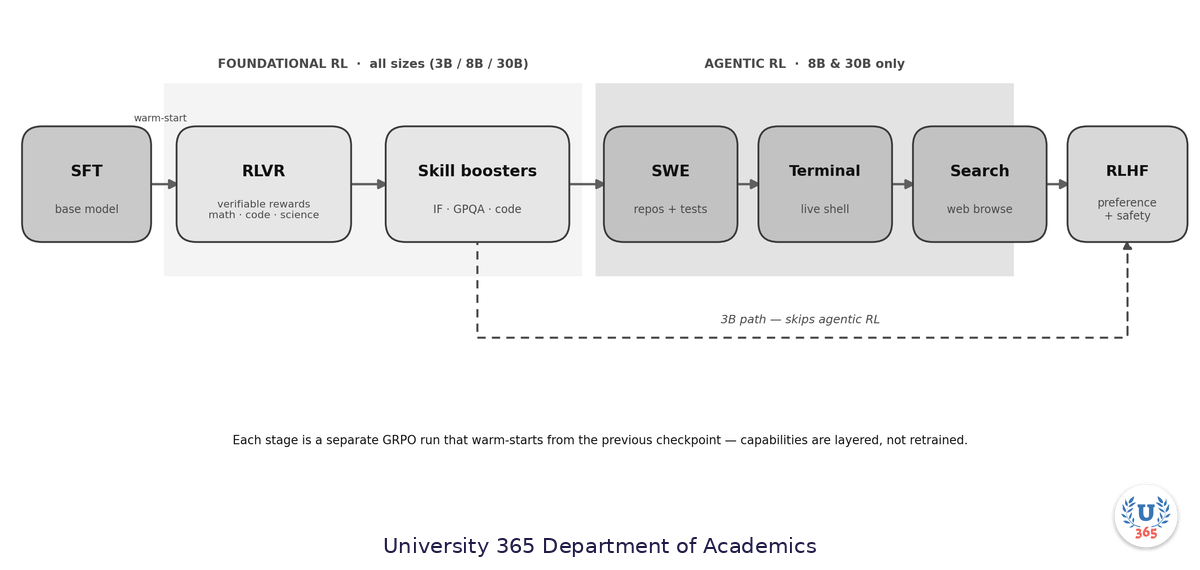
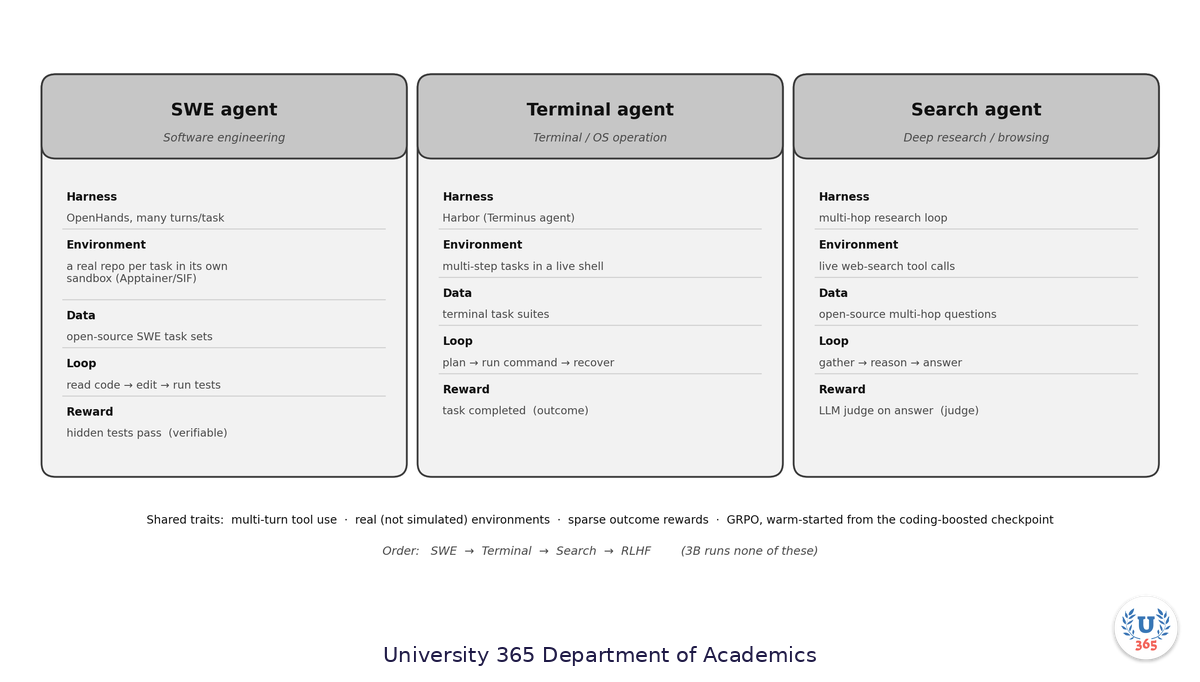
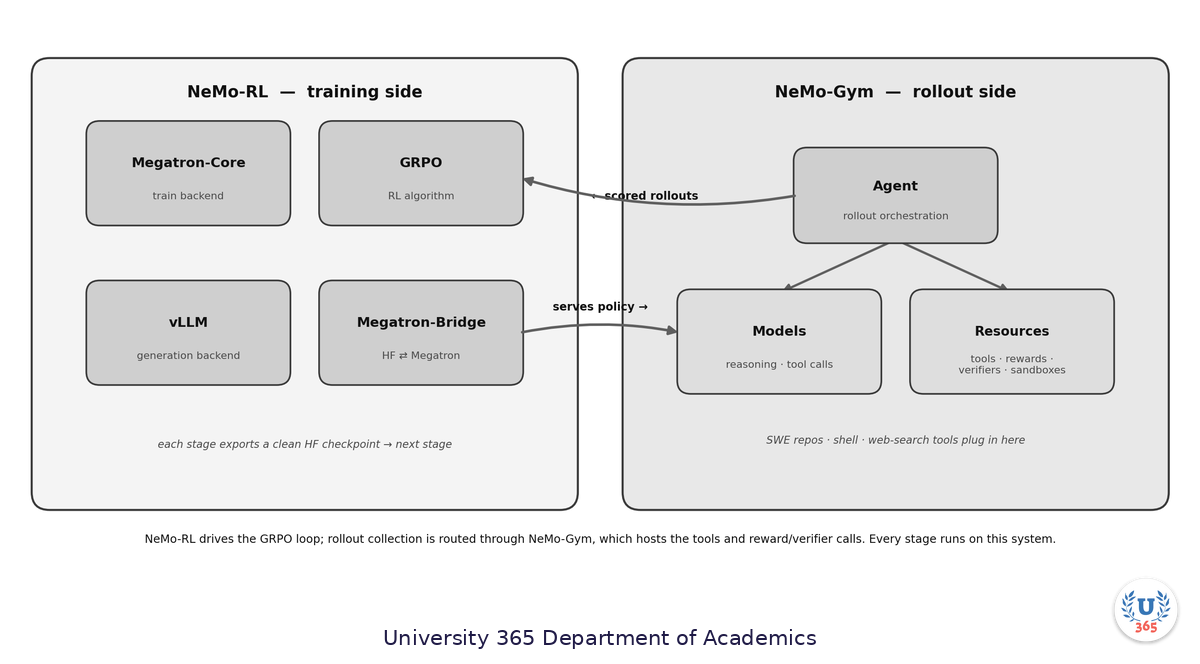
Granite 4.2 8B is not the 3B either, and the difference is structural rather than a matter of scale. IBM's technical blog states that the 8B and 30B models go through an agentic reinforcement-learning block that teaches them to call tools, edit and run code, drive a terminal and search inside real sandboxed environments, while the 3B does not. The 3B therefore has native tool calling and no agentic training behind it. That is why the benchmark table shows NA in the 3B column for SWE-Bench Verified, SWE-Bench Pro and Terminal-Bench 2.1, and it is why this review does not generalise its tool findings to the smaller model.
This is a new review, not a re-score. U365's Tools CMS carries 137 records and the published Tools category carries 138 posts, both read on 2026-11-19 by offset paging and deduplicated by id. Neither surface carries a record or a post for Granite 4.2, for Granite in any size, or for IBM as a tool vendor. A bogus-id control on each surface returned zero. IBM Granite has no U365 record at all, so nothing here inherits a score, a band or a benchmark from an earlier review.
The licence is the strongest single fact in the review. Apache 2.0 on the weights means a company can download the checkpoint, fine-tune it, serve it commercially, and ship it inside a product without a written request, a revenue threshold or a monthly-active-user clause. In a 2026 market where several strong open-weight releases arrive under community licences with conditions, that is not a detail: it is the reason a small model can be adopted by a procurement team that has no legal budget for a negotiation.
The independent measurement exists, and it is modest. The common failure in a small-model review is an absence of evidence, and this release does not have that problem. Artificial Analysis publishes an Intelligence Index figure of 5 for Granite 4.2 8B, rank 12 of 15 among open-weight models of 4 to 40 billion parameters, against a class median of 10. The same page records 38.99 seconds to the first answer token, 88 output tokens per second, 9.8 minutes per Intelligence Index task, $0.06 input and $0.25 output per million tokens, a 75 percent cache discount, and a cost of $0.0405 per evaluated task. The evaluation is a published composite with a named version, v5.0.1, built from nine named evaluations. That is a measured position rather than a claim, and the position is below the middle of its class.
Two dates matter and they are not the same. IBM published the models and the technical blog on 2026-08-25. The Hugging Face repository was created on 2026-08-07 and last modified on 2026-10-20. This review uses 2026-08-25 as the release date and records the repository dates beside it.

Granite 4.2 8B
Tool Snapshot
Granite 4.2 8B, IBM's 8 billion parameter dense reasoning model: a 131,072-token configuration ceiling, a thinking block with three modes, native tool calling, Apache 2.0 on the weights, a published independent index of 5 against a class median of 10, and a token price of $0.06 input and $0.25 output per million.
Category: Applied AI / open-weight mid-size reasoning language model. It is built for reasoning, code generation, tool calling, agentic workflows and multilingual dialogue, and IBM positions it for enterprise and research use.
Primary use cases:
A local reasoning model on hardware you already own. The 8B is the smallest Granite 4.2 size that received the agentic reinforcement-learning stage, and community builds run it on an 8 GB graphics card at Q4 or on a 16 GB Apple machine. It is the size that fits a workstation rather than a server rack.
A tool-calling backend behind an OpenAI-compatible endpoint. vLLM and SGLang both serve it, the model emits tool calls in the OpenAI function-calling format through the chat template, and the repository ships a reasoning-parser plugin so the thinking trace arrives separately from the answer.
Structured extraction and schema-bound output. The card and the reseller listing describe JSON output through a response schema, and the thinking switch lets a caller spend no reasoning tokens on a task that only needs a shape.
Long-document work inside a 131K window. The published sequence length is 131,072, which is about 197 A4 pages at 12-point Arial by the evaluator's own conversion. IBM states a long-context extension to 512K for the family, and the shipped checkpoint does not enable it.
A study object for post-training and reinforcement learning. The technical blog describes the full pipeline: a 15-trillion-token pre-training of the 4.1 base, a 7.2-million-sample supervised stage with 31.6 percent agentic data, multi-environment GRPO reinforcement learning, and an RLHF pass, run on a GB200 NVL72 cluster on CoreWeave.
What it is not. It is not a frontier model on any independent measure: the published index places it 12th of 15 in its own open-weight size class. It is not multimodal: text in, text out, with no image, audio or video path. It is not a 512K-token model in practice: the config carries 131,072 positions, rope_scaling is null, and every serving recipe in the repository uses 131,072. It is not a mixture of experts: it is dense, with all 8 billion parameters active on every token. It is not the 30B, and it does not inherit the 30B's benchmark row. And it is not sold at a published IBM per-token rate on the vendor's own price page on 2026-11-19, though an independent evaluator records one.
Pricing and deployment, as published on 2026-11-19:
Deployment shape | What it costs | Notes |
Self-host, vLLM or SGLang | The hardware, its power and the engineer who serves it. No per-token fee and no licence fee | Apache 2.0. 8 GB of VRAM at Q4 in community builds, more with a long context |
IBM watsonx.ai, deploy on demand | GPU-hour rates on the public price page: NVIDIA L40S from $4.43 per hour, A100 from $5.80, H100 from $14.50, H200 from $16 | The watsonx.ai page carries granite-4.1 rows and no granite-4.2 row on 2026-11-19, so a per-token rate for this model cannot be read from it |
IBM API, as recorded by Artificial Analysis | $0.06 per million input tokens and $0.25 per million output tokens, with a 75 percent cache discount, which gives $0.0475 per million on a 7:2:1 blended ratio | Attributed to IBM's API by the evaluator; not visible on the vendor price page on the day |
Third-party API providers | CoreWeave and DeepInfra are the two providers the evaluator tracks | The evaluator's price and latency figures are recorded against IBM's API rather than against these two |
Reseller platform | One reseller lists $0.10 per million input tokens and $0.15 per million output tokens | A reseller rate, not a vendor rate, and different from the evaluator's figure |
Free tier | The watsonx.ai free plan carries up to 300,000 foundation-model tokens per month | A trial allowance, not a production tier |
There is no per-seat product and no consumer chat app. The model reaches a reader as a checkpoint, an API row or a hosted listing. Everything a person sees, from the prompt template to the tool loop, is supplied by the scaffold around it.
Official links:
Model card: https://huggingface.co/ibm-granite/granite-4.2-8b
Technical blog, "Granite 4.2 LLMs: How They're Built", 2026-08-25: https://huggingface.co/blog/ibm-granite/granite-4-2
GitHub repository: https://github.com/ibm-granite/granite-4.2-language-models
Model collection: https://huggingface.co/collections/ibm-granite/granite-42-language-models
Configuration file: https://huggingface.co/ibm-granite/granite-4.2-8b/blob/main/config.json
IBM Granite product page: https://www.ibm.com/granite
IBM Granite documentation: https://www.ibm.com/granite/docs/
IBM watsonx.ai pricing: https://www.ibm.com/products/watsonx-ai/pricing
SGLang cookbook recipe for Granite 4.2: https://docs.sglang.io/cookbook/autoregressive/IBM/Granite-4.2
Granite Guardian 4.1 8B, the companion safety model the card recommends: https://huggingface.co/ibm-granite/granite-guardian-4.1-8b
Artificial Analysis model page: https://artificialanalysis.ai/models/granite-4-2-8b
Model-specific fields:
Vendor identifier: ibm-granite/granite-4.2-8b on Hugging Face; granite-4.2-8b is the served model name in the vendor's own vLLM command. No separate hosted API id is published on the vendor price page.
Release date: 2026-08-25 for the models and the technical blog. The Hugging Face repository was created 2026-08-07 and last modified 2026-10-20.
Licence: Apache 2.0. No acceptable-use addendum, no revenue threshold and no written-authorisation route.
Parameters: 8 billion, dense, all active per token. The checkpoint is bfloat16.
Architecture: GraniteForCausalLM, a decoder-only dense transformer with 40 layers, a 4,096 hidden size, 32 attention heads, 8 key-value heads (grouped-query attention), a 12,800 MLP hidden size with SwiGLU, RMSNorm at epsilon 1e-5, untied input and output embeddings, a 100,352-token vocabulary, and RoPE with theta 10,000,000.
Context window: max_position_embeddings 131,072 in the shipped config, with rope_scaling null. The model card states "Natively Supports 128K (Long-context extension to 512K)". Every serving recipe in the repository sets 131,072.
Maximum output: 8,192 new tokens in thinking mode and 2,048 in non-thinking mode, as the card's generation table states. The model has no separate output ceiling beyond the shared sequence window.
Modalities: text input, text output. No image, audio or video input, and no generation of any of the three.
Reasoning: a built-in chain of thought inside thinking and </think>, with three modes: thinking (default), non-thinking, and low-effort. In multi-turn use the template strips thinking from earlier assistant turns by default through truncate_history_thinking=True.
Tool calling: native, in the OpenAI function-calling format, rendered from JSON Schema by the chat template. vLLM needs qwen3_coder as the tool parser and the repository's granite_thinking_parser as the reasoning parser; SGLang 0.5.18 or later resolves both from auto.
Structured output: the card and the reseller listing describe JSON through a response schema, and one reseller states that tool_choice and response_format with a JSON schema are accepted on its platform.
Serving: vLLM 0.20 or later, SGLang 0.5.18 or later, Transformers 4.57.1 or later, Docker Model Runner, and community GGUF, FP8, NVFP4 and MXFP4 builds.
Recommended sampling: temperature 1.0 and top_p 0.95 across all tasks, modes and backends, with do_sample true. The shipped generation config carries the same values.
Tested languages: English, German, Spanish, French, Japanese, Portuguese, Arabic, Czech, Italian, Korean, Dutch and Chinese, with the card noting that other languages may work without being fully tested.
Safety companion: Granite Guardian 4.1 8B, which the card recommends for flagging risk across the IBM AI Risk Atlas dimensions. It is a separate model and a separate download.
Knowledge cutoff: not stated on the card, the blog or the repository, and not inferred here.
At a Glance Dashboard
Field | Value |
Category | Applied AI / open-weight mid-size reasoning language model |
CI-First Benefit Score | 5.3 / 10 (CI-First Positive) |
Sub-scores | Time 6 / Quantity 5 / Quality 4 / Skill 6 |
Primary AI Profile | Co-Worker and Assistant (level 2) |
Humics Badge | Humics-Neutral (-1 / +3) |
AI Imposture Risk | Medium overall (Time Medium, Quantity Medium, Skill Illusion Medium) |
Price | IBM API $0.06 input and $0.25 output per million tokens as recorded by the independent evaluator, with a 75 percent cache discount; no granite-4.2 row on the IBM price page on 2026-11-19; deploy on demand from $4.43 per GPU-hour; one reseller at $0.10 and $0.15 |
Independent index | 5 on Artificial Analysis Intelligence Index v5.0.1, rank 12 of 15 in the open-weight 4B to 40B class, class median 10 |
Independent speed | 88 output tokens per second and 38.99 seconds to the first answer token; 9.8 minutes per Intelligence Index task against a class median of 14.5 |
Context window | 131,072 positions in the shipped config; the card states an extension to 512K that the checkpoint does not enable |
Status | Active |
Primary institute | UIT (Technology, AI, Data Science) |

Granite 4.2 8B
The Problem
A reader who wants a reasoning model that runs on their own hardware has four requirements that rarely arrive together. The model has to be small enough to fit on a card a person can buy. It has to think before it answers, because the tasks that justify a local model are the ones where a wrong first token costs an afternoon. It has to call tools, because a model that cannot read a file or run a test is a chat window rather than a worker. And the licence has to permit the work the reader actually does, which for most professionals means commercial work.
Each requirement has a common answer on its own. A 7 to 9 billion parameter model fits a 24 GB card and often an 8 GB card at Q4. Thinking modes have become standard across the 2026 open-weight releases. Native tool calling is now a card feature rather than a differentiator. The licence is where the field narrows: several strong releases in this size class arrive under community licences with revenue thresholds, monthly-active-user clauses or written-authorisation routes, and a reader who plans a product discovers the constraint after the engineering is finished.
The second problem is evidence. A small model invites two opposite errors. The first is to trust the vendor's benchmark table, which is usually a set of reasoning and agentic rows chosen by the vendor and run on the vendor's own test setup. The second is to dismiss the model because it is small, when the relevant question is what it does per dollar on the reader's own task. Neither error is corrected by a launch post. It is corrected by an independent composite and by a third-party test that reports where the model failed.
The third problem is the one this review exists to answer precisely: a reader cannot tell from a model card what a 131K context costs in memory, what a thinking block costs in latency, or what a below-median index score means for the work they have in mind. The card says 8 billion parameters and the download is about 5 GB at Q4. The loaded footprint at full context is several times that, and the difference is the purchase.

Granite 4.2 8B
The Outcome
Granite 4.2 8B answers the first three requirements and answers the fourth with a measured position rather than a promise. It is an 8 billion parameter dense reasoning model under Apache 2.0, with a 131,072-token configuration ceiling, three thinking modes, native tool calling and a documented serving path in two engines. It runs on an 8 GB card at Q4 in community builds and on a 24 GB card at higher precision with a shorter context. Its independent index score is 5 against a class median of 10, which places it in the lower half of its size class, and its cost per evaluated task is $0.0405, which places it second of eight on the evaluator's cost ranking.
The outcome for a reader is therefore specific. If the work is routine reasoning, schema-bound extraction, short tool loops or a private assistant on a workstation, the model does the job at a low price and with no licence question. If the work is hard agentic coding, long-context analysis at the edge of the window, or anything where the model's answer will be trusted without a check, this is not the model that carries it. The vendor's own table says as much in the rows it publishes: SWE-Bench Verified at 47.67 and Terminal-Bench 2.1 at 20.56 are respectable for 8 billion parameters and well below what a frontier coding agent produces.
The outcome for a team is the licence plus the memory arithmetic. Apache 2.0 removes the procurement conversation that several competing releases require, and the KV-cache cost removes the assumption that a 5 GB download runs in 5 GB of memory. A team that reads both before it buys a card gets a usable small model at a predictable price. A team that reads neither gets a model that either does not fit or cannot be shipped.

Granite 4.2 8B
Who Should Use Granite 4.2 8B
Learner type | Difficulty | Typical ROI | Career path |
Students (Bachelor, Master) | Intermediate | A strong study object at a price a student can pay. The model runs on a laptop-class GPU at Q4, the config is readable, the technical blog describes the full post-training pipeline, and three serving recipes are published. A student can serve it, break it, quantize it and measure it. The case against is capability: the independent index places it below the class median, so it is a model to learn on rather than a model to build a portfolio project's hardest feature on. | |
Professionals (career upskilling) | Intermediate | A real case for an engineer who needs a private reasoning model on owned hardware, a cheap extraction endpoint, or a tool-calling backend that can be audited. The Apache 2.0 licence means the work can ship. The measured limits are the reason to keep it on bounded tasks: a below-median index score, 38.99 seconds to the first answer token on the hosted route, and a KV cache that costs more than the weights at long context. | |
Everyone (lifelong learners) | Beginner to Intermediate | A good first local reasoning model, because the download is small, the licence is permissive and the failure modes are visible. A reader who wants a general assistant should still use a hosted product: there is no chat app, no account and no onboarding here. The gain is for people who want to understand what a thinking model is by running one. | LIPS Collect and Review phases for the record of what was asked and what was accepted, and the UP-Context-Engineering Method order for the prompt that bounds the model. No assessment home is asserted. |
For teams and organisations. The licence is permissive and the memory bill is not the download, and a team deciding on it starts with four questions.
Team deployment. The unit of deployment is a served endpoint or a GPU, not a seat. vLLM 0.20 or later with the repository's granite_thinking_parser plugin and qwen3_coder for tool calls, or SGLang 0.5.18 or later with auto for both, gives an OpenAI-compatible endpoint that an existing application can call. The 8B fits a single 24 GB card at bf16 with a moderate context, and a single 8 GB card at Q4 in community builds, so a team can start on hardware it already owns.
Cost at team scale. The line that moves is either GPU-hours or tokens. On IBM's public price page the deploy-on-demand rate is per GPU-hour, from $4.43 for an L40S to $16 for an H200, and no granite-4.2 per-token row is published on 2026-11-19. The independent evaluator records $0.06 input and $0.25 output per million tokens on IBM's API, with a 75 percent cache discount, and one reseller lists $0.10 and $0.15. A team with steady volume should price the GPU-hour route against the token route before committing, because the two are not the same product.
Data and compliance. Self-hosting keeps prompts, documents and outputs inside the estate, and Apache 2.0 adds no field-of-use restriction on top. The model card recommends Granite Guardian 4.1 8B as a safety filter, which is a second model to serve and a second operational surface. The card also states that the content inside the thinking tags is internal reasoning and may contain unpolished intermediate thoughts, which matters for any deployment that logs traces.
U365 for companies. Professional learners reach University 365's academic services individually or through their organisation, and the company route runs through a customized training agreement for employee groups. Corporate education programmes are built on demand, and their tuition follows content and duration.
Skill level required: Intermediate. Downloading a checkpoint is easy and the licence is not a negotiation. Serving it correctly is the work: applying the chat template, enabling the reasoning and tool parsers, sizing the KV cache against the context the task needs, and reading a benchmark table whose size columns invite exactly the confusion this review spends a section on.
Prerequisites. A GPU with enough memory for the precision and context you plan, or an API route. A runtime from the documented list: vLLM 0.20 or later, SGLang 0.5.18 or later, or Transformers 4.57.1 or later. The chat template applied through the tokenizer, because the thinking markers, the tool catalogue and the low-effort switch are rendered by the template. A tool schema and a confirmation rule if the model will take actions. And a decision about whether thinking traces are logged, because the default template strips them from history but not from your logs.
Typical time to first result: Under an hour on a card that fits the checkpoint at Q4, most of it the download and the serving command. Ten minutes on an API route, if the reader has one. The first result is a one-paragraph answer with a visible thinking trace, which is the right first test: it shows whether the model is thinking about the task or about the format.
Typical time to competence: Fifteen to twenty-five hours of active use. Four habits carry most of the value: choosing the thinking mode per task rather than leaving the default, sizing the context to the KV cache the card can hold, using the template and the parsers rather than hand-building prompts, and scoring the output against a held-out sample rather than reading it for plausibility.
Who should wait. Anyone whose task needs a top-quartile model in this size class, because the independent index places this one in the lower half. Anyone who needs a 512K-token window in practice, because the shipped checkpoint is 131,072. Anyone who needs image, audio or video input. Anyone who plans to run a long agent loop on a consumer card without measuring the cache first. And anyone who needs a vendor-published per-token rate on the vendor's own page before they can approve a budget.

Granite 4.2 8B
U365 Institutes Alignment
The alignment below rates what a U365 institute could take from this model as a working instrument and as an object of study. The primary home is UIT (Technology, AI, Data Science), because the release is an engineering artefact before it is anything else: a dense 8 billion parameter checkpoint, a readable config, three thinking modes, a tool protocol with two parser paths, and a permissive licence that lets a student ship what they build. The other readings are real and each is bounded.
UIT (Technology, AI, Data Science)
Rating. High (primary)
Why. Five engineering competencies, each of which survives the removal of the tool. Local inference and memory planning: an 8 billion parameter bf16 checkpoint, a 131,072-position config, and a KV-cache bill that turns a 5 GB download into a 27 GB load at default precision is a concrete lesson in what context costs. Quantization: community GGUF builds run the model at Q4 on an 8 GB card, and the repository states that quantized variants exist for each size, which makes the precision trade measurable. Reasoning control: three modes, a template switch and a separate reasoning parser are a worked example of how a thinking budget is actually implemented. Tool calling: JSON Schema definitions rendered by the template into OpenAI-format calls, with qwen3_coder on vLLM and an auto resolution on SGLang, is the interface lesson an agent engineer needs. Evaluation literacy: a vendor table with strong reasoning rows beside an independent composite of 5 against a class median of 10 is exactly the disagreement a graduate should learn to read.
The limit that holds the row. The training data and the training code are not released, so a student can study the pipeline description and cannot reproduce it. The 3B sibling skips the agentic stage, so the family is not a uniform teaching object. No published programme assesses local-model serving or KV-cache planning as a named component. Adjacent anchors, not assessment homes.
UIB (Business Management, Entrepreneurship)
Rating. Medium
Why. Three decisions the release forces that are commercial before they are technical. The first is build against buy: a single 24 GB card at bf16 or an 8 GB card at Q4, against $0.06 and $0.25 per million tokens on the hosted route and $4.43 to $16 per GPU-hour on deploy-on-demand. The second is licence risk, and here the news is good: Apache 2.0 removes the revenue threshold, the monthly-active-user clause and the written-authorisation route that several competitors carry, so the legal review is short and the product can ship. The third is the cost per finished task, which the independent evaluator prices at $0.0405 per evaluated task against a class median that is several times higher. A business case can be built from those three numbers without a vendor meeting.
The limit that holds the row. The model supplies no management method and does not measure its own return. It publishes no acceptance rate, no cost per finished task on a real workflow, and no utilisation figure, so the business case still has to be assembled from the buyer's own records. No published programme assesses the economics of local inference as a named component. Adjacent anchors, not assessment homes.
UIC (Digital Communication, Marketing)
Rating. Medium
Why. Two competencies, one of them direct. The direct one is structured extraction and drafting at a price that allows volume: a 131K window holds a long brief, a set of source documents or a year of campaign copy, and JSON output through a response schema turns a messy source into a table without a parsing layer. The second is the communication lesson in the release itself: IBM publishes a benchmark table in which the 8B is respectable on reasoning rows and below the class median on an independent composite, and a practitioner who can present both without flattening the difference is doing the job the profession claims. There is no image generation, no campaign surface and no publishing tool here.
The limit that holds the row. The model writes in a flat register by default, one third-party test describes the voice as clinical, and it produces no assets. It teaches no audience analysis and no publication standard. Rated as an extraction and drafting instrument plus a case study in reading a benchmark. No credential is mapped.
UID (Digital Design, UX/UI)
Rating. Low
Why. The model is text-only, so the design contact is indirect. A designer can use it through a scaffold to read a specification, generate a component inventory, audit microcopy against a style guide, or turn a research transcript into a set of requirements, and the 131K window holds a long design document. That is a real use and it is bounded by the absence of perception: no screen reading, no image input and no visual generation.
The limit that holds the row. It makes no visual judgement and produces no image, layout or motion. It cannot review a rendered interface, and it cannot see a chart it is asked to describe. Rated as text support for design work. No credential is mapped.
U365 methods, not an institute (UNOP, ULM, LIPS, CARE and the UP-Context-Engineering Method)
Rating. Applicable
Why. The methods layer matters in the way a local model always does: the model holds no record, so the human has to hold it. LIPS and CARE describe the discipline directly, because the brief, the files in scope, the tool calls the model made and the outcome a person accepted belong in the Fellow's own system rather than in a runtime log. The UP-Context-Engineering Method's eight layers, from USER-PERSONA and FULL-CONTEXT through AI-EXACT-TASK to EXPECTED-FORMAT-AND-CONSTRAINTS, are what turn "summarize this" into a task whose output can be checked, and the constraint layer is where the schema and the confirmation rule belong. ULM is relevant to the purchase rather than to the run: a GPU and its power are a recurring cost in the Finance domain, and the decision to own one belongs in the six-domain plan. UNOP has no direct fit, because the model is not built to teach and its gains come from execution.
The limit that holds the row. The model carries no method of its own, no memory between calls and no coaching surface. A Fellow who does not keep the prompt, the trace and the accepted outcome in their own system has no account of the work, and nothing in the product writes that account for them.

Granite 4.2 8B
How Granite 4.2 8B Works
A dense 8 billion parameter decoder-only transformer with a 131,072-token sequence length, a built-in thinking block with three modes, native tool calling in the OpenAI format, bfloat16 weights, and a KV cache that costs more than the checkpoint at long context.
Inputs: Text. A request is the instruction, the conversation so far, the tool catalogue in JSON Schema form, and the context the caller resends, all rendered by the chat template with the mode flag the caller chooses. There is no image, audio or video input. In an agent, the input is also the state the scaffold hands over: the files in scope, the commands the model may run, and the schema the answer must satisfy.
Outputs: Text, including a thinking block and a user-facing answer, and tool calls in the OpenAI function-calling format. The model does not generate images, audio or video. The card's generation table sets 8,192 new tokens in thinking mode and 2,048 in non-thinking mode, and the sequence window is shared between input and output.
Architecture, as published in the configuration file:
Property | Value |
Architecture | GraniteForCausalLM, decoder-only dense transformer |
Total parameters | 8 billion, all active per token |
Base model | Granite-4.1-8B-Base, pre-trained on roughly 15 trillion tokens |
Layers | 40 |
Hidden size | 4,096 |
Attention | Grouped-query attention, 32 attention heads, 8 key-value heads, head size 128 |
MLP | 12,800 hidden size, SwiGLU activation |
Normalization | RMSNorm, epsilon 1e-5 |
Embeddings | Input and output embeddings untied, 100,352-token vocabulary |
Position encoding | RoPE with theta 10,000,000; rope_scaling null |
Sequence length | 131,072 in max_position_embeddings |
Precision | bfloat16 |
Licence | Apache 2.0 |
Modalities | Text input, text output |
The architecture is ordinary on purpose. Granite 4.2 is a dense transformer with grouped-query attention and RoPE, and IBM says so in the blog rather than dressing it as a novel design. Every block in the published configuration is a standard attention layer, and the blog's own framing is that the model is a reasoning model built on a 4.1 base rather than a new architecture. The practical consequence is that the memory arithmetic is easy to do, and the review does it below.
Thinking is a template switch with three settings, not an effort dial with numbers.
Mode | Template parameters | Behaviour |
Thinking (default) | enable_thinking=True | Full chain of thought inside thinking and </think> before the answer |
Non-thinking | enable_thinking=False | Direct answer with no reasoning tokens |
Low-effort | enable_thinking=True, low_effort=True | A short reasoning budget for simple questions, rendered as {reasoning effort: low} |
There is no published ladder of numeric effort levels, no per-level latency table and no price difference between the modes. The thinking trace can be parsed separately: the repository ships a granite_thinking_parser plugin for vLLM, and SGLang's auto resolves to its built-in nemotron_3 parser, so a client receives the reasoning in one field and the answer in another. In multi-turn use the template strips thinking from earlier assistant turns by default, through truncate_history_thinking=True, which keeps the window for the current question.
Tool calling is native and the format is OpenAI's. The chat template renders JSON Schema tool definitions into the prompt, the model answers with a <tool_call> block that names the function and its parameters, and the serving engine parses it back into the OpenAI tool-call object. The vLLM recipe uses qwen3_coder as the tool parser and the repository's reasoning plugin, with --enable-auto-tool-choice; the SGLang recipe resolves --tool-call-parser auto to qwen3_coder and --reasoning-parser auto to nemotron_3. A hand-built prompt that skips the template is the documented failure mode, because the role markers, the tool catalogue and the mode flag are what the template exists to produce.
The serving recipes, as the repository publishes them:
vllm serve ibm-granite/granite-4.2-8b \
  --served-model-name granite-4.2-8b \
  --dtype bfloat16 \
  --max-model-len 131072 \
  --reasoning-parser granite_thinking_parser \
  --reasoning-parser-plugin ./granite_thinking_parser.py \
  --tool-call-parser qwen3_coder \
  --enable-auto-tool-choice
python3 -m sglang.launch_server \
--model-path ibm-granite/granite-4.2-8b \
--dtype bfloat16 \
--context-length 131072 \
--reasoning-parser auto \
--tool-call-parser autoBoth recipes set the context to 131,072, and neither enables a longer window. That is the first place a reader meets the difference between the card's 512K statement and the shipped configuration.
The memory arithmetic is the purchase, and it is simple enough to do on paper. The 8 billion bfloat16 weights are about 15 GiB. The KV cache is set by the layer count, the key-value head count and the head size: 2 tensors for keys and values, 40 layers, 8 key-value heads and 128 dimensions per head give 81,920 elements per token, which is 160 KiB per token at two bytes per element. At the full 131,072-token window that is 20 GiB of cache. So a full-context bf16 deployment is about 35 GiB before any overhead, which is why a 24 GiB card runs this model comfortably at a moderate context and not at the full window. At Q4 the weights drop to about 5 GiB and the cache does not, which is exactly the reported behaviour of a 5.2 GB download loading into 27 GB. The figures below use GiB, the binary unit a runtime reports, and the download sizes elsewhere in this review use GB, the decimal unit a file listing shows.
Configuration | Weights | KV cache at full 131K | Total before overhead |
bfloat16, full context | About 15 GiB | About 20 GiB | About 35 GiB |
bfloat16, 16K context | About 15 GiB | About 2.5 GiB | About 17.5 GiB |
Q4 weights, full context | About 5 GiB | About 20 GiB | About 25 GiB |
Q4 weights, 16K context | About 5 GiB | About 2.5 GiB | About 7.5 GiB |
bfloat16 with an 8-bit KV cache, full context | About 15 GiB | About 10 GiB | About 25 GiB |
The 512K extension is a base-model property and not a shipped setting. IBM's blog states that the fifth pre-training phase of the 4.1 base models extended the context window to 512K tokens, and the 4.2 card repeats "Long-context extension to 512K". The 4.2 checkpoint's own config.json carries max_position_embeddings 131,072 with rope_scaling null, and every serving recipe uses 131,072. A reader can therefore say the base model saw long-context training up to 512K, and cannot say the released checkpoint serves 512K as configured. No published recipe shows the scaling factor or the setting that would extend it, and this review does not invent one.
What it does not do. It does not read images or screens. It does not search the web by itself: a search tool belongs to the scaffold. It does not hold state between calls, and any memory is the scaffold's. It does not report its own confidence, so a validator has to come from the caller. It does not publish its training data or training code, so the pipeline is described and not reproducible. It does not enforce its own safety: the card recommends Granite Guardian as a separate model, which means the filter is a deployment decision rather than a property of the checkpoint. And it does not serve 512K tokens in the shipped configuration, whatever the base model was trained on.

Granite 4.2 8B
Getting Started with Granite 4.2 8B
A fifteen-minute path from nothing to a first graded answer, on a machine you control or an endpoint you already have.
Read the card's summary table before you download. Five rows decide the rest: 8 billion parameters, dense, a 131,072 sequence length, bfloat16, and Apache 2.0. If any of those is wrong for the task, stop here.
Pick the precision from your card, not from the parameter count. About 16 GB of weights at bfloat16, about 5 GB at Q4. Add the cache arithmetic from the previous section for the context you intend to use. A 16 GB card runs Q4 at a moderate context; a 24 GB card runs bfloat16 at a moderate context.
Serve it with a documented recipe. For vLLM 0.20 or later, use the command in the previous section with the repository's reasoning-parser plugin and qwen3_coder for tool calls. For SGLang 0.5.18 or later, use auto for both parsers. A Transformers single-process run works for a test and is not a serving path.
Render every prompt through the chat template. Apply it with the tokenizer, pass enable_thinking explicitly, and never assemble the role markers by hand. The mode flag and the tool catalogue live in the template.
Send three test requests, not one. A factual question in thinking mode, the same question in non-thinking mode, and a tool-call request with one schema. Compare the three: the first shows the reasoning, the second shows the latency difference, the third shows whether the parser is wired correctly.
Parse the trace separately from the answer. Confirm that the engine returns reasoning_content and content as separate fields. A client that concatenates them will display the model's internal reasoning as if it were the answer.
Measure the two numbers that matter on your hardware. Output tokens per second and seconds to the first answer token, on your card, at your context length. Published figures range from 11 to 33 tokens per second on consumer hardware against 88 on the evaluator's hosted route, and the difference is the hardware and the quantization rather than the model.
Score 20 real tasks before you trust it. Take 20 tasks from the work you have in mind, score each output against a person's read or a label, and record the acceptance rate, the time per accepted task and the cost. That number is the only one that compares with any other model for your work.
Decide the logging policy before the first production request. The template strips thinking from history and not from your logs. If traces will be retained, say where and for how long, because the card warns that they may contain unpolished intermediate thoughts.
If the workload needs a safety filter, serve Guardian beside the model. Granite Guardian 4.1 8B is the companion the card names, and it is a second process with its own memory bill. Budget it at the start rather than discovering it at review.

Granite 4.2 8B
Real Workflows
Three workflows, each with a prompt pack in the UP-Context-Engineering Method's eight layers and a verification checklist in the framework's four tiers. The first is the workload a small local reasoning model is best at, the second is the workload a team deploys, and the third is the measurement that keeps the first two honest.
Workflow 1: Run a private reasoning pass over documents that cannot leave the estate
When to use it: the source documents are confidential, the question needs reasoning across several of them rather than a keyword search, and a person will read the answer before it is used. The 131,072-token window holds a long brief and its annexes in one request, and a local deployment keeps the material inside the boundary.
This sample prompt uses the UP-Context-Engineering Method and the CI-First doctrine. Read the method at https://www.university-365.com/post/the-up-method-university-365-prompting-the-new-gold-standard-for-prompt-engineering, the doctrine at https://www.university-365.com/post/discover-the-ci-first-approach, learn both in a U365 online program at https://www.university-365.com/programs, and request a U.Coach for orientation at https://www.university-365.com/ucoach.
USER-PERSONA: My UP-Context-Engineering USER-PERSONA file is the file for this layer, attached. It is my psychographic file concatenated with the six ULM life-domain files. The parts that matter here: I sign the answer, and I will not sign one I cannot trace to a page. If the file is not attached, ask for it before you start.
FULL-CONTEXT: The FULL-CONTEXT set for this task, added and not merged: the documents in scope with their page or clause markers, the question, the decisions already taken, and the vocabulary the organisation uses. The documents are the only source. If a document is missing or a page is unreadable, name it and stop.
AI-PROFILE-ROLE-EXPERTISE: Act as a Co-Researcher, Analyst & Tester, in the role of a document analyst, with expertise in reading a long pack, separating what the document says from what it implies, and citing the page for every claim.
USER-FINAL-GOAL: One answer to the question, each claim tied to a document and a page, the counter-evidence named, and a list of what the pack does not settle.
AI-EXACT-TASK: Read the pack, answer the question, cite the page for each claim, and list the gaps rather than filling them.
AUDIENCE: Me, and the colleague who will act on the answer. Neither of us will reopen the pack to check a claim we cannot locate.
EXPECTED-FORMAT-AND-CONSTRAINTS: Format: a short answer, then a claims table with claim, document, page and confidence, then the counter-evidence, then the gaps. Constraints: never state a claim without a page; never merge two documents into one citation; never treat a summary line as the source; if the pack contradicts itself, present both readings and say which document governs; keep the whole request inside the 131,072-token window and say if it was truncated. Data limits: the documents stay on the local endpoint; nothing is sent to a hosted provider; no customer name is repeated outside the answer.
EXAMPLES: The two accepted answers in the shared drive are the examples, attached, and the claims table is the format example.
Before you use the output, run the check yourself: open two of the cited pages at random and confirm the claim is on the page, and read the gaps list before you act on the answer. The signature is yours, per CI-First.
What the model does well here: a long window, a visible reasoning trace and a permissive licence. The 131,072-token sequence holds a substantial pack, the thinking block lets a reader see which documents the model weighed, and the Apache 2.0 licence means the deployment needs no permission. The 71.41 RULER 128K score on the vendor's table describes long-context retrieval that is respectable for the size, and the evaluator's independent long-context result of 45.0 percent describes the same competence measured by someone else.
VERIFICATION CHECKLIST for Run a private reasoning pass over documents that cannot leave the estate:
Multi-Model Check: run the same pack and question through a second model, local or hosted, and compare the claims that changed. A claim only one model makes needs a page before it is used.
External Source: open the cited page for a sample of claims. A citation you did not open is a formatting choice, not evidence.
Human Review: read the gaps list and the counter-evidence before the answer. The gaps are where an incomplete pack turns into a confident paragraph.
CI-First Test: can you defend each claim from the pack, without rerunning the model? If not, the answer is the model's, not yours.
Workflow 2: Serve a schema-bound extraction endpoint for an internal application
When to use it: the application needs structured records from messy text, the volume is high enough that a per-token price matters, the schema is fixed, and the application already speaks an OpenAI-compatible API. This is the deployment the model's price and size are built for.
This sample prompt uses the UP-Context-Engineering Method and the CI-First doctrine. Read the method at https://www.university-365.com/post/the-up-method-university-365-prompting-the-new-gold-standard-for-prompt-engineering, the doctrine at https://www.university-365.com/post/discover-the-ci-first-approach, learn both in a U365 online program at https://www.university-365.com/programs, and request a U.Coach for orientation at https://www.university-365.com/ucoach.
USER-PERSONA: My UP-Context-Engineering USER-PERSONA file is the file for this layer, attached. It is my psychographic file concatenated with the six ULM life-domain files. The parts that matter here: I operate the pipeline and I answer for every record it writes, and I will not ship a parser I cannot test. If the file is not attached, ask for it before you start.
FULL-CONTEXT: The FULL-CONTEXT set for this task, added and not merged: the JSON schema for the record, the source document types, the fields that are mandatory, the fields that may be null, the volume and latency budget, and the routing rule for a record that fails validation. The schema is the only authority for the shape. If a mandatory field or the routing rule is missing, name it and stop.
AI-PROFILE-ROLE-EXPERTISE: Act as a Co-Worker & Assistant, in the role of an extraction service, with expertise in returning a schema-valid record and in refusing rather than guessing.
USER-FINAL-GOAL: Every request returns either a record that validates against the schema or a refusal that names the missing field, and the application can parse both without a repair layer.
AI-EXACT-TASK: Read the source text, return one JSON record that matches the schema, or refuse and name the field that could not be read.
AUDIENCE: The application, and the operator who reads the rejections. The application rejects an invalid record, so a refusal is cheaper than a guess.
EXPECTED-FORMAT-AND-CONSTRAINTS: Format: one JSON object that validates against the schema, with no prose around it. Constraints: never invent a value for a mandatory field; use null only where the schema permits it; never translate a number into words; never add a field the schema does not define; if two readings are possible, return the refusal and name both; keep the request inside the context the service publishes. Data limits: the source text stays inside the service boundary; no customer record is echoed into a log; a hosted route is used only if the licence and data review permit it.
EXAMPLES: The two accepted records and one refusal are the examples, attached, and the schema is the format example.
Before you use the output, run the check yourself: validate every record against the schema, read every refusal for the field it names, and confirm that the application, not the model, decides what happens to a rejected record. The pipeline decision is yours, per CI-First.
What the model does well here: a low token price, a documented tool and schema path and a mode switch that can remove reasoning from the bill. The independent evaluator prices it at $0.06 input and $0.25 output per million tokens with a 75 percent cache discount and $0.0405 per evaluated task, and a reseller states that response_format with a JSON schema is accepted. The non-thinking mode exists for exactly this workload.
VERIFICATION CHECKLIST for Serve a schema-bound extraction endpoint for an internal application:
Multi-Model Check: run 200 documents through a second model or a second quantization and compare the fields that differ. A quantization that changes an extract is a change to the product.
External Source: validate every record against the schema in code, not by eye, and confirm the validator is the one the application uses.
Human Review: an operator reads the first day's refusals and a daily sample of accepted records. The refusals are where a silent guess would hide.
CI-First Test: can you explain why a field has the value it has, from the source text and the schema, without rerunning the model? If not, the record is the model's, not the pipeline's.
Workflow 3: Measure the model on your own hardware before you commit to it
When to use it: a decision depends on this model's throughput, memory or accuracy on your own workloads, and you want a number rather than a benchmark row. The gap between the hosted 88 tokens per second and the 11 to 33 reported on consumer hardware is the reason this workflow exists.
This sample prompt uses the UP-Context-Engineering Method and the CI-First doctrine. Read the method at https://www.university-365.com/post/the-up-method-university-365-prompting-the-new-gold-standard-for-prompt-engineering, the doctrine at https://www.university-365.com/post/discover-the-ci-first-approach, learn both in a U365 online program at https://www.university-365.com/programs, and request a U.Coach for orientation at https://www.university-365.com/ucoach.
USER-PERSONA: My UP-Context-Engineering USER-PERSONA file is the file for this layer, attached. It is my psychographic file concatenated with the six ULM life-domain files. The parts that matter here: I approve the purchase, and I will not approve one from a vendor row. If the file is not attached, ask for it before you start.
FULL-CONTEXT: The FULL-CONTEXT set for this task, added and not merged: the hardware and its memory, the quantization you will run, the context lengths you will test, the 20 to 50 tasks drawn from your own work, the scoring rule, the baseline model and its scores, and the price of the hardware and of the hosted alternative. The task set and the scoring rule are the only authority for a result. If the baseline or the scoring rule is missing, name it and stop.
AI-PROFILE-ROLE-EXPERTISE: Act as a Co-Researcher, Analyst & Tester, in the role of a benchmark designer, with expertise in holding a task set fixed across configurations and in reporting a null or negative result as loudly as a gain.
USER-FINAL-GOAL: One table that compares this model against the baseline on the same tasks, at two context lengths, with the acceptance rate, the time per accepted task, the memory used and the cost per accepted task.
AI-EXACT-TASK: Serve each configuration, run the same task set, score the outputs with the stated rule, and record the memory and the time per task for each configuration.
AUDIENCE: Me, and the person who signs the purchase. We read the table and the failure notes, not every log line.
EXPECTED-FORMAT-AND-CONSTRAINTS: Format: a table with one row per configuration, the acceptance rate, the time per accepted task, the peak memory and the cost per accepted task, then a list of the failure modes seen in the sample. Constraints: never change the task set between rows; never report a training or vendor score as a result; never compare a Q4 run with a bf16 run without saying so; if a configuration fails to load, record it rather than substituting another; hold the scoring rule fixed. Data limits: the task set stays inside the estate; no task, output or credential leaves the boundary; the hosted baseline is the one the reader pays for and is named in the table.
EXAMPLES: One completed measurement table from a previous model is the example, attached, and the scoring rule is the format example.
Before you use the output, run the check yourself: re-score ten outputs by hand, confirm the memory figure from the runtime rather than from the download size, and read the failure list before the table. The purchase decision is yours, per CI-First.
What the model does well here: it is cheap enough to measure honestly. A full task set on a local card costs electricity, a hosted run at $0.06 and $0.25 per million tokens costs cents, and the published index gives an outside number to compare your own acceptance rate against. The evaluator's cost of $0.0405 per Intelligence Index task is a fair benchmark for the arithmetic.
VERIFICATION CHECKLIST for Measure the model on your own hardware before you commit to it:
Multi-Model Check: score the same task set with the baseline model and, if possible, with the 30B sibling. A gap that appears on your tasks and not on the vendor's table is the finding.
External Source: read peak memory from the runtime and throughput from your own logs. The download size is not the memory figure and the vendor's tokens per second is not your card's.
Human Review: re-score ten outputs by hand against the rule. A scoring rule that nobody checked is a spreadsheet with opinions.
CI-First Test: can you explain, from the table, why you are buying or not buying? If the answer depends on a row you did not measure, the decision is the vendor's, not yours.

Granite 4.2 8B
Strengths, Limits, and AI Imposture Risk
Strengths
CI-First Benefit | Strength | Evidence |
Time | A cheap, fast-to-first-token-free path to a reasoning model you can run yourself, with no procurement step. | $0.06 input and $0.25 output per million tokens as recorded by the independent evaluator, a 75 percent cache discount, $0.0405 per evaluated task, and 9.8 minutes per Intelligence Index task against a class median of 14.5. Apache 2.0 removes the licence negotiation entirely. Held at 6 by 38.99 seconds to the first answer token on the hosted route, a thinking block that spends tokens before the answer, and 11 to 33 output tokens per second on consumer hardware against 88 on the hosted route. |
Quantity | A 131K window and a low marginal cost per call once the model is served. | 131,072 positions in the config, a 100,352-token vocabulary, and a token price that places it second of eight on the evaluator's cost ranking for its class. Held at 5 because 131K is modest for 2026, the window is text-only, and the KV cache makes a full-context call expensive in memory on any card a person owns. |
Quality | A credible vendor table for the size, and an independent composite that is published rather than missing. | Vendor rows include SWE-Bench Verified 47.67, AIME25 86.67, GPQA 64.14, MMLU-Pro 74.04, BFCL v4 52.39, τ³-bench 58.06 and RULER 128K 71.41. Independent evidence exists and is below the class median: Intelligence Index 5, rank 12 of 15, median 10. Third-party test suites split: 77 of 100 at rank 19 of 70 on one, 81.9 of 100 at rank 59 to 128 of 227 on another, and 26.23 of 100 on an aggregator. |
Skill | A genuinely inspectable model that runs on hardware a learner owns, under a licence that lets them build. | Apache 2.0 on the weights, a readable config with 40 layers and grouped-query attention, a technical blog that describes the full post-training pipeline including GRPO and the sandboxed agentic environments, three serving recipes, a reasoning-parser plugin, quantized variants for each size, and a companion Guardian model. Held at 6 because the model teaches nothing by itself, the training data and code are closed, and the benchmark table invites exactly the size confusion this review spends a section correcting. |
Limits
The independent index places it below the middle of its class. 5 against a class median of 10, rank 12 of 15 among open-weight models of 4 to 40 billion parameters. That is a measured position, not an absence of evidence.
The shipped context is 131,072, not 512K. The card states a long-context extension to 512K, the config carries 131,072 with rope_scaling null, and every serving recipe uses 131,072.
The KV cache costs more than the checkpoint at long context. About 20 GiB at the full window against about 16 GB of bfloat16 weights, which is why a 5.2 GB download is reported loading into 27 GB.
It is text only. No image, audio or video input, and no generation of any of the three. A screenshot-driven agent has no perception path here.
It is dense, so every token costs the full 8 billion parameters. There is no expert routing to make a long generation cheap on compute, and the throughput on consumer hardware reflects that.
The vendor price page does not carry the model. The watsonx.ai page lists granite-4.1 rows and no granite-4.2 row on 2026-11-19, so a budget approval that depends on a vendor per-token row cannot be completed from the vendor's own page.
The family is not uniform. The 3B skips the agentic reinforcement-learning stage, so tool behaviour does not transfer down the family, and the 30B's benchmark row does not transfer up.
Quantization changes behaviour. One local test reports that Q4 builds caused tool-use trouble and that Q8 was more robust, which means the model's effective capability depends on the build a reader chooses.
No state, no memory and no verifier. Persistence, tool confirmation, schema validation and logging are the scaffold's work.
No first-party chat product. There is no account, no interface and no onboarding. Everything a person sees is supplied by the tool around the model.
AI Imposture Risk
Trap | Rating | Evidence |
Time Illusion | Medium | The saving is real: Apache 2.0 with no procurement, $0.06 and $0.25 per million tokens, a 75 percent cache discount, $0.0405 per evaluated task, and a single card in a workstation rather than a cluster. The overhead is equally real: 38.99 seconds to the first answer token on the hosted route, 11 to 33 tokens per second on consumer hardware against 88 on the hosted route, a thinking block that spends tokens before the first useful word, and a KV cache that turns a small download into a 27 GB load at full context. A reader who equates a small download and a low token price with a saved afternoon has counted the wrong two numbers. |
Quantity Illusion | Medium | The product returns fluent prose, plausible records and tool calls at a volume a person cannot read line by line, and a 131K window makes every request look more complete than it is. The failure mode is volume that parses cleanly and is wrong at a rate nobody measured: one local test found the model completing a file-save tool call correctly and still returning incomplete world knowledge, and another found it choosing a contaminated option on a safety-framed question. The counterweight is specific and cheap: validate every record against a schema, score 20 tasks against a label, and read a sample. That is why the trap is Medium rather than High. |
Skill Illusion | Medium | The release is marketed as a reasoning model with a visible chain of thought and an agentic reinforcement-learning stage, and a thinking trace reads like competence whether or not the answer is right. A reader can easily conclude that the model can do their engineering work because they can watch it reason about the work. What the evidence supports is narrower: a below-median independent index, a respectable vendor table for 8 billion parameters, and third-party tests that show the tool call working and the judgement failing. Mitigations exist and they are strong (a published composite, three independent test suites, a permissive licence that makes testing cheap, and a config a reader can inspect). They lower the frequency without moving the capability to the reader, so the trap stays Medium rather than High. |
Overall Imposture Risk: Medium. All three traps are Medium. The framework's Section 5.3 arithmetic places one, two or three Medium traps in the Medium band, and none of the three is High. The v1.3 band-precedence sentence does not change the outcome, because only one rating applies to this trap set. The rating would move to High if two traps became High, for example in a deployment that merged the model's changes without a diff review while treating the thinking trace as evidence of correctness.
Framework v1.2 clause note
Clause 5.2.3-a, agent-authored procedural memory: NULL, recorded with its boundary. A clause note in this review names the version that introduced the two clauses, v1.2, and the framework of record is the CI-First Evaluation Framework v1.4.1, which retains both; the version in the heading is the clause's origin, not a stale framework. Granite 4.2 8B holds no memory store and writes nothing by itself: every request is independent unless the caller resends context, and the chat template strips earlier thinking by default rather than accumulating it. No documented mechanism ships by default by which ibm-granite/granite-4.2-8b writes skills, memory stores or standing instructions on the user's behalf, so the clause returns a null rather than applying. The live condition is specific: a scaffold that lets the model write or revise the workspace's skills, rules or procedural memory by default, or a deployment in which the model's own self-critique becomes the standing instruction without a per-write human decision, re-opens this clause at no lower than Medium, and at High where the user has no routine practice of reading what was written. That condition is the eighth re-check trigger.
Clause 4.2-a, agent-mediated conversation: NULL for the model and for its shipped surface. Neither erosion condition is met. The model returns text to the caller, no agent-authored text is presented as a person's own voice in a human-facing channel by default, and nothing in the product substitutes agent interaction for human contact. The live condition to watch on any deployment: a scaffold that lets the model draft replies, send messages or publish under a person's identity without that person reading the result first meets condition (a), and a workflow in which a person deals with the agent instead of with colleagues meets condition (b). Both are properties of a deployment built around this model rather than properties of the model.
Clause 7.5 is not assessed. It was removed from the framework in v1.4, and this review derives no mode, writes no mode line and records no mode value. The two clauses above are the only pedagogical clauses that apply under v1.4.1.

Granite 4.2 8B
Section 7c: A below-median index, a price page that skips the model, a 5 GB download that loads into 27 GB, and a 512K claim the checkpoint does not enable
A Section 7c finding is recorded where a supplier's governance, safety record or commercial terms have a real result for the reader. The items below were checked against primary sources, and they produce findings a buyer should carry. All findings are stated as facts of record, and the difference between a company statement, a published measurement and a community report is kept intact.
The independent composite exists, and it places the model in the lower half of its own class. Artificial Analysis publishes an Intelligence Index v5.0.1 figure of 5 for Granite 4.2 8B, with rank 12 of 15 among open-weight models of 4 to 40 billion parameters and a class median of 10. The same page records the same index at 6 for the Granite 4.2 30B and 5 for the Granite 4.2 3B. The composite is built from nine named evaluations, so a reader can inspect what it measures. This is the opposite of the evidence gap that afflicts several releases in this class: the number is not missing, it is unflattering. The vendor's table leads with AIME25 at 86.67 and SWE-Bench Verified at 47.67, which are strong rows for the size, and a vendor table with named tasks and a published evaluation setup is evidence of what the vendor measured. It is not an independent composite, and this review does not convert it into one, in either direction.
The price page and the price do not agree, and the reader needs both. The watsonx.ai pricing page read on 2026-11-19 carries granite-4.1-3b, granite-4.1-8b and granite-4.1-30b among its IBM foundation models, tagged as new, and carries no granite-4.2 row of any size. What the page does publish is the deploy-on-demand ladder per GPU-hour: NVIDIA L40S from $4.43, A100 from $5.80, H100 from $14.50 and H200 from $16, plus a free plan of up to 300,000 foundation-model tokens per month and a Standard plan from $1,110 per month. The independent evaluator records $0.06 input and $0.25 output per million tokens "based on IBM's API", with a 75 percent cache discount, and one reseller lists $0.10 and $0.15. The finding is a reader-facing one: a budget approval that requires a vendor per-token row cannot be completed from the vendor page on the day, and the cheapest route depends on which of the three shapes the workload fits.
The download size is not the memory bill, and the gap is the KV cache. Community reports describe the 5.2 GB Ollama download loading into about 27 GB on a 16 GB card, and the arithmetic explains it: 40 layers, 8 key-value heads and 128 dimensions per head give 81,920 elements per token, which is 160 KiB per token at two bytes per element, which is about 20 GiB at the full 131,072-token window. The replies in that thread make the same point: a plain dense transformer with a default FP16 cache takes about 20 GB for full context, and quantizing the cache or shortening the window is the remedy. The OpenWeights Bench measurement estimates 6.4 GB at Q4_K_M for its run, which is a different context setting rather than a contradiction. The finding is not a defect in the model: it is the single most common sizing error in local deployment, and it is arithmetic a reader can do before buying a card.
The 512K statement is a base-model property, not a shipped setting. The blog states that the fifth pre-training phase of the Granite 4.1 base models extended the context window to 512K tokens, and the 4.2 card's summary repeats "Natively Supports 128K (Long-context extension to 512K)". The released checkpoint's config.json carries max_position_embeddings 131,072, rope_scaling is null, and the vLLM and SGLang recipes both set 131,072. The finding is a distinction a planner needs: a base model trained with long-context phases is not a served checkpoint with a long-context configuration, and no published recipe shows the setting that would enable the extension.
The family's agentic claim is size-specific, and IBM says so in the body of the blog. The 8B and 30B models go through an agentic reinforcement-learning block in real sandboxed environments, with code editing, terminal work and web search; the 3B does not, and the benchmark table shows NA in the 3B column for the three software-engineering rows. The finding matters to a reader choosing within the family: the smallest model is the cheapest way to run Granite, and it is not the model that carries the agentic training. A comparison that treats the three sizes as one product overstates the 3B and understates the price of the 8B.
One finding cuts in the vendor's favour and should be said as plainly as the rest. The cost per evaluated task is genuinely low: $0.0405 against a class whose median per-task cost is several times higher, second of eight on the evaluator's cost ranking, with a 75 percent cache discount and a token rate below the class medians of $0.14 input and $0.32 output. The Apache 2.0 licence compounds it, because a self-hosted deployment has no per-token fee at all. A supplier that publishes a permissive licence, a readable config, three serving recipes, a named benchmark suite and a reasoning-parser plugin has done the reader a service, and this review records it.
No sub-score changed for these findings, and the reason is explicit. The Quality sub-score already carries the independent index of 5 and the vendor table. The Time sub-score already carries the token rate, the latency and the local throughput. The Quantity sub-score already carries the 131K ceiling and the KV-cache cost. The Skill sub-score already carries the Apache 2.0 licence, the readable config and the closed training pipeline. The Imposture section already carries the thinking-trace risk. The items above are an index reading, a price-page gap, a memory calculation, a configuration distinction and a family distinction. None of them is a defect in the artefact a buyer receives, and none is a resolved failure that the four dimensions do not already price. Section 7c closes with what it does not do: it does not allege misconduct, it does not treat a marketing sentence as a false claim, and it does not convert a base-model training detail into a product promise.

Granite 4.2 8B
U365 Co-Intelligence Rating
CI-First Profile
Primary profile: Co-Worker and Assistant (level 2). Secondary profiles: Co-Researcher, Analyst and Tester (level 4).
Why this profile and not Co-Creator. IBM's positioning does the reasoning. The model is sold as an engine for reasoning, code generation, tool calling and agentic workflows, and the role it plays is the one the scaffold gives it: execute a stated task, think first, return an answer or a tool call. Co-Worker and Assistant is that role. Co-Researcher, Analyst and Tester is recorded as secondary because the model's strongest published rows are analytical (AIME25, GPQA, MMLU-Pro) and because a reader who uses it to check a document or audit a table is using it as an analyst. Professor, Coach and Tutor is not recorded: the documentation teaches, and the model does not, because nothing in the release is built to move a capability from the model to the person. Challenger, Critic and Devil's Advocate is not recorded either: the model will argue if it is asked to, and no part of the release is built for the role.
CI-First Benefit Score
Dimension | Score (0-10) | Rationale |
Time | 6 | Moderate net saving. $0.06 input and $0.25 output per million tokens, $0.0405 per evaluated task, 9.8 minutes per Intelligence Index task against a class median of 14.5, and no licence negotiation. Apache 2.0 and a single-card deployment remove the two delays that dominate an adoption decision. Held at 6 by 38.99 seconds to the first answer token on the hosted route, 11 to 33 tokens per second on consumer hardware, and a thinking block that spends tokens before the first useful word. |
Quantity | 5 | A 131,072-token window, a 100,352-token vocabulary and a token price second of eight in its class. Held at 5 because 131K is modest for 2026, the window is text-only, and the KV cache makes a full-context call a memory decision rather than a token decision. |
Quality | 4 | A measured position rather than an unknown one, and the measurement is below the class median. Vendor rows are respectable for 8 billion parameters (SWE-Bench Verified 47.67, AIME25 86.67, GPQA 64.14, MMLU-Pro 74.04, BFCL v4 52.39, τ³-bench 58.06, RULER 128K 71.41). Artificial Analysis records the Intelligence Index at 5, rank 12 of 15, median 10. Two third-party test suites place it mid-pack and one aggregator places it low. |
Skill | 6 | A real learning object on hardware a learner owns, under a licence that lets them ship. Apache 2.0, a readable 40-layer config, a technical blog describing the full post-training and reinforcement-learning pipeline, three serving recipes, a reasoning-parser plugin, quantized variants and a companion Guardian model. Held at 6 because the model teaches nothing by itself, the training data and code are closed, and the benchmark table invites a size confusion a learner has to be taught to avoid. |
CI-First Benefit Score: 5.3 / 10 (CI-First Positive)
Why the score sits where it sits
5.3 with sub-scores 6 / 5 / 4 / 6 is a small-model position carrying a good time position, a moderate volume position, a below-median quality position and a strong skill position, and every part of that sentence is deliberate.
Why not higher. The quality evidence does not support a higher band. The one independent composite that measures this model places it 12th of 15 in its own class, at half the class median. The context ceiling is 131K rather than the 512K the card's phrase suggests, and the full window costs about 20 GiB of cache on top of the weights. The vendor's own price page does not carry the model, which means a reader planning a budget has to reconcile three price shapes. And the model is dense, so its throughput on consumer hardware is 11 to 33 tokens per second rather than the 88 the hosted route records.
Why not lower. Three reasons, each measured. The licence is Apache 2.0, which removes the commercial restriction that holds several stronger models in this class at a lower reading. The price per evaluated task is $0.0405, second of eight in the class, with a 75 percent cache discount. And the artefact is genuinely usable: it runs on an 8 GB card at Q4, serves through two documented engines, calls tools in a standard format, and comes with a technical blog that explains how it was built. A model that a reader can download, serve, test and ship for the price of the electricity, with an independent measurement attached, is a positive tool in the framework's terms even when the measurement is modest.
Why 5.3 and not a higher band, stated as arithmetic. Time 6, Quantity 5, Quality 4 and Skill 6 average to 21 divided by 4, which is 5.25, rounded to 5.3. That is CI-First Positive, the 4.1 to 6.0 band. It sits below U365's published reading for Muse Glimmer 30B at 5.5 and above ERNIE 5.1 at 4.5, and it is not comparable with the Granite 4.2 30B, which is a separate review with its own document. The order is not an accident of arithmetic: the framework measures benefit to the person net of overhead, and an 8B model that a person has to serve, size and verify transfers less of its benefit than a larger model that arrives with a rate card and more capacity.
What the score does not carry. The four dimensions measure what the reader's work gains. They do not carry the configuration detail behind the 512K claim, the price-page gap, the KV-cache arithmetic, the quantization sensitivity or the family distinction between the sizes. Those sit in Section 7c with an explicit statement that no sub-score changed. They do not carry the clause questions either, which return nulls with boundaries. A reader who wants the score to encode the memory bill would need a different instrument, and the framework's instrument for that is the 7c finding and the workflow checklist.
Humics Protection Badge
Dimension | Rating | Rationale |
Creativity | Neutral (0) | The model executes a task it is given: reason about a question, extract a record, write a function, answer from documents. It originates no direction, and the person or the scaffold holds the design. A thinking trace that explores several approaches is not ideation: it is the model searching for the answer the prompt already specified. |
Critical Thinking | Erodes (-1) | The product is built to reason on the reader's behalf and to act through tools: the agentic reinforcement learning teaches tool calls, code edits and terminal work inside sandboxed environments, and a visible chain of thought reads like evidence of correctness. A reader who accepts an answer because the reasoning looks thorough exercises less judgement than one who checks the claim. Mitigations exist (a schema, a held-out sample, a diff review, a second model) and they lower the frequency without reversing the direction. |
Social Authenticity | Neutral (0) | The model returns text to a caller and produces no human-facing voice by default, and clause 4.2-a returns a null for it as a generator. The live condition stays in the record: a scaffold that lets the model draft or send messages under a person's identity without that person reading the result first moves this dimension. |
Humics Protection Score: -1 / +3 Badge: Humics-Neutral
Superhuman Usage Guidance
When to invite this tool:
A private reasoning pass over documents that cannot leave a laptop or an estate, where a person reads the answer before it is used.
A schema-bound extraction or classification endpoint where the schema is fixed, the volume is real and a refusal is acceptable.
A first local reasoning model for a learner, because the download is small, the licence is permissive and the failure modes are visible.
A tool-calling backend behind an OpenAI-compatible client, served on a single card with the documented parsers.
A cheap second opinion on a task you have already answered, where a disagreement is a signal rather than a verdict.
A study object for post-training and reinforcement learning, with the caveat that the data and the code are closed.
When to keep this tool out:
Any task that needs a top-quartile model in its size class, because the independent index places it 12th of 15.
Any workload that needs a 512K-token window in practice, because the shipped checkpoint is 131,072.
Any workflow that needs image, audio or video input, or any generation of the three.
Any agent loop on a consumer card without a measured KV cache, because the cache costs more than the weights at long context.
Any safety-critical judgement call presented as a scenario, because a local test found the model choosing a contaminated option on a safety-framed question.
Any deployment where the thinking trace will be read as evidence of correctness rather than as the model's working.
Any budget approval that depends on a vendor per-token row for this model, because the vendor price page does not carry one on 2026-11-19.
U365 method integration:
LIPS + CARE: keep the brief, the documents in scope, the trace the model produced and the outcome a person accepted in the Collect phase, and put the acceptance decision in the Action Plan and Review phases. The model can reason; it cannot own the judgement about whether the reasoning was right.
ULM + EVA: a GPU and its power are a recurring cost in the Finance domain, and the decision to own one belongs in the six-domain plan rather than in a purchase at the moment a model appears. The EVA cycle is the right place to decide which workflow justifies the card.
UP-Context-Engineering: the eight layers are the control surface this model needs, because a stated AI-EXACT-TASK, a bounded FULL-CONTEXT and an EXPECTED-FORMAT-AND-CONSTRAINTS carrying the schema and the confirmation rule are what make a small model's output checkable. The three workflow samples above use the eight layers.
SL-OS: the operating-system layer is where the record of the work lives, and this model writes nothing into it. A reader who wants the trace kept has to keep it.
UNOP: no direct fit. The model is not built to teach, and its gains come from execution rather than from any pedagogical mechanism.
Over-delegation warning: the failure mode with this product is that a visible chain of thought looks like competence. The model shows its working, the working is fluent, and a reader who skims it concludes that the answer has been checked. The evidence says something narrower: a below-median independent index, a 131K window rather than the 512K the card's phrase suggests, a cache that costs more than the weights at full context, and third-party tests in which the tool call succeeds and the judgement fails. A reader who lets this model grade its own work, or who treats a thinking trace as a verification step, has taken the product's worst offer. The defence is cheap and it is the same defence the framework asks for everywhere: a schema, a sample, a second model and a person who reads the answer.

Granite 4.2 8B
What Users Say
Aggregate Rating Table
Platform | Rating | Number of reviews | Link |
Artificial Analysis | Intelligence Index 5, rank 12 of 15 in the open-weight 4B to 40B class, median 10; 88 output tokens per second, 38.99 seconds to first answer token, 9.8 minutes per index task; $0.06 input and $0.25 output per million tokens, $0.0405 per task; two providers | Independent benchmark, not a user rating | |
Hugging Face, model repository | 58,370 downloads in the last month and 128 likes; repository created 2026-08-07, last modified 2026-10-20 | Repository engagement, not a rating platform | |
GitHub, granite-4.2-language-models | 46 stars, 6 forks, 4 contributors, 12 commits, last commit 2026-09-15, no tagged releases | Repository engagement, not a rating platform | |
ModelTested | 77 of 100 overall, rank 19 of 70 models; 23 of 30 coding jobs; 78 on document reading; 55 on the 18 hardest tasks; runs on an 8 GB card at Q4 | Independent task-based test with public and private items | |
OpenWeights Bench | 81.9 of 100 overall, rank 59 to 128 of 227, 10 to 42 of 69 in the 4B to 9B class; 51.4 on hard questions; about 6.4 GB at Q4_K_M; 11.1 tokens per second on one stream; tested 2026-11-05 | Independent battery with stored rows and private items | |
BenchLM | 26.23 of 100 overall, rank 189 of 1,033; carries an independent long-context AA-LCR result of 45.0 percent and 28 of 819 benchmarks covered | Aggregator of vendor rows and independent runs, with partial coverage | |
Reddit, r/LocalLLaMA | 3 points and 24 comments on the memory thread of 2026-08-25; the release itself reported at 372 upvotes and 88 comments within a day of launch | Practitioner discussion, not a rating platform | |
Reddit, r/LocalLLM | 8 points and 4 comments on 2026-09-21, running the Q8 build in a coding agent | Practitioner report, not a rating platform | |
G2 | No listing for the model | Not applicable | Not applicable |
Capterra | No listing for the model | Not applicable | Not applicable |
Trustpilot | No listing for the model | Not applicable | Not applicable |
Note on method, stated plainly because it affects how much this section is worth. No review platform rates an individual open-weight model. No G2, Capterra or Trustpilot listing for ibm-granite/granite-4.2-8b exists, and none is reproduced here. The meaningful signals for a released checkpoint are the independent evaluator's page, the task-based test suites, the repository's download and star counts, and the practitioner threads. That is what this section reports, and where a claim comes from a commenter rather than from a measurement, the commenter is named. The largest single theme in the discussion is not the benchmark table at all. It is memory.
What Users Praise
Three themes dominate, and the first is that the model runs where a person can afford to run it.
The size is real, and it fits hardware people own. One practitioner ran the Q8 build in a coding agent and a web interface on 2026-09-21 and described the edit quality on a small Flask task as looking right in the screenshot, having moved from a Q4 build because the lower precision caused tool-use trouble: Q4 was, in that poster's words, "too aggressive". A second body of reports places the model on an 8 GB graphics card at Q4 or a 16 GB Apple machine, which is the practical claim a small model has to earn. Task-based test suites agree that it is usable: 77 of 100 with 23 of 30 coding jobs on one, 81.9 of 100 on another.
The licence is the feature several readers name first. Apache 2.0 on the weights means a company can adopt it without a legal negotiation, and that is rare enough in the 2026 open-weight field that it changes which model a small team starts with. The vendor's own blog repeats the phrase "free use for both research and commercial purposes", and unlike several competitors it does not attach a revenue threshold or a monthly-user clause to it.
The packaging is usable rather than demonstrative. Three serving recipes, a reasoning-parser plugin, a named tool parser, quantized variants for each size and a technical blog that walks through the pre-training, supervised stage, GRPO and RLHF run is a documentation set a practitioner can work from. The 58,370 downloads and 128 likes on the repository, and 46 stars on GitHub, describe a release people tried rather than only read about. The benchmark table also names its tasks and its test setup, which is more than a marketing chart usually offers.
What Users Complain About
Three complaints recur, and the first is memory.
The download size misleads about the memory bill. The most concrete thread is titled "IBM Granite 4.2 8b is 5.2 GB but loads into 27 GB?", and the replies diagnose it precisely. One commenter with 16 points wrote that "it's a plain old boring dense transformer so KV cache takes lots of space", and recommended quantizing the cache or using a hybrid-attention model. Another added that "it's default FP16 kv-cache, so like 20GB for full context". The complaint is not that the arithmetic is wrong. It is that the number a person sees before downloading is the weight file, and the number that decides whether the model runs is the weights plus the cache.
The capability is below what the launch framing suggests. The independent composite places the model 12th of 15 in its class, and the practitioner tests that go beyond a demo find the same thing in specific ways. One local test served the 8B through vLLM with IBM's own reasoning parser and a tool-calling agent: the file-save tool call succeeded, and the world-knowledge output was incomplete, with whole regions reduced to a handful of countries. The same test found the model choosing a contaminated option on a food-safety question framed with financial stress, which is a judgement failure rather than a formatting one. A separate aggregator places the model at 26.23 of 100 across the benchmarks it covers, with partial coverage acknowledged.
Throughput on consumer hardware is a fraction of the hosted figure. One head-to-head local benchmark measured 16.62 decode tokens per second for Granite against 61.36 for a larger Qwen model on the same setup, and a 24 GB card test found the model at 33.6 tokens per second with a 16K context, needing 53 GB once the window was pushed to 128K. The hosted evaluator records 88 tokens per second, which is a data-centre number. A reader who plans a workflow on the hosted figure and deploys on a desktop card will be disappointed by a factor of three or more, and the gap is the hardware rather than a defect.
Quantization changes behaviour, and the choice is the reader's. The Q4 build that caused tool-use trouble and the Q8 build that fixed it are the same model at different precisions. That is normal for local deployment and it is still a complaint, because a benchmark row does not tell a reader which build they are comparing against.
Sentiment Summary
Overall sentiment: positive on the licence, the size and the packaging; critical of the memory arithmetic that a small download hides; and sober about capability, with practitioners reporting useful results on bounded tasks and visible failures on judgement-heavy ones.
Key themes: an 8 billion parameter dense reasoning model under Apache 2.0; a 131,072-token config ceiling with a 512K claim the checkpoint does not enable; a KV cache of about 20 GiB at full context against a 5.2 GB download; an independent index of 5 against a class median of 10; throughput of 11 to 33 tokens per second on consumer hardware against 88 on the hosted route; and a price of $0.06 and $0.25 per million tokens on the evaluator's reading of IBM's API, with no granite-4.2 row on the vendor price page.
U365 Editorial Note
The model's record argues in two directions, and a reader should hold both. On the positive side, IBM released a dense 8 billion parameter reasoning model under Apache 2.0 with a 131,072-token window, three thinking modes, native tool calling, three serving recipes, a readable config and a technical blog that describes how it was built. It runs on hardware a person owns, it costs $0.0405 per evaluated task, and its licence removes the commercial question that several competitors leave open. On the negative side, the independent composite places it 12th of 15 in its own class at half the class median, the 512K phrase in the card is not enabled in the checkpoint, the KV cache is the real memory bill, the vendor price page does not carry the model, and the tool call succeeding while the judgement fails is the failure mode practitioners actually report. The Framework rates AI Imposture Risk Medium overall with all three traps Medium, and that rating is the editorial position: Granite 4.2 8B is a good small instrument and a poor substitute for a stronger model, and the difference is measurable rather than a matter of taste. A reader who wants a higher rating is asking for a better index position, and no licence, price or packaging change would produce one.

Granite 4.2 8B
Comparison and Alternatives
Model or product | Position | Independent evidence | Commercial shape | Choose it if |
Granite 4.2 8B | IBM's mid-size dense reasoning model: 8B parameters, 131,072-token config, three thinking modes, native tool calling | Intelligence Index 5, rank 12 of 15, class median 10; 88 tokens per second and 38.99 seconds to first answer token on the hosted route; 77 of 100 on one task-based suite and 81.9 of 100 on another | Apache 2.0; $0.06 input and $0.25 output per million tokens as recorded by the evaluator; deploy on demand from $4.43 per GPU-hour; no granite-4.2 row on the IBM price page | You want a private, cheap reasoning model on your own card, the tasks are bounded, and a person checks the output |
Granite 4.2 30B | The flagship of the same generation, 64 layers and the same 131,072-token ceiling, with the same three thinking modes | Intelligence Index 6 on the same index; vendor rows at SWE-Bench Verified 57.00, AIME25 89.17 and RULER 128K 81.38 | Apache 2.0; the same deployment shapes, at roughly four times the weight memory | You need more capability than the 8B offers and the hardware or the token budget can carry a 30B model |
Granite 4.2 3B | The compact sibling, built for laptops and edge devices | Intelligence Index 5 on the same index; NA on the three software-engineering rows because it skips the agentic training stage | Apache 2.0; the smallest memory bill in the family | You need the smallest possible footprint and your tasks are simple reasoning, drafting or extraction without dependable tool use |
Muse Glimmer 30B | The permissive workstation alternative, reviewed separately by U365 at 5.5 | 6 on the independent index at high effort, 9th of 15; a 16.8 GB quantized file on a 24 GB card | Apache 2.0 on the weights; hosted at $0.32 input and $1.35 output per million tokens | You want a stronger small-class model on one 24 GB card and you can pay more per token |
Granite 4.1 8B | The previous generation and the base of this checkpoint | No independent index figure is quoted here; it is a different release with different weights | Apache 2.0; the watsonx.ai price page still lists granite-4-1-8b among its IBM models | You already run 4.1 and want a known quantity, and you will compare the two on your own tasks |
A hosted frontier model | The default alternative for a reader who does not need local weights | The index and price of the specific model you choose, read on the day | A token meter and a vendor relationship, with no hardware and no cache arithmetic | Your task needs top-quartile quality and data can leave your estate |
The comparison that matters most is not the benchmark row, it is the memory. The 8B and the 30B are the same family, the same card template and the same licence, and they are not the same deployment: the 30B is roughly four times the weight memory before any cache, and the 8B at full context already needs about 20 GiB of cache on top of its weights. A buyer comparing the two on benchmark rows alone is comparing the cheaper axis.
On U365's own published readings, this model sits in the middle of the Positive band. Muse Glimmer 30B is 5.5 on a separate review, ERNIE 5.1 is 4.5, and Granite 4.2 8B is 5.3. The Granite 4.2 30B and 3B have their own reviews and no U365 score is used here for either. The gaps are not a verdict on capability in the abstract: they are the framework charging each model for its measured quality position, its memory bill and its licence.
Choose Granite 4.2 8B if you want a permissively licensed reasoning model on hardware you own, the tasks are bounded, the schema or the sample check is in place, and you have measured the cache against the context you need. Choose the Granite 4.2 30B if you need more capability and can carry the memory. Choose the Granite 4.2 3B if the footprint is the binding constraint and tool reliability is not. Choose Muse Glimmer 30B if you want a stronger small-class model on a single 24 GB card and the higher token price is acceptable. Choose Granite 4.1 8B if you already run it and want to compare the generations on your own tasks. Choose a hosted frontier model if quality matters more than locality and your data can leave.

Granite 4.2 8B
Verdict and Next Steps
Verdict: Granite 4.2 8B is an 8 billion parameter dense reasoning model under Apache 2.0, with a 131,072-token configuration ceiling, a thinking block with three modes, native tool calling and a published independent index of 5 against a class median of 10, which makes it a good small instrument and a poor substitute for a stronger model.
At 5.3 / 10, CI-First Positive, with sub-scores 6 / 5 / 4 / 6, it is a model with a clear job: give a reader a reasoning model that runs on a card they own, ships under a licence they can adopt without a conversation, calls tools in a standard format and costs $0.0405 per evaluated task. It does that job well enough to be worth the download. The three facts that keep the score in the middle of the band are the ones a buyer has to act on: an independent position below the class median, a real context ceiling of 131K rather than the 512K the card suggests, and a memory bill at full context that is larger than the download by a factor of five.
Adopt it if the tasks are bounded, the checks are in place, the licence matters to your organisation and you have measured the cache against the context you need. Do not adopt it as a top-quartile model in its class, a 512K-token model, a multimodal model, an autonomous coder, or a model whose thinking trace can stand in for a review. It is none of those, and the price does not change that.
The three things to do in the first week:
Do the memory arithmetic before you buy anything. Decide the precision and the context, then compute the cache: 160 KiB per token at two bytes per element, about 20 GiB at 131,072 tokens, about 2.5 GiB at 16K. Add the weights. A 24 GB card runs bfloat16 at a moderate context; an 8 GB card runs Q4 at a short one. That calculation decides the purchase more than any benchmark row.
Serve it with the documented parsers and score 20 of your own tasks. Take 20 tasks from the work you have in mind, run them in the mode you intend to use, and score them against a label or a person's read. Record the acceptance rate, the time per accepted task and the cost. That table is the only comparison with another model that means anything for your work.
Decide the verification layer before the first production call. A schema for structured output, a diff review for code, a second model for high-stakes answers, and a rule about whether thinking traces are logged. The model does not enforce any of them, and one third-party test found the tool call succeeding while the judgement failed.
UP-Context prompt packs: the three samples are in Real Workflows, one per workflow, each in the UP-Context-Engineering Method's eight layers and each followed by the check the reader runs before using the output.
What would change this verdict. A better independent index position on a new version, a first-party per-token row appearing on the vendor page at a lower rate, a checkpoint that enables the 512K configuration, a licence change, a successor in the Granite line, a quantization that changes the memory floor, or a parser change that breaks the tool loop as written. The re-check triggers at the top of this review name each one.

Granite 4.2 8B
Status and Last Tested
Status: Active | Last tested: 2026-11-19 | Version tested: Granite 4.2 8B (granite-4.2-8b, released 2026-08-25)
Active: the tool is current and recommended.
The badge is Active for two specific reasons. The first is currency: Granite 4.2 is IBM's current generation, released on 2026-08-25, post-trained from the 4.1 base models, and no successor exists on 2026-11-19. The second is the licence: Apache 2.0 on the weights, with no revenue threshold, no user clause and no written-authorisation route, which is the condition that lets the recommendation survive a procurement review. The model is not the strongest in its class, and the review says so in the Quality sub-score and in Section 7c, which records the index position and the configuration distinction. Active does not mean best in class; it means current and recommended for the work the review describes.
The review was written against the model card, the configuration file, the technical blog, the GitHub repository and its serving recipes, IBM's watsonx.ai price page, the independent evaluator's model and provider pages, two task-based test suites, one aggregator, the repository metadata, the release discussion and two practitioner threads. The scores are set on that evidence and on the framework's application rules. The re-check is trigger-based with a six-month outer limit, and the first trigger is the independent index, because the Quality sub-score turns on a published number that can change.

Granite 4.2 8B
Migration Path
Not applicable for an Active model, with the notes a reader still needs.
Granite 4.2 8B is not retired, deprecated or risky, so no migration is required. Three notes belong here anyway, because a reader arriving later will want them.
If a Granite 4.3 or a larger sibling arrives, the transfer is small. The serving stack carries over: vLLM or SGLang with the chat template, a reasoning parser and qwen3_coder for tool calls, and an OpenAI-compatible client that needs a new model name rather than a new design. The chat template syntax and the thinking markers are the part to re-check, because a parser that is renamed or replaced breaks the loop.
If a reader outgrows the 8B, the family offers the 30B and the wider market offers stronger small-class models. The 30B roughly quadruples the weight memory and lifts the vendor's software-engineering rows and the independent index from 5 to 6. Muse Glimmer 30B is the permissive workstation alternative at 5.5 on U365's own reading. The migration is a memory decision first and a quality decision second.
What does not migrate. There is no vendor-managed state to move, because the model holds none. There is no fine-tune to carry, unless the reader made one, and a fine-tune is tied to the base checkpoint. There is no 512K configuration to move a long-document pipeline onto. And there is no lock-in to unwind: Apache 2.0 means the weights, the derivatives and the deployment are the reader's, which is the one migration advantage this model has over several competitors.
Migration steps, if one becomes necessary:
Serve the target model beside the current one and replay the same 20-task set through both.
Compare the acceptance rate, the time per accepted task and the peak memory, not the vendor rows.
Move the schema, the confirmation rule and the logging policy across unchanged, and re-check the tool and reasoning parsers for the target.
Retire the 8B endpoint only after the target passes the same acceptance threshold on a held-out sample.

Granite 4.2 8B
U365's Recommendations to Learn More
Start with the configuration file, then the card
Read config.json before the benchmark table, because it settles the questions the card leaves open. It carries 40 layers, a 4,096 hidden size, 32 attention heads, 8 key-value heads, a 12,800 MLP hidden size, a 100,352-token vocabulary, max_position_embeddings 131,072, rope_scaling null and a rope theta of 10,000,000. Those six lines decide the memory arithmetic, the cache cost and the difference between the card's 512K phrase and the served window. The card is the right second read, because it carries the licence, the languages, the three thinking modes and the benchmark columns.
Then read the technical blog, because the post-training is the product
"Granite 4.2 LLMs: How They're Built" is the document that explains why the 8B behaves differently from the 3B. It describes the 15-trillion-token pre-training of the 4.1 base in five phases, the 7.2-million-sample supervised stage with 31.6 percent agentic data, the multi-environment GRPO reinforcement learning, the RLHF pass, the GB200 NVL72 cluster on CoreWeave, and the agentic block that the 8B and 30B receive and the 3B does not. A reader who skips it will read the benchmark table as one family result, which it is not.
Then read the serving recipe for the engine you will use, because the parsers are the interface
The vLLM and SGLang sections of the model card are short and they carry the two settings that decide whether the model works in an application: the reasoning parser and the tool-call parser. The vLLM path needs the repository's granite_thinking_parser plugin on version 0.20 or later and qwen3_coder for tools; the SGLang path needs version 0.5.18 or later and resolves both from auto. A reader who hand-builds the prompt or skips the parser gets a model that appears to ignore its tools.
Then read the evaluation pages, both of them
Read IBM's benchmark table and the independent evaluator's model page together, because the disagreement between them is the most useful thing in the release. The vendor table names its tasks and its test setup and shows a strong reasoning profile for 8 billion parameters. The independent page publishes a composite of 5 with a rank of 12 of 15 and a class median of 10. A reader who can hold both without averaging them is equipped to judge the next small-model release without this review.
Resources on X
Dedicated X channels: IBM publishes Granite material from its corporate accounts rather than from a Granite-only handle. No dedicated Granite 4.2 account was verified on 2026-11-19, and none is asserted here. The two accounts that carry IBM's AI releases are @IBM and @IBMNews, and the technical material for this model lives on the Hugging Face blog and the GitHub repository rather than on X.

IBM on X: https://x.com/IBM
IBM News on X: https://x.com/IBMNews
IBM Granite product page, which links the release material: https://www.ibm.com/granite
Granite 4.2 technical blog: https://huggingface.co/blog/ibm-granite/granite-4-2
The image above is IBM's own Granite 4.2 language-models banner from the public repository. It is shown as the vendor's own artwork and not presented as a screenshot of a post.
Video walkthroughs, verified on 2026-11-19:
IBM Granite 4.2 8B: Can IBM Beat Qwen Locally?, Token Race: https://www.youtube.com/watch?v=6CnCYSeH-7U
Granite 4.2 (3B vs 8B): IBM's New Reasoning Models, Tested Locally, Fahd Mirza: https://www.youtube.com/watch?v=sUjlKcsR3pk
128k Context on 24GB: Granite vs Qwen vs Ornith 1.5, DIY Smart Code: https://www.youtube.com/watch?v=4q_imc0VZ68
U365 courses and programmes that build the surrounding skill
UIT (Technology, AI, Data Science): the engineering track where local serving, quantization, KV-cache planning, tool calling and evaluation belong.
UIB (Business Management, Entrepreneurship): the commercial track where a card purchase against a token rate is analysed as unit economics, and where a permissive licence is priced as an advantage.
UIC (Digital Communication, Marketing): the communication track where a benchmark table and an independent index are read against each other rather than averaged.
The one habit to carry
Read the configuration file before the card, and do the cache arithmetic before the download. The two mistakes this release punishes are the same mistake in different clothes: believing that a 512K phrase in a card is a 512K window in a checkpoint, and believing that a 5 GB download is a 5 GB deployment. A reader who checks both before spending a GPU-hour will never be surprised by a null rope_scaling or by a 27 GB load on a 16 GB card.

Granite 4.2 8B
CI-First Evaluation Summary Card
Field | Value |
Tool | Granite 4.2 8B (granite-4.2-8b), IBM |
Category | Applied AI / open-weight mid-size reasoning language model |
CI-First Benefit Score | 5.3 / 10, CI-First Positive |
Sub-scores | Time 6 / Quantity 5 / Quality 4 / Skill 6 |
CI-First Profile | Primary: Co-Worker and Assistant (level 2). Secondary: Co-Researcher, Analyst and Tester (level 4) |
Humics Protection | Humics-Neutral (-1 / +3). Creativity 0, Critical Thinking -1, Social Authenticity 0 |
AI Imposture Risk | Medium overall. Time Medium, Quantity Medium, Skill Illusion Medium |
Framework v1.2 clauses | 5.2.3-a null with boundary, 4.2-a null with live condition |
Status | Active |
Last tested | 2026-11-19 |
Version tested | Granite 4.2 8B, released 2026-08-25 |
Pricing | $0.06 input and $0.25 output per million tokens as recorded by the independent evaluator, with a 75 percent cache discount and $0.0405 per evaluated task; no granite-4.2 row on the IBM price page on 2026-11-19; deploy on demand from $4.43 per GPU-hour to $16 per H200-hour; one reseller at $0.10 and $0.15 |
Independent position | Intelligence Index 5 on v5.0.1, rank 12 of 15 in the open-weight 4B to 40B class, class median 10; 88 output tokens per second and 38.99 seconds to the first answer token; 9.8 minutes per index task |
Primary institute | UIT (Technology, AI, Data Science) |
Review status | Active: the tool is current and recommended |

Granite 4.2 8B
Glossary
CI-First Benefit Score
The arithmetic mean of the four benefit dimensions, each scored 0 to 10, rounded to one decimal place. 0 to 2.0 is CI-First Negative, 2.1 to 4.0 is CI-First Neutral, 4.1 to 6.0 is CI-First Positive, 6.1 to 8.0 is CI-First Strong, and 8.1 to 10 is CI-First Transformative. Granite 4.2 8B scores 5.3, which is Positive. The framework itself is explained at https://www.university-365.com/post/the-ci-first-evaluation-framework-how-u365-scores-an-ai-tool-and-what-the-versions-mean
Time Benefit
Whether the tool returns more time than it costs, after the overhead of using it is subtracted. Granite 4.2 8B is 6: $0.06 input and $0.25 output per million tokens with a 75 percent cache discount, $0.0405 per evaluated task, 9.8 minutes per Intelligence Index task against a class median of 14.5, and no licence negotiation, against 38.99 seconds to the first answer token, a thinking block that spends tokens before the answer, and 11 to 33 tokens per second on consumer hardware.
Quantity Benefit
Whether the tool increases the volume of usable work a person can produce in a given time. Granite 4.2 8B is 5: a 131,072-token window, a 100,352-token vocabulary and a token price second of eight in its class, against a text-only modality, a modest context by 2026 standards and a KV cache of about 20 GiB at the full window.
Quality Benefit
Whether the tool helps the user produce better work than they could alone, judged after verification rather than on surface polish. Granite 4.2 8B is 4: the vendor reports SWE-Bench Verified 47.67, AIME25 86.67, GPQA 64.14, MMLU-Pro 74.04, BFCL v4 52.39, τ³-bench 58.06 and RULER 128K 71.41, while the independent evaluator records an Intelligence Index of 5, rank 12 of 15, against a class median of 10, and two task-based suites place it mid-pack with one aggregator lower.
Knowledge and Skill Benefit
Whether the tool helps the user learn what they did not know and do what they did not know how to do. Granite 4.2 8B is 6, scored conservatively: Apache 2.0 on the weights, a readable 40-layer config, a technical blog describing the full post-training and reinforcement-learning pipeline, three serving recipes, a reasoning-parser plugin, quantized variants and a companion Guardian model make it a real learning object on hardware a learner owns, while the model teaches nothing by itself and the training data and code are closed.
Humics Protection Badge
The sum of three ratings, each +1, 0 or -1, across Creativity, Critical Thinking and Social Authenticity. +2 to +3 is Humics-Friendly, -1 to +1 is Humics-Neutral and -2 to -3 is Humics-Risky. Granite 4.2 8B scores -1, which is Humics-Neutral: it neither strengthens nor systematically destroys the three capabilities, and its visible reasoning trace invites the reader to keep the checking habit that a fluent trace discourages.
AI Imposture Risk
The likelihood that the tool traps its user in one of three illusions: the Time Illusion, where the overhead exceeds the saving; the Quantity Illusion, where volume passes for quality; and the Skill Illusion, where the user believes they can do what the tool did. Each trap is rated Low, Medium or High. Granite 4.2 8B is Medium overall, with Time Medium, Quantity Medium and Skill Illusion Medium.
CI-First Profile
The role the AI plays in the working relationship: Co-Creator and Thought Partner (1), Co-Worker and Assistant (2), Professor, Coach and Tutor (3), Co-Researcher, Analyst and Tester (4), or Challenger, Critic and Devil's Advocate (5). Granite 4.2 8B is primarily Co-Worker and Assistant, with Co-Researcher, Analyst and Tester as the secondary role.
User Sentiment
The direction of independent and practitioner reaction to the tool, read from what testers and users actually reported rather than from a rating average, because no review platform rates an individual open-weight model. For Granite 4.2 8B the record is positive on the Apache 2.0 licence, on the small footprint and on the documentation, critical of the memory arithmetic that a 5.2 GB download hides, and sober about capability: 5 on the independent index against a class median of 10, with practitioners reporting useful results on bounded tasks and visible failures on judgement-heavy ones.
Review Status
The badge on this review states how much confidence to place in it. The vocabulary: Active means the tool is current and recommended. Active (updated) means it is current and recommended and was recently re-checked and refreshed. Changed means a re-check trigger fired and an update is pending, so read it with that in mind. Risky means the tool has significant unresolved issues or has been clearly surpassed by newer alternatives, so use it with caution and read the Limits section. Stale means the review has not been re-checked in over six months, so treat pricing and features as unverified. Retired means the tool still works but is no longer recommended, and Deprecated means it has been shut down or fundamentally changed. This review is Active.
Last tested and Re-check
The date on which the review's evidence was last read against the vendor's own surfaces, and the condition under which it will be read again. This review was last tested on 2026-11-19 and is re-checked on a trigger list with a six-month outer limit, because an independent index, a price page and a licence move faster than a calendar interval can track.

Granite 4.2 8B
Sources
Vendor primary sources:
IBM Granite Team, Granite 4.2 8B model card: https://huggingface.co/ibm-granite/granite-4.2-8b
IBM Granite Team, "Granite 4.2 LLMs: How They're Built", 2026-08-25: https://huggingface.co/blog/ibm-granite/granite-4-2
IBM, Granite 4.2 language models repository, including the serving recipes and the reasoning-parser plugin: https://github.com/ibm-granite/granite-4.2-language-models
IBM Granite 4.2 model configuration: https://huggingface.co/ibm-granite/granite-4.2-8b/blob/main/config.json
IBM Granite 4.2 generation configuration: https://huggingface.co/ibm-granite/granite-4.2-8b/blob/main/generation_config.json
IBM Granite 4.2 model collection: https://huggingface.co/collections/ibm-granite/granite-42-language-models
IBM, Granite product page: https://www.ibm.com/granite
IBM, Granite documentation: https://www.ibm.com/granite/docs/
IBM, watsonx.ai pricing: https://www.ibm.com/products/watsonx-ai/pricing
IBM Granite Guardian 4.1 8B: https://huggingface.co/ibm-granite/granite-guardian-4.1-8b
IBM Granite 4.1 8B base model: https://huggingface.co/ibm-granite/granite-4.1-8b-base
SGLang cookbook, Granite 4.2 recipe: https://docs.sglang.io/cookbook/autoregressive/IBM/Granite-4.2
Sibling models, for the comparisons and the disambiguation:
Granite 4.2 30B model card: https://huggingface.co/ibm-granite/granite-4.2-30b
Granite 4.2 3B model card: https://huggingface.co/ibm-granite/granite-4.2-3b
Independent measurement:
Artificial Analysis, Granite 4.2 8B model page: https://artificialanalysis.ai/models/granite-4-2-8b
Artificial Analysis, Granite 4.2 8B providers: https://artificialanalysis.ai/models/granite-4-2-8b/providers
Artificial Analysis, Granite 4.2 30B model page, for the sibling comparison: https://artificialanalysis.ai/models/granite-4-2-30b
ModelTested, Granite 4.2 8B: https://modeltested.com/models/granite-4-2-8b/
OpenWeights Bench, Granite 4.2 8B, tested 2026-11-05: https://openweightsbench.com/models/granite4-2-8b
BenchLM, Granite 4.2 8B benchmark aggregation, last updated 2026-11-19: https://benchlm.ai/models/granite-4-2-8b
Practitioner analysis and community:
Reddit r/LocalLLaMA, "IBM Granite 4.2 8b is 5.2 GB but loads into 27 GB?", 2026-08-25: https://www.reddit.com/r/LocalLLaMA/comments/1vyfd81/ibm_granite_42_8b_is_52_gb_but_loads_into_27_gb/
Reddit r/LocalLLM, "I tried Granite 4.2 8B Q8 in Pi and Pi Web", 2026-09-21: https://www.reddit.com/r/LocalLLM/comments/1wmjyux/i_tried_granite_42_8b_q8_in_pi_and_pi_web_just_wow/
MindStudio, "IBM Granite 4.2 3B vs 8B: Local Reasoning Model Tested": https://www.mindstudio.ai/blog/granite-4-2-3b-8b-local-test
eesel AI, "IBM Granite 4.2 review: benchmarks, pricing, and who it's for": https://www.eesel.ai/blog/granite-4-2-review
Traictory, "IBM Granite 4.2: Open Reasoning Models With Agentic Ambitions", 2026-08-27: https://traictory.com/news/2026-08-27-ibm-granite-4-2-open-reasoning
Writingmate, "Granite 4.2 8B Is on Writingmate": https://writingmate.ai/blog/granite-42-8b-writingmate-release-2026
Token Race, "IBM Granite 4.2 8B: Can IBM Beat Qwen Locally?": https://www.youtube.com/watch?v=6CnCYSeH-7U
Fahd Mirza, "Granite 4.2 (3B vs 8B): IBM's New Reasoning Models, Tested Locally": https://www.youtube.com/watch?v=sUjlKcsR3pk
DIY Smart Code, "128k Context on 24GB: Granite vs Qwen vs Ornith 1.5": https://www.youtube.com/watch?v=4q_imc0VZ68
U365 internal reference:
U365 CI-First Evaluation Framework v1.4.1 (URC methodology), explained at https://www.university-365.com/post/the-ci-first-evaluation-framework-how-u365-scores-an-ai-tool-and-what-the-versions-mean

Granite 4.2 8B
Faculty Note on Evidence Quality
What this review rests on, in order of weight. First, IBM's own primary documents: the model card, the configuration file, the generation configuration, the technical blog, the GitHub repository with its serving recipes and reasoning-parser plugin, and the product and pricing pages. Second, one independent evaluator that publishes its method and its version: Artificial Analysis, whose page carries the Intelligence Index of 5 on v5.0.1, the rank of 12 of 15, the class median of 10, the 88 output tokens per second, the 38.99 seconds to first answer token, the 9.8 minutes per index task, the $0.06 and $0.25 rates, the 75 percent cache discount, the $0.0405 cost per task and the two providers. Third, two task-based test suites and one aggregator, each of which publishes its own method: ModelTested at 77 of 100 with 23 of 30 coding jobs, OpenWeights Bench at 81.9 of 100 with a rank range and a tested date, and BenchLM at 26.23 of 100 with an explicit statement that its coverage is partial. Fourth, the repository metadata, which is a measured count rather than a claim: 58,370 downloads in the last month, 128 likes, 46 GitHub stars, 6 forks, 4 contributors and 12 commits. Fifth, the practitioner threads and the video walkthroughs, used for specific observations and for sentiment, never for a capability claim.
Where the vendor's numbers and the independent numbers part, and why the review does not reconcile them. IBM publishes a broad table of self-run benchmarks with named tasks and a named test setup, and the independent evaluator publishes a composite of 5 against a class median of 10. There is no common method between the two, so a reconciliation would be an invention. The review therefore states the vendor rows as vendor rows, the index as an independent measurement, and the task-based suites as separate instruments with their own coverage. The Quality sub-score of 4 is the consequence: a strong vendor table beside a below-median independent composite is a measured mid-to-low position, and it is not the same as an unknown one.
What is measured and what is inferred. The parameter count, the layer and attention configuration, the vocabulary, the context ceiling, the cache arithmetic, the licence terms, the token rates, the download and like counts, the star and fork counts, the benchmark rows and the test-suite results are measured or published by named parties and reported with their settings. The cache table in the How Granite 4.2 8B Works section is arithmetic from the config, not a benchmark: 40 layers times 8 key-value heads times 128 dimensions times 2 tensors is 81,920 elements per token, and 160 KiB per token at two bytes gives about 20 GiB at 131,072 tokens. The claim that the 8B is a good fit for bounded local reasoning under a permissive licence is an interpretation of those measurements against the work the model is sold for, and it is the interpretation this review defends. The claim that a reader will over-trust the thinking trace is an inference from the framework's model of human behaviour and from the practitioner reports, and it is labelled as an inference wherever it appears.
Three choices a reader can check. The review scores Quality on the independent composite rather than on the vendor table, because the framework asks for the position a skeptical expert would accept. It scores Skill above Quality, which is unusual and deliberate: the licence, the readable config and the published recipes make this a better learning object than its benchmark position suggests, and the Skill dimension measures what a person can do with the artefact rather than what the artefact scores. And it keeps the price question open rather than resolving it, because the vendor page and the independent evaluator disagree and the reader's route decides which number applies.
Three findings cut in the vendor's favour and should be said as plainly as the rest. IBM released the weights under Apache 2.0 with no revenue threshold, no user clause and no written-authorisation route, while several competitors in this class did not. IBM published a technical blog that describes the full post-training pipeline, including the reinforcement-learning environments and the cluster it ran on, rather than a marketing summary. And IBM published three serving recipes with the parser names and version requirements a practitioner needs, plus a reasoning-parser plugin in the repository, which is the difference between a checkpoint and a deployment.
What this review does not do. It does not score the Granite 4.2 30B or the 3B, which have their own reviews and their own documents. It does not convert the vendor table into an independent composite, or the independent composite into a verdict on the family. It does not treat the 512K phrase as a false claim: it is a base-model training property, and the review states both the phrase and the config. It does not estimate a 512K serving configuration, a knowledge cutoff or a download figure it did not read. And it does not convert a permissive licence into a recommendation: a model that can be shipped is not the same as a model that should be, and the Quality sub-score is where that distinction is priced.

Granite 4.2 8B
Status and Re-check
Status: Active | Last tested: 2026-11-19 (Granite 4.2 8B, ibm-granite/granite-4.2-8b, released 2026-08-25) | Re-check: trigger-based (max 6 months)
Active: the tool is current and recommended.
For detailed explanations of the CI-First evaluation terms used in this review, including the Humics Protection Badge and the AI Imposture Risk levels, see the Glossary at the end of this post.
Re-check triggers:
A published re-measurement on the independent index. Artificial Analysis records Granite 4.2 8B at 5 on its Intelligence Index v5.0.1, rank 12 of 15 in its open-weight size class, against a class median of 10. The same evaluator records 6 for the 30B and 5 for the 3B. A new index version, a re-run, or a jump of two points or more moves the Quality sub-score and the whole assessment.
A first-party per-token rate appearing on the IBM price page. On 2026-11-19 the watsonx.ai pricing page carries granite-4.1 rows and no granite-4.2 row, while Artificial Analysis records $0.06 input and $0.25 output per million tokens "based on IBM's API". Either the rate appears on the vendor page, or the third-party rate moves, or the deploy-on-demand GPU-hour ladder changes. Each changes the time and cost reading.
A change to the context configuration in the published checkpoint. The shipped config.json carries max_position_embeddings 131,072, no rope_scaling, and a rope theta of 10,000,000, while the model card states a long-context extension to 512K. A checkpoint with 512K enabled, or a card that drops the claim, changes the Quantity score and the long-context workflow.
A licence change or a change to the gated-file policy. Apache 2.0 on the weights is the reason this model scores where it does against several competitors. A move to a community licence, a use-policy addendum, or a gated repository re-opens the whole commercial reading.
A successor in the Granite line. Granite 4.2 is the current generation on 2026-11-19, post-trained from Granite 4.1 base models. A Granite 4.3, a size change, or a formal retirement of the 4.2 collection moves the comparison and the Migration Path.
A change to the serving recipe that breaks the tool loop as written. The vLLM recipe depends on the granite_thinking_parser plugin in the repository (vLLM 0.20 or later) and on qwen3_coder for tool calls; the SGLang recipe resolves auto to nemotron_3 and qwen3_coder on version 0.5.18 or later. If a runtime renames or drops either parser, the workflows in this review stop working as written.
A published quantized checkpoint that changes the memory floor. The repository states that quantized variants exist for each size, and community builds already run the 8B on an 8 GB card at Q4. A smaller or better-behaved quantization, or a KV-cache quantization that ships as the default, changes what a reader can attempt on consumer hardware.
An agent scaffold that writes skills, rules or procedural memory by default. The clause note records a null with a boundary. That boundary is the condition which would end it, and it is the eighth trigger.




Comments