
Hunyuan Hy4 Flash: Tencent's 1M-token open-weight model at a sixteenth of Hy4's cost on an independent exam

Status: Active | Last tested: 2026-11-19 (Hunyuan Hy4 Flash, Hy4-flash, announced 2026-11-16, open weights published 2026-11-17) | Re-check: trigger-based (max 6 months)
Active: the tool is current and recommended.
For detailed explanations of the CI-First evaluation terms used in this review, including the Humics Protection Badge and the AI Imposture Risk levels, see the Glossary at the end of this post.


In this Tool Review

Hunyuan Hy4 Flash
A 224-billion headline, a 220-billion weight file, and a name that is not Hy4
Five things decide what a number means here, and they are worth separating before any benchmark.
The product is a 220-billion-parameter mixture of experts that activates about 12 billion parameters per token, reads text and images, writes text, and holds a context of 1,048,576 tokens. Tencent calls it Hy4 flash, the repository is tencent/Hy4-flash, and the API id is Hy4-flash. The weights are open under the Tencent Hy License, in BF16 and FP8 instruct builds plus a pretrained base. It was announced on 2026-11-16 and the Hugging Face repository was created on 2026-11-17 at 03:44 UTC, which is the date this review uses for the open-weight release. One secondary account dates the upload to 18 November; the repository's own creation timestamp is the more precise record.
The name carries four near neighbours, and none of them is this model. Hy4 is the 770-billion-parameter flagship released on 2026-11-04, with 49 billion parameters active, Apache 2.0 licensing and weights announced but not published on 2026-11-19. It appears on the Artificial Analysis board and Hy4 flash does not. Hy4 flash-FP8 is the same instruct model quantized to FP8, about 287 GB of safetensors against 441 GB for BF16. Hy4 flash-base is a pretrained model that is not instruction-tuned and is not a chat model. HunyuanVideo, Hunyuan-Large, Hunyuan-T1 and Hy3 preview are different products from earlier generations, and a search for "Hunyuan" in the U365 corpus mostly finds the first of those. This review covers Hy4-flash only, and every comparison names the model it is against.
There is no earlier U365 reading of any Tencent Hy model. Measured on 2026-11-19, the Tools collection held 137 records and none of them carried Hunyuan, Hy4 or Tencent in any field; the Tools-category post page held 138 posts and none carried the model's name or slug. The only Tools post whose text contains the word Hunyuan is the Genmo Mochi 1 review, where HunyuanVideo appears as a comparison for open video generation. That is not a baseline for this model, and this review does not invent one. The nearest published U365 reading is the DeepSeek V4.1 Flash review, because that is the model Tencent benchmarks its cost against and because it is one of the three comparators in the independent exam.
The parameter count is stated three ways, and the weights are the tie-breaker. The press release and the research page say 224 billion total parameters including 64 billion Engram parameters, with 12 billion active. The model card's opening text says 220 billion total including 64 billion Engram, with 12 billion active. The model card's own table gives 155.5 billion backbone, 63.5 billion Engram, 0.43 billion vision encoder and 0.85 billion drafter, which sums to 220.28 billion, and the Hugging Face API counts 220,251,201,958 parameters in the published weights. The active count is 11.3 billion text plus 0.43 billion vision, about 11.7 billion, which rounds to 12. The 224 figure is not reconciled anywhere in the release, and Section 7c states the finding in full. The practical reading: quote 220 billion for the weights and 12 billion active for compute, and treat 224 as a marketing round that the artefact does not support.
What this review is not. It is not a review of Hy4, of Hy4 flash-FP8, of Hy4 flash-base, of Hy3 preview or of HunyuanVideo. It is not a review of Tencent Cloud TokenHub, WorkBuddy, Yuanbao, WeCom, QQ, ima, Marvis or OpenRouter, which are routes to the same model, although their terms matter to a buyer and are named where they do. It is not a deployment guide for a GPU cluster, and the cost figures are per token and per task rather than per rack. And it is not a re-score: no U365 record, post or source document covered a Tencent Hy model before this one.

Hunyuan Hy4 Flash
Tool Snapshot
Hunyuan Hy4 Flash is Tencent's open-weight, 1,048,576-token, image-reading mixture of experts that activates about 12 billion of its 220 billion parameters, scores 39 of 43 on the only independent data-analysis exam that has tested it, and costs $0.070 per million input tokens and $0.281 per million output tokens, or half that until 2026-11-30.
Category: Applied AI / Open-weight multimodal language model, built for everyday productivity: document processing, deep search, slide creation, simple front-end demos, computer use and data analysis. It is the efficiency tier of Tencent's Hy4 generation, self-distilled from the 770-billion-parameter Hy4 and sold as the cost-efficient member of the family rather than as the intelligence ceiling.
Primary use cases:
Document and spreadsheet work at volume. A 1,048,576-token window holds a long report, a batch of contracts or a workbook extract in one request; image input reads charts, screenshots and scanned pages. Tencent's own launch material names document processing first among the everyday tasks it recommends, and the independent exam's strongest rows are document-shaped: 3 of 3 planted data-quality problems caught and 5 of 5 impossible requests refused.
Deep search over a supplied source set. The context window is the product here. A team can place a 200-page evidence pack in the prompt and ask for a brief with quotations, which is the workflow this review tests in the Real Workflows section. The model does not browse on its own; the sources have to be supplied by the rig or the application.
Slide creation and simple front-end demos. Tencent recommends both, and its internal WorkIndex benchmark is built from WorkBuddy tasks that include slide creation and editing. The output is text, so a slide deck or a demo arrives as markup, an outline or code rather than as a rendered file.
Computer use and tool calling through an agent runtime. The model card ships a tool-call parser, the TokenHub page lists function calling, structured outputs and the Responses API, and Tencent reports gains in agentic workflows inside its own products. The model is the reasoning layer; the rig supplies the tools.
Data analysis with a code-executing agent. This is the use the independent exam measures: 39 of 43 questions, an A grade, at $0.13 for the full run. It is also the use where the model's weak class is visible, at 2 of 5 hidden-pattern questions.
What it is not. It is not Hy4: it gives up three questions of accuracy on the independent exam for about a sixteenth of the cost per run, and Tencent itself recommends Hy4 for long-horizon software engineering. It is not a small local model: 220 billion parameters at 4 bits is about 168 GB before context, which needs a 256 GB machine or two 128 GB accelerators, and a 128 GB laptop is short at every published quantization. It is not Apache 2.0: the Tencent Hy License is Apache 2.0 plus commercial terms, and a Model-as-a-Service business above the revenue or user thresholds needs a separate written licence. It is not a frontier reasoner: there is no published independent intelligence index for it, its pretrained base trails Hy4's base on nearly every knowledge row, and its reasoning control has two settings rather than a ladder. It is not a teacher: it produces answers, and the model card does not turn them into a curriculum.
Pricing, as published on 2026-11-19:
Line | Hunyuan Hy4 Flash | Hy4 | Source |
Input, per million tokens | $0.070, or $0.035 until 2026-11-30 | $0.834 | Tencent Hy research page and TokenHub model page |
Output, per million tokens | $0.281, or $0.1405 until 2026-11-30 | $2.501 | Tencent Hy research page and TokenHub model page |
Cached input, per million tokens | $0.003, or $0.0015 until 2026-11-30 | $0.042 | Tencent Hy research page |
Input and output, in renminbi | ¥0.5 input and ¥2 output per million tokens | Not stated in this review | Plotly, reading Tencent's own API on 2026-11-16 |
Context | 1,048,576 tokens | 1,048,576 tokens | Model card |
Maximum output | 64k on TokenHub, 65,536 on OpenRouter, not published on the model card | Not stated in this review | TokenHub and OpenRouter |
Open weights | BF16, FP8 and base, not gated | Announced, not published on 2026-11-19 | Hugging Face |
The price comparison needs one paragraph of arithmetic. The headline ratio hides which line dominates. At list rates, one million input tokens and one million output tokens cost $0.351, and the output line is $0.281 of that, which is 80 per cent of the bill. The promotional rate does not change the ratio because it halves all three lines. Cached input is the one line that can move the total: at $0.003 it is 4.3 per cent of the input rate, and the independent exam recorded 88 per cent of its input tokens read from cache, which cuts the input line by about 84 per cent on a repeated rig. The measured cost of one full exam run was $0.13, which is about $8 per person per year at 1,000 people each asking 10 questions a day for 250 working days, against $123 for Hy4 on the same assumptions. A team that budgets from the $0.281 output rate and writes long answers will spend more than the input rate suggests, and a team that reuses a long system prompt pays the cached rate rather than the list rate.
Official links:
Model card, tencent/Hy4-flash: https://huggingface.co/tencent/Hy4-flash
Model card, raw README with the architecture table and the pretraining benchmark table: https://huggingface.co/tencent/Hy4-flash/raw/main/README.md
GitHub repository, including the vLLM and SGLang recipes: https://github.com/Tencent-Hunyuan/Hy4-flash
Tencent Hy research page, "Introducing Hy4 flash", 2026-11-16: https://hy.tencent.ai/research/hy4-flash
Tencent press release, 2026-11-17: https://www.tencent.com/tencent-launches-hy4-flash-to-power-high-speed-cost-efficient-ai-deployment-for-everyday-workflows
TokenHub model page with the rate card, the discount and the feature list: https://cloud.tencent.com/tokenhub/hy4-flash-en
OpenRouter listing: https://openrouter.ai/tencent/hy4-flash
OpenRouter endpoint JSON, the source of the 65,536-token completion ceiling: https://openrouter.ai/api/v1/models/tencent/hy4-flash/endpoints
Tencent Hy License 1.0: https://huggingface.co/tencent/Hy4-flash/raw/main/LICENSE
GGUF builds from Tencent's AngelSlim team: https://huggingface.co/AngelSlim/Hy4-flash-GGUF
Plotly DataAnalyticsBench result for Hy4 flash: https://plotly.com/blog/hy4-flash-plotly-data-analytics-bench/
Artificial Analysis model leaderboard, which lists Hy4 and not Hy4 flash on 2026-11-19: https://artificialanalysis.ai/leaderboards/models
Model-specific fields:
API model id: Hy4-flash. On OpenRouter the model id is tencent/hy4-flash and the endpoint name is tencent/hy4-flash-20261116.
Repository ids: tencent/Hy4-flash (BF16 instruct), tencent/Hy4-flash-FP8 (FP8 instruct), tencent/Hy4-flash-base (pretrained base).
Architecture: mixture of experts, 42 layers (1 dense feed-forward layer and 41 MoE layers), 512 routed experts per layer with 16 active per token plus 1 shared expert, LatentMoE with a 1,536-dimensional expert space, identity Hyper-Connections with 4 residual streams, multi-head latent attention.
Attention: hybrid layout, 12 sparse-attention layers and 30 sliding-window layers, a 512-token causal window, sparse selection of up to 2,048 tokens, interleaved in a 2-sparse then 10 blocks of 3-SWA pattern.
Engram: learned bigram and trigram tables at backbone layers 1, 11, 21 and 31, 8 hash heads per order, 10.3 million hash entries per head, 768 dimensions per order, 63.4 billion parameters.
Vision: SigLIP2-So400m-Patch16-Res512 encoder adapted for the model, 0.43 billion parameters, connected through an MLP projector; 2 by 2 visual feature merging.
Speculative decoding: DFly2 drafter, 0.85 billion parameters, 5 layers, reuses the target model's KV cache and sparse index selection, constant cost per draft token.
Parameters: 220.28 billion by the model card's table (155.5 backbone, 63.5 Engram, 0.43 vision, 0.85 drafter), 220,251,201,958 by the published weights; 224 billion in the press release. Active: 11.3 billion text plus 0.43 billion vision.
Context window: 1,048,576 tokens. Maximum output: 64k on TokenHub, 65,536 on OpenRouter, not stated on the model card.
Input modalities: text and image. Output modality: text only.
Reasoning control: reasoning_effort supports high (the default, thinking enabled) and no_think (direct responses). There is no medium, low or minimal setting, and no separate effort ladder.
Tooling: function calling, structured outputs, the Responses API, prompt caching and an Anthropic-compatible API surface are listed on TokenHub; OpenRouter lists reasoning, include_reasoning, response_format, structured_outputs, tools, tool_choice, temperature, stop and the token limits as supported parameters.
Licence: Tencent Hy License, Version 1.0, based on Apache 2.0 with additional commercial terms in Clause 10 of the licence.
Availability: TokenHub, WorkBuddy, Yuanbao, WeCom, QQ, ima and Marvis; OpenRouter; Hugging Face, ModelScope and GitCode for the weights. Not gated.
Quantized builds: BF16 about 441 GB, FP8 about 287 GB, Q4_K_M GGUF 156.79 GiB (about 168 GB), SPARK-4Bit 151.3 GiB, SPARK-4Bit-Fast 148.6 GiB, Q3_K 144.70 GiB, IQ2-AH 125.73 GiB.
Serving: vLLM image vllm/vllm-openai:hy4-flash and SGLang image lmsysorg/sglang:hy4-flash, both for data-centre GPUs; llama.cpp support is an open pull request and mlx-lm has no build.
At a Glance Dashboard
Field | Value |
Category | Applied AI / Open-weight multimodal language model (text and image input, text output) |
CI-First Benefit Score | 5.8 / 10 (CI-First Positive) |
Sub-scores | Time 6 / Quantity 7 / Quality 6 / Skill 4 |
CI-First Profile | Primary: Co-Worker and Assistant (level 2). Secondary: Co-Researcher, Analyst and Tester (level 4) |
Humics Protection | Humics-Neutral (-1 / +3) |
AI Imposture Risk | Medium overall, with Time Medium, Quantity Medium and Skill Medium |
Status | Active |
Last tested | 2026-11-19 |
Pricing | $0.070 per million input tokens, $0.281 per million output tokens, $0.003 cached input; half price until 2026-11-30 |
Platforms | Tencent Cloud TokenHub, OpenRouter, and self-hosted through vLLM or SGLang; open weights on Hugging Face |
User sentiment | Positive on price, speed and open weights; critical of verbose thinking, of hidden-pattern accuracy and of the memory needed to run it locally, with a three-day community record |

Hunyuan Hy4 Flash
The Problem
A team that needs an everyday model has three options today, and each one fails in a different currency.
The first is a frontier model. It writes well, reasons well and reads images, and it is the default because it needs no infrastructure. It also prices like a frontier model. Hy4, Tencent's own flagship, lists at $0.834 per million input tokens and $2.501 per million output tokens, which is twelve times the input rate and nine times the output rate of Hy4 flash. On the independent data-analysis exam, one full run cost $2.11 on Hy4 against $0.13 on Hy4 flash. A team that runs a hundred thousand document questions a month is choosing between a line item it can defend and a line item it cannot, and the cheaper model is the one that makes the volume possible.
The second is a small model. It is cheap, it is fast, and it has become genuinely good at short tasks. It also carries a context window that is an order of magnitude smaller than the document set, and often no image input at all. The workaround is a retrieval pipeline: chunk the documents, embed them, retrieve the top passages, stitch them back together, and hope the answer was in the retrieved slice. That pipeline is a second product with its own failures, and the failures are quiet, because a missing passage looks exactly like a model that had nothing to say.
The third is an open-weight model. It is the answer a university or a regulated company reaches for when the data cannot leave the building. The catch is that the models worth running have been large enough to need a data centre, and the ones small enough for a workstation have not been able to hold a long context or read a scanned page. Tencent's own family shows the gap: Hy4 preview is a 770-billion-parameter model whose 4-bit build is 416.97 GB and which needs a 512 GB machine, and the previous Hy3 generation was smaller but weaker.
Hy4 flash is built for the space between those three. It activates about 12 billion parameters, so it is cheap and fast to serve. It carries a 1,048,576-token window, so the document set fits in the prompt rather than in a retrieval index. It reads images, so the scanned page and the chart are inputs rather than a preprocessing project. It ships open weights under a licence that permits commercial use below a stated revenue and user threshold. And it is priced at $0.070 per million input tokens, with a promotional $0.035 until 2026-11-30, which is the rate that makes the volume case work.
The problem it does not solve is the one that matters after the price. A 91 per cent score on one data-analysis exam means roughly one question in eleven is wrong, and the independent test shows which kind: three of the four misses were hidden-pattern questions, where the model has to notice that something in the data is unusual without being told what to look for. That is the class of question an analyst is paid to answer, and it is the class where a cheap model's failure is hardest to see, because the answer is plausible and the query that produced it looked reasonable. The problem, in one sentence: Hy4 flash makes a million tokens cheap enough to send, and does not make the answer at the end of them verified.
There is a second problem, and it is organisational rather than technical. Tencent sells the model through its own cloud, through six consumer products, through OpenRouter and as a download, and each route has different terms, a different price surface and a different maximum output. A team that adopts the model has to decide which route it is on before it can answer a procurement question, and the licence adds a threshold that turns a Model-as-a-Service product into a negotiation. The price is simple; the route is not.

Hunyuan Hy4 Flash
The Outcome
If Hy4 flash works as its evidence says, four things change for a U365 team.
The first is the unit of work. The unit stops being a prompt and becomes a source set. A 1,048,576-token window holds a 200-page evidence pack, a term's worth of meeting notes or a workbook export, and the question can be asked against the whole of it. The independent exam is evidence for the shape rather than for the size: its questions are answered through an agent runtime that made about 8 model calls and wrote about 4,800 output tokens per question, and it passed all 20 straightforward analytics questions, all 5 ambiguous ones, all 5 impossible ones and all 3 data-quality checks. A team that has been chunking documents can stop chunking them, and the saving is not just tokens: it is the retrieval pipeline that no longer has to be built and maintained.
The second is the cost per answer. At $0.13 per full exam run and $8 per person per year on the independent test's assumptions, the model is cheap enough to run on every item rather than on a sample. The comparison that matters is not against a frontier model's headline rate but against the work the answer replaces: one analyst hour is worth thousands of these runs. The vendor's own ratio is that a task costs one thirteenth of Hy4 preview, one twentieth of Hy4 and one eighth of DeepSeek V4.1 Flash at its peak Max-tier price, and the independent test corroborates the direction at one sixteenth of Hy4's cost per run.
The third is a local route that is almost affordable. A 256 GB Mac Studio or two 128 GB DGX Spark machines can hold the Q4_K_M build, at 156.79 GiB before context, and the vendor's quantized drafter keeps decoding above 150 tokens per second in its own tests. AngelSlim's measured numbers are lower, at 48.13 tokens per second on an M5 Max at 4K context, and the 128 GB machines in that table are running a build larger than their memory, which is a caveat rather than a recommendation. The honest outcome is that a university lab can run this model on one high-memory workstation, not on a laptop, and that the software route on a Mac is a patched llama.cpp until pull request #32517 merges.
The fourth is a licence boundary that a university can live with. The Tencent Hy License permits commercial use, modification and redistribution, and its additional terms bite only for a Model-as-a-Service business above US$50 million of worldwide revenue in twelve months or a product above 100 million monthly active users. Internal use is explicitly exempt under Clause 10.3. U365 teaching, research and internal tooling sit inside the exemption; a U365-hosted API sold to third parties would not, and that is the line a programme that wants to build on the model has to see before it starts.
What does not change is the verification burden. The model is fast, cheap and open, and it is still a model that returns a plausible answer whether or not it is right. The independent exam's four misses were all genuine, the model made no errors in the rig, and the score was still 39 of 43. A team that adopts the model without a check has bought volume, not quality. The outcome this review argues for is a cheap model plus a cheap check, because the price makes the check affordable: a second pass, a query audit and a spot check on the hidden-pattern class cost less than the analyst hour they protect.

Hunyuan Hy4 Flash
Who Should Use Hunyuan Hy4 Flash
The learner table. The categories are U365 Fellow profiles, not job titles, and a reader can sit in more than one.
U365 learner | Fit | What the model does for them | What they must bring |
The Builder Fellow | Strong | Turns a specification into working code for a simple front end or a script, reads a screenshot and answers against it, and costs little enough to iterate | The ability to read the code and run it; the model writes plausible code as easily as correct code |
The Analyst Fellow | Strong, with a check | Analyses a supplied dataset through a code-executing rig, states assumptions on ambiguous questions and refuses impossible ones | A query audit and a labelled spot check, because the hidden-pattern class is the weakest measured row |
The Operator Fellow | Strong | Processes documents, extracts fields, reconciles a batch and drafts the follow-up, with the whole pack in one context | A schema and an exception path; the model is not a workflow engine |
The Communicator Fellow | Moderate | Drafts, restructures and translates long source material, and reads an image into a description | Voice editing and fact checking; the output is fluent whether or not the claim is sourced |
The Researcher Fellow | Moderate | Reads a long evidence pack, summarises it and finds connections inside the supplied material | The literature search itself, citation checking, and a second model for the final claim |
The Founder Fellow | Moderate | Prototypes a document or data workflow at a cost that does not need a budget line | A verification habit and a route decision, because the licence and the platform terms are part of the build |
For teams and organisations. Hy4 flash is the first model in the Hy4 generation that a small team can afford to run on every document rather than on a sample, and the first that a university lab can hold on one high-memory workstation.
Team deployment. The model is a single endpoint or a single downloaded artefact, so a team can standardise on it without a platform migration. The route decision is the work: TokenHub for the Tencent product family and the renminbi rate, OpenRouter for a single gateway across providers, self-hosting for data that cannot leave the building.
Cost at team scale. The list rate is $0.070 input and $0.281 output per million tokens, half of that until 2026-11-30, and the independent exam measured $0.13 for a 43-question run, which is about $8 per person per year at 10 questions a day. The output line dominates at 80 per cent of a balanced bill, so answer length is the cost lever a team controls.
Data and compliance. Open weights mean the data can stay inside the institution, which is the reason many U365 partners will consider the model at all. The licence permits internal use without a separate agreement and requires one for a MaaS business above US$50 million of revenue or 100 million monthly active users; the weights are not gated, and Tencent's hosted routes carry their own terms, which a procurement team must read separately.
U365 for companies. The training route is the one to use: a cohort learns to build the rig, audit the queries and measure the hidden-pattern class on its own data before the model goes into a production workflow. The model is the cheap part; the habit is the deliverable.
Skill level: intermediate. The API is OpenAI-compatible, so a developer can call it in an afternoon. Using it well requires the ability to write a schema, read a query log and judge whether an answer is supported by the source, which is analyst skill rather than prompt skill.
Prerequisites: an account on TokenHub or OpenRouter, or a machine with 256 GB of unified memory for the Q4 build; a rig for tool calling if the task needs code execution; and a source pack for the context window. No GPU is needed for the hosted route.
Time to first result: under 15 minutes for a hosted call, including the account and the first request. About an hour for a working document-extraction script. One to two days for a local deployment through vLLM or SGLang on suitable hardware, longer on a Mac because the llama.cpp route is a pull request.
Time to competence: two to three weeks of regular use to learn where the model is reliable, how to write a question that a 12-billion-active model can answer, and how to audit the queries it runs. The independent exam is a useful curriculum: its six question classes are a ready-made exercise set.
Who should wait: a team that needs a published independent intelligence index before it adopts a model, because Hy4 flash has none on 2026-11-19. A team that needs the strongest accuracy in the family, because Hy4 scores 42 of 43 against 39. A team whose workload is long-horizon software engineering, which Tencent itself says belongs on Hy4. A team that needs a supported local route on Apple silicon, because the only route today is a patched build. And a team that cannot audit a query log, because the model's weakest class is exactly the one that looks right.

Hunyuan Hy4 Flash
U365 Institutes Alignment
The alignment below rates what a U365 institute could take from this model as a working instrument and as an object of study. The primary home is UIT (Technology, AI, Data Science), because the model is a complete engineering exercise: a 1M-token context to fill, a quantization ladder to run, an OpenAI-compatible server to deploy, and a public benchmark whose misses a cohort can reproduce. The other three readings are real and each is bounded.
UIT (Technology, AI, Data Science)
Rating. High (primary)
Why. Five engineering competencies, each of which survives the removal of the tool. Long-context engineering: filling a 1,048,576-token window without losing the instruction at the front is the practical skill of the year, and this model makes it affordable enough to practise. Quantization and serving: the release ships BF16, FP8 and five GGUF builds, plus official vLLM and SGLang images, so a cohort can measure the trade between 156.79 GiB at Q4 and 287 GB at FP8 on hardware it can name. Architecture reading: a model whose 63.5 billion Engram parameters are retrieved rather than computed is a concrete lesson in why total and active parameters are different numbers. Evaluation: the independent exam's six question classes, including hidden patterns and impossible requests, are a ready exercise set, and the 39 of 43 result is reproducible from the published transcripts. Cost engineering: 8 model calls and about 4,800 output tokens per question is a rig design problem with a measurable bill.
The limit that holds the row. The model card gives no training compute, no data mix and no instruct-model benchmark table in text, so a cohort can study the artefact and not the training recipe. The architecture is documented in unusual detail for an open release and still leaves the Engram tables unexplained at the level a student would need to rebuild them. No published programme assesses long-context engineering or quantization as a named assessment component: across the 81 published programmes, read by title and description with an accent-folded word-boundary match, long-context returns 0 titles and 0 descriptions, quantization 0 and 0, and model serving 0 and 0. Context engineering returns 1 title and 4 descriptions, the title being the NOVEC Acculturation IA day 3/7, Context Engineering, a corporate training day rather than an assessment home. Adjacent anchors, not assessment homes: Python returns 2 titles and 18 descriptions, and cloud computing 1 and 4.
UIB (Business Management, Entrepreneurship)
Rating. Medium
Why. Three commercial decisions the release forces. Cost per task versus cost per token: the token rates are $0.070 input and $0.281 output, and the unit a manager cares about is a document, a question or a finished run, which the independent test prices at $0.13 and $8 per person per year. Build versus buy: a hosted route costs cents, while a local route needs a 256 GB machine and a patched build, which is a capital decision with a software risk attached. Licence design: the Tencent Hy License is free below US$50 million of revenue and 100 million monthly active users for a MaaS business, and requires a separate written licence above either, which is a threshold a founder can model before writing code. A cohort can run all three on published numbers.
The limit that holds the row. The model supplies no management method and measures no return of its own. Its internal WorkIndex benchmark is not auditable from outside, so the productivity case has to be built by the unit on its own tasks. The licence threshold is a legal question as much as a commercial one, and this review is not legal advice. No published programme assesses the economics of an open-weight deployment as a named component: across the 81 published programmes, read by title and description with an accent-folded word-boundary match, open-weight returns 0 titles and 0 descriptions, deployment economics 0 and 0, unit economics 0 and 0, build versus buy 0 and 0, licence 0 and 0, and token economics 0 and 0. Adjacent anchors, not assessment homes.
UIC (Digital Communication, Marketing)
Rating. Low to Medium
Why. The strongest communication use is the one the context window enables: a 200-page source pack read in one request, with a brief, a set of quotations and a list of what the sources do not say. That is a real editorial instrument, and the model's perfect score on ambiguous questions in the independent exam, 5 of 5, is evidence that it states its assumptions rather than inventing certainty. Image input adds a second surface: a screenshot, a chart or a campaign asset can be described and checked in the same request. The release is also a case study in reading a benchmark: the 224-billion headline, the internal WorkIndex and the image-only instruct comparison are lessons in what a press release leaves out.
The limit that holds the row. The model writes no register of its own and evaluates no audience. It will produce fluent copy whether or not the claim is sourced, and its output length is high, at about 4,800 tokens per question in the independent rig, which is the opposite of editorial restraint. Rated as evaluation contact with a writing surface. No credential is mapped to the model, and the communication competency is assessed by the brief a student writes, not by the model's fluency.
UID (Digital Design, UX/UI)
Rating. Low to Medium
Why. A narrow but real contact. The model reads images, so a designer can ask whether a screenshot shows an error state, whether a layout region matches a described condition, or what a chart says, and the 1M context lets a set of screenshots travel with the specification. Tencent recommends simple front-end demos as a use case, and a design cohort can use the model to turn a described component into markup it then critiques. The visual encoder is a SigLIP2 variant with 2 by 2 feature merging, which is enough to read a screen and not enough to judge a composition.
The limit that holds the row. The model returns text about an image, not a design judgement. It cannot evaluate hierarchy, contrast, spacing or motion, and it has no notion of a design system unless one is written into the prompt. The independent exam says nothing about visual design, and no design competency is assessed by it. Rated as image-reading contact with a prototyping surface. No credential is mapped.
U365 methods, not an institute (UNOP, ULM, LIPS, CARE and the UP-Context-Engineering Method)
Rating. Applicable
Why. The methods layer is where this model fits best, because the product is a context instrument before it is a chat model. The UP-Context-Engineering Method's eight layers map onto a long request almost exactly: AI-EXACT-TASK is the question, FULL-CONTEXT is the source pack that fills the window, EXPECTED-FORMAT-AND-CONSTRAINTS is the schema the answer must satisfy, and the query audit is the practitioner's verification, a discipline rather than a layer of the method. LIPS is where the source pack, the prompt, the query log and the measured result belong, because a 1M-token request that is not recorded cannot be reproduced. CARE applies to the review of a flagged item. ULM and EVA touch the Career and Finance domain and Quality of Life planning weakly, through the analytical capability the model supports. UNOP has no direct fit: the model does not teach, and its gains come from a large context rather than from any pedagogical mechanism.
The limit that holds the row. The model carries no method of its own and writes no record. A Fellow who does not keep the source pack, the prompt and the query log has an answer with no provenance, and the model will not reconstruct the path later. The context window makes that omission easier, not harder, because a long prompt feels like documentation when it is only an input.

Hunyuan Hy4 Flash
How Hunyuan Hy4 Flash Works
A sparse mixture of experts that activates about 12 billion of 220 billion parameters per token, reads text and images into a 1,048,576-token window, and writes text, with the cost of a small model and the memory footprint of a large one.
Inputs: text and images in one message. Images are handled through a SigLIP2-So400m-Patch16-Res512 vision encoder adapted for the model, 0.43 billion parameters, connected to the language backbone through an MLP projector, with 2 by 2 visual feature merging. The chat template interleaves image and text tokens, and the processor accepts either a URL or local image data in the Transformers path. There is no audio and no video input in the published model, although the tokenizer reserves video special tokens, which is a hint about the family rather than a capability of this release.
Outputs: text only. The model can emit a thinking block before the answer when reasoning is enabled, and the chat template carries dedicated think, tool-call and tool-response tokens. TokenHub lists function calling, structured outputs and the Responses API, and OpenRouter lists tools, tool_choice, response_format and structured_outputs among the supported parameters, so a schema-constrained answer is a supported path rather than a prompt trick.
The architecture, as the model card publishes it:
Component | What it does | The number that matters |
Backbone | 42 layers, 1 dense feed-forward layer and 41 mixture-of-experts layers, hidden size 3,072, vocabulary 120,832 | The dense layer is the exception; the model is sparse almost everywhere |
Routed experts | 512 per MoE layer, 16 active per token, plus 1 shared expert, operating in a 1,536-dimensional latent space | 3.1 per cent of the routed experts fire on any token, which is the source of the low active count |
Hybrid attention | 12 sparse-attention layers and 30 sliding-window layers, MLA formulation, 512-token causal window, sparse selection of up to 2,048 tokens | The interleave is 2 sparse layers, then 10 blocks of 3 SWA layers and 1 sparse layer |
Engram | Learned bigram and trigram tables at layers 1, 11, 21 and 31, 8 hash heads per order, 10.3 million entries per head, 768 dimensions | 63.4 billion parameters, retrieved by hash rather than computed |
Vision | SigLIP2-So400m encoder, 27 layers, 1,152 hidden size, 16 by 16 patches | 0.43 billion parameters, about 3.5 per cent of the active count per image token |
DFly2 | 5-layer speculative-decoding drafter that reuses the target model's KV cache and sparse index selection | 0.85 billion parameters, constant cost per draft token, no extra KV memory |
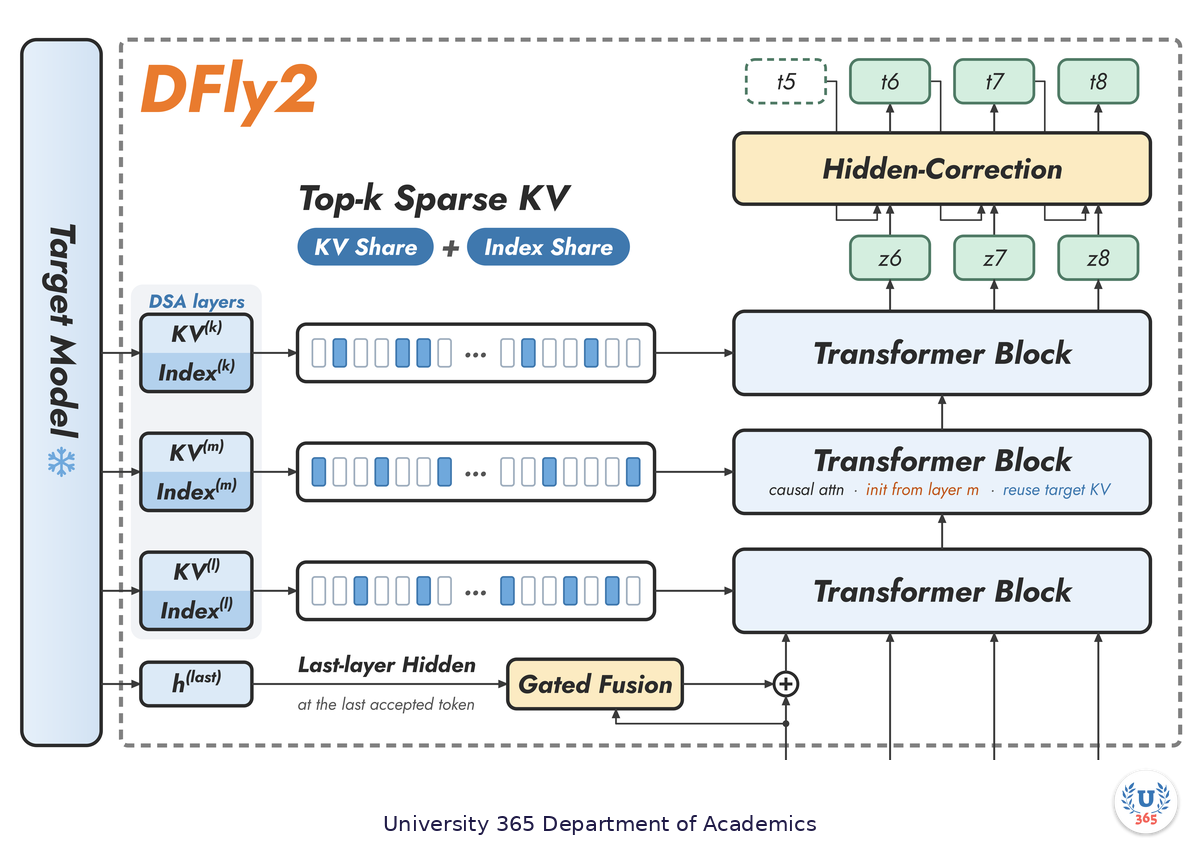
Why the Engram matters more than its name suggests. A conventional mixture of experts stores knowledge in its feed-forward weights and pays for it with memory bandwidth on every token. Hy4 flash moves a large part of that knowledge into lookup tables: 63.5 billion parameters of learned bigram and trigram embeddings, consulted at four layers through multi-head hash lookups. The tables are stored at full width but retrieved, not multiplied, which is why the model can carry 220 billion parameters and activate about 12 billion. It is also why the parameter count is a poor guide to compute: a dense 220-billion-parameter model and this one share a headline number and nothing else. The vendor says the hybrid attention cuts the KV cache to one twenty-fourth of Hy3's and one sixth of Hy4's, which is the number that makes a million-token window affordable to serve, and it publishes no gigabyte figure for it, so the claim can be checked only against a serving benchmark.
How the context is actually used. A 1,048,576-token window is not a licence to paste a million tokens. The attention pattern is hybrid: 30 of 42 layers see only the last 512 tokens, and the 12 sparse layers select up to 2,048 earlier tokens through a group-level index. The model therefore reads the whole prompt, and the part of the prompt that carries the instruction has to survive a routing process that is deliberately narrow. The practical rule from the independent rig is to put the task, the schema and the acceptance test at both ends of the source pack, and to ask for quotations with locations rather than for a summary. The vendor's own long-context claim is about serving cost and decode speed, not about recall at the far end of the window, and no independent needle-in-a-haystack test for this model is published.
Reasoning control. reasoning_effort supports two values: high, which is the default and enables thinking, and no_think, which answers directly. There is no medium, low or minimal setting, and no token budget for thinking. The model card recommends temperature=0.9 and top_p=1.0 for both paths. In practice this means the default is the expensive setting: a routine extraction task pays for thinking tokens unless the caller sets no_think, and the community thread that complains that thinking took too many tokens is complaining about exactly this default. A rig should set the effort per task class rather than accept the default, and should log the reasoning tokens, because they are billed as output.
Serving and quantization. Tencent recommends vLLM or SGLang for production and publishes an official image for each: vllm/vllm-openai:hy4-flash and lmsysorg/sglang:hy4-flash, both running the FP8 instruct model with tensor parallelism 8 and the DFly2 speculative decoder. The BF16 repository is 148 safetensors shards and about 441 GB, the FP8 repository about 287 GB, and the GGUF builds run from 125.73 GiB at IQ2-AH to 156.79 GiB at Q4_K_M. The vendor claims decoding above 150 tokens per second with megakernels, 4-bit quantization and DFly2; AngelSlim's own published table is more modest at 48.13 tokens per second on an M5 Max at 4K context with Q4_K_M, and the same table runs builds larger than the machine's memory, which is a caveat the vendor does not resolve.
The economics, as arithmetic rather than assertion. At list rates, one million input tokens cost $0.070 and one million output tokens cost $0.281, so a balanced request is 80 per cent output cost. Cached input at $0.003 is 4.3 per cent of the input rate, and the independent rig recorded 88 per cent of its input read from cache, which is why a repeated workflow is far cheaper than its first run. The discount until 2026-11-30 halves every line, so a team that adopts in November should model the January bill at double the promotional rate. The vendor's cost-per-task ratios, one thirteenth of Hy4 preview, one twentieth of Hy4 and one eighth of DeepSeek V4.1 Flash at peak Max-tier pricing, are its own WorkIndex measurements, and the independent exam's $0.13 against $2.11 for Hy4 is the corroboration this review uses.
What it is bad at natively. Hidden-pattern questions, where the model has to notice an anomaly that nobody named: 2 of 5 on the independent exam, against 4 of 5 for Hy4. Long-horizon software engineering, which Tencent itself routes to Hy4. Tasks that need a fact that is not in the prompt, because the model is a language model and not a search engine, and the rig has to supply the evidence. Tasks that need a published output ceiling, because the vendor does not print one and the only figure comes from OpenRouter. Local deployment on a 128 GB machine, which every published build exceeds. And any workflow that cannot audit a query log, because the failure that matters is a plausible query that answered the wrong question.

Hunyuan Hy4 Flash
Getting Started with Hunyuan Hy4 Flash
Required accounts: a Tencent Cloud account with TokenHub access and a payment method, or an OpenRouter account, or a machine with enough memory to hold a quantized build. The hosted route needs no GPU and no installation. The local route needs a Linux host with data-centre GPUs for vLLM or SGLang, or a high-memory Apple machine with a patched llama.cpp for the GGUF build.
Route one: TokenHub. Create the account, enable the model, and copy the API key. The endpoint is OpenAI-compatible, the model id is Hy4-flash, and the price is the renminbi or dollar rate on the model page, with the 50 per cent discount applied automatically until 2026-11-30. TokenHub lists the features a rig needs: chat completions, the Responses API, function calling, structured outputs, image input, prompt caching and an Anthropic-compatible surface. The maximum output is 64k.
Route two: OpenRouter. The model id is tencent/hy4-flash, the provider is Tencent, the context is 1,048,576 tokens, the maximum completion is 65,536 tokens, and the listing currently shows $0.035 input, $0.1405 output and $0.0015 cached input per million tokens with a 0.5 discount flag. This is the route to use for a multi-model comparison, because the same key and the same request shape reach the other models in this review's comparison table. Uptime at the time of reading was 100 per cent over 30 minutes and 99.51 per cent over one day.
Route three: self-hosted. Pull vllm/vllm-openai:hy4-flash and run tencent/Hy4-flash-FP8 with tensor parallelism 8, the FLASHMLA_SPARSE attention backend, --tool-call-parser hy_v4, --reasoning-parser hy_v4 and the DFly2 speculative config. The SGLang route is the same model in lmsysorg/sglang:hy4-flash with --speculative-algorithm DFLY --speculative-dfly-block-size 6. Both target data-centre GPUs. For a workstation, use the AngelSlim GGUF build and a llama.cpp built from pull request #32517 or with the supplied patch; a stock release will not load the files, and mlx-lm has no support.
The first request, in the shape that costs least. The example uses the OpenRouter route, whose endpoint and model id are the ones this review verified end to end; on TokenHub, substitute the base URL and the Hy4-flash model id shown in your console.
import os
from openai import OpenAI

client = OpenAI(base_url=os.environ["OPENROUTER_BASE_URL"], api_key=os.environ["OPENROUTER_API_KEY"])
response = client.chat.completions.create(
    model="tencent/hy4-flash",
    messages=[
        {"role": "system", "content": "Answer only from the supplied sources. Quote the source line for every claim."},
        {"role": "user", "content": [{"type": "text", "text": SOURCE_PACK + "\n\nQUESTION: " + question}]},
    ],
    temperature=0.9,
    top_p=1.0,
    max_tokens=2048,
    extra_body={"chat_template_kwargs": {"reasoning_effort": "no_think"}},
)
print(response.choices[0].message.content)
The no_think setting is the cost control in that example. Remove it, or set high, when the task needs reasoning, and log the completion's reasoning tokens so the bill is attributable.
The 15-minute checklist:
Decide the route: TokenHub for the Tencent product family and the renminbi rate, OpenRouter for a single gateway and comparison, self-hosted for data that cannot leave the building.
Put the key in an environment variable, never in a notebook cell that will be shared.
Send one request with a 2,000-token source pack and a question whose answer you already know, and read the answer against the source. This is the calibration that matters more than any benchmark.
Repeat it with reasoning_effort set to no_think and to high, and compare latency, output tokens and answer quality. The difference is the price of thinking on your task.
Add a schema through response_format if the output feeds software. A JSON object with three fields is enough to catch a formatting failure before it reaches a pipeline.
Set a per-request token ceiling and a per-day spend alert. The output line is 80 per cent of a balanced bill, and a runaway generation is the one cost the provider does not cap for you.
Record the model id, the date, the price and the prompt in the LIPS record. A price that changes on 2026-12-01 makes an unrecorded cost estimate unreadable.
What to verify before scaling. Three checks, each cheap. First, a labelled sample of twenty items from your own workload, scored by a person, to see whether the independent exam's 91 per cent travels to your documents. Second, a query audit on a data-analysis task: read the SQL or the Python the rig ran, because a correct-looking answer from a wrong query is the failure mode this model shares with every agent. Third, a long-context probe: put the instruction at the start and the question at the end of a 200-page pack and confirm the answer cites the right page. The vendor's 1M-token claim is about capacity, not recall, and the only recall test that matters is the one on your documents.

Hunyuan Hy4 Flash
Real Workflows
Three workflows, each chosen because the independent evidence covers part of it and because a U365 team can run it in a week. Each carries a UP-Context prompt pack and a four-tier verification checklist.
Workflow 1: Reconcile a batch of supplier documents against a purchase ledger
The job. A finance or operations team receives 200 invoices, delivery notes and statements in a month, in PDF, scan and email form, and has to match each one to a ledger line, flag the mismatches and write the exception note. The work is repetitive, the documents are long, and the cost of a missed mismatch is a payment error.
Why this model. Image input reads the scan, the 1M context holds the batch and the ledger extract in one request, and the price makes a per-document pass affordable. The independent exam's document-shaped rows are the strongest: 3 of 3 planted data-quality problems caught and 5 of 5 impossible requests refused. The model does not replace the ledger; it produces a reconciliation table a person reviews.
UP-Context prompt pack:
AI-EXACT-TASK
Match each supplier document in the batch to one ledger line. Return one row per document with:
document_id, supplier, document_total, currency, ledger_line_id, ledger_total, match (exact,
within_tolerance, mismatch, no_ledger_line), discrepancy_amount, evidence_quote.

ROLE AND PROFILE
You are a reconciliation analyst (Co-Researcher, Analyst and Tester). You do not approve payments.

FULL-CONTEXT
<LEDGER_EXTRACT> ... </LEDGER_EXTRACT>
<DOCUMENT_BATCH> ... </DOCUMENT_BATCH>
Tolerance: 0.5 per cent of document total or 2 currency units, whichever is larger.

EXPECTED-FORMAT-AND-CONSTRAINTS
Return JSON only, an array of rows, no prose. For every row, evidence_quote must be copied from the
document text or the ledger line, with the page number. If a document is unreadable, set match to
"no_ledger_line" only when the ledger has no candidate; use "mismatch" with discrepancy_amount 0
and a note "unreadable" otherwise.

VERIFICATION
State every assumption you made about currency, tax or duplicate documents in an "assumptions" array.
Four-tier verification checklist:
Multi-model check. Run the same batch through a second model on OpenRouter, for example DeepSeek V4.1 Flash, and compare the mismatch rows. Investigate every document where the two disagree; the disagreement rate is the real error bar.
External source check. Open every document flagged mismatch and every document flagged unreadable, and confirm the total against the scan. Check the ledger line in the accounting system, not in the extract.
Human review. A finance officer signs the exception list before any payment is held or released. The model's row is evidence, not an approval.
CI-First test. Can the officer explain and defend each exception without the model? If the answer depends on a query nobody read, the output is not ready.
Workflow 2: Build an evidence brief from a 200-page source pack
The job. A programme team has a regulator's consultation, three partner reports and a set of internal notes, and needs a two-page brief with five findings, each tied to a source line, plus a list of what the sources do not establish. The pack is too long for a small model's window and too sensitive for a frontier API in some jurisdictions.
Why this model. A 1,048,576-token window holds the pack, and the model's perfect score on the independent exam's ambiguous and impossible classes, 5 of 5 on each, is evidence that it states assumptions and refuses an unsupported request rather than inventing an answer. That is the behaviour an evidence brief needs.
UP-Context prompt pack:
AI-EXACT-TASK
Produce a two-page brief with exactly five findings. Each finding: a one-sentence claim, a 40-word
explanation, and one quotation with document title and page. Then list what the pack does not
establish, in three bullets. Then list every question you could not answer from the pack.

ROLE AND PROFILE
You are a research analyst (Co-Researcher, Analyst and Tester). You do not give advice beyond the pack.

FULL-CONTEXT
<PACK> ... </PACK>
Audience: a programme director who will forward the brief to a partner.
Jurisdiction: United Arab Emirates.

EXPECTED-FORMAT-AND-CONSTRAINTS
Markdown, no tables, 700 words maximum. Every claim carries a citation in the form
[Document title, p. N]. A claim without a citation must be deleted, not softened. Separate the
five findings from your interpretation with the heading "What this means".

VERIFICATION
Before you answer, list the five findings as a plan and check each against the pack. If a finding
has no quotation, replace it. If the pack contradicts itself, say so in the finding.
Four-tier verification checklist:
Multi-model check. Ask a second model, given the same five findings and the quotations, whether each quotation supports its claim. Use a different provider, and reject a finding whose quotation the second model cannot find in the pack.
External source check. Open each cited page and confirm the quotation verbatim. Check the document title and date, because a pack assembled from several versions is the commonest source of a wrong citation.
Human review. The programme director reads the brief against the pack before it goes to a partner. The director owns the interpretation, not the model.
CI-First test. Can the director defend each finding in a meeting without the model, pointing to the page? If not, the brief is a draft.
Workflow 3: Turn a specification into a working front-end demo
The job. A design or product team has a one-page specification for a small interface, and needs a working static demo it can click through in a review, not a production application.
Why this model. Tencent recommends simple front-end demos as a use case, the model writes code in the same pass as the copy, and the cost makes a dozen iterations cheap. The independent exam says nothing about front-end code, so this workflow carries the weakest external evidence of the three and the strongest need for the external check.
UP-Context prompt pack:
AI-EXACT-TASK
Build a single-file HTML demo of the interface in the specification. It must run by opening the file,
with no build step and no external dependency except a Google font.

ROLE AND PROFILE
You are a front-end developer (Co-Worker and Assistant). You implement the specification; you do not
redesign it.

FULL-CONTEXT
<SPECIFICATION> ... </SPECIFICATION>
Brand: U365. Primary colour #1F3A5F. Font: Inter. Viewport: 1440 wide and 390 wide.

EXPECTED-FORMAT-AND-CONSTRAINTS
One HTML file with inline CSS and JavaScript. Semantic elements. Keyboard reachable. No placeholder
image URLs; use CSS shapes or inline SVG. Comment every section with the specification clause it
implements.

VERIFICATION
List the three specification clauses you found ambiguous, and state the choice you made for each.
Four-tier verification checklist:
Multi-model check. Ask a second model to review the HTML for accessibility and for clauses it cannot find in the markup. Compare its list with the model's own ambiguity list.
External source check. Open the file in a browser at both viewport widths, click every control, and run it through an HTML validator. The model's claim that the code works is not evidence that it works.
Human review. A designer reviews the demo against the specification, and a developer reviews the JavaScript before it is reused anywhere else.
CI-First test. Can the developer explain each section of the code without the model? If the demo is a black box, it is a prototype that cannot be maintained, and the review should say so.

Hunyuan Hy4 Flash
Strengths, Limits, and AI Imposture Risk
Strengths
CI-First Benefit | Strength | Evidence |
Time | A real saving on the task, and a smaller one than the price implies. | The independent exam's median question took 29 seconds and the whole 43-question run about 33 minutes, against almost three hours for Hy4 on the same rig, which is the four times the vendor claims. The saving is real for document and data work. Held at 6 because 27 of the 51 models on that board answer faster, GPT-6 Luna at 18 seconds and Particle-1 at 16, and because the default reasoning setting spends thinking tokens a routine task does not need. |
Quantity | The strongest dimension, and the one the release was built for. | $0.070 per million input tokens and $0.281 per million output tokens at list, half of that until 2026-11-30, a 1,048,576-token window, a 64k output ceiling, and $0.13 for a full 43-question exam run, which the independent test prices at about $8 per person per year. The rig recorded 88 per cent of its input read from cache, which is where a repeated workflow's cost falls. Held at 7 rather than higher because the usable volume is bounded by the 4 misses and by about 4,800 output tokens per question. |
Quality | A genuine A grade on the only independent exam, with a specific weak class. | 39 of 43, 91 per cent, an A, tied with Ember-1, Claude Fable 5.1 and Thinking Machines' Inkling 2 Small, and perfect on four of the six question classes: 20 of 20 analytics, 5 of 5 ambiguous, 5 of 5 impossible and 3 of 3 data-quality checks. It scores 4 of 5 on statistics traps and 2 of 5 on hidden patterns, and 17 of the 51 models on the board score higher. Held at 6 because the hidden-pattern class is the analyst's core skill, the model has no Artificial Analysis index entry, and its pretrained base trails Hy4's base on nearly every knowledge row. |
Skill | Real for the engineer who deploys it, thin for the user who only prompts it. | The open release is a full engineering education: a documented architecture, a five-build quantization ladder, official vLLM and SGLang recipes, a finetuning pipeline and an independent exam whose transcripts can be studied. Those are transferable capabilities. Held at 4 because the common user never touches them, the model teaches nothing while answering, the thinking trace is optional and often hidden by the consumer surfaces, and the discipline that makes the output safe, a query audit and a labelled sample, is the user's work rather than the tool's. |
Limits
No independent intelligence index. Artificial Analysis lists Tencent Hy4 and does not list Hy4 flash on 2026-11-19. The only independent capability measurement is one data-analysis exam, one run per model, and the examiner itself says repeat runs of other models moved by up to three points.
Hidden-pattern questions are the weak class. 2 of 5 on the independent exam, against 4 of 5 for Hy4. Three of the four misses were hidden patterns: two where the model never isolated the planted anomaly, and one where it found the right place but stopped before naming the cause its own query had shown.
The pretrained base trails its own predecessor. On Tencent's published few-shot table, Hy4 flash Base scores 88.7 on MMLU against 91.6 for Hy4 Base, 71.1 on MMLU-Pro against 73.9, 37.5 on SimpleQA against 57.2, and 52.0 on MMMU-Pro against 59.6. The post-training closes the gap on WorkBuddy-style tasks, and the base gap is still the honest starting point.
The parameter count is stated three ways. 224 billion in the press release, 220 billion in the model card's text and 220.28 billion in its table, against 220,251,201,958 parameters in the published weights. Section 7c states the finding.
The instruct benchmark comparison is an image. The model card's "Appendix: Benchmark results" is a single benchmark.png. The readable text carries the pretraining base table only. A reader cannot search, sort or check the instruct numbers, and the image was briefly missing at launch, which the Hugging Face discussion thread records.
The primary benchmark is internal. WorkIndex is Tencent's own WorkBuddy task set, and its 42.1 against 39.7 for Hy4 preview cannot be audited from outside. The independent exam is the only external number.
The local footprint is large. Q4_K_M is 156.79 GiB, about 168 GB, before the operating system and the KV cache. A 128 GB machine is short at every published build, and the only Mac route is a llama.cpp built from an open pull request or AngelSlim's patch. mlx-lm has no support.
The licence is not Apache 2.0. The Tencent Hy License is Apache 2.0 plus the commercial terms in Clause 10 of the licence: a separate written licence is required for a MaaS business above US$50 million of worldwide revenue in twelve months or a product above 100 million monthly active users. Internal use is exempt.
No vendor-published maximum output. TokenHub prints 64k, OpenRouter prints 65,536, and the model card prints neither. A workflow that depends on a long single answer needs to test the ceiling on its own route.
No published long-context recall test. The 1M window is a capacity claim. The hybrid attention pattern gives 30 of 42 layers a 512-token view, and no needle-in-a-haystack result for this model is published by the vendor or by an independent tester.
Output is verbose at the default setting. The independent rig wrote about 4,800 output tokens per question and made about 8 model calls. A community thread complains that thinking took too many tokens, and the default reasoning_effort is high, which is the expensive setting.
AI Imposture Risk
Trap | Rating | Evidence |
Time Illusion | Medium | The speed is not the illusion: 29 seconds per question and about 33 minutes for a 43-question run are measured, and the four-times-Hy4 claim holds on that rig. The illusion is in what the saving covers. The same run made about 8 model calls per question and wrote about 4,800 output tokens, and a person still reads the answer and audits the queries. The default thinking setting spends tokens on routine work, and 27 of 51 models are faster. The net saving is real for a team that already has a rig and smaller for a team building one. |
Quantity Illusion | Medium | The price invites volume: $0.13 a run, $8 per person per year, a 1M window and a 64k ceiling. The output is fluent, structured and plausible, which is what makes a 91 per cent score dangerous, because one question in eleven is wrong and the wrong ones look like the right ones. The hidden-pattern class is where that lands: a plausible answer built on a query that looked at the wrong slice. A labelled sample and a query audit catch it at moderate effort, which is why this is Medium rather than High. |
Skill Illusion | Medium | A team can wire an OpenAI-compatible endpoint in an afternoon and come away believing it has an AI data-analysis capability. The rig that makes the model useful, the schema, the query log, the exception path and the labelled sample, is the actual skill, and the model supplies none of it. Against that: the weights are open, the architecture is documented, the independent exam publishes its question classes, and the thinking trace can be read when it is enabled. Those are real learning surfaces, and they only work for a team that uses them. |
Overall AI Imposture Risk: Medium. Three traps are Medium, which is the Medium band under the framework's arithmetic, and no trap is High. The band-precedence sentence does not change the outcome: where two ratings could apply to the same trap set, the higher rating governs, and no second rating competes for this set. The rating holds at Medium for a specific reason: the model is genuinely fast and cheap, so the time and volume it offers are real, and the failure that matters is an answer that looks like the others. The checks a reader can own, twenty labelled items, a query audit and a page-level citation check, are cheap enough to run at the model's own scale.
Framework v1.2 clause note
Clause 5.2.3-a, agent-authored procedural memory, with a Skill Illusion floor of no lower than Medium, returns a null for this model. Hy4 flash holds no state between calls and writes nothing. It has no mechanism for creating or revising skills, memory stores or standing instructions, and the weights are a static artefact. The floor is therefore not triggered by the model. The live condition is specific: a rig that lets the model rewrite its own tools, prompts or standing instructions between sessions, without a per-write human decision, would meet the condition, and the floor would apply to the rig rather than to the endpoint.
Clause 4.2-a, agent-mediated conversation, returns a null with a live condition. The model can write in a person's voice when asked, and that is a composition capability rather than an erosion by itself. The dimension is about the human's own communicative capability. Condition (a) is met when model-written text is presented as the person's own voice in a human-facing channel without that person reading it, and an agent that uses Hy4 flash to answer a colleague in the owner's name, unread, crosses it. Condition (b) is met when the person substitutes the model for human contact. The model supplies neither condition on its own.
Recorded together: both clauses return nulls with boundaries and live conditions rather than mechanisms. The reason Skill Illusion sits at Medium is not a clause mechanism. It is the plain fact that a cheap, fluent model with an A grade on one exam invites a team to treat it as an analyst, while its weakest measured class is the one an analyst is paid for, and the model will not say which answer it guessed.

Hunyuan Hy4 Flash
Section 7c: A 224-billion headline, a 220-billion weight file, and the 63.5 billion parameters that are looked up rather than computed
A Section 7c finding is recorded where a supplier's governance, safety record or commercial terms have a real result for the reader. The items below were checked against primary sources on 2026-11-19, and they produce findings a buyer should carry. Every finding is stated as a fact of record, and the difference between a company statement, an independent measurement and a documentation defect is kept intact.
The parameter count in the press release is 1.7 per cent above the parameter count in the weights, and the difference is not explained. The press release dated 2026-11-17 says 224 billion total parameters including 64 billion Engram, with 12 billion active. The research page dated 2026-11-16 says the same. The model card's opening paragraph says 220 billion total including 64 billion Engram, with 12 billion active. Its own spec table gives 155.5 billion backbone, 63.5 billion Engram, 0.43 billion vision encoder and 0.85 billion drafter, which sums to 220.28 billion, and the Hugging Face API reports 220,251,201,958 parameters in the safetensors. The table and the weights agree to within 0.03 billion, which is rounding. The 224 figure has no supporting breakdown anywhere in the release, and it is repeated in Tencent's own X announcement, so a reader who quotes the launch number is quoting a figure the artefact contradicts.
The headline total is not comparable to a dense model's parameter count, because 63.5 billion of it is retrieved rather than computed. The Engram tables are learned bigram and trigram embeddings, consulted at four backbone layers through multi-head hash lookups. They are stored at full width and they occupy memory, and they do not participate in the matrix multiplications that make a dense model expensive. The active count, 11.3 billion text plus 0.43 billion vision, is the number that predicts compute. The consequence for a buyer is twofold: a 220-billion-parameter comparison against a dense 220-billion-parameter model overstates this model's compute by an order of magnitude, and a memory comparison against a 12-billion-parameter model understates its footprint by an order of magnitude. The release invites both mistakes by leading with 224 and 12 in the same sentence.
The benchmark that the launch leans on is internal, and the public comparison is a picture. WorkIndex is Tencent's own WorkBuddy task set. Hy4 flash scores 42.1 there, against 39.7 for Hy4 preview and 51.4 for the shipping Hy4, and the cost-per-task ratios, one thirteenth of Hy4 preview, one twentieth of Hy4 and one eighth of DeepSeek V4.1 Flash at peak Max-tier pricing, are all WorkIndex measurements. The model card's public instruct comparison is published as assets/benchmark.png, a single image, so the numbers cannot be read as text, sorted or checked, and the readable appendix carries the pretraining base table instead. The image was missing at launch, which the Hugging Face forum records as a 404 thread that is now closed; it resolves today. Nothing here is false. The finding is that the only auditable capability number in the release is the one an independent examiner produced, and it covers one task class.
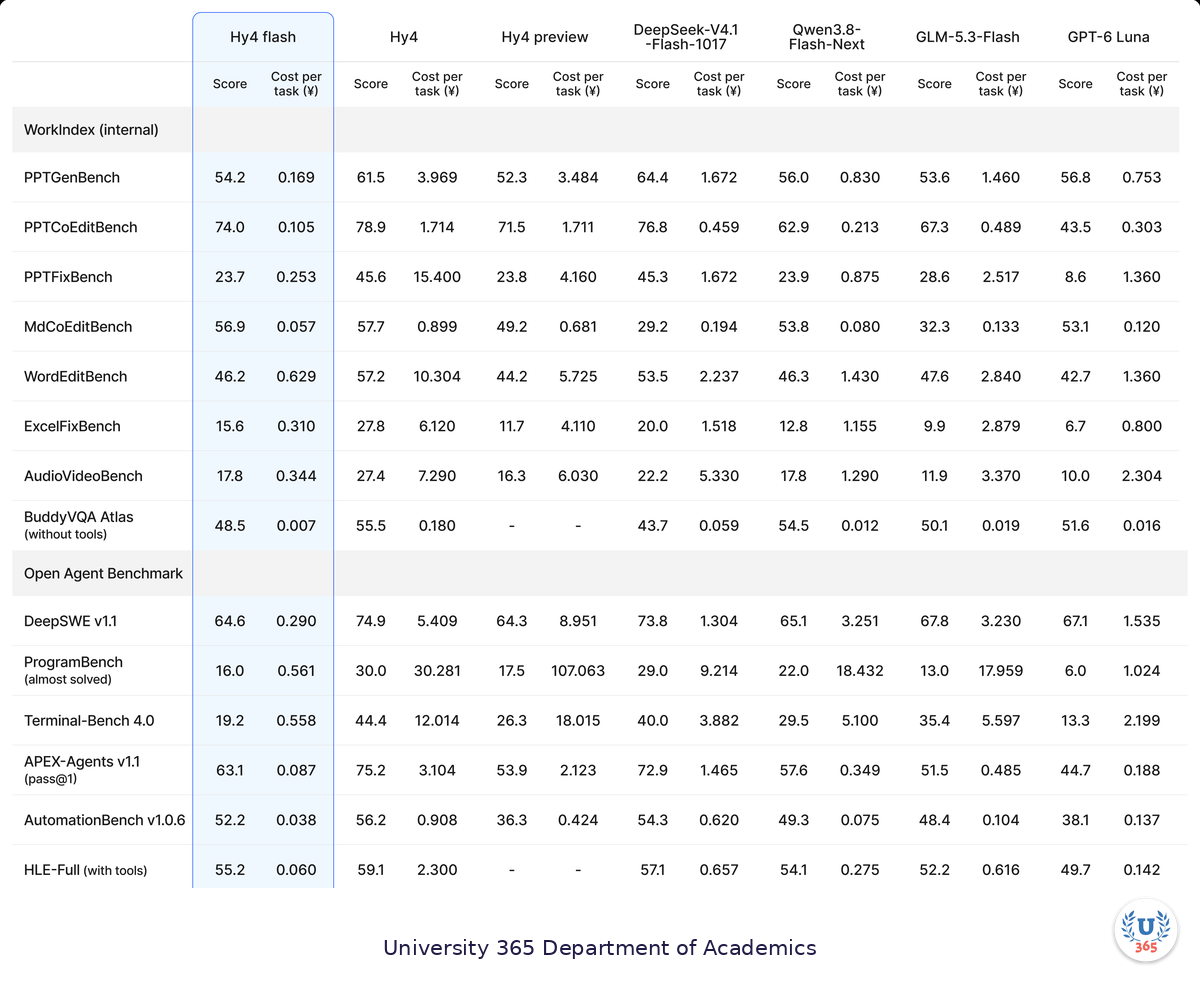
The "slightly above Hy4 preview" claim is carefully scoped, and the shipping Hy4 is ahead. Tencent's sentence compares Hy4 flash with Hy4 preview, the 770-billion-parameter model announced earlier, not with the shipping Hy4. On the vendor's own WorkIndex, shipping Hy4 scores 51.4 against 42.1. On the independent exam, Hy4 scores 42 of 43 against 39, and finds four hidden patterns against two. A reader who reads "slightly above Hy4" into the launch sentence has read the wrong model, and the mistake is easy because the sentence sits next to a chart that contains both.
The licence is an open-weight licence with a commercial threshold, not an open-source licence. The Tencent Hy License, Version 1.0, is based on Apache 2.0 and adds Clause 10. A Model-as-a-Service business needs a separate written licence if its worldwide gross revenue exceeds US$50 million in any twelve-month period, or before using the model in a product with more than 100 million monthly active users. Internal use is exempt under Clause 10.3, and the contact for a licence is hy_partners@tencent.com. Tencent's own materials use both "open-weight" and "open-source", and the X announcement and the model card use "open-weight", which is the accurate term. A university, a research lab and an internal enterprise deployment sit inside the permission; a hosted API sold to third parties does not, above the thresholds. A procurement reader should treat the licence as a commercial document rather than as an Apache 2.0 formality.
The KV cache claim has no unit a buyer can plan with. Tencent states that the hybrid attention design reduces the KV cache to one twenty-fourth of Hy3's and one sixth of Hy4's. Those are ratios against models of different sizes, and the release publishes no gigabytes per token, no maximum concurrent sequences and no context-length table for a given GPU. The claim is plausible given the 512-token sliding window and the 2,048-token sparse selection, and it is not independently measured here. A team sizing a serving cluster has to benchmark it, and a team that budgets from the ratio will be guessing.

Hunyuan Hy4 Flash
U365 Co-Intelligence Rating
CI-First Profile
Primary profile: Co-Worker and Assistant (level 2). Secondary profile: Co-Researcher, Analyst and Tester (level 4).
Why this profile and not Co-Creator. The product's own framing decides it. Tencent sells Hy4 flash for everyday productivity: document processing, deep search, slide creation, simple front-end demos and computer use, with Hy4 reserved for long-horizon engineering. A person directs the work, supplies the source pack and reviews the answer. That is delegation, not dialogue, and Co-Worker and Assistant is the role the model actually plays. Analyst and Tester is recorded as secondary because the strongest independent evidence is a data-analysis exam, where the model runs queries, states assumptions and refuses impossible requests. Professor, Coach and Tutor is not recorded: the model teaches nothing, and its thinking trace is a reasoning record rather than a lesson. Challenger, Critic and Devil's Advocate is not recorded either: the model answers the question it is given, and it does not argue against the premise.
CI-First Benefit Score
Dimension | Score (0-10) | Rationale |
Time | 6 | Moderate savings in the 25 to 50 per cent band. The independent exam's median question took 29 seconds and the full run about 33 minutes, against almost three hours for Hy4, which is the four-times claim reproduced. Held at 6 because 27 of 51 models are faster, the default reasoning setting spends tokens a routine task does not need, and the rig still makes about 8 calls per question with a person reading the result. |
Quantity | 7 | A genuine multiplier at the strong band. $0.070 input and $0.281 output per million tokens, half price until 2026-11-30, a 1M-token window, a 64k ceiling and $0.13 for a full exam run, or about $8 per person per year. Held at 7 because the usable volume is bounded by four misses on 43 questions, by about 4,800 output tokens per question, and by a local footprint that few teams can host. |
Quality | 6 | Moderate, with real independent coverage and a named weak class. 39 of 43, an A, tied at that score with Ember-1, Claude Fable 5.1 and Inkling 2 Small, with 17 of 51 models scoring higher. Perfect on analytics, ambiguity, impossible requests and data quality, 4 of 5 on statistics traps and 2 of 5 on hidden patterns. Held at 6 because there is no Artificial Analysis index entry, the base model trails Hy4's base, and the hidden-pattern class is the one an analyst is paid for. |
Skill | 4 | Marginal, scored conservatively per the framework. The open release teaches deployment, quantization, serving and evaluation to the engineer who runs it, and those are real transferable skills. Held at 4 because the common user only prompts it, the model teaches nothing while answering, and the discipline that makes the output safe, a labelled sample and a query audit, is the user's work. |
CI-First Benefit Score: 5.8 / 10 (CI-First Positive)
Why the score sits where it sits
5.8 with sub-scores 6 / 7 / 6 / 4 is a cheap, fast, open-weight model with an A grade on one independent exam, a named weakness in hidden-pattern analysis, and no independent intelligence index. Every part of that sentence is measured.
Why not higher. Three reasons, each measured. The model has no Artificial Analysis index entry while its own flagship does, so the only independent capability evidence is one data-analysis exam, one run per model, with a stated repeat variance of up to three points. Its weakest class is hidden patterns, 2 of 5, which is the class an analyst is paid for. And its pretrained base trails Hy4's base on nearly every knowledge row, so the post-training gain is task-shaped rather than general.
Why not lower. The independent evidence is better than most models in this library get: an A grade, 91 per cent, perfect on four of six question classes, at $0.13 a run, with the cheapest A-grade result on that board. The context window is a real 1,048,576 tokens, the weights are genuinely open, the licence permits internal and commercial use below a clear threshold, and Tencent prices it at a twentieth of Hy4's cost per task, with the independent exam measuring a sixteenth per run. A Neutral band would misdescribe a model that works.
Why 5.8 and not a higher band, stated as arithmetic. Time 6, Quantity 7, Quality 6 and Skill 4 average to 23 divided by 4, which is 5.75, rounded to 5.8. That sits in the upper half of the CI-First Positive band, which runs from 4.1 to 6.0. The composition is the finding: the two dimensions that measure throughput and cost carry the score, Quality is solid rather than strong, and Skill holds it down because a model that answers does not teach.
Two dimensions do not map cleanly onto this product, and they are named rather than forced. The Knowledge and Skill Benefit asks whether the tool helps the user learn what they did not know and do what they did not know how to do. A chat model returns an answer and no feedback, and the thinking trace is a record of reasoning rather than a curriculum, so the 4 is a statement about the engineering discipline the open release supports and not about a capability the model teaches. The Creativity dimension of the Humics rating has the same shape for a different reason: the model can produce a variant of anything it is given, and it cannot originate a direction the prompt did not contain, so the zero is a non-application rather than a balance between protection and erosion.
What the score does not carry. The four dimensions measure what the reader's work gains. They do not carry the 224-billion headline, the image-only benchmark table, the internal WorkIndex, the licence threshold, the 168 GB local footprint or the open llama.cpp pull request. Those sit in Section 7c and in the limits, and no sub-score moved for any of them. They do not carry the clause questions either, which return nulls with boundaries.
Humics Protection Badge
Dimension | Rating | Rationale |
Creativity | Neutral (0) | It can write, restructure and generate variants, and it cannot originate a direction the prompt did not contain. For a user with an idea it is a fast executor; for a user without one it produces a fluent average of what the prompt implied. It neither sparks ideation nor replaces it, and the zero is a non-application more than a balance. |
Critical Thinking | Erodes (-1) | The product is built for output at volume and at a price that discourages checking, and its answers are fluent whether or not they are right. On the protective side, the default is thinking mode, the reasoning trace can be read, the model states assumptions on ambiguous questions and refuses impossible ones, and the independent exam publishes its misses. On the eroding side, one question in eleven is wrong, the weakest class is the one that looks most like analysis, and the consumer surfaces hide the trace. The erosion lands on the person who reads the answer, not on the engineer who read the model card. |
Social Authenticity | Neutral (0) | The model can write in a person's voice, and that is composition rather than erosion by itself. Clause 4.2-a returns a null for the model. The live condition stays in the record: an agent that sends model-written messages in a person's name without that person reading them crosses condition (a), and the model would be the author of the text even though the agent sent it. |
Humics Protection Score: -1 / +3
Badge: Humics-Neutral
Superhuman Usage Guidance
When to invite this tool:
A document set, a workbook extract or a source pack that fits in a 1M-token window, where the alternative is a retrieval pipeline you would have to build.
Data analysis through a code-executing rig, where the independent exam's A grade and its 5 of 5 refusal rate on impossible requests match your task.
High-volume extraction, classification or drafting where the price per item is the binding constraint and a labelled sample exists.
Image-reading tasks: a screenshot, a chart, a scanned page or a set of assets travelling with the specification.
A local deployment where data cannot leave the building and a 256 GB machine is available.
A prototype front end or a slide outline that a person will review and rebuild.
When to keep this tool out:
Hidden-pattern detection, anomaly hunting and "find what is unusual in this data" questions, where it scores 2 of 5 and its misses look like answers.
Long-horizon software engineering, which Tencent itself routes to Hy4.
Any claim that must be cited to a source the model was not given. It cannot browse and it will still answer.
Any workflow without a query audit, because the failure mode is a plausible query on the wrong slice.
A 128 GB laptop, a stock llama.cpp release or an mlx-lm stack, none of which runs this model today.
A hosted product above 100 million monthly active users, or a MaaS business above US$50 million of revenue, without a separate written licence.
Decisions about a person's credit, employment, housing, insurance, education, healthcare or legal rights, where a general model should not be the decision-maker at all.
U365 method integration:
LIPS + CARE: keep the source pack, the prompt, the model id, the price on the day and the query log inside the LIPS record. The pack is the provenance, and an answer stored without it cannot be reproduced. CARE applies to the review of a flagged item, where the check belongs to a person.
ULM + EVA: touches the Career and Finance domain and Quality of Life planning weakly, through the analytical capability the model supports and the operational reliability of a cheap document pass. It does not touch Body and Health, Spirit and Mind, Character and Emotions, or Social. In the EVA cycle it fits Explore and the Action Plan, not Visualize.
UP-Context-Engineering: the closest fit in the framework. FULL-CONTEXT is the source pack, AI-EXACT-TASK is the question and the schema, EXPECTED-FORMAT-AND-CONSTRAINTS is the JSON contract, and the query audit is the practitioner's verification, a discipline rather than a layer of the method. The method's discipline is what keeps a 1M-token prompt from becoming an unreadable dump.
UNOP: no direct fit. The model does not teach, gives no feedback loop and offers no spaced repetition or recall mechanism.
Over-delegation warning: the failure here is quiet and it is cheap. You put a 200-page pack in the window, ask for the brief, and receive five findings that read like the work of an analyst. One of them rests on a query that looked at the wrong column, and nothing in the output says so. The model made no error, the rig reported no error, and the brief is fluent. That is the shape of the trap: the price makes the pass affordable, the 1M window makes the pack easy, and the A grade makes the answer credible. If HI drops because the team stopped reading the queries and stopped sampling the output, CI-First drops even though the model did not change: CI = HI + (AI x HI). The Superhuman here is the one who reads the query log and labels twenty answers before trusting the other twenty-three.

Hunyuan Hy4 Flash
What Users Say
Aggregate Rating Table
Platform | Rating | Number of reviews | Link |
Plotly DataAnalyticsBench | 39 of 43, 91 per cent, an A, at $0.13 for the run and 29 seconds median per question; tied with three models and below 17 of 51 | One run per model, one sample | |
Artificial Analysis | No entry for Hy4 flash on 2026-11-19; Tencent Hy4 is listed | Independent benchmark, not a user rating | |
Hugging Face | 2,053 downloads, 333 likes, 6 discussions, 4 open, 1 closed | Community activity, not a rating | |
OpenRouter | $0.035 input, $0.1405 output and $0.0015 cached input per million tokens with a 0.5 discount flag; 1,048,576-token context; 65,536-token completion ceiling; 100 per cent uptime over 30 minutes and 99.51 per cent over one day | Model listing, not a rating | |
Tencent blind evaluation | 2.79 out of 4 satisfaction, 6.7 minutes median completion, ¥0.26 per task, with 85 internal WorkBuddy users over 259 tasks in 27 categories | Vendor study, not an independent rating | |
G2, Capterra, Trustpilot | No listing for the model | Not applicable | Not applicable |
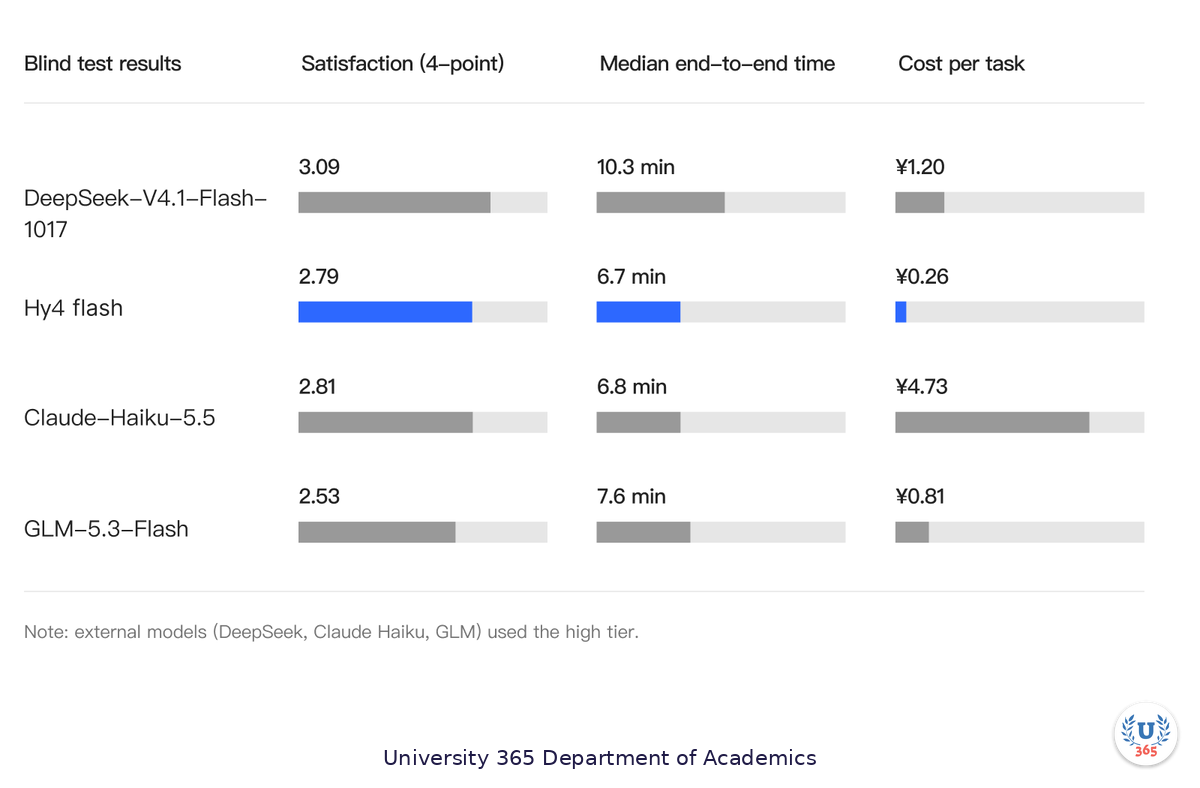
Note on method, stated plainly because it affects how much this section is worth. No review platform rates an open-weight model three days after its weights appear. No G2, Capterra or Trustpilot listing exists, and none is reproduced here. The meaningful signals at this age are one independent exam, the repository's activity, the gateway listing and its uptime, the vendor's own blind study, and a small number of hands-on videos. That is what this section reports, and no quotation and no count is attributed to a platform whose threads were not read.
What Users Praise
The price and the open weights, in that order. The Hugging Face repository drew 2,053 downloads and 333 likes in two days, which is a strong signal for a model that needs 168 GB at 4 bits, because most of those downloads cannot run it locally and are inspecting or quantizing the artefact. The Chinese-language thread that calls the release "一场壮举", a remarkable feat, makes the specific point that the Hy series has kept investing in writing quality and in the local-deployment community, and that Hy4 flash improved writing over Hy3 while cutting parameters by nearly half. That is a user judgement about prose quality, not a benchmark, and it is the kind of evidence a model card does not carry.
The speed against Hy4. The independent examiner's comparison is the clearest praise the model receives: about four times as fast as Hy4 and a sixteenth of the cost, for three fewer questions out of 43. A commenter on X makes the serving point that matters to an engineer: the KV cache is one sixth of Hy4's, which is the number that makes a 1,048,576-token context realistic rather than nominal.
The local-deployment community is moving faster than the vendor. Within two days of the weights, a community port to the CMF inference engine published single-file builds that run on 12 GB cards with 4-bit routed experts, and a GGUF request thread collected six comments pointing at AngelSlim's official quantizations. A model that a community ports in a weekend is a model with a real open-weight audience, and that is a different kind of praise from a benchmark score.
The data-analysis grade. The Plotly result is the strongest independent statement: an A, 39 of 43, the cheapest A-grade model on a 51-model board, perfect on analytics, ambiguity, impossible requests and data quality. The examiner's own summary is that the model joins the cost-accuracy frontier between GPT-6 Luna and Particle-1.
What Users Complain About
Verbose thinking. The most direct complaint is a Hugging Face thread titled "thinking took too much tokens", with the body saying, in Chinese, that the model is too wordy, too wasteful and not suitable for local use. It is one user, and it matches the measurable fact that the rig wrote about 4,800 output tokens per question and the default reasoning setting is high.
Hidden-pattern accuracy. The independent examiner found four genuine misses, three of them hidden patterns, and reported that on those questions the model ran about 33 queries each, above the board median of about 26 but about half as many as Hy4, which found four of the five. A user who needs anomaly detection is the user most likely to be disappointed, and the complaint is not about fluency.
The memory requirement. The hardware analysis is blunt: Q4_K_M is 156.79 GiB, about 168 GB, which fits a 512 GB Mac Studio or two DGX Spark machines with room for context and does not fit a 128 GB machine at any build. The same analysis notes that the benchmarked 128 GB machines were running builds larger than their memory, which suggests SSD offload rather than resident weights, and that the vendor does not confirm it.
The software route on a Mac. llama.cpp support is an open pull request, not a merged feature, and mlx-lm has no build. A Mac user needs a patched compile, and a stock release will not load the files. That is a temporary complaint and it is the reason a reader should not buy hardware for this model on the strength of the model card alone.
The parameter accounting and the training fingerprint. One technical thread reconstructs a PyTorch CUDA initialization signature from the released weights and argues it is consistent with GB200 or GB300 training hardware. Whether or not the inference is right, the thread is a reminder that open weights are inspectable, and that a vendor's claims about how a model was made are not the same as the artefact. A separate complaint is the missing benchmark image at launch, recorded as a 404 thread that is now closed and resolves today.
The licence. The hardware analysis states it plainly: the model is not Apache 2.0, and a MaaS business needs a separate licence above the revenue or user thresholds. For a reader who saw "open" and stopped reading, that is the complaint that matters commercially.
Sentiment Summary
The record is three days old and it is positive on economics and cautious on operations. The strongest praise is for the price, the open weights and the four-times speed against Hy4; the strongest criticism is for verbose thinking, the hidden-pattern class and the memory needed to run it. The independent exam is the only number that carries weight, and it is one run. A reader should treat the sentiment as an early signal about a real release, not as a verdict on a mature model.
U365 Editorial Note
Two findings deserve to sit next to the praise. First, the vendor's blind study is a satisfaction score, not an accuracy score: Hy4 flash scored 2.79 out of 4 against 2.81 for Claude Haiku 5.5, and the same chart shows DeepSeek V4.1 Flash at 3.09, higher than both, while taking 10.3 minutes and costing ¥1.20 a task. Tencent's claim is the narrow one, closest to Haiku on satisfaction and cheapest and fastest of the four, and it does not claim to be the best liked. Second, the independent exam places the model at 39, with 17 of 51 models above it. A reader who wants the best data-analysis model should not read this grade as the top of the field; a reader who wants an A grade at the lowest cost on the board is the reader this model serves.

Hunyuan Hy4 Flash
Comparison and Alternatives
The comparison uses one independent exam for every model it can, because that is the only measurement that covers several of these models on the same questions. Token prices are quoted only where the vendor or the gateway publishes them on the day of reading; where a price is not stated in this review, the cost per exam run is the comparable number.
Model | Open weights | Context | Published price | Independent exam | Cost per run | Median time | U365 review |
Hunyuan Hy4 Flash | Yes, Tencent Hy License | 1,048,576 | $0.070 input, $0.281 output, $0.003 cached; half price to 2026-11-30 | 39 of 43, an A | $0.13 | 29 seconds | This review |
Tencent Hy4 | Announced, not published on 2026-11-19; Apache 2.0 | 1,048,576 | $0.834 input, $2.501 output, $0.042 cached | 42 of 43 | $2.11 | 117 seconds | None |
GPT-6 Luna | No | Not stated in this review | Not stated in this review | 38 of 43 | $0.13 | 18 seconds | Live in the Tools library |
Particle-1 | No | Not stated in this review | Not stated in this review | 40 of 43 | $0.35 | 16 seconds | None |
Claude Haiku 5.5 | No | Not stated in this review | Not stated in this review | 37 of 43 | $0.38 | Not stated in this review | Live in the Tools library |
DeepSeek V4.1 Flash | Yes, per its own licence | Not stated in this review | Not stated in this review | 36 of 43 | $0.46 | Not stated in this review | Live, at 5.3 / 10 CI-First Positive |
GLM-5.3 Flash | Yes, per its own licence | Not stated in this review | Not stated in this review | 38 of 43 | $0.69 | Not stated in this review | Live in the Tools library |
Qwen3.8 Flash | Yes, Flash-Next weights | Not stated in this review | Not stated in this review | Not measured on this exam | Not measured | Not measured | Live in the Tools library |
Read the table by column, not by row. The exam column is the only one measured on the same questions, and it places Hy4 flash at 39 with 17 of 51 models above it. The cost column is the one that changes the decision: at $0.13 a run, Hy4 flash and GPT-6 Luna are the cheapest A-grade results on the board, and Particle-1 is one question better for about 2.7 times the cost. The open-weight column is the one that decides whether a university can use the model at all on sensitive data.
Choose Hunyuan Hy4 Flash if:
You need a 1M-token window and image input at a price that allows a pass over every document, not a sample.
Your data cannot leave the building, and a 256 GB machine or two 128 GB accelerators are available.
Your task is document processing, extraction, reconciliation, deep search over a supplied pack, or data analysis through a rig.
You can audit the queries and label twenty items, and you want the cheapest A-grade model that permits that workflow.
Choose Hy4 if:
Accuracy is the binding constraint and cost is not: 42 of 43 against 39, with four hidden patterns found against two.
The workload is long-horizon software engineering, which Tencent itself recommends Hy4 for.
You need Apache 2.0 rather than the Tencent Hy License, and you can wait for the weights, which were announced and not published on 2026-11-19.
Choose GPT-6 Luna if:
Speed is the binding constraint: 18 seconds a question against 29, at the same $0.13 a run and one question lower on the exam.
You do not need open weights or a 1M window.
Choose Particle-1 if:
You want one more question of accuracy than Hy4 flash and will pay about 2.7 times the run cost for it.
You need the fastest median on this board, at 16 seconds.
Choose Claude Haiku 5.5 or DeepSeek V4.1 Flash if:
You are already inside their platforms and the marginal gain of a cheaper open-weight model does not justify a migration.
You need a vendor with a longer operating history for the exact workload, and you accept a lower exam score at a higher run cost on this board.
Choose Qwen3.8 Flash if:
You want an open-weight efficiency model with a live U365 review and a wider deployment community, and you do not need a published independent exam for this decision.
What this comparison does not do. It does not compare writing quality, translation, coding ability, safety behaviour or long-context recall, because no independent measurement of those exists for this model on 2026-11-19. It does not rank the models on price per token, because several of the prices are not stated here and the units differ by route. And it does not treat a one- or two-question gap on a single exam as a ranking, because the examiner itself says repeat runs moved by up to three points.

Hunyuan Hy4 Flash
Verdict and Next Steps
Verdict: Hunyuan Hy4 Flash is a real open-weight efficiency model with an A grade on the only independent exam that has tested it, a named weakness in hidden-pattern analysis, and a price that makes a document pass affordable. At 5.8 / 10 it is CI-First Positive. Adopt it for high-volume document, image and data work behind a query audit; do not adopt it as your best analyst or as your long-horizon engineer.
The case for it is arithmetic. $0.070 input and $0.281 output per million tokens, half price until 2026-11-30, a 1,048,576-token window, image input, 39 of 43 on an independent exam and $0.13 for the full run. Against Hy4 that is a sixteenth of the cost and four times the speed for three fewer questions. Against the closed models on the same board it is the cheapest A grade, tied with three others and cheaper than every model at 39 or above. For a university that has been choosing between a frontier API it cannot afford at volume and a retrieval pipeline it does not want to build, this is the model that changes the arithmetic.
The case against it is equally specific. There is no Artificial Analysis index entry, so one exam is the whole independent record. The hidden-pattern class, 2 of 5, is the analyst's core skill, and the misses are fluent. The local footprint is 168 GB at Q4, the Mac route is an open pull request, and the licence needs a separate agreement above a revenue or user threshold. And the release's headline number, 224 billion, is 1.7 per cent above what the weights contain.
Next steps, in order:
Run the twenty-item sample. Take twenty documents or questions from your own workload, answer them with the model, and score them against a person's answer. Twenty is enough to see whether 91 per cent travels; it is not enough to certify, and it is the cheapest step.
Audit the queries on one data-analysis task. Read the SQL or Python the rig ran, and compare it with the question. This is the check that catches the hidden-pattern failure, and it takes about an hour.
Set the reasoning effort per task class. Use no_think for extraction and classification, high for analysis and planning, and log the reasoning tokens so the output bill is attributable.
Decide the route before the pilot. TokenHub for the Tencent product family and the renminbi rate, OpenRouter for a single gateway and comparison, self-hosted for sensitive data with a 256 GB machine. The licence question follows the route, not the model.
Model the January bill at list price. The 50 per cent discount ends on 2026-11-30, so a pilot that looks cheap in November will cost twice as much in December. Budget at $0.070 and $0.281 and treat the discount as a launch benefit.
UP-Context prompt pack for the first evaluation:
AI-EXACT-TASK
Evaluate Hy4 flash on 20 items from this workload. For each item, record the question, the answer,
the source line the answer relies on, whether a person agrees with it, and the failure class if not
(hidden pattern, statistics trap, unsupported claim, formatting, other).

ROLE AND PROFILE
You are the evaluator (Co-Researcher, Analyst and Tester). You do not accept an answer because it is
fluent. You accept it because the source line supports it.

FULL-CONTEXT
<WORKLOAD_SAMPLE> ... </WORKLOAD_SAMPLE>
<ACCEPTANCE_CRITERIA> ... </ACCEPTANCE_CRITERIA>

EXPECTED-FORMAT-AND-CONSTRAINTS
A table with one row per item, a count by failure class, and a one-paragraph verdict that names the
class the model fails most often. No score without the failure counts.

VERIFICATION
For every item you mark correct, quote the source line. For every item you mark wrong, quote the
answer and say what the source actually supports.
Related U365 content:
The U365 INSIDE Tools Review of DeepSeek V4.1 Flash, the open-weight model Tencent benchmarks its cost against: https://www.university-365.com/post/deepseek-v4-1-flash-native-vision-and-890-byte-kv-cache-at-low-api-cost
The U365 INSIDE Tools Review library, where the other models in the comparison table are scored on the same framework: https://www.university-365.com/tools
UIT, the institute where long-context engineering, quantization and evaluation are taught.
Status restated: Active, last tested 2026-11-19, re-checked on a trigger list with a six-month outer limit. The triggers that matter most are the end of the promotional price, an Artificial Analysis entry, a merged llama.cpp pull request and a corrected parameter count.

Hunyuan Hy4 Flash
Status and Last Tested
Status: Active.
Version reviewed: Hunyuan Hy4 Flash, API id Hy4-flash, repository tencent/Hy4-flash, announced 2026-11-16, open weights published 2026-11-17, last modified 2026-11-19. The review was written against the BF16 instruct model, the FP8 instruct build, the pretrained base and the published documentation, and every price and benchmark in it was read on 2026-11-19.
Last tested: 2026-11-19. The evidence read on that date: the model card and its raw README, the GitHub repository, the Tencent Hy research page, the Tencent press release, the TokenHub model page with the rate card and the discount, the OpenRouter endpoint JSON, the Tencent Hy License in full, the Plotly DataAnalyticsBench result, the Artificial Analysis leaderboard, the Hugging Face discussions and the hardware analysis from ModelFit.
Next scheduled re-check: trigger-based, with a maximum of six months, which puts the outer date at 2027-05-19. The first trigger to watch is 2026-11-30, when the 50 per cent discount ends and every cost figure in this review doubles at list price.
What Active means here. Active means the tool is current and recommended. It does not mean every claim in the release is verified: the parameter count is contested, the instruct benchmark table is an image, the primary vendor benchmark is internal, and the only independent exam is one run. A reader who arrives more than six months after 2026-11-19 should treat the price, the discount, the OpenRouter ceiling, the licence thresholds, the llama.cpp status and the absence of an Artificial Analysis entry as unverified until they are read again. The architecture, the licence text and the independent exam result are dated artefacts and will not change; the price and the software route will.

Hunyuan Hy4 Flash
Migration Path
Not applicable for an Active model. The migration notes below are for a team arriving from an earlier model or an earlier route, and they are not a retirement plan.
From Hy4 preview. Tencent positions Hy4 flash as a smaller, cheaper model that is slightly above Hy4 preview on its internal WorkIndex and below the shipping Hy4 on the independent exam. A team on Hy4 preview should expect a large cost reduction, a large speed gain and a different failure profile: the hidden-pattern class is weaker than Hy4's, and the parameter count is a third of the preview's. Test the hidden-pattern class before switching, because it is the class the preview was better at.
From a closed frontier API. The request shape is OpenAI-compatible, so the code change is a base URL and a model id. The work is elsewhere: the source pack has to be assembled rather than retrieved, the output has to be checked against a page rather than against a vendor's citations, and the licence has to be read if the deployment is a hosted product. A team that moves for cost should keep the old route for the twenty-item sample until the new route matches it.
From Hy3 or an earlier Hunyuan model. There is no U365 baseline for Hy3, and this review does not invent one. The architecture changed in three ways that matter to a serving team: hybrid attention, LatentMoE and Engram. The KV cache claim, one twenty-fourth of Hy3's, is the one to benchmark before sizing a cluster, because it has no published unit.
From a local 70B deployment. Hy4 flash is larger in memory, at 168 GB for Q4 against roughly 40 GB for a 70B model at 4 bits, and it is cheaper per token in compute because it activates about 12 billion parameters. A team with a single 80 GB GPU cannot run it. A team with a 256 GB machine can, and the software route is vLLM for a server or a patched llama.cpp for a workstation.

Hunyuan Hy4 Flash
U365's Recommendations to Learn More
Start with the model card, not the press release
The model card is the only document that gives the architecture table, the parameter breakdown, the pretraining benchmark table, the reasoning settings, the sampling parameters, the five GGUF builds and the serving recipes in one place. The press release gives the 224-billion figure, the price and the availability list, and it does not give the table that contradicts the first. Read the card first, then read the release, and the discrepancy is visible in ten minutes. The card's own opening paragraph says 220 billion, which is the number to carry.
Then read the licence, before the licence question becomes commercial
The Tencent Hy License is short and it has one section that matters. Clause 10 of the licence defines a Model-as-a-Service business, requires a separate written licence above US$50 million of worldwide revenue in twelve months or 100 million monthly active users, and exempts internal use under Clause 10.3. A reader who plans to host the model for third parties should read Clause 10 before writing code, because the threshold decides whether the product is buildable at all. The contact is hy_partners@tencent.com.
Then read the independent exam, not the internal chart
The Plotly DataAnalyticsBench page carries the question classes, the per-class scores, the cost, the median time, the comparison with Hy4, GPT-6 Luna and Particle-1, and the caveat that one run per model is a single sample with up to three points of movement. It is the only independent capability measurement in this review, and it is the document that turns "slightly above Hy4 preview" into a position: 39 of 43, an A, 17 of 51 above it. Read the four misses as carefully as the 39 passes, because the misses are the classes a reader is most likely to encounter.
Watch a working run before you deploy
Two published walkthroughs cover the release within two days, and both are useful for the shape of the rig rather than for a benchmark: "Tencent Hy4 Flash Is Out. Time to Ditch Qwen 3.8 Flash Next?", by RepoChad, at https://www.youtube.com/watch?v=85Gm68lK0sI, and "I Tested 3 NEW Chinese LLMs: Qwen4-Max, Hy4 Flash, Ernie 5.5 Flash", by AI Coding Daily, at https://www.youtube.com/watch?v=g2qo5V3UGi8, which is the more useful of the two because it runs three models on the same tasks. A third, "Tencent Hy4 Flash Bye DeepSeek V4.1 Flash", by Data Science in your pocket, at https://www.youtube.com/watch?v=WO024aX-LPI, is a cost comparison rather than a test. Check the date and the route before following a command, because the OpenRouter price and the discount changed within the week.
Resources on X
Dedicated X channels: Tencent Hy (@TencentHunyuan) is the first-party account for the Hy family and the account that announced the open weights on 2026-11-18: https://x.com/TencentHunyuan. Its profile image is the one carried in this post, verified on 2026-11-19: https://pbs.twimg.com/profile_images/1810934469769195520/kKSVenHW_400x400.jpg. The launch thread's own image, which carries the 224B headline and the availability list, is at https://pbs.twimg.com/media/HXYXE8aa8AEqG9G.jpg and is the second X thumbnail in this section. The practitioner threads around an open-weight release are where the quantization ports and the memory complaints appear first, because Tencent publishes the weights and the community publishes what it takes to run them.

U365 courses and programmes that build the surrounding skill
UIT (Technology, AI, Data Science): the engineering track where long-context engineering, quantization, serving and evaluation design belong.
UIB (Business Management, Entrepreneurship): the commercial track where a cost per task, a build-versus-buy decision and a licence threshold are analysed.
UIC (Digital Communication, Marketing): the track where a long source pack becomes a brief, and where a benchmark is read before it is repeated.
UID (Digital Design, UX/UI): the track where image input, a front-end demo and a design critique meet.
The one habit to carry
Read the query, not the answer. Hy4 flash's failures in the independent exam were not fluency failures; they were cases where the model looked in the wrong place or stopped before naming what it found, and every one of them produced a readable paragraph. A team that reads the SQL or the Python behind each answer catches that class in minutes, and a team that reads only the answer ships it. At $0.13 a run the temptation is to skip the read because the volume is large and the price is low. The read is the only part of the pipeline that tells you whether the A grade applies to your documents, and the model will not tell you later, because its answer will still look right.

Hunyuan Hy4 Flash
CI-First Evaluation Summary Card
Field | Value |
Tool | Hunyuan Hy4 Flash (Hy4-flash), Tencent |
Category | Applied AI / Open-weight multimodal language model (text and image input, text output) |
CI-First Benefit Score | 5.8 / 10, CI-First Positive |
Sub-scores | Time 6 / Quantity 7 / Quality 6 / Skill 4 |
CI-First Profile | Primary: Co-Worker and Assistant (level 2). Secondary: Co-Researcher, Analyst and Tester (level 4) |
Humics Protection | Humics-Neutral (-1 / +3). Creativity 0, Critical Thinking -1, Social Authenticity 0 |
AI Imposture Risk | Medium overall. Time Medium, Quantity Medium, Skill Medium |
Framework v1.2 clauses | 5.2.3-a null with a live condition, 4.2-a null with a live condition |
Status | Active |
Last tested | 2026-11-19 |
Version tested | Hunyuan Hy4 Flash (Hy4-flash, released 2026-11-17) |
Pricing | $0.070 per million input tokens, $0.281 per million output tokens, $0.003 cached input; half price until 2026-11-30 |
Primary institute | UIT (Technology, AI, Data Science) |
Review status | Active: the tool is current and recommended |

Hunyuan Hy4 Flash
Glossary
CI-First Benefit Score
The arithmetic mean of the four benefit dimensions, each scored 0 to 10, rounded to one decimal place. 0 to 2.0 is CI-First Negative, 2.1 to 4.0 is CI-First Neutral, 4.1 to 6.0 is CI-First Positive, 6.1 to 8.0 is CI-First Strong, and 8.1 to 10 is CI-First Transformative. Hunyuan Hy4 Flash scores 5.8, which is Positive.
Time Benefit
Whether the tool returns more time than it costs, after the overhead of using it is subtracted. Hy4 flash is 6: the independent exam's median question took 29 seconds and the full run about 33 minutes, against almost three hours for Hy4, and 27 of 51 models answer faster, while the rig still makes about 8 calls per question and the default reasoning setting spends tokens a routine task does not need.
Quantity Benefit
Whether the tool increases the volume of usable work a person can produce in a given time. Hy4 flash is 7: $0.070 input and $0.281 output per million tokens, half price until 2026-11-30, a 1,048,576-token window, a 64k output ceiling and $0.13 for a full exam run, or about $8 per person per year, held at 7 by four misses on 43 questions and by about 4,800 output tokens per question.
Quality Benefit
Whether the tool helps the user produce better work than they could alone, judged after verification rather than on surface polish. Hy4 flash is 6: 39 of 43 on the only independent exam, an A, tied with three models and below 17 of 51, perfect on analytics, ambiguity, impossible requests and data quality, 4 of 5 on statistics traps and 2 of 5 on hidden patterns, with no Artificial Analysis index entry and a pretrained base that trails Hy4's base.
Knowledge and Skill Benefit
Whether the tool helps the user learn what they did not know and do what they did not know how to do. Hy4 flash is 4, scored conservatively: the open release teaches deployment, quantization, serving and evaluation to the engineer who runs it, and the common user only prompts it, receives an answer and learns nothing the model did not already know.
Humics Protection Badge
The sum of three ratings, each +1, 0 or -1, across Creativity, Critical Thinking and Social Authenticity. +2 to +3 is Humics-Friendly, -1 to +1 is Humics-Neutral and -2 to -3 is Humics-Risky. Hy4 flash scores -1, which is Humics-Neutral: it executes creative directions without originating them, it erodes critical thinking because a fluent answer at a low price discourages checking, and it can write in a person's voice without that being erosion by itself.
AI Imposture Risk
The likelihood that the tool traps its user in one of three illusions: the Time Illusion, where the overhead exceeds the saving; the Quantity Illusion, where volume passes for quality; and the Skill Illusion, where the user believes they can do what the tool did. Each trap is rated Low, Medium or High. Hy4 flash is Medium overall, with all three traps Medium, and no trap High.
CI-First Profile
The role the AI plays in the working relationship: Co-Creator and Thought Partner (1), Co-Worker and Assistant (2), Professor, Coach and Tutor (3), Co-Researcher, Analyst and Tester (4), or Challenger, Critic and Devil's Advocate (5). Hy4 flash is primarily Co-Worker and Assistant, with Analyst and Tester as a secondary role, because the product is sold for everyday execution and its strongest independent evidence is a data-analysis exam.
User Sentiment
The direction of independent and practitioner reaction to the tool, read from what testers and users actually reported rather than from a rating average, because no review platform rates an open-weight model three days after its weights appear. For Hunyuan Hy4 Flash the record is positive on price, on the 1M-token window and on the open weights, cautious on verbose thinking, on hidden-pattern accuracy and on the memory a local build needs, and it is three days old.
Review Status
The badge on this review states how much confidence to place in it. The vocabulary: Active means the tool is current and recommended. Active (updated) means it is current and recommended and was recently re-checked and refreshed. Changed means a re-check trigger fired and an update is pending, so read it with that in mind. Risky means the tool has significant unresolved issues or has been clearly surpassed by newer alternatives, so use it with caution and read the Limits section. Stale means the review has not been re-checked in over six months, so treat pricing and features as unverified. Retired means the tool still works but is no longer recommended, and Deprecated means it has been shut down or fundamentally changed. This review is Active.
Last tested and Re-check
The date on which the review's evidence was last read against the vendor's own surfaces, and the condition under which it will be read again. This review was last tested on 2026-11-19 and is re-checked on a trigger list with a six-month outer limit, because an open-weight model's price, licence, quantization builds and independent coverage move faster than a calendar interval can track.

Hunyuan Hy4 Flash
Sources
Vendor primary sources:
Tencent, model card for tencent/Hy4-flash, including the architecture table, the parameter breakdown, the pretraining benchmark table, the reasoning settings and the serving recipes: https://huggingface.co/tencent/Hy4-flash
Tencent, raw README with the full text of the model card: https://huggingface.co/tencent/Hy4-flash/raw/main/README.md
Tencent, tencent/Hy4-flash-FP8 and tencent/Hy4-flash-base repositories, read for size and status: https://huggingface.co/tencent/Hy4-flash-FP8 and https://huggingface.co/tencent/Hy4-flash-base
Tencent Hy, "Introducing Hy4 flash: Ultimate cost-efficiency for everyday productivity", 2026-11-16, including the rate table, the WorkIndex claims and the blind evaluation: https://hy.tencent.ai/research/hy4-flash
Tencent, press release, 2026-11-17, including the 224-billion figure and the availability list: https://www.tencent.com/tencent-launches-hy4-flash-to-power-high-speed-cost-efficient-ai-deployment-for-everyday-workflows
Tencent Cloud TokenHub, Hy4-flash model page, including the $0.070 input, $0.281 output and $0.003 cache rates, the 0.5 discount, the 64k output and the feature list: https://cloud.tencent.com/tokenhub/hy4-flash-en
Tencent, Tencent Hy License, Version 1.0, including Clause 10 on Model-as-a-Service: https://huggingface.co/tencent/Hy4-flash/raw/main/LICENSE
Tencent-Hunyuan, GitHub repository, including the vLLM and SGLang deployment commands and the finetuning guide: https://github.com/Tencent-Hunyuan/Hy4-flash
Tencent AngelSlim, GGUF builds for Hy4 flash, including the build sizes: https://huggingface.co/AngelSlim/Hy4-flash-GGUF
Tencent, llama.cpp pull request #32517, "Model: add hy_v4_flash support", open on 2026-11-19: https://github.com/ggml-org/llama.cpp/pull/32517
OpenRouter, Hy4 flash listing: https://openrouter.ai/tencent/hy4-flash
OpenRouter, endpoint JSON with the 1,048,576-token context, the 65,536-token completion ceiling and the discounted rates: https://openrouter.ai/api/v1/models/tencent/hy4-flash/endpoints
Independent measurement and reporting:
Plotly, "Tencent Hy4 flash Benchmark Results for Data Analysis", 2026-11-16, updated 2026-11-19, the 39 of 43 result, the per-class scores, the cost and the time: https://plotly.com/blog/hy4-flash-plotly-data-analytics-bench/
Artificial Analysis, model leaderboard, which lists Tencent Hy4 and does not list Hy4 flash on 2026-11-19: https://artificialanalysis.ai/leaderboards/models
NYU Shanghai RITS, "Tencent Open-Weights Hy4 Flash, a 220B MoE With 12B Active", 2026-11-19, the independent reading of the release, the pretraining table and the blind-test numbers including DeepSeek's 3.09 satisfaction: https://rits.shanghai.nyu.edu/ai/tencent-open-weights-hy4-flash-a-220b-moe-with-12b-active
ModelFit, "Tencent Hy4 Flash Weights Are Out: What Hardware Runs It?", 2026-11-17, updated 2026-11-18, the file sizes, the GGUF ladder, the memory arithmetic and the llama.cpp and mlx-lm status: https://modelfit.io/blog/tencent-hy4-flash-open-weights
Community:
Hugging Face discussions for tencent/Hy4-flash, six threads read on 2026-11-19, including "thinking took too much tokens", "why do the released weights have a GB200 fingerprint?", "README.md benchmark png 404 not found" and "Need gguf!": https://huggingface.co/tencent/Hy4-flash/discussions
Hugging Face community port to the CMF inference engine, single-file builds for 12 GB cards: https://huggingface.co/infosave/Hy4-flash-cmf
"Tencent Hy4 Flash Is Out. Time to Ditch Qwen 3.8 Flash Next?", RepoChad, 2026-11-18: https://www.youtube.com/watch?v=85Gm68lK0sI
"I Tested 3 NEW Chinese LLMs: Qwen4-Max, Hy4 Flash, Ernie 5.5 Flash", AI Coding Daily, 2026-11-19: https://www.youtube.com/watch?v=g2qo5V3UGi8
"Tencent Hy4 Flash Bye DeepSeek V4.1 Flash", Data Science in your pocket, 2026-11-18: https://www.youtube.com/watch?v=WO024aX-LPI
Tencent Hy on X, the open-weight announcement and its image, 2026-11-18: https://x.com/TencentHunyuan/status/2122912575302119554
U365 internal reference:
U365 CI-First Evaluation Framework v1.4.1, read alongside the published doctrine at https://www.university-365.com/post/discover-the-ci-first-approach
U365 INSIDE Tools Review of DeepSeek V4.1 Flash, the open-weight model Tencent compares its cost against, published at 5.3 / 10 CI-First Positive: https://www.university-365.com/post/deepseek-v4-1-flash-native-vision-and-890-byte-kv-cache-at-low-api-cost

Hunyuan Hy4 Flash
Faculty Note on Evidence Quality
What this review rests on, in order of weight. First, the vendor's own primary documents: the model card and its raw README with the architecture table and the pretraining benchmark table, the GitHub repository with the serving recipes, the research page and the press release with the pricing and the WorkIndex claims, the TokenHub model page with the rate card and the discount, the OpenRouter endpoint JSON with the context and the completion ceiling, and the licence in full. Second, one independent benchmark house that publishes its method, its question classes and its per-class scores: Plotly, whose 39 of 43, $0.13 and 29-second median are the independent numbers in this review. Third, the Artificial Analysis leaderboard, used to establish an absence rather than a score: Tencent Hy4 is listed and Hy4 flash is not. Fourth, published analysis and community work, used for the hardware arithmetic, the file sizes, the parameter reconciliation and the reception, and never for a capability number.
Where the vendor's numbers and the independent numbers meet, and where they part. They meet on the cost direction: Tencent says one thirteenth of Hy4 preview, one twentieth of Hy4 and one eighth of DeepSeek V4.1 Flash, and Plotly measures one sixteenth of Hy4's cost per run, which is the same order on a different task set. They meet on the speed direction: Tencent says about four times Hy4, and Plotly measures about four times on its own rig. They meet on the price: $0.070 input and $0.281 output, confirmed by the research page, the TokenHub page and the OpenRouter listing after the 0.5 discount is applied. They part on the accuracy claim in scope rather than in number: the vendor's headline compares against Hy4 preview, and the shipping Hy4 is ahead of both. And they part on the depth of the record: the vendor has an internal benchmark across six task families, and the independent evidence is one exam on one task family, run once.
The documentation conflicts are inside the vendor's own materials, and there are five. The parameter count is 224 billion in the press release and the research page and 220.28 billion in the model card's table, against 220,251,201,958 in the weights. The maximum output is 64k on TokenHub, 65,536 on OpenRouter and absent from the model card. The instruct benchmark comparison is an image while the base table is text. The primary benchmark is internal and cannot be checked. And the words open-weight and open-source are both used for a licence that is Apache 2.0 plus commercial terms. This review states each as a documentation finding, uses the weights and the model card's table where they are the more careful record, and does not convert an absent figure into a favourable one.
What is measured and what is inferred. The 39 of 43, the per-class scores, the $0.13, the 29-second median, the 8 calls per question and the 88 per cent cache rate are measured by Plotly and reported with its method and its one-run caveat. The parameter counts, the architecture, the file sizes, the licence terms and the rate card are read from vendor or artefact primary sources. The absence of an Artificial Analysis entry was measured on the leaderboard on 2026-11-19 and is dated. The judgement that this model is the right instrument for high-volume document and data work behind a query audit is an interpretation of those measurements against the work the model is sold for, and it is the interpretation this review defends. The claim that a reader will over-delegate is an inference from the framework's model of human behaviour, supported by the price, the fluency and the hidden-pattern weakness, and it is labelled as an inference wherever it appears.
One finding cuts against the model and should be said as plainly as the rest. The hidden-pattern class is 2 of 5, against 4 of 5 for Hy4. Three of the four misses in the independent exam were hidden patterns, and in one of them the model found the right place to look and stopped before naming the cause its own query had shown. An analyst's most valuable question is "what is unusual here", and this model is measurably weaker at exactly that than the larger model it replaces in the budget. A reader whose workload is anomaly detection should treat the A grade as a statement about a different task.
One finding cuts in the model's favour and should be said as plainly. On the only independent exam, Hy4 flash is the cheapest A-grade model on a 51-model board, at $0.13 a run, tied with three models at 39 and cheaper than every model at 39 or above. It is perfect on four of six question classes, including 5 of 5 refusals on impossible requests, which is the behaviour a document pipeline needs most: a model that says it cannot answer is cheaper than one that invents an answer. At the promotional rate it is $0.035 per million input tokens, which is the price at which a university can afford to check every document rather than sample it.
What this review does not do. It does not score Hy4, Hy4 flash-FP8, Hy4 flash-base, Hy3 preview or HunyuanVideo, which are separate products and, where published, separate reviews. It does not score TokenHub, WorkBuddy, Yuanbao, WeCom, QQ, ima, Marvis or OpenRouter, which are routes to the same model, although their terms and prices are named where they matter. It does not treat WorkIndex as an independent measurement, and it does not convert one data-analysis exam into an intelligence claim. A reader who needs a capability figure for their own workload has to build the twenty-item sample, and the Verdict and Next Steps section says how.
Attribution and scoring date. This review was scored by Hubert Graef, Dean of Research at University 365 Research Center, on 2026-11-19, against the CI-First Evaluation Framework v1.4.1. The evidence was read on that date, and the review is re-checked on the trigger list at the top of the post.

Hunyuan Hy4 Flash
Status and Re-check
Status: Active | Last tested: 2026-11-19 (Hunyuan Hy4 Flash, Hy4-flash, announced 2026-11-16, open weights published 2026-11-17) | Re-check: trigger-based (max 6 months)
Active: the tool is current and recommended.
For detailed explanations of the CI-First evaluation terms used in this review, including the Humics Protection Badge and the AI Imposture Risk levels, see the Glossary at the end of this post.
Re-check triggers:
The promotional price ends on 2026-11-30. TokenHub sells Hy4 flash at 50 per cent of list until that date: $0.035 input, $0.1405 output and $0.0015 cached input per million tokens, against the list rates of $0.070, $0.281 and $0.003. The cost arithmetic in this review is written so that a reader can redo it at either rate.
Artificial Analysis adds Hunyuan Hy4 Flash to its intelligence board, or changes the Hy4 row. On 2026-11-19 the board lists Hy4 and does not list Hy4 flash, so the only independent capability measurement in this review is one data-analysis exam. An index entry would change the Quality dimension.
A change to the OpenRouter price, provider count or endpoint shape. The OpenRouter listing is the only surface that publishes a maximum completion ceiling for this model, 65,536 tokens, and it currently carries a 0.5 discount flag on all three rates.
A published maximum output from Tencent. TokenHub prints 64k, OpenRouter prints 65,536, and the model card prints neither. A vendor figure would settle which is authoritative.
llama.cpp merges pull request #32517, or mlx-lm adds a Hy4 flash architecture. On 2026-11-19 the only local routes are vLLM and SGLang images for data-centre GPUs, plus a GGUF build that needs the open pull request or AngelSlim's patch.
Tencent changes the Tencent Hy License, or answers the parameter discrepancy. The licence adds a separate written licence for Model-as-a-Service businesses above US$50 million of revenue or 100 million monthly active users, and the vendor's own materials disagree on whether the model has 220 or 224 billion parameters.
Tencent publishes Hy4 weights, or another Hy4 size. Hy4 is the 770-billion-parameter flagship announced on 2026-11-04 under Apache 2.0, with weights announced and not published on 2026-11-19. A released Hy4 would change the comparison at the top of the family.
A second independent evaluation of the instruct model, or a corrected benchmark table. The vendor's public instruct comparison is published as an image, its primary benchmark is internal, and the one independent exam is a single data-analysis run with a known weak class in hidden-pattern questions.




Comments