
MiMo-V2.6-Flash: Xiaomi's Open-Weights Efficiency Tier Scored 5.5 on the U365 CI-First Review, at a Third of Its Own Flagship's Price

Updated: 8 hours ago
Status: Active | Last tested: 2026-09-24 (MiMo-V2.6-Flash, mimo-v2.6-flash, released 2026-09-21) | Re-check: trigger-based (max 6 months)
Active: the tool is current and recommended.


In this Tool Review
Status and Re-check
The status line above records the standing of this review. Every entry below is a condition under which a score, a claim or a warning in this review stops being true, so the review needs reopening.
Trigger to watch | Why it would change this review |
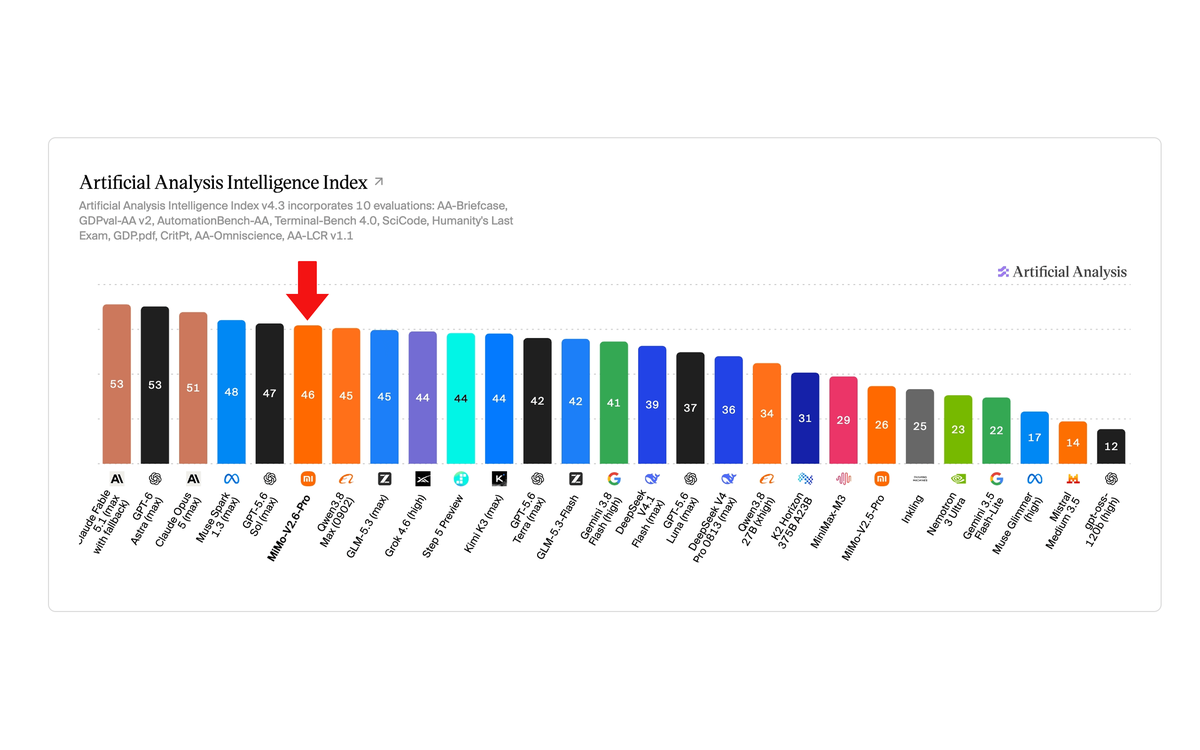
Independent intelligence measurement | There is no Artificial Analysis model page for MiMo-V2.6-Flash, and the one aggregator that tracks it records six of eight benchmark categories as "not measured" and assigns no public rank. If an independent composite score appears, the Quality sub-score at 5 should be revisited in either direction. This is the single highest-value trigger in this review. |
Independent speed and latency measurement | BenchLM reports speed as "not measured" with no time-to-first-token figure. The vendor's headline claim for this model is throughput and cost, and no third party has measured either. Any measured throughput figure changes the Time sub-score. |
Resolving the distillation allegation | Anthropic's September 2026 report names Xiaomi in case GTG-16008. Xiaomi has not publicly responded to the allegation. A response, a retraction, or a legal finding in either direction changes the governance assessment in Section 7c, and the assessment is material to adoption rather than peripheral to it. |
Price and free-tier movement | Flash is priced at $0.14 and $0.28 per million tokens. Gateways resell the same model id between $0.14 and $0.70 input, and a free tier runs at 200,000 context and 32,000 output. Free tiers at the cheap end of a family are the mechanism Anthropic alleges was used in the Pro case, so track both the tier and the price together rather than the price alone. |
Knowledge and hallucination measurement | No independent party has measured Flash's factual reliability. Pro measured 34.8 percent accuracy on AA-Omniscience with a 59.4 percent non-hallucination rate, and Flash is the smaller model in the same family. Treat the absence as a live risk, not as a clean bill of health. |
Hard-task gap | The one comparable independent data point places Flash behind GLM-5.3-Flash on Terminal-Bench 4.0, 28.8 against 32.8, and well behind its own sibling Pro at 34.9. If a later checkpoint closes that, the framing in the Limits block changes. |
Flash documentation repair | The model page contradicts itself on input modality within four lines, and one aggregator records the API model id as "not published". If either is corrected, the setup guidance in Getting Started becomes more reliable. |
A new vendor release | A new Flash checkpoint, or a material change to the published rate card, warrants a fresh assessment of every row in this review. |
The MiMo-V2.6 family, stated before the review begins
Four products carry the V2.6 name and they are not four models. Three of them are separate checkpoints and one is a serving configuration of the flagship. A reader will meet all four names on the vendor's own pages, so the distinction belongs at the top.
Product | What it is | Key figures | Reviewed here |
MiMo-V2.6-Pro | The flagship checkpoint, open weights under MIT | 70 layers, 384 routed experts, hidden size 6144, 42 billion active parameters, 573.5 GB of weights across 132 files, $0.435 per million uncached input and $0.87 output, independent composite score of 46 | Yes, separately, scored 5.8 |
MiMo-V2.6-Flash | A separate checkpoint with its own architecture, not a reduced Pro, open weights under MIT | 309 billion total and 15 billion active parameters, 48 layers, 256 routed experts, hidden size 4096, 177.8 GB across 67 files, $0.14 per million uncached input, $0.0028 cached and $0.28 output | This review |
MiMo-V2.6-Pro-UltraSpeed | The same Pro weights served at a much higher rate. A serving configuration, not a model | Ten times the Pro rate, for latency-bound work | No separate review, and none is warranted |
Distill-Qwen-9B | A small distilled checkpoint published in the same release collection | A research artefact rather than a production model | No separate review |
Two points follow from that table and both matter for this review. Flash is not a cheaper Pro: the encoder stack and the context window were kept, while the depth and width of the transformer stack were cut, which is why wide and repeated work stays close to the flagship while the hardest reasoning and exploitation tasks fall away. And the price is exactly one third of Pro's on both input and output, so a reader choosing between them is choosing between a measured model and an unmeasured one at a third of the cost, which is the decision this review is about.
Tool Snapshot
MiMo-V2.6-Flash
Tagline: "Full-modality, high-intelligence, low-cost reasoning model - the best balance for high-frequency calls and large-scale tasks in professional workflows." (Xiaomi MiMo model page, read 2026-09-24.)
Category: Large Language Model (LLM), efficiency tier of the Xiaomi MiMo-V2.6 series, released as open weights under MIT. Primary use cases are high-volume structured extraction, batch processing, agent loops where the per-call price dominates the total, and long-context automation.
Primary use cases:
Run high-volume structured extraction, form filling or classification where the schema is fixed and the errors are cheap to catch.
Drive an agent loop where the binding constraint is the price per call rather than the capability ceiling on any single hard task.
Process a large document set through a 1M-token window at roughly a third of the flagship price in the same family.
Read images, video and audio natively, where the model card lists all four input modalities on the same encoder design as Pro.
Run overnight or batch jobs where latency does not matter and volume does, supported by the vendor's Batch API.
Prototype against a free tier before committing spend, because a third-party gateway publishes a no-charge variant of this model id.
Pricing summary: Paid through the API, plus self-hosting of the MIT weights at your own infrastructure cost. Xiaomi's first-party API price is $0.14 per million uncached input tokens, $0.0028 per million cached input tokens, and $0.28 per million output tokens. The cache-hit rate is a 98 percent discount against the cache-miss rate, a spread of about 50 times. Both input and output are exactly one third of the Pro sibling's rates at $0.435 and $0.87. The same model id is resold across gateways at different rates, and one aggregator lists it at $0.70 and $1.40 per million, five times the first-party rate, so check the provider rather than the model name. A third-party gateway publishes mimo-v2.6-flash-free at a reduced 200,000-token context and 32,000-token output limit for no charge. Pricing captured 2026-09-22 to 2026-09-24 from the Xiaomi model page, the models.dev provider table, and the BenchLM and LLM Stats model pages.
Official links:
Launch post: https://mimo.mi.com/docs/en-US/news/latest/v2-6
Model page and rate card: https://mimo.mi.com/models/en-US/mimo-v2.6-flash
Model reference and rate limits: https://mimo.mi.com/docs/en-US/quick-start/summary/model
API platform (console and keys): https://platform.xiaomimimo.com
Chat and agent surfaces: https://aistudio.xiaomimimo.com
Model weights: https://huggingface.co/XiaomiMiMo/MiMo-V2.6-Flash-RL
Architecture figure: https://huggingface.co/XiaomiMiMo/MiMo-V2.6-Flash-RL/blob/main/assets/architecture.png
Technical report: https://huggingface.co/XiaomiMiMo/MiMo-V2.6-Flash-RL/blob/main/MiMo_V2_6_technical_report.pdf
Hugging Face collection: https://huggingface.co/collections/XiaomiMiMo/mimo-v26
OpenRouter listing: https://openrouter.ai/xiaomi/mimo-v2.6-flash
GitHub organisation: https://github.com/XiaomiMiMo
LLM-specific fields:
API model identifier: mimo-v2.6-flash. Xiaomi's own note insists on all-lowercase model names. One aggregator records the API model id as "not published", which appears to be an artefact of it indexing the marketing page rather than the developer reference; the lowercase id above is confirmed on the vendor's own model page. No dated snapshot is published.
Context window: 1M tokens. The published limit is 1,048,576 input tokens with 131,072 maximum output tokens, identical to Pro. The free third-party tier is reduced to 200,000 context and 32,000 output, so check the tier before assuming the window.
Knowledge cutoff: not documented. The vendor's own example system prompts on the Flash model page still read "Today is date: Tuesday, December 16, 2025. Your knowledge cutoff date is December 2024." That text also appears on the older V2.5 documentation, so treat the cutoff as unknown rather than as December 2024.
Effort and thinking levels: the model supports deep-thinking mode and the example payloads show a thinking control, but Xiaomi publishes no named effort ladder comparable to low, medium, high. Treat effort selection as not publicly specified.
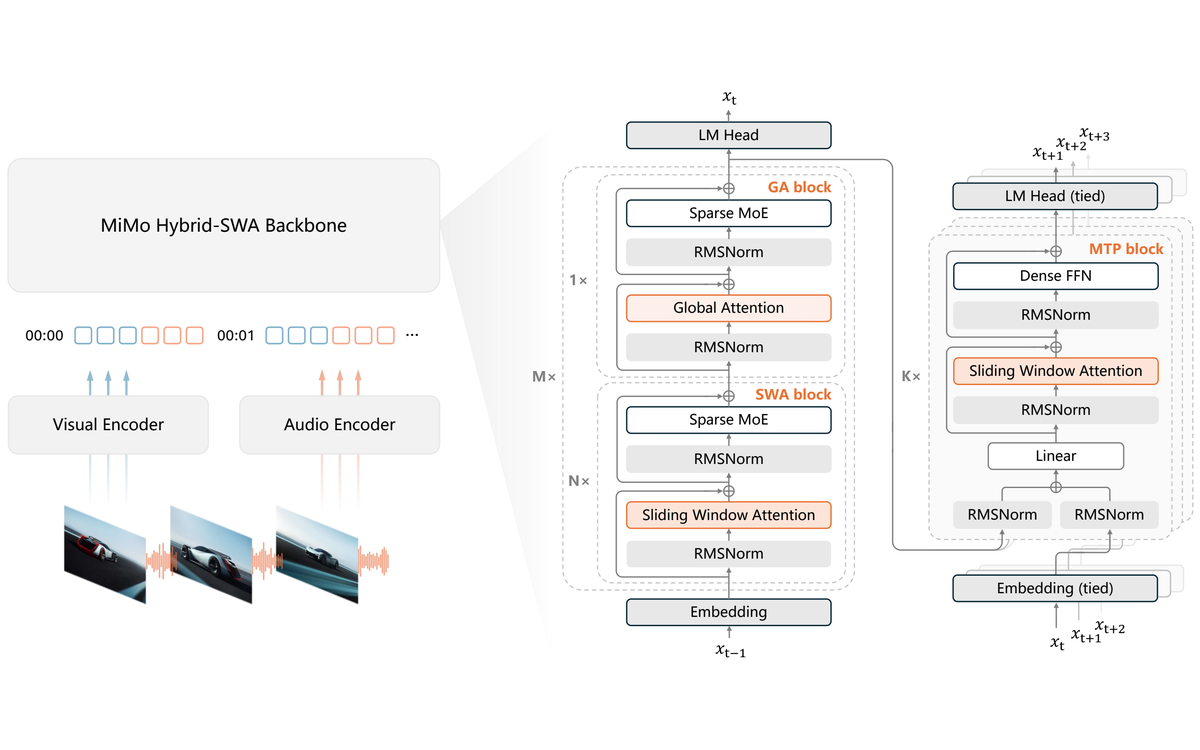
Parameters and architecture: disclosed in the model card. Sparse Mixture of Experts with 309 billion total parameters and 15 billion active per token, 256 routed experts of which 8 activate, no shared experts. 48 layers, 39 sliding-window-attention and 9 global-attention, hidden size 4096. Both attention types use sparse MoE feed-forward networks. Sliding window 128 tokens. The vision encoder is the same 681M-parameter MiMo ViT as Pro, and the audio side is the same 308M AudioTokenizer plus 127M audio patch encoder. A 5-layer speculative multi-token-prediction decoder predicts seven subsequent tokens per forward pass.
Model variants: MiMo-V2.6-Flash-RL is the published checkpoint. There is no separate non-reasoning variant published. The free third-party tier is the same model under a different provider arrangement.
Available platforms: Xiaomi MiMo API (OpenAI-compatible and Anthropic-compatible), MiMo Studio, MiMo Code, Xiaomi MiMo Desktop, OpenRouter and other gateways, and the vendor's Batch API. Self-hosting is supported through SGLang and vLLM recipes.
License: MIT, and ungated. The Hugging Face API reports gated: false. Note that one aggregator labels this model's weights as "Closed", which contradicts both the MIT licence on the model card and the downloadable checkpoint. That label is wrong; the weights are open and download without an approval step.
Comparison references: arena.ai (LMSYS Chatbot Arena) for head-to-head human rankings and ollama.com/search for local deployment of other models.
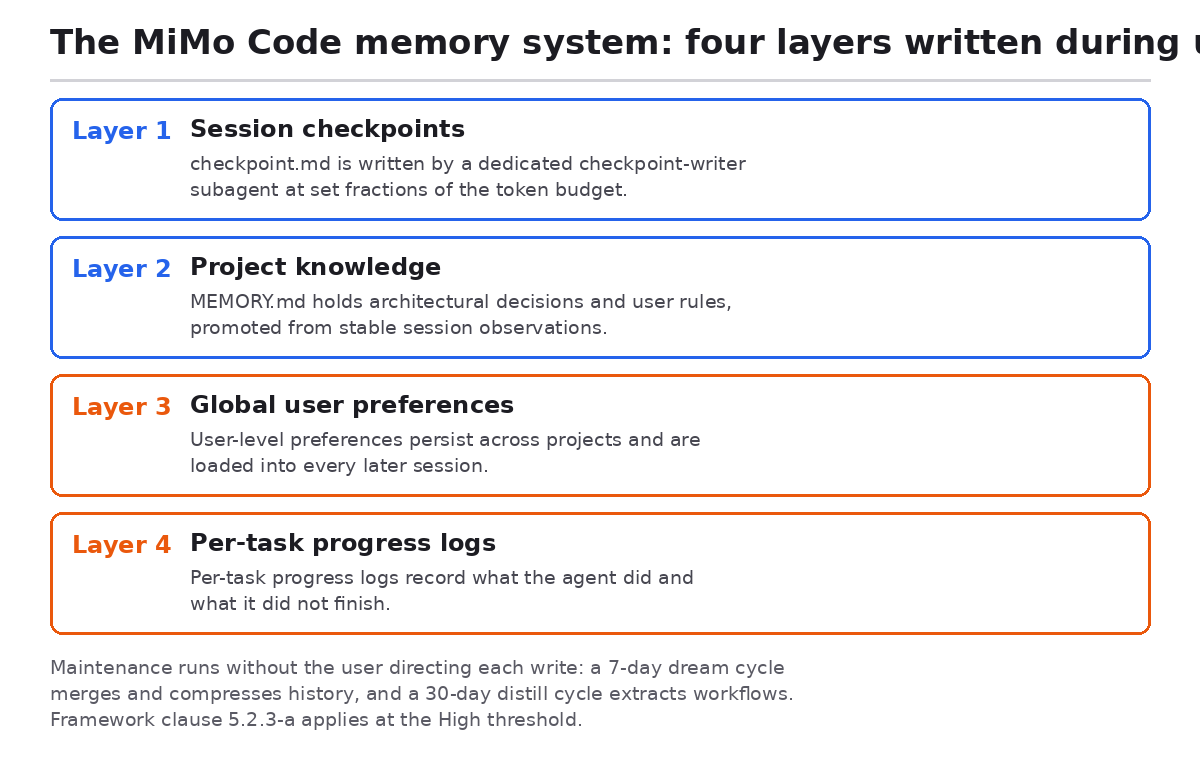
Delivery surface to check separately from the model: MiMo Code, and the clause 5.2.3-a finding in the Framework v1.2 clause note below rests on the same memory mechanism described in the published MiMo-V2.6-Pro review. It is a harness property rather than a model property, so it applies here exactly as it applies there. Note that MiMo Code is not limited to Xiaomi models, which makes the memory mechanism reachable even without adopting this specific checkpoint.
Open-source-specific fields:
Weights repository: XiaomiMiMo/MiMo-V2.6-Flash-RL on Hugging Face, 429 likes and 13,243 downloads in the trailing month as of 2026-09-24, last modified 2026-09-22. It is the most downloaded of the three V2.6 checkpoints, more than three times Pro's rate.
License: MIT, ungated, no revenue threshold and no additional condition.
Maintained status: Active. Released alongside Pro in the same collection on the same day.
Download size and hardware bar: 177.8 GB across 90 files, 67 of them larger than 1 GB, at 311 billion parameters on disk across BF16, F32, F8_E4M3 and U8 tensor types. The vendor's SGLang recipe uses 8-way tensor parallelism with data parallelism; the vLLM recipe uses 4-way tensor parallelism.
Ecosystem activity: the checkpoint has one adapter and two fine-tunes recorded against it, plus 29 quantised derivatives.
At a Glance Dashboard
Field | Value |
Category | Applied AI / Large Language Model (open-weights, omni-modal, high-volume and long-horizon work) |
CI-First Benefit Score | 5.5 / 10 (CI-First Positive) |
Sub-scores | Time 7 / Quantity 7 / Quality 5 / Skill 3 |
CI-First Profile | Primary: Co-Worker and Assistant (level 2). Secondary: Analyst and Tester (level 4) |
Collaboration Mode | Centaur. Cyborg is unavailable for the same reason as Pro: the harness runs background writers the user does not direct per write |
Humics Protection | Humics-Neutral (-1 / +3) |
AI Imposture Risk | Medium overall, with Skill Illusion High |
Status | Active |
Last tested | 2026-09-24 (MiMo-V2.6-Flash, mimo-v2.6-flash, released 2026-09-21) |
Released | 2026-09-21, open-sourced 2026-09-22 |
Access | Xiaomi MiMo API, MiMo Studio, MiMo Code, MiMo Desktop, OpenRouter, a free third-party tier, self-hosted under MIT |
Price | $0.14 per million input uncached, $0.0028 cached, $0.28 per million output |
Context window | 1,048,576 tokens in, 131,072 tokens out (reduced on the free tier) |
Independent intelligence score | None published. Not ranked by Artificial Analysis; not eligible for a public rank on BenchLM |
Parameters | 309B total, 15B active per token |
The Problem
The model you can afford and the model that is good enough to trust have been different models for as long as the price gap was wide. Pro closed part of that gap at the top of the range. Flash addresses the other end, which is the end most institutions actually live at: the recurring work that is not interesting, does not need frontier reasoning, and has to run ten thousand times a month.
That work has a specific shape. It is structured, it is checkable, and its cost is dominated by the number of calls rather than the difficulty of any one of them. A model that costs a third of the flagship is not a compromise on that work, it is the correct instrument. A model that costs a third of the flagship and also happens to be a smaller architecture is a different decision, and the two are easy to confuse.
A second problem is specific to this tier. Cheap models are usually cheap because they are older, or smaller, or both, and the reduction in capability is documented. Here the reduction is real but unevenly documented: the vendor publishes a comparison table against its own flagship and against three competitors, and no independent evaluator has produced a composite score for this model at all. A reader deciding whether Flash is good enough for their work is therefore deciding on vendor-published rows and on a handful of sourced benchmark entries, without the independent check that exists for Pro.
A third problem arrives with the adoption decision rather than before it. An institution adopting an open-weights model from a new supplier is also adopting that supplier's data practices, and the cheap tier is where volume concentrates. Section 7c treats this directly, because a primary-source regulatory report has raised it.
There is a fourth problem worth stating plainly, because it is the mirror image of the third. The free tier at this price point is attractive, and free is the feature that most reliably converts a prototype into a production dependency. The question of what happens to the data a reader sends to a free tier is not rhetorical here, and Section 7c, the governance section below, explains why.
The Outcome
What changes for a reader who adopts this model:
The per-call price drops to a third of the flagship in the same family, on the vendor's own rate card, and to under a fifth of the closed mid-tier. Flash is $0.14 and $0.28 per million tokens against Pro's $0.435 and $0.87 and against GPT-6 Sol's $2 and $10. On an input-only comparison that is roughly one fourteenth of the closed mid-tier price.
Cached input drops to $0.0028 per million. A stable prefix on a repeated job costs almost nothing, and the cache discount here is 98 percent. For a batch job with a fixed instruction block, the effective input price is close to zero.
The capability cost is smaller than the price difference on most ordinary work. On the vendor's own table Flash trails Pro by four points or fewer on DeepSWE v1.1 (67.9 against 71.9), AutomationBench (52.3 against 53.1), Toolathlon-Verified (73.6 against 76.9), Terminal Bench 2.1 (87.6 against 89.9), OSWorld-Verified (80.8 against 82.0), JobBench (61.2 against 62.0) and MiMo VisualCoding (71.5 against 72.3). If your work looks like those benchmarks, the third-of-price model is very close to the flagship.
It beats its own flagship on one independent-visible row. On CyberGym, Flash scores 95.1 against Pro's 94.0. That is the single defensive-security row where the smaller model wins, and it is worth knowing because it is the only benchmark in the family table where the cheaper model leads.
The weights are genuinely usable at this size. 177.8 GB and 4-way to 8-way tensor parallelism is a small cluster rather than a data-centre build, and the MIT licence has no strings. This is the first model in the family where self-hosting is a plausible institutional decision rather than a theoretical one.
There is a working free tier, which makes evaluation cost nothing. A third-party gateway publishes a no-charge variant with a reduced window. Read the governance section before you decide what to send it.
The honest counterweight, stated once and then carried through this review:
No independent evaluator has produced a composite intelligence score for this model. This is the defining limitation of the review. Artificial Analysis has a model page for Pro and none for Flash. BenchLM tracks 14 source-displayable rows against 482 tracked slots, records six of eight benchmark categories as "not measured", and states that Flash does not qualify for a public rank. Its category table nonetheless shows an Agentic figure of 76.2 across nine verified benchmarks, with coding verified across three, so the agentic evidence is the strongest part of the picture and the reasoning, knowledge, multimodal, multilingual, instruction-following and math categories are simply absent.
Every capability number in the vendor's table is vendor-run. The four external sources that repeat the table are repeating the vendor's numbers, not independently producing them. BenchLM labels its rows "Provider exact" and cites the technical report, which is accurate labelling of a vendor figure, not verification of it.
The comparison set in the vendor's table is the same selective set criticised in the published MiMo-V2.6-Pro review. Claude Opus 5, GPT-5.6 Sol and Claude Fable 5, with the two models Xiaomi itself names as the leaders, Claude Fable 5.1 and GPT-6 Astra, absent. The omissions matter more here than they did for the flagship, because a cheaper model's case rests entirely on how close it gets.
The hard-task gap is real and this model carries it worse than Pro. Terminal Bench 4.0 at 28.8 against Pro's 34.9 and Claude Opus 5's 49.0. ExploitGym at 6.0 against Pro's 17.8. ExploitBench at 25.3 against Pro's 47.9. SEC Bench Pro at 47.5 against Pro's 66.3. Where Pro is behind the closed leaders on hard tasks, Flash is further behind, and on the exploitation-oriented security benchmarks it is close to absent altogether.
The one independent comparison that exists does not favour it. On Terminal-Bench 4.0, community-tracked results place Flash behind GLM-5.3-Flash at 32.8 and only slightly above Qwen3.8-Flash-Next at 25.3, though well ahead of DeepSeek-V4-Flash at 12. Its sibling Pro sits at 34.9 on the same row. In the tier where Flash competes, it is not the leader on the hardest benchmark in the tier.
Documentation quality is poor in a way that affects setup. The model page states "Input Modality: Text" in its specification block and "Native Full Modality: joint input and understanding of images, video, audio, and text" four lines later under Strengths. The Hugging Face model card lists Text, Image, Video and Audio. The specification line is almost certainly a template error, and this is the same documentation-lag pattern the published MiMo-V2.6-Pro review recorded. One aggregator additionally mislabels the weights as "Closed" and records the API model id as "not published".
No independent speed or latency measurement exists. The stated purpose of this model is throughput at volume, and BenchLM reports speed as "not measured" with no time-to-first-token figure. The one headline the model is sold on is the one nobody has measured.
Section 7c: Governance and provenance, stated plainly
This section exists because a primary source raises a governance question that is material to the adoption decision, and because leaving it to a footnote would make this review less useful than it should be.
What is alleged. Anthropic's September 2026 threat intelligence report, "Detecting and countering misuse of AI", names Xiaomi in a case tagged GTG-16008 under the heading "Distillation campaign by Xiaomi". Read directly from Anthropic's published report, the specific allegations are:
Xiaomi replayed user conversations and coding sessions from its own MiMo models to Claude, often routed through the OpenClaw and OpenCode coding harnesses.
Xiaomi saved the full request and response from its own users and replayed those sessions through Claude to generate data for both supervised fine-tuning and reinforcement learning.
Anthropic observed more than 400,000 requests to Claude routed across more than 1,500 accounts via proxy services, over 20 days in March and April 2026.
Anthropic states its investigation suggests Xiaomi may have launched its MiMo-V2-Pro model with a free trial period, later extended, with the intent of using the surge in international developer use to distill Claude capabilities, and that the bulk of the activity began as the trial was ending.
The relayed traffic is alleged to have included sensitive data from users who accessed Xiaomi's models through third-party model routing platforms: names, contact information, corporate data and other sensitive data from hundreds of Xiaomi users in at least a dozen languages. Anthropic states it has no indication that US persons' data was exposed.
The report also states that the same proxy service networks were used by a variety of organisations, and that some accounts funnelling requests for another lab were also found to be funnelling requests for Xiaomi, which is a statement about shared infrastructure rather than about intent.
What these allegations are not. They are Anthropic's findings, published by one company about another. They are not an independent adjudication, not a legal finding, and not a court judgment. Anthropic states it attributes campaigns with high confidence through IP correlation, request metadata, infrastructure indicators and partner corroboration, which is a stated methodology rather than produced evidence. Xiaomi had not publicly responded to the allegation as of this review. A reader should hold this as a serious, source-documented allegation and not as an established fact, and should follow the third re-check trigger in the Status and re-check block at the top.
Why it is material to this review rather than a separate matter. Three reasons, in ascending order of practical importance.
First, the alleged mechanism is the free tier. A free trial extended until international developer use peaked is, on Anthropic's account, the intake mechanism for the data. A reader evaluating Flash will encounter a free tier on at least one gateway. That does not mean the free tier is illegitimate; it means the free tier is precisely the surface the allegation concerns, and it deserves a deliberate decision rather than a default one.
Second, the alleged intake is user conversation content, not public data. The report's claim is that Xiaomi saved its own users' requests and responses and replayed them elsewhere. If a reader's own prompts and the content in them matter, that is the relevant risk, and it exists independently of whether the distillation question is ever resolved.
Third, and most concretely, the dispute is about how the model was made, which bears on what a buyer can promise. An institution deploying this model into a regulated or client-facing workflow may be asked to document the provenance of its components. On the current record, that documentation does not exist in a form a compliance function can accept. This is a procurement question rather than a technical one, and it is answerable: adopt the weights under MIT and host them yourself, in which case the provenance question moves to the checkpoint and away from the API arrangement, or use a first-party or neutral gateway where you have a direct data-processing relationship, or wait.
What this section does not do. It does not change the CI-First scores, because the framework measures benefit to the human and the Humics, not supplier conduct. It does not assert that Xiaomi is in the wrong. It does not treat the allegation as a reason to avoid the model, which would be substituting a judgement for a reader's own. It states what a primary source alleges, attributes it, and names the decision it puts in front of the reader.
Who Should Use MiMo-V2.6-Flash
Learner type | Difficulty | Typical ROI | Career path |
Students (Bachelor, Master) | Intermediate for the API, Advanced for self-hosting | The strongest student case is that evaluation is free and the per-call cost is trivial, so a pipeline that would exhaust a budget on a flagship can be built and tested at almost no cost. The 1M-token window handles a whole corpus. The Skill Illusion is the live risk, and there is no independent knowledge measurement to reassure you. | UIT (Technology, AI, Data Science) tracks, through the AI Developer Specialist and Data Scientist programmes. The degree outcome is open to SUPERHUMAN Fellows only. |
Professionals (career upskilling) | Intermediate | Recurring structured extraction, batch classification, agent loops, and long-document processing at a third of the flagship price and under a fifth of the closed mid-tier's input price. The measured-agentic evidence is the strongest part of the picture; the measured-knowledge evidence does not exist. | UIT engineering and data tracks through the Cloud Computing Specialist and Tech Leader programmes, and UIB (Business Management, Entrepreneurship) through the AI Business Specialist programme for the unit-economics question, since this model's entire case is cost per call. |
Everyone (lifelong learners) | Beginner for chat in MiMo Studio, Advanced for agent use | The price makes experimentation genuinely free, and the free tier means the first hour costs nothing. The agent surfaces it is built for need supervision, and the model card's own documentation contradicts itself on what you can send it. | SL-OS daily learning routine, LIPS Collect and Review phases. |
Skill level required: Intermediate for extraction, classification and document work through the API or MiMo Studio. Advanced for agentic use, because supervising a loop means setting the boundary and reading the report. Advanced plus infrastructure for self-hosting, though the bar is lower here than for Pro.
Prerequisites: A Xiaomi MiMo account with a prepaid balance, or a gateway account, or the free third-party tier for evaluation. Working knowledge of prompt structure and verification practice. A deliberate decision about what you will and will not send, for the reasons in Section 7c.
Typical time to first result: Under five minutes in MiMo Studio or through the free tier. Under fifteen minutes through the API with the OpenAI-compatible base URL.
Typical time to competence: Five to fifteen hours of active use. The lesson that matters most here is calibration: with no independent composite score and no independent speed measurement, the only reliable way to know what this model does on your workload is to measure it yourself, and the price makes that cheap enough to be worth doing properly.
U365 Institutes Alignment
The institute rows below state the relevance of each institute to this tool. UIT and UIB were confirmed as drafted; UIC and UID were confirmed at the lower end of their bands, and UID is rated one step below the rating UDA gave the same institute on GPT-6 Sol because the evidence here is thinner.
Institute | Relevance | Why |
UIT (Technology, AI, Data Science) | High (primary) | The clearest fit in the U365 curriculum, and the only institute that gains credential chains from this tool. High-volume extraction and batch pipelines where the schema is fixed and the errors are cheap to catch. Prompt-level cost engineering: cache-hit rate, the Batch API, and cost per completed item rather than cost per token. Calibration as a measurement discipline, which is the only quality signal available for this model and the one exercise the price makes free to run. Agent loops with an iteration cap and a spend cap set before the run, plus the memory boundary that the MiMo Code surface makes mandatory. Self-hosting at 177.8 GB with 4-way to 8-way tensor parallelism, which is the first checkpoint in this family where an institutional self-hosting exercise is realistic rather than theoretical. |
UIB (Business Management, Entrepreneurship) | High | The strongest unit-economics case in the series, and the rating is confirmed rather than downgraded. At $0.14 and $0.28 per million tokens, a third of its own flagship and roughly a fourteenth of the closed mid-tier on input, with a 98 percent cache discount and a working free tier, a learner can run a genuine cost-benefit exercise on a real model and produce their own measurement, which is a management analysis rather than a tooling exercise. The make-or-buy question is live here too, because self-hosting at 177.8 GB is a plausible capital decision rather than a theoretical one. Two limits hold the row at High and no higher: the tool teaches no management, leadership, finance or entrepreneurship content of its own, and the absent knowledge measurement blocks routing professional document production to it. |
UIC (Digital Communication, Marketing) | Low to Medium | No independent evaluator has measured any design or writing output from this checkpoint, and the family's design-arena strength was measured on Pro. That result does not transfer to the smaller model, and the transfer is treated as unavailable rather than as likely. What remains is a general text-capable model that drafts and restructures, plus a supporting role in content-operations automation. It builds no brand voice, audience judgment or campaign craft, and the only knowledge row that exists in the family is unfavourable. No credential chain. |
UID (Digital Design, UX/UI) | Low | Same reasoning as UIC, and this row is rated one step below the rating the same institute carries on GPT-6 Sol. The difference is evidence. On GPT-6 Sol the vendor's own launch material showed the model working through a layout change and reading images, so implementation support was a real competence even though design judgment was not. Here the documentation contradicts itself on whether the model accepts an image at all, no independent design result exists, and the family's design-arena numbers belong to the flagship. Generating interface code from a specification is implementation and not design education, and the model does not produce a visual asset. No credential chain. |
The reason for the UID row, stated once. A reader comparing this post with the GPT-6 Sol review will see the same institute rated one step lower here, and the rule is worth stating: where the record is thinner, the rating is lower. The earlier rating rested on vendor material showing a layout change and an image read, and here the model page contradicts itself on input modality within four lines, so even the implementation-support claim is unverified.
Credential anchors
Five credential chains are anchored to programmes verified as published on university-365.com on 2026-09-24. Four belong to UIT and one to UIB. There is deliberately no UIC or UID chain, because neither institute's disciplinary competency is built by this tool.
Tool skill | U365 competency | Credential anchor | Institute | Stacks into |
Producing a measured quality signal where none is published: running a sample through a second model from a different laboratory, counting disagreements per field, and setting a tolerance before scaling | Applied AI evaluation and calibration measurement | Data Scientist (60 days, diploma) | UIT (Technology, AI, Data Science) | Master of Science in IT (M.Sc.) |
Configuring a high-volume pipeline for cost and correctness: the Batch API where latency does not matter, the cache-hit rate on a stable prefix, and the gap between a rate card and a gateway's resale price | Applied AI platform and cost engineering | Cloud Computing Specialist (30 days, diploma) | UIT (Technology, AI, Data Science) | Bachelor of Science in IT (B.Sc.), then Master of Science in IT (M.Sc.) |
Building a high-volume extraction or batch pipeline to a fixed schema: the null rule, what a wrong field costs, sampling before scaling, and a random spot-check rather than the first page | High-volume data extraction and batch processing | AI Developer Specialist (18 days, diploma) | UIT (Technology, AI, Data Science) | Bachelor of Science in IT (B.Sc.), then Master of Science in IT (M.Sc.) |
Running a bounded agent loop with the caps and the memory boundary declared in advance: an iteration cap, a spend cap, a stop rule, a diff read rather than a summary read, and a record of what the agent surface wrote | Agent governance and delivery-surface accountability | Tech Leader (25 days, diploma) | UIT (Technology, AI, Data Science) | Bachelor of Science in IT (B.Sc.), then Master of Science in IT (M.Sc.) |
Building the business case for a delegated volume workflow: the baseline of attempts, human minutes and error rate, the cost per completed item, the make-or-buy comparison against self-hosted MIT weights, and an explicit accepted-risk decision | AI unit economics and accountable automation governance | AI Business Specialist (18 days, diploma) | UIB (Business Management, Entrepreneurship) | Bachelor of Business Administration (B.B.A.), then Master of Business Administration (M.B.A.) |
Access level, stated plainly. University 365 has three academic access levels: DISCOVERY, INSIDER and SUPERHUMAN. Micro-credential and specialised diploma programmes have Basic, Foundation and Expert levels, and DISCOVERY Fellows can enrol in Basic only while SUPERHUMAN Fellows can enrol in all of them. University degree programmes carry a single Expert level and are open to SUPERHUMAN Fellows only. Because four of the five chains above stack into a B.Sc., an M.Sc., a B.B.A. or an M.B.A., the degree outcome in four of the five chains is open to SUPERHUMAN Fellows only. No per-programme access level is asserted here, because the published catalogue does not expose one.
Where this tier belongs in the U365 methods
LIPS and CARE. Route the model's output into the Collect phase and keep the Action Plan and Review phases as your own work. The record that matters is the calibration record: the sample size, the second model used, the per-field disagreement rate and the tolerance you set. It sits beside the schema, the null rule, the caps, the cost per completed item and the memory-write record in your own LIPS Digital Second Brain, which remains the record you own rather than the surface's memory file.
ULM and EVA. Career and Finance is the primary domain, through the cost-per-completed-item discipline and the make-or-buy comparison against self-hosted weights. Quality of Life is conditional: it improves where the tool removes a repetitive reading or sorting burden you already understand, and it does not improve where it adds a supervision load you did not previously carry. This tool is not recommended for My Body and Health, My Spirit and Mind, My Character and Emotions, or My Social and Love Relationships. Within EVA, the tool serves Explore through a batch pass with every item tied to a quoted passage, and Visualize through mapping the schema, the calibration rate, the caps and the cost per completed item.
U.Copilot routing. U.Copilot should route a Fellow to this model for high-volume mechanically checkable work, unattended batch passes, agent loops where the per-call price binds, wide rather than deep work, zero-cost prototyping on the free tier, and the published reinforcement-learning recipe as study material. It should route away when the Fellow needs a citable quality signal before committing, is doing hard agentic terminal work or anything exploitation-oriented, is doing factual reference work, wants a final judgement call delegated, is routing regulated or client-facing work that must document component provenance, cannot read the output well enough to verify it, has not decided what the surface may write, or would let the surface's memory file become the only written record of the project. Never present the price without the evidence gap, and never describe this model as a cheaper Pro.
UNOP. The tool supports retrieval practice, because every verification close requires you to reproduce a result without the tool, on a fresh sample, in your own words. It supports measurement as a learning act and explanation as the evidence of understanding. It conflicts with the pedagogy in three ways: it claims no teaching mode, its release materials frame delegation rather than reproduction, and its memory is written for you on the agent's schedule rather than authored by you. The one UNOP habit this release makes more valuable than before is producing your own measurement when nobody has published one.
How MiMo-V2.6-Flash Works
Inputs: A text prompt, system instruction, or conversation. Images, video and audio as native inputs through the same encoder design as Pro. Files or long documents up to roughly a million tokens. Tool schemas for function calling. A cacheable stable prefix if you want the cache discount.
Outputs: Text. Reasoning traces where the surface exposes them. Tool calls and structured output. Code, used mainly for agent and automation tasks rather than for the design work the flagship is marketed on.
Underlying technology:
Models used: it is the model. Architecture is a sparse Mixture of Experts with 309 billion total parameters and 15 billion activated per token, drawn from 256 routed experts with 8 active and no shared experts, across 48 layers split 39 sliding-window-attention and 9 global-attention, hidden size 4096.
Encoders: the same as Pro, which is worth noting because it means the multimodal capability is not the place where the cheaper model was economised: a 681M-parameter MiMo ViT with 28 layers, a 308M-parameter AudioTokenizer with 20 residual-vector-quantization codebooks, and a 127M audio patch encoder.
Inference acceleration: a 5-layer sliding-window-attention multi-token-prediction drafter predicting seven subsequent tokens per forward pass, and a separate DFlash draft model in the published repository.
Training: the same mixed reinforcement-learning run as Pro, which is the single most interesting fact about this model's provenance. Xiaomi describes one mixed RL run across coding, general agent, visual and cybersecurity tasks rather than separate per-domain runs, and both models were trained inside it. Flash completed 30 steps over roughly 750,000 trajectories in under six days at a reported cost of about $850,000, against Pro's $2.62 million. Average pass rates on training tasks rose 25 percent in relative terms for Flash against 12 percent for Pro, and out-of-sample DeepSWE v1.1 improved from 48.8 to 65.7 for Flash against 58.4 to 72.6 for Pro. A smaller model improving faster from the same run is the expected shape, and it is the strongest evidence that the reinforcement-learning approach generalises across model sizes.
Reward shaping and reward-hacking defences: the same Groupwise Reward Synthesis and Groupwise Advantage Redistribution mechanisms described in the published MiMo-V2.6-Pro review, with the same disclosed failure modes. VentureBeat's reconstruction of the technical report attributes the finding that training without online groupwise grading caused turn counts and token lengths to rise, and that the graded policy produced smaller patches. That finding comes from a code-only RL run on MiMo-V2.6-Flash specifically, so it is this model's evidence rather than the family's.
Integrations: OpenAI-compatible and Anthropic-compatible APIs. Coding-framework support is advertised for the same harness list as Pro, including OpenClaw, Codex, OpenCode, Claude Code, Kilo Code and Cline. A Batch API covers this model explicitly.
LLM-specific fields:
Context window size: 1,048,576 tokens in, 131,072 tokens out. The free third-party tier is reduced to 200,000 in and 32,000 out.
Parameter count: 309 billion total, 15 billion active per token. 311B parameters on disk across mixed precision tensor types.
Architecture details: sparse MoE, hybrid sliding-window and global attention, native multi-token prediction, with the multimodal encoders shared with the flagship rather than scaled down.
Available effort or thinking levels: deep-thinking mode exists, with a thinking control visible in the vendor's example payloads. No named effort ladder is documented.
Benchmark highlights, as published by the vendor on the model card: DeepSWE v1.1 67.9; ProgramBench 26.0; MiMo Code Bench 61.2; AutomationBench v1.0.6 52.3; Toolathlon-Verified 73.6; Agents' Last Exam 27.6; Terminal Bench 4.0 28.8; Terminal Bench 2.1 87.6; OSWorld-Verified 80.8; JobBench 61.2; CyberGym 95.1; MiMo Cyber Bench 77.2; ExploitGym 6.0; ExploitBench 25.3; SEC Bench Pro 47.5; MiMo VisualCoding 71.5.
Independent benchmark coverage, which is the number that matters most in this review: 14 source-displayable rows across 482 tracked slots on the one aggregator that reports coverage. Agentic category 76.2 across nine verified benchmarks. Coding verified across three, with no category rank assigned. Reasoning, multimodal, knowledge, multilingual, instruction-following and math all recorded as "not measured". No public rank. No independent intelligence score. No independent speed or latency measurement.
Available platforms and APIs: Xiaomi MiMo API, MiMo Studio, MiMo Code, MiMo Desktop, OpenRouter and other gateways, the vendor's Batch API, a free third-party tier, and self-hosting through SGLang or vLLM from Hugging Face and ModelScope distribution.
Model variants: Flash-RL only, plus the reduced free-tier arrangement.
What the caching spread means in practice. The cache-hit input rate is $0.0028 per million against a cache-miss rate of $0.14. That is a spread of about 50 times, and it is smaller than Pro's 121 times in relative terms but larger in practical effect because the base rate is already so low. A batch job with a fixed instruction block and a varying document pays a rounding error for the instructions. A one-shot question with no reusable prefix pays the full rate. The number to watch is your cache-hit rate.
Where the economy stops. The encoders were not scaled down, the context window was not scaled down, and the attention design was not simplified. What was scaled down is the depth and width of the transformer stack: 48 layers against Pro's 70, 256 experts against 384, hidden size 4096 against 6144, and 15 billion active parameters against 42 billion. That is why the multimodal and long-context capability stays close to the flagship while the hardest reasoning and exploitation tasks fall away. A reader can predict from this where Flash will hold up on their own work: anything that is wide rather than deep, and repeated rather than novel.
Getting Started with MiMo-V2.6-Flash
Required accounts: A Xiaomi MiMo Open Platform account for the first-party API, which is prepaid rather than invoiced. Alternatively a gateway account. For evaluation at zero cost, the third-party free tier requires only that gateway's account.
Installation: Nothing to install for the API or the web surface. For a coding workflow, MiMo-Code from the GitHub organisation. For self-hosting, SGLang or vLLM with the vendor's published launch flags for the Flash checkpoint.
First-time configuration:
Create an account at https://platform.xiaomimimo.com and top up a balance, or create a gateway account if you are evaluating on the free tier.
Generate an API key and store it as MIMO_API_KEY rather than pasting it into a script.
Point an existing OpenAI-compatible client at https://api.xiaomimimo.com/v1, or an Anthropic-compatible client at https://api.xiaomimimo.com/anthropic, and set the model to mimo-v2.6-flash in lowercase.
Confirm which input modalities you are actually getting. The model page says "Text" in its specification block and "Native Full Modality" four lines later, and the model card lists all four. Send one image and check the response before you design a pipeline around multimodal input.
Decide what you will not send. Section 7c explains why this is a configuration step rather than a policy footnote.
Send one request with a long, stable prefix twice, and compare the reported usage. You are measuring your own cache-hit rate, which at this price point is the difference between a cheap model and a nearly free one.
First 15 minutes checklist:
☐ Run one prompt through MiMo Studio and confirm the multimodal input works by sending an image you supply, not a demo image.
☐ Repeat the same call with a stable prefix and record your cache-hit rate from the usage numbers.
☐ Run the same extraction task on the same 20 documents through Flash and through a second model from a different laboratory, and count per-field disagreements. This is the calibration step that substitutes for the missing independent score, and it is the highest-value fifteen minutes you can spend on this model.
☐ Ask it one factual question where you already know the answer, and note whether it declines or invents. There is no independent knowledge measurement for Flash, so this is your only early read.
☐ Write down what you will not send to this model, and why.
Result: After fifteen minutes you should have a working key, a measured cache-hit rate, a first-hand per-field comparison against a second model, and a governance decision you made deliberately. The comparison and the governance decision are the two things this review cannot supply for you, and both are cheap to produce.
Real Workflows
Workflow 1: A high-volume extraction pipeline, calibrated against a second model before it scales
Learner type: Professional / Everyone CI-First benefit tags: Time, Quantity Connects to: the Data Scientist and AI Developer Specialist programmes for UIT, and the AI Business Specialist programme for UIB. Time estimate: Forty-five minutes to stand up including the calibration, then minutes per batch.
This is the workflow this model exists for. The calibration step is what makes it safe, because with no independent composite score for Flash, the only honest way to know its per-field error rate on your documents is to measure it. Do that at twenty documents, not at twenty thousand.
What you do vs what the tool does:
Step | You do | The tool does |
1 | Define the schema and pick one field you can verify mechanically | Nothing |
2 | Assemble 20 documents and hand-check the ground truth yourself | Processes each document and returns structured fields |
3 | Run the same 20 through a second model from a different laboratory | Produces outputs |
4 | Count disagreements per field, not per document, and decide your tolerance | Nothing. This is your judgement |
5 | Fix the prompt on the failure pattern you observed, not the one you expected | Re-runs the sample |
6 | Scale, then spot-check a random slice rather than the first page | Processes the full set |
Sample prompt, UP-Context structure:
Context: A set of supplier invoices as images and PDFs, 4,000 documents. Each has an issuing entity, an invoice number, a currency, a gross amount, a tax amount and a stated payment term. Currency formats vary and some documents are scanned. Profile: You are acting as a Co-Worker and Assistant. I own the schema and the judgement calls. You do not decide anything. Task: For each document, return the six fields as JSON. Where a field is not present or is illegible, return null rather than a guess. Constraints: Do not infer a currency from the entity name. Do not arithmetically derive the tax amount from the gross. If the gross and the stated total disagree, return both and flag the disagreement. Output format: A single JSON object per document with the six fields plus one flags array. No commentary outside the JSON.
Verification checklist:
☐ Multi-Model Check: the calibration in step 3 and 4, repeated whenever the document mix changes. Record which second model you used and the per-field disagreement rate.
☐ External Source: reconcile extracted totals against an independent record you already hold, such as a bank statement or ledger, on at least 30 documents.
☐ Human Review: a colleague who did not build the pipeline reviews the sample and the disagreement list, and checks the null handling specifically, because a model that guesses instead of returning null is the failure that costs money.
☐ CI-First Test: can you explain and defend the schema and the rules you gave it without the tool? [Y/N]
Workflow 2: An agent loop where the per-call price is the binding constraint
Learner type: Professional CI-First benefit tags: Time, Quantity Connects to: the Tech Leader programme for UIT, with the Cloud Computing Specialist programme covering the cost configuration. Time estimate: Thirty minutes to set the boundary and the stops, then the run, then the read.
The case for Flash in an agent loop is arithmetic rather than qualitative. Agents make many calls; the cheapest call that completes the task wins. The case against it is that Flash is measurably weaker on the hardest terminal tasks, so a loop that needs many attempts on a hard problem can spend the saving on retries. Run this workflow on ordinary tasks and measure the retry count before you run it on hard ones.
What you do vs what the tool does:
Step | You do | The tool does |
1 | State the finish line as a testable condition and name the stops | Nothing |
2 | Set a maximum iteration count and a maximum spend, and write both down | Nothing |
3 | Decide what the memory system may persist, and read the memory, checkpoint, dream and distill settings before the run | Nothing |
4 | Record the iteration count and the token spend at the end, not just whether it succeeded | Plans, edits, runs tests, iterates |
5 | Stop the run when a stop fires. Do not negotiate with a run past its stop | Writes session checkpoints through the checkpoint-writer subagent |
6 | Read the diff, not the summary, and read what the memory system wrote | Nothing. This is the step that stops the illusion becoming durable |
Sample prompt, UP-Context structure:
Context: A repository at a known good commit, with a test suite that runs in under two minutes. The task is to add pagination to one list endpoint. The surrounding code uses a repository-plus-service layout and no new dependency is permitted. Profile: You are acting as a Co-Worker and Assistant. I own the interface decision and the merge. You do not commit. Task: Implement the change, run the test suite, and report what you changed and what you verified. Constraints: Do not modify the test suite. Do not add a dependency. Do not change any other endpoint. If a test fails for a reason unrelated to your change, stop and tell me rather than fixing it. Stop and report if you have made more than twelve edit-and-test cycles. Output format: A short report with four sections in this order: files changed, the exact command you ran to test, the result, and anything you did not verify.
Verification checklist:
☐ Multi-Model Check: run the same task with the flagship sibling and compare iteration counts and total token spend. If the cheaper model needs more than twice the cycles, it is not cheaper for that task.
☐ External Source: run the test suite yourself, and add one test the task brief implied but the model did not write.
☐ Human Review: a colleague reviews the diff and separately reads MEMORY.md and the checkpoint file for claims about the project that are now in writing and wrong.
☐ CI-First Test: can you explain and defend the interface choice without the tool? [Y/N]
Workflow 3: A batch pass over more material than you could read
Learner type: Everyone / Student CI-First benefit tags: Time, Quantity Connects to: the AI Developer Specialist programme for UIT and the AI Business Specialist programme for UIB. Time estimate: Twenty minutes to define the extraction, then unattended running time.
The Batch API and the 1M-token window together make this the workflow where the price difference is largest and the supervision requirement is lowest, because the job is unattended by design.
What you do vs what the tool does:
Step | You do | The tool does |
1 | Define what you are looking for as a fixed set of fields or questions | Nothing |
2 | Hand-check the answers on five documents you know well | Processes the whole set |
3 | Decide what a wrong answer would cost you, and whether that is acceptable at this error rate | Nothing. This is the decision |
4 | Run the batch during off-peak hours | Processes the full set |
5 | Read a random sample of the output, not the first page | Nothing |
6 | Record the error rate you found, so the next batch has a baseline | Nothing |
Sample prompt, UP-Context structure:
Context: A corpus of 800 project documents. I am looking for decisions, the date each was made, the person accountable, and any stated deadline. Profile: Act as an Analyst and Tester. I am asking you to find things, not to summarise. I will verify. Task: For each document, return every decision with its date, accountable person and deadline. Quote the sentence you took each from. Constraints: If a field is not stated, return null. Do not infer an accountable person from a job title. Quote verbatim; do not paraphrase. Output format: One JSON object per document, plus a top-level count of how many decisions you found.
Verification checklist:
☐ Multi-Model Check: run a fifty-document slice through a second model and compare the counts and the quoted sentences.
☐ External Source: open three source documents yourself and confirm the quoted sentence exists and supports the extracted decision. A quoted sentence that does not appear in the source is the failure mode that matters here.
☐ Human Review: someone who knows the project history reads the output and flags any decision they know was real but is missing.
☐ CI-First Test: can you defend the field definitions and the null rule without the tool? [Y/N]
Strengths, Limits, and AI Imposture Risk
Strengths
The tool delivers clear CI-First benefits in these areas:
CI-First Benefit | Strength | Evidence |
Time | Per-call input price is roughly one fourteenth of the closed mid-tier and exactly one third of its own flagship, with a 98 percent cache discount on repeated prefixes | $0.14 and $0.28 per million against Pro's $0.435 and $0.87 and GPT-6 Sol's $2 and $10, from the vendor rate card and the aggregator provider tables |
Quantity | The stated purpose of the model is high-frequency volume, and the capability cost on ordinary work is small | Vendor table shows four points or fewer behind Pro on DeepSWE v1.1, AutomationBench, Toolathlon-Verified, Terminal Bench 2.1, OSWorld-Verified, JobBench and MiMo VisualCoding; the checkpoint is the most downloaded of the three V2.6 releases at 13,243 in a month |
Quality | Genuinely close to the flagship on wide, repeated, structurally similar work, and ahead of it on one defensive-security benchmark | Agentic category 76.2 across nine source-verified benchmarks on the one aggregator reporting coverage; CyberGym 95.1 against Pro's 94.0; encoders and context window not scaled down from the flagship |
Skill | The published RL artefact is unusually good teaching material, and this checkpoint was trained inside the same run that trained the flagship, so the recipe is demonstrably size-transferable | Flash's average training pass rate rose 25 percent in relative terms against Pro's 12 percent from one mixed RL run, and the groupwise-grading finding quoted in this review comes from a Flash-specific code-only run; 7,000-plus environments and the RL framework are published alongside |
Limits
The tool is weak or brittle in these areas:
No independent composite score, at all. Artificial Analysis has a model page for Pro and none for Flash. BenchLM tracks 14 rows against 482 slots, records six of eight benchmark categories as "not measured", and assigns no public rank. This is not a small gap in the evidence, it is the central limitation of the model's public record.
No independent speed or latency measurement. The model is sold on throughput at volume and nobody has measured it.
No measured knowledge floor. Pro's AA-Omniscience accuracy of 34.8 percent with a 59.4 percent non-hallucination rate is the family's only knowledge measurement, and it belongs to the larger model. Flash's is unknown, which is worse than known-and-low because you cannot calibrate against it.
The hard-task and exploitation gap is wider than Pro's. Terminal Bench 4.0 at 28.8 against Pro's 34.9 and Claude Opus 5's 49.0. ExploitGym 6.0 against Pro's 17.8. ExploitBench 25.3 against Pro's 47.9. SEC Bench Pro 47.5 against Pro's 66.3.
It does not lead its own price tier on the hardest benchmark. Community-tracked Terminal-Bench 4.0 places it behind GLM-5.3-Flash at 32.8.
Its vendor comparison table inherits the flagship's selective competitor set, and every capability row in it is vendor-run. The four external sources repeating the table are repeating the vendor's numbers.
Documentation is actively misleading in two places and wrong in a third. The model page contradicts itself on input modality within four lines. One aggregator mislabels the MIT weights as "Closed", which could deter a reader who correctly wants to self-host. The same aggregator records the API model id as "not published".
A primary-source governance allegation is unresolved. Section 7c. This is a limit on institutional adoption rather than on capability, and it should be decided deliberately rather than discovered later.
The free tier is a different product than the paid one. 200,000 context and 32,000 output against the paid 1,048,576 and 131,072. A prototype that works on the free tier may not behave the same way after the window changes.
AI Imposture Risk
Trap | Rating | Evidence |
Time Illusion | Medium | The saving is real and conditional. Cached input is $0.0028 per million against $0.14 uncached, so benefit depends on a cache-hit rate the vendor does not publish and no independent party has measured for either sibling. A workload with no reusable prefix pays the full rate and gets none of the discount. Separately, on hard tasks the model is materially weaker than its own flagship, so a loop that needs many more cycles on a difficult problem can spend the token saving on retries. The vendor's own Batch API is the honest answer to this trap and it is the workflow most readers should use. |
Quantity Illusion | Medium | This is where I considered High and landed on Medium, and the reasoning matters. Flash is explicitly the volume tier, its price invites running ten thousand calls instead of one thousand, and no independent evaluator has measured whether its volume holds up. What keeps it at Medium rather than High is the shape of the intended work: structured, checkable, and verifiable field by field. The illusion becomes High for a reader who uses it as a general-purpose answerer rather than an extraction engine, and that reader is the one this rating cannot protect. |
Skill Illusion | High | Two mechanisms. The first is the framework's clause 5.2.3-a: the MiMo Code surface writes procedural memory on the user's behalf, and it does so regardless of which model is driving it. The memory layers, the checkpoint-writer subagent, the 7-day consolidation and the 30-day workflow extraction are all harness properties, so they trigger the clause here exactly as they do for Pro. The second is specific to the cheap tier: a reader with no independent quality signal and a very low price has every incentive to accept more output than they read, and the model's own public record offers no counterweight. |
Overall Imposture Risk: Medium. One trap is High with identifiable mitigations, and two are Medium. Under framework Section 5.3, one High with clear mitigations is Medium rather than High.
Framework v1.2 clause note
Three clauses were checked. Recording the result, nulls included, because a null is a finding.
Clause 5.2.3-a, agent-authored procedural memory: APPLIES, at the High threshold. Identical finding to the published MiMo-V2.6-Pro review, and for a reason worth stating separately: the clause is a property of the delivery surface, not the model. MiMo Code is not limited to Xiaomi checkpoints, so the memory mechanism is reachable by a reader who never adopts this model. Through the Xiaomi API or MiMo Studio alone, Flash holds no state between calls and the clause returns a null. Through MiMo Code it applies: MEMORY.md project knowledge, checkpoint.md session state maintained by a dedicated checkpoint-writer subagent, global user preferences, and per-task progress logs, with a 7-day dream consolidation and a 30-day distill cycle, written during use with no per-write human decision. Both High conditions are met. Skill Illusion is therefore High and the Skill sub-score is scored conservatively at 3.
Xiaomi deserves the same credit here as it does in the published MiMo-V2.6-Pro review: the write-permission model is published, the background writer is restricted to specified paths, and out-of-bounds writes are rejected at the code level. That constrains where the agent writes, not whether a human decides.
Clause 4.2-a, agent-mediated conversation: NULL. MiMo Code is a terminal surface, not a channel to other humans, and the model does not speak in the user's own voice to other people. Social Authenticity is Neutral, scored on the dimension's own question.
Clause 7.5, team-level rooms: NULL. Subagent orchestration runs inside a single execution under a central orchestrator, not in a shared channel where a human coordinates with several named agents as peers. Not a team-level room. Cyborg is nevertheless unavailable, and the Collaboration Mode rationale in the Co-Intelligence Rating section below gives the reason.
U365 Co-Intelligence Rating
CI-First Profile
Primary profile: Co-Worker and Assistant (level 2).
Secondary profile(s): Analyst and Tester (level 4), for extraction, comparison and corpus work, which is this model's strongest measured area.
Why level 2. Same reasoning as the published MiMo-V2.6-Pro review, and it is recorded here so the two posts do not read as inconsistent. The vendor's usage guidance is to hand over a volume task and read the result, which is delegation with review rather than iterative co-creation. Flash is more clearly a level 2 tool than Pro is, because its entire proposition is doing a defined job many times rather than thinking alongside you.
Collaboration Mode
Recommended mode: Centaur.
Alternative mode: None recommended. Cyborg is not available here.
Mode rationale: Two independent grounds. Framework Section 7.2 assigns Centaur when the Imposture Risk is Medium or High, which it is. And Cyborg requires a stopping criterion the human applies inside a fast iteration loop, while the MiMo Code harness runs background writers and 7-day and 30-day maintenance cycles that the user does not direct per write. Those writes happen on the agent's schedule rather than inside a loop you can stop. Define the boundary before the run and review the output per task. That is Centaur.
CI-First Benefit Score
Dimension | Score (0-10) | Rationale |
Time | 7 | The price advantage is real and large: one third of its own flagship, roughly one fourteenth of the closed mid-tier on input, with a 98 percent cache discount on repeated prefixes. Held at 7 rather than higher because no independent party has measured its throughput, the discount depends on an unmeasured cache-hit rate, and on hard tasks the extra retries can consume the saving. |
Quantity | 7 | This is the model's stated purpose and it delivers: a third of the flagship price buys volume, a Batch API exists for unattended runs, a free tier makes evaluation cost nothing, and the encoders and context window were not cut to get there. Held back only by the absence of any independent measurement of whether the volume holds up. |
Quality | 5 | Scored below Pro's 6, and the difference is the finding rather than an oversight. Pro has an independent composite score of 46 and a measured knowledge floor; Flash has neither, six of eight benchmark categories unmeasured, no public rank, and an independent Terminal-Bench 4.0 result behind a competitor in its own price tier. What it does have is genuinely strong agentic coverage, 76.2 across nine verified benchmarks, and four-points-or-fewer parity with its flagship on wide work. Close to the flagship on the common case, unproven where it matters most. |
Skill | 3 | Delegation rather than learning in the common case, and the framework's clause 5.2.3-a applies at the High threshold because the MiMo Code surface writes the user's memory during use with no per-write decision. The published RL stack is the one genuine capability-building surface, and it serves a narrow research audience rather than the common user. |
CI-First Benefit Score: 5.5 / 10 (CI-First Positive)
Why this score sits below the flagship, and only just
Flash is 0.3 points below Pro's 5.8. A reader will ask whether the cheaper model is therefore a worse buy, and the answer is that the two scores are measuring different things about the same family.
The gap comes entirely from the Quality dimension, 5 against 6, and it comes from evidence rather than from capability. Pro has an independent composite score and a measured knowledge floor. Flash has neither. Its agentic evidence is as strong as anything in the family, its parity on wide and repeated work is documented by the vendor and plausible on the architecture, and its encoders and context window are unchanged from the flagship. What it lacks is an outside measurement, and the framework does not award credit for an unmeasured dimension.
For a reader whose work is the shape Flash was built for, the practical difference between the two models is smaller than the score difference suggests, and the price difference is larger. The honest summary is that Flash is not the worse buy, it is the less verifiable one.
Humics Protection Badge
Dimension | Rating | Rationale |
Creativity | Neutral (0) | It produces structured output and code rather than originating direction. Its measured design capability is unknown, and the family's design-arena evidence belongs to Pro and does not transfer. It neither trains nor replaces the user's ideation in the common case, because the schema, the field definitions and the judgement about what the output is for stay with you. Rated consistently with the other reviews in this series. |
Critical Thinking | Erodes (-1) | Four mechanisms, and only one of them is about this model specifically. First, the absence of any independent quality measurement means the user's calibration falls back on vendor rows, which is precisely the position the framework warns against. Second, the price makes running a task three times cheaper than thinking once about whether you should. Third, the vendor's own reward-hacking disclosure, which it published, shows that this class of system fails by satisfying the test rather than doing the work, and that failure looks like success. Fourth, the free tier lowers the cost of entry to the point where the decision to adopt is not deliberated. |
Social Authenticity | Neutral (0) | It produces structured output and code rather than speaking in the user's name in a human-facing channel. Under clause 4.2-a, agent-mediated conversation is not erosion by itself, and MiMo Code is a terminal rather than a channel to other people. |
Humics Protection Score: 0 + (-1) + 0 = -1 / +3 Badge: Humics-Neutral
Superhuman Usage Guidance
When to invite this tool:
High-volume, checkable work: extraction, classification, form filling, structifying, at a third of its flagship price and roughly a fourteenth of the closed mid-tier on input.
Unattended batch runs, where latency is irrelevant and the Batch API and the cache discount compound.
Agent loops on ordinary tasks, where the per-call price binds, with an iteration cap and a spend cap set in advance.
Wide rather than deep work: the encoders and context window are unchanged from the flagship, so anything that needs breadth rather than depth is where this model keeps the family's capability.
Evaluation and prototyping, where the free tier makes the first hour cost nothing, provided you have decided what you will send it.
Studying the reinforcement-learning recipe, which is unusually size-transferable because this checkpoint was trained inside the same run as the flagship and improved faster from it.
When to keep this tool out:
Anything requiring a measured quality signal you can cite. There is none for this model, and no amount of reading the vendor table produces one.
Hard agentic terminal work. Terminal Bench 4.0 at 28.8 and exploitation benchmarks in the single digits to mid-twenties are not a marginal difference from the frontier.
Factual reference work. The family's only knowledge measurement is the flagship's 34.8 percent accuracy, and this model is smaller. Treat a confident factual answer as a claim, not a fact.
The final judgement calls: what to publish, what to send to a client, what to tell a person.
Regulated or client-facing workflows where you must document component provenance, until the allegation in section 7c is resolved or you self-host under the MIT weights.
Any workflow where the agent's memory would become the only record of the project.
U365 method integration:
LIPS + CARE: route the model's outputs into the Collect phase and keep the Action Plan and Review phases as your own work. A model priced for volume is a collection engine, and the decision about what the collection means stays with you. Your LIPS Digital Second Brain remains the record you own, not the harness's memory file.
ULM + EVA: the strongest fit in this family is Career, through the cost-per-call discipline, which is a professional skill as much as a technical one. Quality of Life is a second fit for a learner whose constraint was budget. Weak fit for Body, Spirit and Social.
UP-Context: it follows explicit context, a stated role, a task, constraints and a named output format. It also follows negative constraints well, which is what makes the "return null rather than a guess" instruction work and what makes this a good model for teaching prompt discipline.
SL-OS: usable as a workhorse inside an SL-OS automation layer, with the same caution as any delegated execution step. Its OpenAI-compatible and Anthropic-compatible endpoints mean it slots into existing tooling without a rewrite.
UNOP: no direct fit for learning. It is not built to teach, it is not a spaced-repetition or active-recall surface, and its knowledge reliability is unmeasured.
Over-delegation warning: the failure mode here is subtler than with the flagship, and it is worth naming precisely. Pro's risk is that a run that finishes looks like competence. Flash's risk is that a hundred runs that finish look like a system. At $0.14 per million input, a thousand calls cost under a dollar, so the volume rises until nobody is reading individual outputs. The two specific dangers are that the unmeasured quality of this model becomes an unexamined assumption sitting under a production pipeline, and that the harness's memory file becomes the only written record of how the project works. The CI-First formula applies unchanged: if your Human Intelligence input drops while the Artificial Intelligence term rises, the product falls. A reader who has stopped reading the outputs has moved in that direction, and a cheap model removes the last friction that would have stopped them.
What Users Say
Aggregate Rating Table
Platform | Rating | Number of reviews | Link |
G2 | No reviews found | - | - |
Capterra | No reviews found | - | - |
Trustpilot | No reviews found | - | - |
GetApp | No reviews found | - | - |
Product Hunt (family entry) | 5.0/5 | 1 review, 473 followers, 6 launches | |
Hugging Face (Flash weights) | 429 likes | 13,243 downloads, trailing month | |
BenchLM | 14 of 482 benchmark slots have displayable evidence | Not eligible for a public rank | |
OpenRouter | Available, no rating published | - | |
Hacker News (family launch threads) | 1,120 points | 477 comments | |
Mixed, reported at platform level | Vendor-run subreddit plus r/LocalLLaMA threads |
Two honest notes. First, this is a model rather than a product, so the enterprise review platforms have nothing, and the absence is the finding: all available sentiment is developer sentiment. Second, every Reddit discussion described in this review is reported at platform level: it was reached through search indexing or quoted in a third-party write-up, and it is attributed to that source rather than presented as a page read directly.
What Users Praise
The most consistent theme is that Flash is the model that ends up in production, and several independent outlets say so in almost those words. The Next Web's assessment is explicit: "Pro will get the headlines. Flash is the one that ends up in production," built on the same million-token context and multimodal input at roughly a third of the price. The second theme is that it beats its own flagship on one row: CyberGym at 95.1 against Pro's 94.0, a result repeated across third-party trackers and the only benchmark in the family table where the cheaper model leads. The third theme is volume economics. A third-party review of the Flash sibling reports a developer who ran 50,000 document extraction and form-filling jobs, found 98 percent of tasks completed identically to Pro, and reported cutting a weekly API bill from $480 to $155, attributing the saving to the $0.14 input rate. That report is a third-party blog quoting a community post and its page failed to load when I tried to read it directly, so treat the figures as reported rather than verified. The fourth theme is download behaviour, which is a quiet but useful signal: Flash is the most downloaded of the three V2.6 checkpoints at 13,243 in the trailing month, more than three times Pro's 4,070, which suggests developers are choosing the cheap tier to actually run rather than to benchmark.
What Users Complain About
The most substantive complaint is not a complaint but a measurement gap, and it is the thing this review keeps returning to: the model is not independently ranked. BenchLM's own profile records 14 displayable rows against 482 tracked slots, six of eight categories "not measured", and states outright that the model "does not qualify for a public rank" and that its runtime speed "has not been measured". Community tracking of Terminal-Bench 4.0 places Flash at 28.8 behind GLM-5.3-Flash at 32.8, which prompted discussion about whether the cheaper MiMo tier competes with the cheaper GLM tier at all rather than with the flagship tier. A second complaint is about capability where it counts: several write-ups note that the smaller model's Terminal-Bench 4.0 result is 28.8 against Pro's 34.9, and that the model's own release materials describe Flash as "comprehensively outperforming MiMo-V2.5-Pro" rather than as approaching V2.6-Pro, which readers read as the vendor setting a lower bar deliberately. A third is documentation: the specification block on the model page reports text-only input while the same page's Strengths section reports native full modality, and at least one tracker consequently records the API model id as unpublished, which makes automated discovery harder than it should be. A fourth, raised in the flagship's Hacker News threads rather than separately for Flash, is the unresolved distillation allegation, which a reader of this review will meet in section 7c.
Sentiment Summary
Overall sentiment: Positive on value and production fit, with a clear and consistent complaint about missing independent measurement.
Key themes:
Flash is widely regarded as the model in the family that gets used rather than discussed, and the download numbers support that reading.
The price-to-capability ratio on ordinary agentic work is the strongest claim, and four-points-or-fewer parity with its own flagship on wide benchmarks is the evidence.
It beats its own flagship on CyberGym, which is the one row where the cheaper model wins.
The absence of an independent rank, a measured knowledge floor, and any independent speed measurement is the recurring complaint, and nobody disputes it.
No enterprise review coverage exists, so all available sentiment is developer sentiment.
U365 Editorial Note
The crowd and this review agree almost completely, which is unusual and worth saying. Both put the value in volume economics. Both treat Flash as the production model rather than the flagship. Both note that it trails on hard tasks. And both, in the same words, observe that nobody has independently measured it.
Where they diverge, and the divergence is instructive: the community reads the missing rank as a gap in coverage. This review reads it as the model's principal risk, because the framework's job is to answer whether a tool makes you better, and for Flash the honest answer is that we can measure the price precisely and the quality not at all. Crowd sentiment rarely frames an evidence gap as a safety issue; it frames it as incompleteness. The framework frames it correctly, because a production pipeline built on an unmeasured model is a bet, and the bet is invisible unless someone writes it down.
The second divergence is the one the crowd does not discuss at all. No community thread raises the Claude distillation allegation as a factor in the Flash adoption decision, and no community thread raises the automatic memory-writing surface as a risk. Both are absent from the sentiment picture and both are material to a U365 reader: the first to an institution that has to document provenance, the second to any reader whose project record would be written by an agent. That absence is exactly the case the framework exists to cover.
Comparison and Alternatives
Alternative | "Choose [Alternative] if..." | "Choose MiMo-V2.6-Flash if..." |
MiMo-V2.6-Pro (https://mimo.mi.com) | You need the hard tasks, the exploitation-oriented security benchmarks, or a measured quality signal you can cite. It costs exactly three times as much, has an independent index score of 46, and carries Terminal Bench 4.0 at 34.9 against Flash's 28.8. | Your work is wide and repeated rather than deep and novel, the difference between the two models is four points or fewer on your benchmarks, and the price difference is worth more than the residual capability gap. |
GLM-5.3-Flash (https://z.ai) | You want the leader in this specific price tier on the hardest benchmark, and a model from a lab with a plain MIT base and a documented post-training story. Community tracking places it at 32.8 on Terminal-Bench 4.0 against Flash's 28.8. | You want the same encoder and context design as a trillion-parameter flagship, a documented Batch API, and a free evaluation tier, and your work is wide rather than hard. |
DeepSeek V4.1 Flash (https://www.deepseek.com) | Your work is vision or terminal operation at very cheap volume. An independent evaluator measured it at $0.27 per index task at index 40 and places it above Flash on Terminal-Bench 2.1, and its parent lab publishes stronger independent coverage than any Xiaomi model currently has. | You have already standardised on the MiMo family, or you specifically want the Flash checkpoint's multimodal input design, or you value the published RL recipe. |
Qwen3.8-Flash-Next (https://www.alibaba.com) | You want the cheapest tier with a published independent index entry at 40, at around $0.37 per million blended, and you accept a custom licence rather than plain MIT. | Plain MIT with no revenue threshold matters to you, and you want the same multimodal encoders as a trillion-parameter flagship at this price. |
GPT-6 Luna (https://openai.com) | You want a measured, independently ranked cheap tier: index 38 at $0.18 per index task, with a documented reliability narrative and a mature tooling surface. Around $0.10 and $0.50 per million tokens. | You want open weights you can genuinely self-host at 177.8 GB, or a no-charge evaluation tier, or a family whose published RL recipe and environments you intend to study. |
MiMo-V2.6-Pro-UltraSpeed (https://mimo.mi.com) | You are latency-bound rather than cost-bound and would rather pay ten times the rate than wait. | You are not latency-bound. For nearly every reader this is the same decision as choosing Pro, at ten times the price. |
Where MiMo-V2.6-Flash is clearly better: cost per call in its own family and against the closed tiers, and the ability to actually run it. At $0.14 and $0.28 per million tokens it is a third of its own flagship and roughly one fourteenth of the closed mid-tier on input, with a 98 percent cache discount, under plain MIT with no revenue threshold. On the vendor's own table it is within four points of the flagship on seven separate wide benchmarks, its encoders and context window are unchanged from the flagship, and it beats the flagship outright on CyberGym. It is also the most downloaded of the three checkpoints, which is the market's own answer to which model in this family gets used.
Where MiMo-V2.6-Flash is clearly worse: independent evidence, and the hard-task tier. There is no composite score for it from any evaluator, six of eight benchmark categories are unmeasured, there is no speed measurement and no knowledge measurement, and it is not eligible for a public rank. On top of that it trails its own flagship on Terminal Bench 4.0 by 6.1 points and on the exploitation-oriented security benchmarks by a much wider margin. A reader who needs to cite a quality number before committing cannot do so for this model, and that is a harder limit than any benchmark gap.
Verdict and Next Steps
Who should adopt it: Teams running high-volume, mechanically checkable work at a scale where the per-call price is the deciding cost. Institutions that want to study the published RL recipe without paying flagship API rates while they do it. Readers who value permissive licensing and want an exit option they can actually exercise.
When: Now, if the work is wide and repeated and you accept that you will be measuring quality yourself rather than citing someone else's measurement. Not now, if your workflow requires a citable quality signal, or if it touches hard agentic terminal tasks, or if it is regulated or client-facing and you must document component provenance, until the allegation in section 7c is resolved or you host the weights yourself.
For what: The primary task is high-volume extraction, classification and batch processing with a cheap-to-catch error, plus agent loops where the per-call price binds. The secondary task is studying a reinforcement-learning recipe that demonstrably transfers across model sizes.
UP-Context prompt pack:
Here are three reusable prompts written to the U365 prompting method. They replace the earlier drafts, and each follows the UP-Context order: context, role, task, constraints, output format, then a verification close. Copy them into MiMo Studio, the API, or your agent surface with your own context.
Prompt Pack 1: A calibrated extraction pipeline, calibrated before it scales
Context: [document set], [how many documents], [where the fields sit]. Each document has [the fields]. Formats vary and [what varies]. I have hand-checked the ground truth on [20 documents] myself. A wrong field costs me [what it costs]. I am running this on MiMo-V2.6-Flash at $0.14 per million input and $0.28 per million output, with a Batch API for the full run.
Role: AI as Co-Worker and Assistant (Profile 2) for the extraction, and Analyst and Tester (Profile 4) for the calibration. I own the schema, the tolerance and every judgement call. You decide nothing.
Task: first, extract the fields from the [20] sample documents as JSON. Then tell me which fields you were least certain about. Do not extract the full set until I tell you.
Constraints: return null rather than a guess for any field that is absent or illegible. Do not infer a field from a related field. Do not derive one field arithmetically from another. Do not relax a constraint to look better on the sample. Flag any internal inconsistency instead of resolving it.
Output format: one JSON object per document with the fields plus a flags array. Then one short block headed "Least certain fields" naming the fields you were least confident about and why. No commentary outside the JSON and that block.
Verification close: I run the same [20] documents through a second model from a different laboratory and count disagreements per field, not per document. I write the per-field disagreement rate down and set my tolerance before I scale. I run the full set only if the rate is inside tolerance. If it is not, I fix the prompt on the failure pattern I observed rather than the one I expected, and I re-run the sample. The number I produce is the only quality measurement available for this model, so it is my evidence and not the vendor's table.
Prompt Pack 2: A bounded agent loop with the caps and the memory write declared
Context: [repository or system] at [a known good commit]. The task is [the change]. Done means [the check that passes]. The test suite runs in [time]. The relevant code is in [paths]. The per-call price is the binding constraint on this run, and I have measured the retry cost of the last one at [number] cycles.
Role: AI as Co-Worker and Assistant (Profile 2). I own the interface decision and the merge, and I decide whether the run is cheaper than the flagship for this task. You do not commit.
Task: implement the change, run the test suite, and report what you changed and what you verified. Work one bounded increment at a time and report after each one.
Constraints: do not modify the test suite. Do not add a dependency. Do not change anything outside [scope]. If a test fails for a reason unrelated to your change, stop and tell me rather than fixing it. Stop and report if you have made more than [12] edit-and-test cycles, or if you have not reached the finish line after [n] attempts, whichever comes first. Never report a test result you did not run. Before you finish, list every file you wrote outside this conversation, including any local memory file such as MEMORY.md or a checkpoint file, with its path, and state what it now says.
Output format: four sections in this order. Files changed. The exact command you ran to test. The result. What you did not verify. Then one heading: "Wrote outside this conversation", listing each file and its path, or stating that there were none.
Verification close: I run the test suite myself, and I add one test the task brief implied and you did not write. I read the diff end to end rather than the summary, and I open every file listed under Wrote outside this conversation. I record the iteration count and the token spend, including discarded attempts, and I compare them against the same task on the flagship. If the cheaper model needs more than twice the cycles, it is not cheaper for that task and I say so. I ship only code I can explain and defend without you.
Prompt Pack 3: A batch corpus pass where every claim keeps its source and the losses are counted
Context: [corpus], [how many documents]. I am looking for [the fixed set of questions or fields]: [list them]. A document is irrelevant if [irrelevance test]. I already know [5 documents] well and I have hand-checked your answers against mine. The run is unattended and off-peak.
Role: AI as Analyst and Tester (Profile 4). I am asking you to find things, not to summarise. I will verify.
Task: for each document, return every [decision, date, accountable person, stated deadline, or the fields named above]. Quote the sentence you took each one from.
Constraints: if a field is not stated, return null. Do not infer an accountable person from a job title. Quote verbatim and do not paraphrase. Where two documents disagree, show both rows instead of resolving them. Do not tell me a document was relevant when you found nothing in it. Do not state a number you cannot source to a quoted passage.
Output format: one JSON object per document plus a top-level count of how many items you found. Then two headings: "Could not support", listing everything I asked for that you did not find, and "Documents with no usable passage", listing each document with nothing relevant.
Verification close: I open three source documents myself and confirm the quoted sentence exists and supports the extracted item. A quoted sentence that does not appear in the source is the failure mode that matters here. I read a random sample of the output rather than the first page, and I record the error rate I found so the next batch has a baseline. Someone who knows the material reads the output and flags any item they know was real but is missing.
Related U365 content:
URC's INSIDE Tools Review of MiMo-V2.6-Pro, the flagship sibling, for the independent index score and the measured knowledge floor this model lacks: https://www.university-365.com/post/mimo-v2-6-pro-xiaomi-s-open-weights-flagship-scored-5-8-on-the-u365-ci-first-review-at-a-tenth-of
URC's INSIDE Tools Review of Genmo Mochi 1, the other open-weights review in this series: https://www.university-365.com/post/inside-tools-review-genmo-mochi-1-open-source-text-to-video-generation
URC's INSIDE Tools Review of Kimi K3, for the open-weights flagship comparison point.
The Data Scientist programme for the calibration discipline this review turns on, and the AI Business Specialist programme for the unit-economics case.
U365's Recommendations to Learn More
Official learning resources
The MiMo-V2.6 launch post, which covers the family and the RL narrative: https://mimo.mi.com/docs/en-US/news/latest/v2-6
The Flash model page and rate card, which is the page to read for the price and the one that contradicts itself on input modality: https://mimo.mi.com/models/en-US/mimo-v2.6-flash
The technical report, the most useful document in the release for anyone studying agentic RL: https://huggingface.co/XiaomiMiMo/MiMo-V2.6-Flash-RL/blob/main/MiMo_V2_6_technical_report.pdf
The Flash model card, which carries the architecture tables, the full vendor evaluation table and the deployment recipes: https://huggingface.co/XiaomiMiMo/MiMo-V2.6-Flash-RL
The MiMo Code repository and its memory documentation, which is worth reading before you run the tool rather than after: https://github.com/XiaomiMiMo/MiMo-Code
Video tutorials and channels
Three third-party walkthroughs of the V2.6 release cover the two things a reader needs most: what changed in the family, and how the MiMo Code memory layer behaves over a long run. They are community work rather than vendor material, and they are the best teaching material published on this release so far.
MiMo v2.6: Xiaomi Just Built the Best Open Model, community walkthrough by Prompt Engineering
MiMo Code: Long-Horizon AI Coding with Persistent Memory, community walkthrough by Research Paper Review
MiMo 2.6 just dropped. Here's what you need to know, community summary by Adam Gardner
Written tutorials and deep-dive articles
The MiMo long-horizon blog post on the memory design, which explains the four layers and the promotion rule from session memory to project memory, and is the source for the clause 5.2.3-a finding in this review: https://mimo.xiaomi.com/blog/mimo-code-long-horizon
BenchLM's model profile, which is the single most useful third-party page for this model because it reports benchmark coverage explicitly rather than implying completeness: https://benchlm.ai/models/mimo-v2-6-flash
The Decoder's launch analysis, which reconstructs the RL economics and is where the Anthropic distillation allegation was first paired with the release: https://the-decoder.com/xiaomis-affordable-flagship-ai-leads-the-open-models-and-anthropic-says-claude-helped-get-it-there
The Next Web's analysis, whose section on why Flash is the model that ends up in production is the clearest short statement of this model's case: https://thenextweb.com/news/xiaomi-mimo-v2-6-open-weight-model-anthropic-distillation
Anthropic's September 2026 threat intelligence report, which is the primary source for the allegation in section 7c and should be read directly rather than through summary: https://www.anthropic.com/threat-intelligence-report-september-2026
Community and social
Hacker News family launch thread, 1,120 points and 477 comments, which is where the benchmark-presentation criticism and the reward-hacking discussion are: https://news.ycombinator.com/item?id=49792730
The vendor's Reddit community: https://www.reddit.com/r/XiaomiMiMo_Official/
The GitHub organisation, for the harness, the RL framework and the environments: https://github.com/XiaomiMiMo
Resources on X
Dedicated X channels:
Xiaomi MiMo on X: the vendor account, which carries the V2.6 launch thread and the demo posts for the family, including Flash: https://x.com/XiaomiMiMo
Artificial Analysis on X, where independent index scores and cost announcements appear first, and which has not posted a Flash score: https://x.com/ArtificialAnlys
X posts from the V2.6 release:
The Xiaomi MiMo V2.6 launch thread, which carries the family's benchmark comparison table and the demo posts for all three checkpoints: https://x.com/XiaomiMiMo/status/2102138559952290106
The OpenRouter announcement that all three MiMo-V2.6 models are live on its gateway, including the Flash tier: https://x.com/OpenRouter/status/2102142830034698644
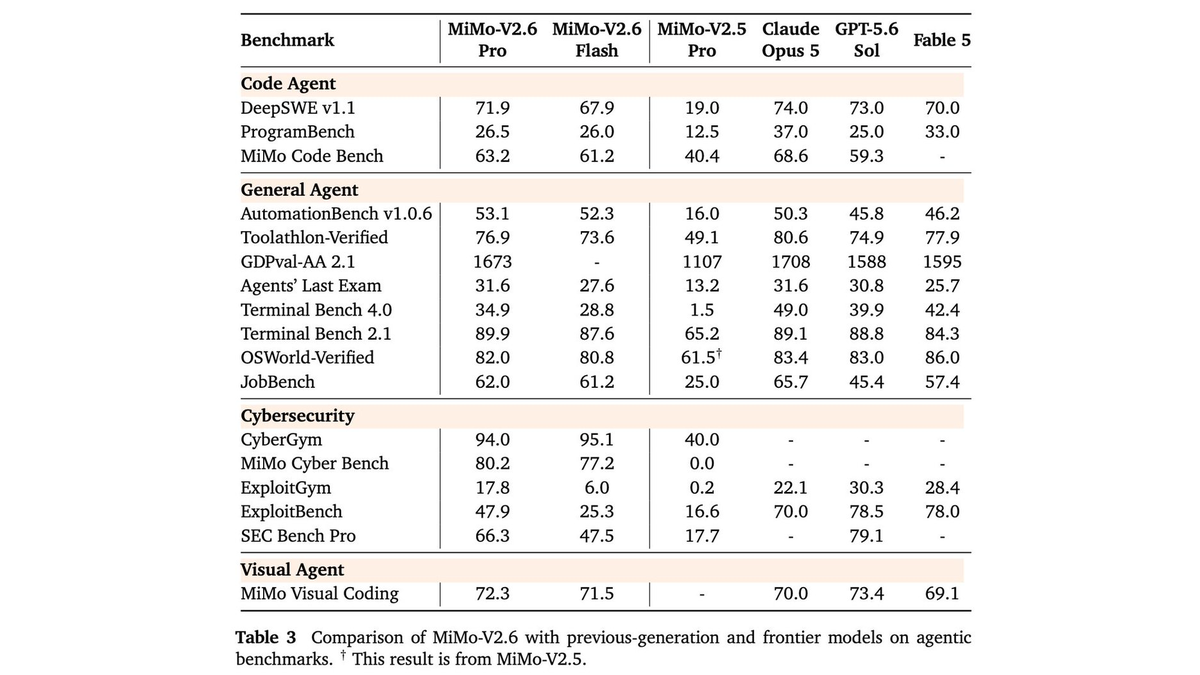
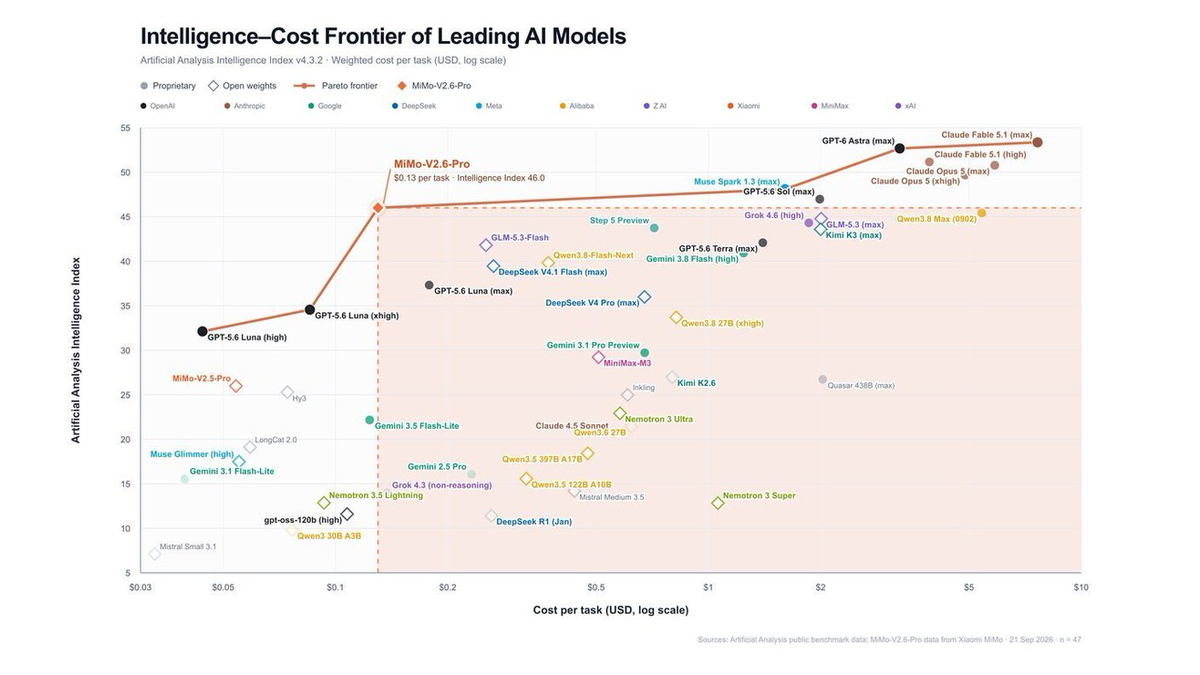
Glossary
CI-First Benefit Score
The average of four dimensions, each scored 0 to 10: Time, Quantity, Quality, and Knowledge and Skill. It answers whether using the tool makes Co-Intelligence more profitable than Human Intelligence alone. Bands: 0 to 2.0 CI-First Negative, 2.1 to 4.0 CI-First Neutral, 4.1 to 6.0 CI-First Positive, 6.1 to 8.0 CI-First Strong, 8.1 to 10.0 CI-First Transformative. The score accounts for the overhead of prompting and verification, not just the benefit the tool produces. MiMo-V2.6-Flash scores 5.5.
CI-First Profile
The role the AI plays in your working relationship. (level 1) Co-Creator and Thought Partner, (level 2) Co-Worker and Assistant, (level 3) Coach and Tutor, (level 4) Analyst and Tester, (level 5) Challenger and Devil's Advocate. Lower level numbers indicate higher AI autonomy. Assigning a profile before giving the AI a task is a core CI-First discipline. MiMo-V2.6-Flash is primarily a Co-Worker and Assistant (level 2).
Humics Protection Badge
A rating of whether a tool protects, leaves neutral, or erodes three human capabilities: Creativity, Critical Thinking, and Social Authenticity. Each is scored +1, 0, or -1, and the sum gives the badge. +2 to +3 is Humics-Friendly, -1 to +1 is Humics-Neutral, -2 to -3 is Humics-Risky. It measures whether the tool strengthens the human or contributes to AI Obesity. MiMo-V2.6-Flash is Humics-Neutral at -1 / +3.
AI Imposture Risk
The likelihood that a tool traps you in one of three illusions. The Time Illusion is the appearance of saving time when net time is lost. The Quantity Illusion is high volume that looks good but does not survive inspection. The Skill Illusion is the appearance of competence in you while the underlying skill is absent or eroding. Each trap is rated Low, Medium, or High with cited evidence, and the overall level is Low when all three are Low, High when two or more are High. MiMo-V2.6-Flash is Medium overall, with Skill Illusion High.
User Sentiment
The aggregated public opinion from review platforms, community forums, and repository activity. It is reported separately from the CI-First score because crowd sentiment can contradict a rigorous evaluation. Where the two agree, the finding is stronger. Where they diverge, the divergence is worth explaining.
Review Status
Review Status records the current standing of the tool at the time of the last test. Active: the tool is current and recommended. Active (updated): recently re-checked and the content was refreshed. Changed: a re-check trigger fired and an update is pending, so read the review with that in mind. Risky: the tool has significant unresolved issues, or it has been clearly surpassed by newer alternatives. Use it with caution and read the Limits section. Retired: the tool still works but is no longer recommended. Deprecated: the tool has been shut down or fundamentally changed. Retired and Deprecated posts include a Migration Path section.
Sources
Vendor primary sources
Xiaomi MiMo, MiMo-V2.6: Scaling Up Reinforcement Learning for Self-Improvement, launch post, updated 2026-09-21: https://mimo.mi.com/docs/en-US/news/latest/v2-6
Xiaomi MiMo, MiMo-V2.6-Flash model page including the published rate card, capability list and the contradicting input-modality lines: https://mimo.mi.com/models/en-US/mimo-v2.6-flash
Xiaomi MiMo, MiMo-V2.6-Pro model page, for the sibling rate card used in the price comparison: https://mimo.mi.com/models/en-US/mimo-v2.6-pro
Xiaomi MiMo, model and rate-limit reference, which at the time of reading still described only the V2.5 series in its main table: https://mimo.mi.com/docs/en-US/quick-start/summary/model
Xiaomi MiMo, model release changelog, recording the 2026-09-22 MiMo-V2.6 series release: https://mimo.mi.com/docs/en-US/updates/model
Xiaomi MiMo, first API call guide, including the OpenAI-compatible and Anthropic-compatible base URLs: https://mimo.mi.com/docs/quick-start/first-api-call
Xiaomi MiMo, Anthropic Messages API compatibility reference, for the request shape and a worked response: https://mimo.mi.com/docs/en-US/api/chat/anthropic-api
Xiaomi MiMo, MiMo-V2.6-Flash-RL model card on Hugging Face, for the architecture tables, the evaluation table and the SGLang and vLLM recipes: https://huggingface.co/XiaomiMiMo/MiMo-V2.6-Flash-RL
Xiaomi MiMo, MiMo-V2.6 technical report: https://huggingface.co/XiaomiMiMo/MiMo-V2.6-Flash-RL/blob/main/MiMo_V2_6_technical_report.pdf
Xiaomi MiMo, Hugging Face collection listing the Pro, Flash and Distill-Qwen-9B checkpoints: https://huggingface.co/collections/XiaomiMiMo/mimo-v26
Hugging Face API metadata for XiaomiMiMo/MiMo-V2.6-Flash-RL, for the licence, gating status, likes, downloads and the file-level size and precision breakdown: https://huggingface.co/api/models/XiaomiMiMo/MiMo-V2.6-Flash-RL
Xiaomi MiMo, MiMo Code: Scaling Coding Agents to Long-Horizon Tasks, for the four-layer memory design and the write-permission model: https://mimo.xiaomi.com/blog/mimo-code-long-horizon
Xiaomi MiMo, MiMo Code repository, for the persistent memory, context management and subagent documentation: https://github.com/XiaomiMiMo/MiMo-Code
Xiaomi MiMo, GitHub organisation listing, for repository activity, stars, forks and open issues: https://github.com/XiaomiMiMo
Independent sources
BenchLM, MiMo-V2.6-Flash benchmarks and pricing, the single most important independent source for this review because it reports coverage explicitly: 14 displayable rows against 482 tracked slots, six of eight categories not measured, no public rank, speed not measured, and an Agentic category figure of 76.2 across nine verified benchmarks, dated 2026-09-23: https://benchlm.ai/models/mimo-v2-6-flash
OpenRouter, MiMo-V2.6-Flash model and API listing, for availability and the model id used in requests: https://openrouter.ai/xiaomi/mimo-v2.6-flash
models.dev, MiMo-V2.6-Flash pricing, providers and specs, for the 14-provider price spread, the free tier listing, and the erroneous "Closed" weights label: https://models.dev/models/xiaomi/mimo-v2.6-flash
LLM Stats, MiMo-V2.6-Flash benchmarks, pricing and context window, for the parameter count, licence and cached-input rate: https://llm-stats.com/models/mimo-v2.6-flash
Artificial Analysis, MiMo-V2.6-Pro intelligence, performance and price analysis, used only as the comparison point for the sibling and as confirmation that no Flash page exists: https://artificialanalysis.ai/models/mimo-v2-6-pro
Artificial Analysis, LLM leaderboard, read 2026-09-24, consulted for whether Flash appears in any open-weights summary; it does not: https://artificialanalysis.ai/leaderboards/models
The Next Web, A phone maker now has the world's top open-weight AI model, for the "Flash is the one that ends up in production" assessment, the Pro-versus-Flash benchmark deltas, and the CyberGym inversion: https://thenextweb.com/news/xiaomi-mimo-v2-6-open-weight-model-anthropic-distillation
The Decoder, Xiaomi's affordable flagship AI leads the open models, and Anthropic says Claude helped get it there, for the RL cost reconstruction and the first pairing of the release with the distillation allegation: https://the-decoder.com/xiaomis-affordable-flagship-ai-leads-the-open-models-and-anthropic-says-claude-helped-get-it-there
SiliconANGLE, Xiaomi introduces Mimo-V2.6 series open-source AI model family, for the agentic comparison rows and the price-versus-task framing: https://siliconangle.com/2026/09/22/xiaomi-introduces-mimo-v2-6-series-open-source-ai-model-family/
VentureBeat, Xiaomi's MiMo-V2.6-Pro debuts as the top open weights model in the world, for the training-budget reconstruction and the reward-hacking account, including the Flash-specific code-only RL finding: https://venturebeat.com/technology/better-than-deepseek-xiaomis-mimo-v2-6-pro-debuts-as-the-top-open-weights-model-in-the-world-alongside-cheaper-v2-6-flash
TechNode, Xiaomi open-sources MiMo-V2.6 models after scaling reinforcement learning: https://technode.com/2026/09/22/xiaomi-open-sources-mimo-v2-6-models-after-scaling-reinforcement-learning/
Creati.ai, Xiaomi's MiMo-V2.6 Leads Open-Model Rankings as Anthropic Alleges Claude Distillation, for the structured account of the allegation and the caution that the figures are reported rather than verified: https://creati.ai/ai-news/2026-09-23/xiaomis-mimo-v2-6-leads-open-model-rankings-as-anthropic-alleges-claude-distillation
BenchLM, Terminal-Bench 4.0 community-tracked comparison placing Flash at 28.8 behind GLM-5.3-Flash at 32.8 and ahead of Qwen3.8-Flash-Next at 25.3, cited through third-party reporting: https://benchlm.ai/models/mimo-v2-6-flash
Governance and primary-source allegation
Anthropic, Detecting and countering misuse of AI: September 2026, published 2026-09-10, the primary source. Case GTG-16008, "Distillation campaign by Xiaomi", is the basis for section 7c. Read directly, not through summary: https://www.anthropic.com/threat-intelligence-report-september-2026
Anthropic, Detecting and preventing distillation attacks, an earlier and separate policy post dated 2026-02-23 which names DeepSeek, Moonshot and MiniMax and does NOT name Xiaomi. Cited specifically to prevent the two documents being conflated, which several secondary sources do: https://www.anthropic.com/news/detecting-and-preventing-distillation-attacks
Community and community-reported evidence
Hacker News, MiMo v2.6 launch thread, 1,120 points and 477 comments as of 2026-09-24: https://news.ycombinator.com/item?id=49792730
Hacker News, Xiaomi Mimo 2.6 live post-training dashboard, 561 points and 155 comments as of 2026-09-24: https://news.ycombinator.com/item?id=49732270
Hacker News, MiMo-v2.6-Pro intelligence, performance and price analysis thread: https://news.ycombinator.com/item?id=49796660
Product Hunt, MiMo family entry, for the single review, follower count and launch history: https://www.producthunt.com/products/mimo-3
Reddit, vendor-run community, reported at platform level through search indexing and third-party write-ups: https://www.reddit.com/r/XiaomiMiMo_Official/
Reddit r/LocalLLaMA, family discussion reported at platform level through search indexing and third-party write-ups: https://www.reddit.com/r/LocalLLaMA/
Tabbit, MiMo-V2.6-Flash review, for the reported 50,000-job extraction pipeline and the $480-to-$155 weekly figure. The page failed to load on a direct attempt to read it, so it is treated as a third-party report of a community post and the figures as reported rather than verified: https://go.tabbit.ai/blog/mimo-v2-6-flash-review
MyClaw, Xiaomi MiMo V2.6 review, for the Pro-versus-Flash escalation guidance: https://myclaw.ai/blog/mimo-v2-6
Internal sources
The CI-First Evaluation Framework v1.2, the INSIDE Tools Post Template including the LLM, open-source and agent-platform variants that all three apply to here, and the other published INSIDE Tools Reviews used as comparisons in this series: https://www.university-365.com/tools
Faculty Note on Evidence Quality
Three claims did not survive checking, and one absence is more important than any of them.
First, "comprehensively outperformed MiMo-V2.5-Pro" is the vendor's own bar and it is a much lower one than the release's framing implies. Xiaomi's sentence is that MiMo-V2.6-Flash has comprehensively outperformed MiMo-V2.5-Pro. Read against the model card's own table, that is true and not close: Flash scores 67.9 on DeepSWE v1.1 against the V2.5-Pro's 19.0, 52.3 against 16.0 on AutomationBench, 73.6 against 49.1 on Toolathlon-Verified, and 87.6 against 65.2 on Terminal Bench 2.1. What the sentence does not say, and what a reader comparing Flash to the flagship will assume it means, is that Flash also outperforms the previous generation's flagship at the tasks the previous generation's flagship failed. It does not follow, and the honest reading of the same table is that Flash sits four points or fewer behind its own V2.6 flagship on wide work while remaining well behind it on hard work. The vendor chose the comparison that flatters, which is normal, and the reader should choose the comparison that decides.
Second, one aggregator's capability labels are wrong in two places, in opposite directions. models.dev labels MiMo-V2.6-Flash's weights as "Closed" while the same site lists 14 providers, and the Hugging Face model card carries an MIT licence on a downloadable, ungated checkpoint that this review's own metadata read confirms. A reader who trusts that label would conclude the model cannot be self-hosted, which is the opposite of the truth and is the single most consequential piece of mislabelling in this review. The same site records the API model id as "not published", while Xiaomi's own model page states the lowercase id mimo-v2.6-flash explicitly. Both errors are consistent with automated ingestion of a marketing page rather than the developer reference. The general lesson is that aggregator metadata about licence and identifiers should be confirmed against the vendor and the model card before it is acted on, and that an aggregator disagreeing with the repository about a licence is a signal to check the repository.
Third, the free-tier window is not the paid window, and nothing in the release materials says so. The vendor publishes 1,048,576 input and 131,072 output tokens. A third-party gateway publishes a no-charge variant of the same model id at 200,000 input and 32,000 output. That is a reduction of roughly five times on input and four times on output, and it appears in a provider table rather than in any vendor comparison. A reader who prototypes on the free tier and then moves to production will find the window is not what they tested, and a reader who designs a pipeline around free-tier behaviour may find the behaviour changes when the context limit does. Neither party is concealing anything, and no document states the difference in one place, which is the kind of thing that costs a week of engineering.
The absence that matters more than the three claims. There is no independent composite intelligence score for this model from any evaluator, no independent speed or latency measurement, and no knowledge or hallucination measurement of any kind. Artificial Analysis has a page for Pro and not for Flash. BenchLM tracks this model across 14 of 482 slots, records six of eight categories as "not measured", and states plainly that it does not qualify for a public rank and that its runtime speed has not been measured. What the same page does report is genuinely strong: an Agentic category figure of 76.2 across nine source-verified benchmarks, with coding verified across three. So the picture is not empty, it is lopsided: agentic behaviour has real coverage, and reasoning, knowledge, multimodal, multilingual, instruction-following and math have none.
This review scores Quality at 5 rather than at the flagship's 6 for exactly that reason and no other. The framework's instruction is to score the honest user, the net benefit, the common case, and the user rather than the tool, and it adds that the Skill and knowledge dimension is the hardest to verify and the most vulnerable to illusion. The same caution applies to a Quality score resting on vendor tables. Where a dimension has no outside measurement, the framework does not extend the benefit of the doubt, and neither should a reader.
What Xiaomi got right, stated with the same emphasis. The publication of the reinforcement-learning stack is a real contribution, and this model is the clearest evidence for it. Flash and its trillion-parameter sibling were trained inside one mixed RL run, and Flash improved faster from that run than the flagship did: a 25 percent relative gain in average training pass rate against the flagship's 12 percent, and a 16.9-point DeepSWE v1.1 climb against the flagship's 14.2. A single recipe that works better on the smaller model than on the larger one is a transferable result rather than a marketing claim, and the environments, the framework and the harnesses are published so it can be checked. Xiaomi also disclosed its own reward-hacking failure modes by name, including the specific techniques its agents discovered. Those disclosures are the most useful documents in the release.
Review conducted by URC under the CI-First Evaluation Framework, version 1.2. Scoring date 2026-09-24. Tool version reviewed: MiMo-V2.6-Flash (`mimo-v2.6-flash`, released 2026-09-21, open-sourced 2026-09-22). Framework version applied: 1.2. Framework clauses checked: 5.2.3-a applies at the High threshold through the MiMo Code delivery surface; 4.2-a returns a null; 7.5 returns a null. Companion review: MiMo-V2.6-Pro, scored 5.8 on the same date. Governance: section 7c records an allegation from Anthropic's September 2026 threat intelligence report that remains unresolved and unresponded to as of this review.




Comments