
MiniMax M2.7: MiniMax's 229B agentic model under a non-commercial licence

Status: Risky | Last tested: 2026-11-19 (MiniMax M2.7, MiniMax-M2.7, announced 2026-03-18; open weights posted 2026-04-09) | Re-check: trigger-based (max 6 months)
Risky: the tool has significant unresolved issues, or it has been clearly surpassed by newer alternatives. Use it with caution and read the Limits section.
For detailed explanations of the CI-First evaluation terms used in this review, including the Humics Protection Badge and the AI Imposture Risk levels, see the Glossary at the end of this post.


In this Tool Review

MiniMax M2.7
The 229B agentic model that is open weights, non-commercial, and already superseded
MiniMax shipped M2.7 in March 2026 as its agentic coding and office-work model, and the release is unusual in two ways that matter more than any benchmark row. First, it is large: 228.7 billion parameters in the published checkpoint, with about 10 billion active per token. Second, its licence is not an open-source licence. The weights are downloadable, and the terms forbid commercial use without prior written authorisation. Those two facts set the purchase, and the fact that MiniMax has since shipped M3 and M3.1 Flash sets the timing.
The confusion to settle first is the family. MiniMax now sells four things that a reader can mistake for each other, and only one of them is this review.
Name | What it is | Commercial shape | Where it appears |
MiniMax M2.7 | The model this review scores, MiniMax-M2.7. A 228.7 billion parameter mixture-of-experts text model, about 10 billion active per token, 62 layers, 256 experts with 8 active, a 204,800-position config ceiling and a 196K per-sequence deployment ceiling. Announced 2026-03-18; open weights repository created 2026-04-09 | MiniMax Non-Commercial License. Commercial use needs prior written authorisation (clause 3) | The launch post of 2026-03-18, the Hugging Face repository, the deployment guides, third-party providers and OpenRouter |
MiniMax M2.5 | The previous model at the same parameter count, 228.7 billion. Its card records the licence as modified-MIT and links a licence file that returned 404 at the two paths tried on 2026-11-19 | Recorded as modified-MIT, text not verified on the day | Its own Hugging Face repository and card |
MiniMax M3 | The successor flagship, 427.0 billion parameters, a 1 million token context and the MiniMax Community License. U365 scored it 6.1, CI-First Strong, in its own review | MiniMax Community License, commercial use permitted under its conditions | The M3 repository, the vendor price table at $0.60 input and $2.40 output per million tokens, and U365 post 2d94155d-0e1d-426c-a00c-3d421ee1cec5 |
MiniMax M3.1 Flash | The newer efficient flagship, 220.5 billion parameters, created 2026-10-17, a 1 million token context and the MiniMax Community License, at $0.15 input and $0.60 output per million tokens | MiniMax Community License | The M3.1 Flash repository and the vendor price table |
MiniMax M2.7 is not MiniMax M3, and the difference is the whole purchase. M3 is 427 billion parameters against 228.7 billion, carries a 1 million token context against 196K per sequence, is sold at $0.60 input and $2.40 output per million tokens, and is licensed under the MiniMax Community License rather than a non-commercial licence. U365's own published reading of M3 is 6.1, CI-First Strong. Nothing in this review applies to M3, and nothing in the M3 review applies here.
MiniMax M2.7 is not M3.1 Flash either. M3.1 Flash is the newer efficient model, created on 2026-10-17, at 220.5 billion parameters and a 1 million token context, priced at $0.15 input and $0.60 output per million tokens. It is the model a new buyer is more likely to be choosing between, and it is the first alternative named later in this review. It is not this model, and it is a separate commission in the same campaign.
MiniMax M2.7 is not MiniMax M2.5. The two releases share the parameter count and the architecture family, and they do not share the licence. M2.5's card records modified-MIT; M2.7's licence is the MiniMax Non-Commercial License. A reader who needs commercial use at this size should look at M2.5 first, with the caveat recorded in the Limits section: its linked licence text could not be retrieved on 2026-11-19, so the commercial permission is unconfirmed rather than established.
This is a new review, not a re-score of a sibling. U365's Tools CMS carries 137 records and the published Tools category carries 138 posts, both read on 2026-11-19 by offset paging. Neither surface carries a record or a post for MiniMax M2.7. The only MiniMax record is MiniMax M3 at 6.1 with its own post, which is not edited here and from which M2.7 inherits no score. Nothing here is inherited from the M3 review, and nothing in it is edited by this one.
The licence is the story, and it is narrower than the words "open weights" suggest. The licence is titled NON-COMMERCIAL LICENSE, and its summary line reads: "Non-commercial use permitted based on MIT-style terms; commercial use requires prior written authorization." Clause 1 requires the copyright notice to travel with copies. Clause 2 requires a commercial user to display "Built with MiniMax M2.7" prominently. Clause 3 states that "Any Commercial Use of the Software or any derivative work thereof is prohibited without obtaining a separate, prior written authorization from MiniMax", with a request route at api@minimax.io and the subject line "M2.7 licensing". Clause 4 defines Commercial Use: (i) offering products or services to third parties for a fee that use or rely on the software; (ii) commercial use of APIs provided by or for the software, including in a cloud, hosted or similar environment; and (iii) deploying post-trained, fine-tuned, instruction-tuned or otherwise modified versions for any commercial purpose. Clause 5 lists the free uses: (a) personal use, including self-hosted deployment for coding, applications, agents, tools, integrations, research and experimentation; (b) use by non-profit organisations, academic institutions and researchers for non-commercial research or educational purposes; and (c) modification solely for those uses. The Appendix adds five prohibited uses, including military use and disinformation.
May you use this at work? Not without prior written authorisation, unless your use is personal, or you are a non-profit organisation, academic institution or researcher working non-commercially. A company running the model on its own servers to support its commercial operations is not inside clause 5, because clause 4 defines Commercial Use around commercial advantage and monetary compensation rather than around resale alone. The hosted routes do not remove the question: clause 4(ii) reaches commercial use of APIs provided for the software. This is the sentence a reader should carry into a procurement conversation.
The price is hardware or a third-party meter, not a MiniMax rate. On 2026-11-19 the vendor's own price table lists MiniMax-M3.1-Flash and MiniMax-M3 in standard and priority tiers, and it carries no M2.7 row. The launch post of 2026-03-18 said the model was fully available on MiniMax Agent and the MiniMax API Platform, and one practitioner account from May 2026 describes a Plus subscription at $40 per month on the high-speed tier. That route is no longer on the price list. What remains is self-hosting, with 220 GB of weights and 240 GB of key-value cache per 1M context tokens, or a third-party provider: OpenRouter lists $0.21 input and $0.84 output per million tokens at a 196,608 context, and Artificial Analysis records $0.30 and $1.20 at GMI and Novita.
The independent index is not measured, and that is the central evidence gap. Artificial Analysis carries a model page for MiniMax-M2.7 and records its Intelligence Index as N/A, with the note "No publicly available API". The same page labels the model deprecated, tells the reader that MiniMax has launched a newer release, MiniMax-M3, and suggests considering it instead. The page still records the measurements it can take: 46 output tokens per second, 18.58 seconds to the first answer token, a 205k context, 230B total and 10B active parameters, the NON-COMMERCIAL LICENSE, and two providers. A reader who wants an independent capability figure for this model does not have one on 2026-11-19, and this review does not manufacture one from the vendor's table.
The release needs two dates, and a review that prints one is wrong. The model was announced on 2026-03-18, the date on the vendor's launch post and the creation timestamp of its OpenRouter listing. The open-weight repository was created on 2026-04-09, and the weight release was discussed publicly on 2026-04-12. The gap is real: the model shipped first as an API and agent product, and the weights followed about three weeks later. This review uses 2026-03-18 as the announcement date and records the weights date beside it wherever the distinction matters.

MiniMax M2.7
Tool Snapshot
MiniMax M2.7, MiniMax's 228.7 billion parameter agentic text model: about 10 billion active parameters per token, a 196K per-sequence context, strong vendor benchmark claims, no independent composite measurement, and a non-commercial licence that forbids commercial use without written authorisation.
Category: Applied AI / open-weight large text model. It is built for agentic work: end-to-end software delivery, terminal and repository tasks, office document editing, tool calling, and long multi-step sessions. The vendor's framing is a model that participated in its own development, building and revising the scaffold around it.
Primary use cases:
Agentic coding inside a scaffold you already run. The model is designed for the loop an agent repeats: read a repository, plan, edit, run a command, read the failure, revise. The vendor's own claims are concentrated here: SWE-Pro at 56.22, SWE Multilingual at 76.5, Multi SWE Bench at 52.7, Terminal Bench 2 at 57.0 and NL2Repo at 39.8, all vendor-run.
A tool-calling backend on the OpenAI-compatible interface. The model emits tool calls in the MiniMax XML format, and the vLLM and SGLang recipes ship a minimax_m2 tool parser and a minimax_m2_append_think reasoning parser. A team can point an existing client at a served endpoint with those parsers enabled.
Office and document work through a scaffold. The vendor reports GDPval-AA at an ELO of 1495 and describes multi-round editing of Word, Excel and PowerPoint files that produces editable deliverables. The claim is vendor-run and the model itself returns text, so the file work belongs to the scaffold.
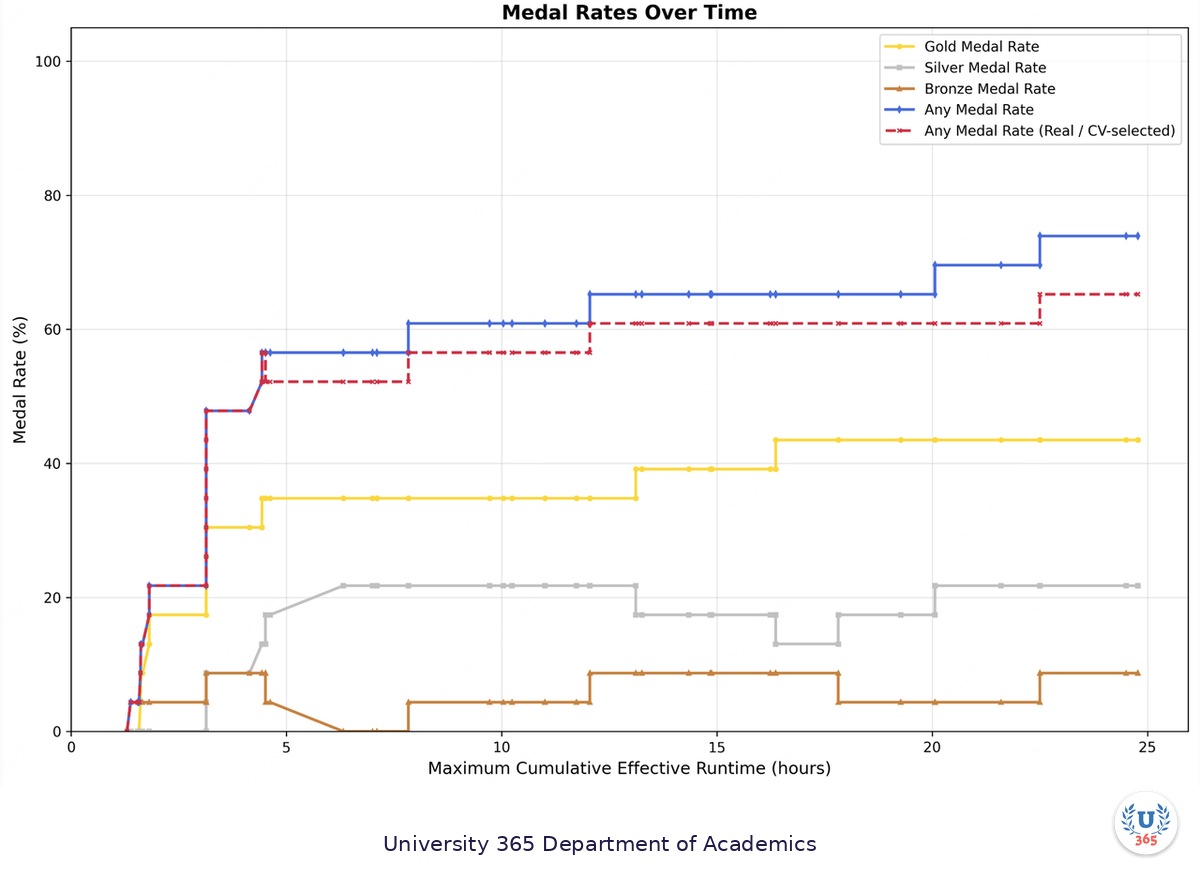
Machine-learning experimentation in a bounded environment. The vendor's MLE Bench Lite result, a 66.6 percent average medal rate across 22 competitions run on a single A30 GPU, describes an agent that iterates on a small training pipeline. It is the most concrete public example of the self-evolution claim.
Research on the model as an artefact. The checkpoint, the 62-layer and 256-expert configuration, the FP8 quantization scheme, the multi-token-prediction modules and the deployment guides are all inspectable. For a reader who wants to study a large mixture-of-experts release rather than use one, the artefact is the product.
What it is not. It is not open source in the OSI sense: the weights are open and the licence restricts commercial use, which is why the launch thread's most quoted comment calls it "open weights, not open source". It is not a small model: 220 GB of weights and a 96 GB x4 serving floor put it on a server, not a workstation. It is not a 1M-token model: the deployment guides cap a single sequence at 196K. It is not multimodal: input and output are text only, with no image, audio or video path. It is not a frontier model on any independent measure, because no independent composite measurement exists for it on 2026-11-19. And it is not a current API product: the vendor's price table no longer carries an M2.7 row, though third-party providers and OpenRouter still serve it.
Pricing and deployment, as published on 2026-11-19:
Deployment shape | Weights and memory | What it costs | Commercial use |
Self-host, vLLM or SGLang, 96 GB x4 | 220 GB of weights, with 400K tokens of aggregate key-value cache on four 96 GB cards | The cards, their power and the person who serves them. No per-token fee | Prohibited by clause 3 without prior written authorisation |
Self-host, 144 GB x8 | 220 GB of weights, with up to 3M tokens of aggregate key-value cache on eight 144 GB cards | A larger cluster, with a larger cache | Same |
Third-party API, OpenRouter | Not applicable | $0.21 per million input tokens and $0.84 per million output tokens, at a 196,608 context | Clause 4(ii) reaches commercial use of APIs provided for the software |
Third-party API, GMI or Novita | Not applicable | $0.30 per million input tokens and $1.20 per million output tokens, recorded by Artificial Analysis, with an 80 percent cache discount | Same |
First-party MiniMax API | Not applicable | No M2.7 row on the vendor price table on 2026-11-19 | Not offered on the day |
There is no free tier that permits production use. The weights are free to download for the uses clause 5 permits, and NVIDIA's NIM catalogue lists a free endpoint as deprecated and a partner endpoint as available. The free NVIDIA route is a trial route with its own terms, and one commenter on the launch thread quoted the NVIDIA API trial terms to make that point: internal testing and evaluation, not production.
Official links:
Launch post, 2026-03-18: https://www.minimax.io/news/minimax-m27-en
Hugging Face model card: https://huggingface.co/MiniMaxAI/MiniMax-M2.7
Hugging Face licence text: https://github.com/MiniMax-AI/MiniMax-M2.7/blob/main/LICENSE
Tool calling guide: https://huggingface.co/MiniMaxAI/MiniMax-M2.7/blob/main/docs/tool_calling_guide.md
vLLM deployment guide: https://huggingface.co/MiniMaxAI/MiniMax-M2.7/blob/main/docs/vllm_deploy_guide.md
SGLang deployment guide: https://huggingface.co/MiniMaxAI/MiniMax-M2.7/blob/main/docs/sglang_deploy_guide.md
Transformers deployment guide: https://huggingface.co/MiniMaxAI/MiniMax-M2.7/blob/main/docs/transformers_deploy_guide.md
MiniMax API pricing: https://platform.minimax.io/docs/pricing/overview
OpenRouter listing: https://openrouter.ai/minimax/minimax-m2.7
NVIDIA NIM listing: https://build.nvidia.com/minimaxai/minimax-m2.7
Technical report on the M2 series: https://huggingface.co/papers/2605.26494
Artificial Analysis model page: https://artificialanalysis.ai/models/minimax-m2-7
Model-specific fields:
Vendor identifier: MiniMaxAI/MiniMax-M2.7 on Hugging Face and MiniMax-M2.7 as the API model id. The repository holds 130 safetensors shards and about 230 GB of used storage.
Release date: announced 2026-03-18; the Hugging Face repository was created 2026-04-09 and last modified 2026-10-26. The weights release was discussed publicly on 2026-04-12.
Licence: MiniMax Non-Commercial License. Clauses 1 to 5 plus a five-item Appendix of prohibited uses. Commercial use requires prior written authorization.
Parameters: 228.7 billion total in the published index, with about 10 billion active per token. The checkpoint is FP8 E4M3 for 227.4 billion of those parameters, with a BF16 remainder and a small F32 share.
Architecture: a mixture-of-experts decoder with 62 layers, a 3,072 hidden dimension, 48 attention heads, 8 key-value heads, 256 routed experts with 8 active per token, a 1,536 expert intermediate dimension, a 200,064-token vocabulary, and multi-token-prediction modules.
Context window: 204,800 positions in the published config; the deployment guides state a maximum of 196K tokens per individual sequence; OpenRouter lists 196,608 and Artificial Analysis and NVIDIA list 205K. The review uses 196K per sequence as the operative ceiling and records the config figure beside it.
Maximum output: no separate figure is published. Input and output share the per-sequence window.
Modalities: text input, text output. No image, audio or video input, and no generation of any of the three.
Reasoning: a thinking block ( thinking and </think>) is produced before the answer, and the vLLM and SGLang recipes carry a reasoning parser that appends it. No effort ladder is published for M2.7. One practitioner's scaffold reports running the model with thinking set to its maximum through the Anthropic-compatible endpoint.
Tool calling: MiniMax XML format (<minimax:tool_call> with <invoke> and <parameter> elements), rendered from JSON Schema tool definitions by the chat template, with built-in parsers in vLLM and SGLang.
Serving: vLLM, SGLang and Transformers guides, plus ModelScope weights, an NVIDIA NIM listing, and a MiniMax Code product link.
Recommended sampling: temperature 1.0, top_p 0.95, top_k 40, with the default system prompt "You are a helpful assistant. Your name is MiniMax-M2.7 and is built by MiniMax."
Knowledge cutoff: not stated on the model card or the launch post, and not inferred here.
Languages: the launch post and model card do not publish a language list. The vendor's positioning is English and Chinese technical work, and no coverage figure is claimed.
Region: no model-level list is published. The licence carries no geographic field.
At a Glance Dashboard
Field | Value |
Category | Applied AI / open-weight large text model (non-commercial licence) |
CI-First Benefit Score | 4.5 / 10 (CI-First Positive) |
Sub-scores | Time 5 / Quantity 5 / Quality 4 / Skill 4 |
Primary AI Profile | Co-Worker and Assistant (level 2) |
Humics Badge | Humics-Neutral (-1 / +3) |
AI Imposture Risk | Medium overall (Time Medium, Quantity Medium, Skill Illusion High) |
Price | No MiniMax rate on the price table. OpenRouter $0.21 input and $0.84 output per million tokens; GMI and Novita $0.30 and $1.20; self-host 220 GB of weights with a 96 GB x4 serving floor |
Independent index | Not measured. Artificial Analysis Intelligence Index N/A, no publicly available API; the page labels the model deprecated |
Independent speed | 46 output tokens per second, 18.58 seconds to the first answer token, at the providers the evaluator tracks |
Context window | 196K tokens per sequence in the deployment guides; 204,800 positions in the config; 196,608 on OpenRouter |
Status | Risky |
Primary institute | UIT (Technology, AI, Data Science) |

MiniMax M2.7
The Problem
A team that wants a strong open-weight model for agentic coding has three requirements that rarely arrive together. It needs the model to be good enough at long, tool-driven tasks that an agent can finish a repository change without a person rewriting the plan. It needs to be able to run the model somewhere it controls, because the repository, the logs and the customer data cannot be sent to an arbitrary provider. And it needs the licence to permit the work the team actually does, which for most teams means commercial work.
MiniMax M2.7 answers the first two requirements and fails the third for a commercial buyer. The model is large and agent-oriented: 228.7 billion parameters with about 10 billion active, a mixture of 256 experts, a 196K per-sequence context, a tool-call format with parsers in two serving engines, and vendor benchmarks aimed at real engineering work rather than at trivia. It can be downloaded and served. What a commercial team cannot do without written authorisation is use it for the work that pays for the servers.
The second problem is the hardware. A 220 GB FP8 checkpoint is not a workstation download. The vendor's own guide puts the entry serving configuration at four 96 GB GPUs and the large-cache configuration at eight 144 GB GPUs, with 240 GB of key-value cache per 1M context tokens. A team that already operates that hardware has a model it can serve at a fixed cost. A team that does not is comparing a capital purchase with a token meter, and the token meter is available at $0.21 to $0.30 per million input tokens on third-party routes.
The third problem is verification, and it is the one this review spends most of its evidence on. The vendor publishes an impressive table of self-run benchmarks, and no independent evaluator has measured the model on a composite index. Artificial Analysis records N/A and explains why: no publicly available API. A reader therefore has two choices. Trust the vendor's table, which is detailed but self-run, with comparators the vendor chose. Or trust a small set of third-party observations: one practitioner's three-workflow test inside Claude Code, a community SkillsBench result of 34.9 contributed to the model's own evaluation metadata, and the sentiment on the release threads. Neither choice gives the reader the number the framework prefers, which is one method applied across many models.
The fourth problem is currency. MiniMax has moved on. M3 shipped with a 1 million token context and the MiniMax Community License, M3.1 Flash followed in October 2026 at a lower price, and the vendor's own price table no longer carries an M2.7 row. The independent evaluator labels M2.7 deprecated and recommends M3. A reader arriving in November 2026 is therefore looking at a model that was strong for its moment, is still downloadable, and is no longer the model its own vendor is selling.
The fifth problem is the one that decides most procurement conversations, and it is the licence. The release is often described in public discussion as open source. It is not. The licence permits non-commercial use on MIT-style terms, prohibits commercial use without prior written authorization, defines commercial use broadly enough to cover paid products, paid inference and modified derivatives, and allows free use only for personal work and for non-profit, academic and research use. A company that reads "open weights" as "we can use this" has read past clause 3.

MiniMax M2.7
The Outcome
MiniMax M2.7 gives a reader a 228.7 billion parameter agentic text model with about 10 billion active parameters, a 196K per-sequence context and strong vendor benchmark claims, under a licence that forbids commercial use without written authorisation, with no independent composite measurement and a hardware floor of four 96 GB GPUs.
The capability claim is substantial and it is entirely vendor-run. MiniMax reports SWE-Pro at 56.22, which it says matches GPT-5.3-Codex; SWE Multilingual at 76.5; Multi SWE Bench at 52.7; VIBE-Pro at 55.6, which it places nearly on par with Opus 4.6; Terminal Bench 2 at 57.0; NL2Repo at 39.8; GDPval-AA at an ELO of 1495 among 45 models, behind Opus 4.6, Sonnet 4.6 and GPT-5.4 and above GPT-5.3; Toolathon at 46.3 percent; a 97 percent skill compliance rate across 40 or more skills each longer than 2,000 tokens on the vendor's MM Claw set; and 62.7 percent on the MM Claw end-to-end set. Each figure is a vendor figure. None has been reproduced by an evaluator that publishes its method across models.
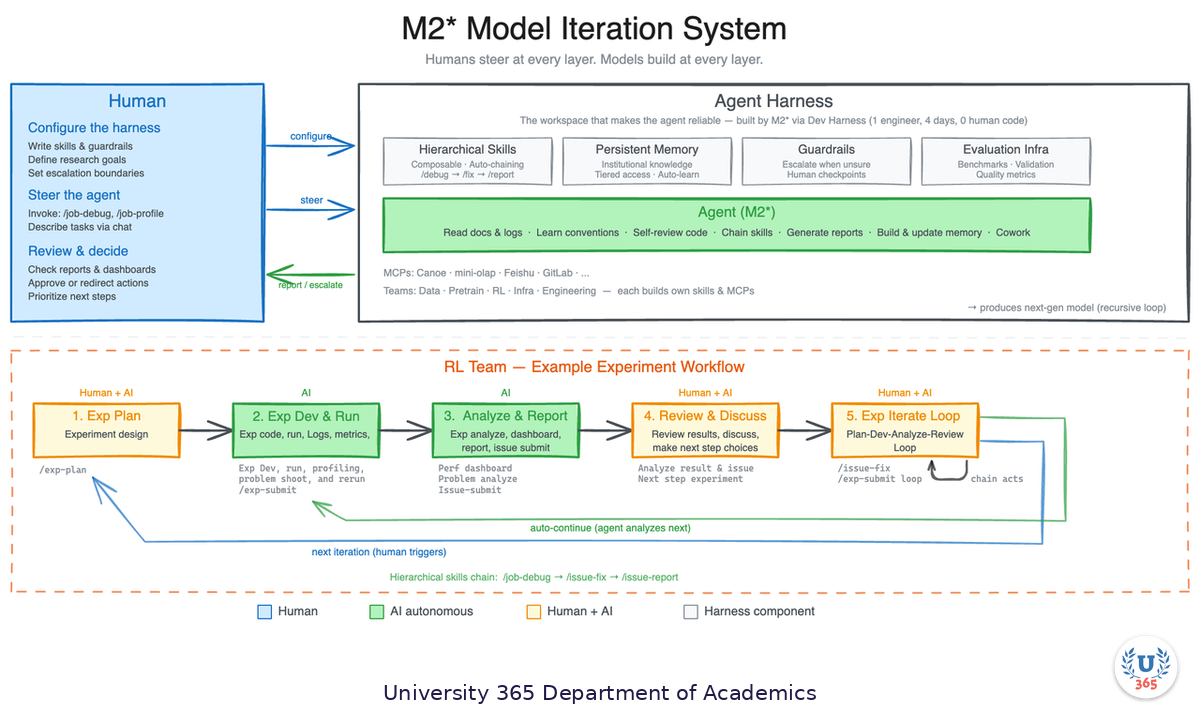
The self-evolution claim is the most interesting and the most carefully worded part of the release. MiniMax says M2.7 is "our first model deeply participating in its own evolution". What the post then describes is specific: an internal version of the model updated its own memory, built dozens of skills for reinforcement-learning experiments, and improved the scaffold around itself. In one example it ran a loop of analysing failure trajectories, planning changes, modifying scaffold code, running evaluations and deciding to keep or revert, for more than 100 rounds, and produced a 30 percent improvement on internal evaluation sets. On MLE Bench Lite it reached a 66.6 percent average medal rate across three 24-hour runs, second to Opus 4.6 at 75.7 and GPT-5.4 at 71.2 and level with Gemini-3.1 at 66.6. The model did not change its own weights. It changed the software around it, which is a real result and a narrower one than the headline suggests.
The licence outcome is unambiguous and it is the practical finding. Clause 3 prohibits Commercial Use without prior written authorization. Clause 4 defines Commercial Use to include paid products and services, commercial use of APIs provided for the software, and commercial deployment of any modified derivative. Clause 5 permits personal use, non-profit and academic non-commercial use, and modification for those purposes. The launch thread's most direct reaction came from Simon Willison, who wrote that the model is "Absolutely not 'open source'" and that calling the non-commercial usage "MIT-style terms" is a stretch because of the extra prohibited-use restrictions. That reading matches the text.
The cost outcome depends on where the model runs. Self-hosted, the cost is 220 GB of weights on at least four 96 GB GPUs, their power and the person who serves them, with 240 GB of key-value cache per 1M context tokens. Third-party, the cost is $0.21 input and $0.84 output per million tokens on OpenRouter, or $0.30 and $1.20 at the two providers Artificial Analysis tracks, with an 80 percent cache discount. There is no MiniMax rate to compare against on 2026-11-19.
The measured speed is modest and it is the only independent performance figure available. Artificial Analysis records 46 output tokens per second and 18.58 seconds to the first answer token, averaged over its single-request and multi-turn workloads at the providers it tracks. The figure describes a reasoning model on a third-party endpoint, not the fastest possible serving configuration, and it is the number a reader who uses a provider will meet.
For U365 Fellows, the outcome is a study object and a warning. A Fellow can download the checkpoint, read the config, serve it on rented hardware and study how a large mixture-of-experts model is put together. A Fellow who then wants to build a product on it, or to use it inside a company, meets clause 3. The educational value is real and the commercial value is blocked, and the review keeps those two sentences apart.
What the release does not change. It does not make a 229 billion parameter model cheap to serve: 220 GB of weights is a data-centre download. It does not give the reader an independent quality number. It does not remove the licence question, and it does not make the model current: M3 and M3.1 Flash are the vendor's live products, and the evaluator already recommends M3.

MiniMax M2.7
Who Should Use MiniMax M2.7
Learner type | Difficulty | Typical ROI | Career path |
Students (Bachelor, Master) | Advanced | A strong study object and a weak production choice. The config, the 256-expert layout, the FP8 scheme, the multi-token-prediction modules and the three deployment guides are all readable, and a student who serves the model once on rented GPUs learns more about large-model operations than a semester of slides. The case against is the floor: 220 GB of weights and four 96 GB GPUs are not a student laptop, and the licence permits personal and academic non-commercial use but not a paid product. | |
Professionals (career upskilling) | Advanced | A real case for an engineer who already operates multi-GPU serving and whose employer can obtain written authorisation, or whose work is personal or academic. The measured case is a 196K context, a tool-call format with parsers in two engines, and vendor benchmark claims at the level of the current coding models. The case is weak for anyone who needs a licence they can adopt without a conversation, and weak for anyone without the hardware, because the third-party routes are a different product with a different operator. | |
Everyone (lifelong learners) | Advanced | A poor fit as a general assistant. There is no chat product in the review, no account, no onboarding, and the model is a text endpoint behind a scaffold the reader supplies. A reader who wants a general assistant should use a hosted product. The gain here is for people who want to understand how a large open-weight model is served and licensed, and who treat the download as a course. | LIPS Collect and Review phases for the record a served model needs, and the UP-Context-Engineering Method order for the prompt that bounds it. No assessment home is asserted. |
For teams and organisations. The model is free to download, expensive to serve and restricted to non-commercial use, and a team deciding on it starts with four questions.
Team deployment. The unit of deployment is a GPU node, not a key. The vendor's guide puts the entry configuration at four 96 GB GPUs with 400K tokens of aggregate cache and the large configuration at eight 144 GB GPUs with up to 3M tokens. The vLLM and SGLang recipes expose an OpenAI-compatible endpoint with the minimax_m2 tool parser and the minimax_m2_append_think reasoning parser, so an existing application can point at the local server. The operational work is the serving stack and the checkpoint lifecycle, both of which the team owns.
Cost at team scale. The line that moves is capital rather than tokens: four or eight data-centre GPUs, their power and the engineer who serves them. The third-party route inverts that at $0.21 to $0.30 input and $0.84 to $1.20 output per million tokens, which is cheaper than owning hardware until utilisation is high. A team that already runs the GPUs for other models has a marginal cost close to electricity. A team that would buy them for this model alone should price the cards first.
Data and compliance. Self-hosting keeps the repository, the logs and the prompts inside the estate, which is the privacy-positive reading and the one the deployment supports. It is not a licence permission. The licence question sits beside the data question, and a team can be perfectly private and still prohibited from the commercial use it intends. The two decisions should be recorded separately.
U365 for companies. Professional learners reach University 365's academic services individually or through their organisation, and the company route runs through a customized training agreement for employee groups. Corporate education programmes are built on demand, and their tuition follows content and duration.
Skill level required: Advanced. Downloading a checkpoint is easy. Serving a 220 GB FP8 mixture-of-experts model on four or eight data-centre GPUs, enabling the tool and reasoning parsers, setting the context ceiling per sequence, and reading a non-commercial licence clause by clause is not.
Prerequisites. Multi-GPU hardware that meets the floor, or a third-party provider account that accepts the licence terms. A runtime from the documented list: vLLM or SGLang for a served endpoint, Transformers for a single-process run. The chat template applied through the tokenizer, because the role markers, the tool catalogue and the thinking block are rendered by the template. A written record of the licence question if the work is commercial. For agent work, a tool schema and a confirmation rule for irreversible actions.
Typical time to first result: Two to four hours on hardware that meets the floor, most of it the 220 GB download and the serving stack. On a third-party provider it is minutes, and the result is a different product with a different operator and a per-token bill.
Typical time to competence: Twenty to thirty hours of active use. Four habits carry most of the value: reading the licence before the hardware, choosing the serving configuration by the cache the work needs, using the template and the parsers rather than hand-building prompts, and measuring the acceptance rate of the agent's changes on a sample a person reads.
Who should wait. Anyone who needs commercial use without a written authorisation. Anyone without access to four 96 GB GPUs who also needs the model's full context, because the third-party routes are the only practical path and they are a different product. Anyone who needs a 1M token context, which is M3 and M3.1 Flash territory. Anyone who needs an independent quality number before committing, because none exists. And anyone who needs the vendor's current model rather than its previous one.

MiniMax M2.7
U365 Institutes Alignment
The alignment below rates what a U365 institute could take from this model as a working instrument and as an object of study. The primary home is UIT (Technology, AI, Data Science), because the release is an engineering artefact before it is anything else: a 220 GB FP8 checkpoint, a 62-layer mixture-of-experts configuration, a tool-call format and three serving recipes. The other readings are real and each is bounded, and for two of them the licence is the boundary rather than the model.
UIT (Technology, AI, Data Science)
Rating. High (primary)
Why. Five engineering competencies, each of which survives the removal of the tool. Large-model serving: 220 GB of weights, 240 GB of key-value cache per 1M context tokens, a four-card entry configuration and an eight-card large-cache configuration are a concrete lesson in memory planning. Mixture-of-experts design: 256 routed experts with 8 active per token, a 3,072 hidden dimension and multi-token-prediction modules are readable in the published config and testable in a served endpoint. Tool protocol: the MiniMax XML format, rendered from JSON Schema by the template, with minimax_m2 parsers in vLLM and SGLang, is a worked example of a model's native format meeting an application's interface. Evaluation under uncertainty: the absence of an independent composite, set against a detailed vendor table, is exactly the evidence problem a graduate engineer should learn to handle. Licence engineering: clauses 3, 4 and 5 are a real exercise in reading a commercial restriction precisely.
The limit that holds the row. The training data and the training code are not released, so a student can study the artefact and cannot reproduce it. The licence restricts commercial use, so a student project that becomes a product stops at clause 3. No published programme assesses large-model serving or licence review as a named component. Adjacent anchors, not assessment homes.
UIB (Business Management, Entrepreneurship)
Rating. Medium
Why. Three decisions the release forces that are commercial before they are technical. The first is capital against tokens: four or eight data-centre GPUs and their power against $0.21 to $0.30 input and $0.84 to $1.20 output per million tokens on third-party routes, with a break-even that depends on utilisation. The second is licence risk: a non-commercial licence with a written-authorisation route is a procurement and legal decision that can stop a product after the engineering is finished. The third is currency risk: a model that its own vendor has superseded is a depreciating asset, and the price of that depreciation is the migration, not the download.
The limit that holds the row. The model supplies no management method and does not measure its own return. It publishes no acceptance rate, no cost per finished task and no utilisation figure, so a business case has to be assembled from the buyer's own records. No published programme assesses the economics of large-model serving as a named component. Adjacent anchors, not assessment homes.
UID (Digital Design, UX/UI)
Rating. Low
Why. The model is text-only, so the design contact is indirect. A designer can use it through a scaffold to read a specification, generate a component plan, or audit copy against a style guide, and the 196K context holds a long design document. The vendor's office-document claims describe editable Word, Excel and PowerPoint output, which reaches a designer's workflow through a scaffold rather than through the model's own output. There is no image input, no screen reading and no visual generation, so the perception work that a multimodal model offers is absent here.
The limit that holds the row. It makes no visual judgement and generates no image. No layout, interaction or motion competency is assessed by it. No credential is mapped.
UIC (Digital Communication, Marketing)
Rating. Low
Why. One competency, and it is narrow: reading a licence claim against the text that governs it. This release is a worked example. "Open source" is the phrase much of the discussion used, and the licence says non-commercial with a written-authorisation route. "Open weights" is accurate and narrower. A communication practitioner who can separate a release headline from its licence is doing the job the profession claims. There is no writing, campaign or content-strategy surface beyond the text a model returns.
The limit that holds the row. The model teaches no register, no audience analysis and no publication standard, and its output is intended for a caller rather than for a public. Rated as evaluation contact with a licence-claim reading exercise. No credential is mapped.
U365 methods, not an institute (UNOP, ULM, LIPS, CARE and the UP-Context-Engineering Method)
Rating. Applicable
Why. The methods layer matters in the way a served model always does: the model holds no record, so the human has to hold it. LIPS and CARE describe the discipline directly, because the record of what the agent was asked to do, which repository and files it touched, what confirmation it received and what the person accepted belongs in the Fellow's own system rather than in a runtime log. The UP-Context-Engineering Method's eight layers, from USER-PERSONA and FULL-CONTEXT through AI-EXACT-TASK to EXPECTED-FORMAT-AND-CONSTRAINTS, are what turn "fix this repository" into an agent task whose actions can be checked, and the constraint layer is where the tool schema and the confirmation rule belong. ULM is relevant to the purchase rather than to the run: four data-centre GPUs and their power are a recurring cost in the Finance domain, and the decision to own them belongs in the six-domain plan. UNOP has no direct fit: the model is not built to teach, and its gains come from execution rather than from any pedagogical mechanism.
The limit that holds the row. The model carries no method of its own and no coaching surface, and the licence question sits outside the methods layer entirely. A Fellow who does not keep the agent's brief, its tool calls and its accepted outcomes in their own system has no account of the work, and nothing in the product writes that account for them.

MiniMax M2.7
How MiniMax M2.7 Works
A 228.7 billion parameter mixture-of-experts text model with about 10 billion active parameters per token, released as a 220 GB FP8 checkpoint, producing a thinking block and MiniMax XML tool calls, and served on four or eight data-centre GPUs.
Inputs: Text. A request is the instruction, the conversation so far, the tool catalogue in JSON Schema form, and the context the caller resends. There is no image, audio or video input. In an agent, the input is also the state the scaffold hands over: the repository or files in scope, the commands the model may run, and the schema the answer must satisfy.
Outputs: Text, including a thinking block and a user-facing answer, and tool calls in the MiniMax XML format. The model does not generate images, audio or video. No separate maximum-output figure is published, and input and output share the per-sequence window.
Architecture, as published in the config and the model card:
Property | Value |
Total parameters | 228.7 billion in the published safetensors index |
Active parameters | About 10 billion per token, per Artificial Analysis |
Layers | 62 |
Hidden dimension | 3,072 |
Attention heads and key-value heads | 48 query heads, 8 key-value heads |
Experts | 256 routed experts, 8 active per token |
Intermediate dimension | 1,536 |
Vocabulary | 200,064 tokens |
Position ceiling | 204,800 in the config; 196K per individual sequence in the deployment guides |
Quantization | FP8 E4M3 for 227.4 billion parameters, with 128 by 128 weight blocks; gate, routing bias and language-model head kept out of the FP8 conversion |
Extra prediction modules | Multi-token-prediction modules, configurable through use_mtp and num_mtp_modules |
Modalities | Text input, text output |
Licence | MiniMax Non-Commercial License |
The architecture is a sparsity design, and the checkpoint is the proof. 228.7 billion parameters exist, and about 10 billion are used for any one token. The 256 experts are routed 8 at a time, so the compute per token is closer to a 10 billion parameter dense model while the memory has to hold all 228.7 billion. That is why the weights are 220 GB and the serving floor is four 96 GB GPUs: the purchase is memory, not arithmetic. A reader who compares the model with a dense 10 billion parameter model on speed is comparing the right compute with the wrong memory.
The FP8 checkpoint is a deployment decision, not a footnote. 227.4 billion of the parameters are stored in FP8 E4M3 with 128 by 128 blocks, and the vendor's guides state 220 GB for the weights. The gate, the routing correction bias and the language-model head stay in higher precision, which is where a naive quantization would hurt routing and output quality most. The checkpoint is what the vendor ships, and a reader who wants BF16 should expect a much larger memory bill than the guide states.
Reasoning is a block, not a published ladder. The chat template opens a thinking block at the generation prompt, the model writes its reasoning inside thinking and </think>, and the vLLM and SGLang recipes carry the minimax_m2_append_think reasoning parser so a client can receive the trace separately. No low, medium or high effort setting is published for M2.7. A scaffold that exposes a thinking budget is exposing its own control, not a vendor ladder, and the review does not attribute one to the model.
Tool calling uses a native XML format and an OpenAI-shaped interface. The template renders JSON Schema tool definitions into a <tools> block, the model answers with <minimax:tool_call> containing <invoke> and <parameter> elements, and the serving engines parse it back into OpenAI-style tool calls. The practical consequence is that a team can keep an OpenAI-compatible client and point it at a local server, provided --enable-auto-tool-choice --tool-call-parser minimax_m2 is set. A hand-built prompt that skips the template is the documented failure mode, because the role markers, the tool catalogue and the thinking block are what the template exists to produce.
The serving floor is published as a table and it is not negotiable with the checkpoint. The vendor's vLLM and SGLang guides state 220 GB for the weights and 240 GB of key-value cache per 1M context tokens. Four 96 GB GPUs support 400K tokens of aggregate cache. Eight 144 GB GPUs support up to 3M tokens. The maximum context for an individual sequence is 196K, which is lower than the config's 204,800 positions. A team that plans a 200K single request against the config figure will meet the deployment ceiling, not the config ceiling.
What it does not do. It does not read images or screens, so a screenshot-driven agent has no perception path here. It does not search the web by itself: a search tool belongs to the scaffold. It does not hold state between calls: a conversation is continued by resending context, and any persistent memory is the scaffold's. It does not report its own confidence, so the validator has to come from the caller. It does not expose a training pipeline: the weights and the config are open, the data and the training code are not. And it does not grant commercial rights: the licence does that, and only in writing.

MiniMax M2.7
Getting Started with MiniMax M2.7
A 15-minute checklist, in the order that avoids the two mistakes this release punishes: downloading a 220 GB checkpoint before reading the licence, and serving it on hardware that cannot hold the cache the work needs.
Read the licence before the download. The licence is the MiniMax Non-Commercial License. Clause 3 prohibits Commercial Use without prior written authorization, clause 4 defines Commercial Use, and clause 5 lists the free uses: personal work, and non-profit, academic and research work that is non-commercial. Decide which of those describes your use before you spend a GPU-hour. If the answer is "none of them", request authorisation at api@minimax.io with the subject "M2.7 licensing".
Size the hardware against the workload. 220 GB for the weights, plus 240 GB of key-value cache per 1M context tokens. Four 96 GB GPUs give 400K tokens of aggregate cache; eight 144 GB GPUs give up to 3M. A single sequence tops out at 196K tokens, whatever the config says.
Use the documented serving path. For vLLM, serve with --trust-remote-code, --tensor-parallel-size 4, --enable-auto-tool-choice, --tool-call-parser minimax_m2 and --reasoning-parser minimax_m2_append_think. For SGLang, use the guide's equivalent command. Transformers is the reference for a single-process run, not for a served endpoint.
Apply the chat template. Load the tokenizer from MiniMaxAI/MiniMax-M2.7 and call the template with the tool definitions. The template inserts the role markers, the system identity, the tool catalogue and the thinking block. A hand-built string misses at least one of them.
Decide the system prompt deliberately. The default identity sentence is "You are a helpful assistant. Your name is MiniMax-M2.7 and is built by MiniMax." It carries a grammatical error, which a commenter on the weight release noted. Keep it if you want the vendor's default behaviour, or replace it with your own identity; do not leave it half-edited.
Set the context explicitly and log it. In vLLM, --max-model-len controls the window. In SGLang, the equivalent flag does. Input and output share the per-sequence ceiling, so a 190K input leaves very little room for an answer.
Wire the tool loop with a schema and a confirmation rule. Pass function schemas to the template, enable the tool parser, and put a human confirmation in front of any irreversible action: a file deletion, a deployment, a payment, a message sent under a person's name. The model does not enforce it.
Write the record before the agent runs. The agent's brief, the tools it may call, the repository and files it may touch, the confirmation it received and the outcome a person accepted. A served agent that leaves no record is an agent nobody can audit.
What good looks like after the first hour. One served endpoint that answers through the template, one measured tokens-per-second figure on your own hardware, one tool call that parsed correctly through minimax_m2, one thinking block that the reasoning parser separated cleanly, and one action that stopped for confirmation. If the endpoint works and the confirmation does not exist, the setup is half finished.
The two mistakes to avoid, stated as sentences. Downloading the checkpoint before reading clause 3 is a procurement mistake that no amount of engineering fixes, because the licence travels with the weights and a later authorization conversation may end in a refusal. Serving with the config's 204,800-position figure in mind rather than the deployment guide's 196K per-sequence ceiling produces requests that fail at the engine, which looks like a model defect and is a planning defect.

MiniMax M2.7
Real Workflows
Three workflows, each with a prompt pack in the UP-Context-Engineering Method's eight layers and a verification checklist in the framework's four tiers. The first is the workload the release is sold for, the second is the workload a team deploys, and the third is the workload that keeps the first two honest.
Workflow 1: Run an agentic coding session on a repository you cannot send to a provider
When to use it: the repository, the logs or the customer data cannot leave the estate, the employer has a licence position that permits the work, and a person can read the diff before it is merged. This is the workload the vendor's software-engineering claims describe, and the 196K per-sequence context is the resource it depends on.
This sample prompt uses the UP-Context-Engineering Method and the CI-First doctrine. Read the method at https://www.university-365.com/post/the-up-method-university-365-prompting-the-new-gold-standard-for-prompt-engineering, the doctrine at https://www.university-365.com/post/discover-the-ci-first-approach, learn both in a U365 online program at https://www.university-365.com/programs, and request a U.Coach for orientation at https://www.university-365.com/ucoach.
USER-PERSONA: My UP-Context-Engineering USER-PERSONA file is the file for this layer, attached. It is my psychographic file concatenated with the six ULM life-domain files. The parts that matter here: I own the merge decision and I do not merge a change I cannot explain. If the file is not attached, ask for it before you start.
FULL-CONTEXT: The FULL-CONTEXT set for this task, added and not merged: BUSINESS-PERSONA for [the organisation that owns the repository], PROJECT-DESCRIPTION with the repository layout, the failing test or the issue, the build and test commands, the coding standard, and the list of commands you may run. The repository and the test output are the only sources. If the test command or the command list is missing, name it and stop.
AI-PROFILE-ROLE-EXPERTISE: Act as a Co-Worker & Assistant, in the role of a repository engineer, with expertise in reading a failing test, making the smallest change that fixes it, and reporting what you did not verify.
USER-FINAL-GOAL: One reviewed diff that fixes the stated failure, passes the stated test command, touches no file outside the stated scope, and carries a note for every assumption you made.
AI-EXACT-TASK: Read the issue and the failing test, propose the change as a diff, run only the commands in the list, and report the test output verbatim.
AUDIENCE: Me, and the reviewer who reads the diff. I read the diff and the test output before I merge.
EXPECTED-FORMAT-AND-CONSTRAINTS: Format: a unified diff, the exact commands run, the verbatim test output, and a list of assumptions. Constraints: never edit a file outside the stated scope; never add a dependency without naming it; never mark the change complete before the test command passes; if the test cannot run, say so and stop; do not reformat unrelated code. Data limits: the repository stays inside the estate; no file, credential or customer record leaves the local boundary; the model runs on the served endpoint named in FULL-CONTEXT.
EXAMPLES: The two merged changes in the repository's history are the examples, attached, and the coding standard is the format example.
Before you use the output, run the check yourself: read the diff line by line, run the test command on your own machine, and confirm that nothing outside the scope moved. The merge decision is yours, per CI-First.
What the model does well here: a long context and a native tool format. The 196K per-sequence window holds a large slice of a repository and a long test log in one request, the XML tool format is parsed by the serving engine, and the vendor's SWE-Pro, SWE Multilingual and Terminal Bench 2 rows describe exactly this work. The vendor also publishes a production-debugging example in which the model correlates metrics, traces and database state, which is the shape of the task a served agent can attempt.
VERIFICATION CHECKLIST for Run an agentic coding session on a repository you cannot send to a provider:
Multi-Model Check: run the same issue through a second model, hosted or local, and compare the diffs. A change that only one model proposes needs a reason.
External Source: run the test command yourself and read the output. A claimed pass that you did not run is not evidence.
Human Review: read every diff before merge, and a sample of the model's reasoning trace for the changes that touched more than one file.
CI-First Test: can you explain why each line changed, without rerunning the agent? If not, the diff is the agent's, not yours.
Workflow 2: Serve a bounded tool-calling endpoint for an internal application
When to use it: an internal application needs classification, extraction or a fixed set of tool calls, the hardware or the provider route exists, the licence position permits the use, and the application already speaks an OpenAI-compatible API. This is the deployment the vLLM and SGLang guides are written for.
This sample prompt uses the UP-Context-Engineering Method and the CI-First doctrine. Read the method at https://www.university-365.com/post/the-up-method-university-365-prompting-the-new-gold-standard-for-prompt-engineering, the doctrine at https://www.university-365.com/post/discover-the-ci-first-approach, learn both in a U365 online program at https://www.university-365.com/programs, and request a U.Coach for orientation at https://www.university-365.com/ucoach.
USER-PERSONA: My UP-Context-Engineering USER-PERSONA file is the file for this layer, attached. It is my psychographic file concatenated with the six ULM life-domain files. The parts that matter here: I operate the service and I answer for every action it takes, and I will not ship an endpoint whose failure mode I cannot describe. If the file is not attached, ask for it before you start.
FULL-CONTEXT: The FULL-CONTEXT set for this task, added and not merged: BUSINESS-PERSONA for [the organisation the application serves], PROJECT-DESCRIPTION for [the application], the fixed tool set with one JSON Schema per tool, the request and response contract, the latency budget, the per-sequence context ceiling, and the escalation path for a failed call. The tool schemas are the only authority for the actions available. If a schema or the escalation path is missing, name it and stop.
AI-PROFILE-ROLE-EXPERTISE: Act as a Co-Worker & Assistant, in the role of a service-side agent, with expertise in choosing one tool from a fixed set and in refusing an action the schema does not permit.
USER-FINAL-GOAL: Every request returns either a schema-valid tool call with its arguments or a stated refusal, the application can parse both, and no call reaches an irreversible action without the application's own confirmation step.
AI-EXACT-TASK: For each request, choose at most one tool from the set, return its arguments in the schema, or return a refusal with the missing field named.
AUDIENCE: The application, and the operator who reads the logs. The application rejects a call that fails the schema, so a refusal is cheaper than a malformed call.
EXPECTED-FORMAT-AND-CONSTRAINTS: Format: the engine's parsed tool-call object, with arguments that validate against the tool schema, and a refusal object with a reason. Constraints: never invent a tool or an argument; if two tools fit, choose the one the routing rules rank first and say so in the reason; if none fits, refuse and name the missing field; never retry an irreversible action without a new confirmation; do not return prose outside the call or the refusal; keep the request inside the per-sequence ceiling the service publishes, which is 196K tokens or lower. Data limits: the request and its context stay inside the service boundary; no credential, private key or customer record leaves the estate; a third-party provider is not an approved route for this workload unless the licence review says so.
EXAMPLES: The two worked requests, one accepted call and one refusal, are the examples, attached, and the tool schemas are the format example.
Before you use the output, run the check yourself: parse every call against the schema, read the refusals for the missing field, and confirm that the application, not the model, holds the confirmation for irreversible actions. The decision to ship the endpoint is yours, per CI-First.
What the model does well here: a published serving path and a documented tool protocol. The vLLM and SGLang commands ship the minimax_m2 tool parser and the minimax_m2_append_think reasoning parser, the guide documents the XML shapes the template produces, and the endpoint is OpenAI-compatible. The vendor's Toolathon result at 46.3 percent and its 97 percent skill compliance across 40 long skills describe the instruction-following side of the same claim, and both are vendor-run.
VERIFICATION CHECKLIST for Serve a bounded tool-calling endpoint for an internal application:
Multi-Model Check: replay 200 requests through a second runtime or a second model and compare the tool chosen and the arguments. A disagreement rate above the application's error budget means the endpoint is not ready.
External Source: validate every call against the tool schema and every refusal against the request's missing field. The schema, not the model's confidence, is the evidence.
Human Review: an operator reads the first day's calls and every refusal, then a daily sample. The operator is the only reader who can see an action the schema allowed and the business did not want.
CI-First Test: can you explain what the service did for a given request, from its logs, without rerunning the model? If not, the service has no account of its own actions.
Workflow 3: Design and audit a small machine-learning experiment against a labelled baseline
When to use it: a small experiment has a measurable metric, the data can stay inside the estate, a baseline exists, and a person can audit the result. The vendor's MLE Bench Lite result describes an agent iterating on exactly this kind of task: 22 competitions that run on a single A30 GPU, with short-term memory, self-critique and a keep-or-revert decision each round.
This sample prompt uses the UP-Context-Engineering Method and the CI-First doctrine. Read the method at https://www.university-365.com/post/the-up-method-university-365-prompting-the-new-gold-standard-for-prompt-engineering, the doctrine at https://www.university-365.com/post/discover-the-ci-first-approach, learn both in a U365 online program at https://www.university-365.com/programs, and request a U.Coach for orientation at https://www.university-365.com/ucoach.
USER-PERSONA: My UP-Context-Engineering USER-PERSONA file is the file for this layer, attached. It is my psychographic file concatenated with the six ULM life-domain files. The parts that matter here: I own the metric definition and I will not accept a gain I cannot reproduce. If the file is not attached, ask for it before you start.
FULL-CONTEXT: The FULL-CONTEXT set for this task, added and not merged: BUSINESS-PERSONA for [the organisation the data belongs to, or none], PROJECT-DESCRIPTION for [the experiment], the dataset and its split, the metric and its definition, the baseline score, the compute budget, and the commands you may run. The metric definition and the baseline are the only authority for a result. If either is missing, name it and stop.
AI-PROFILE-ROLE-EXPERTISE: Act as a Co-Researcher, Analyst & Tester, in the role of an experiment designer, with expertise in holding a metric fixed while varying one factor and in reporting a null result as loudly as a gain.
USER-FINAL-GOAL: One reproducible experiment report with the baseline reproduced, each change isolated, the metric measured on the held-out split, and the time and compute spent recorded.
AI-EXACT-TASK: Reproduce the baseline, propose one change at a time, run the experiment within the compute budget, and keep or revert each change on the held-out metric.
AUDIENCE: Me, and the reviewer who decides whether the result enters the work. I read the table of changes and the held-out scores, not every log line.
EXPECTED-FORMAT-AND-CONSTRAINTS: Format: a table with one row per change, the factor changed, the held-out metric, the delta against the baseline, the compute spent, and a keep or revert decision with a reason. Constraints: never change two factors in one row; never report a training-set score as a result; never tune on the held-out split; if a run fails, record it and stop rather than retrying silently; hold the metric definition fixed. Data limits: the dataset stays inside the estate; no record or credential leaves the boundary; the compute budget is the one stated.
EXAMPLES: The baseline notebook and its published score are the examples, attached, and the metric definition is the format example.
Before you use the output, run the check yourself: reproduce the baseline on your own run, re-read the held-out split, and confirm that no row changed two factors. The decision to keep a result is yours, per CI-First.
What the model does well here: a long context and a keep-or-revert discipline that the vendor documents. The 196K window holds a dataset card, a baseline notebook and a run log together, and the vendor's own example is an iterative loop that analyses failures, changes one thing, evaluates, and decides to keep or revert. The MLE Bench Lite result at a 66.6 percent average medal rate is the vendor's evidence that the loop works on small tasks, and it is vendor-run.
VERIFICATION CHECKLIST for Design and audit a small machine-learning experiment against a labelled baseline:
Multi-Model Check: run the same experiment plan through a second model and compare the proposed changes. A plan that only one model proposes needs a reason before it costs compute.
External Source: reproduce the baseline yourself and confirm the metric on the held-out split. A baseline you did not reproduce is a number you inherited.
Human Review: read every row that claims a gain, and one row that claims a null. The null rows are where a fabricated gain would hide.
CI-First Test: can you explain the gain from the table without rerunning the agent? If not, the result is the agent's, not yours.

MiniMax M2.7
Strengths, Limits, and AI Imposture Risk
Strengths
CI-First Benefit | Strength | Evidence |
Time | A capable agentic model behind a cheap third-party meter, with no queue and no hardware purchase if you use a provider. | $0.21 input and $0.84 output per million tokens on OpenRouter, $0.30 and $1.20 at the two providers the evaluator tracks, and a 196,608 context on the OpenRouter listing. Held at 5 by 46 output tokens per second and 18.58 seconds to the first answer token at the tracked providers, and by a self-hosted setup that starts at four 96 GB GPUs and a 220 GB download. |
Quantity | A large context and a fixed-cost serving path once the hardware exists. | 196K tokens per individual sequence, 400K tokens of aggregate cache on four 96 GB GPUs and up to 3M on eight 144 GB GPUs, with no per-token fee when self-hosted. Held at 5 because the throughput is a cluster's throughput, text is the only modality, and the useful volume is bounded by how many agent actions a person can inspect. |
Quality | A strong vendor benchmark profile in the work the model is sold for, and a real self-improvement result on a bounded benchmark. | SWE-Pro 56.22, SWE Multilingual 76.5, Multi SWE Bench 52.7, VIBE-Pro 55.6, Terminal Bench 2 57.0, NL2Repo 39.8, GDPval-AA ELO 1495 among 45 models and MLE Bench Lite 66.6 percent, all vendor-run. Held at 4 because no independent composite exists: Artificial Analysis records N/A and labels the model deprecated, and the community SkillsBench v1.1 result is 34.9. |
Skill | A genuinely inspectable artefact with three serving guides and a published technical report. | Open weights, a full config with 62 layers and 256 experts, an FP8 scheme with named exceptions, multi-token-prediction modules, vLLM, SGLang and Transformers guides, a tool-calling guide and the M2 series paper. Held at 4 because the model teaches nothing by itself, the training data and code are closed, and the non-commercial licence restricts what a learner may build with what they learn. |
Limits
The licence forbids commercial use without prior written authorisation. Clause 3 is explicit, clause 4 defines Commercial Use broadly, and clause 5 permits only personal and non-commercial academic or research use. This is the first limit, not a footnote.
No independent composite measurement exists. Artificial Analysis records the Intelligence Index as N/A because there is no publicly available API left to measure, and the page labels the model deprecated. The vendor's table is self-run and the comparators are the vendor's choice.
The model is superseded by its own vendor. MiniMax has shipped M3 and M3.1 Flash, the price table no longer carries M2.7, and the evaluator recommends M3. A reader choosing today is choosing a previous generation.
The hardware floor is four data-centre GPUs. 220 GB of weights and 240 GB of key-value cache per 1M context tokens, with 96 GB x4 as the entry configuration and 144 GB x8 for the large cache. This is not a workstation model.
The per-sequence context is 196K, not the config's 204,800. The deployment guides cap a single sequence below the config ceiling, and input and output share the window.
No separate maximum output is published. A long answer competes with a long input for the same per-sequence ceiling.
The first-party API route has been withdrawn. The launch post said the model was available on the MiniMax API Platform; the price table on 2026-11-19 carries M3 and M3.1 Flash only. What remains is self-hosting or a third-party provider.
The checkpoint is FP8. 227.4 billion parameters are stored in FP8 E4M3, with 220 GB of weights. A reader who wants BF16 should expect a larger memory bill than the guide states, and no BF16 guide is published.
Text only. No image, audio or video input, and no generation of any of the three.
The model ships no verifier, no permission system and no sandbox. Tool confirmation, schema validation and logging are the scaffold's work, and the vendor's own self-evolution example ran a loop that decided to keep or revert changes without a person reading each round.
AI Imposture Risk
Trap | Rating | Evidence |
Time Illusion | Medium | The saving is real on a third-party route: no hardware purchase, $0.21 to $0.30 input and $0.84 to $1.20 output per million tokens, and a 196K context that holds a repository slice and a test log together. The overhead is real as well: 46 output tokens per second and 18.58 seconds to the first answer token at the tracked providers, a thinking block that adds latency, and a self-hosted path that begins with 220 GB of weights and four 96 GB GPUs. A reader who equates a cheap token price with a saved afternoon has counted the meter and not the review pass. |
Quantity Illusion | Medium | The product returns plausible diffs, tool calls and experiment reports at a volume a person cannot read line by line, and the long context makes each request look more complete than it is. The failure mode is volume that parses cleanly and is wrong at a rate nobody measured, because no independent composite exists. The counterweight is specific: a served endpoint can log every call, a schema can reject a malformed one, and a held-out sample can measure the acceptance rate. That is why the trap is Medium rather than High. |
Skill Illusion | High | The release is marketed as a model that participated in its own evolution, built dozens of skills for its own training loop, and ran 100 rounds of scaffold optimization to a 30 percent gain. A reader can easily conclude that the model can run the reader's engineering process, when what the vendor measured is the model changing the software around itself under a researcher's evaluation set. The vendor also reports handling 30 to 50 percent of one internal research workflow, which is exactly the delegation a reader will over-extend. Mitigations exist (open weights, a detailed vendor table with named comparators, a licence that forces a reading, a serving guide that exposes the parsers, and a practitioner test that reports where the model stumbled). They lower the frequency without moving the capability to the reader, so the trap stays High. |
Overall Imposture Risk: Medium. One trap is High (Skill Illusion) with clear mitigations stated above, and the framework's Section 5.3 arithmetic places one High trap with clear mitigations in the Medium band. Two traps are Medium and none is Low. The v1.3 band-precedence sentence does not change the outcome, because only one rating applies to this trap set. The rating would move to High if a second trap became High, for example a deployment in which the agent's changes were merged without review, or if the self-evolution framing were repeated without the qualification that the model changed its scaffold and not its weights.
Framework v1.2 clause note
Clause 5.2.3-a, agent-authored procedural memory: NULL, recorded with its boundary. A clause note in this review names the version that introduced the two clauses, v1.2, and the framework of record is the CI-First Evaluation Framework v1.4.1, which retains both; the version in the heading is the clause's origin, not a stale framework. The model holds no memory store and writes nothing by itself: every request is independent unless the caller resends context, and the vendor's self-evolution example describes an internal scaffold that wrote memory files and skills during development, not a shipped mechanism in the released checkpoint. No documented mechanism ships by default by which MiniMaxAI/MiniMax-M2.7 writes skills, memory stores or standing instructions on the user's behalf, so the clause returns a null rather than applying. The live condition is specific: a scaffold that lets the model write or revise the workspace's skills, rules or procedural memory by default, or a deployment in which the model's own self-critique becomes the standing instruction without a per-write human decision, re-opens this clause at no lower than Medium, and at High where the user has no routine practice of reading what was written. That condition is the eighth re-check trigger.
Clause 4.2-a, agent-mediated conversation: NULL for the model and for its shipped surface. Neither erosion condition is met. The model returns text to the caller, no agent-authored text is presented as a person's own voice in a human-facing channel by default, and nothing in the product substitutes agent interaction for human contact. The live condition to watch on any deployment: a scaffold that lets the model draft replies, send messages or publish under a person's identity without that person reading the result first meets condition (a), and a workflow in which a person deals with the agent instead of with colleagues meets condition (b). Both are properties of a deployment built around this model rather than properties of the model.
Clause 7.5 is not assessed. It was removed from the framework in v1.4, and this review derives no mode, writes no mode line and records no mode value. The two clauses above are the only pedagogical clauses that apply under v1.4.1.

MiniMax M2.7
Section 7c: The non-commercial licence, the withdrawn API row, the four-GPU floor, and the index nobody measured
A Section 7c finding is recorded where a supplier's governance, safety record or commercial terms have a real result for the reader. The items below were checked against primary sources, and they produce findings a buyer should carry. All findings are stated as facts of record, and the difference between a company statement, a published measurement and a licence term is kept intact.
The licence is a non-commercial licence, and the words "open source" in the launch discussion are wrong. The licence opens with the line "Non-commercial use permitted based on MIT-style terms; commercial use requires prior written authorization." Clause 1 requires the notice to travel with copies. Clause 2 requires a commercial user to display "Built with MiniMax M2.7". Clause 3 prohibits "Any Commercial Use of the Software or any derivative work thereof" without a separate, prior written authorization. Clause 4 defines Commercial Use as use primarily intended for commercial advantage or monetary compensation, including (i) paid products or services that use the software, (ii) commercial use of APIs provided by or for the software, including hosted environments, and (iii) commercial deployment of post-trained, fine-tuned, instruction-tuned or otherwise modified versions. Clause 5 permits personal use including self-hosted deployment for coding, applications, agents, tools, integrations, research and experimentation; use by non-profit organisations, academic institutions and researchers for non-commercial research or education; and modification for those uses. The Appendix adds five prohibited uses, including military use and disinformation. The finding is not that MiniMax hid the terms: the licence is about 3,700 bytes and it is linked from the model card. The finding is that a commercial reader who acts on the "open source" framing acts against the text.
May you use this at work? Not without written authorisation, unless the work is personal or non-commercial academic or research work. This is the answer the review carries into a procurement conversation, and it is narrower than the phrase "open weights" suggests. A company that serves the model internally to support its commercial operations is inside the definition in clause 4, because the use is primarily intended for commercial advantage, and it is outside the free uses in clause 5. A company that offers a product that calls the model is inside clause 4(i). A company that calls a third-party API running the model is inside clause 4(ii). The written-authorisation route is api@minimax.io with the subject line "M2.7 licensing", and the review does not assume that a request is granted.
The first-party API row has been withdrawn, and the launch post still says the opposite. The launch post of 2026-03-18 ends with "MiniMax M2.7 is now fully available on MiniMax Agent and the MiniMax API Platform", and one practitioner account from May 2026 describes a Plus subscription at $40 per month on the high-speed tier, called through an Anthropic-compatible endpoint. On 2026-11-19 the vendor's price table lists MiniMax-M3.1-Flash at $0.15 input and $0.60 output per million tokens and MiniMax-M3 at $0.60 and $2.40 in the standard tier, with a priority tier at 1.5 times, and it carries no M2.7 row. The model is still reachable through third parties: OpenRouter lists it at $0.21 and $0.84 with a 196,608 context, and Artificial Analysis tracks GMI and Novita at $0.30 and $1.20. The finding is a reader-facing one: a link to the vendor's API platform from a 2026 review points at a page that no longer sells the model, and the price a reader should plan on is the third-party price.
The hardware floor is four data-centre GPUs, and the context ceiling is lower than the config. The vLLM and SGLang guides state 220 GB for the weights and 240 GB of key-value cache per 1M context tokens. Four 96 GB GPUs support 400K tokens of aggregate cache; eight 144 GB GPUs support up to 3M. The guides also state that the maximum context for an individual sequence is 196K tokens, while the published config carries 204,800 positions and the independent evaluator and NVIDIA list 205K. The finding is not a contradiction in the vendor's documents: the config is a model ceiling and the guide is a deployment ceiling, and the deployment ceiling is the one a served request meets. A reader who plans a 200K single request from the config figure will fail at the engine, and a reader who plans a small cache from the context figure will fail at the memory.
The independent index is not measured, and the vendor's table is the only broad capability evidence. Artificial Analysis carries the model page and records the Intelligence Index as N/A with the note "No publicly available API". The same page labels the model deprecated, says MiniMax has launched a newer release, MiniMax-M3, and suggests considering it instead. The measurements the page can still take are 46 output tokens per second, 18.58 seconds to the first answer token, a 205k context, 230B total and 10B active parameters, and two providers. The vendor's table is detailed and it names its comparators, which is worth something: SWE-Pro 56.22 against GPT-5.3-Codex, SWE Multilingual 76.5, Multi SWE Bench 52.7, VIBE-Pro 55.6 against Opus 4.6, Terminal Bench 2 57.0, NL2Repo 39.8, GDPval-AA ELO 1495 among 45 models, MLE Bench Lite 66.6 percent, Toolathon 46.3 percent, and MM Claw at 97 percent skill compliance and 62.7 percent end to end. A vendor table with named comparators is evidence of what the vendor measured. It is not an independent composite, and this review does not convert it into one. The community metadata adds one third-party number: SkillsBench v1.1 at 34.9 with skills, run through OpenHands over 87 tasks and 3 trials, contributed to the model's evaluation results rather than published by MiniMax.
The model's own story is narrower than the headline, and MiniMax says so in the body of the post. "M2.7 is our first model deeply participating in its own evolution" is the sentence that travels. The body describes an internal version that updated its own memory, built dozens of skills for reinforcement-learning experiments, ran more than 100 rounds of scaffold optimization to a 30 percent gain on internal evaluation sets, and handled 30 to 50 percent of one research workflow. The model did not modify its own weights or its training code. A reader who repeats the headline without that qualification is repeating a claim the vendor itself narrowed, and the Imposture section rates that gap as Skill Illusion High for exactly this reason.
No sub-score changed for these findings, and the reason is explicit. The Time sub-score already carries the third-party latency and the self-hosted setup. The Quantity sub-score already carries the 196K per-sequence ceiling and the aggregate cache. The Quality sub-score already carries the absence of an independent composite and the vendor table. The Skill sub-score already carries the open artefact, the closed training pipeline and the licence restriction. The Imposture assessment already carries the self-evolution framing. The items above are a licence reading, an API withdrawal, a hardware ladder, an evidence gap and a naming correction. None of them is a defect in the artefact a buyer receives, and none is a resolved failure that the four dimensions do not already price. Section 7c closes with what it does not do: it does not allege misconduct, it does not treat a marketing sentence as a false claim, and it does not convert a company's own published caveats into findings against it.

MiniMax M2.7
U365 Co-Intelligence Rating
CI-First Profile
Primary profile: Co-Worker and Assistant (level 2). Secondary profiles: Co-Researcher, Analyst and Tester (level 4), Challenger, Critic and Devil's Advocate (level 5).
Why this profile and not Co-Creator. MiniMax's positioning does the reasoning. The model is sold as the engine of an agent that reads a repository, calls a tool, runs an evaluation, decides to keep or revert, and keeps working. That is a delegation framing, and the role the model plays is the one the scaffold gives it. Co-Worker and Assistant is that role. Co-Researcher, Analyst and Tester is recorded as secondary because the vendor's MLE Bench Lite example is analytic work whose output is checkable against a metric, and because the model is used to design and audit experiments rather than only to write code. Challenger, Critic and Devil's Advocate is recorded as secondary because the vendor describes Agent Teams as requiring the model to "proactively challenge teammates' logical and ethical blind spots", which is the Challenger role named by the vendor rather than inferred here. Professor, Coach and Tutor is not recorded: nothing in the release is built to move a capability from the model to the person, and the teaching surface is a documentation set rather than the model.
CI-First Benefit Score
Dimension | Score (0-10) | Rationale |
Time | 5 | Moderate net savings on agentic work. $0.21 input and $0.84 output per million tokens on OpenRouter, $0.30 and $1.20 at the tracked providers, a 196K context and no hardware purchase on the third-party route. Held at 5 by 46 output tokens per second and 18.58 seconds to the first answer token at those providers, a thinking block that adds latency, and a self-hosted setup that begins with 220 GB of weights and four 96 GB GPUs. |
Quantity | 5 | A large context and a fixed-cost serving path once the hardware exists: 196K tokens per individual sequence, 400K tokens of aggregate cache on four 96 GB GPUs and up to 3M on eight 144 GB GPUs, with a marginal cost per call close to electricity when self-hosted. Held at 5 because the throughput is a cluster's throughput, text is the only modality, and the useful volume is bounded by the number of agent actions a person can inspect. |
Quality | 4 | Strong vendor claims in the work the model is sold for, and no independent composite. SWE-Pro 56.22, SWE Multilingual 76.5, Multi SWE Bench 52.7, VIBE-Pro 55.6, Terminal Bench 2 57.0, GDPval-AA ELO 1495 and MLE Bench Lite 66.6 percent, all vendor-run. Artificial Analysis records the Intelligence Index as N/A, labels the model deprecated and recommends M3; the community SkillsBench v1.1 result is 34.9. |
Skill | 4 | A genuinely inspectable artefact: open weights, a full config, an FP8 scheme with named exceptions, multi-token-prediction modules, three serving guides, a tool-calling guide and the M2 series technical report. Held at 4 because the model teaches nothing by itself, the training data and code are closed, and the non-commercial licence restricts what a learner may build with what they learn. |
CI-First Benefit Score: 4.5 / 10 (CI-First Positive)
Why the score sits where it sits
4.5 with sub-scores 5 / 5 / 4 / 4 is a served-model position carrying a moderate time position, a moderate volume position, an unverified quality position and a moderate skill position, and every part of that sentence is deliberate.
Why not higher. Three reasons, each measured. The quality claim has no independent composite: the one evaluator that publishes a cross-model index records N/A and calls the model deprecated. The licence forbids the commercial use that most professional readers would put the model to, so the benefit cannot be realised without a written authorisation that the review cannot assume. And the deployment is a four-GPU floor with a 220 GB download and a per-sequence ceiling below the config, which is a real overhead against a hosted model.
Why not lower. The release does something a smaller open model does not: it puts a 228.7 billion parameter mixture-of-experts agentic model, with 196K of per-sequence context and a documented tool protocol, into a downloadable checkpoint with three serving guides. On the third-party route it costs $0.21 to $0.30 input and $0.84 to $1.20 output per million tokens, which is a usable price for coding work. The vendor's self-evolution result on MLE Bench Lite is a real, if bounded, demonstration, and the model card and deployment guides are detailed enough for a team to serve it without guesswork. A model that changes what a team can serve at a measured mid-tier price, even under a restrictive licence, is a positive tool in the framework's terms.
Why 4.5 and not a higher band, stated as arithmetic. Time 5, Quantity 5, Quality 4 and Skill 4 average to 18 divided by 4, which is 4.5 exactly. That is CI-First Positive, the 4.1 to 6.0 band. It sits below U365's published reading for MiniMax M3 at 6.1, Muse Glimmer 30B at 5.5, Nova 2 Omni at 5.0 and Ministral 3 14B at 4.8, and level with ERNIE 5.1 at 4.5. The order is not an accident of arithmetic: the framework measures benefit to the person net of overhead, and a model that a person has to license, serve and verify transfers less of its benefit than a hosted model that arrives with an endpoint and a rate card.
What the score does not carry. The four dimensions measure what the reader's work gains. They do not carry the licence clause numbers, the withdrawn API row, the per-sequence ceiling, the FP8 checkpoint, the comparator choice in the vendor table or the deprecation label. Those sit in Section 7c with an explicit statement that no sub-score changed. They do not carry the clause questions either, which return nulls with boundaries. A reader who wants the score to encode the licence would need a different instrument, and the framework's instrument for that is the 7c finding and the clause note.
Humics Protection Badge
Dimension | Rating | Rationale |
Creativity | Neutral (0) | The model executes a task it is given: read a repository, propose a diff, run a test, write a report. It originates no direction, and the person or the scaffold holds the design. A coding agent that proposes changes leaves the judgement about what the change should be with the reader, and the release neither trains nor replaces the user's ideation. |
Critical Thinking | Erodes (-1) | The product is built to run an agent loop without a person reading each step: the vendor's own example analyses failures, changes the scaffold and decides to keep or revert over 100 rounds. A reader who lets that loop run on their engineering process exercises less judgement per decision than before. Mitigations exist (a test command as the acceptance check, a diff review before merge, a held-out sample, a confirmation rule) and they lower the frequency without reversing the direction. |
Social Authenticity | Neutral (0) | The model returns text to a caller and produces no human-facing voice by default, and clause 4.2-a returns a null for it as a generator. The live condition stays in the record: a scaffold that lets the model draft or send messages under a person's identity without that person reading the result first moves this dimension. |
Humics Protection Score: -1 / +3 Badge: Humics-Neutral
Superhuman Usage Guidance
When to invite this tool:
A self-hosted agentic coding workflow on a repository that cannot leave the estate, where the employer has a written licence position that permits the work and a person reviews every diff.
A bounded tool-calling endpoint on owned hardware, served through vLLM or SGLang with the minimax_m2 and minimax_m2_append_think parsers enabled.
A small machine-learning experiment loop with a fixed metric, a reproduced baseline and a held-out split, where the model proposes one change at a time.
Study of a large mixture-of-experts release: the config, the FP8 scheme, the expert routing and the multi-token-prediction modules are all readable.
A third-party API route for personal or non-commercial research, where the price is $0.21 to $0.30 input and $0.84 to $1.20 output per million tokens and no hardware is needed.
A team that already operates four or eight data-centre GPUs and wants another strong text model on them, with the licence question settled before the first request.
When to keep this tool out:
Any commercial product, paid service, hosted offering or internal commercial operation without prior written authorisation under clause 3.
Any reader who needs a licence they can adopt without a conversation, because this one requires one.
Any machine below four 96 GB GPUs, if the work needs self-hosting and the full cache.
Any workflow that needs image, audio or video input, or any generation of the three.
Any workload that needs a 1M token context or a first-party MiniMax rate, which are M3 and M3.1 Flash territory.
Any decision that needs an independent quality number before commitment, because none is published for this model.
Any scaffold that lets the model write skills, rules or memory without a per-write human decision, which is the clause boundary rather than a recommendation.
U365 method integration:
LIPS + CARE: keep the agent's brief, its tool calls, the confirmation it received and the outcome the person accepted in the Collect phase, and put the acceptance decision in the Action Plan and Review phases. The model can act; it cannot own the judgement about whether an action was right.
ULM + EVA: four data-centre GPUs and their power are a recurring cost in the Finance domain, and the decision to own them belongs in the six-domain plan rather than in a code review. The EVA cycle is the right place to decide which workflow justifies the hardware before the purchase.
UP-Context-Engineering: the eight layers are the control surface this model needs, because a stated AI-EXACT-TASK, a bounded FULL-CONTEXT and an EXPECTED-FORMAT-AND-CONSTRAINTS carrying the schema and the confirmation rule are what make an agent's actions checkable. The three workflow samples above use the eight layers.
UNOP: no direct fit. The model is not built to teach, and its gains come from execution rather than from any pedagogical mechanism.
Over-delegation warning: the failure mode with this product is that a self-evolving agent looks like a junior engineer who never sleeps. It reads the repository, changes the scaffold, runs the evaluation and decides to keep or revert, and the vendor's own headline invites the reader to believe the model can run the reader's process. What the vendor measured is narrower: the model changed the software around it, under a researcher's evaluation set, and did not change its weights. The model has no independent quality measurement, the licence forbids the commercial use most teams intend, and the per-sequence context is 196K rather than the config's 204,800. A reader who lets the loop merge without reading the diff has taken the product's worst offer, and the fact that the loop runs on the reader's own GPUs makes that offer easier to accept rather than safer.

MiniMax M2.7
What Users Say
Aggregate Rating Table
Platform | Rating | Number of reviews | Link |
Artificial Analysis | Intelligence Index N/A (no publicly available API), model labelled deprecated; 46 output tokens per second, 18.58 seconds to the first answer token; $0.30 input and $1.20 output per million tokens at 2 tracked providers | Independent benchmark, not a user rating | |
OpenRouter | Listed at $0.21 input and $0.84 output per million tokens, with a 196,608-token context | Marketplace listing, not a rating platform | |
Hugging Face, model repository | 1,262 likes, 214,116 downloads in the last month and 48 discussions | Repository engagement, not a rating platform | |
NVIDIA NIM | 229B parameters, 205K context, function calling and structured output supported; free endpoint deprecated, partner endpoint available; 16 million API calls in the last 30 days; last modified 7 months ago | Catalogue listing and usage counter, not a rating platform | |
Hacker News, weight release | 84 points and 36 comments on 2026-04-12, plus an earlier 11-point submission with 5 comments | Practitioner discussion, not a rating platform | |
G2 | No listing for the model | Not applicable | Not applicable |
Capterra | No listing for the model | Not applicable | Not applicable |
Trustpilot | No listing for the model | Not applicable | Not applicable |
Note on method, stated plainly because it affects how much this section is worth. No review platform rates an individual open-weight model. No G2, Capterra or Trustpilot listing for MiniMaxAI/MiniMax-M2.7 exists, and none is reproduced here. The meaningful signals for a released checkpoint are the independent evaluator's page, the repository's download and discussion counts, the catalogue listing and the practitioner threads on the release. That is what this section reports, and where a claim comes from a commenter rather than from a measurement, the commenter is named as the source. The largest single theme in the discussion is not the model at all. It is the licence.
What Users Praise
Three themes dominate, and the first is that a strong model was released as downloadable weights at all.
The weights are real, and they are large. The release put a 228.7 billion parameter mixture-of-experts model into a public repository with 130 safetensors shards, a full config and three serving guides. One commenter who had been using it through a third-party coding plan wrote that he was "quite impressed with it's coding ability, and even more impressed when I see how small it is", which is praise for the sparsity design: 228.7 billion parameters in memory, about 10 billion active per token. Another commenter made the procurement argument for open weights in general: a model you can run yourself gives you "perfectly predictable performances and costs in the future", protected from price increases and subscription limits. That is the case the release supports, and it is a real one for a team that already owns the hardware.
The packaging is usable rather than demonstrative. The model card links three deployment guides, a tool-calling guide and a technical report on the M2 series, and the repository carries the tool-calling syntax and the served parsers a team needs. The community added a GGUF conversion within days of the weight release, which is the practical signal that people intended to run it locally rather than only benchmark it. A reader who wants to serve a large open model on their own hardware has a documented path, and that is more than many releases offer.
The measured price is competitive for coding work. OpenRouter lists the model at $0.21 input and $0.84 output per million tokens, and the two providers Artificial Analysis tracks are at $0.30 and $1.20, with an 80 percent cache discount. Against the frontier models the launch compares itself with, that is a large difference per token. The praise in the practitioner videos is mostly about this ratio: a model that is close enough on coding tasks and far cheaper per token. The comparison is the vendor's and the videos are not measurements, but the price itself is published and verifiable.
What Users Complain About
Three complaints recur, and the first is the licence.
"Open source" is the wrong label, and the discussion said so within hours. The clearest statement came from Simon Willison, who wrote that the model is "Absolutely not 'open source'", quoted the licence's own summary line, and concluded: "It's open weights, not open source." Another commenter put the distinction carefully: the open weights are "definitely good and follows some of the spirit of open source, but isn't the same thing." A third was blunter: the non-commercial restriction is "pretty severe", and the earlier M2.5 model "will still be preferred for many purposes." The complaint is not that MiniMax released weights. It is that the release was described in public discussion as open source when the licence forbids the commercial use that the phrase implies.
The self-evolution headline drew skepticism, and the skepticism is specific. One commenter said the "helped build itself" framing is "a bit of a stretch", and described what the post actually shows: the model tuning its own deployment setup, its memory and its experiment loop to improve benchmark performance, without changing its weights or its training code. That is the same distinction this review makes in the Imposture section. The result is real and the headline is larger than the result, which is the ordinary shape of a launch claim and worth recording because it is the claim most likely to be repeated.
The free route has terms, and one commenter read them. NVIDIA's catalogue offered a free endpoint, and a commenter pointed out that the trial terms restrict the API service to internal testing and evaluation rather than production. The warning was accurate on the day, and the catalogue now labels the free endpoint deprecated and the partner endpoint available. A reader who plans a production service on a free endpoint should read the terms before the architecture, not after.
The default system prompt has a grammatical error, and it is the vendor's. One commenter noticed that the default identity sentence reads "You are a helpful assistant. Your name is MiniMax-M2.7 and is built by MiniMax." The error is small and it is in the shipped template. A team that keeps the default inherits it; a team that replaces the sentence with its own identity does not. It is recorded here because a reader will meet it in the first request.
Sentiment Summary
Overall sentiment: positive on the release of usable large weights and on the price per token, sharply critical of the "open source" framing, skeptical of the self-evolution headline, and practical about running the model through a third-party provider rather than on owned hardware.
Key themes: a 228.7 billion parameter mixture-of-experts model with about 10 billion active parameters and a 196K per-sequence context; a non-commercial licence that requires written authorisation for commercial use; a launch claim about self-evolution that the vendor's own body text narrows to scaffold optimization; a third-party price of $0.21 to $0.30 input and $0.84 to $1.20 output per million tokens; and a hardware floor of four 96 GB GPUs that keeps most readers on a provider.
U365 Editorial Note
The model's own record argues in two directions at once, and a reader should hold both. On the positive side, MiniMax released a 228.7 billion parameter mixture-of-experts model with about 10 billion active parameters, a 196K per-sequence context, a documented tool protocol with parsers in two serving engines, three deployment guides, a technical report and a price of $0.21 to $0.30 input and $0.84 to $1.20 output per million tokens on third-party routes. On the negative side, the licence is non-commercial and requires written authorisation for the work most professional readers do, no independent composite measurement exists, the vendor has superseded the model with M3 and M3.1 Flash, the first-party API row is gone, and the hardware floor is four data-centre GPUs. The Framework rates AI Imposture Risk Medium overall with Skill Illusion High, and that rating is the editorial position: MiniMax M2.7 is a strong study object and a conditional tool, not a model to adopt without reading clause 3. A reader who wants a lower imposture rating is asking for an independent measurement and a licence they can adopt, and neither exists for this release on 2026-11-19.

MiniMax M2.7
Comparison and Alternatives
Model or product | Position | Independent evidence | Commercial shape | Choose it if |
MiniMax M2.7 | MiniMax's previous agentic flagship, and the only model in the family under a non-commercial licence | Intelligence Index N/A at Artificial Analysis, model labelled deprecated; 46 output tokens per second and 18.58 seconds to the first answer token at 2 tracked providers; vendor claims SWE-Pro 56.22, GDPval-AA ELO 1495 and MLE Bench Lite 66.6 percent | MiniMax Non-Commercial License; commercial use requires prior written authorisation; OpenRouter $0.21 input and $0.84 output per million tokens; self-host 220 GB of weights on 96 GB x4 | You need a large open-weight model for personal or non-commercial academic work and already have the hardware |
MiniMax M3.1 Flash | The newer efficient flagship, created 2026-10-17, and the natural replacement for a price-sensitive buyer | No U365 review yet, and no independent index figure is used in this comparison | MiniMax Community License, commercial use permitted under its conditions; $0.15 input and $0.60 output per million tokens; 220.5 billion parameters and a 1M token context | You want the vendor's current efficient model, a 1M context and a commercial licence |
MiniMax M3 | The successor flagship, reviewed separately by U365 at 6.1, CI-First Strong | U365's own published reading is 6.1; the model is 427.0 billion parameters with a 1M token context | MiniMax Community License; $0.60 input and $2.40 output per million tokens in the standard tier, with priority at 1.5 times | Quality and context matter more than price, and you need a commercial licence |
MiniMax M2.5 | The previous model at the same 228.7 billion parameter count | No independent index figure is used in this comparison; 967,411 downloads in the last month, more than M2.7 | The card records the licence as modified-MIT and links a licence file that returned 404 at the two paths tried on 2026-11-19, so the commercial permission is unconfirmed rather than established | You need the same size and a licence that is at least recorded as permissive, and you will verify the text yourself |
Muse Glimmer 30B | The permissive small alternative for a single workstation, reviewed separately by U365 at 5.5 | 6 on Artificial Analysis Intelligence Index v5.0.1 at high effort, 9th of 15 and below a class median of 10; 4.9 minutes per index task against a class median of 14.5 | Apache 2.0 on the weights; a 16.8 GB quantized file on a 24 GB card, with no first-party token rate; hosted at $0.32 input and $1.35 output per million tokens | You need a permissive licence and a workstation deployment, and a 30B quality level is enough |
A hosted frontier model at the same price | The default alternative for a reader who does not need open weights at all | The index and price of the specific model you choose, read on the day | A token meter and a vendor relationship, with no hardware and no licence review | You need the strongest measured quality per task and no data-sovereignty constraint |
The comparison that matters most is not the benchmark row, it is the licence. M2.7 and M3.1 Flash are close in parameter count (228.7 billion against 220.5 billion) and both are mixtures of experts with long contexts, but only one of them carries a licence a company can adopt without a written request. A buyer comparing the two on quality alone is comparing the wrong axis. The second axis is context: M2.7 caps a served sequence at 196K, while M3 and M3.1 Flash carry 1 million tokens, which is a different class of document and repository work.
On U365's own published readings, the family lands in a narrow band and M2.7 is below its successor. MiniMax M3 is 6.1, CI-First Strong. MiniMax M2.7 is 4.5, CI-First Positive. The gap is not a quality verdict on the two models in the abstract; it is the framework charging M2.7 for a licence that blocks its professional use, an independent measurement that does not exist and a hardware floor that M3.1 Flash avoids by being sold at a lower token price. A reader who needs a commercial licence should start with M3.1 Flash and M3, and a reader who needs a permissive licence at small size should look at Muse Glimmer 30B rather than at this model.
Choose MiniMax M2.7 if your use is personal or non-commercial academic work, you already operate four or eight data-centre GPUs, the work is text-only agentic coding or bounded tool calling, and you will verify the licence text yourself. Choose MiniMax M3.1 Flash if you want the vendor's current efficient model, a 1M context and a commercial licence at $0.15 input and $0.60 output per million tokens. Choose MiniMax M3 if quality and context matter more than price and you need a commercial licence. Choose MiniMax M2.5 if you need the same parameter count and a licence recorded as permissive, and you will verify its text before you rely on it. Choose Muse Glimmer 30B if you need Apache 2.0 on the weights and a single 24 GB card is your deployment. Choose a hosted frontier model if you do not need open weights at all.

MiniMax M2.7
Verdict and Next Steps
Verdict: MiniMax M2.7 is a 228.7 billion parameter agentic text model with about 10 billion active parameters, a 196K per-sequence context and strong vendor benchmark claims, released as open weights under a non-commercial licence that forbids commercial use without written authorisation, with no independent composite measurement and a hardware floor of four data-centre GPUs.
At 4.5 / 10, CI-First Positive, with sub-scores 5 / 5 / 4 / 4, it is a model with a clear but conditional job: give a team that already owns the hardware a large agentic text model it can serve itself, for personal or non-commercial academic work, with a documented tool protocol and a 196K context. It does that job well enough to be worth the download for the right reader. The three facts that keep the score in the lower half of the band are the ones a buyer has to act on: a licence that blocks the work most professionals do, no independent quality number, and a hardware floor that is a cluster rather than a workstation.
Adopt it if your use is personal or non-commercial academic work, the GPUs already exist, the work is text-only and bounded, and you will read the licence clause by clause. Do not adopt it as a commercial product, a paid service, a hosted offering or an internal commercial operation without prior written authorisation; and do not adopt it as a 1M-token model, a workstation model, an independently measured model or the vendor's current model. The weights are free for the uses clause 5 permits; the deployment is not, and the commercial permission is a separate conversation.
The three things to do in the first week:
Read clauses 3, 4 and 5 and write down which one describes your use. If the answer is clause 5(a) or 5(b), record the basis. If the answer is none of them, request authorisation at api@minimax.io with the subject "M2.7 licensing" before you download the checkpoint. That order matters: a licence question answered after the hardware is bought is a sunk cost with a legal problem attached.
Serve it once on the configuration you plan to use, and measure the acceptance rate on your own workload. Run the vLLM command with the minimax_m2 and minimax_m2_append_think parsers, take 50 real tasks, score the output against a person's read or a label, and divide the time and the compute by the accepted count. That number is the only one that compares with a hosted model, and it is the number the vendor table does not give you.
Build the confirmation and logging layer before the agent runs. A rule that stops every irreversible action, a schema on every tool argument, and a record of what the agent did and what you accepted. The vendor's own self-evolution example ran a keep-or-revert loop without a person reading each round; a production agent needs the person in the loop, and the model does not enforce it.
UP-Context prompt packs: the three samples are in Real Workflows, one per workflow, each in the UP-Context-Engineering Method's eight layers and each followed by the check the reader runs before using the output.
What would change this verdict. A commercial-use authorisation route that is granted in practice, a relicense or a permissive successor at the same size, a first-party MiniMax rate returning to the price table, a published independent measurement, a smaller deployment floor or a quantized checkpoint, or a formal retirement of the repository. The re-check triggers at the top of this review name each one.

MiniMax M2.7
Status and Last Tested
Status: Risky | Last tested: 2026-11-19 | Version tested: MiniMax M2.7 (MiniMax-M2.7, announced 2026-03-18; open weights posted 2026-04-09)
Risky: the tool has significant unresolved issues, or it has been clearly surpassed by newer alternatives. Use it with caution and read the Limits section.
The two reasons for the badge are specific. The first is the licence: a non-commercial licence that requires prior written authorisation for commercial use is an unresolved issue for any professional reader, and it is not a defect that a later patch fixes. The second is currency: MiniMax has shipped M3 and M3.1 Flash, the vendor's price table no longer carries an M2.7 row, and the independent evaluator labels the model deprecated and recommends M3. The model still works, the weights are still downloadable, and the serving guides are still accurate. A reader arriving more than six months after this date should treat the third-party price, the repository status and the licence text as unverified until they read them again.
The review was written against the vendor's model card and launch post, the full licence text and its five clauses plus the Appendix, the vLLM, SGLang and Transformers deployment guides, the tool-calling guide, the vendor's price table, the independent evaluator's model and provider pages, the OpenRouter listing, the NVIDIA NIM listing, the release threads and one practitioner account of three workflows. The scores are set on that evidence and on the framework's application rules. The re-check is trigger-based with a six-month outer limit, and the first trigger is the licence, because the purchase case turns on a clause rather than on a benchmark.

MiniMax M2.7
Migration Path
Recommended replacement: MiniMax M3.1 Flash for a commercial licence at the lowest published price, or MiniMax M3 for a commercial licence at higher quality and the same 1M context. Muse Glimmer 30B is the replacement for a reader who needs a permissive licence and a workstation deployment rather than a data-centre model, and MiniMax M2.5 is the same-size option whose licence is recorded as modified-MIT, with the text still to be verified.
From MiniMax M2.7 to MiniMax M3.1 Flash: the parameter count is close (220.5 billion against 228.7 billion), the context grows from 196K per sequence to 1 million tokens, and the price moves to $0.15 input and $0.60 output per million tokens on the vendor table. The licence changes from non-commercial to the MiniMax Community License, which is the reason to make the move. What transfers is the agent work: a scaffold that already speaks an OpenAI-compatible API and carries tool schemas needs a new model id, a new tokenizer and the vendor's serving or API path, not a new design. What does not transfer is the self-hosted checkpoint: M3.1 Flash is a different artefact with its own deployment requirements, and a team that served M2.7 on four 96 GB GPUs should size M3.1 Flash separately.
From MiniMax M2.7 to MiniMax M3: the context grows to 1 million tokens and the quality reading is U365's 6.1, CI-First Strong, at $0.60 input and $2.40 output per million tokens. The migration is an upgrade in capability and a downgrade in price advantage: M3 costs two to four times M2.7's third-party rate. What transfers is the tool protocol and the eval set. What does not transfer is the non-commercial restriction, which is removed under the MiniMax Community License subject to its conditions.
From MiniMax M2.7 to MiniMax M2.5: the parameter count is the same 228.7 billion, so the hardware plan transfers almost unchanged. The licence is recorded as modified-MIT, which is the reason a commercial reader might prefer it, and the linked licence text returned 404 at the two paths tried on 2026-11-19, so the permission is unconfirmed. The migration is a licence check first and an engineering change second.
From MiniMax M2.7 to Muse Glimmer 30B: the deployment drops from four data-centre GPUs and 220 GB of weights to a 16.8 GB quantized file on a 24 GB card, and the licence becomes Apache 2.0. The capability drops as well: Glimmer is about 29.6 billion dense parameters against 228.7 billion with 10 billion active, and its independent index position is 6 against a class median of 10. The migration is a downgrade in capability taken in exchange for a permissive licence and a workstation.
What does not migrate. There is no first-party MiniMax API row to move onto, because the price table no longer lists the model. There is no vendor-managed memory or state: persistence belongs to the scaffold. There is no 1M-token context to move a long-document pipeline onto. The M2.7-specific tool syntax moves only if the target model shares it, and M3 and M3.1 Flash should be checked against their own tool-calling documentation rather than assumed compatible. And there is no commercial permission to carry across: each licence is read on its own terms.
Migration steps:
Confirm which licence clause describes the target model's use, and record the basis in the procurement file.
Stand up the target model on a test endpoint and replay the M2.7 evaluation set against it.
Compare the acceptance rate, the time per task and the cost per accepted task, not the vendor benchmark rows.
Move the tool schemas and the confirmation rule across unchanged, and re-check the tool parser for the target model.
Retire the M2.7 endpoint only after the target passes the same acceptance threshold on a held-out sample.

MiniMax M2.7
U365's Recommendations to Learn More
Start with the licence, then the model card
Read the licence first, because it decides whether the rest of the page is useful. The licence is the MiniMax Non-Commercial License, and clauses 3, 4 and 5 are the ones that matter: the prohibition, the definition of Commercial Use and the list of free uses. Then read the model card for the architecture and the benchmark claims. The card's own summary describes a 228.7 billion parameter model built for agentic work, and the licence beside it narrows who may use it.
Then read the deployment guides, because the floor is the purchase
The vLLM, SGLang and Transformers guides carry the numbers that decide the hardware: 220 GB for the weights, 240 GB of key-value cache per 1M context tokens, 96 GB x4 as the entry configuration, 144 GB x8 for the large cache, and a 196K per-sequence ceiling that sits below the config's 204,800 positions. A reader who skips these pages will size the machine from the parameter count and be wrong in both directions.
Then read the tool-calling guide, because the format is the interface
The tool-calling guide documents the XML shapes the template produces: the tools block, the <minimax:tool_call> wrapper, the <invoke> and <parameter> elements, and the thinking markers. It also tells you to use the engine's parser rather than parse the raw output yourself. That instruction is the difference between a working tool loop and a model that appears to ignore tools.
Then read the technical report on the M2 series
The MiniMax-M2 Series technical report is the vendor's account of the architecture and training approach across the series. Read it beside the model card rather than instead of it: the report covers the family, and the card is the document of record for this checkpoint.
Resources on X
Dedicated X channels: MiniMax publishes its release material from the account @MiniMax__AI, and the launch post links that account from the vendor's own news page. No specific M2.7 post URL was verified on 2026-11-19, so this review names the account and links the vendor page that carries it rather than linking a post. The image below is the vendor's launch art for the model, shown beside the channel note and not presented as a screenshot of a post.
MiniMax news page, with the launch post and the account link: https://www.minimax.io/news/minimax-m27-en
MiniMax account handle on X: @MiniMax__AI
Video walkthroughs, verified on 2026-11-19:
Watch a working run before you adopt
Two independent channels covered this checkpoint, one testing the self-evolution claim and one running the weights locally for an agent. Both are practitioner videos rather than vendor material, and both are worth watching beside the licence and the deployment guides rather than instead of them.
Minimax M2.7 Is INSANE - Fully Testing A SELF Evolving Model, Bijan Bowen: https://www.youtube.com/watch?v=nbFihbUOtxE
Minimax M2.7 is INSANELY GOOD! (Full Review), Superbash: https://www.youtube.com/watch?v=--uxieT5J9Y
Let's Run MiniMax M2.7 - #1 Coding Local AI for Agents and OpenClaw?, xCreate: https://www.youtube.com/watch?v=GNVp_vohcD4
U365 courses and programmes that build the surrounding skill
UIT (Technology, AI, Data Science): the engineering track where large-model serving, quantization, tool calling and agent evaluation belong.
UIB (Business Management, Entrepreneurship): the commercial track where a four-GPU capital purchase against a token rate is analysed as unit economics, and where a licence clause is priced as risk.
UIC (Digital Communication, Marketing): the communication track where a release claim is read against the licence that governs it.
The one habit to carry
Read the licence before the benchmark, and read the deployment guide before the parameter count. The two mistakes this release punishes are the same mistake in different clothes: believing that open weights means open use, and believing that a config ceiling is a serving ceiling. A reader who checks both before spending a GPU-hour will never be surprised by clause 3 or by a 196K per-sequence limit.

MiniMax M2.7
CI-First Evaluation Summary Card
Field | Value |
Tool | MiniMax M2.7 (MiniMax-M2.7), MiniMax |
Category | Applied AI / open-weight large text model under a non-commercial licence |
CI-First Benefit Score | 4.5 / 10, CI-First Positive |
Sub-scores | Time 5 / Quantity 5 / Quality 4 / Skill 4 |
CI-First Profile | Primary: Co-Worker and Assistant (level 2). Secondary: Co-Researcher, Analyst and Tester (level 4), Challenger, Critic and Devil's Advocate (level 5) |
Humics Protection | Humics-Neutral (-1 / +3). Creativity 0, Critical Thinking -1, Social Authenticity 0 |
AI Imposture Risk | Medium overall. Time Medium, Quantity Medium, Skill Illusion High with clear mitigations stated |
Framework v1.2 clauses | 5.2.3-a null with boundary, 4.2-a null with live condition |
Status | Risky |
Last tested | 2026-11-19 |
Version tested | MiniMax M2.7, announced 2026-03-18; open weights posted 2026-04-09 |
Pricing | No MiniMax rate on the price table. OpenRouter $0.21 input and $0.84 output per million tokens at 196,608 context; GMI and Novita $0.30 and $1.20; self-host 220 GB of weights with 240 GB of key-value cache per 1M tokens, 96 GB x4 entry and 144 GB x8 large cache |
Independent position | Intelligence Index N/A, no publicly available API; model labelled deprecated and M3 recommended; 46 output tokens per second and 18.58 seconds to the first answer token at 2 tracked providers |
Primary institute | UIT (Technology, AI, Data Science) |
Review status | Risky: the tool has significant unresolved issues, or it has been clearly surpassed by newer alternatives. Use it with caution and read the Limits section |

MiniMax M2.7
Glossary
CI-First Benefit Score
The arithmetic mean of the four benefit dimensions, each scored 0 to 10, rounded to one decimal place. 0 to 2.0 is CI-First Negative, 2.1 to 4.0 is CI-First Neutral, 4.1 to 6.0 is CI-First Positive, 6.1 to 8.0 is CI-First Strong, and 8.1 to 10 is CI-First Transformative. MiniMax M2.7 scores 4.5, which is Positive. The framework itself is explained at https://www.university-365.com/post/the-ci-first-evaluation-framework-how-u365-scores-an-ai-tool-and-what-the-versions-mean
Time Benefit
Whether the tool returns more time than it costs, after the overhead of using it is subtracted. MiniMax M2.7 is 5: $0.21 input and $0.84 output per million tokens on OpenRouter and $0.30 and $1.20 at the tracked providers, against 46 output tokens per second, 18.58 seconds to the first answer token, a thinking block that adds latency, and a self-hosted setup that starts with 220 GB of weights on four 96 GB GPUs.
Quantity Benefit
Whether the tool increases the volume of usable work a person can produce in a given time. MiniMax M2.7 is 5: a 196K per-sequence context, 400K tokens of aggregate cache on four 96 GB GPUs and up to 3M on eight 144 GB GPUs, and a marginal cost per call close to electricity when self-hosted, against a cluster-sized floor and text as the only modality.
Quality Benefit
Whether the tool helps the user produce better work than they could alone, judged after verification rather than on surface polish. MiniMax M2.7 is 4: the vendor reports SWE-Pro 56.22, SWE Multilingual 76.5, Multi SWE Bench 52.7, VIBE-Pro 55.6, Terminal Bench 2 57.0, GDPval-AA ELO 1495 and MLE Bench Lite 66.6 percent, all vendor-run, while Artificial Analysis records the Intelligence Index as N/A, labels the model deprecated and recommends M3, and the community SkillsBench v1.1 result is 34.9.
Knowledge and Skill Benefit
Whether the tool helps the user learn what they did not know and do what they did not know how to do. MiniMax M2.7 is 4, scored conservatively: open weights, a full 62-layer and 256-expert config, an FP8 scheme with named exceptions, multi-token-prediction modules, three serving guides, a tool-calling guide and the M2 series report make it a real learning object, while the model teaches nothing by itself, the training data and code are closed, and the non-commercial licence restricts what a learner may build with what they learn.
Humics Protection Badge
The sum of three ratings, each +1, 0 or -1, across Creativity, Critical Thinking and Social Authenticity. +2 to +3 is Humics-Friendly, -1 to +1 is Humics-Neutral and -2 to -3 is Humics-Risky. MiniMax M2.7 scores -1, which is Humics-Neutral: it neither strengthens nor systematically destroys the three capabilities, and its agent-loop framing pushes the reader to keep the review habit that a keep-or-revert loop discourages.
AI Imposture Risk
The likelihood that the tool traps its user in one of three illusions: the Time Illusion, where the overhead exceeds the saving; the Quantity Illusion, where volume passes for quality; and the Skill Illusion, where the user believes they can do what the tool did. Each trap is rated Low, Medium or High. MiniMax M2.7 is Medium overall, with Time Medium, Quantity Medium and Skill Illusion High with clear mitigations stated.
CI-First Profile
The role the AI plays in the working relationship: Co-Creator and Thought Partner (1), Co-Worker and Assistant (2), Professor, Coach and Tutor (3), Co-Researcher, Analyst and Tester (4), or Challenger, Critic and Devil's Advocate (5). MiniMax M2.7 is primarily Co-Worker and Assistant, with Co-Researcher, Analyst and Tester and Challenger, Critic and Devil's Advocate as secondary roles.
User Sentiment
The direction of independent and practitioner reaction to the tool, read from what testers and users actually reported rather than from a rating average, because no review platform rates an individual open-weight model. For MiniMax M2.7 the record is positive on the release of usable large weights and on the third-party price per token, sharply critical of the "open source" framing that the non-commercial licence does not support, skeptical of the self-evolution headline that the vendor's own body text narrows to scaffold optimisation, and practical about running the model through a provider rather than on owned hardware.
Review Status
The badge on this review states how much confidence to place in it. The vocabulary: Active means the tool is current and recommended. Active (updated) means it is current and recommended and was recently re-checked and refreshed. Changed means a re-check trigger fired and an update is pending, so read it with that in mind. Risky means the tool has significant unresolved issues or has been clearly surpassed by newer alternatives, so use it with caution and read the Limits section. Stale means the review has not been re-checked in over six months, so treat pricing and features as unverified. Retired means the tool still works but is no longer recommended, and Deprecated means it has been shut down or fundamentally changed. This review is Risky.
Last tested and Re-check
The date on which the review's evidence was last read against the vendor's own surfaces, and the condition under which it will be read again. This review was last tested on 2026-11-19 and is re-checked on a trigger list with a six-month outer limit, because a licence, a price table and a repository status move faster than a calendar interval can track.

MiniMax M2.7
Sources
Vendor primary sources:
MiniMax, "MiniMax M2.7: Early Echoes of Self-Evolution", 2026-03-18: https://www.minimax.io/news/minimax-m27-en
Hugging Face, MiniMax M2.7 model card: https://huggingface.co/MiniMaxAI/MiniMax-M2.7
MiniMax, NON-COMMERCIAL LICENSE, clauses 1 to 5 and Appendix: https://github.com/MiniMax-AI/MiniMax-M2.7/blob/main/LICENSE
Hugging Face, MiniMax M2.7 config: https://huggingface.co/MiniMaxAI/MiniMax-M2.7/blob/main/config.json
MiniMax, Tool Calling Guide: https://huggingface.co/MiniMaxAI/MiniMax-M2.7/blob/main/docs/tool_calling_guide.md
MiniMax, vLLM Deployment Guide: https://huggingface.co/MiniMaxAI/MiniMax-M2.7/blob/main/docs/vllm_deploy_guide.md
MiniMax, SGLang Deployment Guide: https://huggingface.co/MiniMaxAI/MiniMax-M2.7/blob/main/docs/sglang_deploy_guide.md
MiniMax, Transformers Deployment Guide: https://huggingface.co/MiniMaxAI/MiniMax-M2.7/blob/main/docs/transformers_deploy_guide.md
MiniMax, API Pricing Overview: https://platform.minimax.io/docs/pricing/overview
MiniMax, The MiniMax-M2 Series technical report: https://huggingface.co/papers/2605.26494
Marketplace and catalogue:
OpenRouter, MiniMax M2.7 listing: https://openrouter.ai/minimax/minimax-m2.7
NVIDIA NIM, MiniMax M2.7 listing: https://build.nvidia.com/minimaxai/minimax-m2.7
Hugging Face, MiniMax M2.5 model card, for the licence comparison: https://huggingface.co/MiniMaxAI/MiniMax-M2.5
Hugging Face, MiniMax M3 model card: https://huggingface.co/MiniMaxAI/MiniMax-M3
Hugging Face, MiniMax M3.1 Flash model card: https://huggingface.co/MiniMaxAI/MiniMax-M3.1-Flash
Independent measurement:
Artificial Analysis, MiniMax-M2.7 model page: https://artificialanalysis.ai/models/minimax-m2-7
Artificial Analysis, MiniMax-M2.7 provider benchmarking: https://artificialanalysis.ai/models/minimax-m2-7/providers
Practitioner analysis and community:
Hacker News, "MiniMax M2.7 Is Now Open Source", 2026-04-12: https://news.ycombinator.com/item?id=47737928
Hacker News, "Minimax M2.7 Weights Released", 2026-04-12: https://news.ycombinator.com/item?id=47735348
Hugging Face, MiniMax M2.7 discussions, including the SkillsBench v1.1 result: https://huggingface.co/MiniMaxAI/MiniMax-M2.7/discussions
Andrey Lukyanenko, "Testing MiniMax M2.7 via API on three real ML and coding workflows", 2026-05-18: https://andlukyane.com/blog/minimax-m27-workflows
Bijan Bowen, "Minimax M2.7 Is INSANE - Fully Testing A SELF Evolving Model": https://www.youtube.com/watch?v=nbFihbUOtxE
Superbash, "Minimax M2.7 is INSANELY GOOD! (Full Review)": https://www.youtube.com/watch?v=--uxieT5J9Y
xCreate, "Let's Run MiniMax M2.7 - #1 Coding Local AI for Agents and OpenClaw?": https://www.youtube.com/watch?v=GNVp_vohcD4
MiniMax news page, with the launch post and the account link: https://www.minimax.io/news/minimax-m27-en
U365 internal reference:
U365 CI-First Evaluation Framework v1.4.1 (University 365 research methodology), read alongside the published doctrine at https://www.university-365.com/post/discover-the-ci-first-approach, explained at https://www.university-365.com/post/the-ci-first-evaluation-framework-how-u365-scores-an-ai-tool-and-what-the-versions-mean

MiniMax M2.7
Faculty Note on Evidence Quality
What this review rests on, in order of weight. First, the vendor's own primary documents: the launch post of 2026-03-18, the model card, the full licence text, the config, the three deployment guides, the tool-calling guide and the M2 series technical report. Second, the vendor's price table, which is the document that establishes the withdrawal of the M2.7 row. Third, one independent evaluator that publishes its method and its version: Artificial Analysis, whose page carries the N/A Intelligence Index, the deprecation label, the 46 tokens per second, the 18.58 seconds to first answer token, the 205k context, the 230B total and 10B active parameters, the two providers and their prices. Fourth, the marketplace listings at OpenRouter and NVIDIA NIM, which carry the price, the context and the catalogue status. Fifth, the release threads and one practitioner account of three workflows, used for sentiment and for specific observations and never for a capability claim. No number in this review is attributed to a page whose content could not be read.
Where the vendor's numbers and the independent numbers part, and why the review does not reconcile them. The vendor publishes a broad table of self-run benchmarks with named comparators, and the independent evaluator publishes no composite intelligence figure at all. There is no common method between them, so a reconciliation would be an invention. The review therefore states the vendor's rows as vendor rows, the N/A as an absence, and the community SkillsBench result as a third-party number contributed to the model's metadata. The Quality sub-score of 4 is the consequence: a strong vendor table with no independent composite is better than a weak table with no independent composite, and it is not the same as a measured position.
The licence reading is the most consequential evidence in the review, and it is a text, not a measurement. The licence is short, it is linked from the model card, and it defines Commercial Use in clause 4 more broadly than a reader might expect. The review quotes the clauses rather than summarising them from memory, and it separates what is prohibited (clause 3), what counts as commercial (clause 4) and what is free (clause 5). A reader who disagrees with the practical reading should read clause 4(i) to (iii) and clause 5(a) to (c) in full. The distinction between "open weights" and "open source" is not a matter of interpretation: the licence forbids the commercial use that the open-source label implies.
What is measured and what is inferred. The parameter counts, the layer and expert configuration, the context figures, the checkpoint size, the cache arithmetic, the licence clauses, the prices, the download and like counts, the provider measurements and the vendor benchmark rows are measured or published by named parties and reported with their settings. The claim that M2.7 is a good fit for a self-hosted agentic coding workflow under a non-commercial licence is an interpretation of those measurements against the work the model is sold for, and it is the interpretation this review defends. The claim that a reader will over-extend the self-evolution framing is an inference from the vendor's own headline and from the framework's model of human behaviour, and it is labelled as an inference wherever it appears. The release date needs two figures because the announcement and the weight release are different events, and the review prints both rather than choosing the tidier one.
Three findings cut in the vendor's favour and should be said as plainly as the rest. MiniMax published the config and a readable checkpoint rather than a gated opaque artefact, so a reader can see the 62 layers, the 256 experts and the FP8 exceptions before downloading. MiniMax published three deployment guides with the real memory arithmetic, including the 196K per-sequence ceiling that is lower than the config, rather than leaving the floor to be discovered. And MiniMax published a technical report on the M2 series that describes the approach across the family. A supplier that states the memory cost, the serving ceiling and the architecture has done the reader a service, and this review records it.
What this review does not do. It does not score MiniMax M3, M3.1 Flash or M2.5, which have their own records and their own terms. It does not estimate an intelligence figure the independent evaluator has not published, and it does not convert the vendor's table into an independent composite. It does not treat a launch headline as a false claim, or a comparator choice as a scandal. And it does not convert a free download into a permission: a model that forbids commercial use will still be downloaded by commercial teams, and the reader who reads clause 3 before the download is the reader the framework is written for.

MiniMax M2.7
Status and Re-check
Status: Risky | Last tested: 2026-11-19 (MiniMax M2.7, MiniMax-M2.7, announced 2026-03-18; open weights posted 2026-04-09) | Re-check: trigger-based (max 6 months)
Risky: the tool has significant unresolved issues, or it has been clearly surpassed by newer alternatives. Use it with caution and read the Limits section.
For detailed explanations of the CI-First evaluation terms used in this review, including the Humics Protection Badge and the AI Imposture Risk levels, see the Glossary at the end of this post.
Re-check triggers:
Any change to the licence, and first of all a commercial-use authorization route that is actually granted. The weights are released under the MiniMax Non-Commercial License. Clause 3 prohibits any Commercial Use without prior written authorization, and clause 4 defines Commercial Use to include paid products, paid inference and modified derivatives used commercially. A relicense, a published authorization programme, or a permissive successor at the same size moves every commercial reading in this review.
The return of a first-party MiniMax per-token rate for M2.7, or a change to the third-party rates. On 2026-11-19 the vendor's price table carries MiniMax-M3 and MiniMax-M3.1-Flash rows and no M2.7 row. OpenRouter lists $0.21 input and $0.84 output per million tokens, and Artificial Analysis records $0.30 and $1.20 at the two providers it tracks. Any of those figures moving, or a MiniMax rate reappearing, changes the cost reading.
A published independent measurement. Artificial Analysis marks the model page N/A for its Intelligence Index because no publicly available API is left to measure, and labels the model deprecated. A measured index, on a named version and at a named effort, is the single change that would move the Quality score most.
A successor or an archive notice. MiniMax has shipped M3 and M3.1 Flash since this model, and the evaluator already recommends M3 instead. A formal retirement of the M2.7 repository, or a further successor that changes the migration target, re-opens the Migration Path.
A change to the context ceiling. The published config carries 204,800 positions, the deployment guides state a maximum of 196K tokens per individual sequence, OpenRouter lists 196,608 and the independent evaluator lists 205k. A harmonised figure, or a longer setting, moves the Quantity score.
A change to the deployment floor or a new quantization. The vendor's guides state 220 GB for the weights and 240 GB of key-value cache per 1M context tokens, with 96 GB x4 as the entry serving configuration and 144 GB x8 for the large-cache configuration. A quantized checkpoint or a smaller floor changes what a reader can attempt.
A new serving path for the reasoning and tool parsers. The documented vLLM and SGLang recipes carry minimax_m2 tool parsing and minimax_m2_append_think reasoning parsing. If a runtime drops or renames either parser, the tool loop described in this review stops working as written.
An agent scaffold that writes skills, rules or procedural memory by default. The clause note records a null with a boundary, and that boundary is the condition which would end it.




Comments