
North Small Translate 1.0: A 218B Translation Model You Can Download but Not Sell

Updated: Nov 19

Status: Active | Last tested: 2026-11-19 (North Small Translate 1.0, north-small-translate-1.0, released 2026-09-10) | Re-check: trigger-based (max 6 months)
Active: the tool is current and recommended.
For detailed explanations of the CI-First evaluation terms used in this review, including the Humics Protection Badge and the AI Imposture Risk levels, see the Glossary at the end of this post.


In this Tool Review

North Small Translate 1.0
Small in the name, non-commercial in the licence, and a first place that belongs to one language pair
Four facts settle before any score, because each one changes what a number on the vendor's page means.
"Small" is a position in a family, not a parameter count. The model has 218 billion total parameters and 25 billion active parameters, and the published safetensors metadata gives 218,254,938,112 parameters in BF16. It needs one B200 at the 4-bit quantization, or two H100s, as a minimum. The repository was first created under the name North Minor Translate and renamed on 2026-08-26, with a pull request that changed the baked-in identity line from "North Minor Translate" to "North Small Translate". The name describes the tier Cohere chose, not the hardware you will need.
The weights are non-commercial, and the API is the commercial route. Cohere publishes the checkpoints under CC BY-NC 4.0 with an acceptable use addendum, and the model card adds Cohere Labs' Acceptable Use Policy. The licence defines NonCommercial by purpose: "not primarily intended for or directed towards commercial advantage or monetary compensation." A business that translates its own manuals with the weights is using them in the course of its business, and that is the case the licence text makes you argue about. Cohere points commercial users to Sales, offers a commercial licence, and runs enterprise deployment through Model Vault and through RWS Language Weaver. The API is free within limits today.
The 83.6 headline is a judge score, and the official human evaluation of the same system says something narrower. Cohere reports 83.60 across all languages on the WMT26 test set, using GPT-5.6-Sol as a reference-free judge, and 84.36 for an agentic multi-pass workflow. The same system was submitted to the WMT26 General MT shared task as Cohere CAT+, with a Cohere researcher who is also an organizer of that task as first author, disclosed in the paper's first footnote. In the official human evaluation, Cohere CAT+ ranks first in English to Czech and mid-table in most other directions, with an average rank of 18.3 across 46 systems, and the findings paper names Wayfinder as the best system overall. Both numbers are real. They measure different things, and the review keeps them apart everywhere a benchmark is quoted.
This is a new review, not a refresh. North Mini Code is a different model with a different licence (Apache 2.0) and a different task (agentic coding), and it has its own review in this wave. Command A+ is a general model on the same 218B foundation, and it is a separate card. Where this review compares against either of them, it names which one it means.

North Small Translate 1.0
Tool Snapshot
A 218 billion parameter mixture-of-experts translation model from Cohere, 25 billion active parameters, 50 languages, 16K tokens of input and 16K of output, trained as a non-reasoning model for throughput, published under a non-commercial licence with three quantizations and a free API tier: a genuine specialist translator whose headline benchmark is a vendor judge score rather than the official human ranking.
Category: Applied AI / Open-weight machine translation model for documentation, internal communication, localization and language access. It is a dedicated translation model rather than a general assistant, and it is the first translation model in Cohere's North family.
Primary use cases:
Translating documents you own into languages you serve. The vendor's own list is specific: internal documentation, wikis, standard operating procedures, technical manuals, safety manuals, incident reports, HR policies, employee handbooks and intranet content. The 16K window takes a long document in one call, and the model supports instruction following for register and terminology.
Localization of product content and customer communication where the data cannot leave your estate. The weights run on your hardware, the model card publishes the vLLM recipe, and the 4-bit checkpoint fits one B200. For a public body or a company with residency obligations, that is the reason to read the page.
Language access for communities whose languages a general model serves badly. The model covers 50 languages and locale variants, including 18 beyond the high-resource set, and the WMT26 evaluation reports per-language results rather than one average. The weakest rows are also published, which is useful.
Post-editing, terminology work and quality estimation. The technical report states that the model is trained for MT-related tasks beyond translation: post-editing, terminology adherence, error detection and quality estimation, plus structured translation of JSON, HTML and CSV content.
MT engineering and evaluation study. A peer-reviewed system description with the full five-step training recipe, three quantizations, a serving recipe and open weights is a working object for a localization engineering course or a lab that studies translation quality.
What it is not. It is not a general assistant: it is trained for translation and MT-adjacent tasks, and the card states text in and text out with no image input. It is not a reasoning model: Cohere trained it as a non-reasoning model on purpose, to keep latency and cost down, and the 84.36 agentic figure comes from a multi-pass workflow you have to build rather than from a thinking mode. It is not a commercial licence: the weights are non-commercial, and the paid route is a separate agreement. It is not a small model on a workstation: 218B total parameters and a 131GB 4-bit download put it on a data-centre GPU. And it is not the market leader on the official human evaluation, whatever the launch post's first sentence says.
Pricing, as published on 2026-11-19:
Route | Price | Notes |
North Small Translate, Cohere API | Free until rate limits are reached | The model page states this for both trial and production keys. The rate-limit page carries no row for this model, so the limit that applies is not published there. The rate-limit page states that trial keys, and production keys on newer Chat models, are limited to 1,000 API calls a month. |
North Small Translate, commercial licence | $0.000676 per task in the vendor's own comparison | Vendor-computed, at an average of 661 tokens per task, against Gemini 3.1 Pro Preview at $0.038928 per task. A commercial licence is obtained through Cohere Sales. |
North Small Translate, self-hosted | No rate | 4-bit: one B200 or two H100s. 8-bit: two B200 or four H100s. BF16: four B200 or eight H100s. |
Model Vault, B200 192GB | $8.00 per GPU-hour promotional through 2027-03-31, $9.75 on demand | Cohere's managed inference platform, priced by GPU and replica. |
Model Vault, H100 80GB | $4.25 per GPU-hour promotional, $6.25 on demand | The same platform at the smaller card. |
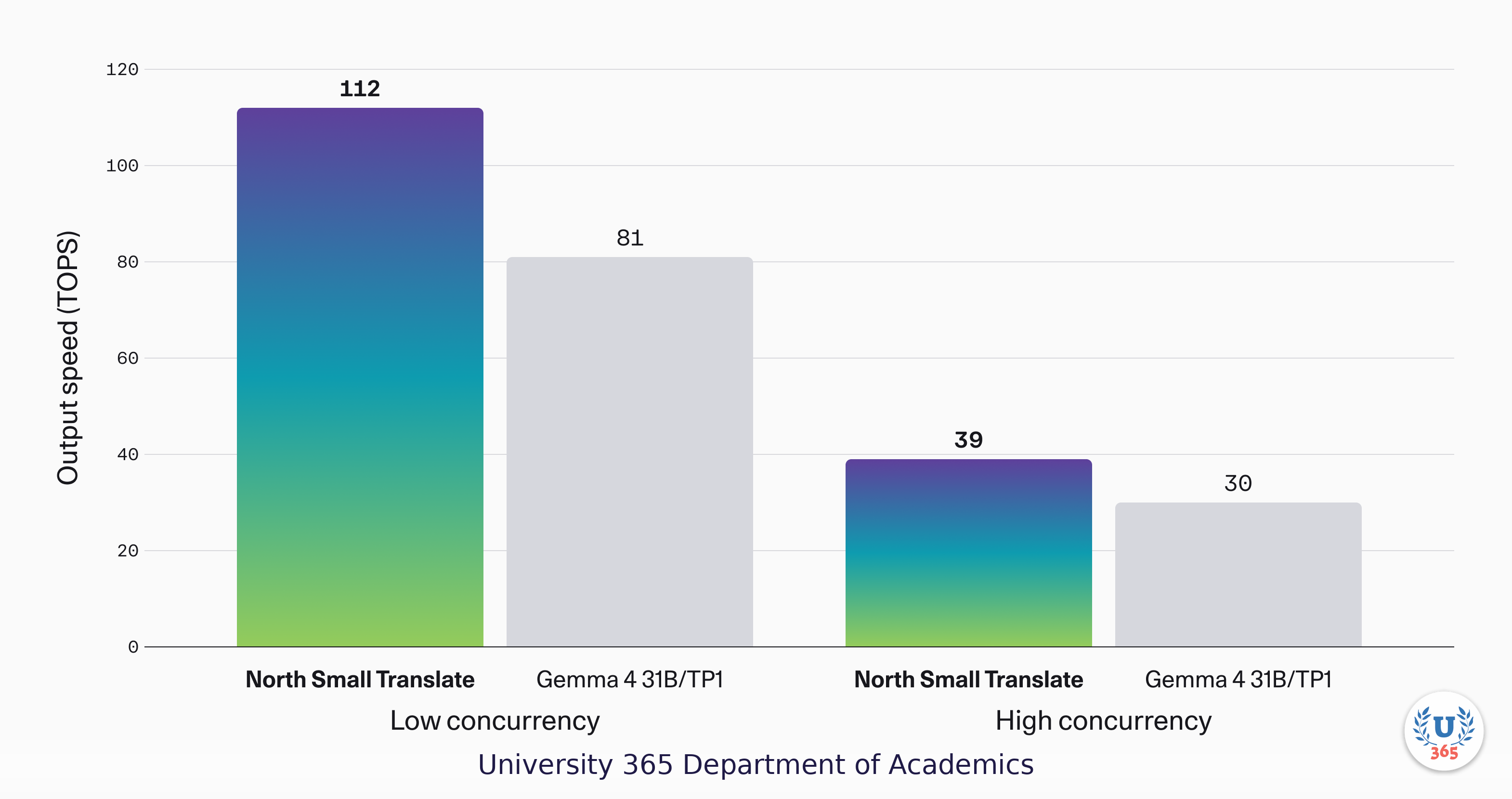
The price comparison needs one paragraph of arithmetic, and for this model the arithmetic separates two products. The API route is free within limits that Cohere does not publish for this model, so a pilot costs nothing and a production workload costs a negotiation. The commercial licence is quoted per task, not per token, so it cannot be compared with a per-token rate without the token count the vendor used: 661 tokens per task on average, which makes the $0.000676 figure a statement about short documents. The self-hosted route is a GPU bill: one B200 at the promotional $8.00 per GPU-hour is $192 for a day, and the break-even against the commercial per-task figure depends on how many tasks one B200 completes in an hour, a number Cohere does not publish per GPU. The vendor does publish an internal throughput comparison against Gemma 4 31B, at 112 against 81 output tokens per second at low concurrency, and that is a vendor measurement on one GPU with one competitor, not a capacity plan.
Official links:
Model documentation: https://docs.cohere.com/docs/north-small-translate-1.0
Launch post, 2026-09-10: https://cohere.com/blog/north-small-translate
Technical report, published at WMT26: https://cohere.com/north-small-translate-tech-report
ACL Anthology entry for the system paper: https://aclanthology.org/2026.wmt-main.70/
Model card and BF16 weights: https://huggingface.co/CohereLabs/North-Small-Translate-1.0
4-bit checkpoint: https://huggingface.co/CohereLabs/North-Small-Translate-1.0-w4a16
8-bit checkpoint: https://huggingface.co/CohereLabs/North-Small-Translate-1.0-fp8
Licence text with the acceptable use addendum: https://cohere.com/cohere-labs-cc-by-nc-license
Cohere Labs Acceptable Use Policy: https://docs.cohere.com/docs/c4ai-acceptable-use-policy
Pricing: https://cohere.com/pricing
Rate limits: https://docs.cohere.com/docs/rate-limits
Demo Space: https://huggingface.co/spaces/CohereLabs/North-Small-Translate-1.0
WMT26 General MT findings: https://aclanthology.org/2026.wmt-main.48/
WMT26 General MT task page: https://www2.statmt.org/wmt26/translation-task.html
LLM-specific fields:
Model identifier: north-small-translate-1.0 on the Chat V2, Chat V1 and Chat Completions endpoints. The Hub repositories are CohereLabs/North-Small-Translate-1.0, -fp8 and -w4a16.
Architecture: a decoder-only sparse mixture-of-experts Transformer, Cohere2MoeForCausalLM, with 128 experts, 8 activated per token plus shared experts, a sigmoid router, and sliding-window attention of 4,096 tokens interleaved with global attention in a 3:1 ratio. The technical report states that it is built on the same foundation as Command A+.
Parameters: 218,254,938,112 in BF16, read from the Hub's safetensors metadata, which is 218.25 billion. The active count is 25 billion.
Context window: 16,000 tokens of input and 16,000 tokens of output, stated on the docs page, the model card and the launch post.
Maximum output: 16,000 tokens.
Reasoning control: none. Cohere trained the model as a non-reasoning model by design. No effort level, thinking flag or token budget is published. The optional Agentic Translation workflow is a multi-pass loop around the model, not a reasoning mode inside it.
Modalities: text input, text output. The EU AI Act summary states that the model was not trained with image content.
Sampling: greedy decoding is recommended and is what the production deployment uses. No sampling defaults are published for this checkpoint.
Serving: vLLM for the 4-bit checkpoint, with cohere_melody 0.9.0 or later for response parsing, and the cohere_command4 tool-call and reasoning parsers in the card's example. The BF16 checkpoint runs in transformers from a source build. The card's vLLM example sets --max-model-len 32768, which is above the 16K the same card states: plan on 16K and treat the flag as a template default.
Quantizations: BF16 at roughly 437GB, FP8, and NVFP4 W4A16 at roughly 131GB. All three are the checkpoints Cohere serves in production, per the model card.
Licence: CC BY-NC 4.0 with an acceptable use addendum, plus the Cohere Labs Acceptable Use Policy. The repository ships no licence file; the licence is declared in metadata and published on Cohere's site.
Availability: first-party API, open weights on Hugging Face (gated), and a demo Space. No OpenRouter listing for this model, and no inference provider on the Hub.
Languages: 50 languages and locale variants, with Modern Standard Arabic, German, French, Japanese, Korean, Russian and Ukrainian as tier-one languages.
Governance: Cohere publishes a public summary of training content under EU AI Act Article 53(1)(d) that names both Command A+ and North Small Translate, with Cohere Germany GmbH as the provider.
At a Glance Dashboard
Field | Value |
Category | Applied AI / Open-weight machine translation model, 50 languages |
CI-First Benefit Score | 5.5 / 10 (CI-First Positive) |
Sub-scores | Time 6 / Quantity 6 / Quality 5 / Skill 5 |
CI-First Profile | Primary: Co-Worker and Assistant (level 2). Secondary: Co-Researcher, Analyst and Tester (level 4) |
Humics Protection | Humics-Neutral (-1 / +3) |
AI Imposture Risk | Medium overall, with Skill Illusion High |
Status | Active |
Last tested | 2026-11-19 |
Pricing | API free within unpublished limits. Commercial licence quoted at $0.000676 per task. Self-hosted on one B200 at 4-bit |
Platforms | Cohere API (Chat V2, V1, Completions), self-hosted vLLM and transformers, Model Vault, RWS Language Weaver for enterprise |
User sentiment | Adoption signal rather than sentiment: 67 likes and 32 downloads in the last month on the BF16 repository. The recurring requests are a GGUF build and the paper, and neither has a vendor answer in the repository threads |

North Small Translate 1.0
The Problem
A translation buyer in 2026 has three routes and each one fails in a different place. A neural translation service is cheap, fast and flat: it handles a phrase well and a document badly, it does not follow a glossary unless the platform supports one, and it cannot be tuned. A general frontier model translates well and costs like a frontier model, and it needs a hosted endpoint, which is the one thing a public body or a regulated company may not use. A human translation agency is the quality reference and the cost reference, and it does not scale to 50 languages on a weekly release cycle.
The gap in the middle is a specialist translation model that runs on hardware the buyer controls, follows instructions about register and terminology, and covers enough languages to be useful rather than symbolic. That is what this release is: a 218B mixture with 25B active, trained on translation and MT-adjacent tasks, released with weights in three quantizations, and documented well enough to serve. The 4-bit checkpoint on one B200 is the deployment that makes it a real option rather than a benchmark entry.
The second problem is the one the licence creates. "Open weights" reads as freedom, and here it means research access. The licence permits non-commercial use, the acceptable use policy adds restrictions, and a company that wants the model in a product buys a commercial licence or runs through a partner platform. A reader who downloads the weights expecting to deploy them in a business has misread the product, and the vendor's own page does not make that hard to misread: it lists internal communication, HR policies and employee handbooks as use cases, then states that the weights are non-commercial. Both statements are true of different routes. The review separates them because a procurement decision turns on the difference.
The third problem is evidence. The launch post leads with a score that beats DeepL and Google Translate, and the score is produced by a judge model that Cohere chose, on a test set Cohere entered, with a first author who helps run the shared task. None of that makes the number false. It makes it a vendor measurement, and the same test set has an official human evaluation that places the system mid-table overall and first in one language pair. A buyer who reads only the launch post will believe the model is the best translation system available. A buyer who reads the findings paper will believe it is a strong specialist with uneven coverage. The second reading is the one that survives verification.
The fourth problem is the one a business brings and cannot solve with a benchmark. Translation quality is only checkable by someone who reads the target language. A company that publishes in 50 languages does not have 50 reviewers, and the economics of a free API or a 131GB download push toward publishing more, not toward reviewing more. That is the quantity illusion in its purest form, and this model is built and marketed for exactly the workflow that produces it.

North Small Translate 1.0
The Outcome
North Small Translate 1.0 gives a team a specialist translation model it can run on its own hardware, across 50 languages, with a 16K window, strong throughput, published weights and a peer-reviewed training recipe, and it does so under a non-commercial licence, with a headline score that the official human evaluation of the same system does not support.
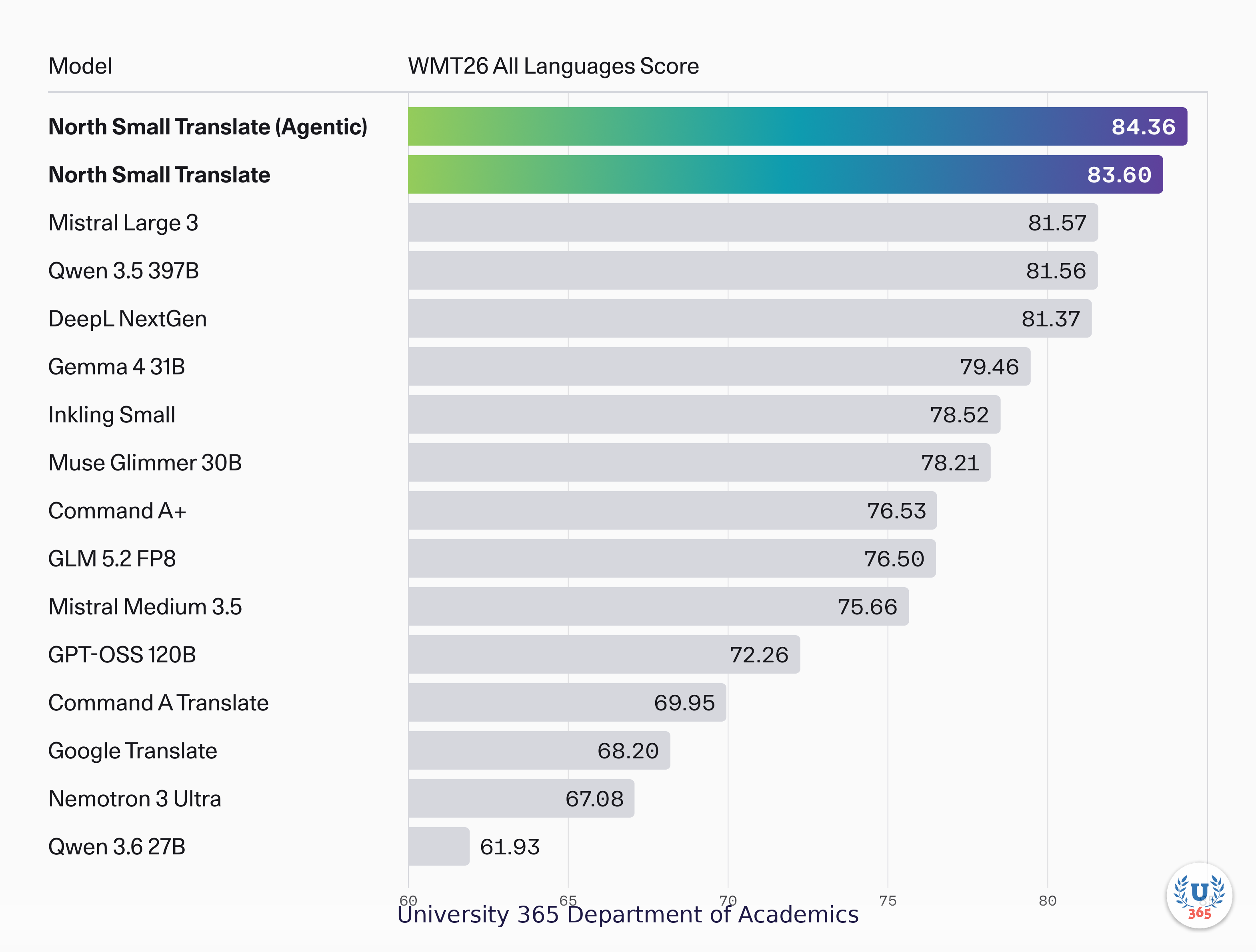
The performance position is real and narrower than the launch post. In the official WMT26 General MT human evaluation, Cohere CAT+ ranks first in English to Czech at 79.0, eighth in English to Thai at 78.4, tenth in English to Korean at 73.0, and fourteenth in English to Japanese, Indonesian and Kazakh. It ranks near the bottom in English to Ladin at 6.9 and mid-table in English to Northern Sami at 35.3. Its average rank across the language pairs it entered is 18.3, in a task that evaluated 46 systems, and the findings paper names Wayfinder as the best system overall. On the vendor's own judge score it is first overall at 83.6. The gap between those two statements is the most important thing in this review, and it is not a scandal: it is what happens when a vendor picks a judge, a weighting and a language set, and a shared task uses human annotators with a different protocol.
The deployment position is better than the parameter count suggests. The 4-bit checkpoint is 131GB against roughly 437GB for BF16, it fits one B200 or two H100s, and the model card publishes the vLLM command and the parser library needed to get clean output. It is a non-reasoning model, so there is no thinking trace to pay for on every call, and the vendor's internal comparison puts it at 112 output tokens per second against 81 for Gemma 4 31B at low concurrency on one GPU. The 16K output ceiling is generous for a translation model and small for a book: two chapters fit, a 300-page manual does not.
The licence position is the one that decides the business case. The weights are CC BY-NC 4.0. The licence defines non-commercial by purpose, and internal business use is the ambiguous middle: a company translating its own HR handbook is not selling the translation, and it is using the model for its commercial advantage. Creative Commons does not give a bright line for that case, Cohere's own material points commercial users to Sales, and the acceptable use policy separately bans generating synthetic data for commercial purposes. The API is the clean route: free within limits, governed by Cohere's commercial terms, and available today. A reader who needs the weights in a product needs a commercial licence, and should get that answer before building anything.
Where the outcome is smaller than the announcement. The launch post says the model outperforms DeepL and Google Translate and leads its class. On the vendor's judge score it does. On the official human evaluation it beats Google Translate and Command A Translate in most directions, loses to Gemini 3.1 Pro and Wayfinder, and falls to 6.9 in one language pair. The 84.36 agentic figure is 0.76 above the standard model for a workflow that spends several calls per document, and the report itself notes that the reinforcement-learning step degraded some low-resource languages and needed a corrective DPO pass. None of this makes the model weak. It makes the claim narrower than the sentence that carries it.
For U365 Fellows, the outcome is a translation instrument with a clear boundary. A Fellow who runs a multilingual project can put a document through the API for nothing, read the output in a language they know, and see the quality for themselves. A Fellow working in a language they do not read cannot verify it, and should not publish it. The habit this model rewards is the one the framework keeps returning to: decide who can check the output before you decide how much to produce.
What the release does not change. It does not make the weights commercial, it does not publish the rate limit that applies to this model, it does not ship a licence file, it does not make the official human ranking match the vendor's judge score, and it does not give a monolingual team the ability to judge 50 languages. Those facts sit in the limits, in Section 7c, in the imposture table and in the clause note, and no download moves them.

North Small Translate 1.0
Who Should Use North Small Translate 1.0
Learner type | Difficulty | Typical ROI | Career path |
Students (Bachelor, Master) | Intermediate | A real but bounded case. A student in translation studies or computational linguistics can run the free API, compare the output with a human reference, and learn why a judge score and a human score disagree. The peer-reviewed paper, the five-step training recipe and the open weights make it a better object of study than a closed translation service. The return collapses where the student cannot read the target language: comparing outputs in a language you do not speak teaches you nothing about quality. | |
Professionals (career upskilling) | Advanced | A narrow, real case: a localization engineer or documentation lead who needs a self-hosted translator for sensitive content and can run vLLM. The 4-bit checkpoint on one B200 is the deployment, and the API is the cheap way to evaluate it first. It is not the tool for a professional who wants a translation plug-in: there is no product surface, no review workflow and no glossary manager. | |
Everyone (lifelong learners) | Not recommended | The model has no consumer product, no app and no onboarding. A learner can use the demo Space, and that is a demonstration rather than a workflow. The honest recommendation for personal translation is a consumer translation service with a review habit, not a 218B checkpoint. | None asserted. |
Researchers and lab engineers | Advanced | The strongest case in the release. A peer-reviewed WMT26 system paper with the full training protocol, three quantizations, a public test set, the official human evaluation and open weights gives a lab a reproducible object for MT research. The licence permits non-commercial research, which is the work a lab does. | UIT for the research engineering and evaluation design; the U365 methods layer for the experiment record. No credential is claimed for research supervision. |
For teams and organisations. A team deciding on this model starts with four questions, and the first one is the licence.
Team deployment. Two routes. The API route takes an identifier and a key, is free within limits Cohere does not publish for this model, and carries Cohere's commercial terms. The self-hosted route takes a 131GB download, one B200 or two H100s, vLLM with the cohere_melody parser, and a licence review, because the weights are non-commercial. There is no middle route where the weights are free for production.
Cost at team scale. The API is free until the limit, then a Sales conversation. The commercial licence is quoted at $0.000676 per task on 661-token tasks, which favours short documents. Self-hosting is a GPU bill: $8.00 per B200 GPU-hour on Model Vault at the promotional rate, $192 for a day, whether the card is busy or not. At sustained utilization the GPU is cheaper per token; at low utilization the free API is cheaper than owning the card.
Data and compliance. The self-hosted route answers a residency question because the text never leaves the estate, and the model card states that the checkpoints Cohere serves in production are the same ones published. The governance file is stronger than most: Cohere publishes an EU AI Act Article 53(1)(d) summary that names this model, with Cohere Germany GmbH as the provider. The licence and the acceptable use policy are the binding constraints, and a legal reviewer should read both before a product ships.
U365 for companies. Professional learners reach University 365's academic services individually or through their organisation, and the company route runs through a customized training agreement for employee groups. Corporate education programmes are built on demand, and their tuition follows content and duration.
Skill level required: Intermediate to run the API, Advanced to self-host. An API call is a few lines. Serving 131GB on vLLM, parsing the output with the right library, sizing the context and building a review workflow are engineering work.
Prerequisites. For the API: a Cohere key and a document in a supported language. For self-hosting: one B200 or two H100s at the 4-bit quantization, vLLM, cohere_melody 0.9.0 or later, and the chat template that ships with the checkpoint. For any production use: a named reviewer who reads the target language, and a licence decision.
Typical time to first result: Fifteen minutes on the API. Half a day to self-host if the card is already provisioned, most of it the 131GB download and the vLLM setup. A week to a first reviewed batch, because the review workflow is the part that takes design.
Typical time to competence: Forty to eighty hours, most of it on evaluation and editorial review rather than on prompting. Three habits carry the value: keep a human reference for each language you publish, test terminology adherence on your own glossary, and record the model version with every published translation so a later change is attributable.
Who should wait. Anyone who needs a commercial licence without a procurement cycle, because the weights are non-commercial. Anyone who needs a consumer product or a review interface, because there is none. Anyone who needs an independent capability score before committing, because none exists. Anyone who needs image or audio input, because the model is text only. And anyone who cannot staff a reviewer for the target language, because the model will not tell you whether its output is good.

North Small Translate 1.0
U365 Institutes Alignment
The alignment below rates what a U365 institute could take from this model as a working instrument and as an object of study. The primary home is UIT (Technology, AI, Data Science), because the release's most useful property for a cohort is that a 218B mixture-of-experts translation model, its serving path, its training recipe and the official human evaluation of the same system can all be studied together.
Institute | Scope | Rating | Why | The limit that holds the row |
--- | --- | --- | --- | --- |
UIT (Technology, AI, Data Science) | Model serving, MT evaluation, structured translation, localization engineering | High (primary) | Four engineering competencies survive the removal of the tool. Serving: a 131GB 4-bit checkpoint, a published vLLM command, a parser library and three quantizations are a working syllabus in inference engineering. Evaluation design: a vendor judge score, an official human evaluation with a different verdict, and a findings paper that stopped publishing automatic scores because systems hill-climb them make this the best available case for teaching what a benchmark measures. Structured translation: JSON, HTML and CSV output with key and placeholder preservation is a real engineering task. Licence reading: a non-commercial weights licence beside a free API and a commercial licence is a case in reading permission rather than a licence badge. | The limit that holds the row. The engineering is deployment and evaluation, not model building, and the licence decides how far a commercial cohort can go: the weights are non-commercial, the 131GB 4-bit checkpoint needs one B200 or two H100s, and the model carries no glossary manager, no translation memory and no review workflow. No published programme assesses model serving, translation or benchmark auditing as a named component: across the 81 published programmes, model serving, serving, translation, machine translation, localisation, localization, quantisation, quantization, inference, vllm and benchmark each return 0 titles and 0 descriptions, and evaluation returns 0 titles and 1 description, the carrier being Financial Analysis Specialist. Adjacent anchors, not assessment homes. |
UIB (Business Management, Entrepreneurship) | Localization economics, licence and procurement, build versus buy | Medium | Two decisions the release forces that are commercial before they are technical. Build versus buy: a free API within limits, a commercial licence quoted per task and a GPU-hour self-hosted route are three cost structures a cohort can model on published numbers, and the break-even depends on utilization. Licence and procurement: non-commercial weights, an acceptable use policy that bans commercial synthetic data, and a Sales route are a practical exercise in reading terms before a build. The scope is narrow because the model has no product surface to sell. | The limit that holds the row. The model supplies no management method and measures no return of its own: the per-task figure is the vendor's own comparison on 661-token tasks rather than a rate card, the API limit that applies to this model is unpublished, and a self-hosted business case rests on a GPU-hour rate rather than on a measured cost per completed task. No published programme assesses the economics of a model deployment as a named component: across the 81 published programmes, unit economics, build versus buy, licence, license, procurement, cost and price each return 0 titles and 0 descriptions. Adjacent anchors, not assessment homes. |
UIC (Digital Communication, Marketing) | Multilingual content operations, brand voice, editorial review | Low to Medium | A direct contact, with a condition. The model translates announcements, intranet content, newsletters and customer communication into 50 languages, which is a content-operations capability a communication team can use. The condition is editorial: register, formality and brand voice are instructions the team must write and check, and the model's fluency in a language the team does not read is not evidence that the brand sounds right in it. A communication cohort can use the model to draft and a native reviewer to approve, and that division is the lesson. The row is a multilingual production surface with no communication mechanic of its own, which is the Low to Medium shape on this instrument. | The limit that holds the row. The model writes no register of its own: formality, brand voice and terminology are instructions the team writes and a native reviewer checks, and fluency in a language the team does not read is not evidence that the brand sounds right in it. No published programme assesses translation, editorial or brand voice as a named component: across the 81 published programmes, translation, machine translation, localisation, localization, multilingual, register, brand voice, editorial and campaign each return 0 titles and 0 descriptions, while copywriting returns 0 titles and 1 description, on Social Media Marketing Manager, and content strategy returns 0 titles and 1 description, on Content Marketing Specialist. Rated as production contact with a writing surface. |
UID (Digital Design, UX/UI) | Interface strings, structured content, localization of design systems | Low | A narrow contact. The model translates JSON and structured content with key and placeholder preservation, which is the mechanical part of interface localization, and the technical report scores structured translation at 93.7 on the vendor's own scale. The design decisions (string length, tone, layout in another script, right-to-left rendering) remain design work, and the model has no visual input. A design cohort can use it for first-pass string translation and must test every string in the interface. | The limit that holds the row. The model produces no layout, no component, no interaction and no image, so it cannot test string length, script rendering or right-to-left layout in the interface, and every string it returns has to be placed and read by a designer. No published programme assesses interface localization as a named component: across the 81 published programmes, localization, localisation, interface strings, design system and right-to-left each return 0 titles and 0 descriptions. Adjacent anchors, not assessment homes. |
U365 methods, not an institute (UNOP, ULM, LIPS, CARE and the UP-Context-Engineering Method) | Method layer: task definition, context, review and record | Applicable | The methods layer fits the way a translation pipeline needs to be controlled. The UP-Context-Engineering Method's eight layers make a run repeatable: AI-EXACT-TASK fixes the target language and the register, EXPECTED-FORMAT-AND-CONSTRAINTS fixes the glossary and the output shape, and FULL-CONTEXT carries the source document and the term base that must stay constant between two runs. CARE applies to the review of every published translation, because the check belongs to a named reviewer plus a reference rather than to the model. LIPS applies to the record, because a published translation that does not name the checkpoint, the quantization and the prompt cannot be compared with the next one. ULM is the six-domain frame that holds the decision about which languages to publish rather than the run: the licence, the GPU bill and the per-task rate are a recurring cost in the Career and Finance domain, and Quality of Life planning holds whether the added coverage is worth the work at all. ULM carries no cost method, and cost per completed task is CI-First cost engineering and the independent evaluator's metric. UNOP has no direct fit: the model is built to translate, and its contribution is capability rather than pedagogy. | The limit that holds the row. The model carries no method of its own and no coaching surface: it returns a translation, and the task definition, the term base, the reviewer's decision and the record are the team's, because nothing in the model writes them. |

North Small Translate 1.0
How North Small Translate 1.0 Works
A decoder-only sparse mixture-of-experts Transformer built on the Command A+ foundation, post-trained in five steps for translation quality, reading text and returning text inside a 16K window, with a default system instruction, a chat template and structural markers that the serving parser must understand.
The architecture. The model has 218 billion total parameters and 25 billion active parameters. The model card describes 128 experts, 8 activated per token, plus shared experts applied to every token. The attention stack interleaves sliding-window layers with a 4,096-token window and global layers without positional embeddings, in a 3:1 ratio, a design the card states was first introduced in Command A. The router applies a sigmoid activation over the expert logits and normalizes over the selected top-k. The Hub's architecture tag is Cohere2MoeForCausalLM. The technical report states that the model is built on the same foundation as Command A+, which is why a general model and a translation specialist share a parameter count.
The training. Cohere describes five steps, and the sequence is the interesting part. It starts with coarse supervised fine-tuning to establish general instruction following and extend language coverage from 35 pre-training languages to 50. Fine-grained supervised fine-tuning follows on curated synthetic data, aimed at translation quality and at MT-adjacent tasks such as error detection, terminology and post-editing. Direct preference optimization comes next, then online reinforcement learning with an LLM-as-a-judge reward, then a final light DPO pass with a reduced learning rate to fix regressions the RL step introduced. The report's own table shows the progression on WMT25 with GEMBA-ESA averaged over 14 languages: 71.3 after coarse SFT, 76.2 after fine-grained SFT, 80.1 after DPO, 80.0 after online RL, 81.8 after the final light DPO. The RL step did not improve the average and did degrade some low-resource languages, which the authors state plainly.
The data. The technical report describes difficulty sampling: a first-stage model translates candidate documents, a judge scores them, and the corpus keeps the documents where the model makes major errors. The card states that the model was post-trained specifically for translation quality. Cohere's EU AI Act summary records training data up to June 2026, at least 48 languages in the overall training data, Common Crawl as a public source, licensed third-party text, and synthetic data generated with Cohere's own models including Command A. The summary also states that this model was not trained with image content.
The output contract. The model wraps its reply in structural markers such as <|START_TEXT|> and <|END_TEXT|>. The card notes that these are deliberately not registered as special tokens, because the vLLM parsers rely on seeing them, and that skip_special_tokens=True therefore does not remove them. In transformers, generate returns the prompt followed by the completion, so you slice off the prompt and parse the remainder with Cohere's melody library, which is the same parser vLLM uses. In vLLM, the card's command passes --tool-call-parser cohere_command4 and --reasoning-parser cohere_command4. A reader who parses the raw string will see the system instruction and the markers in the output, and may mistake them for a model defect.
The system instruction. The chat template applies a default system instruction that names the model and sets its safety defaults. You can replace it by passing platform_instruction_override through the template, and a per-conversation system message is appended after the default instruction rather than replacing it. That detail matters for a translation pipeline: if your glossary or register instruction must override the default, use the override field, not a system message.
The agentic workflow. The launch post reports 84.36 for "North Small Translate (Agentic)", which the paper describes as an optional framework where the model evaluates and post-edits its own draft. That is a loop you build: translate, ask the model or a judge to find errors, then ask it to fix them. The paper reports 84.4 in its table for the agentic variant against 83.6 for the standard model, a 0.8-point gain on the vendor's judge scale, and the launch post's own example describes the trade: more tokens for a small quality gain, worth it on a contract or a safety procedure and not worth it on a high-volume feed.
What the model does not do. It does not reason before answering: it was trained as a non-reasoning model to protect throughput, and the optional loop is outside the model. It does not read images, audio or video. It does not carry a glossary, a translation memory or a review workflow: those are yours. And it does not report its own confidence, which is why the quality-estimation task the report describes is a prompt you write rather than a score the model returns by default.

North Small Translate 1.0
Getting Started with North Small Translate 1.0
The fastest path is the API, and the fifteen-minute checklist below is enough to see whether the model belongs in your workflow. The self-hosted path is a separate decision, and it starts with a GPU and a licence review.
Route 1, the API, in about fifteen minutes:
Create a Cohere account and an API key. The model is available on trial and production keys, and the model page states that it is free until rate limits are reached.
Send one document you already have a human translation of, in a language you or a colleague can read. Do not start with a language nobody on the team reads.
Ask for the translation with the target language, the register and any glossary in the instruction, and state that only the translation should be returned.
Compare the output with the human reference. Count errors rather than judging fluency: an omission, a mistranslation and a wrong term are countable, and "sounds good" is not.
Record the model identifier, the date and the settings with the sample, because a later checkpoint will not reproduce it.
The model page gives this shape for the call:
import os
from cohere import ClientV2

co = ClientV2(api_key=os.environ["COHERE_API_KEY"])
response = co.chat(
    model="north-small-translate-1.0",
    messages=[{
        "role": "user",
        "content": "Translate the following text into German. Return only the translation.\n\n" + source_text,
    }],
)
print(response.message.content[0].text)
Route 2, self-hosted, in about half a day:
Choose the quantization against the hardware you have. The 4-bit NVFP4 checkpoint is 131GB and fits one B200 or two H100s. The 8-bit checkpoint needs two B200 or four H100s. BF16 is roughly 437GB and needs four B200 or eight H100s.
Download the checkpoint, and accept the repository conditions on the Hub first, because the repositories are gated.
Install vLLM and cohere_melody 0.9.0 or later. Start the server with the card's command, adapting tensor parallelism to your cards, and set the maximum model length to the context you actually plan to use rather than to the card's 32768 example.
Send one request and confirm that the output parses cleanly: no system instruction in the response, no structural markers, and a complete translation.
Decide where the review happens before you connect the model to a publishing pipeline. The model is fast enough to produce more than a team can check, and that is the failure mode this deployment creates.
What it costs to try. The API route costs nothing within the unpublished limit. The self-hosted route costs a GPU: one B200 on Model Vault at the promotional $8.00 per GPU-hour is $192 for a day, and an on-premises card is a capital cost. A team that wants a commercial licence should ask Cohere Sales for the per-task or per-token basis before it builds, because the published $0.000676 per task is the vendor's own comparison figure on 661-token tasks and not a rate card.
The first decision is not which model, it is who reviews. A translation pipeline without a named reviewer per target language is a volume machine. The model's quality is good enough in the strong pairs that an unreviewed output will often pass, and that is exactly what makes the unreviewed workflow dangerous: it works until the one document where it does not.

North Small Translate 1.0
Real Workflows
Three workflows, each chosen because the model's published property and a check the reader already owns sit in the same place. Each sample prompt uses the UP-Context-Engineering Method's eight layers in method order, with the constraints and the data limits inside EXPECTED-FORMAT-AND-CONSTRAINTS.
Workflow 1: Translate a policy document into a tier-one language, with a native reviewer as the judge
When to use it: the document is internal, the target language is one the model handles well, and a named colleague reads that language. This is the vendor's own first use case, and it is the workflow where the model's strengths and the review requirement are easiest to see.
This sample prompt uses the UP-Context-Engineering Method and the CI-First doctrine. Read the method at https://www.university-365.com/post/the-up-method-university-365-prompting-the-new-gold-standard-for-prompt-engineering, the doctrine at https://www.university-365.com/post/discover-the-ci-first-approach, learn both in a U365 online program at https://www.university-365.com/programs, and request a U.Coach for orientation at https://www.university-365.com/ucoach.
USER-PERSONA: My UP-Context-Engineering USER-PERSONA file is the file for this layer, attached. It is my psychographic file concatenated with the six ULM life-domain files. The parts that matter here: I own the policy, I sign the published version, and I will not publish a translation that no native reader has approved. If the file is not attached, ask for it before you start.
FULL-CONTEXT: The FULL-CONTEXT set for this task, added and not merged: BUSINESS-PERSONA for [the organisation], PROJECT-DESCRIPTION for [the policy update], the source document at [path], the approved term base at [path], the target language and locale, and the name of the reviewer who reads that language. The source document and the term base are the only authority. If the term base is missing, say so and translate without inventing terms.
AI-PROFILE-ROLE-EXPERTISE: Act as a Co-Worker and Assistant, in the role of a professional translator working on an internal policy document, with expertise in formal register, terminology consistency and preserving defined terms exactly.
USER-FINAL-GOAL: A translation the reviewer can approve in one pass, with the terminology decisions visible, so the policy ships this week in both languages.
AI-EXACT-TASK: Translate the whole document into [target language and locale], preserve headings, lists and defined terms, apply the term base, mark any term you could not map, and return only the translation plus a short list of the decisions a reviewer should check.
AUDIENCE: A native-speaking colleague who will read the translation against the source and either approve it or return it with corrections.
EXPECTED-FORMAT-AND-CONSTRAINTS: Format: (1) the translation, matching the source structure, (2) a list of term-base applications and unmapped terms, (3) a list of the three sentences most likely to need a reviewer's judgment. Constraints: do not summarize, add or omit content; do not translate defined terms into synonyms; keep placeholders and cross-references unchanged; use the formal register stated in the source; if a passage is ambiguous, translate the most literal reading and mark it rather than guessing. Data limits: the document is cleared for this model at the level I state in the FULL-CONTEXT set; no personal data beyond what the policy already carries, and I paste no credential into a surface I have not cleared.
EXAMPLES: The approved translation of the previous version of this policy is attached as the register and terminology example.
Before you use the output, run the check yourself: have the named native reviewer read the translation against the source and count omissions, mistranslations and wrong terms, confirm every defined term and placeholder is unchanged, and approve only when the reviewer signs the translation. The decision is yours, per CI-First.
Four-tier verification checklist:
Multi-Model Check: run the same policy passage through a second translation model and compare the two outputs against the term base, and investigate every segment where the two disagree before the reviewer sees it.
External Source: open the approved translation of the previous version and confirm the register and the defined terms against it rather than against the model's memory.
Human Review: the named native reviewer reads the translation against the source and signs it, because a reviewer who read it and thought it looked fine has not verified it.
CI-First Test: can the reviewer defend every defined term and every marked ambiguity from the source document alone? If not, the translation is a draft.
Workflow 2: Build a 50-language release with a publish gate per language
When to use it: you have a documentation set and a demand for many languages, and you want the model to extend coverage without turning volume into an unchecked claim. This is the workflow the model's economics push you toward, and the one that needs a gate.
This sample prompt uses the UP-Context-Engineering Method and the CI-First doctrine. Read the method at https://www.university-365.com/post/the-up-method-university-365-prompting-the-new-gold-standard-for-prompt-engineering, the doctrine at https://www.university-365.com/post/discover-the-ci-first-approach, learn both in a U365 online program at https://www.university-365.com/programs, and request a U.Coach for orientation at https://www.university-365.com/ucoach.
USER-PERSONA: My UP-Context-Engineering USER-PERSONA file is the file for this layer, attached. It is my psychographic file concatenated with the six ULM life-domain files. The parts that matter here: I run the documentation programme, I decide what gets published in which language, and I will not publish a language nobody on the team can check. If the file is not attached, ask for it before you start.
FULL-CONTEXT: The FULL-CONTEXT set for this task, added and not merged: BUSINESS-PERSONA for [the organisation], PROJECT-DESCRIPTION for [the release], the source documentation set at [path], the target language list with a reviewer named or marked none for each, the approved glossary, and the publication policy for machine translation. The reviewer list is the authority for what may publish. If a language has no reviewer, it is drafted and not published.
AI-PROFILE-ROLE-EXPERTISE: Act as a Co-Researcher, Analyst and Tester, in the role of a localization programme lead designing a gated release, with expertise in coverage planning, terminology control, spot-check sampling and publication risk.
USER-FINAL-GOAL: A release where every published language has a named reviewer and a recorded check, and every unpublished language is a deliberate decision rather than a gap nobody noticed.
AI-EXACT-TASK: Build the release plan: for each target language, state the reviewer, the sample size for the spot check, the terminology test, the pass criterion and the publication decision rule; then name the languages that should not publish this cycle and why.
AUDIENCE: The release review, which will check one language at random and ask who approved it.
EXPECTED-FORMAT-AND-CONSTRAINTS: Format: (1) a per-language table with reviewer, sample size, terminology test, pass criterion and decision, (2) the sampling method, (3) the list of blocked languages with the reason, (4) the rollback rule if a published error is found. Constraints: no language publishes without a named reviewer; the sample is drawn before the outputs are read; a failed terminology test blocks the language; do not treat a fluent sample as a passed check. Data limits: the documentation is cleared for this model at the level I state in the FULL-CONTEXT set; no customer data enters the sample, and I paste no credential into a surface I have not cleared.
EXAMPLES: The previous release's per-language gate table is attached as the format example, including the two languages that were blocked.
Before you use the output, run the check yourself: confirm every published language has a named reviewer and a recorded check, re-run the terminology test on the full set, and read the pre-drawn sample before the totals rather than after. The decision is yours, per CI-First.
Four-tier verification checklist:
Multi-Model Check: run one language through a second translation model and compare the two outputs against the glossary, and test the term only one model renders correctly first.
External Source: confirm the source set is frozen at the version the release names, and open the publication policy the gate cites.
Human Review: the named reviewer for each language reads the pre-drawn sample and signs the gate table, and no language publishes on a fluent sample alone.
CI-First Test: can you name who approved each published language and show the recorded check? If not, the language is not published.
Workflow 3: Measure this model against your incumbent on 100 of your own segments
When to use it: before you commit to the commercial licence, and before you believe either the 83.6 or the 18.3. The official human evaluation is the strongest evidence in the release, and it is still about a test set you did not choose. Your own segments are the only authority for your own work.
This sample prompt uses the UP-Context-Engineering Method and the CI-First doctrine. Read the method at https://www.university-365.com/post/the-up-method-university-365-prompting-the-new-gold-standard-for-prompt-engineering, the doctrine at https://www.university-365.com/post/discover-the-ci-first-approach, learn both in a U365 online program at https://www.university-365.com/programs, and request a U.Coach for orientation at https://www.university-365.com/ucoach.
USER-PERSONA: My UP-Context-Engineering USER-PERSONA file is the file for this layer, attached. It is my psychographic file concatenated with the six ULM life-domain files. The parts that matter here: I run the evaluation, I sign the recommendation, and I will report a difference I cannot establish as unresolved. If the file is not attached, ask for it before you start.
FULL-CONTEXT: The FULL-CONTEXT set for this task, added and not merged: BUSINESS-PERSONA for [the organisation], PROJECT-DESCRIPTION for [the evaluation], 100 segments sampled from your own content with the sampling rule, the human reference or the incumbent translation for each, the glossary, the two systems under test with their identifiers and settings, and the judge definition. The segment set and the judge definition are the authority. If a segment has no reference and no incumbent, exclude it rather than scoring it by impression.
AI-PROFILE-ROLE-EXPERTISE: Act as a Co-Researcher, Analyst and Tester, in the role of an evaluation engineer comparing a specialist translation model with an incumbent under one protocol, with expertise in sampling, judge-based scoring and reporting uncertainty rather than a single mean.
USER-FINAL-GOAL: A recommendation I can defend: adopt, reject or run a larger test, with the evidence and the uncertainty on one page.
AI-EXACT-TASK: Score both systems on the same 100 segments, with the same prompt and the same judge, report the per-segment win, loss and tie counts, the mean difference with an interval, the segments where the two systems disagree most, and the terms each system failed.
AUDIENCE: A procurement review that will re-score ten segments at random and check the judge prompt.
EXPECTED-FORMAT-AND-CONSTRAINTS: Format: (1) the sampling rule and the segment count, (2) the judge prompt quoted in full, (3) the win, loss and tie counts with the interval, (4) the ten largest disagreements with the source and both outputs, (5) the terminology failures, (6) what the test does not measure. Constraints: identical prompt and judge for both systems; no segment dropped after scoring; report ties as ties; if the interval crosses zero, say the difference is unresolved; do not quote the vendor's 83.6 as your result. Data limits: the segments are cleared for both systems at the level I state in the FULL-CONTEXT set; no customer-identifying text enters the sample, and I paste no credential into a surface I have not cleared.
EXAMPLES: One scored segment with the judge's rationale is attached as the format example.
Before you use the output, run the check yourself: re-score ten segments by hand against the judge, confirm the sampling rule was recorded before scoring, and check that the interval is reported rather than the mean alone. The decision is yours, per CI-First.
Four-tier verification checklist:
Multi-Model Check: have a second model re-score ten segments under the same judge prompt and compare the disagreements, because a judge that moves under a second reader is not ready.
External Source: open the human reference or the incumbent translation for every segment in the sample and confirm it is the version of record.
Human Review: re-score ten segments by hand and compare them with the judge, and treat more than two disagreements as a result that is not usable.
CI-First Test: would you defend the recommendation with the interval on the page rather than the mean? If not, run a larger test.

North Small Translate 1.0
Strengths, Limits, and AI Imposture Risk
Strengths
Time
Strength. A real saving on document translation, at the upper half of the moderate band.
Evidence. One 16K call takes a long document, the model is non-reasoning so there is no thinking trace to wait for, the API is free within limits, and the vendor's internal comparison puts throughput at 112 output tokens per second against 81 for Gemma 4 31B at low concurrency on one GPU. Held at 6 rather than 7 because the review of the output is the long part, the self-hosted setup costs half a day, and a reader without a GPU saves nothing.
Quantity
Strength. A real multiplier for language coverage, bounded by reviewers and hardware.
Evidence. 50 languages and locale variants in one model, 16K input and 16K output, structured translation of JSON, HTML and CSV, and three quantizations that fit one B200 at the 4-bit size. Held at 6 because the usable volume is capped by how many languages you can review, the free API limit is unpublished, and a commercial self-host needs a licence.
Quality
Strength. A clear improvement over the base model and over commodity translation in the official human evaluation, and not the market leader.
Evidence. In the official WMT26 human evaluation, Cohere CAT+ ranks first in English to Czech at 79.0, eighth in English to Thai, tenth in English to Korean, and above Command A+ and Google Translate in most directions, with an average rank of 18.3. Held at 5 because it is mid-table overall, weak in several low-resource pairs, and the launch post's first place is a vendor judge score rather than the human ranking.
Skill
Strength. A real education in translation engineering for a team that builds the pipeline.
Evidence. A peer-reviewed system paper with the five-step training protocol, three quantizations, a published serving recipe, a public test set and the official human evaluation give a localization engineer a working object. MT-adjacent tasks (post-editing, terminology, quality estimation) build review skill rather than only output. Held at 5 because the common user meets a translation box, not a method, and the licence limits where the skill can be applied commercially.
Limits
The weights are non-commercial. CC BY-NC 4.0 with an acceptable use addendum, plus Cohere Labs' Acceptable Use Policy. Commercial deployment needs a licence from Cohere or a partner platform.
Internal business use is not clearly permitted by the licence. The licence defines NonCommercial by purpose, and a company using the weights in its own operations is the ambiguous case. Creative Commons gives no bright line for it.
The headline score is not the official human ranking. 83.6 is a GPT-5.6-Sol judge score computed by the vendor. The official WMT26 human evaluation places the same system at an average rank of 18.3 across 46 systems, first in one language pair.
No independent index scores the model. Artificial Analysis lists six Cohere models and not this one, and the catalogue that records its WMT26 rows marks them provider-run and gives it no overall score.
The rate limit that applies to this model is not published. The model page says the API is free until rate limits are reached, and the rate-limit page has no row for it. The same page states that trial keys, and production keys on newer Chat models, are limited to 1,000 API calls a month.
The repository ships no licence file. The licence is declared in metadata and published on Cohere's site, and a legal reviewer will want the addendum and the acceptable use policy read together.
The 16K input and 16K output ceiling is small for long documents. Two chapters fit, a book does not, and the vendor's own long-context score (48.9 on a 0 to 100 scale) shows quality at length is well below the headline.
The vLLM example contradicts the stated context. The card's command sets --max-model-len 32768 while the card and the docs state 16K input and 16K output.
The output needs a parser. Structural markers are not special tokens, transformers returns the prompt with the completion, and a reader who parses the raw string will see the system instruction and the markers.
No third-party safety evaluation is published. The card and the acceptable use policy describe intended use, and no refusal rate, red-team result or external audit is published.
AI Imposture Risk
Time Illusion
Rating. Medium
Evidence. The saving is real: one call per document, no reasoning latency, a free API within limits, and a throughput claim above a 31B competitor. The illusion sits in the review. A fluent translation of a 4,000-word policy takes minutes to produce and hours to check properly, and the check is the part the tool does not do. A team that measures time to output rather than time to approved output will overstate the saving by most of the workflow.
Quantity Illusion
Rating. Medium
Evidence. The model makes 50 languages feel reachable, and the vendor's own use case list is bulk content: wikis, handbooks, manuals, intranet pages. A team can translate the whole set at no marginal cost and publish languages it cannot read. Held at Medium rather than High because the licence blocks commercial volume, the published long-context score warns that length costs quality, and a reviewer gate is a design a team can put in place before the first batch.
Skill Illusion
Rating. High
Evidence. The launch post says the model outperforms DeepL and Google Translate, the score is 83.6, and the model returns fluent text in languages the buyer does not read. The gap between "I published 50 languages" and "I can judge those translations" is the illusion, and it is widest exactly where the product is most useful. The official human evaluation is the correction: the same system is first in one language pair and mid-table overall. A reader who holds that fact, and a named reviewer per language, can close the gap; a reader who holds the launch post cannot.
Overall Imposture Risk: Medium. One trap is High and two are Medium. Under the framework's arithmetic, one High with clear mitigations stated is Medium rather than High, and the band-precedence sentence does not change the outcome because no second High competes with it. The Skill Illusion mitigation is concrete: read the official findings table, name a reviewer per target language, and test the model on segments you can check before you publish anything.
Framework v1.2 clause note
Clause 5.2.3-a, agent-authored procedural memory: NULL, recorded with its boundary. The model holds no state between calls and writes nothing by itself. A translation is request-scoped output, and fine-tuning produces a new checkpoint that the user trains and serves, which is user-authored memory in the plain sense. No documented mechanism ships by default by which this model writes skills, memory stores or standing instructions on the user's behalf, so the clause returns a null rather than applying. The live condition is specific: a translation pipeline that writes approved terms, style rules or corrections into a shared store without a per-write human decision re-opens the clause, and an open-weight model makes that arrangement cheap to build. The clause's no-lower-than-Medium floor for Skill Illusion changes nothing here, because Skill Illusion is already rated High on the evidence above.
Clause 4.2-a, agent-mediated conversation: NULL for the model as a translator. Neither erosion condition is met by the model's default use. The person writes the content and commissions a rendering, which is the relationship a human translator has with a client, and the model does not speak in a persona or hold a conversation on the user's behalf. The live condition to watch on any deployment: a pipeline that publishes model-translated announcements, leadership messages or HR policies under a person's or an organisation's name, in a language that person cannot read, with no native reviewer, meets condition (a) in substance. The vendor's own use case list names exactly those documents, which is why the condition is recorded rather than dismissed.
Recorded together: both clause questions return nulls with boundaries and live conditions rather than mechanisms, and the boundary is the part that matters. The reason Skill Illusion rates High is not a clause mechanism. It is the plain fact that the vendor's headline measures a judge the vendor chose, while the official human evaluation of the same system places it mid-table, and the reader most exposed is the one who cannot check the output.

North Small Translate 1.0
Section 7c: A non-commercial licence beside a commercial product, a headline that the official evaluation does not repeat, and a documentation set with three defects
A Section 7c finding is recorded where a supplier's governance, safety record, documentation or commercial terms have a real result for the reader. The items below were checked against primary sources, and they produce findings a buyer should carry. All findings are stated as facts of record, and the difference between a company statement, a published measurement and a documentation defect is kept intact.
The licence and the commercial product are two different offers, and the page presents them together. The weights are published under CC BY-NC 4.0 with an acceptable use addendum. The licence's own definition is purpose-based: "NonCommercial means not primarily intended for or directed towards commercial advantage or monetary compensation." Cohere's product page lists internal communication, HR policies, employee handbooks and leadership communications among the uses, and the docs page describes "flexible deployment options for research and enterprise use" immediately before stating that the weights are non-commercial. Both statements hold if "enterprise use" means the API, Model Vault or RWS Language Weaver, and neither sentence says that. The finding is a scope ambiguity with a procurement cost: a company that reads the page as permission and downloads the weights has taken a licence it may not have. Creative Commons' own guidance on for-profit use of an NC work says the answer depends on whether the use is primarily intended for commercial advantage, including internal use, which is the same ambiguity stated by the licence steward.
The acceptable use policy adds a restriction the licence does not carry. The policy prohibits "Synthetic data for commercial uses: generating synthetic data outputs for commercial purposes, including to train, improve, benchmark, enhance or otherwise develop model derivatives, or any products or services in connection with the foregoing." A team that plans to fine-tune the model on its own data and use the derivative commercially is blocked by the policy even before the non-commercial question is argued. That is a material term for any lab or vendor that treats open weights as a fine-tuning base, and it is published on a separate page from the licence.
The headline score and the official human evaluation measure different things, and the launch post does not say so. Cohere reports 83.60 on the WMT26 test set using GPT-5.6-Sol as a reference-free judge, with 84.36 for the agentic workflow. The system paper, published in the WMT26 proceedings, states that it "ranks first overall" on that judge. The WMT26 findings paper, written by the shared-task organizers, publishes a contrastive human evaluation of the same submitted system, entered as Cohere CAT+, and the per-direction tables show first place in English to Czech and mid-table positions in most other directions, with an average rank of 18.3 across 46 systems; the findings name Wayfinder as the best system overall. The findings paper also states that the shared task stopped publishing automatic evaluation scores because it cannot prevent participating systems from hill-climbing the metrics. The finding is a measurement-validity problem rather than a capability problem: the model is a strong specialist and the official evaluation says so, and the number that circulates is a vendor judge score that the vendor's own peer-reviewed venue does not use for ranking. The paper discloses that its first author is also an organizer of the shared task, and Cohere is listed among the task's sponsors.
Three documentation defects, each small and each a real support cost. The model page says the API is free until rate limits are reached, and the rate-limit page has no row for North Small Translate while carrying rows for Command A+, Command A Translate, Command A Reasoning, Command A Vision, Command A, Command R+, Command R, Command R7B and North Mini Code. The model card's vLLM command sets --max-model-len 32768 while the same card and the docs state a 16K input and 16K output window. The launch post calls the 4-bit build W4A4 while the model card calls it NVFP4 W4A16 and describes 4-bit weights with 16-bit activations. None of the three changes what the model does; each one costs a support ticket, and the first one is the one a pilot will hit.
The model's identity changed before release, and the change is visible in the repository. The repository was created under the name North Minor Translate and renamed to North Small Translate on 2026-08-26, with a merged pull request that changed the baked-in identity line in the default platform instruction. The rename is the clean explanation for the "Small" in the name: it is a tier label, not a parameter claim, and the 218B total and 25B active figures are confirmed in the docs, the model card and the safetensors metadata. A reader who sees "Small" and plans a single 80GB card will be surprised by the 131GB 4-bit download.
The EU AI Act summary covers the model, and one date in it does not line up. Cohere publishes a public summary of training content under Article 53(1)(d) that names both Command A+ and North Small Translate, identifies Cohere Germany GmbH as the provider, states that North Small Translate is based on the same base model as Command A+, states that it was not trained with image content, and records data collection up to June 2026. The same table records 20 May 2026 as the date of placement of the model on the Union market, which is before the 10 September 2026 release of this checkpoint and reads as the family's date rather than this model's. The finding is a documentation imprecision in an otherwise strong governance document, and it does not change the licence or the capability.
No independent index scores the model, and the absence is measured on two surfaces. Artificial Analysis lists six Cohere models and its page for this model does not exist. BenchLM records two WMT26 rows for North Small Translate, marks both as reported by Cohere, explains that provider-run rows are not comparable to official WMT human evaluation, and gives the model no overall score and no rank. This is measured absence, not a measured weakness, and the Quality score is set on the official human evaluation rather than on the absence: the human evaluation is independent evidence and it places the model mid-table with one first place.
No score changed for any finding in this section, and here is why. The framework scores benefit to the reader and the three Humics. A licence ambiguity, a benchmark framing problem and three documentation contradictions are facts a buyer should carry, and none of them changes what the model does on a translation task. The findings that do touch a score are already inside it: the mid-table human ranking and the weak low-resource pairs hold Quality at 5, the unpublished rate limit and the non-commercial weights hold Quantity at 6, and the licence boundary sits inside the Time and Quantity rationales. What this section does not do is treat a documentation defect as a capability finding, or a vendor judge score as an independent one. A reader who adopts this model is also adopting the clarity of its documentation, and that is the part a corrected page fixes rather than a benchmark.

North Small Translate 1.0
U365 Co-Intelligence Rating
CI-First Profile
Primary profile: Co-Worker and Assistant (level 2). Secondary profile: Co-Researcher, Analyst and Tester (level 4).
Why this profile and not Co-Creator. The model takes a document and a target language and returns a translation. That is a delegation framing: the job is defined, the output is checked against a source, and the person owns the decision to publish. Co-Worker and Assistant is the role it actually plays. Analyst and Tester is recorded as secondary because the same release is trained for post-editing, error detection and quality estimation, and a team that runs the model against its own reference set is using it as an object of measurement. Professor, Coach and Tutor is not recorded: the model returns a translation, not a correction, and nothing in the release is built to move a capability to the reader. Challenger, Critic and Devil's Advocate is not recorded either: the model does not argue against the user, and the agentic loop critiques a translation rather than the user's position.
CI-First Benefit Score
Time
Score (0-10). 6
Rationale. A real saving on document translation, at the upper half of the moderate band. One 16K call takes a long document, the model is non-reasoning, the API is free within limits, and the vendor's internal comparison puts it at 112 output tokens per second against 81 for Gemma 4 31B at low concurrency on one GPU. Held at 6 because the review is the long part, self-hosting costs half a day, and a reader without a GPU saves nothing.
Quantity
Score (0-10). 6
Rationale. A real multiplier for language coverage, bounded by reviewers and hardware. 50 languages, 16K in and 16K out, structured translation, and a 131GB 4-bit checkpoint that fits one B200. Held at 6 because usable volume is capped by the number of languages you can review, the free API limit is unpublished, and commercial self-hosting needs a licence.
Quality
Score (0-10). 5
Rationale. A moderate, verified improvement, not a leading position. The official WMT26 human evaluation places Cohere CAT+ first in English to Czech at 79.0, above Command A+ and Google Translate in most directions, and at an average rank of 18.3 across 46 systems, with weak rows in Ladin (6.9), Northern Sami (35.3) and Estonian (57.4). The vendor's 83.6 is a judge score and is not the human ranking.
Skill
Score (0-10). 5
Rationale. A real education for the team that builds the pipeline: a peer-reviewed system paper, the full five-step recipe, three quantizations, a serving recipe, a public test set and the official evaluation. MT-adjacent tasks build review skill. Held at 5 because the common user meets a translation box rather than a method, and the licence limits commercial application.
CI-First Benefit Score: 5.5 / 10 (CI-First Positive)
Why the score sits where it sits
5.5 with sub-scores 6 / 6 / 5 / 5 is a specialist translator that saves real time and multiplies language coverage, with a moderate quality position and a licence that limits where the work can go.
Why not higher. The two dimensions that would raise the score are the two the release cannot support. Quality cannot rise above moderate while the official human evaluation places the system mid-table overall and the weakest rows fall below 60. Quantity cannot rise above 6 while the usable volume is capped by reviewers, the rate limit is unpublished and the weights are non-commercial.
Why not lower. The performance and deployment positions are real and documented: first place in English to Czech in the official human evaluation, above Command A+ and Google Translate in most directions, a 16K window, a 131GB 4-bit checkpoint on one B200, a non-reasoning design built for throughput, and a peer-reviewed training recipe with open weights for non-commercial research. A Neutral band would misdescribe it.
Why 5.5 and not a higher band, stated as arithmetic. Time 6, Quantity 6, Quality 5 and Skill 5 average to 22 divided by 4, which is 5.5, and 5.5 sits in the CI-First Positive band. The composition is the finding: the two dimensions that describe the throughput and the coverage carry the score, and the two that describe the quality and the transferable skill hold it at the top of Positive rather than into Strong.
What the score does not carry. The four dimensions measure what the reader's work gains. They do not carry the licence ambiguity, the documentation contradictions or the missing licence file, which is why those sit in Section 7c and in the limits with an explicit statement that no sub-score moved for them. They do not carry the clause questions either, which return nulls with boundaries. A reader who wants the score to encode legal risk would need a different instrument, and the framework's instrument is the 7c finding.
Humics Protection Badge
Creativity
Rating. Neutral (0)
Rationale. The model renders content into another language and can follow register, terminology and structure instructions. It does not originate the argument, the policy or the campaign, and a translator who receives a fluent draft still decides the word choices that carry the voice. The craft changes: less first-draft typing, more judgment on the draft. That is a shift in the work, not an erosion of the capability.
Critical Thinking
Rating. Erodes (-1)
Rationale. Fluent output in a language the user does not read, at no marginal cost, under a headline that says it beats DeepL and Google Translate. The failure mode is not an obvious error: it is a plausible translation with a dropped negation, a wrong defined term or a register that insults the reader, in a document the buyer cannot check. The price of asking is close to zero, so nothing forces a sample check, and the official human evaluation shows the average position is mid-table rather than first. The mitigations lower the frequency and do not reverse the direction: a named reviewer, a term base and a sampled back-translation are checks the reader has to design.
Social Authenticity
Rating. Neutral (0)
Rationale. The model translates the user's own content rather than speaking in a persona, and clause 4.2-a returns a null for it as a translator. The live condition stays in the record: a deployment that publishes announcements, leadership messages or HR policies in a person's or an organisation's name, in a language nobody in the organisation reads, moves this dimension. The vendor's own use case list makes that deployment easy to build, which is why the condition is recorded.
Humics Protection Score: -1 / +3 Badge: Humics-Neutral
Superhuman Usage Guidance
When to invite this tool:
Translating internal documentation, policies or manuals into a language where a named colleague can review the output.
Localization of product content in an estate where the text cannot leave your infrastructure, and where a commercial licence or a partner platform covers the deployment.
Language access work where the target language is one a general model serves badly and you have a speaker of that language to check the result.
Post-editing, terminology work and quality estimation, because the model is trained for those tasks and the check is a term base plus a reviewer.
MT engineering and evaluation teaching, because the same system has a vendor judge score and an official human ranking that disagree, and both are published.
Research under a non-commercial licence, which is the use the weights are published for.
When to keep this tool out:
Any commercial product or client deliverable built on the weights without a licence from Cohere or a partner platform.
Any language where nobody on the team can read the output, because the model will not tell you whether it is right.
Any workflow that needs image, audio or video input, because the model is text only.
Any decision that needs an independent capability index, because none scores this model.
Any fine-tuning plan that generates synthetic data for commercial purposes, because the acceptable use policy prohibits it.
Any assumption that the launch post's first place is the official ranking, because it is not.
U365 method integration:
LIPS + CARE: route every translation into the Collect phase and keep the Action Plan, Review and Execute phases as your own work. The model can produce the target text; it cannot own the decision to publish it.
ULM + EVA: the decision about which languages to publish belongs in the Career and Finance domain, and the EVA cycle is where a team explores whether the added coverage changes the work or only the volume. Quality of Life planning holds whether the added coverage is worth the work at all.
UP-Context-Engineering: the method's eight layers are the control surface this model needs, because AI-EXACT-TASK fixes the target language and register, EXPECTED-FORMAT-AND-CONSTRAINTS fixes the glossary and the output shape, and FULL-CONTEXT carries the source and term base that must stay constant between two runs. The three workflow samples above use the eight layers.
UNOP: no direct fit. The model is built to translate, and its gains come from training and licence rather than from any pedagogical mechanism.
Over-delegation warning: the failure mode with this model is that 50 languages look like one decision. A team translates everything, publishes in languages it cannot read, and calls the coverage a capability. The official human evaluation is the corrective fact: first in one language pair, mid-table overall, weak in several low-resource pairs. The framework's arithmetic is the point: if your Human Intelligence input drops while the Artificial Intelligence term rises, the product falls. Keep a reviewer per language, keep a reference for each, and treat an unreviewed translation as a draft rather than a deliverable.

North Small Translate 1.0
What Users Say
Aggregate Rating Table
Platform | Rating | Number of reviews | Link |
G2 | No listing | 0 | No product page exists for a model checkpoint |
Capterra | No listing | 0 | No product page exists |
Trustpilot | No listing | 0 | No product page exists |
Gartner peer reviews | No listing | 0 | No product page exists |
Hugging Face, BF16 repository | 67 likes | 3 discussions (2 open, 1 merged pull request) | |
Hugging Face, 4-bit repository | 10 likes | No discussion threads | |
Hugging Face Space | 20 likes | No rating |
Model checkpoints do not accumulate the star ratings that application software does, so the useful record is the download and discussion surface rather than a review site. Two figures describe adoption: 32 downloads in the last month on the BF16 repository and 27 on the 4-bit repository, against 67 and 10 likes. The demo Space runs on CPU hardware and carries 20 likes. For a model released on 2026-09-10 with a non-commercial licence and a gated repository, that is early adoption rather than a signal about quality.
What practitioners report
The discussion record is thin and specific. Three threads are open or merged on the BF16 repository. One asks for a GGUF release, one asks for the paper, and one is the vendor's own merged pull request that renamed the model from North Minor Translate to North Small Translate and changed the identity line in the default instruction. The GGUF request has one comment and no vendor reply. The paper request has one comment and no vendor reply, although the technical report was published and is linked from the launch post. There is no practitioner thread about translation quality, no comparison report from a user, and no third-party benchmark posted in the repository.
The press coverage adds one substantive item. The New Stack reported the launch and the licence split, and quoted Cohere's Nicholas Frosst describing the agentic mode as translate, review, find the errors and fix them, the same loop used in training. He said the extra tokens are worth it on a contract or a safety procedure and not worth it when efficiency matters more, which matches the 0.76-point difference between the standard and agentic scores. The article also records the commercial route: licensed deployment through Model Vault.
U365 Editorial Note
Read the download counts as adoption, not as quality, and read the silence as the finding. The two questions a buyer would want answered by users, whether the model holds up on a real document and whether the licence question was resolved in practice, have no public answer in the repository threads. The vendor's own paper and the WMT26 findings are the substantive record, and they disagree about the headline. A buyer who wants practitioner evidence should run the hundred-segment comparison in Workflow 3, because there is no community report to borrow.

North Small Translate 1.0
Comparison and Alternatives
Model | Size and shape | Context | Licence and access | Price | Position in the official WMT26 human evaluation | CI-First position | Choose it if |
North Small Translate 1.0 | 218B total, 25B active, sparse MoE, text only | 16K in, 16K out | CC BY-NC 4.0 for the weights; API on Cohere terms | API free within unpublished limits; commercial licence quoted at $0.000676 per task | First in English to Czech at 79.0; average rank 18.3 across 46 systems | 5.5 / 10, CI-First Positive | You need a specialist translator you can self-host across 50 languages for non-commercial or licensed work, and you have a reviewer per language |
Cohere Command A Translate | 111B dense, text only | 16K (8K in, 8K out) | Proprietary, Cohere API and private deployment | Commercial terms through Cohere; per-token rate not published | Vendor table reports 70.0 on the same judge scale; not scored here | Not reviewed | You need a commercial 23-language translator on a smaller hardware footprint and Cohere's terms are acceptable |
Cohere Command A+ | 218B total, 25B active, text and images | 128K context, 64K output | Proprietary, Cohere API | Commercial terms through Cohere | Vendor table reports 76.5 on the same judge scale; the official table shows it below Cohere CAT+ in most directions | Separate review in this campaign | You want one commercial model for translation, agentic work and image input rather than a dedicated translator |
DeepL NextGen | Proprietary translation platform | Document and platform workflow | Commercial platform | Per-character commercial pricing; ask DeepL for the current rate | Vendor table reports 81.4 on the same judge scale; the product is a platform with glossary, workflow and collaboration features | Not reviewed | You need the platform features rather than a model you run |
Google Translate | Proprietary translation service | Sentence and document input | Commercial API and consumer product | Per-character API pricing; ask Google for the current rate | 68.2 on the vendor's judge scale; below Cohere CAT+ in the directions compared | Not reviewed | You need commodity volume, broad consumer reach and a familiar API, and judged quality is secondary |
Choose North Small Translate 1.0 if: you need a specialist translator you can run yourself, you can accept a non-commercial licence or buy a commercial one, and you have a named reviewer for every language you publish.
Choose Command A Translate if: the job is translation into the 23 languages Cohere has served for longer, you want a commercial licence without a weight licence discussion, and the 111B model fits your hardware more easily.
Choose Command A+ if: you want one commercial model that translates, follows instructions and reads images, and you accept that the official human evaluation places it below the dedicated translator in most directions.
Choose DeepL NextGen if: the workflow features are the product. A translation platform carries a glossary, a review flow, format handling and project management, and those features are what a localization team uses every day.
Choose Google Translate if: the requirement is broad, cheap, familiar translation at volume, and the quality bar is a gist rather than a publication.

North Small Translate 1.0
Verdict and Next Steps
North Small Translate 1.0 is a 5.5 / 10 CI-First Positive specialist for one job: giving a team a translation model it can run itself, across 50 languages, with a 16K window and a published training recipe, under a licence that permits research and requires a commercial agreement for production. It is not the market leader, and it is not a free commercial translator.
The verdict in one paragraph. The release is generous in the parts that are hard to build and honest in the parts that are easy to check. A 218B mixture with 25B active, three quantizations, a 131GB 4-bit checkpoint on one B200, a vLLM recipe with a parser, 50 languages, MT-adjacent tasks and a peer-reviewed WMT26 system paper are a serious contribution at this size. Against that, the weights are non-commercial, the licence and the acceptable use policy put real limits on business use, the rate limit that applies to the API is unpublished, and the headline score is a vendor judge score that the official human evaluation of the same system does not repeat. A team that adopts it should adopt the review discipline with it.
What to do in the first week:
Run the free API on five documents you already have human translations of, in languages your team can read, and count errors rather than judging fluency.
Read the licence and the acceptable use policy together, and decide whether your intended use is commercial before you download the weights.
Ask Cohere Sales for the commercial basis if the answer is yes, and ask for the rate limit that applies to this model if the answer is no.
If you will self-host, download the 4-bit checkpoint, start vLLM with cohere_melody, and confirm that the output parses without the system instruction or the structural markers.
Name the reviewer for every target language, and block the languages with no reviewer before the first batch rather than after the first complaint.
UP-Context prompt pack for the first session:
USER-PERSONA: My UP-Context-Engineering USER-PERSONA file is the file for this layer, attached. It is my psychographic file concatenated with the six ULM life-domain files. The parts that matter here: I own the multilingual release, I sign what publishes, and I will not publish a language nobody on the team can read. If the file is not attached, ask for it before you start.
FULL-CONTEXT: The FULL-CONTEXT set for this task, added and not merged: BUSINESS-PERSONA for [the organisation], PROJECT-DESCRIPTION for [the release], the source documents at [path], the glossary at [path], the target language list with a named reviewer or a none marker for each, the licence text and the acceptable use policy at [path], and the deployment route (API or self-hosted). The reviewer list is the authority for what may publish. If a language has no reviewer, it is a draft.
AI-PROFILE-ROLE-EXPERTISE: Act as a Co-Worker and Assistant, in the role of a localization lead planning a first release with a specialist translation model, with expertise in coverage planning, terminology control, licence reading and publication risk.
USER-FINAL-GOAL: A first release where every published language has a named reviewer and a recorded check, every blocked language is a written decision, and the licence position is settled before any weight is downloaded.
AI-EXACT-TASK: Build the first-release plan: the licence decision, the deployment route, the per-language reviewer and check, the sample size for the spot check, the terminology test, the publication rule and the rollback rule. Then state the three ways this plan could produce a bad published translation and the check that would catch each one.
AUDIENCE: My release review, which will pick one language at random and ask who approved it.
EXPECTED-FORMAT-AND-CONSTRAINTS: Format: (1) the licence decision with the clause it rests on, (2) the deployment route and its cost, (3) a per-language table with reviewer, check, pass criterion and decision, (4) the three failure modes with a check each, (5) what the plan does not measure. Constraints: no language publishes without a named reviewer; no weight is downloaded before the licence decision; the vendor's 83.6 is not quoted as our result; if a language has no reviewer, mark it blocked rather than "to be checked later". Data limits: the documents are cleared for this model at the level I state in the FULL-CONTEXT set; no customer-identifying text enters the sample, and I paste no credential into a surface I have not cleared.
EXAMPLES: The previous release's per-language gate table is attached as the format example.
Related U365 content:
The CI-First doctrine, for the scoring logic behind this review: https://www.university-365.com/post/discover-the-ci-first-approach
The UP-Context-Engineering Method, for the eight layers in the prompt pack: https://www.university-365.com/post/the-up-method-university-365-prompting-the-new-gold-standard-for-prompt-engineering
The U365 programmes that build the surrounding skill: https://www.university-365.com/programs
Orientation with a U.Coach: https://www.university-365.com/ucoach

North Small Translate 1.0
Status and Last Tested
Status: Active | Last tested: 2026-11-19 | Version tested: North Small Translate 1.0 (north-small-translate-1.0, released 2026-09-10)
Active: the tool is current and recommended.
The model was released on 2026-09-10, the Hub repositories were last modified on 2026-09-30, and the WMT26 system paper was published in the October 2026 proceedings. This review was written on 2026-11-19, against the model documentation, the launch post, the model card and the three repository pages, the licence and the acceptable use policy, the pricing and rate-limit pages, the technical report, the WMT26 findings paper, two independent catalogues, one press report and the repository discussions. The scores are set on that evidence and on the framework's application rules. The re-check is trigger-based with a six-month outer limit, and the first trigger is an independent evaluation, because no independent index scores the checkpoint today.
A reader who arrives more than six months after this date should treat the licence terms, the rate limit, the commercial route and the official human ranking as unverified until they are re-checked against Cohere's pages and the WMT26 findings.

North Small Translate 1.0
Migration Path
North Small Translate 1.0 is Active, so this review carries no migration away from it. It carries the migration into it, because a reader arriving here is more likely to be moving from a translation platform, from Command A Translate, or from a general model than starting from nothing.
The vendor publishes no retirement notice for a model this review replaces, so this section describes the move rather than an obligation. Six things change, and the first two are legal:
Change the licence position, and know which route you are on. The weights are CC BY-NC 4.0 and the API runs on Cohere's commercial terms. A move from a platform subscription to the weights is a move from a service contract to a copyright licence with a non-commercial limit, and a legal reviewer should see both the licence and the acceptable use policy.
Change the cost structure. A platform bills per character or per seat; this model bills per GPU-hour when self-hosted, and nothing within the API limit. The comparison is a card, an engineer and electricity against a per-character invoice, and the break-even is utilization.
Re-plan the context and the chunking. The window is 16K in and 16K out, so a book becomes chapters and a manual becomes sections. A pipeline built around a platform's document handling has to do that segmentation itself, and the quality at length is below the headline: the vendor's own long-context score is 48.9 on a 0 to 100 scale.
Re-plan the output handling. The model returns structural markers and the card's transformer path returns the prompt with the completion. Install cohere_melody, parse the response, and strip the markers before anything reaches a reader or a translation memory.
Re-plan the language set. Command A Translate serves 23 languages and this model serves 50, with different strengths. Move the strong pairs first, keep the weak rows (Ladin, Northern Sami, Estonian in the official evaluation) behind a reviewer, and do not assume the platform's quality carries across.
Re-plan the review. A platform carries a review workflow; a model does not. The named reviewer per language, the term base and the sample check are work you now own, and they are the difference between a translation pipeline and a volume machine.
The vendor publishes no formal migration guide for this move. The model documentation, the model card, the technical report and the WMT26 findings are the documents that carry it.

North Small Translate 1.0
U365's Recommendations to Learn More
Start with the licence, not the launch post
The licence is the shortest document that changes a business decision. Read CC BY-NC 4.0 with the acceptable use addendum, and read the Cohere Labs Acceptable Use Policy beside it, because the policy adds a restriction on commercial synthetic data that the licence does not carry. A reader who understands those two documents knows which of the three routes (API, commercial licence, self-hosted research) is open to them before spending a day on a download.
Then read the official findings table as well as the launch post
The WMT26 General MT findings paper publishes the human evaluation of the same system under its shared-task name, Cohere CAT+. Read the per-direction table rather than the average, because the model is first in English to Czech and mid-table in most other directions. That reading is the correction to the 83.6 headline, and it is published by the organizers rather than by a competitor.
Then read the technical report's training section
The paper's training section describes the five-step recipe, difficulty sampling and the two data-synthesis strategies. It is the part that teaches, and it is unusually specific for a vendor paper: the RL step degraded some low-resource languages, the final DPO pass fixed part of it, and the report says so. A team that wants to fine-tune a translation model should read that section before writing a training plan, and should read the acceptable use policy before writing a commercial one.
Then read the model card's serving command
The vLLM command, the parser library and the structural markers are the difference between a clean integration and a week of debugging. Read the card with the docs page open, and note the two contradictions: the example's --max-model-len 32768 against the stated 16K, and the launch post's W4A4 against the card's NVFP4 W4A16.
U365 courses and programmes that build the surrounding skill
UIT (Technology, AI, Data Science): the engineering track where model serving, evaluation design, structured translation and cost-per-completed-task arithmetic belong.
UIB (Business Management, Entrepreneurship): the commercial track where a free API, a per-task licence and a GPU-hour compare.
UIC (Digital Communication, Marketing): the track where multilingual content, register and brand voice are judged against a native reader rather than against a fluency impression.
Watch the model and the method explained
Two recordings are worth an hour before a pilot: Cohere's own conversation with Marine Carpuat on machine translation and AI-mediated communication, and a third-party review of this checkpoint.
Resources on X

Dedicated X channels: Cohere (@cohere) carries the launch thread, the explainer from the localization team and the pointer to the technical report.
Cohere (@cohere): the first-party account for the launch thread, the explainer from the localization team, and the WMT26 pointer. https://x.com/cohere
The one habit to carry
Name the reviewer before you choose the model. This model's evidence problem is not that its numbers are false; it is that the number that circulates measures a judge, the number that ranks measures a human evaluation, and the reader most exposed is the one who cannot read the output. The only defence is a named reviewer per language and a reference to check against. That habit transfers to every translation model that follows this one.

North Small Translate 1.0
CI-First Evaluation Summary Card
Field | Value |
Tool | North Small Translate 1.0 (north-small-translate-1.0), Cohere |
Category | Applied AI / Open-weight machine translation model, 50 languages, non-commercial weights |
Primary use case | A specialist translator a team can run itself for documentation, internal communication, localization and language access |
CI-First Benefit Score | 5.5 / 10, CI-First Positive |
Sub-scores | Time 6: a real saving on document translation, held by the review time and the half-day setup. Quantity 6: 50 languages and a 131GB 4-bit checkpoint, held by reviewers, the unpublished API limit and the non-commercial weights. Quality 5: first in English to Czech in the official human evaluation, mid-table overall, weak in several low-resource pairs, with a vendor judge score that is not the human ranking. Skill 5: a peer-reviewed system paper, the five-step recipe and three quantizations, held by the common user meeting a translation box rather than a method. |
CI-First Profile | Primary: Co-Worker and Assistant (level 2). Secondary: Co-Researcher, Analyst and Tester (level 4) |
Humics Protection | Humics-Neutral (-1 / +3). Creativity 0, Critical Thinking -1, Social Authenticity 0 |
AI Imposture Risk | Medium overall. Time Medium, Quantity Medium, Skill Illusion High |
Framework v1.2 clauses | 5.2.3-a null with boundary, 4.2-a null with live condition |
Invite conditions | Reviewed internal documentation, self-hosted localization on cleared data, language access with a speaker to check, post-editing and terminology work, MT engineering and evaluation teaching, non-commercial research |
Keep-out conditions | Commercial products built on the weights without a licence, any language with no reviewer, image or audio input, decisions that need an independent index, commercial synthetic-data generation, and any assumption that the launch post's first place is the official ranking |
U365 methods | LIPS + CARE on the review of a translation, ULM + EVA on the decision to publish a language, the UP-Context-Engineering Method on the run, UNOP no direct fit |
Over-delegation warning | 50 languages look like one decision. The official evaluation is first in one pair and mid-table overall. Keep a reviewer per language. |
Verification checklist | One free API call on a document with a human reference, one licence decision with the clause it rests on, one parsed self-hosted response, one per-language gate table, one hundred-segment comparison against your incumbent |
Status | Active |
Last tested | 2026-11-19 |
Version tested | North Small Translate 1.0, released 2026-09-10 |
Framework version | CI-First Evaluation Framework v1.4.1 |
Review status | Active: the tool is current and recommended |

North Small Translate 1.0
Glossary
CI-First Benefit Score
The arithmetic mean of the four benefit dimensions, each scored 0 to 10, rounded to one decimal place. 0 to 2.0 is CI-First Negative, 2.1 to 4.0 is CI-First Neutral, 4.1 to 6.0 is CI-First Positive, 6.1 to 8.0 is CI-First Strong, and 8.1 to 10 is CI-First Transformative. North Small Translate 1.0 scores 5.5, which is Positive.
Time Benefit
Whether the tool returns more time than it costs, after the overhead of using it is subtracted. North Small Translate 1.0 is 6: one 16K call takes a long document, the model is non-reasoning, the API is free within limits, and the vendor reports 112 output tokens per second against 81 for Gemma 4 31B at low concurrency on one GPU. It is held at 6 because the review is the long part, self-hosting costs half a day, and a reader without a GPU saves nothing.
Quantity Benefit
Whether the tool increases the volume of usable work a person can produce in a given time. North Small Translate 1.0 is 6: 50 languages and locale variants, 16K in and 16K out, structured translation, and a 131GB 4-bit checkpoint that fits one B200. It is held at 6 because usable volume is capped by the number of languages you can review, the API limit is unpublished, and commercial self-hosting needs a licence.
Quality Benefit
Whether the tool helps the user produce better work than they could alone, judged after verification rather than on surface polish. North Small Translate 1.0 is 5: the official WMT26 human evaluation places the same system, entered as Cohere CAT+, first in English to Czech at 79.0 and at an average rank of 18.3 across 46 systems, with weak rows in Ladin (6.9), Northern Sami (35.3) and Estonian (57.4). The vendor's 83.6 is a GPT-5.6-Sol judge score, not the human ranking, and Quality is set on the human evaluation.
Knowledge and Skill Benefit
Whether the tool helps the user learn what they did not know and do what they did not know how to do. North Small Translate 1.0 is 5: a peer-reviewed WMT26 system paper with the five-step training recipe, difficulty sampling, three quantizations, a serving recipe and a public test set give a localization engineer a working object, and the MT-adjacent tasks build review skill. It is held at 5 because the common user meets a translation box rather than a method, and the licence limits commercial application.
Humics Protection Badge
The sum of three ratings, each +1, 0 or -1, across Creativity, Critical Thinking and Social Authenticity. +2 to +3 is Humics-Friendly, -1 to +1 is Humics-Neutral and -2 to -3 is Humics-Risky. North Small Translate 1.0 scores -1, which is Humics-Neutral: it erodes critical thinking by producing fluent output in languages the buyer cannot check, and it neither strengthens nor destroys creativity or social authenticity by default.
AI Imposture Risk
The likelihood that the tool traps its user in one of three illusions: the Time Illusion, where the overhead exceeds the saving; the Quantity Illusion, where volume passes for quality; and the Skill Illusion, where the user believes they can do what the tool did. Each trap is rated Low, Medium or High. North Small Translate 1.0 is Medium overall, with Skill Illusion High and the other two Medium.
CI-First Profile
The role the AI plays in the working relationship: Co-Creator and Thought Partner (1), Co-Worker and Assistant (2), Professor, Coach and Tutor (3), Co-Researcher, Analyst and Tester (4), or Challenger, Critic and Devil's Advocate (5). North Small Translate 1.0 is primarily Co-Worker and Assistant, with Analyst and Tester as a secondary role.
Review Status
The badge on this review states how much confidence to place in it. The vocabulary: Active means the tool is current and recommended. Active (updated) means it is current and recommended and was recently re-checked and refreshed. Changed means a re-check trigger fired and an update is pending, so read it with that in mind. Risky means the tool has significant unresolved issues or has been clearly surpassed by newer alternatives, so use it with caution and read the Limits section. Stale means the review has not been re-checked in over six months, so treat pricing and features as unverified. Retired means the tool still works but is no longer recommended, and Deprecated means it has been shut down or fundamentally changed. This review is Active.
Last tested and Re-check
The date on which the review's evidence was last read against the vendor's own surfaces, and the condition under which it will be read again. This review was last tested on 2026-11-19 and is re-checked on a trigger list with a six-month outer limit, because a checkpoint's licence, rate limit, serving path and official evaluation move faster than a calendar interval can track.
User Sentiment
The aggregate of what users report about a tool, read from the platforms that carry it and kept in separate cohorts: repository adoption, discussion threads, hosted catalogues and practitioner reports are reported side by side and never averaged into one figure. North Small Translate 1.0 reads as early adoption rather than sentiment: 32 downloads in the last month on the BF16 repository and 27 on the 4-bit one, 67 and 10 likes, a GGUF request and a paper request with no vendor reply, and no practitioner report about translation quality anywhere in the repository threads.

North Small Translate 1.0
Sources
Vendor primary sources:
Cohere, North Small Translate model documentation, read 2026-11-19: https://docs.cohere.com/docs/north-small-translate-1.0
Cohere, "Introducing North Small Translate", 2026-09-10: https://cohere.com/blog/north-small-translate
Cohere, product page for North Small Translate: https://cohere.com/north-small-translate
Cohere, "North Small Translate: Advanced Cost-Effective Translation (Cohere CAT+)", technical report: https://cohere.com/north-small-translate-tech-report
Cohere, WMT26 system paper, ACL Anthology 2026.wmt-main.70: https://aclanthology.org/2026.wmt-main.70/
Cohere Labs, model card and BF16 weights: https://huggingface.co/CohereLabs/North-Small-Translate-1.0
Cohere Labs, 4-bit checkpoint and serving recipe: https://huggingface.co/CohereLabs/North-Small-Translate-1.0-w4a16
Cohere Labs, 8-bit checkpoint: https://huggingface.co/CohereLabs/North-Small-Translate-1.0-fp8
Cohere Labs, repository file listing, read 2026-11-19: https://huggingface.co/CohereLabs/North-Small-Translate-1.0/tree/main
Cohere Labs, demo Space: https://huggingface.co/spaces/CohereLabs/North-Small-Translate-1.0
Cohere, CC BY-NC 4.0 licence with acceptable use addendum: https://cohere.com/cohere-labs-cc-by-nc-license
Cohere, Cohere Labs Acceptable Use Policy: https://docs.cohere.com/docs/c4ai-acceptable-use-policy
Cohere, pricing, read 2026-11-19: https://cohere.com/pricing
Cohere, API keys and rate limits, read 2026-11-19: https://docs.cohere.com/docs/rate-limits
Cohere, "Public Summary of Training Content for Command A+ and family", v1.1, 2026-09-10, EU AI Act Article 53(1)(d): https://docs.cohere.com/_fern-files/cohere.docs.buildwithfern.com/465ad10da2a73b55ca4291e34e665bf843f8f918fd8a0c4e8f0092a8d60f93ef/assets/documents/eu-ai-public-summary_command-a-plus-family_20260910.pdf
Cohere, Command A Translate documentation: https://docs.cohere.com/docs/command-a-translate
Cohere, model overview: https://docs.cohere.com/docs/models
Independent measurement and reporting:
WMT26, "Findings of the WMT26 General Machine Translation Shared Task: Contrastive Dynamic Human Evaluation at Scale", ACL Anthology 2026.wmt-main.48: https://aclanthology.org/2026.wmt-main.48/
WMT26, General MT task page: https://www2.statmt.org/wmt26/translation-task.html
WMT26, shared-task data and human annotations: https://github.com/wmt-conference/wmt26-general-mt
Artificial Analysis, Cohere model comparison, the six tracked Cohere models: https://artificialanalysis.ai/models/creators/cohere
BenchLM, North Small Translate model page, provider-run rows and unranked status: https://benchlm.ai/models/north-small-translate-1-0
BenchLM, WMT26 benchmark page: https://benchlm.ai/benchmarks/wmt26
Creative Commons, Frequently Asked Questions, NonCommercial guidance for for-profit use: https://creativecommons.org/faq/
Press and community:
The New Stack, report on the North Small Translate launch and the commercial route: https://thenewstack.io/cohere-north-translate-sovereignty
Hugging Face discussions, three threads on the BF16 repository, read 2026-11-19: https://huggingface.co/CohereLabs/North-Small-Translate-1.0/discussions
U365 internal reference:
U365 CI-First Evaluation Framework v1.4.1 (University 365 research methodology), explained for readers at https://www.university-365.com/post/discover-the-ci-first-approach

North Small Translate 1.0
Faculty Note on Evidence Quality
What this review rests on, in order of weight. First, the publisher's own primary documents: the model documentation, the launch post, the model card, the three repository pages, the licence with its addendum, the acceptable use policy, the pricing page and the rate-limit page. Second, the peer-reviewed record: the WMT26 system paper and the WMT26 findings paper, which are separate documents written by different author groups and which disagree about the headline. Third, the governance document: Cohere's EU AI Act Article 53(1)(d) public summary of training content, which names the model, the provider, the base-model relationship and the data cut-off. Fourth, two independent catalogues, one of which records the model's WMT26 rows as provider-run and gives it no rank. Fifth, one press report and three repository threads, used for adoption and for sentiment, and never for a capability claim.
Where the vendor's numbers and the independent numbers meet, and where they part. They meet on the specification: the docs page, the model card and the launch post agree on 218B total, 25B active, 16K input and 16K output, 50 languages and three quantizations, and the safetensors metadata gives 218,254,938,112 parameters. They part on quality. The vendor's judge score puts the model first overall at 83.6. The official human evaluation of the same submitted system puts it first in English to Czech and at an average rank of 18.3 across 46 systems, and the findings paper names Wayfinder as the best system overall. Both statements are true, and the review reports the vendor's as a vendor measurement and the human evaluation as the independent one. This is the same structure the framework calls unverifiable evidence: not a contradiction, a difference in instrument.
The conflict inside the publisher's own materials is a scope conflict rather than a contradiction. The launch post lists internal communication, HR policies and employee handbooks as use cases, and the licence forbids commercial use of the weights. The docs page describes enterprise deployment options and then states that the weights are non-commercial. The two statements resolve only if enterprise use means the API, Model Vault or RWS Language Weaver, and neither page says that. The review names the ambiguity and does not resolve it in the vendor's favour or against it. A legal reader should get the answer in writing before a build.
What is measured and what is inferred. The parameter count, the active count, the context window, the architecture, the quantizations, the hardware minimums, the licence text, the AUP text, the pricing figures, the WMT26 human ranks, the download and like counts and the provider identity are measured by named parties and reported with their settings. The judgement that this model is the right instrument for a reviewed, non-commercial documentation pipeline is an interpretation of those measurements against the work the model is sold for, and it is the interpretation this review defends. The claim that a buyer will overproduce languages is an inference from the framework's model of human behaviour, supported by the zero marginal cost and the vendor's bulk use cases rather than by a controlled study, and it is labelled as an inference wherever it appears.
The most arguable score dimension, stated plainly. Quantity is the dimension a reasonable reviewer could move. A reader who counts a free API and 50 languages as near-unlimited volume would score it 7, and a reader who notes that every published language needs a reviewer, that the API limit is unpublished and that commercial self-hosting needs a licence would score it 5. This review holds 6 because the model genuinely multiplies the number of languages a small team can draft, while accepting that the usable multiplier is set by review capacity and that a measured rate limit would settle the question.
One adverse finding stated as prominently as the favourable ones. The launch post's first place is a vendor judge score, and the official human evaluation of the same system places it mid-table overall with one first place. A company that adopts this model on the strength of the headline has adopted a number produced by a judge the vendor chose, on a task where the vendor's first author is an organizer, and the venue itself stopped publishing automatic scores because systems can hill-climb them. The favourable finding is equally plain: the same official evaluation places Cohere CAT+ first in English to Czech and above Command A+ and Google Translate in most directions, which is a real result for an open-weight model under 1T parameters.
One finding cuts in the publisher's favour and should be said as plainly as the rest. The governance and documentation package is stronger than most open releases: a peer-reviewed system paper with the training recipe and the negative result from the RL step, a public EU AI Act training-content summary that names the model and states what it was not trained on, three production-matched quantizations, a published serving recipe, and weights that a university lab can download and study under a licence that permits exactly that. A research group can reproduce a baseline and publish the result, which is what the release says it wants.
What this review does not do. It does not score Command A+, Command A Translate or North Mini Code, which are different models with their own pages or their own commissions. It does not score the Cohere API platform, Model Vault or the RWS Language Weaver platform, which are separate surfaces around the model. It does not treat a vendor judge score as an independent one, and it does not convert the official average rank into a per-language expectation. A reader who needs that figure has to run the comparison, and Workflow 3 says how.
Review by Hubert Graef, Dean of Research, University 365 Research Center. Scored on 2026-11-19 under the CI-First Evaluation Framework v1.4.1.

North Small Translate 1.0
Status and Re-check
Re-check triggers:
A published independent evaluation of this checkpoint. No independent index scores it today. Artificial Analysis lists six Cohere models and does not include this one, and the catalogue that records its WMT26 rows marks them as provider-run and gives the model no overall score. One reproducible third-party measurement would replace the vendor's judge score as the quality evidence.
A change to the licence, or a commercial route for the weights. The weights are CC BY-NC 4.0 today and commercial use runs through Cohere Sales or the RWS Language Weaver platform. A paid weight licence would change the Quantity score and the whole procurement argument.
A published rate card or a published rate limit for this model. The model page says the API is free until rate limits are reached, and the rate-limit page carries no row for this model. A published limit or a per-token price would change the Time and Quantity scores.
A new checkpoint in the North Translate line. A version 1.1, a reasoning variant, or a 50-language successor is a different product with different numbers.
A change to the recommended hardware or the quantization set. The 4-bit checkpoint at 131GB on one B200 is the deployment that makes this affordable, and a change to it changes the cost argument.
A change to the base model. The technical report states that this model is built on the same foundation as Command A+. A successor to Command A+ makes this a previous-generation checkpoint.
A change to the acceptable use policy. The policy bans commercial generation of synthetic data, which restricts fine-tuning work that the licence alone would not.
A corrected or revised WMT26 findings table. The official human evaluation is the strongest independent evidence in this review, and a revision to it, or a WMT27 result, replaces the position recorded here.




Comments