
The AI-Powered Business Plan

Updated: 3 days ago


UIB University 365 Institute of Business
Series Entrepreneurship Series | Level Basic (Free)
Duration 15 to 20 minutes | Access Free
Business Management, Digital Entrepreneurship, Innovation, Finance, Leadership

UNOP Sound (University 365 Neuroscience Oriented Pedagogy)
Take five minutes to prepare your brain. Play the isochronous tone track (40Hz gamma frequency) with your eyes closed. Gamma-frequency tones before a learning session raise attention and make the material easier to absorb.
[Audio player: UNOP Pre-Lecture Isochrone (40Hz, 5 minutes)]
Table of Contents
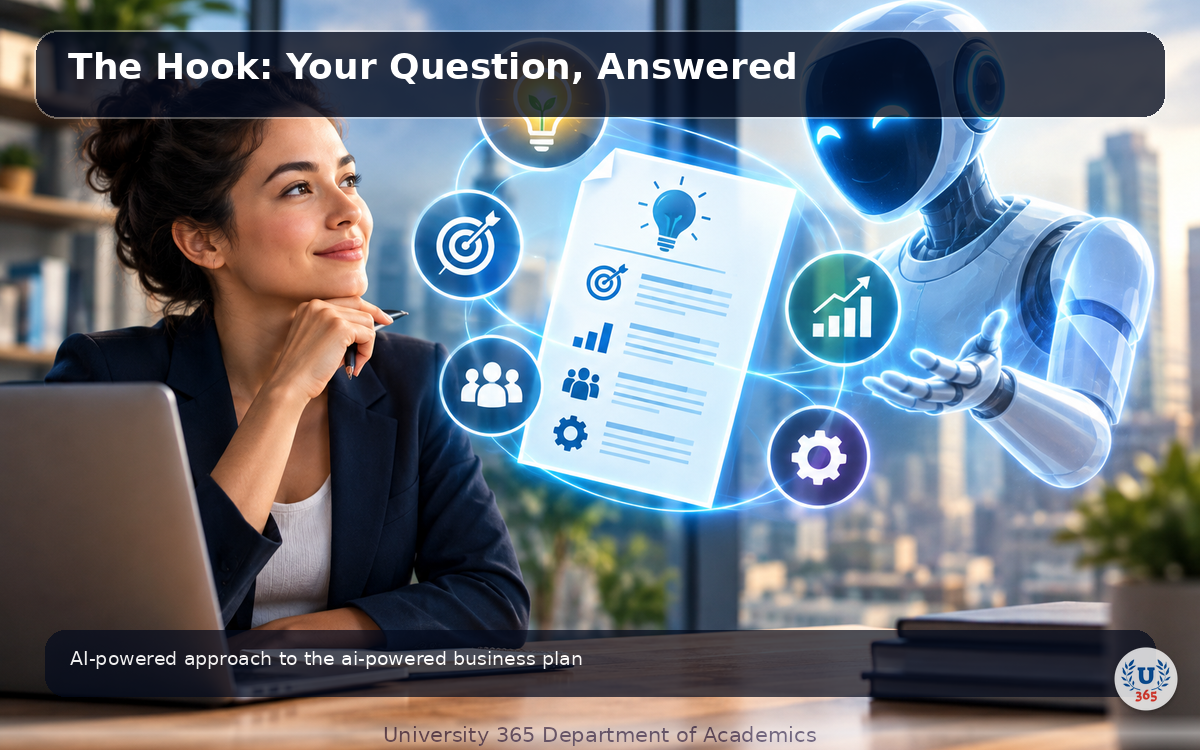
The Hook: Your Question, Answered
You have a business idea. You need a business plan by tomorrow. Investors want to see market analysis, financial projections, competitive landscape, and an executive summary. Where do you start?
In this lecture, you will learn how to use AI to tackle this challenge in 15 minutes. The AI handles the data processing and pattern recognition. You handle the judgment and decisions. This is the CI-First approach: human intelligence orchestrates, AI amplifies.

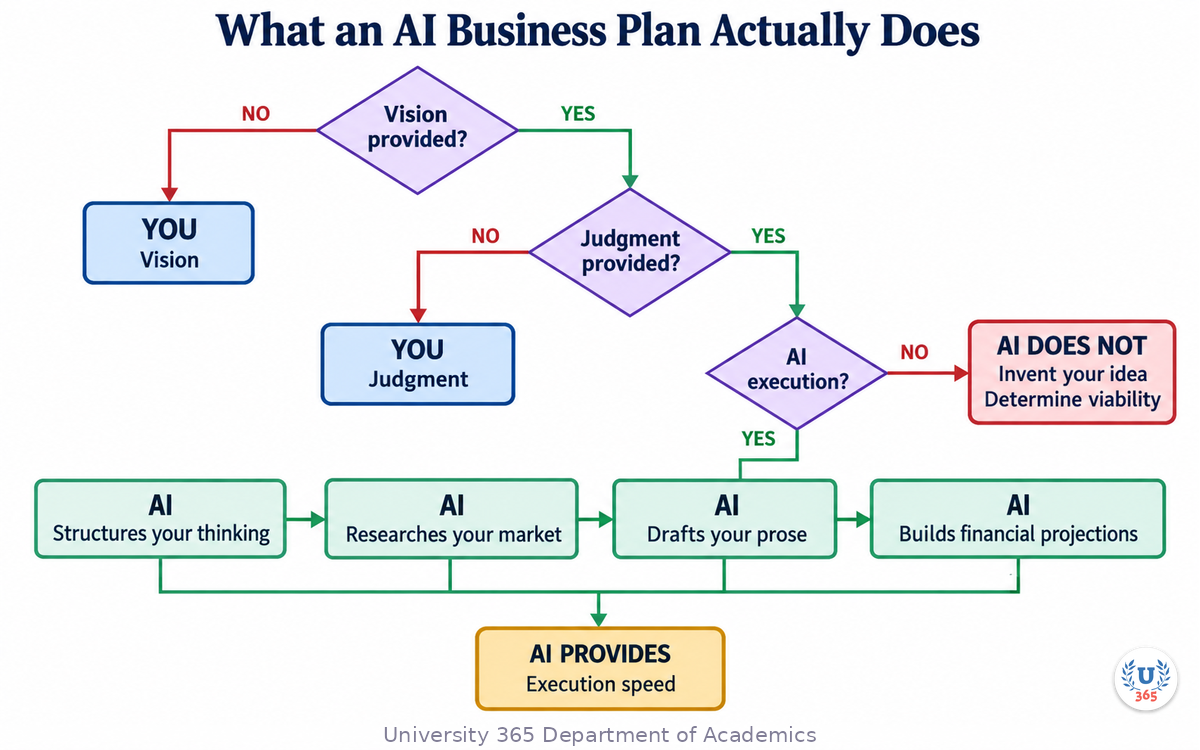
What an AI Business Plan Actually Does
AI does not invent your business idea or determine if it is viable. It structures your thinking, researches your market, drafts your prose, and builds your financial projections. You provide the vision and judgment. AI provides the execution speed.
Step 1: Define Your Business Concept
Before asking AI to write anything, you need to articulate your business concept clearly. AI needs context about what your business does, who it serves, and how it makes money.
Step 2: Research Market and Competition with AI
AI can gather market size data, identify competitors, analyze industry trends, and assess market gaps in minutes. This research forms the foundation of your market analysis section.
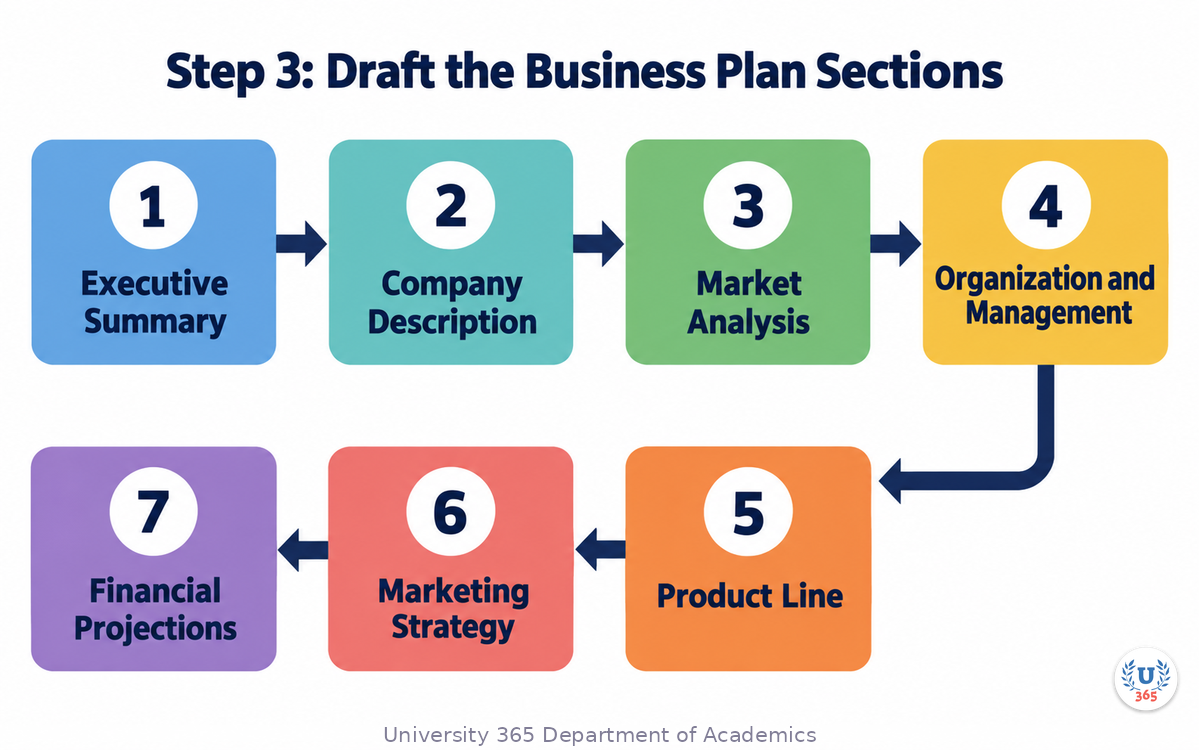
Step 3: Draft the Business Plan Sections
A standard business plan has 7 sections: executive summary, company description, market analysis, organization and management, product line, marketing strategy, and financial projections. AI can draft each section based on your input.
Step 4: Build Financial Projections
AI can generate revenue models, cost structures, break-even analysis, and cash flow projections. You provide assumptions. AI builds the spreadsheets and charts.
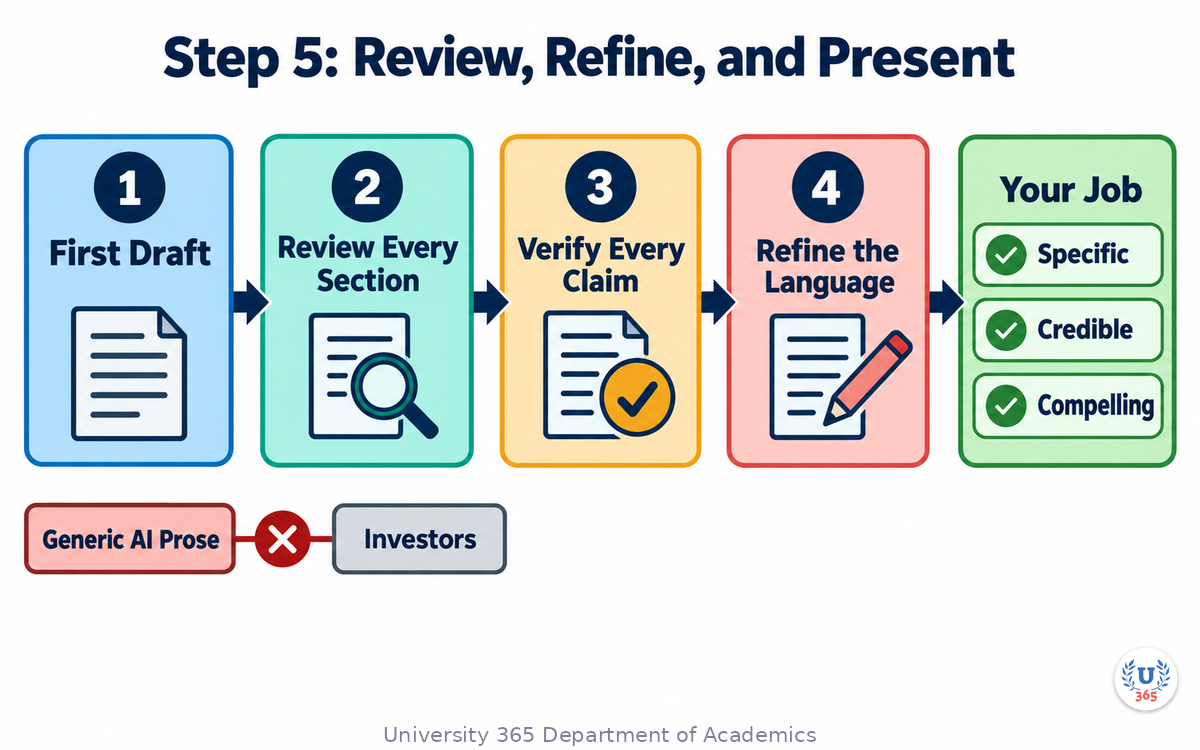
Step 5: Review, Refine, and Present
AI produces a first draft. You must review every section, verify every claim, and refine the language. A business plan full of generic AI prose will not impress investors. Your job is to make it specific, credible, and compelling.
Feynman Summary: Explain It Like You Are 12
Imagine you have a problem to solve at work. It usually takes a long time and a lot of effort. Now imagine you have a super-smart robot friend who can do the boring parts in seconds.
That is what AI does for the ai-powered business plan. The robot reads all the information, finds the patterns, and shows you the results. You look at what the robot found and decide what to do.
The robot does not make the final decision. You do. The robot just does the hard work of gathering and organizing information so you can focus on thinking and deciding.
That is the CI-First way: you are the boss, the AI is your helper. Together, you get better results faster.
Mindmap: The Complete Picture
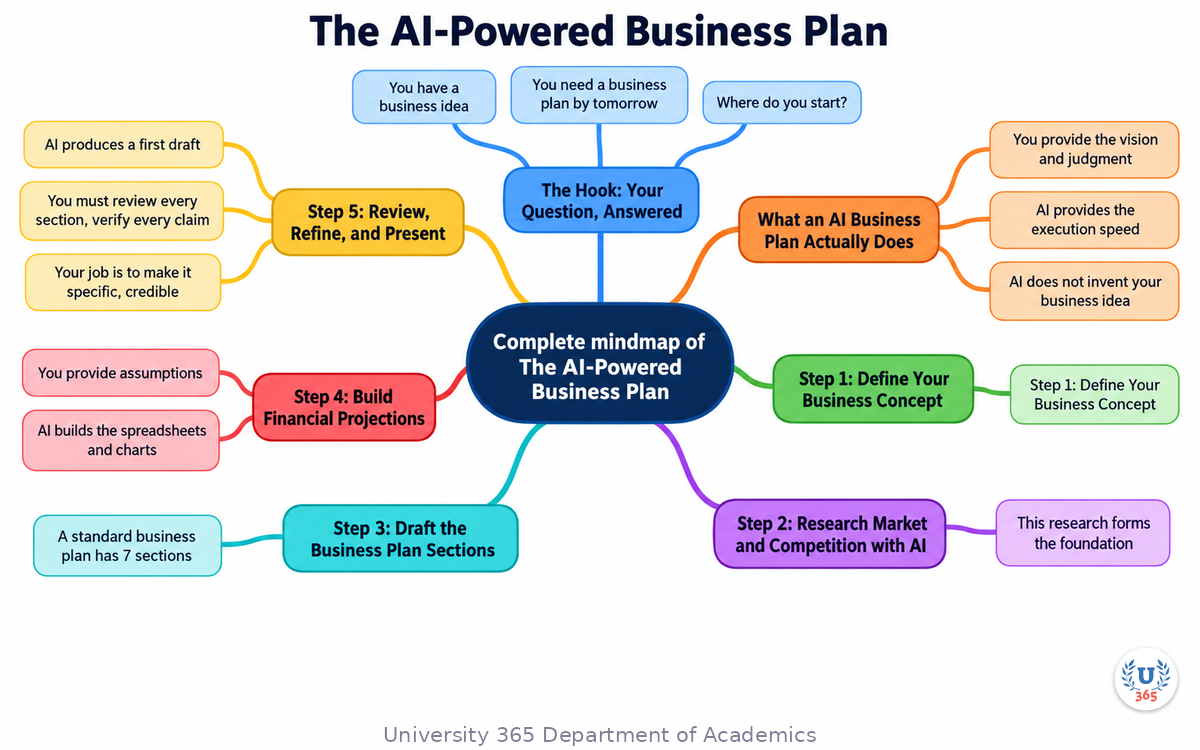
The mindmap shows the complete workflow: defining your objective leads to gathering and preparing data, which feeds into AI analysis and processing, which produces insights and recommendations, which you validate with human judgment before taking action. The CI-First principle wraps the entire process: you start with human-defined goals and end with human-validated decisions.
UNOP Sound (University 365 Neuroscience Oriented Pedagogy)
Take five minutes to consolidate your memory. Play the isochronous tone track (10Hz alpha frequency) with your eyes closed. Alpha-frequency tones after a learning session support consolidation, helping move what you just learned from short-term to long-term memory.
[Audio player: UNOP Post-Lecture Isochrone (10Hz, 5 minutes)]
Practical Exercise: Apply What You Learned
Exercise: 15-Minute Application Sprint
Identify a real scenario: Think of a situation in your work or business where this topic applies.
Define your objective: What specific outcome do you want to achieve in 15 minutes?
Use an AI tool: Open ChatGPT, Claude, or Gemini and apply the framework from this lecture.
Analyze the output: Did AI produce useful results? What needs verification? What needs human judgment?
Make a decision: Based on AI output plus your judgment, what action will you take?
What to Look For
Did AI produce specific, actionable output or generic statements? Generic output means your prompt needs more context.
Did AI invent any data or make unsupported claims? Always verify critical facts against primary sources.
What would you do differently from what AI suggested? The gap between AI output and your judgment is where your value lies.
The CI-First formula is CI = HI + (AI x HI). Your intelligence is the foundation. AI multiplies it. But the final decision is yours.
Applied AI Connection
This exercise demonstrates the CI-First workflow in practice. You defined the objective (human intelligence). AI processed and analyzed (AI amplification). You validated and decided (human intelligence). The speed gain from AI lets you iterate faster and explore more options than you could manually.
Glossary
Term | Definition |
**Business Plan** | A structured document describing a company's goals, market, strategy, and financial projections, used to guide operations and attract investment. |
**Executive Summary** | A one-to-two page overview of the entire business plan, typically written last but placed first. |
**Market Analysis** | Research on market size, trends, customer demographics, and competitive landscape that supports the business case. |
**Break-Even Analysis** | Calculation of the point where revenue equals costs, showing when the business becomes profitable. |
**Competitive Landscape** | Analysis of direct and indirect competitors, their strengths, weaknesses, and market positioning. |
**Value Proposition** | A clear statement of what your product does, who it serves, and why it is better than alternatives. |
**Go-To-Market Strategy** | The plan for how a company will reach target customers and achieve competitive advantage. |
**CI-First** | Co-Intelligence First: the U365 principle that human intelligence orchestrates and AI amplifies. |
**5M2S** | 5 Minutes to Success: the U365 principle of using AI to compress time-intensive tasks into minutes. |
**UNOP** | University 365 Neuroscience-Oriented Pedagogy: the pedagogical framework behind all U365 lectures. |
**UP-Context Method** | University 365 Prompting-Context Method: providing context-rich prompts for better AI outputs. |
**Pitch Deck** | A visual presentation version of the business plan, typically 10-15 slides, used for investor meetings. |
Quiz: TEST YOUR UNDERSTANDING
1. What can AI NOT do when creating a business plan?
A) Determine if your business idea is actually viable in the real market
B) Draft the executive summary
C) Research competitors
D) Generate financial projections
2. How many sections does a standard business plan have?
A) 7 sections
B) 3 sections
C) 12 sections
D) 20 sections
3. What should you do after AI generates the first draft?
A) Review every section, verify every claim, and refine the language
B) Submit it immediately to investors
C) Delete it and start over
D) Nothing, it is complete
4. What is the executive summary?
A) A one-to-two page overview of the entire business plan, written last but placed first
B) A summary of executive salaries
C) A legal document
D) A marketing brochure
5. In the CI-First approach to business planning, what is the human's role?
A) Provide the vision and judgment while AI provides execution speed
B) Let AI make all decisions
C) Do all the writing manually
D) Only review the financial section
Answers: 1-B, 2-B, 3-B, 4-B, 5-B
Related Resources
U365 INSIDE Publications
Book Essential: Co-Intelligence by Ethan Mollick: The Centaur model and human-AI collaboration
Lecture 1: AI for Market Research: First lecture in the Business AI Series
External Resources
Harvard Business Review: AI in Business: How AI is transforming business operations: hbr.org
McKinsey: The State of AI: Annual report on AI adoption: mckinsey.com
Stanford AI Index: Annual report on AI progress and adoption: aiindex.stanford.edu
Related U365 Lectures (Coming Soon)
Other lectures in the Entrepreneurship Series at UIB
Cross-institute lectures on AI applications
U.Copilot for This Lecture
Discuss this lecture with U.Copilot, your AI chat companion trained on this content.
Copy and paste the following prompt into the U.Copilot chat on university-365.com:
You are U.Copilot for Lectures, an AI chat companion specially trained on University 365 lecture content. You are helping a Fellow who just completed the lecture "The AI-Powered Business Plan" from the Entrepreneurship Series at the U365 Institute of Business (UIB). Your role is to help the Fellow deepen their understanding of this topic. You can: - Clarify any concept from the lecture - Provide additional examples and practical applications - Explain how to use specific AI tools for these tasks - Discuss how to verify AI outputs and apply human judgment - Help the Fellow apply the CI-First approach to their own work - Suggest follow-up learning based on the Fellow's industry and interests Always maintain U365's CI-First approach: encourage the Fellow to think critically, verify AI outputs, and maintain human judgment as the orchestrator of AI tools. Use the UP-Context Method: provide context-rich, role-aware responses that account for the Fellow's learning level and goals.
Next Steps
Now that you have completed this lecture, here is what to do next:
Try the practical exercise above to apply what you learned to a real scenario
Experiment with different AI tools to see which works best for your specific use case
Explore other lectures in the Entrepreneurship Series at UIB
Apply the CI-First approach to your daily work: ask "how can AI help?" before starting any task
Join a UIB program if you want structured learning in business management and digital entrepreneurship: visit university-365.com/tuition
The companies that succeed in the AI age are not the ones with the most AI tools. They are the ones whose people know how to direct AI effectively and apply judgment to its outputs. This lecture gave you the framework. Now practice it.
IMPORTANT NOTICE
This lecture is published by University 365 as part of its INSIDE Publications Hub. The content is free to read for all visitors. Lectures in this series may be part of a structured academic program leading to a Micro-Credential for your Career (MCC). To enroll in an academic program, visit university-365.com/tuition.
This content is for educational purposes. While we strive for accuracy, AI is a fast-moving field. Verify current tool capabilities and market data against primary sources for professional applications.
Copyright University 365, Inc. All rights reserved. This content is protected under University 365's copyright policies. For permissions or inquiries, contact uda@university-365.com.
Published by the Department of Academics, University 365.
Lecture delivered by the University 365 Institute of Business (UIB).
Denise Cromwell, Dean of Business, UIB
Signed for the academic year 2026.




Comments