
Doubao Seed 2.1 Turbo: half of Pro's price, a 256K window, and no independent exam

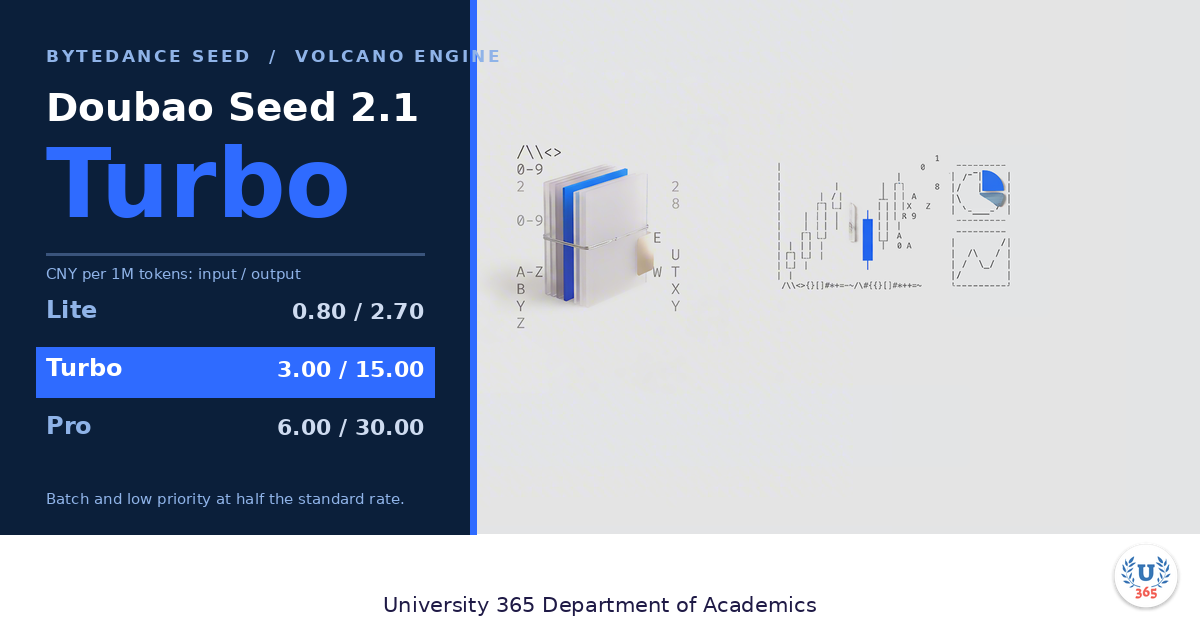
Status: Active | Last tested: 2026-11-19 (Doubao Seed 2.1 Turbo, doubao-seed-2-1-turbo-260628, announced 2026-06-23) | Re-check: trigger-based (max 6 months)
Active: the tool is current and recommended.
For detailed explanations of the CI-First evaluation terms used in this review, including the Humics Protection Badge and the AI Imposture Risk levels, see the Glossary at the end of this post.


In this Tool Review

Doubao Seed 2.1 Turbo
Three names, one price row, and a release date the documentation page does not print
Four things decide what a number means here, and they are worth separating before any benchmark.
The product is ByteDance's mid-tier hosted model, and the mid-tier claim is a price position rather than a published capability ranking. Doubao Seed 2.1 Turbo sits between Doubao Seed 2.1 Lite and Doubao Seed 2.1 Pro on the Volcano Engine price sheet, at CNY 3.00 input and CNY 15.00 output per million tokens against CNY 0.80 and CNY 2.70 for Lite and CNY 6.00 and CNY 30.00 for Pro. The vendor's own description, as the third-party catalogue LinkAI reproduces it, is a model that balances effect and cost while upgrading coding, agent and multimodal ability. No parameter count is published, the weights are closed, and the vendor describes no training recipe.
Three names belong to this one product, and only one of them is a model id. The billing name on the price sheet is doubao-seed-2.1-turbo. The callable Model ID on the Ark model list is doubao-seed-2-1-turbo-260628, hyphenated and dated. The gateway slug on OpenRouter is bytedance-seed/seed-2-1-turbo, with an endpoint snapshot of bytedance-seed/seed-2-1-turbo-20260810. A request, a procurement record and a cost estimate that use different names are describing the same model in three vocabularies, and this review names the surface every time it quotes one.
The release date is published by the vendor's announcement, not by the documentation pages. The Ark model list, the price sheet and the deep-thinking guide were read on 2026-11-19 and none of them prints a calendar release date. The dated id ends in 260628, and the vendor's own announcement of the 2.1 series, the Volcano Engine article indexed on 2026-06-23 at 12:56, dates the launch of Doubao-Seed-2.1-pro and Doubao-Seed-2.1-turbo to 2026-06-23. This review uses 2026-06-23 and states the four-day gap to the checkpoint token rather than collapsing the two into one number. A team that needs a contractual date should take it from the vendor's account team; the date here is the announcement date, with its source named.
The family around it is where a reader gets lost. Doubao Seed 2.1 Pro is a different tier: its current checkpoint doubao-seed-2-1-pro-260915 carries a 1,024K context window and a 1,024K maximum input, and its earlier checkpoint doubao-seed-2-1-pro-260628 carries 256K on both, at a standard rate of CNY 6.00 and CNY 30.00. Doubao Seed 2.1 Lite carries 1,024K at CNY 0.80 and CNY 2.70. Doubao Seed 2.0 Pro, 2.0 Lite, 2.0 Mini and 2.0 Code are the previous generation. Doubao Seed Evolving is a separately announced model on a weekly iteration cycle. Seedance 2.5 and Seedream 5.5 are the video and image generators, not language models. This review covers doubao-seed-2-1-turbo-260628 only, and every comparison names the model it is against.
What this review is not. It is not a review of Doubao Seed 2.1 Pro, Lite or Evolving, of the 2.0 generation, of Seedance or Seedream, or of the consumer Doubao app. It is not a review of Volcano Engine Ark as a platform, although the platform's four price routes are part of the cost case. And it is not a re-score: no U365 record, post or source document covered this model before this one.

Doubao Seed 2.1 Turbo
Tool Snapshot
Doubao Seed 2.1 Turbo is ByteDance's mid-tier hosted model, served on Volcano Engine, with a 256K context window, text, image and video input, a reasoning switch that is on by default, and a price of CNY 3.00 per million input tokens and CNY 15.00 per million output tokens, half that on the batch and low-priority routes and double it on the low-latency route.
Category: Applied AI / Hosted mid-tier language model. It is sold for production tasks that involve coding, agent workflows and multimodal understanding, at a price that sits halfway between the cheap tier and the flagship of the same generation.
Primary use cases:
Agent and tool-calling workflows. The model list records function calling, structured output and GUI task processing, and the vendor's launch material leads with agent ability. The model is the reasoning layer, and the rig supplies the tools and the screens.
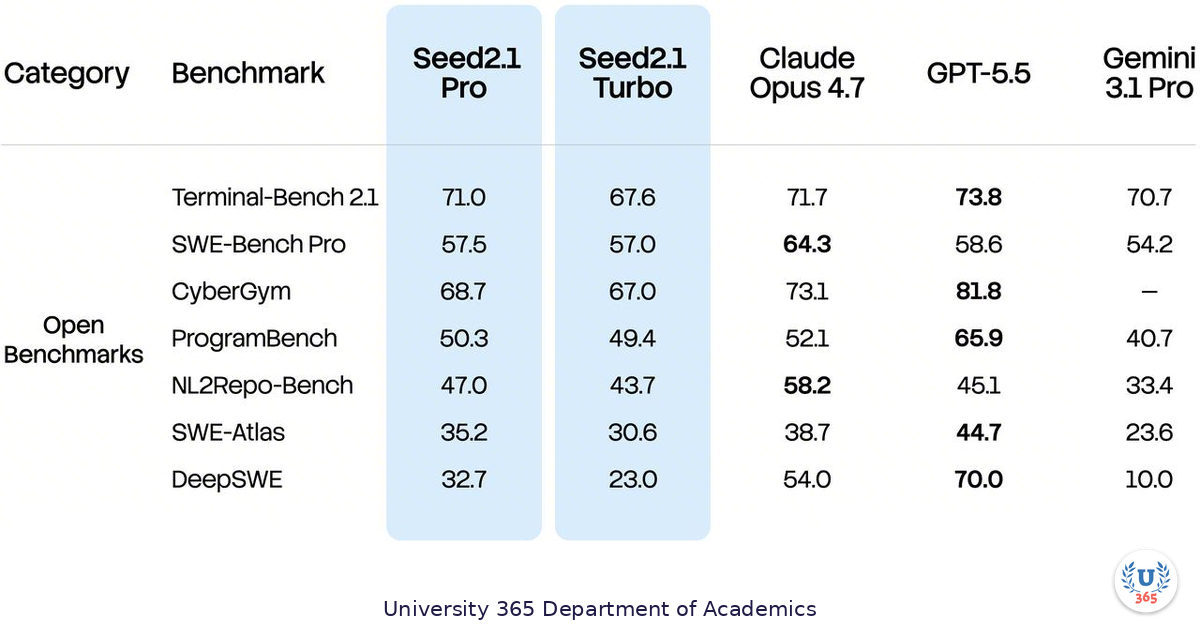
Coding and repository work. Terminal-Bench 2.1 at 67.6 and DeepSWE at 23.0 are the vendor's own scores, and the family announcement places Pro level with Claude Opus 4.7 on Terminal-Bench 2.1. Turbo is the tier offered at half of Pro's standard rate for the same task family.
Long-document reading at 256K. A 256K window holds a 400-page report or a contract set in one request, and the 256K answer ceiling means the output does not have to be truncated to fit a default.
Multimodal intake. Text, images and video enter the same window on the surfaces that document the modality, so a screenshot, a chart or a recording can travel with the specification rather than through a preprocessing step.
High-volume classification and extraction on the batch route. The batch and low-priority rates are half the standard rate, which is where a per-document pass becomes affordable.
What it is not. It is not the flagship: Pro carries a 1,024K window on its current checkpoint and Turbo carries 256K, and no published benchmark compares the two tiers against each other. It is not open: the weights are closed and there is no repository to download. It is not a cheap model by the standards of its own platform: DeepSeek V4.1 Flash is served on the same price sheet at CNY 2.00 input and CNY 8.00 output at peak, and CNY 1.00 and CNY 4.00 off-peak. It is not a search engine, a database or a policy engine, and it will answer whether or not the source supports the answer. And it is not an English-first product: every primary vendor document is in Chinese.
Pricing, as published on 2026-11-19. All figures are the vendor's own, in renminbi per million tokens, for the input band [0, 256]K that the price sheet prints for this model.
Route | Input | Cached input | Output | What the route is for |
Online inference, standard | CNY 3.00 | CNY 0.60 | CNY 15.00 | The default paid route |
Online inference, low latency | CNY 6.00 | CNY 1.20 | CNY 30.00 | The same model at double the rate, for latency-sensitive calls |
Online inference, low priority | CNY 1.50 | CNY 0.60 | CNY 7.50 | Half the standard rate, scheduled on spare capacity |
Batch inference | CNY 1.50 | CNY 0.60 | CNY 7.50 | Half the standard rate, for jobs that can wait |
Cache storage | Not applicable | CNY 0.017 per million tokens per hour | Not applicable | The storage line for an explicit cache |
The conversion, stated as a conversion. At the reference rate of 6.6667 CNY per US dollar on 2026-11-19 (Frankfurter, European Central Bank reference rates), the standard rate is about $0.450 input, $0.090 cached input and $2.250 output per million tokens; the low-latency rate is about $0.900 and $4.500; and the batch and low-priority rate is about $0.225 and $1.125. Those are this review's conversions, not the vendor's list price, and the vendor publishes no dollar rate. The one dollar rate that a buyer can read on a screen is OpenRouter's, at $0.50 input and $2.50 output per million tokens, on a single provider, in FP8.
The arithmetic a buyer should do before the tier argument. One million input tokens and one million output tokens cost CNY 18.00 on the standard route, CNY 9.00 on the batch or low-priority route and CNY 36.00 on the low-latency route. The output line is 83 per cent of a balanced standard bill, so answer length, not prompt length, is the cost lever. Cached input is 20 per cent of the input rate, and the vendor bills cache storage separately at CNY 0.017 per million tokens per hour, which is the line a team that keeps a long system prompt warm should model rather than ignore. And the tier comparison has a trap in it: Turbo's standard rate, CNY 3.00 and CNY 15.00, is exactly Pro's batch and low-priority rate, so the "half of Pro" sentence is true on like-for-like routes and false if one side is quoted at standard and the other at batch.
Official links:
Volcano Engine Ark, model list (模型列表), with the Model ID, the capability tags, the 256K context, the 256K input and answer ceilings and the rate limits: https://docs.volcengine.com/docs/ark/model-list
Volcano Engine Ark, model pricing (模型价格), with the standard, low-latency, low-priority and batch rows for this model: https://docs.volcengine.com/docs/ark/model-pricing
Volcano Engine Ark, deep thinking (深度思考), with the thinking.type switch, the seven reasoning_effort values and the per-model default and mapping table: https://docs.volcengine.com/docs/ark/deep-thinking
Volcano Engine Ark, context cache (上下文缓存): https://docs.volcengine.com/docs/ark/context-cache
Volcano Engine Ark, structured output (结构化输出): https://docs.volcengine.com/docs/ark/structured-output-beta
Volcano Engine Ark, GUI Agent capability (GUI Agent 能力): https://docs.volcengine.com/docs/ark/gui-task-processing
Volcano Engine Ark, product overview (产品简介): https://docs.volcengine.com/docs/ark/product-overview
OpenRouter, Seed 2.1 Turbo listing and endpoint JSON, with the dollar rate, the context and the completion ceiling: https://openrouter.ai/bytedance-seed/seed-2-1-turbo
LinkAI, model page for doubao-seed-2.1-turbo, with the modality and capability summary: https://link-ai.tech/models/doubao-seed-2-1-turbo
OKNP.ai, model record for Doubao-Seed-2.1-Turbo, with the release date, the price and the vendor score table: https://oknp.ai/zh/model/doubao-seed-21-turbo
Artificial Analysis model leaderboard, read for the presence or absence of an entry on 2026-11-19: https://artificialanalysis.ai/models
Model-specific fields:
Billing name: doubao-seed-2.1-turbo, as printed on the price sheet.
Callable Model ID: doubao-seed-2-1-turbo-260628, as printed on the model list.
Gateway id: bytedance-seed/seed-2-1-turbo, endpoint snapshot bytedance-seed/seed-2-1-turbo-20260810, one provider named Seed, FP8 quantization.
Context window: 256K tokens. Maximum input: 256K. Maximum answer: 256K, default 4K. Maximum thinking chain: 256K.
Rate limits: 500 requests per minute and 1,000,000 tokens per minute, labelled non-rigid by the platform.
Input modalities: text, images and video. Output modality: text only.
Reasoning: thinking.type accepts enabled (the default) and disabled. reasoning_effort on the Chat API and reasoning.effort on the Responses API accept none, minimal, low, medium, high, xhigh and max; the default for this model is high, minimal turns thinking off, none maps to minimal, and xhigh and max both map to high.
Tooling: function calling, structured output, JSON mode, streaming, GUI task processing, the Responses API and an OpenAI-compatible surface.
Caching: context cache supported, cached input at CNY 0.60 per million tokens on the standard, low-priority and batch routes.
Parameters: not disclosed. Weights: closed. Licence: Volcano Engine commercial terms; no open-weight release exists.
Availability: Volcano Engine Ark in mainland China, and OpenRouter as a single third-party route.
At a Glance Dashboard
Field | Value |
Category | Applied AI / Hosted mid-tier language model (text, image and video input, text output) |
CI-First Benefit Score | 4.8 / 10 (CI-First Positive) |
Sub-scores | Time 6 / Quantity 6 / Quality 4 / Skill 3 |
CI-First Profile | Primary: Co-Worker and Assistant (level 2). Secondary: Co-Researcher, Analyst and Tester (level 4) |
Humics Protection | Humics-Neutral (-1 / +3) |
AI Imposture Risk | Medium overall, with Time Medium, Quantity Medium and Skill Medium |
Status | Active |
Last tested | 2026-11-19 |
Pricing | CNY 3.00 input, CNY 15.00 output and CNY 0.60 cached input per million tokens on the standard route; CNY 1.50 and CNY 7.50 on batch and low priority; CNY 6.00 and CNY 30.00 on low latency |
Platforms | Volcano Engine Ark (mainland China) and OpenRouter |
User sentiment | Thin and vendor-weighted: a launch-stage record with no review-platform listing, one four-model practitioner coding test and a small number of explainer videos |

Doubao Seed 2.1 Turbo
The Problem
A team that wants a capable model at a middle price has three options, and each one fails in a different currency.
The first is the flagship of a Chinese family. It is strong, it is documented in Chinese, and it is priced for enterprises: Doubao Seed 2.1 Pro at CNY 6.00 input and CNY 30.00 output per million tokens is twice Turbo on both lines, and its current checkpoint carries a 1,024K window that most workloads do not fill. A team that buys the flagship for a 200-page document pays for capacity it will not use, and a team that buys the cheap tier pays for a smaller model on tasks where coding and agent work are the actual job.
The second is a cheaper model on the same platform. DeepSeek V4.1 Flash is on the same price sheet at CNY 2.00 input and CNY 8.00 output at peak and half that off-peak, with a published independent review history in the U365 library. On price per token it beats Turbo on both lines. What Turbo offers in exchange is a 256K answer ceiling, a reasoning ladder with a documented default, GUI task processing and ByteDance's own agent tooling. Whether that exchange is worth the premium is a question the vendor's published evidence cannot answer, because no published test compares the two on the same tasks.
The third is a western frontier API. It is well documented in English, it is independently benchmarked, and it costs several times the renminbi rate once the exchange rate and the per-task token counts are in the bill. For a university or a company operating in China, it also carries a data-residency question that no price comparison settles.
Turbo is built for the space between those three. It is the middle tier of a current generation, priced at half of Pro on like-for-like routes and a quarter of Pro on the batch route against Pro's standard rate. It carries a 256K window, which is enough for a long report and not enough for a repository snapshot and a specification together. It accepts text, images and video, which removes a preprocessing project for document and screen work. It exposes a reasoning switch with a documented default and a documented mapping, which is more than many hosted models say about their own thinking tokens. And it is documented in Chinese only, which is fine for a team in China and a real cost for a team outside it.
The problem it does not solve is the one that decides whether any of this is adoptable. There is no independent measurement of the model. Not a low score: no score. Artificial Analysis has no page for it, the model is absent from the leaderboard's loaded data, no arXiv technical report for the 2.1 generation was found, and the vendor's own score table covers four of its six named domains. The only capability numbers in circulation are the vendor's, reproduced by a third-party catalogue, and a vendor's own benchmark is a claim rather than a measurement. The problem, in one sentence: Turbo is priced like a production model and evidenced like a launch announcement, and the gap between those two is what a buyer has to close with their own sample.
There is a second problem, and it is organisational. The product has three names, four price routes and a dated checkpoint id, and none of the four primary vendor pages prints a release date. A procurement record that captures the family name captures a billing row, not a model. A budget that captures the standard rate captures the most expensive route. And a re-check that watches the family name will not notice the day the checkpoint changes underneath it.

Doubao Seed 2.1 Turbo
The Outcome
If Turbo works as its price and capability set suggest, four things change for a U365 team.
The first is the unit of a document task. A 256K window holds a 400-page report, a term of meeting notes or a contract set in one request, and a 256K answer ceiling means the output does not have to be cut to fit a default. The saving is structural: it is the chunk-and-reconcile loop that no longer has to be built, and it is the same saving a 1M window offers, at a quarter of the Pro standard rate on the batch route.
The second is the route as a design decision. Four rates for one model means the workflow decides the price. A nightly classification job belongs on the batch route at CNY 1.50 and CNY 7.50. An interactive assistant belongs on the standard route at CNY 3.00 and CNY 15.00. A latency-critical agent belongs on the low-latency route at double, and a team that puts a batch job on the standard route has paid twice what the work required. This is the cheapest optimisation available and it needs no engineering beyond a queue.
The third is the reasoning bill becoming visible. Thinking is on by default, the default effort is high, the thinking chain has its own 256K ceiling, and thinking tokens are billed as output at CNY 15.00 per million. The vendor documents the switch and the ladder, which means a team can set effort per task class and attribute the bill. A team that leaves the default on for extraction is paying for analysis it did not ask for.
The fourth is a multimodal intake that needs no second service. Text, images and video enter the same window on the surfaces that document the modality, and GUI task processing is a named capability. A screenshot of an error state, a chart from a report and a recording of a workflow can be handed to the same endpoint as the written instruction.
What does not change is the verification burden. Nothing in the vendor's documentation says how often the model is wrong, and no third party has published a number. The vendor's four scores are strong, and they are the vendor's. A team that adopts the model on the strength of a 67.6 on Terminal-Bench 2.1 has adopted a claim. The outcome this review argues for is the middle tier plus a cheap check: twenty labelled items from the team's own workload, a per-route budget, and a rule that thinking is set per task class rather than left at its default. That check costs less than the difference between the standard and batch rates on a month of work.

Doubao Seed 2.1 Turbo
Who Should Use Doubao Seed 2.1 Turbo
The learner table. The categories are U365 Fellow profiles, not job titles, and a reader can sit in more than one.
U365 learner | Fit | What the model does for them | What they must bring |
The Builder Fellow | Strong | Turns a specification into a working script or a simple front end, reads a screenshot of the result and iterates on it, at a rate that makes iteration cheap | The ability to read the code and run it; the vendor's coding scores are the vendor's own, and plausible code is generated as easily as correct code |
The Operator Fellow | Strong | Processes a document batch, extracts fields, reconciles against a ledger and drafts the exception note, with the batch on the half-price route | A schema, a queue for the batch route, and an exception path the model does not own |
The Analyst Fellow | Moderate, with a check | Reads a long source pack, summarises it, states assumptions and answers against supplied evidence | A labelled sample and a citation check, because no independent accuracy measurement exists for this model |
The Communicator Fellow | Moderate | Drafts, restructures and translates long source material, and reads an image or a recording into a description | Voice editing and fact checking: no independent writing evaluation exists, and the output is fluent by construction |
The Researcher Fellow | Moderate | Holds a 400-page pack in one window, finds connections inside the supplied material and produces a structured brief | The literature search itself, citation checking, and a second model for the claim that matters |
The Founder Fellow | Moderate | Prototypes a document, coding or agent workflow at a middle-tier price, on a platform that already bills in renminbi | A route decision before the pilot, because four rates and three names are part of the build |
For teams and organisations. Turbo is the tier a small team can put on a production workload without paying flagship rates, provided the team decides its route first.
Team deployment. One endpoint, one dated model id, four billing routes. Standardise on the pinned id and put the route in the job definition rather than in the code, so a nightly job and an interactive assistant can share the same integration.
Cost at team scale. One million input tokens and one million output tokens cost CNY 18.00 on the standard route and CNY 9.00 on the batch route, which is about $2.70 and $1.35 at the reference rate used in this review. The output line is 83 per cent of a balanced bill, so a team that controls answer length controls the invoice.
Data and compliance. The model is hosted in mainland China, the weights are closed, and the terms are Volcano Engine's commercial terms. A team with data that cannot leave its own jurisdiction should treat the model as unavailable rather than as a candidate, and a team that needs an English data-processing agreement should ask for one before the pilot.
U365 for companies. The training route is the one to use: a cohort learns to pin the model id, choose the route, set the reasoning effort per task class, and measure its own accuracy on twenty labelled items before the model reaches a production workflow.
Skill level: intermediate. The API is OpenAI-compatible, so a developer can call it in an afternoon. Using it well requires the ability to write a schema, to read a Chinese-language parameter table, and to judge whether an answer is supported by the source, which is analyst skill rather than prompt skill.
Prerequisites: a Volcano Engine account with the model enabled, or an OpenRouter account for the dollar route; a queue or scheduler if the batch route is the point; and a source pack for the window. No GPU is needed on either hosted route.
Time to first result: under 30 minutes for a hosted call, including account setup and enabling the model. About an hour for a working extraction script against a schema. One to two days for a batch pipeline with a review queue.
Time to competence: two to three weeks of regular use to learn where the model is reliable, how to set the reasoning ladder per task class, and how to read the vendor's Chinese documentation without guessing. The four vendor scores are a starting exercise set, not a curriculum.
Who should wait: a team that needs an independent benchmark before it adopts any model, because none exists for this one. A team that needs a 1M-token window, which Pro carries and Turbo does not. A team that needs English primary documentation or a non-Chinese data-residency option. A team whose workload is dominated by long-horizon coding, where DeepSWE at 23.0 on the vendor's own table is a modest number. And a team that cannot run a twenty-item sample, because the published evidence will not substitute for it.

Doubao Seed 2.1 Turbo
U365 Institutes Alignment
The alignment below rates what a U365 institute could take from this model as a working instrument and as an object of study. The primary home is UIT (Technology, AI, Data Science), because the model is a complete engineering exercise in cost and route design: four billing routes for one endpoint, a seven-value reasoning ladder that collapses to four reachable settings, a 256K window to fill, a structured-output contract to write, and a vendor score table whose gaps a cohort can name. The other three readings are real and each is bounded.
UIT (Technology, AI, Data Science)
Rating. High (primary)
Why. Four transferable competencies. Route engineering: one model, four rates, and a decision about which job belongs on which route is a lesson in cost architecture that survives the removal of the tool. Reasoning control: the difference between thinking.type and reasoning_effort, the documented default of high, and the fact that xhigh and max map to high for this model is a concrete exercise in reading a parameter table rather than a blog post. Contract design: structured output, JSON mode and tool calling give a cohort a schema to write and a failure mode to test. Evaluation: the vendor publishes scores in four of six domains, so the first task in any evaluation module is to name what the table does not cover, which is the discipline the whole CI-First framework exists to teach.
The limit that holds the row. The weights are closed and no parameter count is published, so a cohort can study the interface and never the artefact. The documentation is Chinese-first, which narrows the reading surface for an English-medium cohort. No published programme assesses route engineering or reasoning-ladder design as a named component. Adjacent anchors, not assessment homes.
UIB (Business Management, Entrepreneurship)
Rating. Medium
Why. Three commercial decisions a manager can run on published numbers. Tier versus route: the standard rate equals Pro's batch rate, so a buy decision built on a tier comparison alone can be wrong by a factor of two in either direction. Cost per finished task versus cost per token: a balanced million-token exchange is CNY 18.00 standard and CNY 9.00 batch, and the unit a manager cares about is a document or a finished run. Vendor dependence: a closed model with no independent measurement is a procurement risk a founder can price, and the exercise is to write the risk down before the pilot rather than after it.
The limit that holds the row. The model supplies no management method and measures no return of its own. The vendor's score table is not auditable from outside, and the platform's terms are a legal question rather than a commercial one. This review is not legal advice, and no published programme assesses middle-tier model procurement as a named component.
UIC (Digital Communication, Marketing)
Rating. Medium
Why. The strongest communication use is a long source pack read in one request, with a brief, a set of quotations and a list of what the sources do not establish. Image and video input add a second surface: a screenshot, a campaign asset or a recording can be described and checked in the same request, and a 256K answer ceiling means a long brief is not cut short. The release is also a case study in reading a claim: a middle-tier model with four rates, three names and no independent evaluation is a lesson in what a launch announcement leaves out, and the four published scores are a lesson in naming coverage rather than quoting the best row.
The limit that holds the row. The model writes no register of its own and evaluates no audience. It will produce fluent copy whether or not the claim is sourced, and no independent writing evaluation covers it. A communication competency is assessed by the brief a student writes, not by the model's fluency.
UID (Digital Design, UX/UI)
Rating. Low to Medium
Why. A narrow but real contact. The model reads images and video, so a designer can ask whether a screenshot shows an error state, whether a layout region matches a described condition, or what a chart says, and GUI task processing is a named capability, which means the model can be pointed at an interface rather than only at a picture. A design cohort can use it to turn a described component into markup it then critiques, on the cheap route.
The limit that holds the row. The model returns text about an image, not a design judgement. It cannot evaluate hierarchy, contrast, spacing or motion, and it has no notion of a design system unless one is written into the prompt. No design competency is assessed by the vendor's score table, which covers coding, knowledge work, computer use and science only, and two of those six domains are empty for this model.
U365 methods, not an institute (UNOP, ULM, LIPS, CARE and the UP-Context-Engineering Method)
Rating. Applicable
Why. The methods layer is where this model fits best, because the product is a context instrument before it is a chat model. The UP-Context-Engineering Method maps onto a long request: AI-EXACT-TASK is the question, FULL-CONTEXT is the source pack that fills the 256K window, EXPECTED-FORMAT-AND-CONSTRAINTS is the JSON contract, and the verification layer is the sample and the citation check. LIPS is where the source pack, the prompt, the model id, the route and the measured result belong, because a request that is not recorded cannot be reproduced and a route that is not recorded cannot be explained on the invoice. CARE applies to the review of a flagged item. ULM and EVA touch the Career and Quality of Life domains weakly, through the document throughput the model supports. UNOP has no direct fit: the model does not teach and offers no recall mechanism.

Doubao Seed 2.1 Turbo
How Doubao Seed 2.1 Turbo Works
A closed, hosted language model on Volcano Engine Ark, with a 256K window, text, image and video input, a 256K answer ceiling, a reasoning switch that is on by default, and four billing routes for the same endpoint.
Inputs: text, images and video in one request. The Ark model list tags the model with multimodal understanding, and the gateway's own architecture record lists text+image+video as the input modality. The vendor's dedicated image and video guides were not readable as text on the day of this review, so the modality statement here rests on the model list tag, the gateway record and a third-party catalogue that lists text, images and video. A team whose workflow depends on video should test one file before it builds a pipeline around it.
Outputs: text only. The model can emit a thinking chain before the answer when thinking is enabled, and the thinking chain has its own ceiling of 256K. The model list records structured output, JSON mode, tool calling and GUI task processing, so a schema-constrained answer is a supported path rather than a prompt trick.
The reasoning ladder, as the vendor documents it. Two parameters control thinking. thinking.type accepts enabled (the default) and disabled, which is the blunt switch. The finer control is reasoning_effort on the Chat API and reasoning.effort on the Responses API, with seven published values: none, minimal, low, medium, high, xhigh and max. For this model the default is high, minimal turns thinking off, none maps to minimal, and xhigh and max both map to high. Seven values therefore resolve to four reachable behaviours: no thinking, light, balanced and deep. A team that budgets for max is buying high, and the vendor's table says so plainly.
The four routes, and why they are the architecture. The same endpoint is billed four ways. Standard online inference is the default. Low-latency inference doubles every line for calls that cannot wait. Low-priority inference halves the input and output lines and keeps the cached rate unchanged, for work that can be scheduled. Batch inference matches the low-priority rate and is built for jobs submitted as a file. The cache storage line, CNY 0.017 per million tokens per hour, applies to an explicit cache and is the one charge that accrues with time rather than with tokens.
The limits the platform states. 500 requests per minute and 1,000,000 tokens per minute, both labelled non-rigid, which means the platform may throttle below them under load. The answer default is 4K, which is small for a document task and has to be raised explicitly. The thinking chain can consume the output ceiling, so a task that asks for a long answer and deep thinking competes with itself for the same 256K. And there is no published parameter count, no published training data description and no published evaluation beyond the four scores in the model card.
What the vendor claims, and what it does not. The vendor's own score table, reproduced by a third-party catalogue that verified it on 2026-11-02, carries four numbers: Terminal-Bench 2.1 at 67.6, DeepSWE at 23.0, HLE-text-only with search at 54.6, and OSWorld at 76.4 in the generalist computer-use setting, with a GUI-only figure of 73.2 alongside it. Two of the six named domains, knowledge work and science, are empty. There is no published latency, no throughput, no error rate and no long-context recall test. The vendor's marketing description says the model balances effect and cost and upgrades coding, agent and multimodal ability; that is a positioning sentence, not a measurement.
The economics, as arithmetic rather than assertion. At the standard rate, one million input tokens and one million output tokens cost CNY 18.00, and the output line is CNY 15.00 of that, or 83 per cent. At the batch rate the same exchange costs CNY 9.00. Cached input is one fifth of the input rate, so a repeated system prompt is cheaper than a fresh one, provided the cache storage line is modelled. A team that leaves thinking on at high for extraction pays output rates for tokens it did not need, and a team that sets minimal for classification and high for planning will see the difference on the first invoice.
What it is bad at, as far as the record goes. Nobody has published a failure class for this model, which is itself the finding. The vendor's DeepSWE score of 23.0 is modest against the terminal score of 67.6, which suggests the harder software-engineering set is where the model is weaker, and the two numbers should be read together rather than as one. The 256K window is a capacity, not a recall guarantee, and no needle test is published. The documentation is Chinese-first. And the model is closed, so a team that needs to inspect, fine-tune or self-host it has no route at all.

Doubao Seed 2.1 Turbo
Getting Started with Doubao Seed 2.1 Turbo
Required accounts: a Volcano Engine account with Ark access and the model enabled, or an OpenRouter account for the dollar route. Neither route needs a GPU or an installation.
Route one: Volcano Engine Ark. Create the account, enable Doubao Seed 2.1 Turbo, and copy the API key and the base URL from the console. The surface is OpenAI-compatible and also offers a Responses API. Pin the model id doubao-seed-2-1-turbo-260628 in the request rather than the undated billing name, because the id is what the model list publishes and what a re-check can watch. Choose the billing route in the access-point settings, not in the prompt.
Route two: OpenRouter. The model id is bytedance-seed/seed-2-1-turbo, the provider is Seed, the context is 262,144 tokens, the maximum completion is 235,929 tokens, and the listing shows $0.50 input and $2.50 output per million tokens in FP8. This is the route to use for a multi-model comparison, because the same key and the same request shape reach the other models in this review's comparison table. It is a single-provider listing, so a provider failure is a model outage on that route.
The first request, in the shape that costs least. The example uses the OpenRouter route, whose model id is the one this review checked against the endpoint record; the base URL and the key come from your OpenRouter account settings, and on Ark they come from the console, with the model id doubao-seed-2-1-turbo-260628.
import os
from openai import OpenAI

client = OpenAI(base_url=os.environ["OPENROUTER_BASE_URL"], api_key=os.environ["OPENROUTER_API_KEY"])
response = client.chat.completions.create(
    model="bytedance-seed/seed-2-1-turbo",
    messages=[
        {"role": "system", "content": "Answer only from the supplied sources. Quote the source line for every claim."},
        {"role": "user", "content": SOURCE_PACK + "\n\nQUESTION: " + question},
    ],
    max_tokens=4096,
    extra_body={"reasoning_effort": "minimal"},
)
print(response.choices[0].message.content)
The minimal setting is the cost control in that example: it turns thinking off, which is the right default for extraction and classification. Raise it to low, medium or high when the task needs reasoning, and log the completion's thinking tokens, because they are billed as output.
The 15-minute checklist:
Decide the route before the tier: standard for interactive work, batch for nightly jobs, low priority for tolerant jobs, low latency only when the latency is worth double.
Put the key in an environment variable, never in a notebook cell that will be shared.
Pin doubao-seed-2-1-turbo-260628 on Ark, and write the id into your architecture note. The undated name on the price sheet is a billing row.
Send one request with a 2,000-token source pack and a question whose answer you already know, and read the answer against the source. This calibration matters more than any vendor score.
Repeat it with thinking off and thinking at high, and compare latency, output tokens and answer quality. The difference is the price of thinking on your task.
Set the answer ceiling above the 4K default, and add a schema through structured output if the answer feeds software.
Record the model id, the route, the date, the rate and the prompt in the LIPS record. A route that is not recorded cannot be explained on the invoice.
What to verify before scaling. Three checks, each cheap. First, a labelled sample of twenty items from your own workload, scored by a person, because no independent measurement of this model exists. Second, a route audit: read the invoice lines and confirm that the batch work was billed at the batch rate, which is the most common avoidable overspend on this platform. Third, a long-context probe: put the instruction at the start and the question at the end of a 200-page pack and confirm the answer cites the right page. The 256K claim is about capacity, not recall, and the only recall test that matters is the one on your documents.

Doubao Seed 2.1 Turbo
Real Workflows
Three workflows, each chosen because a U365 team can run it in a week and because the model's published capability set covers part of it. Each carries a UP-Context prompt pack and a four-tier verification checklist.
Workflow 1: Reconcile a supplier document batch on the batch route
The job. A finance or operations team receives 200 invoices, delivery notes and statements in a month, in PDF, scan and email form, and has to match each one to a ledger line, flag the mismatches and write the exception note. The work is repetitive, the documents are long, and the cost of a missed mismatch is a payment error.
Why this model. Image input reads the scan, a 256K window holds a batch and a ledger extract, the 256K answer ceiling allows a full reconciliation table rather than a truncated one, and the batch route halves the rate, which is the difference between sampling the batch and processing all of it.
UP-Context prompt pack:
AI-EXACT-TASK
Match each supplier document in the batch to one ledger line. Return one row per document with:
document_id, supplier, document_total, currency, ledger_line_id, ledger_total, match (exact,
within_tolerance, mismatch, no_ledger_line), discrepancy_amount, evidence_quote.

ROLE AND PROFILE
You are a reconciliation analyst (Co-Researcher, Analyst and Tester). You do not approve payments.

FULL-CONTEXT
<LEDGER_EXTRACT> ... </LEDGER_EXTRACT>
<DOCUMENT_BATCH> ... </DOCUMENT_BATCH>
Tolerance: 0.5 per cent of document total or 2 currency units, whichever is larger.

EXPECTED-FORMAT-AND-CONSTRAINTS
Return JSON only, an array of rows, no prose. For every row, evidence_quote must be copied from the
document text or the ledger line, with the page number. If a document is unreadable, set match to
"no_ledger_line" only when the ledger has no candidate; use "mismatch" with discrepancy_amount 0
and a note "unreadable" otherwise. Keep the visible answer to the table and the assumptions array.

VERIFICATION
State every assumption you made about currency, tax or duplicate documents in an "assumptions" array.
Four-tier verification checklist:
Multi-model check. Run the same batch through a second model on OpenRouter, for example DeepSeek V4.1 Flash, and compare the mismatch rows. Investigate every document where the two disagree; the disagreement rate is the real error bar, because this model has no published accuracy figure.
External source check. Open every document flagged mismatch and every document flagged unreadable, and confirm the total against the scan. Check the ledger line in the accounting system, not in the extract.
Human review. A finance officer signs the exception list before any payment is held or released. The model's row is evidence, not an approval.
CI-First test. Can the officer explain and defend each exception without the model? If the answer depends on a query nobody read, the output is not ready.
Workflow 2: Build an evidence brief from a 400-page source pack with images
The job. A programme team has a regulator's consultation, three partner reports, a set of internal notes and the screenshots that go with them, and needs a two-page brief with five findings, each tied to a source line, plus a list of what the sources do not establish.
Why this model. A 256K window holds the pack and the images, image input means a chart or a scanned page is an input rather than a preprocessing project, and the 256K answer ceiling allows a full brief with quotations in one response. The saving is structural: it is the chunk-and-retrieve loop that no longer has to be built.
UP-Context prompt pack:
AI-EXACT-TASK
Produce a two-page brief with exactly five findings. For each finding give: the finding in one
sentence, the evidence quote, the source document and page, and the confidence (high, medium, low).
Then list what the source pack does NOT establish.

ROLE AND PROFILE
You are a research analyst (Co-Researcher, Analyst and Tester). You do not recommend a course of
action and you do not fill a gap with general knowledge.

FULL-CONTEXT
<SOURCE_PACK> ... </SOURCE_PACK>
<IMAGES> ... </IMAGES>
<AUDIENCE_AND_PURPOSE> ... </AUDIENCE_AND_PURPOSE>

EXPECTED-FORMAT-AND-CONSTRAINTS
Markdown. Five findings, then a section titled "What these sources do not establish". Every finding
carries a verbatim quotation and a page reference. If two sources disagree, say so in the finding
rather than choosing one silently. If a claim cannot be tied to a quotation, drop it and say that
you dropped it.

VERIFICATION
At the end, list every document you could not read in full and why. Do not summarise a document you
could not open.
Four-tier verification checklist:
Multi-model check. Run the same pack through a second model and compare the five findings. A finding that only one model produces is the finding to check first.
External source check. Open every quotation at the page cited and confirm it is verbatim. The model is fluent whether or not the quote is real, and a fabricated page number is the failure that costs a programme its credibility.
Human review. The programme lead reads the "what these sources do not establish" section before the brief goes out, because that section is the one the model is most likely to soften.
CI-First test. Can a reader reconstruct each finding from the pack without the model? If the brief cannot be traced back, it is a draft rather than evidence.
Workflow 3: Turn a screenshot of a broken interface into a fix
The job. A builder has a front-end that renders incorrectly on one screen, a screenshot of the failure, the component file and the error log, and needs a diagnosis and a patch rather than a description of the problem.
Why this model. Image input reads the screenshot, the named GUI task processing capability means the model can be pointed at an interface, the coding scores are the vendor's strongest published numbers, and the standard rate is low enough to iterate ten times on one bug.
UP-Context prompt pack:
AI-EXACT-TASK
Diagnose why this interface renders as it does in the screenshot, and produce a minimal patch.
Return: the diagnosis, the file and line, the patch as a diff, and the test that would prove the fix.

ROLE AND PROFILE
You are a front-end engineer (Co-Worker and Assistant). You do not redesign the component and you
do not change behaviour that the specification does not mention.

FULL-CONTEXT
<SCREENSHOT> ... </SCREENSHOT>
<COMPONENT_FILE> ... </COMPONENT_FILE>
<ERROR_LOG> ... </ERROR_LOG>
<EXPECTED_RENDERING> ... </EXPECTED_RENDERING>

EXPECTED-FORMAT-AND-CONSTRAINTS
A diff that applies cleanly, no prose inside the diff, and one paragraph of diagnosis that names the
CSS property or the state transition responsible. If the screenshot is insufficient to diagnose,
say which additional state you need instead of guessing.

VERIFICATION
State the smallest test that would fail before the patch and pass after it.
Four-tier verification checklist:
Multi-model check. Ask a second model to review the diff rather than to produce one. Two models producing patches disagree; one model reviewing another's patch is the cheaper check.
External source check. Apply the patch and look at the rendered page at the same viewport as the screenshot. A diff that applies is not a fix.
Human review. The builder reads the diagnosis and confirms it names a real cause, because a plausible CSS change can hide the actual bug.
CI-First test. Can the builder explain why the patch works without re-reading the model's answer? If not, the next bug will need the model again, and nothing was learned. ---

Doubao Seed 2.1 Turbo
Strengths, Limits, and AI Imposture Risk
Strengths
CI-First Benefit | Strength | Evidence |
Time | A real structural saving on document work, and an explicit latency route when the saving is not enough. | A 256K input window and a 256K answer ceiling remove the chunk-and-reconcile loop for a 400-page pack, which is where the hours go in a diligence or contract task. The low-latency route exists at double the standard rate, so latency can be bought rather than hoped for. Held at 6 because no latency or throughput figure is published for this model, thinking is on by default at high, and the 4K answer default has to be raised before a long task works. |
Quantity | A genuine multiplier, and the cheapest route is a queue rather than an engineering project. | CNY 3.00 input and CNY 15.00 output per million tokens standard, CNY 1.50 and CNY 7.50 on the batch and low-priority routes, CNY 0.60 cached input, a 256K answer ceiling and a 256K thinking ceiling. One million tokens each way costs CNY 18.00 standard and CNY 9.00 batch. Held at 6 because the output line is 83 per cent of a balanced bill, the 1,000,000 tokens-per-minute limit is labelled non-rigid, thinking tokens are billed as output, and DeepSeek V4.1 Flash is cheaper on both lines on the same platform. |
Quality | Unmeasured. The vendor's own scores are strong and nobody has checked them. | Four vendor scores in a six-domain table: Terminal-Bench 2.1 at 67.6, DeepSWE at 23.0, HLE-text-only with search at 54.6 and OSWorld at 76.4. No independent index row, no arXiv report, no leaderboard entry, and two of the six domains are empty. Scored at 4, the framework's measured-absence position: a capability label and a vendor table are not a measurement. |
Skill | Thin for the user, real for the engineer who builds the route. | The API is OpenAI-compatible, the reasoning ladder is documented well enough to teach cost control, and four billing routes are a lesson in cost architecture. Held at 3 because the common user only prompts, the model teaches nothing while answering, the primary documentation is Chinese-first, the weights are closed so nothing can be inspected, and the discipline that makes the output safe is the user's sample rather than the tool's feature. |
Limits
No independent measurement exists. Artificial Analysis has no entry for this model and the leaderboard's loaded data carries Doubao Seed Code and not this model. No technical report for the 2.1 generation was found on arXiv. The vendor's four scores are the whole capability record, and they cover four of the vendor's six named domains.
The vendor's score table is empty in two of six domains. Knowledge work and science carry no number. A reader who needs a science or knowledge-work claim has nothing to read, and the gap is not small in a model sold for production tasks.
DeepSWE at 23.0 is a modest software-engineering number. Side by side with Terminal-Bench 2.1 at 67.6, it suggests the harder engineering set is where the model is weaker. The two numbers are published together and should be read together.
The documentation is Chinese-first. Every primary vendor page is in Chinese: the model list, the price sheet, the deep-thinking guide, the cache guide and the structured-output guide. An English-medium team is working from a translation it made itself.
No release date is printed on the documentation pages. The date used here comes from the vendor's announcement of the 2.1 series, dated 2026-06-23, and the callable id ends in 260628. The four-day gap is unexplained.
The billing name is not callable. doubao-seed-2.1-turbo is a price-sheet row; doubao-seed-2-1-turbo-260628 is the Model ID. A request, a procurement record or a re-check that uses the family name has captured the wrong fact.
The reasoning ladder has two dead rungs. Seven values are published; xhigh and max both map to high for this model, and none maps to minimal. Four behaviours are reachable, and a budget written for max is a budget for high.
The window is 256K, not 1M. Pro's current checkpoint carries 1,024K of context and 1,024K of input. A team that needs a repository snapshot and a specification in one request has to move tier.
The model is closed. No weights, no parameter count, no training description, no self-hosting and no fine-tuning path that this review could verify. A team with a data-residency constraint has no route.
The cheapest-looking comparison is a trap. Turbo standard at CNY 3.00 and CNY 15.00 equals Pro batch at CNY 3.00 and CNY 15.00, so a tier comparison that mixes routes can conclude the tiers cost the same or differ fourfold, and both readings can be argued from the same page.
A third-party record is wrong about batch. One model catalogue records batch inference as unsupported for this model; the vendor's price sheet prints batch rows for it at half the standard rate. Section 7c states the finding.
AI Imposture Risk
Trap | Rating | Evidence |
Time Illusion | Medium | The saving is structural and real: a 256K window removes the chunk loop, and the low-latency route buys speed when speed is the constraint. The illusion is in what the saving covers. No latency is published for this model, thinking is on by default at high, the answer default is 4K and has to be raised, and the documentation is Chinese, which adds setup time for a team outside China. A team that reads the window as a speed claim will be surprised. |
Quantity Illusion | Medium | The price invites volume, and the batch route invites more: CNY 1.50 and CNY 7.50 per million tokens is cheap enough to process everything rather than a sample. The output is fluent and structured, and there is no published error rate to set against the volume, which is what makes a vendor score dangerous. A labelled sample and a route audit catch it at moderate effort, which is why this is Medium rather than High. |
Skill Illusion | Medium | A team can wire an OpenAI-compatible endpoint in an afternoon and conclude it has an AI capability. The skills that make the model useful, the schema, the route choice, the reasoning setting per task class and the labelled sample, are the team's work and the model supplies none of them. Against that: the reasoning ladder is documented, structured output is supported and the four vendor scores name their own domains, so the learning surfaces are real for a team that uses them. |
Overall AI Imposture Risk: Medium. Three traps are Medium, which is the Medium band under the framework's arithmetic, and no trap is High. The band-precedence sentence does not change the outcome: where two ratings could apply to the same trap set, the higher rating governs, and no second rating competes for this set. The rating holds at Medium for a specific reason: the model is genuinely cheap on two of its four routes and genuinely capable in the vendor's own table, so the time and volume it offers are real, and the failure that matters is an answer nobody measured. The checks a reader can own, twenty labelled items, a route audit and a citation check, are cheap enough to run at the model's own scale.
Framework v1.2 clause note
Clause 5.2.3-a, agent-authored procedural memory, with a Skill Illusion floor of no lower than Medium, returns a null for this model. Doubao Seed 2.1 Turbo holds no state between calls and writes nothing. It has no mechanism for creating or revising skills, memory stores or standing instructions, and the weights are closed and static. The floor is therefore not triggered by the model. The live condition is specific: a rig that lets the model rewrite its own tools, prompts or standing instructions between sessions, without a per-write human decision, would meet the condition, and the floor would apply to the rig rather than to the endpoint.
Clause 4.2-a, agent-mediated conversation, returns a null with a live condition. The model can write in a person's voice when asked, and that is a composition capability rather than an erosion by itself. The dimension is about the human's own communicative capability. Condition (a) is met when model-written text is presented as the person's own voice in a human-facing channel without that person reading it, and an agent that uses this model to answer a colleague in the owner's name, unread, crosses it. Condition (b) is met when the person substitutes the model for human contact. The model supplies neither condition on its own.
Clause 7.5, team-level rooms: NULL, recorded for completeness. The subsection was superseded and removed from the framework on 2026-10-13, and nothing in this model's surfaces reaches its case.
Recorded together: both live clauses return nulls with boundaries and live conditions rather than mechanisms. The reason Skill Illusion sits at Medium is not a clause mechanism. It is the plain fact that a cheap, fluent model with four vendor scores and no independent measurement invites a team to treat it as a production capability, while the failure class nobody has published is the one that decides whether the output is right.

Doubao Seed 2.1 Turbo
Section 7c: Three names, four rates, and a ladder with two dead rungs
A Section 7c finding is recorded where a supplier's governance, safety record or commercial terms have a real result for the reader. The items below were checked against primary sources on 2026-11-19, and they produce findings a buyer should carry. Every finding is stated as a fact of record, and the difference between a company statement, a third-party record and a documentation defect is kept intact.
The name on the price sheet is not a model id, and the family carries more ids than tiers. The price sheet lists doubao-seed-2.1-turbo at CNY 3.00, CNY 0.60 and CNY 15.00. The model list publishes doubao-seed-2-1-turbo-260628 as the Model ID, with a 256K context and a 256K input ceiling. The gateway publishes bytedance-seed/seed-2-1-turbo with an endpoint snapshot of ...-20260810. Pro shows why this matters: it carries doubao-seed-2-1-pro-260915 with a 1,024K window and doubao-seed-2-1-pro-260628 with 256K, both under one price row of CNY 6.00 and CNY 30.00. A procurement document that records the family name has recorded a billing row, and an architecture note that records it has recorded nothing a deployment can pin.
The tier price difference disappears when the routes are mixed. Turbo standard is CNY 3.00 input and CNY 15.00 output per million tokens. Pro batch and Pro low-priority are also CNY 3.00 and CNY 15.00. So "Turbo is half of Pro" is true on like-for-like standard routes, true again on like-for-like batch routes, and false for a team that compares its own standard Turbo traffic with a Pro batch quote it could have had. The reverse error is larger: Turbo batch at CNY 1.50 and CNY 7.50 is a quarter of Pro standard, which reads like a tier gap and is a scheduling decision. The finding is not that the vendor hides anything; both rows are on the same page. The finding is that the route, not the tier, is where most of the money is, and the price sheet rewards a reader who reads it as a matrix rather than as a list.
Seven reasoning values are published and four are reachable. The deep-thinking guide lists none, minimal, low, medium, high, xhigh and max, and says every supporting model accepts all seven. Its own per-model table then states that this model's default is high, that minimal turns thinking off, that none maps to minimal, and that xhigh and max both map to high. The behaviour a caller gets is therefore no thinking, light, balanced or deep. A team that specifies "maximum effort" in a design document has specified high, and nothing on the page will correct it. This is the kind of finding that costs a team a week: the budget, the latency expectation and the quality assumption are all built on a rung the model cannot reach.
A third-party model catalogue records batch inference as unsupported, and the vendor's price sheet lists it. The catalogue record, dated 2026-10-08, carries a field that reads "batch: not supported", alongside correct figures for context, price and modality. The vendor's price sheet prints a batch-inference section with a row for this model at CNY 1.50 input, CNY 0.60 cached and CNY 7.50 output. On this point the catalogue is wrong, and a buyer who plans a nightly pipeline from the catalogue will not build it. The finding matters beyond this model: a third-party record is a secondary source, it can be dated and still be wrong, and the primary page is the one that decides whether a workflow exists.
The vendor's documentation prints no release date, and the announcement is four days earlier than the checkpoint. The model list, the price sheet, the product overview and the deep-thinking guide were read on 2026-11-19 and none states a calendar date. The dated id ends in 260628. The vendor's announcement of the 2.1 series, as indexed on 2026-06-23 at 12:56, dates the launch of Pro and Turbo to that day. This review uses 2026-06-23 and names the gap. The finding is a documentation one: a dated checkpoint token is a version marker, not a release date, and a reader who converts one into the other without a source is guessing.
What this section does not do. No sub-score changed for these findings, and the reason is explicit. The Time and Quantity sub-scores already carry the route arithmetic and the answer default. The Quality sub-score already carries the absence of measurement, which is the whole reason it sits at 4. The Imposture assessment already carries the fluency risk of a cheap, high-volume model. The items above are about identity, route pricing, parameter documentation and a secondary source that is wrong. None of them is a resolved failure and none is a defect in the artefact a buyer receives. This section does not allege misconduct, does not treat an unpublished benchmark as a hidden defect, and does not convert a procurement obstacle into a capability judgment.

Doubao Seed 2.1 Turbo
U365 Co-Intelligence Rating
CI-First Profile
Primary profile: Co-Worker and Assistant (level 2). Secondary profile: Co-Researcher, Analyst and Tester (level 4).
Why this profile and not Co-Creator. The product's own framing decides it. The vendor sells the model for production tasks, coding, agent workflows and multimodal intake, at a middle price, with a reasoning switch and a structured-output contract. A person specifies the task, supplies the source and reviews the answer, and the model executes at volume. That is delegation, not dialogue, and Co-Worker and Assistant is the role the model actually plays. Analyst and Tester is recorded as secondary because the vendor's strongest evidence is a benchmark set that includes terminal, software-engineering, knowledge and computer-use tasks, which is the shape of an analyst's work rather than a co-creator's. Professor, Coach and Tutor is not recorded: the model teaches nothing, and its thinking chain is a reasoning record rather than a lesson. Challenger, Critic and Devil's Advocate is not recorded either: the model answers the question it is given and does not argue against the premise.
CI-First Benefit Score
Dimension | Score (0-10) | Rationale |
Time | 6 | A moderate saving in the 25 to 50 per cent band, from structure rather than speed. A 256K input window and a 256K answer ceiling remove the chunk-and-reconcile loop for a 400-page pack, and the low-latency route buys speed at double the standard rate when speed is the constraint. Held at 6 because no latency or throughput is published for this model, thinking is on by default at high, and the 4K answer default has to be raised before a long task works. |
Quantity | 6 | A genuine multiplier, short of the strong band. CNY 3.00 input and CNY 15.00 output per million tokens standard, half that on batch and low priority, CNY 0.60 cached input, a 256K answer ceiling and a 256K thinking ceiling. Held at 6 because the output line is 83 per cent of a balanced bill, the tokens-per-minute limit is labelled non-rigid, thinking tokens are billed as output, and DeepSeek V4.1 Flash is cheaper on both lines on the same price sheet. |
Quality | 4 | Measured absence. Four vendor scores in a six-domain table, no independent index row, no technical report, no leaderboard entry, and two domains empty. A capability label and a vendor table are not a measurement, so the architecture is not priced as a result. Four is the framework's marginal position, and it is the honest one until a third party measures the model or the reader measures it on a fixed task set. |
Skill | 3 | Delegation rather than learning in the common case, with no teaching mechanism, closed weights and Chinese-first documentation, scored conservatively per the framework's guidance. The documented reasoning ladder and the four billing routes are real learning surfaces for the engineer who builds the route, and reading them is a habit the model does not teach. |
CI-First Benefit Score: 4.8 / 10 (CI-First Positive)
Why the score sits where it sits
4.8 with sub-scores 6 / 6 / 4 / 3 is a cheap-on-two-routes, 256K, multimodal model with four vendor scores and no independent measurement, whose documentation is a Chinese parameter table rather than a curriculum. Every part of that sentence is read from a named page.
Why not higher. Three reasons, each measured. There is no independent evidence of any kind, and the vendor's own table is empty in two of its six domains. The window is 256K while the same family sells 1,024K at double the standard rate, so the tier is a capacity compromise rather than a capacity advantage. And the price advantage is narrower than the headline: on the same platform, DeepSeek V4.1 Flash costs CNY 2.00 and CNY 8.00 at peak and half that off-peak, against CNY 3.00 and CNY 15.00 standard here.
Why not lower. The product is not a weak one. Four vendor scores, a 256K window, a 256K answer ceiling, text, image and video input, documented reasoning control, structured output, tool calling, GUI task processing and four billing routes are a real production feature set. The batch and low-priority rates at half the standard rate are a genuine cost instrument, and the cache line at one fifth of the input rate rewards a repeated prompt. A CI-First Neutral band would misdescribe a model that a team can put to work.
Why 4.8 and not a higher band, stated as arithmetic. Time 6, Quantity 6, Quality 4 and Skill 3 average to 19 divided by 4, which is 4.75, rounded to 4.8. That sits in the upper half of the CI-First Positive band, which runs from 4.1 to 6.0. The composition is the finding: the dimensions that measure throughput carry the score, Quality is the measuring gap rather than a measured weakness, and Skill holds it down because a closed model with Chinese-first documentation teaches little to the person who only prompts it.
Two dimensions do not map cleanly onto this product, and they are named rather than forced. The Knowledge and Skill Benefit asks whether the tool helps the user learn what they did not know and do what they did not know how to do. A hosted chat model returns an answer and no feedback, and the thinking chain is a record of reasoning rather than a curriculum, so the 3 is a statement about the engineering discipline the documented ladder supports and not about a capability the model teaches. The Creativity dimension of the Humics rating has the same shape for a different reason: the model can produce a variant of anything it is given and cannot originate a direction the prompt did not contain, so the zero is a non-application rather than a balance between protection and erosion.
What the score does not carry. The four dimensions measure what the reader's work gains. They do not carry the three names, the four routes, the two dead ladder rungs, the missing release date, the closed weights or the third-party record that is wrong about batch. Those sit in Section 7c and in the limits, and no sub-score moved for any of them. They do not carry the clause questions either, which return nulls with boundaries.
Humics Protection Badge
Dimension | Rating | Rationale |
Creativity | Neutral (0) | It can write, restructure and generate variants, and it cannot originate a direction the prompt did not contain. For a user with an idea it is a fast executor; for a user without one it produces a fluent average of what the prompt implied. It neither sparks ideation nor replaces it, and the zero is a non-application more than a balance. |
Critical Thinking | Erodes (-1) | The product is built for output at volume and at a price that discourages checking, and its answers are fluent whether or not they are right. On the protective side, thinking can be turned off and its effort set, the thinking chain is returned, structured output forces a schema, and the vendor's score table names its own empty domains. On the eroding side, no independent measurement exists, no published error rate exists, the batch rate makes a full pass cheaper than a sample, and the consumer-facing product that resells the family presents answers without the table. The erosion lands on the person who reads the answer, not on the engineer who read the parameter table. |
Social Authenticity | Neutral (0) | The model can write in a person's voice, and that is composition rather than erosion by itself. Clause 4.2-a returns a null for the model. The live condition stays in the record: an agent that sends model-written messages in a person's name without that person reading them crosses condition (a), and the model would be the author of the text even though the agent sent it. |
Humics Protection Score: -1 / +3
Badge: Humics-Neutral
Superhuman Usage Guidance
When to invite this tool:
A document set, a contract pack or a workbook extract that fits in a 256K window, where the alternative is a retrieval pipeline you would have to build.
A batch extraction or classification job that can wait, where the half-price route is the difference between sampling and processing everything.
Coding work where a screenshot, a component file and an error log travel together, and the vendor's terminal score is the evidence you are relying on.
A multimodal intake that needs text, images and video in one request without a second service.
A workflow where thinking must be switchable per task class and the thinking tokens must be attributable on the invoice.
An agent rig that needs structured output, tool calling and GUI task processing behind an OpenAI-compatible endpoint.
When to keep this tool out:
Any decision where an independent benchmark is a precondition, because none exists for this model.
Long-horizon software engineering, where the vendor's own DeepSWE score of 23.0 is a modest number.
A workload that fills a repository snapshot and a specification in one request, which needs Pro's 1,024K window.
Data that cannot leave mainland China, or a procurement process that requires English primary documentation.
A science or knowledge-work claim, because those two domains are empty in the vendor's own table.
A fine-tuned or self-hosted deployment, because the weights are closed and no parameter count is published.
Decisions about a person's credit, employment, housing, insurance, education, healthcare or legal rights, where a general model should not be the decision-maker at all.
U365 method integration:
LIPS + CARE: keep the source pack, the prompt, the model id, the route, the rate on the day and the sample result inside the LIPS record. The route is part of the provenance, because a result that cannot be costed cannot be defended. CARE applies to the review of a flagged item, where the check belongs to a person.
ULM + EVA: touches the Career and Quality of Life domains weakly, through the document throughput the model supports and the operational reliability of a batch pass. It does not touch Body and Health, Spirit and Mind, Character and Emotions, or Social. In the EVA cycle it fits Explore and the Action Plan, not Visualize.
UP-Context-Engineering: the closest fit. FULL-CONTEXT is the source pack, AI-EXACT-TASK is the question and the schema, EXPECTED-FORMAT-AND-CONSTRAINTS is the JSON contract, and the verification layer is the labelled sample and the citation check. The method's discipline is what keeps a 256K prompt from becoming an unreadable dump.
UNOP: no direct fit. The model does not teach, gives no feedback loop and offers no spaced repetition or recall mechanism.
Over-delegation warning: the failure here is quiet, cheap and plausible. You put a 400-page pack in the window, ask for five findings, and receive five findings that read like the work of an analyst. Nothing in the output says that no third party has ever measured this model, and nothing in the price says that the batch route you used bills thinking tokens at the output rate. The model made no error the vendor has published, the rig reported no error, and the brief is fluent. That is the shape of the trap: a middle-tier price makes a full pass affordable, a 256K window makes the pack easy, and four vendor scores make the answer credible. If HI drops because the team stopped sampling the output and stopped auditing the route, CI-First drops even though the model did not change: CI = HI + (AI x HI). The Superhuman here is the one who labels twenty answers and checks one invoice before trusting the other three hundred and eighty documents.

Doubao Seed 2.1 Turbo
What Users Say
Aggregate Rating Table
Platform | Rating | Number of reviews | Link |
Artificial Analysis | No entry for Doubao Seed 2.1 Turbo on 2026-11-19; the leaderboard's loaded data carries Doubao Seed Code and not this model | Independent benchmark, not a user rating | |
LMArena | No readable public row for this model was found on 2026-11-19 | Independent preference ranking, not a user rating | |
OpenRouter | $0.50 input and $2.50 output per million tokens; 262,144-token context; 235,929-token completion ceiling; one provider, FP8, no discount flag | Model listing, not a rating | |
OKNP.ai | Release 2026-06-23; 256K context and 256K output; four vendor scores reproduced; batch recorded as unsupported, which the vendor's price sheet contradicts | Model catalogue, not a rating | |
LinkAI | 256K context, 256K output, text and image input; deep thinking, tool calling and structured output listed as advanced capabilities | Model catalogue, not a rating | |
YouTube, EmpirioLabs AI | A four-model coding comparison that includes Seed 2.1 Turbo, 811 views at the time of reading; the verdict was not transcribed into this review | Practitioner video, not a benchmark | |
YouTube, Standarity and The 1% Mindset | Two explainer videos on Seed 2.1, 204 and 122 views at the time of reading | Practitioner video, not a benchmark | |
G2, Capterra, Trustpilot | No listing for the model | Not applicable | Not applicable |
Note on method, stated plainly because it affects how much this section is worth. No review platform rates a hosted model that has no consumer brand of its own. There is no G2, Capterra or Trustpilot row to reproduce, and none is invented here. The meaningful signals at this age are the gateway listing and its single-provider shape, two third-party catalogues that disagree with the vendor on one point, a small number of practitioner videos, and the vendor's own announcement. That is what this section reports, and no quotation and no count is attributed to a platform whose threads were not read.
What Users Praise
The price position against the flagship. The clearest positive signal is the vendor's own framing and the price sheet behind it: Turbo at CNY 3.00 input and CNY 15.00 output is half of Pro's standard rate, and on the batch route it is a quarter of Pro's standard rate. For a team that had priced the 2.1 generation out of its budget, that is the number that changes the decision, and the third-party catalogues lead with it.
The modality set at a middle tier. Both catalogues list text and image input, and the gateway records video as well. A middle-tier model that accepts a screenshot or a recording without a second service is a real convenience for document and interface work, and it is the feature the vendor's own description names first after cost.
The documented reasoning control. The deep-thinking guide publishes the switch, the seven effort values, the per-model default and the mapping table. For a market where many model cards say nothing about how thinking is billed, a vendor that prints the default and the mapping earns a specific kind of praise from the engineer who has to budget for it.
A batch route that exists. The vendor prints batch and low-priority rows for this model at half the standard rate. A team that expected a middle tier to be stripped of the cost instruments reserved for the flagship finds them here, and that is a real point in the product's favour.
What Users Complain About
Nobody has measured it. The absence of an independent evaluation is the complaint this review records first, because it is the one a technical buyer will make. Artificial Analysis has no page, the leaderboard does not carry the model, and no technical report for the generation was found. A team that wants a third-party number to take to a committee has nothing to take.
The documentation is Chinese only. Every primary page is in Chinese: the model list, the price sheet, the thinking guide, the cache guide. A team outside China is translating a parameter table before it can plan, and the translation is the team's own work rather than the vendor's.
DeepSWE at 23.0. The vendor publishes a terminal score of 67.6 and a software-engineering score of 23.0 for the same model. A reader who works on long-horizon engineering reads the second number as the relevant one, and it is modest.
Closed weights. There is no repository, no parameter count and no self-hosting path. A team that wanted to inspect the artefact or run it inside its own perimeter has no option, and that is a structural complaint rather than a benchmark one.
A secondary record that is wrong. The batch field in one catalogue says unsupported while the vendor's price sheet lists batch rows for this model. That is a defect in a secondary record rather than in the vendor's product, and it is recorded here because a buyer who plans from the catalogue will plan the wrong pipeline.
Sentiment Summary
The record is thin and it is vendor-weighted. The strongest praise is for the price position, the modality set, the documented reasoning control and the existence of a batch route; the strongest criticism is for the total absence of independent measurement, the Chinese-only documentation, the modest software-engineering score and the closed weights. There is no review-platform corpus to summarise, and no community thread large enough to read as sentiment. A reader should treat this section as a statement about how little is public, not as a verdict on a mature product.
U365 Editorial Note
Two findings deserve to sit next to the praise. First, the four vendor scores are a coverage gap as much as a capability claim: they cover coding, knowledge work, computer use and science domains, and two of those six are empty for this model, so a reader who quotes 67.6 on Terminal-Bench 2.1 is quoting the best row of a table with holes in it. Second, the tier that looks cheaper is not cheaper on every route: Turbo standard equals Pro batch, and Turbo batch is a quarter of Pro standard, so the same two models can be described as costing the same or as differing fourfold depending on which rows are compared. Neither sentence is a vendor defect. Both are sentences whose meaning depends on a route, and this review states the route every time it quotes a price.

Doubao Seed 2.1 Turbo
Comparison and Alternatives
The comparison uses published U365 scores where a review exists, and the vendor's or the gateway's published figures where a price is known. Where a figure is not stated here, the review that covers the model carries it, and this table does not invent one.
Model | Open weights | Context | Published price (CNY per million tokens) | Independent measurement | U365 review |
Doubao Seed 2.1 Turbo | No | 256K | 3.00 input, 15.00 output, 0.60 cached; 1.50 and 7.50 batch and low priority; 6.00 and 30.00 low latency | None found | This review, 4.8 / 10 CI-First Positive |
Doubao Seed 2.1 Pro | No | 1,024K on the 260915 checkpoint, 256K on 260628 | 6.00 input, 30.00 output, 1.20 cached; 3.00 and 15.00 batch and low priority | None found | Live, at 5.0 / 10 CI-First Positive: https://www.university-365.com/post/doubao-seed-2-1-pro-bytedance-s-million-token-model-priced-in-renminbi-and-measured-by-nobody-yet |
Doubao Seed 2.1 Lite | No | 1,024K | 0.80 input, 2.70 output, 0.16 cached; 0.40 and 1.35 batch | None found | None |
DeepSeek V4.1 Flash | Yes, per its own licence | Not stated in this review | 2.00 input and 8.00 output at peak; 1.00 and 4.00 off-peak; 0.04 cached at peak | Covered by its own independent review history | Live, at 6.3 / 10 CI-First Strong, status Changed: https://www.university-365.com/post/deepseek-v4-1-flash-native-vision-and-890-byte-kv-cache-at-low-api-cost |
GLM-5.3 | Yes, per its own licence | Not stated in this review | Not stated in this review | Covered by its own independent review history | Live, at 5.8 / 10 CI-First Positive: https://www.university-365.com/post/glm-5-3-zhipu-ai-s-bilingual-reasoning-model-at-753b-parameters |
Qwen3.8 Max | No | Not stated in this review | Not stated in this review | Covered by its own independent review history | Live, at 5.5 / 10 CI-First Positive: https://www.university-365.com/post/qwen3-8-max-alibaba-s-flagship-multilingual-llm |
Kimi K3 | Yes, per its own licence | Not stated in this review | Not stated in this review | Covered by its own independent review history | Live, at 6.5 / 10 CI-First Strong: https://www.university-365.com/post/kimi-k3-the-2-8t-open-source-llm-built-for-agentic-coding |
MiniMax M3 | No | Not stated in this review | Not stated in this review | Covered by its own independent review history | Live, at 6.1 / 10 CI-First Strong: https://www.university-365.com/post/minimax-m3-frontier-multimodal-model-with-1m-context-for-coding-and-agentic-work |
Read the table by column, not by row. The price column is the one this review measured on the vendor's own page, and it is a renminbi matrix rather than a single number: the same model costs CNY 3.00 and CNY 15.00 standard, half that on batch, and double that on low latency. The context column is where the tier decision lives: Pro carries 1,024K and Turbo carries 256K, at double the standard rate. The independent-measurement column is the one that should decide a contested purchase, and for the two Doubao rows it reads "none found", which is the honest state and not a euphemism.
Choose Doubao Seed 2.1 Turbo if:
You need a 256K window, text, image and video input, and a reasoning switch, at a middle-tier renminbi price with a batch route.
Your workload is a document batch or an extraction job that can queue, where the half-price route is the difference between sampling and processing everything.
Your integration is OpenAI-compatible and your team can read Chinese parameter tables or work from a translation it controls.
You are willing to run your own twenty-item sample, because no third party will do it for you.
Choose Doubao Seed 2.1 Pro if:
You need a 1,024K window and a 256K answer on the same platform, and the standard rate of CNY 6.00 and CNY 30.00 fits the budget.
Your work is the harder engineering set, where the flagship tier is the one the vendor positions against frontier models.
You want the U365 review that already exists for the family, at 5.0 / 10.
Choose DeepSeek V4.1 Flash if:
Price per token is the binding constraint: CNY 2.00 and CNY 8.00 at peak and half that off-peak beats Turbo on both lines on the same platform.
You want a published independent review history and a model with a live U365 score at 6.3.
You do not need the 256K answer ceiling or ByteDance's GUI tooling.
Choose GLM-5.3, Qwen3.8 Max, Kimi K3 or MiniMax M3 if:
You want a model with a live U365 review at a known score, and a wider deployment community, and you do not need a 256K window at a renminbi middle-tier price.
Your decision turns on an independently reviewed capability rather than on a vendor table, which is the trade this review cannot make for Turbo.
What this comparison does not do. It does not compare writing quality, translation, safety behaviour or long-context recall, because no independent measurement of those exists for this model on 2026-11-19. It does not rank the models on price per token across currencies, because the vendor publishes renminbi, the gateway publishes dollars, and a conversion is the reviewer's number rather than the vendor's. And it does not treat the absence of a benchmark as evidence of weakness: it treats it as evidence of absence, which is a different claim.

Doubao Seed 2.1 Turbo
Verdict and Next Steps
Verdict: Doubao Seed 2.1 Turbo is a production-shaped middle tier with a 256K window, a documented reasoning ladder, four billing routes and four vendor scores, and no independent measurement of any kind. At 4.8 / 10 it is CI-First Positive. Adopt it for queued document and multimodal work behind a labelled sample and a route audit; do not adopt it as a benchmarked capability or as the cheapest model on its own platform.
The case for it is the price matrix. CNY 3.00 input and CNY 15.00 output per million tokens standard, CNY 1.50 and CNY 7.50 on the batch and low-priority routes, CNY 0.60 cached input, a 256K window, a 256K answer ceiling, text, image and video input, structured output, tool calling and GUI task processing. Against Pro that is half the standard rate and a quarter of the standard rate on the batch route, and against a western frontier API it is a renminbi line item that a finance team can audit. The reasoning ladder is documented well enough that thinking becomes a per-task cost decision rather than a default.
The case against it is equally specific. There is no independent measurement: no index row, no technical report, no leaderboard entry, and the vendor's own table is empty in two of its six domains. DeepSWE at 23.0 is modest for the engineering work the model is sold for. The documentation is Chinese only, the weights are closed, and the window is half of Pro's. And the cheapest comparison on the platform is not this model: DeepSeek V4.1 Flash costs less on both lines, peak and off-peak.
Next steps, in order:
Run the twenty-item sample. Take twenty documents, questions or bugs from your own workload, answer them with the model, and score them against a person's answer. Twenty is enough to see whether the vendor's numbers travel; it is not enough to certify, and it is the cheapest step.
Choose the route before the pilot. Batch for nightly work, low priority for tolerant work, standard for interactive work, low latency only when latency is worth double. Write the route into the job definition, and check the first invoice against it.
Set the reasoning effort per task class. Thinking off for extraction and classification, low or medium for drafting, high for planning and review. Log the thinking tokens, because they are billed as output at CNY 15.00 per million.
Pin the model id. doubao-seed-2-1-turbo-260628 on Ark, bytedance-seed/seed-2-1-turbo on the gateway. The undated name on the price sheet is a billing row, not a deployment target.
Budget at the standard rate and treat the batch rate as a saving. A pilot that assumes the batch rate for interactive traffic will be wrong by a factor of two, and the batch route does not serve a conversation.
UP-Context prompt pack for the first evaluation:
AI-EXACT-TASK
Evaluate Doubao Seed 2.1 Turbo on 20 items from this workload. For each item, record the question,
the answer, the source line the answer relies on, whether a person agrees with it, the thinking
tokens billed, and the failure class if not (unsupported claim, wrong source, wrong format,
over-refusal, other).

ROLE AND PROFILE
You are the evaluator (Co-Researcher, Analyst and Tester). You do not accept an answer because it is
fluent. You accept it because the source line supports it.

FULL-CONTEXT
<WORKLOAD_SAMPLE> ... </WORKLOAD_SAMPLE>
<ACCEPTANCE_CRITERIA> ... </ACCEPTANCE_CRITERIA>
<ROUTE_AND_RATE> ... </ROUTE_AND_RATE>

EXPECTED-FORMAT-AND-CONSTRAINTS
A table with one row per item, a count by failure class, the thinking tokens billed per item, and a
one-paragraph verdict that names the class the model fails most often. No score without the failure
counts.

VERIFICATION
For every item you mark correct, quote the source line. For every item you mark wrong, quote the
answer and say what the source actually supports.
Related U365 content:
The U365 INSIDE Tools Review of Doubao Seed 2.1 Pro, the flagship tier with a 1,024K window at 5.0 / 10: https://www.university-365.com/post/doubao-seed-2-1-pro-bytedance-s-million-token-model-priced-in-renminbi-and-measured-by-nobody-yet
The U365 INSIDE Tools Review of DeepSeek V4.1 Flash, the cheaper model on the same platform at 6.3 / 10: https://www.university-365.com/post/deepseek-v4-1-flash-native-vision-and-890-byte-kv-cache-at-low-api-cost
The U365 INSIDE Tools Review library, where the other models in the comparison table are scored on the same framework: https://www.university-365.com/tools
UIT, the institute where model evaluation, route engineering and cost architecture are taught.
Status restated: Active, last tested 2026-11-19, re-checked on a trigger list with a six-month outer limit. The triggers that matter most are a first independent measurement, a change to any of the four rates, a new checkpoint id and a 1,024K window on this tier.

Doubao Seed 2.1 Turbo
Status and Last Tested
Status: Active.
Version reviewed: Doubao Seed 2.1 Turbo, billing name doubao-seed-2.1-turbo, Model ID doubao-seed-2-1-turbo-260628, gateway id bytedance-seed/seed-2-1-turbo, announced 2026-06-23. The review was written against the Ark model list, the Ark price sheet and the Ark reasoning guide, and every price and score in it was read on 2026-11-19.
Last tested: 2026-11-19. The evidence read on that date: the Ark model list with the Model ID, the capability tags, the 256K limits and the rate limits; the Ark price sheet with the standard, low-latency, low-priority and batch rows; the Ark deep-thinking guide with the switch, the seven values and the per-model mapping; the OpenRouter listing and endpoint JSON; two third-party model catalogues; the vendor's announcement of the 2.1 series as indexed on 2026-06-23; and the Artificial Analysis leaderboard, read to establish an absence rather than a score.
Next scheduled re-check: trigger-based, with a maximum of six months, which puts the outer date at 2027-05-19. The first trigger to watch is a first independent measurement, because that is the one finding that would move the Quality sub-score and possibly the band.
What Active means here. Active means the tool is current and recommended. It does not mean every claim in the vendor's table is verified: there is no independent measurement, two of the vendor's six domains are empty, and the documentation is Chinese only. A reader who arrives more than six months after 2026-11-19 should treat the four rates, the checkpoint id, the reasoning mapping and the absence of an independent entry as unverified until they are read again. The modality set and the published limits are dated artefacts and will not change; the price matrix and the checkpoint will.

Doubao Seed 2.1 Turbo
Migration Path
Not applicable for an Active model. The notes below are for a team arriving from an earlier model, an earlier tier or an earlier route, and they are not a retirement plan.
From Doubao Seed 2.1 Pro. This is a downgrade in window and a gain in price. Pro's current checkpoint carries 1,024K of context and 1,024K of input at CNY 6.00 and CNY 30.00; Turbo carries 256K at CNY 3.00 and CNY 15.00. Move the workloads that never filled the window, keep the ones that did, and re-test the long-context tasks first, because the prompt layout that worked at 1,024K will behave differently at 256K.
From DeepSeek V4.1 Flash. This is an upgrade in window and a downgrade in price advantage. DeepSeek V4.1 Flash is cheaper on both lines, peak and off-peak, and it carries its own published review history. A team moving to Turbo for the 256K answer ceiling, the GUI tooling or the ByteDance agent stack should move only the workloads that need those, and keep the rest where the price is lower.
From a western frontier API. The request shape is OpenAI-compatible, so the code change is a base URL and a model id. The work is elsewhere: the documentation is in Chinese, the billing is in renminbi, the model id is dated, and the route is a decision rather than a default. A team that moves for cost should keep the old route for the twenty-item sample until the new route matches it, and should record the route and rate in the LIPS record at the same time.
From the 2.0 generation. Doubao Seed 2.0 Pro, Lite and Mini are the previous generation and this review does not compare them on capability, because no published test places them on the same questions. The practical changes are the reasoning ladder, which is documented per model and maps differently across generations, the price matrix, which segments 2.0 Pro by input length and does not segment 2.1 Turbo, and the model id, which is dated in both generations.

Doubao Seed 2.1 Turbo
U365's Recommendations to Learn More
Start with the model list, not the price sheet
The model list is the only page that gives the Model ID, the capability tags, the context, the input ceiling, the answer ceiling, the thinking ceiling and the rate limits in one table. The price sheet gives the rates and not the id, and a team that starts there will write doubao-seed-2.1-turbo into a configuration file and discover later that the callable identity is doubao-seed-2-1-turbo-260628. Read the list first, copy the dated id, then read the price.
Then read the price sheet as a matrix, not a list
Four rows carry this model: standard, low latency, low priority and batch. The differences are not small. Standard is CNY 3.00 and CNY 15.00, low latency is double, and low priority and batch are half. The trap is that Turbo standard equals Pro batch, so a tier comparison that mixes routes can produce any answer between parity and a fourfold gap. A reader who spends ten minutes on the matrix will make a better decision than one who reads the headline rate.
Then read the reasoning table, including the mapping column
The deep-thinking guide publishes seven effort values and then maps two of them away for this model: xhigh and max become high, and none becomes minimal. The mapping column is where the real behaviour lives, and it is the column a reader skips. If a design document specifies maximum reasoning, this page is the one that corrects it.
Watch a working run before you deploy
Two explainer videos and one four-model coding comparison are public around the release, with the titles and authors below as published on 2026-11-19: "What is Doubao Seed 2.1?", by Standarity, at https://www.youtube.com/watch?v=ejY4MPMmwnI, a short orientation; "ByteDance Seed 2.1: New Agent Model", by The 1% Mindset, at https://www.youtube.com/watch?v=pAjTFj_zxRc, a walkthrough of the agent framing; and "Qwen3.8 Flash vs DeepSeek V4 Pro 0813 vs MiniMax M3 vs Seed 2.1 Turbo: three coding tests", by EmpirioLabs AI, at https://www.youtube.com/watch?v=rJ0bu_Jk6nE, which is the most useful of the three because it runs four models on the same coding tasks and includes two models that carry a U365 review. None of them is a benchmark, and this review does not transcribe their verdicts.
Resources on X
Dedicated X channels: ByteDance Seed (@bytedanceSeed) is the first-party research account for the Seed family and the account to watch for a checkpoint change: https://x.com/bytedanceSeed, verified as a live profile on 2026-11-19. Doubao (@doubao) is the consumer product account, in Chinese, and it is where the family's feature announcements appear before the documentation updates: https://x.com/doubao, also verified on 2026-11-19. No individual post about this checkpoint could be resolved to a stable permalink on the day of this review, so this section names the two accounts rather than quoting a thread.

U365 courses and programmes that build the surrounding skill
UIT (Technology, AI, Data Science): the engineering track where model evaluation, route engineering, structured output and cost architecture belong.
UIB (Business Management, Entrepreneurship): the commercial track where tier versus route, cost per task and vendor dependence are analysed.
UIC (Digital Communication, Marketing): the track where a long source pack becomes a brief, and where a benchmark table is read for its gaps before it is repeated.
UID (Digital Design, UX/UI): the track where screenshot reading, interface diagnosis and a prototyping loop meet.
The one habit to carry
Read the route, not the rate. Turbo's invoice is decided by which of four rows a job lands on, and a team that reads only the headline rate will overpay by a factor of two on exactly the workloads this model is good at. The same discipline applies to the evidence: a vendor table with two empty domains and no independent row is a route map with holes, and the twenty-item sample is how a reader fills them. Neither check is technical, both are cheap, and the model will not tell you later which one you skipped.

Doubao Seed 2.1 Turbo
CI-First Evaluation Summary Card
Field | Value |
Tool | Doubao Seed 2.1 Turbo (doubao-seed-2.1-turbo, Model ID doubao-seed-2-1-turbo-260628), ByteDance, served on Volcano Engine |
Category | Applied AI / Hosted mid-tier language model (text, image and video input, text output) |
CI-First Benefit Score | 4.8 / 10, CI-First Positive |
Sub-scores | Time 6 / Quantity 6 / Quality 4 / Skill 3 |
CI-First Profile | Primary: Co-Worker and Assistant (level 2). Secondary: Co-Researcher, Analyst and Tester (level 4) |
Humics Protection | Humics-Neutral (-1 / +3). Creativity 0, Critical Thinking -1, Social Authenticity 0 |
AI Imposture Risk | Medium overall. Time Medium, Quantity Medium, Skill Medium |
Framework v1.2 clauses | 5.2.3-a null with a live condition, 4.2-a null with a live condition |
Clause 7.5 | NULL, recorded for completeness; the subsection was superseded and removed from the framework on 2026-10-13, and nothing in this model's surfaces reaches its case |
Status | Active |
Last tested | 2026-11-19 |
Version tested | Doubao Seed 2.1 Turbo (doubao-seed-2.1-turbo, release 2026-06-23, checkpoint doubao-seed-2-1-turbo-260628) |
Pricing | CNY 3.00 input, CNY 15.00 output and CNY 0.60 cached input per million tokens standard; CNY 1.50 and CNY 7.50 batch and low priority; CNY 6.00 and CNY 30.00 low latency |
Primary institute | UIT (Technology, AI, Data Science) |
Review status | Active: the tool is current and recommended |

Doubao Seed 2.1 Turbo
Glossary
CI-First Benefit Score
The arithmetic mean of the four benefit dimensions, each scored 0 to 10, rounded to one decimal place. 0 to 2.0 is CI-First Negative, 2.1 to 4.0 is CI-First Neutral, 4.1 to 6.0 is CI-First Positive, 6.1 to 8.0 is CI-First Strong, and 8.1 to 10 is CI-First Transformative. Doubao Seed 2.1 Turbo scores 4.8, which is Positive.
Time Benefit
Whether the tool returns more time than it costs, after the overhead of using it is subtracted. Turbo is 6: a 256K input window and a 256K answer ceiling remove the chunk-and-reconcile loop for a 400-page pack, and the low-latency route buys speed at double the standard rate, while no latency figure is published, thinking is on by default at high, and the 4K answer default has to be raised.
Quantity Benefit
Whether the tool increases the volume of usable work a person can produce in a given time. Turbo is 6: CNY 3.00 input and CNY 15.00 output per million tokens standard, half that on batch and low priority, CNY 0.60 cached input, a 256K answer ceiling and a 256K thinking ceiling, held at 6 because the output line is 83 per cent of a balanced bill, the tokens-per-minute limit is labelled non-rigid, thinking tokens are billed as output, and DeepSeek V4.1 Flash is cheaper on both lines on the same platform.
Quality Benefit
Whether the tool helps the user produce better work than they could alone, judged after verification rather than on surface polish. Turbo is 4, the measured-absence position: four vendor scores in a six-domain table (Terminal-Bench 2.1 67.6, DeepSWE 23.0, HLE-text-only with search 54.6, OSWorld 76.4), no independent index row, no technical report, no leaderboard entry, and two of the six domains empty.
Knowledge and Skill Benefit
Whether the tool helps the user learn what they did not know and do what they did not know how to do. Turbo is 3, scored conservatively: the documented reasoning ladder and the four billing routes teach cost control to the engineer who builds the route, and the common user only prompts, receives an answer and learns nothing the model did not already know.
Humics Protection Badge
The sum of three ratings, each +1, 0 or -1, across Creativity, Critical Thinking and Social Authenticity. +2 to +3 is Humics-Friendly, -1 to +1 is Humics-Neutral and -2 to -3 is Humics-Risky. Turbo scores -1, which is Humics-Neutral: it executes creative directions without originating them, it erodes critical thinking because a fluent answer at a volume price discourages checking and no independent error rate exists, and it can write in a person's voice without that being erosion by itself.
AI Imposture Risk
The likelihood that the tool traps its user in one of three illusions: the Time Illusion, where the overhead exceeds the saving; the Quantity Illusion, where volume passes for quality; and the Skill Illusion, where the user believes they can do what the tool did. Each trap is rated Low, Medium or High. Turbo is Medium overall, with all three traps Medium, and no trap High.
CI-First Profile
The role the AI plays in the working relationship: Co-Creator and Thought Partner (1), Co-Worker and Assistant (2), Professor, Coach and Tutor (3), Co-Researcher, Analyst and Tester (4), or Challenger, Critic and Devil's Advocate (5). Turbo is primarily Co-Worker and Assistant, with Analyst and Tester as a secondary role, because the product is sold for production execution and its vendor evidence is a benchmark set shaped like analysis work.
User Sentiment
The direction of independent and practitioner reaction to the tool, read from what testers and users actually reported rather than from a rating average, because no review platform rates an individual hosted model. For Doubao Seed 2.1 Turbo the record is thin and vendor-weighted: positive on the price position against the flagship and on the four billing routes a middle tier usually loses, positive on the documented reasoning control and the modality set, critical of the total absence of independent measurement, critical of Chinese-only documentation, and divided on the coding case, where the vendor's own DeepSWE score of 23.0 sits far below its terminal score of 67.6.
Review Status
The badge on this review states how much confidence to place in it. The vocabulary: Active means the tool is current and recommended. Active (updated) means it is current and recommended and was recently re-checked and refreshed. Changed means a re-check trigger fired and an update is pending, so read it with that in mind. Risky means the tool has significant unresolved issues or has been clearly surpassed by newer alternatives, so use it with caution and read the Limits section. Stale means the review has not been re-checked in over six months, so treat pricing and features as unverified. Retired means the tool still works but is no longer recommended, and Deprecated means it has been shut down or fundamentally changed. This review is Active.
Last tested and Re-check
The date on which the review's evidence was last read against the vendor's own surfaces, and the condition under which it will be read again. This review was last tested on 2026-11-19 and is re-checked on a trigger list with a six-month outer limit, because a middle-tier model's price matrix, checkpoint id and independent coverage move faster than a calendar interval can track.

Doubao Seed 2.1 Turbo
Sources
Vendor primary sources:
Volcano Engine Ark, model list (模型列表), with the Model ID doubao-seed-2-1-turbo-260628, the capability tags, the 256K context, the 256K input and answer ceilings, the 256K thinking ceiling and the 500 RPM and 1,000,000 TPM limits: https://docs.volcengine.com/docs/ark/model-list
Volcano Engine Ark, model pricing (模型价格), with the standard online row at CNY 3.00, 0.60 and 15.00, the low-latency row at 6.00, 1.20 and 30.00, and the low-priority and batch rows at 1.50, 0.60 and 7.50, all in the [0, 256]K input band: https://docs.volcengine.com/docs/ark/model-pricing
Volcano Engine Ark, deep thinking (深度思考), with thinking.type, the seven reasoning_effort values, the default of high for this model and the mapping of none to minimal and xhigh and max to high: https://docs.volcengine.com/docs/ark/deep-thinking
Volcano Engine Ark, context cache (上下文缓存): https://docs.volcengine.com/docs/ark/context-cache
Volcano Engine Ark, structured output (结构化输出): https://docs.volcengine.com/docs/ark/structured-output-beta
Volcano Engine Ark, GUI Agent capability (GUI Agent 能力): https://docs.volcengine.com/docs/ark/gui-task-processing
Volcano Engine Ark, product overview (产品简介): https://docs.volcengine.com/docs/ark/product-overview
OpenRouter, Seed 2.1 Turbo listing: https://openrouter.ai/bytedance-seed/seed-2-1-turbo
OpenRouter, endpoint JSON with the $0.50 input and $2.50 output rates, the 262,144-token context, the 235,929-token completion ceiling, the single provider and the FP8 quantization: https://openrouter.ai/api/v1/models/bytedance-seed/seed-2-1-turbo/endpoints
Volcano Engine, announcement of the Doubao 2.1 series, dated 2026-06-23, as indexed with its timestamp and summary: https://aihot.virxact.com/items/cmqq6ew4206xnslp5nkkfk7dj
Third-party records and catalogues:
OKNP.ai, model record for Doubao-Seed-2.1-Turbo, with the release date of 2026-06-23, the price table, the vendor score table verified on 2026-11-02, the closed-weight status and the batch field this review contradicts: https://oknp.ai/zh/model/doubao-seed-21-turbo
LinkAI, model page for doubao-seed-2.1-turbo, with the 256K context, the 256K maximum output, the text and image input modalities and the advanced capability list: https://link-ai.tech/models/doubao-seed-2-1-turbo
Artificial Analysis, model leaderboard, read to establish the absence of an entry on 2026-11-19: https://artificialanalysis.ai/models
arXiv, full-text and metadata search for Doubao Seed, seven results on 2026-11-19 and none of them a technical report for the 2.1 generation: https://arxiv.org/search/?searchtype=all&query=Doubao+Seed
Frankfurter, exchange rates, with the 2026-11-19 reference rate of 1 US dollar to 6.6667 renminbi used for every conversion in this review: https://api.frankfurter.app/latest?from=USD&to=CNY
Community:
"Qwen3.8 Flash vs DeepSeek V4 Pro 0813 vs MiniMax M3 vs Seed 2.1 Turbo: three coding tests", EmpirioLabs AI, 811 views at the time of reading: https://www.youtube.com/watch?v=rJ0bu_Jk6nE
"What is Doubao Seed 2.1?", Standarity, 204 views at the time of reading: https://www.youtube.com/watch?v=ejY4MPMmwnI
"ByteDance Seed 2.1: New Agent Model", The 1% Mindset, 122 views at the time of reading: https://www.youtube.com/watch?v=pAjTFj_zxRc
ByteDance Seed on X, verified as a live profile on 2026-11-19: https://x.com/bytedanceSeed
Doubao on X, verified as a live profile on 2026-11-19: https://x.com/doubao
U365 internal reference:
U365 CI-First Evaluation Framework v1.4.1 (University 365 research methodology), read alongside the published doctrine at https://www.university-365.com/post/discover-the-ci-first-approach
U365 INSIDE Tools Review of Doubao Seed 2.1 Pro, the flagship tier of the same generation, published at 5.0 / 10 CI-First Positive: https://www.university-365.com/post/doubao-seed-2-1-pro-bytedance-s-million-token-model-priced-in-renminbi-and-measured-by-nobody-yet
U365 INSIDE Tools Review of DeepSeek V4.1 Flash, the cheaper model on the same platform, published at 6.3 / 10 CI-First Strong: https://www.university-365.com/post/deepseek-v4-1-flash-native-vision-and-890-byte-kv-cache-at-low-api-cost

Doubao Seed 2.1 Turbo
Faculty Note on Evidence Quality
What this review rests on, in order of weight. First, the vendor's own documentation: the Ark model list with the Model ID, the capability tags and the four length limits; the Ark price sheet with four billing routes in renminbi; and the Ark deep-thinking guide with the switch, the seven effort values and the per-model mapping. Second, the vendor's own announcement of the 2.1 series, dated 2026-06-23, which is the only source in this review that dates the release. Third, two independent catalogues and one gateway: LinkAI and OKNP for the modality and capability summary, and OpenRouter for a dollar rate, a 262,144-token context, a 235,929-token completion ceiling and a single-provider shape. Fourth, the vendor score table as the catalogue reproduces it, used for the four capability numbers and never for a claim about the reader's own workload. Fifth, the Artificial Analysis leaderboard and an arXiv search, both used to establish an absence rather than a score.
Where the vendor's material and the third-party records meet, and where they part. They meet on the price: CNY 3.00, 0.60 and 15.00 is confirmed by the vendor's price sheet and by the catalogue's price table. They meet on the context: 256K appears on the model list, in both catalogues and in the gateway's 262,144-token record. They meet on the modality: text and image appear everywhere, and the gateway adds video. They part on batch: the catalogue says unsupported and the vendor's price sheet prints a batch row for this model at half the standard rate, and this review follows the primary page and records the secondary source as wrong. They part on release date: the catalogue and the announcement index both give 2026-06-23, while the callable id carries 260628, and this review states both rather than choosing one silently. And they part on the reasoning ladder: seven values are published for every supporting model, and the vendor's own mapping table makes two of them unreachable on this one.
The documentation conflicts and gaps, and there are five. No calendar release date appears on any vendor documentation page. The billing name and the callable Model ID differ, and the family carries four dated ids across two tiers. The reasoning ladder publishes seven values and reaches four. Two of the six vendor score domains are empty. And the batch field in a third-party catalogue contradicts the vendor's own price sheet. This review states each as a documentation finding, uses the primary page where the primary and the secondary disagree, and does not convert an absent figure into a favourable one.
What is measured and what is inferred. The four rates, the four length limits, the rate limits, the capability tags, the reasoning mapping, the gateway's context and completion ceilings, and the four vendor scores are read from named pages on 2026-11-19 and reported with their dates. The renminbi to dollar conversions are this review's arithmetic at a named reference rate, and they are labelled as conversions wherever they appear. The absence of an Artificial Analysis entry was measured on the leaderboard on 2026-11-19 and is dated. The judgement that this model is the right instrument for queued document and multimodal work behind a labelled sample is an interpretation of those readings against the work the model is sold for, and it is the interpretation this review defends. The claim that a reader will over-delegate is an inference from the framework's model of human behaviour, supported by the price matrix, the fluency and the missing measurement, and it is labelled as an inference wherever it appears.
One finding cuts against the model and should be said as plainly as the rest. The vendor's own software-engineering score, DeepSWE at 23.0, sits far below its terminal score of 67.6, and the model is sold for coding and agent work. A reader whose workload is long-horizon engineering should read the second number as the relevant one. The gap between two scores on one table is not proof of weakness, and it is the only published signal about the harder engineering set, which makes it the honest place to start.
One finding cuts in the model's favour and should be said as plainly. The cost instruments are unusually complete for a middle tier. Batch and low-priority routes at half the standard rate, cached input at one fifth of the input rate, a 256K answer ceiling, a documented reasoning switch with a per-task default, structured output and tool calling are the features a production team actually needs, and they are present at CNY 3.00 and CNY 15.00 rather than only at the flagship rate. A team that builds the route correctly gets a production workflow at a quarter of Pro's standard rate on the work it can queue.
What this review does not do. It does not score Doubao Seed 2.1 Pro, Lite or Evolving, the 2.0 generation, Seedance or Seedream, or the consumer Doubao app. It does not treat a vendor score table as an independent measurement, and it does not convert one vendor's terminal score into a capability claim for the reader's workload. It does not compare this model with any other on the same questions, because no published test places them on the same questions. And it does not infer a release date from a checkpoint token without stating the announcement it came from. A reader who needs a capability figure for their own work has to build the twenty-item sample, and the Verdict and Next Steps section says how.
Attribution and scoring date. This review was scored by Hubert Graef, Dean of Research at University 365 Research Center, on 2026-11-19, against the CI-First Evaluation Framework v1.4.1. The evidence was read on that date, and the review is re-checked on the trigger list at the top of the post.

Doubao Seed 2.1 Turbo
Status and Re-check
Status: Active | Last tested: 2026-11-19 (Doubao Seed 2.1 Turbo, doubao-seed-2-1-turbo-260628, announced 2026-06-23) | Re-check: trigger-based (max 6 months)
Active: the tool is current and recommended.
For detailed explanations of the CI-First evaluation terms used in this review, including the Humics Protection Badge and the AI Imposture Risk levels, see the Glossary at the end of this post.
Re-check triggers:
A new checkpoint id, or the withdrawal of doubao-seed-2-1-turbo-260628. The callable identity of the product is the dated id, and a new id is a new model for the purpose of this review. Doubao Seed 2.1 Pro already carries two ids with different windows, so the family does not treat a checkpoint as a cosmetic change.
A first independent measurement. On 2026-11-19 no third-party index carries this model, and the only capability numbers in this review are the vendor's own. One published evaluation at a stated setting would move the Quality dimension and could move the band.
A change to any of the four rates. The standard online rate is CNY 3.00 input and CNY 15.00 output per million tokens, the low-latency rate is double that, and the low-priority and batch rates are half of it. A change on any line changes the cost arithmetic in the Tool Snapshot and the Quantity sub-score.
A change to the reasoning ladder. The documentation accepts seven effort values and maps xhigh and max to high for this model. If the top two rungs become reachable, a task that needs them changes shape.
A published release date on the vendor's documentation pages. The Ark pages print a dated model id and no calendar date. The date used here comes from the vendor's own announcement of the 2.1 series, and it is four days earlier than the checkpoint token.
An English documentation set or a region outside mainland China. Either removes procurement friction without touching a score, and each changes who can adopt the model at all.
A 1,024K window on Turbo, as Pro already has. Pro's current checkpoint carries 1,024K of context and a 256K answer. Turbo carries 256K and 256K. A window increase on Turbo would move the Time and Quantity sub-scores.
A change to the OpenRouter listing. The gateway carries this model at its own dollar rate, on a single provider, with a 262,144-token context and a 235,929-token completion ceiling. A second provider, a price move or a withdrawal changes the non-Chinese route.




Comments