
How to Pick the Right AI Model Without the Headache

Updated: Oct 8


UIB University 365 Institute of Business
Series Business AI Series | Level Basic (Free)
Duration 25 minutes | Access Free
Business Management, Digital Entrepreneurship, Innovation, Finance, Leadership

UNOP Sound (University 365 Neuroscience Oriented Pedagogy)
Take five minutes to prepare your brain. Play the isochronous tone track (40Hz gamma frequency) with your eyes closed. Gamma-frequency tones before a learning session raise attention and make the material easier to absorb.
[Audio player: UNOP Pre-Lecture Isochrone (40Hz, 5 minutes)]
In this Lecture

The Hook: Your Question, Answered
You open a new chat, click the model picker, and read nine names you cannot place. One says "Instant". One says "Thinking". One says "Pro". One is named after a metal, one after a planet, one after a letter and a number. You pick the one you picked last time, type your question, and move on. Later you wonder whether you picked badly, and whether the answer would have been different with the model below it in the list.
That uncertainty is the headache this lecture removes.
Here is the honest position, stated before we start. In 2026 there is no single best model. There is a best model for a specific job at a specific price with a specific latency, and the same person can need four different ones on the same afternoon. What you need is not a ranking. You need a decision procedure you can run in ninety seconds without reading a leaderboard.
By the end of this lecture you will have that procedure. You will know the three tiers you actually meet in practice, the six questions that decide which tier fits, how to test the candidates against your own work instead of someone else's benchmarks, and what to do on the day the model you rely on is retired.
You will learn to use AI deliberately here, in five minutes of practical work and twenty of structured reading. You direct. The model executes. This is the CI-First approach: human intelligence orchestrates, AI amplifies.
Why Model Choice Became a Real Job
For a couple of years, model choice barely mattered. Through 2023 and most of 2024 there was one obvious frontier model, everyone used it, and the differences between the fast tier and the smart tier were mostly about speed and price. You could pick the default and be right nearly every time.
Three things ended that.
The first is that the frontier stopped being one model. OpenAI's own API model directory now lists several flagship families side by side, including the GPT-5.6 line and the GPT-6 line, alongside specialised coding models. Anthropic ships its own Claude line. Google ships Gemini. Each of those is a family, not a model, with a fast member and a deep member.
The second is that the fast tier stopped being a downgrade. Modern small models handle summarisation, extraction, classification, formatting and routine drafting well enough that paying frontier prices for them is waste. The gap between the cheapest tier and the most expensive tier is now often a factor of ten or more in cost, against a quality difference that may be invisible on your task.
The third is that models became components inside systems. A single workflow can call a cheap model to classify an incoming ticket, a mid-tier model to draft the reply, and a frontier reasoning model to decide the two hard cases a week. Once models are components, picking one model for everything is the same mistake as picking one power tool for a whole workshop.
The practical consequence: model selection is now a small recurring task, and a cheap one. Ninety seconds of deliberate choice beats a year of accidental default.
The 2026 Landscape: The Three Tiers You Actually Meet
Ignore the full catalogue. Nearly every decision you will make in the next year falls into three tiers, plus a specialist fourth.
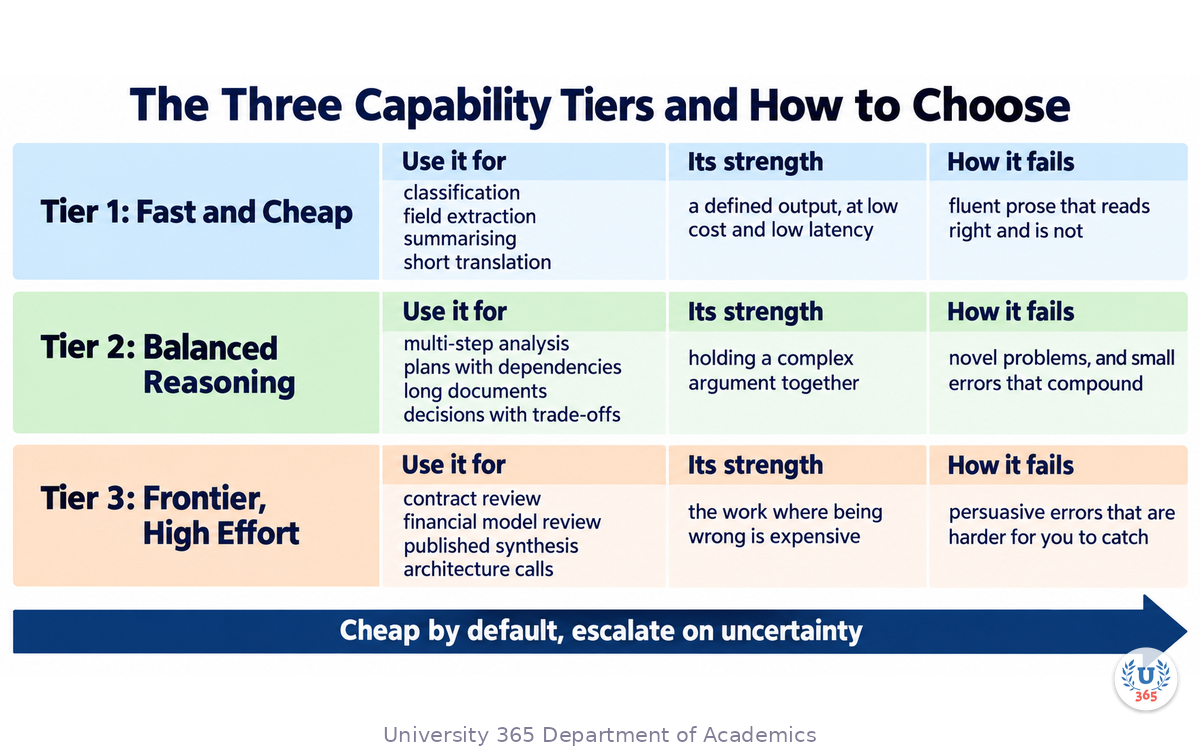
Tier 1: the fast, cheap tier. This is the workhorse. It answers in a second or two, costs a fraction of the frontier, and is right for high-volume routine work: classification, extraction, rewriting, translation of short passages, summarisation of a document you already understand, formatting data, first-draft boilerplate. The names change often. What stays constant is the role: the tier you use when the task is well specified and the cost of being slightly less clever is low.
Tier 2: the general reasoning tier. This is the model you reach for when the task is genuinely hard: multi-step analysis, a plan with dependencies, a decision with trade-offs, a document that needs to hold together over five thousand words. In 2026 these models expose a reasoning-effort setting rather than being a separate family. Turning reasoning effort up buys thinking time and accuracy; turning it down buys speed. That single control is the most useful switch in the picker.
Tier 3: the frontier, high-effort tier. The top of the line, at the top of the price. Use it for the work where being wrong is expensive and the volume is low: a contract analysis, a financial model review, a research synthesis you will publish, an architecture decision. If you are reaching for this tier more than a few times a day per person, either your work is genuinely hard or your Tier 2 configuration is wrong.
The specialist fourth: coding and agentic models. Alongside the general line, vendors now ship models built specifically for long-horizon software work and tool use. OpenAI's own directory describes its current coding model as its most capable agentic coding model. If your job is building software or running an agent that acts on tools, this is a separate decision from general model choice, and benchmark charts for general chat will mislead you.
Two further lines sit beside the tiers and are chosen differently: image generation and speech or realtime audio. Choose those by output format, not by reasoning, because a reasoning benchmark tells you nothing about whether an image model can render legible text.
One warning about reading this section six months from now. Specific model names in this lecture are the ones live on 1 October 2026. Model names change faster than any other fact in this field. The tiers do not.
The Six Questions That Decide the Model
Run these in order. The first question that produces a hard answer usually settles the choice, and the whole sequence takes about ninety seconds once you have used it twice.
1. What is the output format? Text, image, audio, structured data, or an action on a tool. If the answer is image, audio or realtime speech, you are in a different product line, and reasoning quality is the wrong axis to optimise. If the answer is structured data, you need a model with reliable structured output support rather than the cleverest one.
2. How hard is the task, in one sentence? Can you state the task so precisely that a competent colleague could do it without asking you a question? If yes, it is a Tier 1 task. If the task requires judgment about what the right answer even looks like, it is Tier 2 or higher. This single question moves more decisions than the other five combined, because most people overestimate the difficulty of their routine work and underestimate the difficulty of their ambiguous work.
3. What is the volume? Ten a day is a different decision from ten thousand a day. At low volume, cost differences are noise and you should buy quality. At high volume, a ten-fold unit price difference is the entire business case, and a small model plus a good prompt beats a frontier model plus no prompt.
4. What is the cost of being wrong? If a wrong answer is caught by the next person who reads it, cheap is fine. If a wrong answer goes into a contract, a financial statement, a medical decision, or a published document, pay for the deep tier and still verify. This question is about consequences, not about how clever the question sounds.
5. What is the latency budget? A person waiting at a keyboard notices anything past three or four seconds. A batch job that runs overnight does not care. Reasoning models produce better answers by thinking longer, which means a direct trade between quality and waiting time. Decide the budget before you choose, so the trade is a decision rather than a surprise.
6. Does the task need tools or context it does not have? If the answer requires reading your files, querying a database, browsing, or running code, the model needs tool access or a connected context source. A weaker model with the right tool will beat a stronger model without it on that task, every time.
The tie-breaker. If two candidates survive all six questions, choose the cheaper one for thirty days, measure, and promote only if the measurement says to. Defaulting upward costs money silently. Defaulting downward costs you a measurement, which is cheap.
The Decision Table You Can Actually Use
This table is the ninety-second version. It is not a benchmark and does not name prices, because prices change monthly. It maps the job to the tier and tells you what to watch.
Your task | Start at | Why | Watch for |
Classify, tag, or route incoming text | Tier 1 fast | Well-specified, high volume, low consequence | Rate limits at volume; consistency of labels |
Extract fields from documents into a table | Tier 1 fast, structured output | The task is mechanical, not creative | Tables and odd layouts; always validate a sample |
Summarise a document you already know well | Tier 1 fast | You can catch omissions yourself | Silent dropping of numbers and qualifiers |
Draft routine correspondence from a template | Tier 1 fast | Pattern following, not reasoning | Tone drift from your house voice |
Translate short passages | Tier 1 fast | Mature task, strong quality at low cost | Names, units, and legal terms |
Multi-step analysis with dependencies | Tier 2 reasoning | Needs a plan and self-correction | Reasoning effort set too low |
A document that must hold together over thousands of words | Tier 2 reasoning, high effort | Requires consistency across sections | Contradictions between early and late sections |
A decision with real trade-offs | Tier 2 reasoning, high effort | Judgment under ambiguity | Confidently wrong framing of the problem |
Contract, financial, or regulatory review | Tier 3 frontier, high effort | Consequential, low volume | Still verify: high tier is not a guarantee |
Research synthesis you will publish | Tier 3 frontier, plus your own sources | Accuracy under citation pressure | Invented citations; require verifiable links |
Software to build or refactor | Specialist coding model | Long-horizon tool use is a different skill | General chat benchmarks mislead here |
An agent that acts on your systems | Specialist agentic model, Tier 2 for planning | Needs reliable tool calling and recovery | Silent failure when a tool call breaks |
An image with legible labels or a diagram | Image model chosen for text rendering | Reasoning quality is irrelevant | Illegible or invented labels |
Voice conversation or transcription | Speech or realtime line | Output format decides | Latency in a live conversation |
Read the table as a starting position, not a verdict. Two rows in it are worth a sentence of explanation.
The row on structured extraction is where most business value is created, because it turns unstructured documents into data you can use. It is also where the most wasted spend sits, because teams run it on a frontier model when a small one with a good schema performs the same. Try the cheap tier first on a sample of fifty documents, and count only the failures.
The row on agents is where most teams underestimate the work. An agent is not a better chat model. It is a loop that plans, calls tools, reads results, and recovers from errors, and the model's ability to keep that loop coherent matters far more than its benchmark score. If your agent fails halfway through a job, the fix is often a better tool definition and a smaller, more reliable model, not a bigger one.
What Changed in the Picker, and Why Default Is Not a Strategy
Two changes in 2026 made the old habit of ignoring the model picker actively expensive.
The first is retirement. Vendors now retire models on published timelines, and a retired model does not fail loudly. It is removed from the picker, existing conversations quietly continue on a successor with different behaviour, and any system that hard-coded the model name breaks on its own schedule. In the first half of 2026 alone, OpenAI retired several older flagship and reasoning models from the ChatGPT picker while leaving API access in place. That pattern matters to you in two ways: if you built on the picker, your work changed without you; if you built on the API, your work kept running while your mental model of the product became wrong.
The second is the collapse of separate reasoning models into a single model with a reasoning-effort control. Where you once switched between a fast model and a thinking model, you now set effort on one model. The practical effect is good, because it gives you a dial instead of a switch, and it removes an excuse: on the hard task, there is no longer a different model to blame. You simply did not turn the dial up.
There is a third change that is not about the picker but changes the answer anyway. Connected context and tooling have become the normal way to give a model your information. Instead of pasting a document, you attach a file library to a project or connect a tool that the model can query. Once the model can reach your data, the marginal value of raw model cleverness falls relative to the value of good context and a well-defined tool. That is why the CI-First doctrine puts the human in the orchestrator's seat rather than the model at the centre.
So the habit to build is small and cheap: before the first prompt of a new kind of task, spend ninety seconds on the six questions, write the choice down, and keep the same choice for the next thirty days unless something breaks. A written default you chose beats a default you inherited.
Agents Change the Question
Everything above assumes one model answering one prompt. An agent is a different shape, and it deserves its own rule, because the mistakes are expensive and quiet.
An agent runs a loop. It receives a goal, decides the next step, calls a tool, reads the result, decides again, and stops when the goal is met or the budget runs out. Four properties of that loop decide whether your agent works, and none of them is intelligence in the benchmark sense.
Reliability of tool calls. The model must produce a well-formed call every time, with the right argument names and types. A model that is clever but occasionally emits a malformed call will fail an eight-step job far more often than a plainer model that never does. Measure this directly: run your real tool with a hundred synthetic tasks and count malformed calls.
Error recovery. When a tool returns an error, does the agent try a different approach, or does it repeat the same failing call? Recovery behaviour is the single most useful thing to watch in a test run, and it is invisible in a chat comparison.
Budget discipline. A loop with no stop condition burns tokens. Give the agent an explicit step budget and an explicit spend ceiling, and make exceeding either one a visible failure rather than a silent invoice.
Grounding. An agent that can act on your systems must be able to say what it did and why, in a form you can audit. Log every tool call with its arguments and its result. If you cannot reconstruct the run afterwards, you cannot safely let it run unattended.
The model choice for an agent follows from these four properties, not from a general leaderboard. In practice the sequence is: pick the specialist agentic or coding model for the loop itself, because tool use is what it was trained for; use a Tier 2 reasoning model for the planning step when the plan is genuinely hard; and use a Tier 1 model for the cheap sub-steps inside the loop, such as classifying a result into one of five categories. A well-built agent uses all three, and the cost of the whole run is dominated by how well you defined the tools, not by which frontier model you chose.
One more rule, and it is the CI-First rule. The agent acts, the human decides what it is allowed to act on. Approval gates are not bureaucracy. They are the difference between an agent that saves your team a day a week and an agent that changes something in production at two in the morning.
Three Decisions People Get Backwards
Three specific mistakes account for most wasted spend and most disappointing results. Each one is a decision made backwards, and each is easy to reverse once you see it.
Backwards decision one: choosing the model before defining the task. A team decides to standardise on the frontier model, then looks for problems worth its cost. The result is a licence bill with no matching workflow, and a team that concludes AI is overpriced. The correction is to start from the task, define what correct means, and then discover that most of your tasks sit in Tier 1. In practice, teams that start from the task spend a fraction of what teams that start from the model spend, and they ship more, because a cheap model used deliberately beats an expensive model used vaguely.
Backwards decision two: treating prompt quality as a substitute for model tier, or the reverse. These two levers are not interchangeable, and the failure modes look different. If your prompt is vague, a bigger model will produce a more fluent version of the wrong answer, and you will read the fluency as quality. If your model is too weak for the reasoning the task needs, no amount of prompt engineering will produce the plan, because the task requires a capability the model does not have. Diagnose in this order: first state the task precisely, then test a cheap model, then raise the tier only if the failures are about reasoning rather than about instructions. A model that fails because your prompt was ambiguous is not the model's fault, and moving up a tier will hide that problem rather than fix it.
Backwards decision three: optimising the average instead of the tail. Averages are comfortable and misleading. A model that is right on eighty percent of your work and quietly wrong on the other twenty is worse than a model that is right on sixty percent and flags its own uncertainty on the rest, because only the second one lets you build a review process. When you compare candidates, ask what their failures look like, whether they are detectable, and how much they cost to catch. A detectable failure with a cheap check is a manageable risk. An undetectable failure that reads exactly like a correct answer is not, whatever the score.
The common thread is that all three mistakes come from treating model choice as a purchase rather than as a design decision. A purchase asks which one is best. A design decision asks what the job requires, what the constraints are, and how the failure will be caught. Only the second question has a stable answer.
The Hidden Bill: Cost, Latency and Reasoning Tokens
Model choice looks free until you look at three lines on the invoice that are not the headline price.
Reasoning tokens are billed output. On a reasoning model, the thinking the model does is generated tokens, and generated tokens are the expensive kind. Turning reasoning effort from low to high can multiply the cost of a single request by several times even though the answer you see is a similar length. This is not a defect; you are buying the thinking. It does mean that "let us just use high effort everywhere" is an expensive habit, and that a task which does not need reasoning should not be sent to a model that will do it anyway.
Cached input changes the arithmetic. Repeated context, such as a project instruction block or a long shared document, can be served from cache at a fraction of the normal input price. That makes a design with a large, stable context far cheaper per call than a design that re-sends changing context. If your per-call cost looks wrong, check how much of your prompt is identical between calls.
Latency is a product decision, not a technical one. A reasoning model that takes forty seconds is unusable inside a chat interface a customer is watching and perfectly fine inside an overnight batch. The cost of latency is not on the invoice; it is in whether people use the tool at all.
A short worked example makes the trade concrete, and the numbers are illustrative rather than current prices. Suppose a team processes 20,000 support messages a month. Running all of them through a frontier reasoning model at high effort costs a lot and adds seconds of waiting to each one. Running all of them through a Tier 1 model is cheap but mis-routes the genuinely difficult cases. The sensible design routes everything through Tier 1, escalates the roughly five percent that the model flags as uncertain, and sends a further fraction of those to a reasoning model. The volume of expensive calls falls by an order of magnitude, the quality on the hard cases goes up rather than down, and the escalation rule is a small piece of code you can read and change.
That pattern, cheap by default and escalate on uncertainty, is the single most valuable cost control in applied AI. It also mirrors the way good human teams work.
Run Your Own Bake-Off in One Afternoon
Public benchmarks are useful for eliminating candidates and useless for choosing one. They test the tasks the benchmark authors chose, on data you are not using, scored by methods that may not match your definition of correct. Two models that are nine points apart on a public leaderboard can be indistinguishable on your work, and the cheaper one can win.
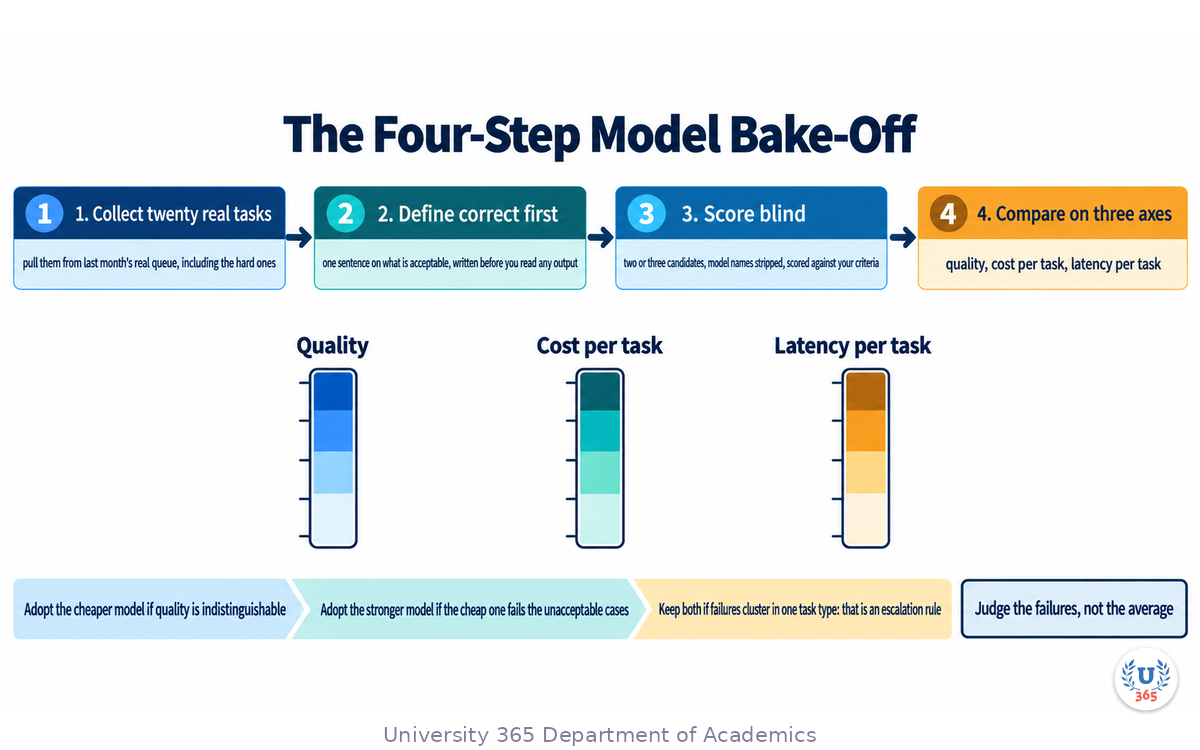
Here is a four-step bake-off you can run in an afternoon.
Step 1: Collect twenty real tasks. Not invented examples. Pull twenty items from last month's actual queue, including at least five you found hard and two that turned out badly. A test set of easy cases will make every model look identical.
Step 2: Write down what correct means, before you look at any output. For each task, one sentence on what a good answer contains and what makes an answer unacceptable. Without this, you will judge by tone, and the most confident answer will win.
Step 3: Run two or three candidates and score blind. Strip the model name from the outputs before you read them, and score each against your criteria rather than against each other. Three candidates is the useful maximum: the cost of a fourth rarely changes the decision.
Step 4: Compare on the three axes that matter. Quality per the criteria, cost per task, and latency per task. Then make one of three decisions: adopt the cheaper model if quality is indistinguishable; adopt the stronger model if the cheap one fails the unacceptable cases; or keep both if the failures cluster in one task type, because that is an escalation rule, not a model decision.
Two practical notes from running this repeatedly. First, judge a model on its failures, not on its average. A model that is right nineteen times and wrong once in a way you would have caught is better than a model that is right eighteen times and confidently wrong twice. Second, rerun the bake-off after any model retirement or major version bump, because your measurement goes stale faster than you expect.
What to Do When the Model Changes Under You
Model retirement is now routine, and the teams that handle it well share one property: they never depended on a model name in more than one place.
Keep the model name in configuration, not scattered through prompts and code. When you need to swap, you change one value.
Keep the evaluation set. The twenty tasks from your bake-off become the regression test for the replacement. When the old model is retired, run the twenty tasks on the successor and compare against the scores you already recorded. This turns a disruptive event into a short, measurable task.
Keep a written note of why you chose what you chose. In six months the choice looks arbitrary, and without the note you will either re-run the whole investigation or change it on a hunch.
Accept that behaviour will shift. A successor model is not a drop-in clone. Instructions that worked, formats that were followed, and refusals that never happened can all move. Re-check your most relied-upon prompts against the new model rather than assuming they transfer.
Finally, decide in advance which model changes require your attention and which do not. A change to a Tier 1 classification model used for routing is worth an hour of retesting. A change to the model you use for casual drafting is not worth any. Write that policy down so the decision does not depend on who is at their desk that week.
Feynman Summary: Explain It Like You Are 12
Imagine you need help with homework, and you have a choice of three helpers.
The first helper is very fast and works cheaply. Ask them to sort your notes into piles, and they will do it in a second. Ask them why the ending of a story matters, and they will give you a short answer that sounds fine but is not very deep.
The second helper is slower but thinks harder. Ask them a real question, and they will sit quietly, work through it, and come back with an answer that holds together. They cost more, because their thinking time is what you are paying for.
The third helper is the best in the school and the most expensive. You save them for the one question that really counts, the one where getting it wrong would be a disaster.
The clever part is not picking the best helper. It is matching the helper to the job, and knowing when to hand a question up the line to the next one. If you use the expensive helper for sorting notes, you waste money. If you use the fast helper for the question that decides your grade, you get a confident wrong answer.
That is the whole lecture. Match the model to the job, test with your own work, and keep the decision in your hands.
Mindmap: The Complete Picture
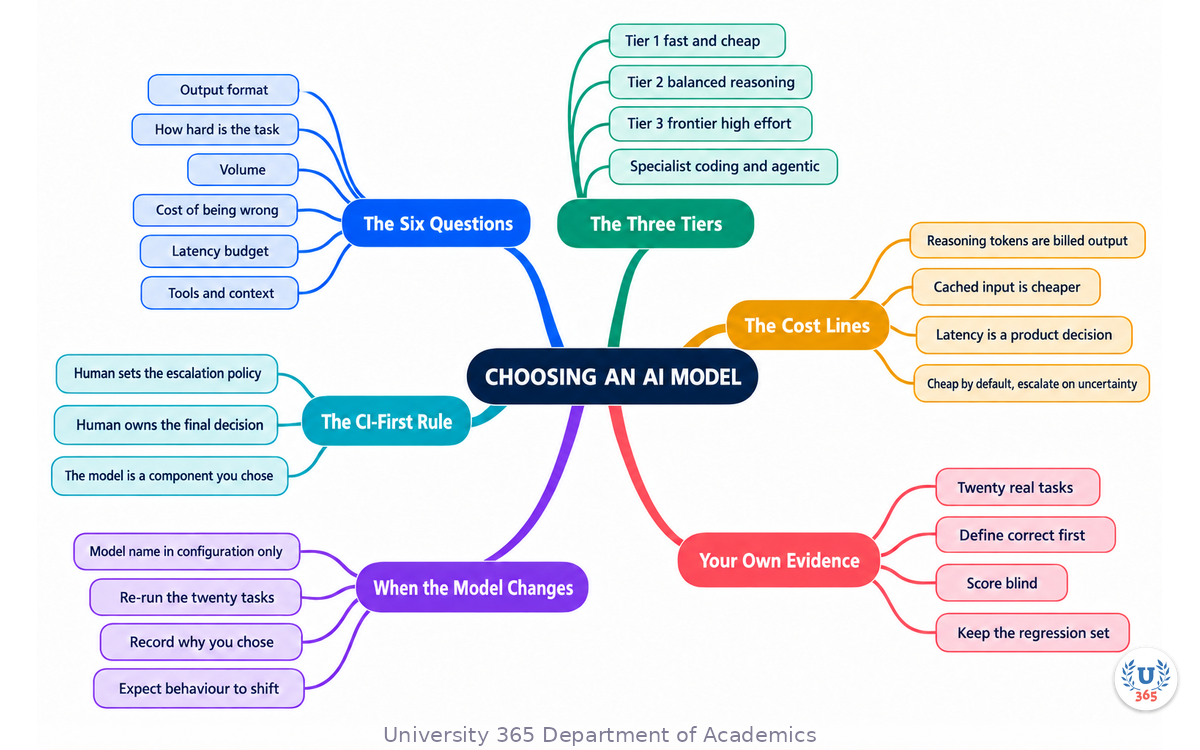
The mindmap shows the decision as a single structure. At the centre stands the job, not the model. From the job, three branches set the constraints: output format, difficulty, and consequence of error. A fourth branch covers the operational constraints, being volume, latency and tool access. Those two branches feed a tier decision, whose three leaves are the fast tier, the reasoning tier and the frontier tier, plus the specialist branch for coding and agentic work. From the tier, a fifth branch holds the validation loop: the twenty-task bake-off, the blind score, and the regression set kept for the next model change. The outermost ring is the governance ring, and it carries the CI-First rule that a human sets the escalation policy and owns the final decision.
Read it left to right as a procedure, and inside out as a principle. The procedure is the six questions. The principle is that the model is a component you choose, never a default you inherit.
UNOP Sound (University 365 Neuroscience Oriented Pedagogy)
Take five minutes to consolidate your memory. Play the isochronous tone track (10Hz alpha frequency) with your eyes closed. Alpha-frequency tones after a learning session support consolidation, helping move what you just learned from short-term to long-term memory.
[Audio player: UNOP Post-Lecture Isochrone (10Hz, 5 minutes)]
Practical Exercise: The Ninety-Second Model Choice
This exercise takes about twenty minutes the first time and about five minutes every time after that. Do it on real work, not a test.
Part 1: Choose deliberately (10 minutes)
Pick one task you will do more than five times this week. Then answer the six questions in writing, in one line each.
Output format. What kind of answer do you need: prose, structured data, an image, audio, or an action?
Difficulty. Can you state the task so precisely that a competent colleague could do it without asking you anything?
Volume. How many times will you run it, and over what period?
Cost of error. If the answer is wrong, who catches it, and what happens if nobody does?
Latency budget. Are you waiting at the keyboard, or is this a batch job?
Context and tools. Does the answer need your files, a database, a live page, or code execution?
Write your tier decision next to the six answers. Then write one sentence you can repeat to a colleague: "I use X for this because of Y."
Part 2: Test it on ten real cases (10 minutes)
Take ten real items from last week. Run them through your chosen model. Before you look at any output, write one sentence saying what a good answer contains and what would make it unacceptable. Then score each output against your sentence, not against the other outputs.
Count only the unacceptable ones. If the count is zero, you have a default you can keep for thirty days. If the count is not zero, look for the pattern in the failures before you change the model: the fix is often a sharper prompt, a schema, or an escalation rule rather than a bigger model.
What to Look For
Did the model fail on the easy cases or only on the hard ones? Failures concentrated in one task type are an escalation rule, not a model decision.
Did it invent data, a citation, a number, or a source? Treat any unsourced specific as a defect, whatever the tier.
Did it follow the format you asked for, every time, or did it drift after a few examples?
How long did each call actually take, as opposed to how long it felt?
Which single answer changed your decision? If none did, your test set is too easy.
Applied AI Connection
This exercise is the CI-First workflow at its smallest scale. You set the objective, you defined what correct means, the model produced candidates, and you decided which were acceptable. The judgment stayed with you, and the AI carried the volume. Scale the same pattern up and you have the escalation design described in the Hidden Bill section, which is how a team of ten handles the AI workload of a team of forty without paying frontier prices for routine work.
Glossary
Term | Definition |
Frontier model | The most capable model a vendor currently offers, at the highest cost per token and often the highest latency. |
Tier 1 (fast tier) | The cheap, low-latency model line intended for high-volume, well-specified work such as classification, extraction, and summarising. |
Tier 2 (reasoning tier) | The general model line that can think through multi-step problems, usually exposing a reasoning-effort setting rather than a separate thinking model. |
Tier 3 (frontier tier) | The top-of-line model used for low-volume, high-consequence work where being wrong is expensive. |
Reasoning effort | A setting on a reasoning model that controls how much internal thinking it does, trading latency and cost for accuracy. |
Reasoning tokens | The tokens a reasoning model generates while thinking. They are billed as output even though the reader never sees them. |
Cached input | Repeated prompt content that the provider serves at a reduced price because it is identical between calls. |
Structured output | A model response constrained to a defined schema, such as JSON with named fields, rather than free prose. |
Tool calling | A model's ability to request that an external function or service be run and to use the result in its answer. |
Agent | A system that loops through plan, act, observe, and decide, calling tools until the goal is met or a budget is exhausted. |
Escalation rule | A policy that routes a defined subset of requests, usually the uncertain ones, to a more capable and more expensive model. |
Bake-off | A small, controlled comparison of two or three candidate models on your own real tasks, scored blind against criteria you set first. |
Regression set | The saved set of real tasks and recorded scores used to re-test a model after a version change or retirement. |
Model retirement | A vendor ending a model's availability on a published schedule, after which requests may continue on a successor with different behaviour. |
Latency budget | The maximum acceptable time for a response, decided by whether a person is waiting for it. |
MCP | Model Context Protocol, an open standard that lets a model reach external tools and data sources through a common interface. |
CI-First | Co-Intelligence First: the U365 principle that human intelligence orchestrates and AI amplifies. |
5M2S | 5 Minutes to Success: the U365 principle of starting with small, repeatable AI tasks and building from there. |
UNOP | University 365 Neuroscience-Oriented Pedagogy: the pedagogical framework behind all U365 lectures. |
Quiz: TEST YOUR UNDERSTANDING
1. What is the first question in the six-question decision sequence?
A) What is the output format?
B) Which model scored highest on the latest leaderboard?
C) How many tokens does the model support?
D) Which model has the most recent release date?
2. Why should reasoning tokens be considered in your cost decision?
A) They are billed as output tokens, so raising reasoning effort multiplies the cost of a request
B) They are free because the reader never sees them
C) They are charged only once per account
D) They reduce the price of the following request
3. A team routes every support message through a frontier reasoning model. What is the recommended redesign?
A) Route everything through the cheap tier and escalate only the cases the model flags as uncertain
B) Buy a more expensive model and keep the same routing
C) Reduce the prompt length until the cost falls
D) Stop using AI for support entirely
4. Why does a public benchmark ranking usually fail to settle a model choice?
A) It tests the benchmark author's tasks on data you are not using, scored by methods that may not match your definition of correct
B) It is always out of date within a day
C) It only measures models from one vendor
D) It reports cost but not quality
5. What is the purpose of keeping the twenty-task regression set?
A) To re-test the replacement model after a version change or retirement against scores you already recorded
B) To train a new model on your data
C) To publish your own leaderboard
D) To measure how many tokens you have used
Answers: 1-A, 2-A, 3-A, 4-A, 5-A
Related Resources
U365 INSIDE Publications
Mastering the Major AI Models: A Practical Guide: the companion lecture that walks through what each major model family is actually good at.
Building an AI-First Company Culture: how model choice fits into an organisation-wide adoption program.
AI for Market Research: From Data to Strategy in 15 Min: an applied example where model tiering decides cost.
The CI-First Workflow: Applied to Any Field: the doctrine behind the human-in-the-orchestrator's-seat rule.
External Resources
OpenAI API model directory: the authoritative current list of available models and their capabilities: developers.openai.com
OpenAI platform documentation: guidance on prompting, reasoning, and tool use: platform.openai.com
Model Context Protocol: the open standard for connecting models to tools and data: modelcontextprotocol.io
Stanford AI Index: annual, independent reporting on AI capability and adoption: hai.stanford.edu
Related U365 Lectures
Other lectures in the Business AI Series at UIB, including AI for Sales Forecasting and Automating Business Operations with AI Agents.
The Prompting 101 series, for the prompt structure that makes a cheaper model perform better.
U.Copilot for This Lecture
Discuss this lecture with U.Copilot, your AI chat companion trained on this content.
Copy and paste the following prompt into the U.Copilot chat on university-365.com:
You are U.Copilot for Lectures, an AI chat companion specially trained on University 365 lecture content. You are helping a Fellow who just completed the lecture "How to Pick the Right AI Model Without the Headache" from the Business AI Series at the U365 Institute of Business (UIB). Your role is to help the Fellow deepen their understanding of model selection. You can: - Walk through the six questions with the Fellow's own task - Help them define what "correct" means for their task before they test any model - Explain the difference between the fast, reasoning and frontier tiers in plain language - Discuss reasoning effort, cached input and reasoning tokens as cost drivers - Help design an escalation rule for the cases their cheap tier gets wrong - Explain how model retirement affects a system they have already built Always maintain U365's CI-First approach: encourage the Fellow to keep the judgment, verify the output, and treat the model as a component they chose rather than a default they inherited. Use the UP-Context-Engineering Method: provide context-rich, role-aware responses that account for the Fellow's learning level and goals.
Next Steps
Now that you have completed this lecture, here is what to do next:
Run Part 1 of the practical exercise on one task you will repeat this week, and write your tier decision down.
Test it on ten real cases and count only the unacceptable answers.
Write your escalation rule for the task types where the cheap tier fails.
Read the companion lecture, Mastering the Major AI Models: A Practical Guide, to understand what each major family does well.
Join a UIB program if you want structured learning in business management and digital entrepreneurship: visit university-365.com/tuition.
The habit this lecture gives you is small. Ninety seconds before a new kind of task, and a written reason for the choice. Over a year, that habit is the difference between a team that spends deliberately on AI and a team that spends by accident.
IMPORTANT NOTICE
This lecture is published by University 365 as part of its INSIDE Publications Hub. The content is free to read for all visitors. Lectures in this series may be part of a structured academic program leading to a Micro-Credential for your Career (MCC). To enroll in an academic program, visit university-365.com/tuition.
This content is for educational purposes. While we strive for accuracy, AI is a fast-moving field: model names, prices and capabilities change monthly. Verify current model availability and pricing against the provider's own documentation before making a procurement or architecture decision.
Copyright University 365, Inc. All rights reserved. This content is protected under University 365's copyright policies. For permissions or inquiries, contact uda@university-365.com.
Published by the Department of Academics, University 365.
Lecture delivered by the University 365 Institute of Business (UIB).
Denise Cromwell, Dean of Business, UIB
Signed for the academic year 2026.





Comments